Hubbry Logo
Roger FryRoger FryMain
Open search
Roger Fry
Community hub
Roger Fry
logo
8 pages, 0 posts
0 subscribers
Be the first to start a discussion here.
Roger Fry
Roger Fry
from Wikipedia

Roger Eliot Fry (14 December 1866 – 9 September 1934) was an English painter and critic, and a member of the Bloomsbury Group. Establishing his reputation as a scholar of the Old Masters, he became an advocate of more recent developments in French painting, to which he gave the name Post-Impressionism. He was an early figure to raise public awareness of modern art in Britain, and he emphasised the formal properties of paintings over the "associated ideas" conjured in the viewer by their representational content. He was described by the art historian Kenneth Clark as "incomparably the greatest influence on taste since Ruskin ... In so far as taste can be changed by one man, it was changed by Roger Fry".[2] The taste Fry influenced was primarily that of the Anglophone world, and his success lay largely in alerting an educated public to a compelling version of recent artistic developments of the Parisian avant-garde.[3]

Key Information

Life

[edit]

Born in London in 1866, the son of the judge Edward Fry, he grew up in a wealthy Quaker family in Highgate. His siblings included Joan Mary Fry, Agnes Fry and Margery Fry; Margery was principal of Somerville College, Oxford. Fry was educated at Clifton College[4] and King's College, Cambridge,[5] where he was a member of the Conversazione Society, alongside freethinking men who would shape the foundation of his interest in the arts, including John McTaggart and Goldsworthy Lowes Dickinson. After taking a first in the Natural Science tripos, he went to Paris and then Italy to study art. Eventually, he specialised in landscape painting.

In 1896, he married artist Helen Coombe and they had two children, Pamela and Julian. Helen became seriously mentally ill and the couple moved to Guildford, Surrey in the hope the quieter environment would help.[citation needed] But in 1910 Helen was committed to a mental institution, where she remained for the rest of her life. Fry took over care of their children with the help of his sister, Joan Fry. That same year, Fry met the artists Vanessa Bell and her husband Clive Bell, and it was through them that he was introduced to the Bloomsbury Group. Vanessa's sister, the author Virginia Woolf later wrote in her biography of Fry that "He had more knowledge and experience than the rest of us put together".

River with Poplars (ca. 1912)

Shortly after their relocation to Guildford, Fry had a house called Durbins built to his own design in Chantry View Road, then on the edge of the town, overlooking the Surrey Hills. Durbins was in a stripped-back classical style with large windows suggesting Dutch precedent and Fry regarded it as a 'genuine and honest piece of domestic architecture'.[6] The most unusual feature is a double-height living hall (or ‘house-place’ as Fry called it). It is now a Grade II* listed building. He employed Lottie Hope and Nellie Boxall (in 1912) as his young servants until 1916 when he decided to rent the house and establish a trust for it. Lottie and Nellie went to work for Leonard and Virginia Woolf on his recommendation.[7]

In 1911 Fry began an affair with Vanessa Bell, who was recovering from a miscarriage. Fry offered her the tenderness and care she felt lacking from her husband. They remained lifelong close friends, even though Fry's heart was broken in 1913 when Vanessa fell in love with Duncan Grant and decided to live permanently with him.

After short affairs with artists Nina Hamnett and Josette Coatmellec, Fry too found happiness with Helen Maitland Anrep. She became his emotional anchor for the rest of his life, although they never married (she too had had an unhappy first marriage, to the mosaicist Boris Anrep).

Fry died after a fall at his home in London and his death caused great sorrow among the Bloomsbury Group, who loved him for his generosity and warmth. Vanessa Bell decorated his coffin. Fry's ashes were placed in the vault of Kings College Chapel in Cambridge. Virginia Woolf was entrusted with writing his biography, a task she found difficult because his family asked her to omit certain matters, his love affair with Vanessa Bell among them.[8]

Artistic style

[edit]
Portrait of Clive Bell by Roger Fry (c. 1924)

As a painter Fry was experimental (his work included a few abstracts), but his best pictures were straightforward naturalistic portraits,[9][10] although he did not pretend to be a professional portrait painter.[11] In his art he explored his own sensations and gradually his own personal visions and attitudes asserted themselves.[12] His work was considered to give pleasure, 'communicating the delight of unexpected beauty and which tempers the spectator's sense to a keener consciousness of its presence'.[13] Fry did not consider himself a great artist, "only a serious artist with some sensibility and taste".[14] He considered Cowdray Park his best painting: "the best thing, in a way that I have done, the most complete at any rate".[15]

Career

[edit]

In the 1900s, Fry started to teach art history at the Slade School of Fine Art, University College London.

In 1903 Fry was involved in the foundation of The Burlington Magazine, the first scholarly periodical dedicated to art history in Britain. Fry was its co-editor between 1909 and 1919 (first with Lionel Cust, then with Cust and More Adey) but his influence on it continued until his death: Fry was on the consultative committee of The Burlington since its beginnings and when he left the editorship, following a dispute with Cust and Adey regarding the editorial policy on modern art, he was able to use his influence on the committee to choose the successor he considered appropriate, Robert Rattray Tatlock.[16] Fry wrote for The Burlington from 1903 until his death: he published over two hundred pieces on eclectic subjects – from children's drawings to bushman art. From the pages of The Burlington, it is also possible to follow Fry's growing interest in Post-Impressionism.

Edward Carpenter (1894)

Fry's later reputation as a critic rested upon essays he wrote on Post-Impressionist painters,[17] and his most important theoretical statement is considered to be An essay in Aesthetics,[18] one of a selection of Fry's writings on art extending over a period of twenty years published in 1920.[19] In "An essay in Aesthetics", Fry argues that the response felt from examining art comes from the form of an artwork; meaning that it is the use of line, mass, colour and overall design that invokes an emotional response. His greatest gift was the ability to perceive the elements that give an artist his significance.[20] Fry was also a born letter writer, able to communicate his observations on art or human beings to his friends and family.[21]

In 1906 Fry was appointed Curator of Paintings at the Metropolitan Museum of Art in New York. This was also the year in which he "discovered" the art of Paul Cézanne, the year the artist died, beginning the shift in his scholarly interests away from the Italian Old Masters and towards modern French art.

In November 1910, Fry organised the exhibition 'Manet and the Post-Impressionists' (post-impressionism being a term which Fry coined[22]) at the Grafton Galleries, London. This exhibition was the first to prominently feature Gauguin, Cézanne, Matisse, and Van Gogh in England and brought their art to the public.[23] Though the exhibition would eventually be widely celebrated, the sentiments at the time were much less favourable. This was due to the exhibition's selection of art that the public was unaccustomed to at the time. Fry was not immune to the backlash. Desmond MacCarthy, the secretary of the exhibition stated that "by introducing the works of Cézanne, Matisse, Seurat, Van Gogh, Gauguin and Picasso to the British public, he smashed for a long time his reputation as an art critic. Kind people called him mad and reminded others that his wife was in an asylum. The majority declared him to be a subverter of morals and art, and a blatant self-advertiser." Yet the foreignness of "post-impressionism" would inevitably disappear and eventually, the exhibition would be regarded as a critical moment for art and culture.[24] Virginia Woolf later said, "On or about December 1910 human character changed", referring to the effect this exhibit had on the world. Fry followed it up with the Second Post-Impressionist Exhibition in 1912. It was patronised by Lady Ottoline Morrell, with whom Fry had a fleeting romantic attachment.

English Heritage blue plaque for Fry and his Omega Studios at 33 Fitzroy Square, Fitzrovia, London Borough of Camden

In 1913 he founded the Omega Workshops, a design workshop based in London's Fitzroy Square, whose members included Vanessa Bell and Duncan Grant and other artists of the Bloomsbury Group. It was an experimental design collective in which all the work was anonymous with everything that was produced in the workshops, bold decorative homeware ranging from rugs to ceramics and furniture to clothing, bearing only the Greek letter Ω (Omega). As Fry told a journalist in 1913: 'It is time that the spirit of fun was introduced into furniture and into fabrics. We have suffered too long from the dull and the stupidly serious.'[25] As well as high society figures such as Lady Ottoline Morrell and Maud Cunard, other clients included Virginia Woolf, George Bernard Shaw, H.G. Wells, W.B. Yeats and E.M. Forster and also Gertrude Stein, with whom Fry shared a love of contemporary art, on one of her visits to London in the 1910s.[25] The workshops also brought together the artists Wyndham Lewis, Frederick Etchells, Edward Wadsworth and Henri Gaudier-Brzeska who would later, following a quarrel between Fry and Wyndham Lewis with the latter setting up The Rebel Art Centre in 1914 as a rival business,[26] branch away to form the Vorticist movement. The workshops stayed open during World War I but closed in 1919. The Courtauld Gallery houses one of the most important collections of designs and decorative objects made by artists of the Omega Workshops[27] and, in 2017, held an exhibition 'Bloomsbury Art and Design' that presented a wide-ranging selection of objects from its holdings, many of which were bequeathed to The Courtauld Institute of Art by Roger Fry.[28] An earlier exhibition in 2009, 'Beyond Bloomsbury: Designs of the Omega Workshops 1913–19', contained the largest collection of surviving working drawings of the Omega Workshops, bequeathed to The Courtauld Gallery by Fry's daughter Pamela Diamand in 1958.[29]

The London Artists' Association was set up in 1925 by Samuel Courtauld and John Maynard Keynes at the instigation of Roger Fry[30] who was a friend of both men and advised them on their art collections.[31][32] Fry's association with Samuel Courtauld was celebrated by him in The Burlington Magazine after Courtauld endowed a chair in History of Art at London University which Fry welcomed as an 'unexpected realisation of a long-cherished hope'.[33] In 1933, he was appointed the Slade Professor at Cambridge, a position that Fry had much desired.

In September 1926 Fry wrote a definitive essay on Seurat in The Dial.[34] Fry also spent ten years translating, "for his own pleasure",[35] the poems of the symbolist poet Stephane Mallarmé.[36] Between 1929 and 1934, the BBC released a series of twelve broadcasts wherein Fry conveys his belief that art appreciation should begin with a sensibility to form as opposed to an inclination to praise art of high culture. Fry also argues that an African sculpture or a Chinese vase is just as deserving of study as a Greek sculpture.

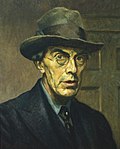
His works can be seen in Tate Britain, the Ashmolean Museum, Leeds Art Gallery, National Portrait Gallery, Scottish National Gallery of Modern Art, Manchester Art Gallery, Somerville College, Museum of New Zealand Te Papa Tongarewa and the Courtauld Gallery who purchased the 1928 self-portrait (above) with the assistance of the Art Fund[37] and others in 1994.[38] The Collection of Roger Fry of paintings and decorative art objects bequeathed to the Courtauld [39][40] also contains photographs which are held in the Conway Library who are in the process of digitising their collection of primarily architectural images as part of the wider Courtauld Connects project.[41] Lithographs produced by Fry from 1927 to 1930 are held at Tate Britain and the Museum of New Zealand Te Papa Tongarewa.[42] The lithographs were drawn in France (except for one from Trinity College, Cambridge) and many were published in the portfolio, Ten Architectural Lithographs.[42]

The Arts Council exhibition 'Roger Fry Paintings and Drawings' at their St James Square gallery in 1952, consolidated Fry's reputation as an artist. A blue plaque was unveiled in Fitzroy Square on 20 May 2010.[23]

[edit]

Works

[edit]
  • Giovanni Bellini (1899)
  • Studland Beach (1911)[43]
  • Vision and Design (1920)
  • Twelve Original Woodcuts (1921) – portfolio hand printed by Leonard & Virginia Woolf, the second publication of the Hogarth Press
  • Duncan Grant (1923)
  • A Sampler of Castille (1923)
  • The Artist and Psycho-Analysis (1924)
  • Art and Commerce (1926)
  • Transformations (1926)
  • Flemish Art (1927)
  • Cézanne- A Study of His Development (1927) [First published in French as « Le développement de Cézanne », 1926]
  • Henri Matisse (1930)
  • Characteristics of French Art (1932)
  • Arts of Painting and Sculpture (1932)
  • Art History as an Academic Study (1933)
  • Last Lectures (1933)
  • Reflections on British Painting (1934)

Translations:

See also

[edit]

References

[edit]

Sources

[edit]
[edit]
Revisions and contributorsEdit on WikipediaRead on Wikipedia
from Grokipedia
Roger Eliot Fry (14 December 1866 – 9 September 1934) was an English painter, art critic, and curator renowned for introducing modern French art, particularly , to Britain through his influential exhibitions in 1910 and 1912. Born into a wealthy Quaker family in , , as the son of judge Sir Edward Fry, he initially studied natural sciences at , graduating with first-class honors in 1888, before pursuing art training in , France, and at the in in 1892. Fry's career spanned curatorship, criticism, and creative endeavors, beginning with his role as European Adviser to financier J. Pierpont Morgan and of European paintings at the from 1906 to 1910, during which time the museum acquired significant works, including those by and , under his curatorial guidance. He co-founded The Burlington Magazine in 1903 and served as its co-editor from 1909 to 1919, contributing over 200 articles that advanced objective, formalist art analysis focused on psychological and stylistic elements rather than narrative content. In 1913, Fry established the Omega Workshops, a collaborative design firm that applied Post-Impressionist and Cubist principles to and interiors, involving artists like and until its closure in 1919. As a key member of the from around 1911, Fry developed aesthetic theories alongside , emphasizing "significant form" in art, and he later became the Slade Professor of Fine Art at the in 1933. His scholarly publications included Giovanni Bellini (1899), Vision and Design (1920), and Cézanne: A Study of His Development (1927), which solidified his reputation as a leading advocate for , including support for British artists like and . Fry also broadcast art lectures on from 1929 until his death from complications following a fall in 1934.

Early Life and Education

Childhood and Family Background

Roger Fry was born on 14 December 1866 in , , to a wealthy Quaker family of intellectual and professional standing. His father, Sir Edward Fry, served as a prominent judge and jurist on England's highest courts, while his mother, Mariabella Hodgkin Fry, descended from a distinguished Quaker lineage, being the daughter of physician and abolitionist and great-granddaughter of meteorologist Luke Howard. The family home at No. 6 The Grove provided a stable, affluent environment, though Fry was the second son among several siblings, including sisters who shared in the household's disciplined routine. Fry's early years were shaped by a strict Quaker education at home, rooted in the Society of Friends' principles of morality, simplicity, and spiritual introspection, which discouraged frivolity and prioritized utilitarian and ethical pursuits over artistic endeavors. This austere upbringing, influenced by eight generations of Quaker heritage tracing back to Zephaniah Fry in 1658, fostered a worldview that linked virtue with restraint, yet it subtly informed Fry's later theories on art as a medium for spiritual and emotional truth, emphasizing purity and honesty in form. His parents' suspicion of as non-essential further reinforced this focus on and intellect during his formative years. He attended preparatory school at , before entering public school. From 1881 to 1885, Fry attended in , a leading public school where he excelled in scientific studies and cultivated early friendships, such as with philosopher J. McT. E. McTaggart, that would endure lifelong. It was during his time at Clifton that Fry first encountered art through school activities, developing an initial interest in drawing and painting, which hinted at his emerging aesthetic sensibilities amid a curriculum dominated by rational inquiry. Following Clifton, Fry transitioned to university studies in natural sciences at .

Academic Training and Early Interests

Roger Fry enrolled at , in 1885 to study natural sciences, reflecting his family's expectations for a scientific career, though his Quaker upbringing instilled an ethical perspective that later informed his views on art's moral dimensions. Despite earning first-class honors in both parts of the natural sciences in 1887 and 1888, Fry increasingly devoted time to , sketching, and Italian painting studies, influenced by lectures from J. H. Middleton. In 1887, Fry was elected to the , the university's elite intellectual society known formally as the Conversazione Society, where freethinking discussions shaped his emerging ideas on . There, he contributed early essays that blended scientific observation—drawing from figures like —with artistic theory, exploring perception and form in ways that foreshadowed his later formalism. After graduating in 1888, Fry pursued his artistic interests abroad, traveling to in 1891 to study 15th-century masters such as and , whose works captivated him with their structural clarity. The following year, in 1892, he briefly attended the in to hone his painting skills, though he found the academic style constraining and soon returned to . By 1900, these experiences led to his first professional , including reviews for the Athenaeum, where he analyzed exhibitions with a focus on formal qualities over narrative content. Fry continued developing as a critic and painter, balancing his growing expertise in .

Professional Career

Curatorial and Editorial Positions

In 1903, Roger Fry co-founded The Burlington Magazine alongside art historians and connoisseurs such as Bernhard Berenson and Herbert Horne, establishing it as the first scholarly periodical dedicated to in Britain and a platform for rigorous discourse on European art traditions. He served as co-editor from 1909 to 1919, during which he shaped its editorial direction by emphasizing connoisseurship, critical analysis, and the promotion of emerging scholarly methods, including contributions on and early modern movements. Under his influence, the magazine became a key venue for debates on authenticity and attribution, fostering a professional community of art experts that elevated standards in the field. From 1906 to 1910, Fry held the position of of Paintings at the in New York, having previously served as European Adviser to financier J. Pierpont Morgan from 1905, where he played a pivotal role in expanding the institution's holdings of European art through strategic acquisitions and reinstallations. His efforts focused particularly on early Italian painting, including the so-called "primitives"—acquiring works by Sienese and Florentine artists that introduced American audiences to pre-Renaissance masterpieces and challenging prevailing tastes for more classical styles. Fry also organized thematic displays to highlight these acquisitions, such as arrangements of Sienese and Florentine panels, which educated visitors on the formal qualities and historical significance of these undervalued works. His tenure marked a shift toward a more international and scholarly approach to collecting, though it ended amid personal and professional transitions. Throughout his career, Fry undertook advisory roles for British institutions, leveraging his expertise to guide acquisitions that enriched national collections. As a founding member and executive committee member of the Contemporary Art Society (established in 1909), he advised on purchases of contemporary works for public museums, including recommendations that influenced the Gallery's holdings of modern British and European art. His counsel extended to other bodies, such as the and regional galleries, where he advocated for balanced acquisitions that prioritized artistic merit over market trends, thereby shaping the accessibility and diversity of Britain's public art resources. These roles underscored Fry's commitment to institutional reform, ensuring that curatorial decisions promoted broader public engagement with art.

Academic and Lecturing Roles

Fry began his academic career as a lecturer in at the , , where he taught from the early 1900s through 1913, delivering courses on topics ranging from to principles of design and modern aesthetics. His lectures emphasized formalism, encouraging students to analyze the structural independent of narrative or moral content, which laid groundwork for his advocacy of contemporary movements. In the 1920s, Fry delivered a series of lectures at the , where he elaborated on the concept of "significant form"—the arrangement of lines, colors, and shapes that evokes aesthetic emotion—as central to art appreciation, influencing subsequent generations of scholars and artists. These talks, part of broader extension programs and public engagements, bridged his earlier curatorial insights with theoretical discourse on . Fry achieved a long-sought academic milestone in 1933 when he was appointed Slade Professor of Fine Art at the , serving until 1934 despite declining health following a heart attack. In this role, he focused his lectures on , highlighting its rhythmic forms and decorative qualities as parallels to modern Western abstraction, while also revisiting Post-Impressionist innovations to underscore cross-cultural aesthetic principles. His inaugural address and subsequent talks, later compiled as Last Lectures (1939), defended as a rigorous . Beyond formal appointments, Fry was a prolific guest lecturer across and the , promoting international dialogue on through talks at various institutions, where he discussed formal in modern during the 1920s. These engagements fostered greater appreciation for non-Western and traditions, drawing on his expertise to educate diverse audiences.

Advocacy for Modern Art

Post-Impressionist Exhibitions

In 1910, Roger Fry organized the exhibition "Manet and the " at the Grafton Galleries in , running from November 8, 1910, to January 15, 1911, which introduced British audiences to key works by French modern artists including , , , , and , alongside , , , , and . In the accompanying catalog, Fry coined the term "" to describe these artists' departure from 's focus on naturalism, emphasizing instead a synthesis of form and color to convey emotional and imaginative significance rather than mere representation. Fry's introductory essay defended the works as prioritizing individual expression and design over literal depiction, arguing that true art evokes deeper emotional responses through and primitive influences, with positioned as a central figure bridging and this new phase. The exhibition provoked significant public backlash and mixed critical reception, with conservative reviewers decrying the art as "bizarre, morbid, and horrible," associating its non-naturalistic styles and depictions of the with moral degeneracy and a threat to Victorian values. While some figures praised it for liberating , the overall controversy highlighted broader social anxieties about , temporarily damaging Fry's reputation but establishing him as a champion of progressive art. Fry followed this with the "Second Post-Impressionist Exhibition" at the same venue, held from October 5 to December 31, 1912, and reopened from January 4 to the end of January 1913, featuring expanded representations of French artists such as Picasso, , , , , , Othon Friesz, and Matisse, alongside British contributors including , , , and Roger Fry himself. This show doubled attendance from the first, indicating growing , though it still faced criticism for its selections; Fry's catalog essays continued to advocate for emotional expression through formal innovation, now incorporating British responses to these influences. These exhibitions marked a turning point in British art, profoundly influencing domestic movements by exposing artists to continental and inspiring the formation and evolution of groups like the Camden Town Group, which adopted bolder color and form inspired by Cézanne and Van Gogh, and , where and others drew on the cubist and futurist elements showcased to develop a distinctly angular, dynamic style.

Omega Workshops and Design Initiatives

In 1913, Roger Fry founded the Omega Workshops as an experimental design aimed at applying Post-Impressionist principles to everyday objects, with the goal of enabling people to "live with good art" through affordable, artist-made designs. The enterprise was established at 33 in London's district, where Fry served as the primary organizer and raised initial capital of £1,300 from supporters including and . Collaborating closely with and , both key artists, Fry envisioned the workshops as a space where and could merge, allowing designers to work anonymously under the Greek letter stamp to emphasize creativity over individual authorship. The Omega Workshops produced a range of decorative items, including furniture, textiles, , and murals, characterized by bold abstract patterns, vibrant colors, and geometric forms inspired by modern European art. Artists at the workshops, paid a modest of 30 shillings per week for up to 35 hours of labor, decorated subcontracted pieces from firms like J. Kallenborn & Sons while experimenting with techniques such as painted screens and trays. Notable examples include Vanessa Bell's Bathers in a Landscape painted screen and terracotta cat figures by , which exemplified the workshops' playful fusion of Post-Impressionist aesthetics with . The workshops attracted a select clientele from artistic and high-society circles, such as Lady Ian Hamilton, whose flat at 1 Hyde Park Gardens featured custom rugs and furnishings, and Lalla Vandervelde, who commissioned private pieces. Despite initial enthusiasm, including a prominent display at the Ideal Home , the enterprise faced mounting financial challenges from high production costs, inefficient methods, limited orders, and the disruptions of , which strained the market for avant-garde goods. By early 1919, after a final in February, the workshops held a clearance sale and were officially wound up on 20 June, marking the end of Fry's ambitious design initiative. Though short-lived, the Omega Workshops exerted a lasting influence on modern design by pioneering the integration of into domestic objects, challenging Victorian conventions and inspiring later movements in British . Surviving pieces, such as the Peacock Stole in chiffon silk with its vivid motifs and rugs featuring fluid geometric patterns, are preserved in collections including the , which holds the largest archive of Omega working drawings bequeathed in 1958. These artifacts underscore the workshops' role in democratizing modern aesthetics, even as economic realities curtailed their commercial success.

Artistic Practice

Painting Career

Fry began his painting career in the late 1880s with a focus on realistic portraits and landscapes, training under Francis Bate and exhibiting at the New English Art Club (NEAC) as early as 1891. His early works included naturalistic family sketches and portraits, such as those of his wife Helen Fry, dated around 1900–1910. These pieces demonstrated a conventional style influenced by academic training in and , where he worked as a capable portraitist. Following his exposure to Cézanne's work in exhibitions, Fry shifted toward Post-Impressionist experimentation after 1910, prioritizing color and form in landscapes and still lifes. Notable examples include River with Poplars (c. 1912), an oil painting on wood depicting a French riverside scene with abstracted color blocks, held in the collection. Similarly, Cowdray Park (1915), which Fry regarded as his most complete work, captured a estate in bold, simplified forms and was exhibited at the NEAC. Fry's paintings were shown at the NEAC throughout his career and in a joint exhibition of paintings and drawings with Hon. Neville Lytton at the Galleries of the Alpine Club in in 1907, and in solo exhibitions at the Carfax Gallery. However, his output remained limited, as his primary energies were devoted to , curating, and advocacy. As of 2025, Fry's paintings have seen renewed interest through rediscovery efforts and exhibitions highlighting his contributions to . In the 1920s, Fry continued painting, producing introspective works like his Self-Portrait (1928), which emphasized vibrant color and structural form over narrative detail, now in the Courtauld Gallery collection.

Stylistic Development and Influences

Fry's early artistic style was shaped by Italian primitives and other Old Masters, resulting in detailed, symbolic compositions that emphasized intricate patterns and moral depth in landscapes and portraits. Trained under Francis Bate in the 1890s, he produced works like Blythburgh, the Estuary (1892), characterized by realistic rendering, vibrant yet mellow colors, and a holistic view of subjects influenced by attention to natural detail. His fascination with Italian primitives, evident in early writings and collections, led to an appreciation for their formal design and emotional intensity, which informed his initial focus on symbolic narrative over mere representation. Following his exposure to around 1910, particularly through the 1907 Cézanne and his own of the Manet and the Post-Impressionists exhibition, Fry adopted the concept of "significant form," prioritizing rhythm, color, and abstraction in his painting. This shift, inspired by Cézanne's structural solidity and Matisse's bold color use, marked a departure from detailed realism toward expressive form, as seen in River with Poplars (c. 1912), where solid masses and decorative patterns evoke emotional response through formal qualities rather than literal depiction. Fry's technique evolved to emphasize plastic freedom and direct vision, drawing from these influences to create compositions that conveyed inner emotional states via abstracted elements. In his later phases during the and , Fry integrated elements from African and , incorporating flattened perspectives and bold palettes to enhance rhythmic and decorative harmony. African sculptures, which he collected and praised for their "ultra-primitive directness of vision" and "complete plastic freedom," influenced his pursuit of unmediated perception and vitality in form. Similarly, 's emphasis on decorative and emotional , as explored in his writings, contributed to works like Chiswick House (1933), featuring fluent brushwork and harmonious tones that blend naturalism with abstracted spatial compression. These integrations reflected Fry's broadening aesthetic, seeking universal formal principles beyond Western traditions. Throughout his career, Fry critiqued his own painting as limited by a lack of innate talent, ultimately viewing it as secondary to his role as a , though he persisted in using it to explore theoretical ideas. This self-assessment underscored his belief that artistic practice served primarily to test and refine his formalist principles rather than achieve mastery in execution.

Critical Writings

Early Essays and Translations

Roger Fry's first major publication was the monograph Giovanni Bellini in 1899, which examined the painter's work within its historical and artistic milieu, emphasizing the evolution of Bellini's style from early influences to his mature period. This book, published by At the Sign of the Unicorn in , marked Fry's emergence as a scholar of and contributed to the renewed appreciation of Bellini, who had been somewhat overlooked in favor of Florentine masters; it went through three editions between 1899 and 1901. In the monograph, Fry analyzed key works such as The Agony in the Garden and St. Francis in Ecstasy, situating them in the context of Venetian and the transition from Gothic to forms. Beginning in 1903, Fry became a prolific contributor to The Burlington Magazine, which he co-founded that year as the first British periodical dedicated to . His essays in the magazine focused on art, including attributions and stylistic analyses of works by artists like and , while advocating for an empirical approach to criticism that prioritized direct observation over preconceived theories. Notable pieces included discussions of Umbrian exhibitions and ceramics, where Fry stressed the importance of formal qualities and historical in aesthetic judgment. These writings established Fry's reputation for rigorous, evidence-based scholarship and laid the groundwork for his later explorations of modern aesthetics. In the 1900s, Fry also published articles in the Quarterly Review, offering critiques of the contemporary British art scene. For instance, his 1905 essay "Watts and Whistler" evaluated the symbolic depth of George Frederic Watts's paintings alongside James McNeill Whistler's tonal harmonies, arguing for a balance between emotional expression and technical innovation in British practice. Another piece in 1910 addressed Oriental influences on Western art, indirectly commenting on the insularity of British exhibitions by highlighting global artistic exchanges. These reviews critiqued the dominance of academic traditions in galleries and called for greater openness to international styles. During the 1920s, Fry turned to literary translation, rendering poems by the French Symbolist Stéphane Mallarmé into English, which he viewed as paralleling visual art through their emphasis on form and suggestion over narrative. His 1922 translation of "Hérodiade," published in The Criterion, captured Mallarmé's intricate rhythms and imagery, linking poetic ambiguity to the formalist principles Fry applied to painting. Fry worked on these translations intermittently for years, seeing in Mallarmé's work a model for evoking emotion through structural elements akin to those in Post-Impressionist canvases; a fuller collection appeared posthumously in 1936. These efforts underscored Fry's belief in cross-medium aesthetic parallels, influencing his broader theoretical framework.

Major Books and Theoretical Contributions

Roger Fry's theoretical writings in the 1920s solidified his role as a pioneer of formalist , emphasizing the intrinsic qualities of form over narrative or moral content. In these works, he developed the concept of "significant form," arguing that art's primary value resides in the arrangement of lines, colors, and volumes that directly evokes aesthetic emotion, detached from representational purposes. This approach marked a decisive break from Victorian aesthetics, which prioritized didactic or imitative functions in art. Vision and Design (1920) compiles Fry's essays spanning two decades, including key pieces like "An Essay in Aesthetics" and "Retrospect," where he articulates the foundations of his formalism. Central to the book is the idea of significant form as the "essence of every art," comprising relations of forms and colors that arouse a specific aesthetic emotion, independent of any subject matter or likeness to . Fry describes this emotion as arising from the "overtones" of physical needs, played upon by rhythmic and harmonious design, as in the recorded by a drawn line or the unified momentum in Michelangelo's figures. He critiques representationalism by asserting that "we may, then, dispense once for all with the idea of likeness to ," viewing such as an intrusion of that disrupts pure aesthetic experience. In Transformations (1926), Fry delves deeper into the perceptual dynamics of aesthetic experience, exploring how art induces "transformations" in consciousness through formal innovations. He examines cubism's breakthroughs, such as the fragmentation and reconfiguration of , which shift from everyday associations to an intensified awareness of plastic relations and rhythmic continuity. Aesthetic emotion, Fry posits, emerges not from sensations alone but from the internal interrelations of forms, creating a unique state of mind unburdened by practical or representational concerns. This work refines his critique of Victorian norms, emphasizing that representation remains "secondary to spatial values" and irrelevant to true aesthetic response. Fry's Cézanne: A Study of His Development (1927) applies his formalist lens to Paul Cézanne's oeuvre, tracing the artist's evolution from impressionistic naturalism to a profound volumetric synthesis that influenced modernist . He highlights Cézanne's techniques for constructing form through color planes and geometric simplification, achieving a rhythmic unity that conveys emotional depth without reliance on illusionistic depth or narrative. Fry praises this as a revival of significant form, where "parallel planes and unified composition" realize a concrete reality beyond surface imitation, positioning Cézanne as a pivotal figure in liberating art from representational constraints. At the core of these publications lies Fry's enduring theory: art functions as a rhythmic that evokes profound, non-utilitarian , directly challenging the Victorian of representational and moral edification. By prioritizing "order and variety" in design, Fry advocated for an aesthetic judgment rooted in emotional resonance with form alone, influencing subsequent modernist criticism.

Personal Life

Marriages and Family

Roger Fry married the artist Helen Coombe on 3 December 1896 at the in . Soon after the marriage, Coombe began exhibiting signs of mental illness, later diagnosed posthumously as , with the first acute episode occurring around 1898; she was hospitalized briefly in 1899 but recovered sufficiently to give birth to their two children—Julian Edward Fry on 2 March 1901 and Agnes Pamela Fry in 1902—before suffering a severe breakdown that led to her permanent institutionalization at in in November 1910, where she remained until her death in 1937..pdf) In response to Helen's deteriorating condition, Fry assumed primary caregiving responsibilities for both his wife and their young children, relocating the family to , , in hopes that a quieter environment would aid her recovery; however, her institutionalization left him to raise Julian and Pamela largely alone, with assistance from his Margery Fry and other relatives, amid ongoing family crises that included financial strains and emotional turmoil. Julian later pursued a career in , while Pamela engaged in artistic pursuits, though both navigated the challenges of their mother's absence and their father's demanding professional life. These personal difficulties occasionally intersected with Fry's friendships in the , providing occasional emotional relief during periods of hardship. After Helen's institutionalization, Fry formed a long-term with Helen Maitland Anrep, whom he met in 1924 at a party in Vanessa Bell's studio; Anrep, previously married to the mosaicist Boris Anrep, separated from her husband and began living with Fry at 48 Bernard Street in , offering him steadfast emotional support until his death in from complications following a fall. Although they never formally married, their relationship provided Fry with domestic stability amid his continued travels and professional commitments, contrasting sharply with the earlier disruptions caused by his first wife's illness.

Bloomsbury Group Involvement

Roger Fry's involvement with the Bloomsbury Group stemmed from his undergraduate years at King's College, Cambridge, where he joined the Cambridge Apostles, an influential intellectual society that fostered discussions on art, ethics, and philosophy among members who would later form the core of the Bloomsbury circle, including John Maynard Keynes and Lytton Strachey. Fry's formal entry into the group occurred around 1910, when he met Vanessa and Clive Bell and was invited to lecture at Vanessa's newly founded Friday Club, a venue for artists and critics to share ideas on contemporary art. Within the Bloomsbury milieu, Fry formed deep intellectual bonds with key figures. He engaged in lively discussions on literature and aesthetics with , whose experimental narrative techniques were shaped by Fry's formalist theories of art appreciation and sensation, as evident in her adoption of impressionistic styles inspired by . Similarly, Fry debated the societal role of art and its economic dimensions with Maynard Keynes, collaborating closely with him in 1918 to purchase undervalued Impressionist and works in for the , using Keynes's financial acumen to secure masterpieces like a Cézanne still life, Fruits on a Table (c. 1890). Fry's personal ties extended to a romantic affair with , beginning in 1911 during a holiday in where he supported her through a , and lasting until 1913 when she began a relationship with ; this intimate connection deepened their artistic partnership without disrupting the group's open dynamics. Fry actively participated in Bloomsbury's social and intellectual gatherings, including the Friday Club exhibitions and Thursday evening sessions at the Omega Workshops, where members debated Post-Impressionist innovations and modern aesthetics amid lively exchanges with guests like George Bernard Shaw. After Fry's sudden death in 1934, Woolf honored him with Roger Fry: A Biography (1940), a poignant tribute that captured his vibrant personality and enduring impact on the group's modernist ethos. This collaborative environment, rooted in shared intellectual and emotional ties, propelled Fry's advocacy for modernism beyond his formal curatorial and critical roles.

Legacy

Death and Final Years

In the early 1930s, Roger Fry's health began to decline significantly, marked by recurring heart problems that left him frail and often . A severe heart attack in 1933 confined him to rest for an extended period, and he experienced persistent internal pains that he attributed variously to or more serious conditions, leading him to consult multiple physicians and even unconventional practitioners. Despite these challenges, Fry persisted with his scholarly work, including contributions to the cataloging and analysis of for the International Exhibition of Chinese Art held in in 1935–1936; his introductory essay on , emphasizing its formal qualities and emotional resonance, was published posthumously in the exhibition's handbook. On September 7, 1934, Fry suffered a serious fall down the stairs at his home on Bernard Street in , breaking his pelvis and exacerbating his underlying health issues. He was rushed to the Royal Free Hospital in , where complications from the injury, including a heart attack, led to his death the following day, September 9, at the age of 67. Fry's funeral took place on September 13, 1934, at , attended by prominent members of the , including , , and Maynard Keynes; the service featured readings from Spinoza and Bach's chorale, reflecting his philosophical and artistic inclinations. His ashes were subsequently interred in the vault of , near those of his friend and fellow alumnus Goldsworthy Lowes Dickinson. At the time of his death, Fry left several projects unfinished, most notably a planned book on that built on his lectures; these materials were entrusted to colleagues such as his daughter Pamela Diamand and friend Matthew Stewart Hodson for completion and potential publication.

Enduring Influence

Fry's pioneering role in introducing to Britain fundamentally shifted artistic sensibilities away from Victorian naturalism toward modernist and formal innovation. By coining the term "Post-Impressionism" and organizing landmark exhibitions in 1910 and 1912 at the Grafton Galleries, he exposed the British public to works by artists such as Cézanne, Gauguin, and Van Gogh, challenging entrenched academic traditions and fostering a new appreciation for through color and form. Art historian later credited Fry with transforming public taste, describing him as "incomparably the greatest influence on taste since Ruskin" and noting that "in so far as taste can be changed by one man, it was changed by Roger Fry." Fry's formalist approach, emphasizing the intrinsic qualities of line, color, and composition over or representational content, left a profound legacy in education and . In Britain, his theories, articulated in works like Vision and Design (1920), shaped institutional practices, including at the , where his advocacy for influenced curatorial priorities and the integration of formalism into public collections. This framework extended transatlantically, serving as a foundational influence on American critic Clement Greenberg's mid-century formalist writings, which built upon Fry's emphasis on medium specificity and aesthetic . Fry's ideas thus permeated art historical pedagogy, promoting a disciplined of visual elements that remains central to contemporary . Fry's enduring recognition is evident in commemorative honors and retrospective exhibitions marking key anniversaries of his life and work. A blue plaque was erected by English Heritage in 2010 at 33 Fitzroy Square, the site of the Omega Workshops, acknowledging his contributions as artist and critic. The centennial of his birth in 1966 prompted the Arts Council-organized exhibition Vision and Design: The Life, Work and Influence of Roger Fry, 1866-1934 at the Tate Gallery, which showcased his paintings, writings, and impact on modernism. Exhibitions in the 2010s and 2020s, such as Post-Impressionist Living: The Omega Workshops at Charleston Farmhouse (2019), further highlighted his oeuvre, drawing renewed scholarly attention. In November 2025, Charleston hosted a major exhibition revisiting Fry's lesser-known creative self, featuring his vibrant portraits, landscapes, and interiors. Modern reevaluations of Fry's theories have critiqued their Eurocentric biases while revitalizing interest in his applied designs. Scholars have examined how his formalist privileging of Western post-Impressionist traditions marginalized non-European "primitive" arts, despite his own fascination with African and Oceanic influences, prompting broader discussions of global . Concurrently, the Omega Workshops' bold, abstract patterns in furniture and textiles have inspired contemporary designers, with exhibitions and collaborations in the and —such as those featured in T: Style Magazine (2019)—repositioning Fry's decorative legacy as a bridge between fine and applied arts in sustainable, artist-led production.

References

Add your contribution
Related Hubs
User Avatar
No comments yet.