Hubbry Logo
Flying YankeeFlying YankeeMain
Open search
Flying Yankee
Community hub
Flying Yankee
logo
8 pages, 0 posts
0 subscribers
Be the first to start a discussion here.
Flying Yankee
Flying Yankee
from Wikipedia

Flying Yankee
Type and origin
Power typeDiesel
BuilderBudd Company and Electro-Motive Corporation
ModelBM-MEC 6000
Build date1935
Total produced1
Specifications
Configuration:
 • AARB-2
Gauge4 ft 8+12 in (1,435 mm) standard gauge
BogiesJacobs
Prime moverWinton 201-A
Engine typeDiesel
Cylinders8
Career
OperatorsBoston and Maine Railroad
LocaleNorth America
DeliveredFebruary 1935
Last runMay 7, 1957
Retired1957
Current ownerFlying Yankee Association
DispositionUndergoing restoration to operating condition
Flying Yankee
Overview
Service typeInter-city rail
StatusDiscontinued
LocaleNew England
First service1935
Last service1957
Former operatorsBoston and Maine Railroad
Maine Central Railroad
Route
TerminiNorth Station
Bangor Union Station
Distance travelled254 miles (409 km)
Average journey time5.5-6 hours
Service frequencyDaily except Sunday
Train numbersNorthbound: 15
Southbound: 16
On-board services
Seating arrangementsStreamline coaches (1954)
Catering facilitiesRestaurant lounge car, catering by The Armstrong Company
Technical
Track gauge4 ft 8+12 in (1,435 mm)

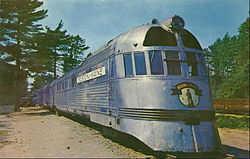
The Flying Yankee is a diesel-electric streamliner built in 1935 for the Boston and Maine Railroad by Budd Company and with mechanical and electrical equipment from Electro-Motive Corporation. It was the third streamliner train in North America.[1] That train ceased passenger service in 1957 and is stored at the Conway Scenic Railroad in New Hampshire. It was owned by the state of New Hampshire, until it was purchased by the Flying Yankee Association after being selected by the state of New Hampshire to receive ownership of the diesel streamliner. In May of 2025 the trainset was added to the New Hampshire State Register of Historic Places by the states preservation office.[2][3]

History

[edit]

Prior to 1935, the name Flying Yankee referred to a passenger train that ran between Bangor, Maine, and Boston, Massachusetts, at least back to 1891. The train was hauled by an early 4-6-2 steam locomotive; cars were standard heavyweight construction.

The new Flying Yankee in the 1930s was a lightweight train constructed with welded stainless steel using Budd's patented process. The engine was an 8-cylinder Winton 201-A diesel, driving a generator;[4] the lead truck was equipped with traction motors. It was fitted with air conditioning in all cars. No dining car was provided; instead, meals were prepared in a galley and served to passengers in trays that clipped to the back of the seat in front.[1]

It was the third streamliner in service after the Union Pacific's M-10000 and the Chicago, Burlington and Quincy Railroad's Pioneer Zephyr. The Flying Yankee was a virtual clone of the latter, except that it dispensed with the baggage/mail space to seat 142 in three articulated cars.[1]

The train was delivered in February 1935, and toured the BM-MEC railroad system before entering service on April 1.[1] The daily route served began in Portland, then to Boston, followed by a return to Portland and continuing to Bangor, Maine, returning through Portland to Boston and finally returning to Portland late in the day, a distance of 750 miles (1,210 km) per day. This schedule was kept six days a week; the trainset spent Sundays undergoing maintenance. The train proved extremely successful, attracting new ridership and earning a profit for its owners.

Later on, as newer equipment replaced it on one route, it would be switched to other routes, bearing the names Cheshire, Minute Man, Mountaineer, and Business Man.[1]

As railroad passenger ridership declined in the 1950s, the Yankee was also getting old, and thus the trainset, as The Minuteman, was retired, running its last on May 7, 1957.[1]

Most of the train's route is currently operated by Amtrak's Downeaster, which runs as far north as Brunswick, Maine.

Current location

[edit]

The railroad donated the trainset to the Edaville Railroad tourist/museum operation in Carver, Massachusetts, in 1957. The train remained on static display there until it was moved in 1993 to Glen, New Hampshire, after being purchased by Bob Morrell, then-owner of Story Land.

The Flying Yankee sitting at the Hobo Railroad in 2020, with its trucks removed

In 1997, the train was moved to the Concord and Claremont Railroad shops in Claremont, New Hampshire, for a restoration after it was purchased by the state of New Hampshire. By 2004, the major structural restoration had been completed, and detailed restoration of components is ongoing with the goal of restoring the train completely to running condition. The train was moved on August 10, 2005, to the Hobo Railroad in Lincoln, New Hampshire.

Plans to move it to Concord, New Hampshire, site of a former Boston and Maine railyard, fell through in 2017.[5] In November 2023, the state of New Hampshire put the equipment up for sale, with a focus on "the relocation and encouraged restoration" of the trainset.[6] In April 2024, the trainset was sold to the Flying Yankee Association, who hopes to restore and operate the set in the Mount Washington Valley, with a possibility of running it on the Conway Scenic Railroad.[7][8] It was moved to Conway on July 30, 2024, where it is currently undergoing restoration.[9]

References

[edit]

Further reading

[edit]
[edit]
Revisions and contributorsEdit on WikipediaRead on Wikipedia
from Grokipedia
The Flying Yankee was a pioneering streamlined in , consisting of a three-car articulated stainless-steel trainset powered by a 600-horsepower Winton 201-A , which operated from 1935 to 1957 on routes connecting , , to points in and for the Boston & Maine Railroad (B&M) and (MEC). Built by the Edward G. Budd Company of and mechanically identical to the earlier , the was the third to enter service on the continent, debuting on April 1, 1935, after an initial demonstration run in of that year. Its innovative design featured fluted stainless-steel construction for durability and aesthetics, along with a baggage-buffet car, a full coach, and a coach-observation car, providing a total capacity of 132 passengers while capable of speeds over 100 miles per hour. Primarily running the 253.7-mile Boston-to-Bangor route via , the train later served shorter lines such as Boston to (as the Minute Man), and Boston to (as the Mountaineer), adapting to post-World War II demand shifts. During its 22-year career, the Flying Yankee covered approximately 2.7 million miles and significantly boosted ridership for the and MEC by up to 50%, demonstrating the viability of diesel-electric streamliners during the and proving instrumental in modernizing rail travel in the Northeast. Service ended on May 7, 1957, amid declining passenger numbers due to competition from automobiles and airlines; the train was subsequently stored and displayed statically at sites including the Edaville Railroad, before preservation by the State of . In 2024, it was transferred to the Flying Yankee Association for $1 and relocated to the in New Hampshire for restoration with the goal of eventual operation, as of November 2025.

Design and Development

Construction

The Flying Yankee was constructed between 1934 and 1935 by the Edward G. Budd Manufacturing Company in , , as a pioneering diesel-electric designed for high-speed passenger service. The primary builder, Budd, utilized its patented shot-welding process to fabricate the train's body from lightweight 18-8 alloy, which provided exceptional durability and corrosion resistance while minimizing weight to facilitate faster operation. This construction approach marked a significant advancement in manufacturing, drawing inspiration from the earlier completed by Budd in 1934. The train featured an articulated three-car configuration consisting of a (Car A), a coach car (Car B), and an observation-dining car (Car C), semi-permanently coupled to reduce the number of trucks and enhance ride smoothness and efficiency. Measuring just over 199 feet in length and 9 feet 1 inch in width, the design emphasized aerodynamic streamlining, including a rounded "shovel nose" front end tested in wind tunnels and flush-mounted windows arranged in a continuous horizontal ribbon to reduce air resistance. The collaboration extended to key subcontractors: the Winton Engine Corporation, a division of ' Electro-Motive Corporation, supplied the 600-horsepower, eight-cylinder 201-A , while provided the electrical generators, main generator, and GE 721 traction motors for the diesel-electric propulsion system. The total construction cost was $280,000, funded through a $225,000 loan from the under the , with the Boston & Maine Railroad and contributing a $55,000 as joint owners. This financial arrangement reflected the era's efforts to modernize rail infrastructure amid the , enabling the railroads to acquire an innovative, cost-effective alternative to steam-powered trains without full upfront .

Technical Specifications

The Flying Yankee was powered by a diesel-electric system featuring a single 8-cylinder, two-cycle Winton 201-A diesel engine rated at 600 horsepower and 700 rpm, manufactured by the Winton Engine division of General Motors' Electro-Motive Corporation. This engine drove a main generator that supplied electricity to two GE 721 traction motors, each mounted on the axles of the lead truck to provide propulsion for the articulated three-car consist. The lightweight stainless-steel construction, utilizing Budd Company's shot-welded technique, contributed to the trainset's empty weight of approximately 113 tons, enabling efficient operation compared to heavier steam-hauled trains of the era. Designed for high-speed service, the train had a top speed capability of over 100 mph, with some records indicating speedometer readings up to 120 mph, though operational cruising speeds typically ranged around 80-90 mph on its routes. Passenger accommodations emphasized comfort and modernity, with a total of 142 across the three s: a baggage-buffet-coach, a full coach, and a coach-observation featuring a solarium lounge. Amenities included Frigidaire throughout, shatterproof double-glazed windows, and compact dining facilities in the buffet section, representing advanced features for rail travel. The powerplant offered improved fuel efficiency over contemporary steam locomotives, achieving lower operating costs through diesel consumption, though exact figures such as passenger-miles per gallon were not standardized in period documentation. Safety systems incorporated electro-pneumatic brakes supplied by the New York Air Brake Company, applied to all wheels, along with hermetically sealed windows to enhance passenger protection and environmental control. These specifications underscored the Flying Yankee's role as an early example of streamlined, self-propelled rail technology.

Operational History

Inauguration and Early Service

The Flying Yankee, a pioneering diesel-electric streamliner, was delivered to the Boston & Maine Railroad (B&M) in February 1935 after construction by the Budd Company and a promotional tour across the rail network. It arrived in Boston on February 9, 1935, where it underwent testing and exhibition runs to generate public interest. The official inauguration occurred on April 1, 1935, with the first scheduled revenue service commencing shortly thereafter on April 4, covering a demanding 740-mile round-trip from Boston to Bangor via Portland, Maine, completed in approximately six hours at an average speed of 60 mph. Ceremonies marked its early appearances, including stops in New Hampshire cities like Manchester and Concord, where large crowds gathered, such as over 13,000 visitors in Concord. The initial route operated as a daily service (except Sundays) looping from Portland to , then to Bangor, returning via Portland to , and ending back in Portland, totaling about 730 miles per day. This itinerary highlighted the train's speed and efficiency, with the -to-Portland segment (roughly 110 miles) traversed in about 90 minutes, a significant improvement over prior steam-powered services. As New England's first , it captured widespread public excitement during the , drawing enthusiastic crowds at stations and positioning itself as a symbol of modernity and progress with promotions emphasizing its sleek design, quiet operation, and air-conditioned comfort as "the train of tomorrow." Marketed to attract both tourists and business travelers, the Flying Yankee replaced slower conventional trains and quickly became a highlight of travel. In its first year of operation (1935–1936), the train carried 94,500 passengers and generated $266,800 in gross revenue, contributing to a 48 percent increase in passenger ticket sales on the Boston-Bangor route for the . Overall ridership on the service grew by approximately 50 percent compared to previous years, underscoring its immediate commercial success. Early operations faced minor hurdles, including adjustments to its diesel engines for optimal performance and adaptations for compatibility with older rail infrastructure, which occasionally limited top speeds on less-maintained sections. Despite these, the operated reliably, boosting revenues for both the and its partner, the (MEC), through enhanced efficiency over steam alternatives.

Routes and Performance

The Flying Yankee's primary route was the Boston to Bangor service, approximately 254 miles one way via Portland, maintained through the early 1940s. Wartime demands prompted temporary rerouting to routes like to , and to . Schedules emphasized daily efficiency, with the train departing at 11:00 AM and arriving in Portland by 12:50 PM, then continuing to Bangor by 4:00 PM, completing the full run in about five hours; the return leg left Bangor at 4:15 PM, reaching around 9:25 AM the next morning, operating six days a week to allow for maintenance. This timetable supported commuter and longer-distance travel, with all seats reserved and no baggage service to streamline operations. By the late , the schedule had stabilized to accommodate peak demand, including seasonal increases during summer months to serve tourism in coastal areas. Performance highlights included an average operating speed of around 60 mph over the Boston-Bangor route, with capabilities exceeding 100 mph on straightaways and rapid acceleration that contributed to overall trip times under five hours for 253.7 miles. The diesel-electric powerplant delivered notable efficiency gains over steam locomotives, achieving operating costs at just 25% of revenue per mile in 1937-1938 and logging over 2.7 million miles in service with high reliability during peak periods. Integration with connecting services extended the train's reach, particularly through links to ferries from Bar Harbor to , facilitating international travel for passengers arriving via the Bangor extension. Seasonal adjustments ramped up frequencies and capacity in summer to handle surges to Maine's coastal destinations, ensuring seamless transfers to local steamers and buses. Economically, the Flying Yankee generated $266,800 in revenue during its first year and boosted ticket sales by 48% on the Boston-Bangor route, demonstrating the viability of diesel streamliners and influencing subsequent designs across U.S. railroads.

Decline and Withdrawal

Following , the Flying Yankee faced intensifying competition from the burgeoning automobile industry and expanding commercial air travel, which significantly eroded passenger rail demand across the . Highway expansions, including the early phases of the , further facilitated personal vehicle use and reduced reliance on trains for regional travel. By the early , overall U.S. passenger rail ridership had plummeted, with rail's dropping from about 74% in 1945 to approximately 35% by 1957, directly impacting lightweight streamliners like the Flying Yankee. During , the train encountered unprecedented demand surges as gasoline rationing and rubber shortages curtailed automobile travel, overwhelming its 142-seat capacity and prompting operational adjustments. The Boston & Maine and Maine Central railroads shifted the Flying Yankee to shorter routes, such as Boston to , to better manage traffic, and the Maine Central ultimately sold its ownership stake to the Boston & Maine in 1942 due to these strains. Service continued through the war but resumed postwar with accumulated wear from high utilization and limited maintenance opportunities under wartime restrictions. By the mid-1950s, escalating maintenance challenges compounded the economic pressures on the aging . The original Winton 201-A diesel engines, already considered obsolete by the 1940s, suffered from scarce replacement parts as the manufacturer ceased production, driving up repair expenses and operational downtime. These issues, combined with general wear after over two million miles of service, made continued use increasingly uneconomical compared to newer, heavier conventional diesel locomotives that offered greater reliability for freight-prioritized networks. In response, the & Maine Railroad, now sole operator, prioritized cost-effective conventional equipment over maintaining the lightweight design. The Flying Yankee, operating as The Minuteman on its final routes, completed its last scheduled service on May 7, 1957, primarily between and Portland, marking the end of 22 years of revenue operations after covering approximately 2.7 million miles.

Preservation

Post-Retirement Storage

Following its retirement from revenue service on May 7, 1957, the Flying Yankee was donated by the Boston & Maine Railroad to Nelson Blount, founder of the Edaville Railroad in South , for use as a static display piece. The trainset remained in outdoor storage at Edaville from 1958 to 1993, exposed to the elements without maintenance, which led to significant deterioration including cracked glass panels, surface rust on the exterior despite its corrosion-resistant properties, moldering upholstery, and interior damage from rodents and weathering. The core structure held up better than conventional materials would have, owing to the durable construction, preventing total structural failure. In 1993, the train was acquired by private collector Robert S. Morrell, owner of Storyland amusement park, and relocated by truck convoy to temporary outdoor storage in , . It continued to suffer from neglect and vandalism during this period, with further interior degradation from exposure, though the exterior stainless steel body maintained its integrity. Morrell sold the trainset to the State of in 1996 after failing to secure a to operate it on a state-owned rail line. In November 1997, it was moved again to the shops of the Claremont & Concord Railroad in , for indoor storage, marking the end of its pre-preservation phase in the .

Restoration Efforts

The Flying Yankee Association (FYA), originally established as the Flying Yankee Restoration Group in 1996, is a dedicated to preserving and restoring the historic Boston & Maine for eventual operational use. The group formalized its 501(c)(3) status with the IRS in 1997 and initially partnered with the State of to pursue funding and restoration activities. After a period of dormancy in the 2000s and , dedicated volunteers reactivated the organization with a new board in April 2021, refocusing efforts on comprehensive restoration. Full ownership of the trainset was transferred from the State of to the FYA in July 2024 for a nominal fee of $1, enabling direct control over preservation initiatives. Restoration work began in earnest in the late and early , with initial projects targeting key mechanical components damaged during decades of outdoor storage, including partial overhauls of the traction motors and generators. By the early , volunteers had rebuilt the trucks, nearly completed an overhaul of the original Winton 201A engine, and installed a new brake system, while retaining as many 1935-era parts as possible to maintain historical authenticity. The FYA has collaborated with specialists for specialized tasks, such as shipping the two GE 721 traction motors to qualified repair shops for bearing replacement, pinion gear mounting, and fabrication of missing lubrication piping and cable connectors. These efforts addressed corrosion and wear from prolonged exposure, prioritizing the train's diesel-electric to support future mobility. Funding has relied on donations, grants, and targeted campaigns, with the FYA operating solely through volunteers and community support. In February 2025, coinciding with the streamliner's 90th anniversary, the association launched a dedicated fundraiser for finalizing the restoration, exceeding its $30,000 goal by raising $31,042 to cover shipping and reassembly costs. Earlier contributions included smaller grants and material donations from rail preservation partners, though large-scale federal funding has been limited. In May 2025, the Flying Yankee was added to the State Register of Historic Places. The FYA has entered into a lease agreement with the for land to construct a jointly-owned building to house both a restoration space and exhibits. The FYA also plans a permanent shop and facility in , to facilitate ongoing work, with designs emphasizing protected indoor storage to prevent further deterioration. The overarching objective is to return the Flying Yankee to service on heritage railroads, such as the , allowing public rides while honoring its original design and operational legacy. This includes test runs and full revenue operations once mechanical and electrical systems are fully integrated, with volunteers emphasizing original components to ensure the train remains a functional artifact of rail innovation.

Current Status

As of November 2025, the Flying Yankee trainset is stored at the in , following its relocation there in July 2024 from the former Hobo Railroad site in , where it had been maintained since 2005. The move, facilitated by the Flying Yankee Association (FYA), involved transporting the power car and three coaches separately to enable continued disassembly and targeted restoration work under improved facilities. The train's condition reflects partial restoration progress, with the overall structure largely rebuilt and key mechanical components addressed. The A-car (power car) is partially restored, the B-car (intermediate coach) is nearly complete, and the C-car (baggage-coach) has been stripped to its frame for further work; trucks and traction motors have been rebuilt, the original Winton 201A engine is almost entirely rebuilt, and a new brake system has been acquired. Interiors remain in progress, with reinstallation pending after stripping and assessment, rendering the trainset non-operational until engine integration and final assembly. Public access is limited to occasional static displays and guided tours organized by the FYA, including open houses held throughout the summer of 2025 on dates such as June 28, July 26, August 23, and September 13, with an additional event on October 25 due to popular demand. No regular operations are available yet. Future plans center on completing restoration to enable limited heritage service integrated with operations in the Valley, including construction of a dedicated shop and for long-term preservation and display. The FYA continues for these efforts, with recent success in securing funds for work.

References

Add your contribution
Related Hubs
User Avatar
No comments yet.