


Community hub
Recent from talks
Contribute something
Nothing was collected or created yet.
British Rail Class 66
View on Wikipedia
| British Rail Class 66 | |||||||||||||||||||||||||||||||||||||||||||||||||
|---|---|---|---|---|---|---|---|---|---|---|---|---|---|---|---|---|---|---|---|---|---|---|---|---|---|---|---|---|---|---|---|---|---|---|---|---|---|---|---|---|---|---|---|---|---|---|---|---|---|
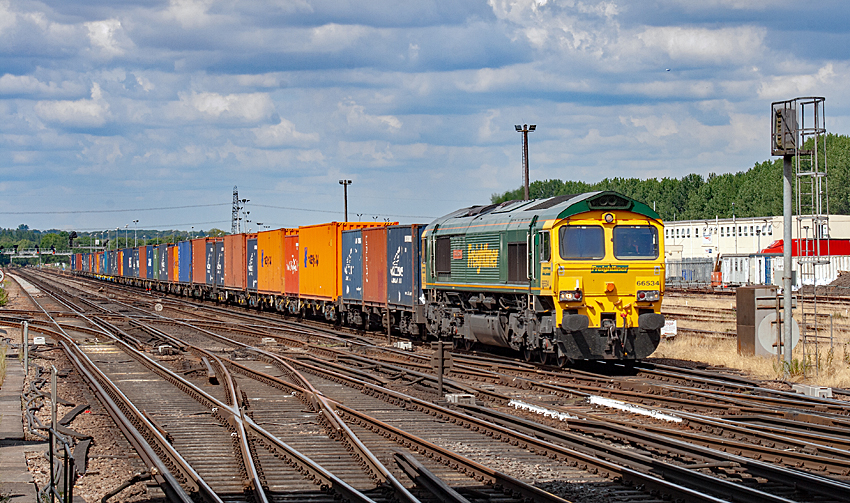
 A Class 66 at Eastleigh | |||||||||||||||||||||||||||||||||||||||||||||||||
| |||||||||||||||||||||||||||||||||||||||||||||||||
| |||||||||||||||||||||||||||||||||||||||||||||||||
| |||||||||||||||||||||||||||||||||||||||||||||||||
| |||||||||||||||||||||||||||||||||||||||||||||||||
| References to "UIC II" and "EU Stage IIA" relate to emissions control regulations set by the UIC and EU, respectively. In general, and without regard for subsequent modifications, locomotives ordered before 31 December 2002 will be original specification,[6] while those ordered after that date will be either UIC II or EU Stage IIA specification. | |||||||||||||||||||||||||||||||||||||||||||||||||
The British Rail Class 66 is a type of six-axle diesel-electric freight locomotive developed in part from the Class 59, for use on UK railways. Since its introduction the class has been successful and has been sold to British and other European railway companies. In Continental Europe it is marketed as the EMD Class 66 (JT42CWR).
History
[edit]Background
[edit]On the privatisation of British Rail's freight operations in 1996, Wisconsin Central Transportation Systems under the control of Ed Burkhardt bought a number of the newly privatised rail freight companies: Transrail Freight, Mainline Freight, Loadhaul, and later, Railfreight Distribution and Rail Express Systems; thus controlling 93% of UK rail freight. After a public relations exercise involving the input of the general public, the company was named English Welsh & Scottish Railway (EWS).[2]
EWS inherited a fleet of 1,600, mainly diesel, locomotives, with an average age of over 30 years; 300 had been cannibalised for spares. Typical of the fleet, the 2,580 hp (1,920 kW) Class 47s needed a major overhaul every seven years, costing £400,000; yet had an average daily availability of less than 65% with only 16 days between major failures. To enable it to offer its stated lower pricing to customers, EWS needed to reduce operating costs and increase availability.[2]
Order and specification
[edit]After reviewing the existing privately commissioned Class 59, which was more powerful, highly reliable and with lower operating costs, EWS approached its builder Electro-Motive Diesel (EMD), then a division of General Motors. EMD offered their JT42CWR model, which had the same loading gauge-passing bodyshell as the Class 59. The engine and traction motors were different models to enable higher speeds, and the Class 66s incorporated General Motors' version of a "self-steering bogie" ("radial truck", in American usage), designed to reduce track wear and increase adhesion on curves.[2]
Placing what was termed as "the biggest British loco order since steam days",[2] EWS placed an order for 250 units in May 1996 to be built at the EMD plant in London, Ontario, Canada at a cost of £375 million. Financed by Locomotion Capital (later Angel Trains), the first locomotives were ready in early 1998; the fastest delivery of an all-new locomotive type by GM.[7][8] Initially, the locomotives were expected to be allocated the TOPS Class 61, the Class 66 designation was confirmed in July 1996.[9]
The EMD 710 12-cylinder diesel engine is a development of a two-stroke engine used for over 20 years, whilst the EM2000 control equipment is the same as that used on the Iarnród Éireann 201 Class. EWS reduced the locomotive's time into operation through specifying cab systems laid out like the Class 59, whilst increasing availability with a fuel tank of 8,180 litres (1,800 imp gal; 2,160 US gal) capacity, compared to 3,470 litres (760 imp gal; 920 US gal) on a standard Class 47.[2]
United Kingdom
[edit]
The first locomotive shipped to the UK arrived at Immingham in June 1998,[8] taken to Derby for testing. The second was taken to AAR's Pueblo Test Centre for endurance testing, before shipping to the UK. The locomotives then shipped at a rate of 11 per month into the UK via Newport Docks, until the order was completed in December 2001. After unloading, EWS engineers then simply took off the tarpaulin, unblocked the suspension, and finally as each was shipped with water and fuel, connected the batteries, before starting the engine and handing the locomotive into service. The ability to simply start up '66s' on the dockside and drive them under their own power to depots to enter service was nothing short of a revelation compared with many other BR locomotives, particularly the British Rail Class 60s.[10][2]
Each locomotive is specified and guaranteed to 95% availability, aiming for a minimum of 180 days mean time between failures. It is designed to cover 1.6 million km between major rebuilds, equivalent to 18 years' service, with each major rebuild costed at £200,000.[2]
In 1998 Freightliner placed an order for locomotives. They were followed by GB Railfreight, and then Direct Rail Services. The last of more than 500 built over an 18-year period was No 66779, Evening Star, delivered to GB Railfreight in spring 2016.[11]
Although sometimes unpopular with many rail enthusiasts, due to their ubiquity and having caused the displacement of several older types of (mostly) British built locomotives, their high reliability has helped rail freight to remain competitive. Rail enthusiasts labelled the type "The Red Death" as they displaced many older types of locomotive[12] whilst also acquiring the nicknames of "sheds" for the EWS (now DBS) locomotives (due to their upturned roof looking like a shed roof)[5] with the Freightliner locomotives being called "Freds" as a portmanteau of Freightliner and Shed.[13]
Continental Europe
[edit]The Class 66 design has also been introduced to Continental Europe where it is currently certified for operations in Germany, the Netherlands, Belgium, Luxembourg, Sweden, Norway, Denmark, France, and Poland, with certification pending in the Czech Republic and Italy. They currently operate on routes in Sweden and Denmark and between Germany, Belgium, The Netherlands and Poland. As a result of its well-known British identity, EMD Europe markets the locomotive as "Series 66".
UK importation
[edit]By 2011, following an increase in UK rail traffic after the 2008 Global Economic Crisis, EMD were struggling to source critical components of the locomotive — specifically castings. The final units of the Class 66 were produced in the London, Ontario plant that year following an industrial dispute and the introduction of new EU crash and emissions regulations which culminated in the cessation of production.
Due to a reduction in European freight volumes and migration of several operators to electric traction using multi-current locomotives such as the Alstom Traxx and Siemens Eurosprinter, since mid-2012, a number of EMD Series 66 locomotives have been imported by GBRf and converted to UK type specifications. To date:[14]
- 2012: Three ex-Dutch locos, which have been numbered 66747–749. The former identities of these were DE6316, DE6313 and DE6315 respectively.
- 2013: Two ex-German "Rush Rail" locomotives, which have been numbered 66750 and 66751. The former identities of these were DE6606 (also used in Sweden with the number T664025) and DE6609 (also 2906) respectively
- 2019: Three ex-Swedish locomotives, which have been numbered 66790–792. The former identities of these were T66403, T66404 and T66405 respectively.
- 2024: Eleven locomotives from France, which have been numbered 66306–316.[15]
Emission compliance
[edit]Numbers 66752-779 were the last Class 66s ordered for service in Great Britain because of increasingly stringent emission regulations. 66779 was the last Class 66 ever to be built. Although the Class 66s meet stage 3a of the regulations, they do not meet stage 3b. Stage 3b would have required additional exhaust treatment equipment that could not easily be accommodated within the UK loading gauge. The same restrictions apply to the Class 68 and Class 70. The restriction does not apply to second-hand locomotives, provided that they are imported from within the European Union. The purpose of the regulation was to put a cap on the total number of non-compliant locomotives in the EU.[16]
Current operators
[edit]Class 66 operators in Great Britain are:
DB Cargo UK
[edit]
DB Cargo UK bought out EWS. Their Class 66 fleet includes four locomotives capable of banking heavy trains over the Lickey Incline. On these specific locomotives, the knuckle coupler has been modified to allow remote releasing from inside the cab, whilst in motion. It also includes fifteen locomotives fitted with RETB signalling equipment, for working in northern Scotland and RETB-fitted branchlines.[17] A few DB Cargo UK Class 66s are now working in Europe as part of DB Cargo France and DB Cargo Polska.[18]
GB Railfreight
[edit]
GB Railfreight initially leased seventeen Class 66/7 locomotives, before increasing its fleet to 32. During April 2006 five more low-emission locomotives (numbered 66718-722) were delivered, liveried for use on the Metronet/Transport for London contracts. A further order for five more locomotives (66723-727) was delivered in early 2007, and another five locomotives (66728–732) in April 2008. 66733-746 are formed of Class 66s from Direct Rail Services, Freightliner and Colas Rail. In 2011 66720 was painted in a special "Rainbow" livery.[19] In June 2012, 66734 derailed at Loch Treig whilst working 6S45 North Blyth–Fort William and was consequently cut up on site and scrapped.[20]
In September 2013, GB Railfreight announced a new order of a further 8 Class 66/7 locomotives from EMD, the first of the class to be built at EMD's Muncie, Indiana plant. On 2 February GBRf ordered a further 13 locomotives. These 21 locomotives are numbered 66752–772.[21] Numbers 66752–756 were shipped from America and arrived at Newport Docks in July 2014. No. 66752 has been named The Hoosier State, a nickname for Indiana.[22] A further seven locomotives (66773–779) were later added to the fleet, utilising six power units that had been in the UK, plus one recovered from the scrapped 66734. The presence of these power units in the UK circumvented European emission compliance regulations and permitted them to be exported to EMD Muncie for installation in further class 66 bodyshells.[citation needed]
The final Class 66 built, 66779, remained under a tarpaulin until 10 May 2016 when it was revealed at the NRM York with a special livery and nameplates to commemorate the fact it is the final Class 66 ever built for the British market.[11][23] The locomotive has been painted in BR Lined Green and named Evening Star, in reference to BR Standard Class 9F 92220 Evening Star which was the last BR steam locomotive to be built. It was unveiled in a special ceremony inside the Great Hall at the National Railway Museum in York on 10 May 2016 before staying there opposite its namesake, No. 92220, for two weeks. At the same ceremony, the CEO of GBRf, John Smith, handed the curator of the National Railway Museum a document offering 66779 to the national collection when it is retired in about 40 years time.[24]
In addition to those locomotives sourced from domestic operators (Direct Rail Services, Freightliner, Colas Rail and DB Cargo UK), eight further locomotives have been obtained from European operators. A further five have been purchased from Heavy Haul Power International and will be transferred from Germany beginning in April 2021. The locos will go to Doncaster to be converted to UK specification.[25]
Former operators
[edit].jpg)
Former Class 66 operators include:
Fastline operated intermodal services between Doncaster and Birmingham International Railfreight Terminal (BIFT), and Thamesport, in North Kent, using refurbished Class 56 locomotives. The company ordered five Class 66/3 locomotives to operate a coal flow from Hatfield Colliery, which were delivered in 2008.[26][27]
Following the demise of Jarvis in 2010, and Fastline going into administration on 29 March 2010,[28] these locomotives were placed in storage, being towed to Direct Rail Services' Carlisle Kingmoor and Crewe Gresty Lane depots for storage. During 2011, DRS repainted the five ex-Fastline locomotives and added them to their own fleet, keeping their original numbers.[citation needed]
Future operators
[edit]In January 2026, DB Cargo UK announced that it was to sell 25 locomotives to Bulgarian operator Grup Ferovar Roman. The locomotives include 66006, 66009, 66014, 66024, 66027, 66040, 66047, 66069, 66075, 66076, 66080, 66085, 66086, 66087, 66089, 66095, 66110, 66111, 66115 and 66197.[29]
Driver reception
[edit]The British train drivers' union ASLEF has complained that the locomotives are unfit and unsafe to work in, citing excessive heat, noise levels and poor seating.
In April 2007, ASLEF proposed a ban on their members driving the locomotives during the British summer 2007 period. Keith Norman, ASLEF's general secretary, described the cabs as "unhealthy, unsafe and unsatisfactory". Research showed that in July 2006, when the weather had been extremely hot, the number of incidents where a driver had passed a signal at danger (SPAD) increased.[30] EWS entered into discussions and made amendments to a series of trial locomotives,[30] GB Railfreight and Freightliner also investigated cab improvements.[31] In June 2007, progress on the issue led ASLEF to withdraw its threat of industrial action.[32]
In Norway, CargoNet related complaints about the noise levels in the CD66 variant of the Class 66 resulted in higher pay rates for drivers.[33]
Accidents and incidents
[edit]- On 28 February 2001, 66521 was involved in the 2001 Great Heck rail crash/Selby rail crash which resulted in 10 deaths including the driver Stephen Dunn.[34] The locomotive was written off and scrapped as a result of major damage sustained in the accident.[35]
- On 9 February 2006, a freight train hauled by English Welsh & Scottish 66017, derailed at Brentingby Junction near Melton Mowbray. Having passed a signal at danger, the locomotive and the first three wagons were derailed at catch points at the end of the Up Goods Loop. There were no injuries.[36]

- On 4 January 2010, a freight train, hauled by 66048, derailed at Carrbridge in snowy weather, blocking the Highland Main Line.[37] Having passed a signal at danger the train was derailed at trap points,[38] subsequently falling down an embankment into trees and injuring the two crew members. The locomotive was hauling container flats from Inverness to Mossend Yard on behalf of Stobart Rail.[39] The line was reopened on 12 January.[40]
- On 21 November 2011, 66111 derailed between Exeter Central and Exeter St Davids on working an engineering works service.[41]
- On 28 June 2012, GBRf operated 66734 derailed at Loch Treig whilst working the 6S45 North Blyth to Fort William Alcan Tanks.[42] Due to its position and the environmental risks associated with recovery, after agreement from owners Porterbrook it was cut-up on site and the mechanics recycled as spare parts.[43][44]
- On 1 August 2015, 66428 was hauling an engineering train that ran into the rear of another engineering train at Logan, Ayrshire. It was severely damaged.[45] The train that was run into was hauled by 66305.[46]
- On 14 August 2017, 66713 was hauling a freight train that derailed near Ely, due to defective suspension on the wagon that was first to derail. The railway between Ely and Peterborough was closed for a week.[47]
- On 4 September 2018, 66230 was hauling a freight train which collided with a vehicle on a level crossing at Dollands Moor Freight Yard, Kent. One cab was extensively damaged in the post-impact fire.[48] The locomotive was stored in Toton TMD.[citation needed]
- On 23 January 2020, 66154 was hauling a freight train which derailed at Wanstead Park and ran for 2.5 miles (4.0 km) before stopping near Walthamstow Queen's Road station.[49]
- On 23 March 2020, 66057 ran through a buffer stop at the end of a siding at Bromsgrove and was derailed. The derailment caused the locomotive to foul the main line, and a Class 170 diesel multiple unit, unit number 170 107, collided with the derailed locomotive at around 85 miles per hour (137 km/h). No one was injured.[50] The driver of the locomotive was subsequently convicted of an offence contrary to the Health and Safety at Work etc. Act 1974. He was sentenced to 8 months' imprisonment, suspended for 18 months.[51]
- On 11 November 2020, 66603 was hauling a freight train that derailed at Sheffield.[52] The derailment was caused by broken rail fastenings which allowed the track to spread.[53]
- On 19 August 2021, 66754 was hauling a freight train which collided with a tractor on a level crossing between March and Whittlesea in Cambridgeshire. The locomotive and three wagons were derailed.[54][55]
- On 24 December 2021, 66779, working a train from Hams Hall (near Birmingham) to London Gateway derailed on the down Thames Haven line while on the approach to the port near to Stanford-le-Hope in Essex.[56][57]
- On 5 July 2022, 66729 was hauling a freight train that passed a signal at danger and ran into the rear of another freight train near Loversall Carr Jn, Doncaster.[58]
- On 19 October 2022 66739 was hauling a loaded cement train from Clitheroe Castle Cement Gb to Carlisle N.Y. when eight wagons derailed at Petteril Bridge Junction with one crashing into the River Petteril and one half way down the embankment.[59]
- On 5 April 2024, 66776 passed a red signal and was derailed at West Ealing.[60]
Sub-classes
[edit] | This section may contain original research. (October 2024) |
Minor differences between different orders, and different operating companies have resulted in a number of subclasses being defined.[citation needed]
| Subclass | Quantity | Loco nos. | Operators | Comments |
|---|---|---|---|---|
| Class 66/0[8] | 223 |
|
DB Cargo UK |
|
| 5 |
|
Direct Rail Services | On long-term lease from DB Cargo UK, all in DRS livery.[citation needed] | |
| Class 66/3 | 16 |
|
GB Railfreight |
|
| Class 66/4 | 10 | 66411–420 | Freightliner | Acquired from Direct Rail Services in 2011. 66411, 66412 & 66417 exported for use by Freightliner PL.[18] |
| 14 | 66421-434 | Direct Rail Services | Intended use is on intermodal traffic. Occasionally used on nuclear flask traffic.[8] | |
| Class 66/5 | 81 |
|
Freightliner |
|
| Class 66/6 | 28 |
|
||
| 10 | 66651-660 | DB Cargo UK |
| |
| 4 | 66687
66689 66693 66694[64] |
GB Railfreight |
| |
| Class 66/7[65] | 99[65] | 66701–776, 66778, 66780-792, 66795-799[66][64] | GB Railfreight | Operates on coal, intermodal services and also engineering / departmental work for Transport for London and Network Rail on London Underground and National Rail lines.[8]
|
| Class 66/8 | 5 | 66846–850 | Colas Rail | Formerly Freightliner 66573–577. |
| Class 66/9 | 7 | 66951–957 | Freightliner | A lower emission variant – fuel capacity reduced to compensate for the increased weight of other components.[8] |
Names
[edit] | This section needs additional citations for verification. (December 2024) |
| Number | Name | Operator | Notes |
|---|---|---|---|
| 66005 | Maritime Intermodal One | DB Cargo UK | [68] |
| 66035 | Resourceful | Unveiled at the 2018 Severnside Open Day.[69] | |
| 66047 | Maritime Intermodal Two | [68] | |
| 66051 | Maritime Intermodal Four | [68] | |
| 66090 | Maritime Intermodal Six | [68] | |
| 66091 | accurascale | Named after the model railway company at the DB Cargo UK Rail 200 Heritage Weekend at Midland Railway – Butterley in July 2025[70] | |
| 66100 | Armistice 100 (1918-2018) | [71] | |
| 66142 | Maritime Intermodal Three | [68] | |
| 66148 | Maritime Intermodal Seven | [68] | |
| 66162 | Maritime Intermodal Five | [68] | |
| 66175 | Rail Riders Express | Named at Toton on 20 March 2020.[72] | |
| 66190 | Martin House Children's Hospice | [73] | |
| 66200 | The Jeremy Vine Show | Named at The Greatest Gathering in Derby after the famous BBC Radio 2 presenter.[74] | |
| 66301 | Drax Power Station 50 Years | GB Railfreight | [75] |
| 66307 | Ipswich Town | [76] | |
| 66308 | Signalman Willie Taylor | Named on 1 May 2024 at Carlisle Station to mark 40 years since he prevented a fatal rail collision.[77] | |
| 66413 | Lest We Forget (denamed) | Freightliner | Name transferred to 66623 in 2023.[78] |
| 66415 | You Are Never Alone | [79] | |
| 66418 | Patriot | Named in 2016 in honour of the 20,000 railwaymen that lost their lives in the First World War.[80] | |
| 66419 | Lionesses' Roar | Named in honour of the England women's national football team.[81] | |
| 66421 | Gresty Bridge TMD | Direct Rail Services | Previously carried by 20305.[82] |
| 66422 | Max Joule | Name unveiled at the 2022 Direct Rail Services Open Day.[83] | |
| 66424 | Driver Paul Scrivens | [84] | |
| 66425 | Nigel J Kirchstein | [85] | |
| 66428 | Carlisle Eden Mind | [86] | |
| 66429 | Charlie Brise | Named after a former DRS employee and TSSA union representative.[87] | |
| 66431 | Kingmoor TMD | [87] | |
| 66433 | Carlisle Power Signal Box | [88] | |
| 66501 | Spirit of 65 – Celebrating 60 years of Freightliner | Freightliner | Named in March 2025 to celebrate 60 years of Freightliner.[89] |
| 66503 | The Railway Magazine | Named in 2004 with another plate (Celebrating 125 years 1897–2022) added below in 2022 to celebrate the magazine's anniversary.[90] | |
| 66508 | City of Doncaster | [78] | |
| 66509 | Josiah's Wish | [91] | |
| 66522 | East London Express (denamed) | [79] | |
| 66526 | Steve Dunn (denamed) | Named after freight driver who was killed in the Selby rail crash.[92][78] | |
| 66528 | Madge Elliot MBE (Borders Railway 2015) | Named after veteran rail campaigner Madge Elliot.[93][79] | |
| 66533 |
|
Different name carried each side.[79] | |
| 66534 | OOCL Express | Named on 21 November 2001 at Manchester.[94] | |
| 66540 | Ruby | [95] | |
| 66552 | Maltby Raider | Named in 2004 to celebrate Freightliner's achievement of 0.75 million tonnes of coal from Maltby Main Colliery.[96] | |
| 66587 | As One We Can | Named and repainted in Ocean Network Express' (ONE) pink livery in 2019 to celebrate Freightliner's partnership with ONE.[97] | |
| 66594 | NYK Spirit of Kyoto | [79] | |
| 66614 | Poppy | Named in 2016 in honour of the 20,000 railwaymen that lost their lives in the First World War[80] | |
| 66619 | Derek W Johnson MBE | Named after Chairman of Johnson Stevens Agencies Ltd.[98] | |
| 66623 | Lest We Forget | Name transferred from 66413 in 2023.[78] | |
| 66701 | Whitemoor (denamed) | GB Railfreight | Named on 23 May 2004 at Whitemoor depot.[99] |
| 66705 | Golden Jubilee | Additionally carried a Union Jack in its livery until 2016.[100] | |
| 66706 | Nene Valley | [101] | |
| 66708 | Glory to Ukraine | Named on 6 April 2022 and partially painted in the colours of the Flag of Ukraine.[102] | |
| 66709 | Sorrento | Named and repainted in Mediterranean Shipping Company's corporate colours in 2012 to celebrate the 10-year partnership anniversary with GB Railfreight.[103] | |
| 66710 | Karen Harrison | Named at the Greatest Gathering after the first woman in Britain to be appointed as a train driver.[74] | |
| 66711 | Sence | [104] | |
| 66713 | The Forest City | Named in reference to the Class 66's birthplace in London, Ontario.[105][better source needed] | |
| 66714 | Cromer Lifeboat | [106][better source needed] | |
| 66715 | Valour | [107][better source needed] | |
| 66716 | Locomotive & Carriage Institution 1911-2011 | Named on the Nene Valley Railway.[108] | |
| 66718 | Peter, Lord Hendy of Richmond Hill of Imber in the County of Wiltshire | Originally named Sir Peter Hendy CBE in 2013, it was repainted in a black livery with the current name adopted in May 2023.[109] | |
| 66719 | Michael Portillo | Named at the Greatest Gathering after the British journalist and broadcaster that hosted railway documentaries such as Great British Railway Journeys and Great Continental Railway Journeys.[74] | |
| 66720 | Wascosa | [110] | |
| 66721 | Harry Beck | Named after the designer of London Underground's Tube map.[111] | |
| 66723 | ZA723 Chinook | Named after the helicopter in 2008.[112] | |
| 66725 | Sunderland | [76] | |
| 66726 | Sheffield Wednesday | [113] | |
| 66728 | Institution of Railway Operators | [114] | |
| 66729 | Derby County | [115] | |
| 66731 | Capt. Tom Moore – A True British Inspiration | Named in April 2020 in honour of the 100th birthday of Captain Tom Moore.[116] | |
| 66733 | Cambridge PSB | [117][better source needed] | |
| 66734 | Platinum Jubilee | Repainted in purple livery in 2022 and named to commemorate the Platinum Jubilee of Elizabeth II.[118] | |
| 66736 | Wolverhampton Wanderers | [119] | |
| 66738 | Huddersfield Town | [76] | |
| 66739 | Bluebell Railway | [120] | |
| 66740 | Sarah | Named after Sarah Whurr in 2014, working for GBRF's finance team.[121][better source needed] | |
| 66741 | Swanage Railway | [122][better source needed] | |
| 66742 | Port of Immingham Centenary 1912-2012 | Unveiled by Michael Portillo.[123] | |
| 66744 | Crossrail | [124] | |
| 66747 | Made in Sheffield | [125] | |
| 66748 | St Michael's Mount | Named and repainted in the "Belmond Britannic Explorer" luxury livery and named in honor of the famous tidal island landmark in Cornwall.[126] | |
| 66749 | Christopher Hopcroft MBE | [127] | |
| 66750 | Bristol Panel Signal Box | [128] | |
| 66751 | Inspiration Delivered | [129] | |
| 66752 | The Hoosier State | A nickname for the American state of Indiana.[22] | |
| 66753 | EMD Roberts Road | [130] | |
| 66754 | Northampton Saints | Named at Wellingborough Aggregates Terminal on 22 April 2015.[131] | |
| 66755 | Tony Berkeley OBE | [132] | |
| 66756 | Royal Corps of Signals | [133] | |
| 66757 | West Somerset Railway | [134] | |
| 66758 | The Pavior | Named in honour of the Worshipful Company of Paviors.[135] | |
| 66761 | Wensleydale Railway Association 25 years 1990 - 2015 | Named on 17th July 2015 to honour 25 years of the Wensleydale Railway Association. The locomotive spent a weekend after the naming ceremony hauling passenger services on the 22 mile heritage railway.[136] | |
| 66763 | Severn Valley Railway | [137] | |
| 66764 | Major John Poyntz Engineer and Railwayman | Named on 16 June 2021 in honour of last RE Inspector of Railways.[138] | |
| 66765 | Julie Carn | [139] | |
| 66766 | Gail Richardson | [139] | |
| 66767 | King’s Cross PSB 1971–2021 | Named on 25 April 2021 at Kings Cross station.[140] | |
| 66769 | League Managers Association | Carries the Prostate Cancer UK logo. Named in August 2021.[141] | |
| 66770 | Darius Cheskin | [87] | |
| 66771 | Amanda | Named in a ceremony at Cleethorpes station in August 2019 in honour of staff member Amanda Wilson.[142] | |
| 66772 | Maria | Named in a ceremony at Cleethorpes station in August 2019 in honour of staff member Maria Dennison.[142] | |
| 66773 | Pride of GB Railfreight | Name chosen by Matthew Parris in recognition of LGBT+ employees across the rail industry.[143] | |
| 66775 | HMS Argyll | Named in a ceremony at HMNB Devonport in July 2017.[144] | |
| 66778 | Cambois Depot 25 Years | [145] | |
| 66779 | Evening Star | Last class 66 to be built. Gifted to the NRM.[146] | |
| 66780 | The Cemex Express | [147][148] | |
| 66781 |
|
||
| 66783 | The Flying Dustman | Named in March 2018 to mark the partnership between Biffa and GB Railfreight.[151] | |
| 66784 | Keighley & Worth Valley Railway | [152][page needed] | |
| 66785 | John Ellis | [153] | |
| 66786 | Cambridge University Railway Club | [154] | |
| 66787 | Three Bridges ASC | [155][better source needed] | |
| 66789 | British Rail 1948-1997 | Named to commemorate the 70th anniversary of British Rail and painted in BR 'large logo' blue.[156][better source needed] | |
| 66790 | Louise | [157] | |
| 66791 | Settle & Carlisle 150 | To celebrate 150 years of freight on the Settle to Carlisle line[158] | |
| 66792 | Collaboration | [159] | |
| 66794 | Steve Hannam | [160][better source needed] | |
| 66795 | Bescot LDC | Named in October 2021 following the completion of an upgrade to the Bescot Local Distribution Centre.[161][162] | |
| 66796 | The Green Progressor | Named in September 2021.[163] | |
| 66798 | Justine | [157] | |
| 66799 | Modern Railways Diamond Jubilee | [164] | |
| 66847 | Terry Baker | Freightliner | [165][better source needed] |
| 66849 | Wylam Dilly | [166] | |
| 66850 | David Maidment OBE | [167][better source needed] | |
| 66957 | Stephenson Locomotive Society 1909–2009 | GB Railfreight | Named at Shildon, on 30 March 2009, as part of the Stephenson Locomotive Society's 100th anniversary celebrations.[168] |
Models
[edit]In 2006, Hornby Railways launched its first version of the BR Class 66 in OO gauge range in a variety of liveries.[169]
In 2008, Bachmann produced a OO gauge model of 66411 Eddie the Engine in DRS Stobart livery.[170] In 2013, following on from Bachmann's OO gauge EWS and Freightliner liveried models of the Class 66, Bachmann introduced a DCC-ready version of 66846 in Colas Rail livery.[171]
Since 2019, Hattons have offered a variety of paint schemes for their class 66 model in OO gauge.[172]
Both Graham Farish[173] and Dapol produce models of the Class 66 for British N gauge.[174]
In 2008, Aristocraft introduced a G scale version of the Class 66 in GB Railfreight livery[175][176] and in Freightliner livery.[177]
Notes
[edit]- ^ Locomotives produced from 2006 onwards, including those of Series 66 imported from continental Europe, are model JT42CWRM.
- ^ Also used by Classes 59, 67, 68 (numbers 68008–68015 only), 69, 70, and 73/9.
- ^ Locomotive 66039 only, as part of 'first in class' testing for the East Coast Main Line digital signalling programme.[4]
References
[edit]- ^ a b c d e f g h Product Information: EMD Class 66 Freight Locomotive (JT42CWRM) (PDF). Heusenstamm: EMD Europe GmbH. July 2008. Archived from the original (PDF) on 19 March 2009. Retrieved 7 February 2023.
- ^ a b c d e f g h i j k l JAH (1 April 1998). "EWS workhorses will deliver savings". Railway Gazette International. DVV Media International. Archived from the original on 2 March 2020. Retrieved 6 February 2014.
- ^ a b Vehicle Diagram Book No. 100 for Main Line Diesel Locomotives (PDF). Derby: Mechanical & Electrical Engineering Department, British Railways Board. January 1992. 59-0aA, 59-1aA (in work pp. 115–116). Retrieved 5 February 2023 – via Barrowmore MRG.
- ^ Clinnick, Richard (April 2023). "Modernising the Moorgate branch". Rail Express. No. 323. Horncastle: Mortons Media Group. p. 87. ISSN 1362-234X.
Two DB Cargo locomotives, Nos. 66039 and 67002, are the 'first in class' for those fleets...
- ^ a b Buck, Martin (2005). Freightmaster review : a decade of change 1995 to 2004. Swindon: Freightmaster Publishing. p. 60. ISBN 978-0-9537540-4-5. Wikidata Q105958844.
- ^ a b Foster, Stefanie (17 April 2013). "Fifteenth anniversary of the Class 66". Rail Magazine. Retrieved 7 February 2023.
- ^ Jones 2018, p. 22.
- ^ a b c d e f g h i "rolling stock : class 66 [sic]". thejunction.org.uk. 16 August 2006. Archived from the original on 20 February 2012. Retrieved 30 December 2013.
- ^ Clinnick, Richard (16 March 2016). "Class '66s' 'clickety-clicked' for UK freight". RAIL. No. 796. ISSN 0953-4563. Retrieved 1 June 2025.
RAIL 282 carried the design of what the new EWS locomotive (at the time expected to be a Class 61) would look like, with full details. [...] That issue of RAIL also confirmed that the '61' would be what is (today) the Class 66, while what had been specified then as a '66' turned out to be what is now the '67'.
- ^ Jones 2018, pp. 22, 24.
- ^ a b Jones 2018, p. 26.
- ^ Buck, Martin (2005). Freightmaster review : a decade of change 1995 to 2004. Swindon: Freightmaster Publishing. p. 7. ISBN 978-0-9537540-4-5. Wikidata Q105958844.
- ^ Piggott, Nick, ed. (October 1999). "Sheds and Freds". The Railway Magazine. Vol. 145, no. 1, 182. London: IPC. p. 13. ISSN 0033-8923.
- ^ a b c "Import of EMD Series 66 increases due to lack of UK motive power". Railway Gazette. September 2013.
- ^ a b Office of Rail and Road (1 February 2024). "GBRf Class 66 Upgrade" (PDF). Retrieved 28 April 2025.
- ^ Bickerdyke, Paul (June 2014). "Future of locos is 'in the secondary market'". Rail Express. No. 217. p. 9. ISSN 1362-234X.
- ^ Fox, Hall & Pritchard 2008[page needed]
- ^ a b c d e f "Brits Abroad". The Railway Magazine. Retrieved 26 August 2020.
- ^ "GB Railfreight goes for the unusual look to brighten a dull day". Railway Herald. No. 274. 11 July 2011. p. 4. ISSN 1751-8091. Retrieved 11 July 2011.
- ^ "Now scrapped GBRf 66734 down the bank at Loch Treig Scotland". BritishRailways.tv. 2015. Archived from the original on 14 April 2015. Retrieved 10 April 2015.
- ^ "GB Railfreight expands Class 66 fleet". Railway Gazette. 4 September 2013. Archived from the original on 22 February 2014. Retrieved 6 February 2014.
- ^ a b Dunn, Pip, ed. (August 2014). "Reborn in the USA! America builds first 66s". Railways Illustrated. p. 9. ISSN 1479-2230.
- ^ "Brand new Class 66s delivered to Yorkshire". RAIL. 16 February 2016. Retrieved 16 February 2016.
- ^ Milner, Chris, ed. (June 2016). "Last class 66 is named Evening Star". The Railway Magazine. Vol. 162, no. 1, 383. Horncastle: Mortons Media. p. 7. ISSN 0033-8923.
- ^ "GB Railfreight acquires Class 66 locos from Germany". Railway Gazette. Retrieved 27 October 2020.
- ^ "Fastline Freight's 66/3s arrive at Newport". Railway Herald. No. 137. 30 June 2008. p. 3. ISSN 1751-8091. Retrieved 30 December 2013.
- ^ "Fastline's first Class 66/3s arrive for UK power contract". Rail. No. 595. 2 July 2008. p. 6.
- ^ "Fastline Ltd". Archived from the original on 9 April 2010. Retrieved 30 December 2013.
- ^ "DB Cargo UK sells 25 Class 66s to Romanian operator". Modern Railways. Retrieved 19 January 2026.
- ^ a b "Boycott threat over 'dirty' locos". BBC News. 30 April 2007. Retrieved 30 December 2013.
- ^ "Positive moves from operators on 66s". Locomotive Journal. ASLEF: 7. April 2007. Archived from the original on 27 September 2011. Retrieved 10 July 2011.
- ^ "News Archive: Progress on 66 cabs leads to normal working". ASLEF. 14 June 2007. Archived from the original on 30 September 2017. Retrieved 30 September 2017.
- ^ "Enighet mellom NLF og CargoNet". lokmann.no (in Norwegian). 5 October 2004. Archived from the original on 28 September 2007.
- ^ "Tragic results of driver fatigue". BBC News. 13 December 2001.
- ^ a b "Diesel/Electric Locomotive Information: 66521". UKRail.co.uk. Archived from the original on 30 October 2021. Retrieved 30 October 2021.
- ^ Rail Accident Investigation Branch (January 2007). "Rail Accident Report: Derailment of a freight train at Brentingby Junction, near Melton Mowbray – 9 February 2006". Railways Archive. Retrieved 22 June 2011.
- ^ "Snow derailment problems continue". BBC News. 4 January 2010. Retrieved 5 January 2010.
- ^ "Investigation into an accident involving a freight train at Carrbridge, Inverness-shire, on 4 January 2010" (PDF). Rail Accident Investigation Branch. Retrieved 16 January 2010.
- ^ "Probes into SPADs in Devon and Scotland". Rail. No. 635. Bauer Media Group. 13 January 2010. pp. 8–9.
- ^ "Inverness-Perth Route Reopens After a Week of Endeavour". Network Rail. 13 January 2010. Archived from the original on 30 December 2013. Retrieved 11 June 2010.
- ^ "VIDEO: Derailed train causes services to be cancelled". Exeter Express and Echo. 25 November 2011. Archived from the original on 5 May 2013. Retrieved 30 December 2013.
- ^ "Man winched to safety in Scotland after floods derail train". The Daily Telegraph. 29 June 2012. Archived from the original on 30 June 2012.
- ^ Milner, Chris (31 January 2013). "Derailed Class 66 to be cut up on site". The Railway Magazine. Archived from the original on 27 December 2013. Retrieved 26 December 2013.
- ^ QTS Group (13 June 2014). "Loco Recovery". YouTube. Retrieved 12 January 2021.
- ^ "Collision near Logan". Rail Accident Investigation Branch. 14 August 2015. Retrieved 17 August 2015.
- ^ "Freight train collision near Logan, East Ayrshire 1 August 2015" (PDF). Rail Accidents Investigation Branch. 13 July 2016. Retrieved 16 July 2016.
- ^ "Freight train derailment at Ely West Junction 14 August 2017" (PDF). Rail Accidents Investigation Branch. Retrieved 2 August 2018.
- ^ "Collision between a train and utility vehicle at Dollands Moor freight yard, Kent 4 September 2018" (PDF). Rail Accidents Investigation Branch. Retrieved 25 June 2019.
- ^ "Derailment of a Freight Train near Wanstead Park, London 23 January 2020" (PDF). Rail Accidents Investigation Branch. Retrieved 16 November 2020.
- ^ "Passenger train collision with a derailed locomotive at Bromsgrove 23 March 2020" (PDF). Rail Accidents Investigation Branch. Retrieved 18 November 2020.
- ^ "Driver sentenced to eight months imprisonment for causing crash". Office of Rail and Road. Retrieved 10 January 2023.
- ^ "Freight train derails at Sheffield". RAIL. 11 November 2020. Retrieved 4 December 2020.
- ^ "Freight train derailment at Sheffield station". Rail Accidents Investigation Branch. Retrieved 4 December 2020.
- ^ "Cambridgeshire: Train driver injured in level crossing collision". BBC News Online. 19 August 2021. Retrieved 20 August 2021.
- ^ "Collision and derailment of a freight train at Kisby user worked level crossing". Rail Accident Investigation Branch. Retrieved 14 September 2021.
- ^ "Freight train derailment at London Gateway". Rail Accident Investigation Branch. Retrieved 31 January 2022.
- ^ "Freight train derailment at London Gateway, Essex, 24 December 2021" (PDF). Rail Accident Investigation Branch. December 2023. Retrieved 5 April 2024.
- ^ "Signal passed at danger and collision between freight trains near to Loversall Carr Junction". Rail Accident Investigation Branch. Retrieved 22 July 2022.
- ^ Holden, Michael (20 October 2022). "Carlisle – Newcastle / Skipton trains disrupted after freight train derailment". RailAdvent. Retrieved 21 October 2022.
- ^ "Passengers face delays after derailment at West Ealing". BBC News. 5 April 2024. Retrieved 5 April 2024.
- ^ Hewitt, Sam (4 January 2018). "GB Railfreight buys DB Cargo Class 66s". The Railway Magazine.
- ^ Clinnick, Richard. "Crash damaged Class 66 moves to Stoke". Rail Magazine. Retrieved 27 July 2025.
- ^ RailUK-admin (25 April 2024). "'Peak' performance from DB Cargo UK's regeared Class 66 locomotive". Rail UK. Retrieved 23 September 2025.
- ^ a b c "GB Railfreight modifying 12 Class 66s". RailAdvent. 25 September 2025. Retrieved 23 September 2025.
- ^ a b c Bayer, Gareth (17 August 2021). "GBRf closes in on 100 'Sheds'". Rail Express.
- ^ a b Clinnick, Richard (25 January 2021). "GB Railfreight targets more Class 66s from overseas". RAIL. Retrieved 21 September 2021.
- ^ Clinnick, Richard (3 June 2019). "First of three Swedish '66s' arrives for GB Railfreight". RAIL. Retrieved 3 June 2019.
- ^ a b c d e f g "Maritime's two new locomotives unveiled". Maritime Transport. 2 April 2019. Retrieved 8 January 2024.
- ^ "Severnside Open Day". 22 March 2018. Retrieved 9 January 2024.
- ^ "DB Cargo Have Only Gone And Named A Loco After Us!". Accurascale. 19 July 2025. Retrieved 23 September 2025.
- ^ "DB Cargo UK holds centenary Armistice Day locomotive naming". Tank News International. 19 November 2018. Archived from the original on 9 January 2024. Retrieved 9 January 2024.
- ^ Holden, Michael (31 March 2020). "Rail Riders has a named locomotive once again!". Rail Advent. Retrieved 8 January 2024.
- ^ Greenwood, Darren (5 June 2023). "Martin House name goes national after York station livery launch". The Press. Retrieved 9 January 2024.
- ^ a b c Bickerdyke, Paul, ed. (September 2025). "A truly Great Gathering". The Railway Magazine. Vol. 171, no. 1494. Kelsey Media (published 3 September 2025). pp. 4, 42‒45. ISSN 0033-8923.
- ^ "Gold class 66 Locomotive set for greatest gathering appearance". Rail Advent. 14 February 2025. Retrieved 13 February 2026.
- ^ a b c "GB Railfreight names locomotive after Ipswich Town Football Club". Rail Advent. 15 January 2024. Retrieved 17 January 2024.
- ^ "Engine named after signalman who stopped Carlisle train disaster". BBC News. 2 May 2024. Retrieved 20 May 2024.
- ^ a b c d Bendall, Simon; Clinnick, Richard; Coward, Andy (January 2024). "Naming Update". Fleet Review. Railways Illustrated. No. 251. p. 22.
- ^ a b c d e Smith, Dave (2020). Freightliner Locomotives. Amberley Publishing. ISBN 978-1-4456-7370-7.
- ^ a b "New Basford Hall TMD Unveiled With Remembrance Naming". Rail Express. 22 December 2016. Retrieved 4 January 2024.
- ^ Coward, Andy, ed. (December 2022). "Naming update". Railways Illustrated. No. 238. Horncastle: Mortons Media Group. p. 23. ISSN 1479-2230.
- ^ "DRS open day raises more than £37,000 for charity". Rail Magazine. 27 July 2018. Retrieved 9 January 2024.
- ^ "Direct Rail Services open day to become biennial event". RailAdvent. 9 March 2023. Retrieved 5 January 2024.
- ^ Anderson, Stuart (7 June 2023). "Driver Paul Scrivens to debut on the North Norfolk Railway". Eastern Daily Press. Retrieved 8 January 2024.
- ^ Bendall, Simon; Clinnick, Richard; Coward, Andy (October 2022). "Naming Update". Fleet Review. Railways Illustrated. No. 236. p. 25.
- ^ "Direct Rail Services raise £10k for charities and local causes". Direct Rail Services. 23 July 2019. Retrieved 9 January 2024.
- ^ a b c d Bendall, Simon; Clinnick, Richard; Coward, Andy (September 2024). "Naming Update". Fleet Review. Railways Illustrated. No. 259. p. 25.
- ^ "Carlisle Power Signal Box locomotive marks 50 years of progress". News & Star. 17 June 2023. Retrieved 9 January 2024.
- ^ Karlsson, Oliver (25 August 2025). "Freightliner UK marks 60 Years with anniversary locomotives". Rail Color News. Retrieved 25 August 2025.
- ^ Bestwick, Alex (9 August 2022). "Locomotive's rededication marks magazine milestone". The Railway Hub. Retrieved 6 November 2022.
- ^ "I Wish To Be A Freight Train Driver". Make-A-Wish. Retrieved 9 January 2024.
- ^ "Loco named after driver". Gezatte & Herald. 1 October 2001. Retrieved 8 January 2024.
- ^ "Train is named after rail campaigner Madge Elliot". BBC News. 3 June 2015. Retrieved 7 January 2025.
- ^ "OOCL Express Naming Ceremony". OOCL. 30 November 2001. Retrieved 11 October 2021.
- ^ "Freightliner celebrates 40 years" (pdf). Railway Herald. 27 January 2006. p. 9. Retrieved 9 January 2024.
- ^ "Class 66 66552 'Maltby Raider'". Wings Wheels and Rail Gallery. Retrieved 9 January 2024.
- ^ "G&W and ONE celebrate new contract with loco naming". Genesee & Wyoming Railroad. Retrieved 9 January 2024.
- ^ "Class 66 66619 'Derek W. Johnson MBE'". Wings Wheels and Rail Gallery. Retrieved 9 January 2024.
- ^ "Celebrate a Railway Revival – Whitemoor Community Open Day". Network Rail Media Centre. 1 April 2004. Retrieved 11 October 2021.
- ^ "R30334: Hornby GBRf Class 66 Diesel 66 705 Golden Jubilee". Kernow Model Rail Centre. Retrieved 9 January 2024.
- ^ "Nene Valley Railway "Nene Corridor" Project Launch". Six Bells Junction. 26 April 2003. Retrieved 9 January 2024.
- ^ Holden, Michael (6 April 2022). "GB Railfreight unveils new livery for Class 66 locomotive in support of Ukraine". RailAdvent. Retrieved 4 May 2022.
- ^ "New look for GBRF Class 66". Railway Herald. 26 April 2012. Retrieved 9 January 2024.
- ^ "Bardon Hill locomotive named 'Sence'". AggNet. 9 July 2015. Retrieved 9 January 2024.
- ^ "R30020 GBRf, Class 66, Co-Co, 66713 'Forest City'". Hornby Model Railways. Retrieved 17 January 2024.
- ^ "TT3016M GBRf, Class 66, Co-Co, 66714 'Cromer Lifeboat'". Arnold Models. Retrieved 17 January 2024.
- ^ "Valour-Railway Locomotive No 66715". Imperial Wharf Museum. Retrieved 17 January 2024.
- ^ "Centenary Locomotive Naming". The Locomotive & Carriage Institution. Retrieved 17 January 2024.
- ^ "GB Railfreight honors Lord Peter Hendy with loco renaming ceremony". RailAdvent. 28 May 2023. Retrieved 17 January 2024.
- ^ "GB Railfreight celebrates Wascosa and Network Rail partnership". News. Railways Illustrated. No. 235. October 2022. p. 13.
- ^ "R30021 GBRf, Class 66, Co-Co, 66721 'Harry Beck' - Era 11". Hornby Hobbies. Retrieved 23 May 2023.
On 26 January 2007, 66721 was named 'Harry Beck', by John Smith, MD of GB Railfreight...
- ^ "Chinook takes to the air to celebrate loco naming". Railnews. 30 September 2008. Retrieved 17 January 2024.
to unveil the striking squadron-badged plaque on loco 66723...
- ^ "VIDEO: 66726 Sheffield Wednesday passes damaged train on Settle-Carlisle line". Craven Herald & Pioneer. 3 September 2021. Retrieved 17 January 2024.
- ^ "Depot creates new jobs for rail town". Railnews. 28 April 2008. Retrieved 17 January 2024.
- ^ "First GBRf names loco 'Derby County'". Derby County F.C. 17 April 2010. Archived from the original on 18 April 2010. Retrieved 17 January 2024.
- ^ "GB Railfreight thanks Captain Tom Moore for his NHS fundraising with locomotive naming". Rail Magazine. Retrieved 30 April 2020.
- ^ "GB Railfreight: Facebook". Facebook. 10 September 2014. Retrieved 17 January 2024.
Today, 66733 was named 'Cambridge PSB' at Cambridge Station...
- ^ "GBRF Marks Platinum Jubilee with special livery". Railway Herald. 1 June 2022. Retrieved 17 January 2024.
- ^ "66376 Wolverhampton Wanderers Nameplate". Martin Loader's Railway Photography. Retrieved 17 January 2024.
- ^ Sam Hewitt (28 July 2020). "Bluebell Railway Celebrates Six Decades Of World's Most Popular Line". Heritage Railway.
- ^ "GB Railfreight: Facebook". Facebook. 14 August 2014. Retrieved 17 January 2024.
66740 is the latest of our locos to be named after one of our office girls...
- ^ "GB Railfreight: Facebook". Facebook. 7 May 2015. Retrieved 17 January 2024.
We've just named 66741 'Swanage Railway'...
- ^ "GB Railfreight helps the Port of Immingham celebrate 100 years of operation with locomotive naming" (PDF). Europorte. 30 April 2012. Retrieved 17 January 2024.
- ^ "Northfleet: Crossrail". Kent Rail. Retrieved 17 January 2024.
No. 66744 was formally named Crossrail during a ceremony at the site...
- ^ Michael Holden (11 July 2019). "GBRf name class 66 locomotive 'Made in Sheffield'". RailAdvent. Retrieved 17 January 2024.
- ^ "Railway Herald". Railway Herald. 4 August 2025. Retrieved 4 August 2025.
- ^ "GBRf employee wins Lifetime Achievement Award at the end of a 60-year career". GB Railfreight. 28 February 2020.
- ^ White, Cameron (13 June 2020). "Rare GBRf European class 66 locomotive convoy". RailAdvent. Retrieved 13 June 2020.
- ^ "GB Railfreight celebrates relationship with Hitachi Rail Europe by naming Class 66 locomotive". GetLink. 27 May 2015. Retrieved 17 January 2024.
- ^ "GB Railfreight names Class 66 at Roberts Road". Rail Magazine. 9 December 2014. Retrieved 17 January 2024.
- ^ "GB Railfreight celebrates rugby success with locomotive naming at Northampton..." press.getlinkgroup.com. Retrieved 14 April 2022.
- ^ "His Lordship's Locomotive". Modern Railways. 26 July 2018. Retrieved 17 January 2024.
- ^ Sam Hewitt (16 August 2017). "GB Railfreight Cements Links With Armed Forces". The Railway Magazine. Retrieved 17 January 2024.
- ^ "40 years since the re-opening of West Somerset Railway". ITV News. 28 September 2016. Retrieved 17 January 2024.
- ^ "GB Railfreight and the Worshipful Company of Paviors christen 'The Pavior'". GB Railfreight. 14 September 2018. Retrieved 17 January 2024.
- ^ "We're delighted to have named 66761 at the Wensleydale Railway today". Facebook UK. 17 July 2015. Retrieved 29 December 2025.
- ^ Tom Davis (21 May 2016). "Severn Valley Railway unveils £800,000 Kidderminster Diesel Depot". The Shuttle. Retrieved 17 January 2024.
A GB Railfreight loco 66763 was also named 'Severn Valley Railway' at the official launch.
- ^ White, Cameron (18 June 2021). "HM Railway Inspector has GBRF Class 66 locomotive dedicated in his name". RailAdvent. Retrieved 20 June 2021.
- ^ a b Bendall, Simon; Clinnick, Richard; Coward, Andy (September 2022). "Naming Update". Fleet Review. Railways Illustrated. No. 235. p. 23.
- ^ "GBRf name new locomotive as King's Cross project reaches final stage". GB Railfreight. 30 April 2021. Retrieved 11 October 2021.
- ^ White, Cameron (16 August 2021). "Class 66 locomotive named in honour of partnership between GB Railfreight, Prostate Cancer UK and the League Managers Association". RailAdvent. Archived from the original on 16 August 2021. Retrieved 16 August 2021.
- ^ a b "GBRf honour long serving employees with loco naming". GBRf. 16 August 2019.
- ^ "GB Railfreight Unveil New Brighton Pride Rainbow Locomotive". GB Railfreight. 2 August 2019. Retrieved 2 August 2019.
- ^ "Royal Navy Warship HMS Argyll honoured by train company". justplymouth.com. 12 July 2017.
- ^ Harris, Nigel, ed. (12 August 2020). "News in brief". Rail Magazine. No. 911. Peterborough: Bauer Consumer Media. p. 28. ISSN 0953-4563.
- ^ Plongf4. "Our Trains". GB Railfreight. Archived from the original on 11 October 2021. Retrieved 11 October 2021.
{{cite web}}: CS1 maint: numeric names: authors list (link) - ^ "CEMEX and GB Railfreight presented the new CEMEX-liveried locomotive at a dedicated naming ceremony held at Dove Holes Quarry, Buxton". Cemex. 14 June 2019. Retrieved 17 January 2024.
- ^ Emma Holden (20 June 2019). "GBRf and Cemex launch new branded Class 66 locomotive". Cemex. Retrieved 17 January 2024.
- ^ Bendall, Simon; Coward, Andy (August 2022). "Naming Update". Fleet Review. Railways Illustrated. No. 234. p. 21.
- ^ Hare, Simon (30 June 2024). "Power station's last coal delivery arrives by rail". BBC News. Retrieved 30 June 2024.
- ^ "GB Railfreight and Biffa christen "The Flying Dustman"". GBRF. 28 March 2018. Retrieved 4 November 2022.
- ^ "GBRF marks KWVR's 50th anniversary". Rail Magazine. 18 July 2018.
- ^ "GB Railfreight honours John Ellis with a surprise locomotive naming". GBRailfreight. 21 July 2023. Retrieved 17 January 2024.
- ^ "GB railfreight 66786 'Cambridge University Railway Club'". Cambridge University Railway Club. Retrieved 17 January 2024.
- ^ "LinkedIn GB Railfreight". LinkedIn. 1 July 2023. Retrieved 17 January 2024.
- ^ @GBRailfreight (27 February 2018). "GBRf are proud to unveil our latest class 66 newly renamed 'British Rail 1948-1997'. The loco marks the 70th anniversary of British Railways and is currently undergoing a number of modifications to bring to GBRf 66/7 standard and reliability" (Tweet) – via Twitter.
- ^ a b "GB Railfreight hosts its 2023 ladies' naming ceremony". GB Railfreight. 22 August 2023. Retrieved 17 January 2024.
- ^ "Reopened Horton Quarry rail link marks 150 years of freight on Settle-Carlisle line". railmagazine.com. Retrieved 22 August 2025.
- ^ Bendall, Simon; Coward, Andy (July 2022). "Naming Update". Fleet Review. Railways Illustrated. No. 233. p. 23.
- ^ @GBRailfreight (28 May 2021). "We're proud to unveil our latest named Class 66 'Steve Hannam'. Specially painted in BR Railfreight triple grey livery, the locomotive celebrates the rail career of Steve Hannam who played a vital role in maintaining Class 59 & 66 locomotives in the UK" (Tweet) – via Twitter.
- ^ "GB Railfreight name new locomotive to celebrate major Bescot LDC upgrade". GB Railfreight. 8 October 2021.
- ^ Holden, Alan (9 October 2021). "GB Railfreight names Class 66 locomotive to celebrate Bescot LDC upgrades". RailAdvent. Archived from the original on 9 October 2021. Retrieved 10 October 2021.
- ^ White, Cameron (18 September 2021). "HS2 fan names Class 66 locomotive – with unexpected surprise". RailAdvent. Archived from the original on 19 September 2021. Retrieved 20 September 2021.
- ^ "Class 43 and Class 66 locomotive named at Kidderminster station on the Severn Valley Railway". RailAdvent. 28 September 2022. Retrieved 17 January 2024.
- ^ @GBRailfreight (26 April 2019). "Monday the 22nd April marked the proud unveiling of Colas Rail Ltd.'s newly named loco class 66847 "Terry Baker". The Loco was named in memory of the late Terry Baker. A devoted Crystal Palace fan and loved colleague" (Tweet) – via Twitter.
- ^ "Class 66 66849 'Wylam Dilly'". Wings Wings And Rail Gallery. Retrieved 17 January 2024.
- ^ "TT3019M Colas Rail, Class 66, Co-Co, 66850, 'David Maidment OBE'". Arnold Models. Retrieved 17 January 2024.
- ^ "Locomotives Associated with the SLS". Stephenson Locomotive Society. Archived from the original on 5 December 2019. Retrieved 22 July 2019.
- ^ "Hornby BR Class 66". Hornby Railways Collector Guide. Retrieved 1 February 2020.
- ^ Wild, Mike (January 2008). "Bachmann releases Eddie the Engine in Stobart livery". Hornby Magazine. No. 7. Hersham: Ian Allan Publishing. p. 8. ISSN 1753-2469. OCLC 226087101.
- ^ "Bachmann 'Shed' now adorned in Colas Rail livery". British Railway Modelling. Vol. 20, no. 12. Bourne: Warners Group Publications. March 2013. p. 94. ISSN 0968-0764. OCLC 1135061879.
- ^ "Hatton BR Class 66". Hatton's model directory. Retrieved 19 May 2022.
- ^ "Farish '66/9' completes the set". Model Rail. No. 113. Peterborough: EMAP Active. January 2008. p. 66. ISSN 1369-5118. OCLC 173324502.
- ^ Wild, Mike (January 2008). "New Class 66 liveries from Dapol". Hornby Magazine. No. 7. Hersham: Ian Allan Publishing. p. 81. ISSN 1753-2469. OCLC 226087101.
- ^ Jones, Ben (January 2008). "Garden Shed". Model Rail. No. 113. Peterborough: EMAP Active. pp. 8–9. ISSN 1369-5118. OCLC 173324502.
- ^ Wild, Mike (January 2008). "Aristocraft 'G' scale 66 lands". Hornby Magazine. No. 7. Hersham: Ian Allan Publishing. pp. 76–77. ISSN 1753-2469. OCLC 226087101.
- ^ Jones, Brian (June 2008). "Radio-controlled Aristocraft 'Fred'". British Railway Modelling. Vol. 16, no. 3. Bourne: Warners Group Publications. pp. 32–37. ISSN 0968-0764. OCLC 1135061879.
Sources
[edit]- Peter Fox; Peter Hall; Robert Pritchard (2004). British Railways Locomotives & Coaching Stock 2004. Sheffield: Platform 5. ISBN 978-1-902336-39-8. Wikidata Q105958847.
- Peter Fox; Peter Hall; Robert Pritchard (2008). British Railways Locomotives & Coaching Stock 2008. Sheffield: Platform 5. ISBN 978-1-902336-63-3. Wikidata Q105958849.
- Jones, Ben (July 2018). "Freight without Frontiers: 20 years of Class 66". The Railway Magazine. pp. 23–29.
Further reading
[edit]- Taylor, Ross (2015). General Motors Type 5: Class 66 Locomotives. Amberley Publishing. ISBN 978-1-4456-4850-7. OCLC 921186595. OL 28831950M. Wikidata Q105958850.
- "That's two down – only another 248 Class 66s to go...!". RAIL. No. 327. EMAP Apex Publications. 25 March – 7 April 1998. p. 17. ISSN 0953-4563. OCLC 49953699.
- "EWS takes delivery of its first American-design Class 66s". RAIL. No. 328. EMAP Apex Publications. 8–21 April 1998. p. 9. ISSN 0953-4563. OCLC 49953699.
- "First Canadian Class 66 arrives in Britain!". RAIL. No. 330. EMAP Apex Publications. 6–19 May 1998. pp. 8–9. ISSN 0953-4563. OCLC 49953699.
- "Class 66 hauls revenue-earning freight train after just six weeks!". RAIL. No. 333. EMAP Apex Publications. 17–30 June 1998. pp. 8–9. ISSN 0953-4563. OCLC 49953699.
- Holley, Mel (15–28 July 1998). "Off to Colorado with Ed's new Class 66!". RAIL. No. 335. EMAP Apex Publications. pp. 24–30. ISSN 0953-4563. OCLC 49953699.
- Holley, Mel (9–22 September 1998). "Three more new Class 66s arrive in Britain – it may be 50 by Christmas". RAIL. No. 339. EMAP Apex Publications. pp. 12–13. ISSN 0953-4563. OCLC 49953699.
- "Seven more Class 66s ready for delivery to EWS". RAIL. No. 340. EMAP Apex Publications. 23 September – 6 October 1998. p. 14. ISSN 0953-4563. OCLC 49953699.
- "Second batch of Class 66s arrive – and they go straight into traffic". RAIL. No. 342. EMAP Apex Publications. 21 October – 3 November 1998. p. 17. ISSN 0953-4563. OCLC 49953699.
- "Third batch of '66s' arrives as EWS hires four ships". RAIL. No. 343. EMAP Apex Publications. 4–17 November 1998. p. 12. ISSN 0953-4563. OCLC 49953699.
- "EWS on target for 60 '66s' by Christmas". RAIL. No. 344. EMAP Apex Publications. 18 November – 1 December 1998. p. 10. ISSN 0953-4563. OCLC 49953699.
External links
[edit]
- "Nothing stops a Class 66". RAIL. No. 492. Bauer Media Group. Archived from the original on 10 October 2007 – via Pigeonsnest.co.uk.
- "Special Report: The Class 66s" (PDF). Railway Herald. No. 127. 18 April 2008. pp. 19–25. ISSN 1751-8091. Archived from the original (PDF) on 27 July 2011. Retrieved 10 February 2011.
British Rail Class 66
View on GrokipediaOverview and Specifications
Introduction
The British Rail Class 66 is a Co-Co diesel-electric freight locomotive developed by General Motors' Electro-Motive Division (EMD) specifically for heavy haulage duties on the UK's rail network.[4] It evolved as a successor to the Class 59, incorporating design refinements to meet European loading gauges and operational needs while retaining the robust two-stroke diesel engine technology proven in North American service.[6] Built primarily at EMD's facility in LaGrange, Illinois, with additional production in London, Ontario, the Class 66 has become a cornerstone of modern freight operations due to its reliability and versatility.[7] The locomotive's introduction marked a significant investment in UK freight infrastructure, beginning with an initial order placed in May 1996 by the English, Welsh & Scottish Railway (EWS) for 250 units, valued at £350 million and described as the largest locomotive order since the steam era.[8] This fleet was intended to replace aging Classes 47 and 58 locomotives, providing enhanced power and efficiency for intermodal and bulk freight services across the privatized rail system.[9] Over time, subsequent orders from various operators expanded production, resulting in a total of 480 units delivered for UK use, making the Class 66 one of the most numerous diesel classes in the country.[6] Beyond the UK, the Class 66 design has seen widespread adoption in Europe for similar heavy freight roles, with exports supporting operators in countries like Germany, France, and the Netherlands.[10] Its enduring presence underscores EMD's successful adaptation of American locomotive engineering to European standards, ensuring sustained performance in demanding cross-border logistics.[9]Technical Specifications
The British Rail Class 66 is a six-axle diesel-electric freight locomotive featuring a Co-Co wheel arrangement, with power distributed across six axles via two three-axle bogies equipped with EMD Hi-Ad high-adhesion designs.[11] It is powered by a single EMD 12-710G3B 12-cylinder, two-stroke, turbocharged diesel engine rated at 3,300 hp (2,462 kW) at 904 rpm.[4] Key dimensions include an overall length of 21.4 m, width of 2.65 m, and height of 3.91 m, while the operating weight is 129.6 tonnes with an axle load of 21.6 tonnes, ensuring compatibility with UK Route Availability 7 infrastructure.[12] The electrical system comprises an AR10 alternator generating three-phase AC power, which is rectified to DC and supplied to six axle-hung D43TRC traction motors, one per axle, enabling a maximum speed of 120 km/h (75 mph).[11] Fuel capacity stands at 6,400 litres in standard configurations, supporting extended operations with efficiency features such as automatic engine stop-start to reduce idling consumption.[11] The braking system utilizes Knorr-Bremse compressed air brakes, including direct and automatic controls for train and locomotive functions, with provisions for dynamic braking via the traction motors for enhanced retardation on gradients.[4]| Specification | Detail |
|---|---|
| Wheel Arrangement | Co-Co |
| Prime Mover | EMD 12-710G3B (12-cylinder, 2,462 kW) |
| Length | 21.4 m |
| Width | 2.65 m |
| Height | 3.91 m |
| Weight | 129.6 tonnes |
| Axle Load | 21.6 tonnes |
| Traction Motors | 6 × D43TRC (DC) |
| Top Speed | 120 km/h (75 mph) |
| Fuel Capacity | 6,400 L |
Performance Characteristics
The British Rail Class 66 locomotive delivers a maximum starting tractive effort of 409 kN and a continuous tractive effort of 260 kN at 25.6 km/h, enabling robust performance in demanding freight operations.[4] This capability stems from its 1,850 kW power output at the wheel rim, provided by the EMD 12-710G3B diesel engine, which supports efficient power delivery across varied load conditions.[4] Fuel efficiency for the Class 66 is approximately 201 g/kWh at full and intermediate loads, reflecting the engine's optimized combustion and turbocharging, though idling rises to 402 g/kWh due to the two-stroke design.[13] The locomotive achieves a 95% availability rate, with a mean time between failures of at least 180 days, contributing to its high operational reliability in freight networks.[14] In terms of haulage, the Class 66 can manage up to 3,000 tonnes on level track, making it well-suited for intermodal containers and bulk freight such as aggregates or coal.[4] Its tractive effort-speed characteristics allow sustained performance on gradients up to 10‰ with 1,800-2,400 tonne trains, as demonstrated in operational curves.[4] The locomotive reaches a top speed of 75 mph (120 km/h), with acceleration from 0 to 75 mph achievable in under 60 seconds when loaded, supporting timely freight schedules on mixed-traffic routes.[4]Design and Development
Background and Origins
The British Rail Class 66 originated as a direct evolution of the highly successful Class 59 diesel-electric freight locomotive, which had been introduced in 1990 to address reliability issues in UK heavy haul operations. Built by General Motors Electro-Motive Division (EMD), the Class 59 demonstrated superior performance and availability compared to contemporary British designs, prompting further development for broader adoption in the European freight market. The Class 66 retained the core bodyshell and six-axle Co-Co configuration of its predecessor but incorporated refinements to enhance efficiency and standardization.[15] In the mid-1990s, following the privatization of British Rail under the Railways Act 1993, the freight sector faced significant challenges, including an aging fleet with low availability rates—often below 70% for classes like the Class 47—and increasing competition from road transport. The newly formed English, Welsh & Scottish Railway (EWS), which acquired the majority of UK rail freight operations in 1996, identified a pressing need for a modern, standardized locomotive capable of hauling heavier trains at speeds up to 75 mph while minimizing maintenance costs. This market demand drove the conceptualization of the Class 66 as a versatile workhorse suited to the post-privatization landscape, with EWS placing its initial order in May 1996.[16][17] The design drew heavily from North American EMD architectures, particularly the SD70 series, but was adapted to meet European requirements, including compliance with the smaller UK loading gauge and stricter emissions standards. Key modifications included the adoption of a 12-cylinder EMD 710-series prime mover for improved fuel efficiency over the Class 59's 16-cylinder unit, along with high-traction radial bogies to handle varied UK track conditions and integrated on-train monitoring systems for regulatory adherence. These adaptations ensured the locomotive's compatibility with continental European networks while prioritizing reliability for cross-border freight.[18][15] Development progressed to prototype stage in 1997, with the first unit (66001) under construction at EMD's London, Ontario facility starting in May of that year, focusing on integration of UK-specific safety and braking systems. Initial testing occurred in Canada to validate the adapted design, followed by preparations for UK network trials upon delivery. These early evaluations confirmed the locomotive's performance under simulated European conditions, paving the way for certification and deployment.[18][17]Orders and Production
Following the success of the Class 59 locomotives, which demonstrated the reliability of Electro-Motive Diesel (EMD) designs in UK freight operations, English, Welsh & Scottish Railway (EWS) placed an order for 250 Class 66 units in May 1996—the largest such procurement in Britain since the steam era.[19] This £375 million deal, financed via a long-term lease with Locomotion Capital (later Angel Trains), initiated production at EMD's plant in London, Ontario, Canada, with assembly commencing in early 1998.[16] The first locomotive, 66001, arrived at Immingham Docks on April 18, 1998, underwent testing at Derby, and entered revenue service on June 2, 1998, hauling coal from Bentinck Colliery to Drakelow Power Station.[19] Deliveries for the EWS batch proceeded at a rate of up to 30 units per month, with the final unit, 66250, completed on June 21, 2000, though additional production for the subclass continued until 2005.[19] Subsequent orders expanded the fleet, including an initial batch of five for Freightliner in March 1999 (valued at £23 million for an expanded group of 15 via a lease-back with Forward Trust Rail), growing to a total of 100 units delivered between 2000 and 2008.[19] Direct Rail Services ordered 10 units in 2002, delivered in October 2003, while GB Railfreight placed orders for seven in 2001 and 21 more in 2013–2015, shifting production to EMD's Muncie, Indiana, facility for the later batches to meet updated emission standards.[19][10] The final UK-built Class 66, 66779, was completed in 2015 and arrived at Newport, Wales, in February 2016, marking the end of production for the type in Britain due to evolving EU emissions regulations.[20] In total, 480 Class 66 locomotives were manufactured for UK operators, with most units assembled in Canada and the United States, engines produced at EMD's LaGrange, Illinois, plant.Sub-classes and Variants
The British Rail Class 66 locomotive features several sub-classes, designated 66/0, 66/3 through 66/9, each incorporating targeted modifications to address evolving operational demands such as environmental compliance, thermal management, and track compatibility. These variants primarily differ in engine tuning for power and emissions, cooling enhancements, axle loading capacities, and bogie configurations, allowing adaptation to diverse freight applications without altering the core six-axle diesel-electric design.[21] The 66/0 sub-class forms the baseline model, encompassing the initial production run of 250 units built to a uniform specification with a standard 3,200 hp engine and conventional bogies optimized for general freight duties at speeds up to 75 mph.[9] Subsequent variants introduced refinements for specialized conditions; for instance, the 66/4 incorporates an upgraded cooling system with larger roof and bodyside grilles to mitigate overheating in elevated ambient temperatures, enhancing reliability during prolonged operations in warmer environments.[22] The 66/6 represents a heavy-haul iteration for Freightliner, equipped with a lower gear ratio for a maximum speed of 65 mph (105 km/h) and increased starting tractive effort of 467 kN, while supporting axle loads of up to 21.6 tonnes for intensive services, often paired with re-geared transmissions for increased low-speed tractive effort. Later variants incorporate Tier 2 emissions-compliant engines that reduce NOx and particulate emissions.[9][16][11] Further evolution is evident in the 66/9, which employs OTOS bogies engineered for superior curve negotiation and stability at higher speeds, improving ride quality and reducing wheel-rail wear on mixed-traffic routes; imported locomotives from continental Europe have been adapted for UK networks, often classified under sub-classes like 66/9 to accommodate differences such as loading gauges.[19]Operational History
Introduction in the United Kingdom
The British Rail Class 66 diesel-electric locomotives were introduced to the United Kingdom's freight network in 1998 as a modern replacement for aging fleet types such as the Classes 47 and 56, offering improved power, reliability, and efficiency for heavy haulage duties. The first unit, No. 66001, arrived at Immingham Docks on April 18, 1998, marking the start of a transformative era for UK rail freight under operator English Welsh & Scottish Railway (EWS). Following initial testing at Derby and Toton, including a dynamic brake test run from Toton to Buxton on May 27, 1998, the locomotive entered revenue service on June 2, 1998. Early operations focused on coal traffic to demonstrate its capabilities on demanding routes, such as to power stations including Ratcliffe-on-Soar, where it handled loaded services efficiently despite the challenging gradients and tonnages involved.[19] By late 1998, additional units joined the fleet, enabling expansion into intermodal container services from major ports like Felixstowe—operated by Freightliner following their initial order in 1999—and aggregates trains from quarries, such as those in the Mendip Hills, supporting construction material distribution across the network. These key routes underscored the locomotive's versatility, allowing EWS and emerging operators to consolidate freight volumes previously split among less reliable older classes.[19][23] Fleet growth accelerated rapidly, with EWS taking delivery of its initial 250 locomotives by June 2000, supplemented by Freightliner's early acquisitions reaching 10 units that year, totaling over 260 Class 66s in service across the UK. This expansion was driven by the type's strong early performance, including high availability rates that reached 98% within the first few years of operation, far surpassing predecessors and minimizing downtime on critical freight paths. Such reliability directly influenced subsequent orders from other operators, solidifying the Class 66 as the dominant force in British rail freight during the late 1990s and early 2000s.[19][9]Expansion and Importation
Following the initial introduction of the Class 66 in the United Kingdom, the locomotive's design proved adaptable for broader European freight operations, leading to production tailored for continental markets. Between 2006 and 2009, Electro-Motive Diesel built 60 JT42CWRM variants specifically for Euro Cargo Rail, the French subsidiary of DB Cargo, to support cross-border freight services primarily in France, Germany, and surrounding countries.[24] These units, designated as Class 77 in France and numbered 77001–77060, featured modifications for the UIC loading gauge and were delivered to enhance heavy haul capabilities on non-electrified lines. Overall, more than 100 Class 66 locomotives were produced for various continental European operators during the mid-2000s, including allocations to firms in the Netherlands, Belgium, and Poland, marking a significant expansion beyond the UK's initial 250-unit order. This phase of production from 2002 to 2008 focused on reliability in diverse European networks, with units leased for intermodal and bulk freight. In recent years, the Class 66 has seen reverse flow through importation back to the UK, driven by surplus capacity in Europe and growing domestic demand. In 2022, GB Railfreight leased 11 former continental units from Akiem, originally operated in mainland Europe, which underwent conversion at EMD's Longport facility to meet UK bridge and tunnel specifications, including regearing and emissions adjustments.[25] These locomotives were renumbered 66306–316 and entered service progressively through 2024 and into 2025, with the final unit, 66316, completing modifications, arriving at Immingham in December 2024, and entering service in September 2025.[26][27] This importation bolstered GB Railfreight's fleet to 115 units by mid-2025, providing cost-effective additions amid the end of new production. The Class 66's growth continued with additional orders in 2014 and 2015, when GB Railfreight acquired 21 new units (66752–66772), the final batch built by EMD before cessation due to evolving emissions standards.[20] By 2025, the total UK fleet exceeded 500 locomotives, incorporating these later builds and imports, reflecting sustained demand for the type's 3,000 hp output and versatility in freight tasks. Cross-border operations have included limited leasing arrangements, such as units provided to Europorte for French and Channel Tunnel-linked services, enabling seamless integration between UK and continental networks.[28]Emission Compliance and Upgrades
Early British Rail Class 66 locomotives, introduced in 1998, predate the EU's locomotive-specific emission standards introduced in 2006 under Directive 2004/26/EC. Locomotives were excluded from earlier EU Stage I and II non-road mobile machinery standards. Production under transitional provisions continued until stricter Stage IIIB rules took effect in 2012 for new engine types, with flexibility for existing types expiring in 2016, halting new builds without further modifications.[20] Later production runs and retrofits incorporated EU Stage IIIA compliance for rail propulsion engines, with limits of HC+NOx at 5.0 g/kWh, CO at 5.0 g/kWh, and particulates at 0.2 g/kWh, achieved via updated EMD 710-series engines with enhanced electronic controls.[29] For instance, the 66/6 subclass, geared for heavier freight with a maximum speed of 65 mph and introduced in 2000, benefited from these refinements.[13] In 2019, Progress Rail repowered GB Railfreight's Class 56 locomotives (redesignated Class 69) with EMD 12-710 Series engines meeting Stage IIIA standards, improving emissions and efficiency; this project drew on technologies related to the Class 66 design.[30] Recent developments include GB Railfreight's 2024 efforts to modernize imported units, with the Office of Rail and Road authorizing 11 Class 66 locomotives (nos. 66306–66316) from France for UK service following structural and technical upgrades, though specific emissions enhancements were not detailed in the approval.[31] These retrofits, including engine remapping and control system updates, align with broader fleet modernization to lower NOx and particulate outputs.[32] Such adaptations support the UK rail industry's Rail Environment Policy Statement, which targets net-zero carbon emissions by 2050 through progressive reductions in diesel fleet impacts.[33]Operators
Current Operators
DB Cargo UK operates the largest fleet of Class 66 locomotives in the UK, with 170 units comprising subclasses 66/0 and 66/9. These are primarily deployed for coal haulage and intermodal freight services, supporting bulk and container movements across the network. In 2025, the operator stood down two older units (66140 and 66170) as part of fleet management efforts.[12][34] Freightliner maintains a fleet of 115 Class 66/4 locomotives, which form the backbone of its intermodal operations. These units are specialized in hauling container traffic from key ports such as Felixstowe, Southampton, and Liverpool, enabling efficient deep-sea and domestic freight flows.[35] GB Railfreight runs 55 locomotives, including Class 66/6 models and imported Class 66/11 variants, tailored for diverse freight tasks. In September 2025, it received 66316, the last Class 66 imported to the UK. The fleet supports construction aggregate transport and biomass deliveries, contributing to infrastructure projects and sustainable energy supply chains.[27] Direct Rail Services (DRS) employs 19 Class 66/9 locomotives for specialized nuclear logistics. These units handle the secure transport of nuclear flasks and radioactive waste between power stations and disposal facilities, emphasizing safety and regulatory adherence in high-security operations.[36] Colas Rail leases a fleet of 4 Class 66/0 locomotives, focused on engineering and maintenance roles. They are used for aggregates distribution and infrastructure support, including track renewal and renewal projects for Network Rail.[37] Across these operators, approximately 450 Class 66 locomotives remain in active service in the UK as of September 2025, underscoring the class's enduring dominance in freight haulage.[38]Former Operators
The English, Welsh and Scottish Railway (EWS) was the primary initial operator of the British Rail Class 66, placing an order for 250 locomotives delivered between 1998 and 2000 to replace aging fleet members such as Classes 37, 47, and 56, thereby standardizing heavy freight haulage across its network. These units established the Class 66 as a benchmark for reliability and efficiency in UK rail freight, handling diverse traffics including intermodal, coal, and aggregates. EWS's operations transitioned following its acquisition by Deutsche Bahn in June 2007 for £309 million, with the company rebranded as DB Schenker Rail UK in 2009 and later as DB Cargo UK in 2016, after which the inherited Class 66 fleet continued under the new entity.[19][39] Advenza Freight, a short-lived operator based in Gloucester, leased four Class 66 locomotives (originally 66406–66409, renumbered 66841–66844) from Porterbrook in May 2009 to support scrap metal and cement flows. The company, part of the Cotswold Rail group, operated these units for just five months before entering liquidation in October 2009 amid financial challenges, leading to the locomotives being stored at Gloucester and later reallocated to other operators such as Colas Rail.[19] Fastline Freight leased three low-emission Class 66/3 locomotives (66301–66303) in June 2008, later expanding to five units including sub-leased examples, primarily for coal traffic on routes such as Doncaster to Portbury and Chaddesden to Ratcliffe. Based at Doncaster, the operator focused on open-access intermodal and bulk freight but ceased trading in March 2010 after its parent company Jarvis plc entered administration; the locomotives were returned to Beacon Rail leasing and subsequently reassigned to Freightliner and Direct Rail Services.[19] Private wagon and aggregate firms, such as Mendip Rail, also engaged in short-term Class 66 leases during the early 2000s to haul stone from Mendip Hills quarries to terminals like Eastleigh and Acton. Established in 2001 as a joint venture between Aggregate Industries and Foster Yeoman, Mendip Rail's independent operations transitioned in 2011 when Freightliner acquired the contract and supporting locomotives, integrating them into its broader fleet.[40]Reception and Cultural Impact
Driver and Industry Reception
Drivers have consistently praised the Class 66 for its high reliability, with availability rates often exceeding 98% and mean distances between failures reaching 70,000 miles, significantly outperforming predecessors like the Class 47 (7,000 miles) and Class 57 (30,000 miles).[9][41] This dependability has made it a staple for freight operations, allowing operators to withdraw hundreds of older locomotives such as Classes 31, 33, and 47 between 1998 and 2000, thereby facilitating post-privatization growth in UK rail freight capacity and efficiency.[9] Ease of maintenance is another highlighted strength, as drivers report straightforward preparation and fault diagnosis, contributing to minimal downtime and operational robustness.[41] However, the locomotive has faced criticism for its cab environment, particularly in early models. A 2020 ASLEF survey of over 1,000 drivers identified the Class 66 96 times among traction types, with 15 respondents citing excessive noise levels—sometimes reaching 84 dB—and three linking it to tinnitus; opening windows for ventilation exacerbated the issue by allowing engine heat and further noise intrusion.[42][41] Compared to the quieter Class 59 predecessor, the Class 66 is notably noisier at higher notches, and initial ergonomic layouts were described as "atrocious," requiring awkward postures for controls.[41] Early production units also experienced occasional bogie issues with the self-steering High Traction Radial Bogies, though these were rectified in subsequent builds to improve ride quality and reduce wheel flange wear.[9] Operators like GB Railfreight responded to cab complaints by modifying later units (from 66708 onward) with improved seating, sound deadening, air conditioning, and revised layouts to enhance driver comfort.[9] The Class 66's introduction has been credited within the industry for revitalizing UK freight post-privatization by providing a modern, versatile diesel-electric option that supported expanded traffic volumes and encouraged smaller operators to invest in new rolling stock.[9] Driver feedback remains generally positive for its pulling power and versatility across electrified and non-electrified lines, though ride quality is often rated lower due to vibration, with some preferring the smoother Class 60 for heavy hauls.[41] In recent years, imported continental units have incorporated emissions upgrades to comply with evolving EU standards, maintaining familiar handling characteristics while reducing environmental impact, as noted in ongoing operator adaptations.[43]Names and Nicknames
The British Rail Class 66 locomotives feature a significant number of official namings, with over 50 units dedicated to individuals, events, organizations, and locations across various operators. These namings often serve as tributes within the rail industry, reflecting appreciation for personnel, milestones, or partnerships. For example, DB Cargo UK named 66091 "accurascale" in July 2025 at the Midland Railway Butterley to honor the model railway manufacturer's fundraising efforts for rail-related charities.[44] Similarly, Freightliner 66528 was named "Madge Elliot MBE Borders Railway Opening 2015" to commemorate the 2015 reopening of the Scottish rail line and its namesake, a key campaigner.[45] Dedication trends emphasize recognition of railway staff and historical figures, alongside corporate sponsors and community causes. GB Railfreight's 66126 "Driver Jack Mills" honors the driver injured in the 1963 Great Train Robbery, while 66424 "Driver Paul Scrivens 1969-2021" and 66425 "Nigel J Kirchstein 1957-2021" memorialize deceased colleagues.[45] Charity-linked namings include 66190 "Martin House Children’s Hospice" and 66428 "Carlisle Eden Mind", supporting health and mental health initiatives. During the English Welsh & Scottish Railway (EWS) era, namings highlighted freight heritage and regional ties, such as Freightliner 66501 "Spirit of '65 - Celebrating 60 years of Freightliner", marking the company's anniversary.[46] In recent years, imported units have continued this tradition. In 2024, GB Railfreight acquired eleven Class 66s from France, renumbered 66306–66316, with subsequent dedications like 66307 "Ipswich Town" for a local football club sponsorship and 66312 "Nigel Harris" in November 2024, honoring the former editor of RAIL magazine. In August 2025, GB Railfreight named 66791 “Settle & Carlisle 150” to commemorate 150 years of freight on the Settle and Carlisle line.[47][48][49] Informally, Class 66 locomotives have earned several nicknames among rail enthusiasts and operators, often derived from their appearance or operational impact. The most widespread is "Shed", referencing the angular, boxy cab design that resembles a utilitarian structure. EWS variants in maroon livery were known as "Red Death" due to their efficiency in displacing older British-built freight locomotives during the late 1990s and early 2000s.[50] Other colloquial terms include "Chicken Shed" for the same shape and "Ying" as a playful shorthand, though these vary by region and context.[51]Incidents and Safety
Notable Accidents
One of the most significant incidents involving a Class 66 locomotive occurred on 4 January 2010, when freight train 4N47 from Inverness to Perth derailed at Carrbridge station in the Scottish Highlands. The train, hauled by DB Schenker locomotive No. 66048, was traveling at approximately 56 mph when it overshot a run-out section of track designed to divert runaway trains safely, leading to the derailment of the locomotive and the first 6 wagons down an embankment. The primary cause was identified as passing a signal at danger due to reduced braking performance from snow and ice on the rails and braking system, compounded by slippery conditions. The driver and technician suffered minor injuries, but no public injuries were reported; the incident caused substantial damage to the locomotive, wagons, infrastructure, and nearby property, and disrupted services on the Highland Main Line for several days. The Rail Accident Investigation Branch (RAIB) investigation highlighted the need for improved winter weather protocols and brake testing procedures.[52] In June 2012, another Class 66 was involved in a derailment at Loch Treig on the West Highland Line, underscoring vulnerabilities to environmental hazards. On 28 June, GB Railfreight train 6S45 from Fort William to Carlisle, powered by locomotive No. 66734, encountered a landslip caused by heavy rainfall, which displaced the track and led to the derailment of the entire locomotive and the first five wagons toward the lochside. The incident occurred in a remote, road-inaccessible location, complicating recovery efforts that lasted weeks and required helicopter assistance. While no injuries occurred, the locomotive sustained significant damage to its leading bogie and body, rendering it uneconomical to repair and resulting in its eventual scrapping; the event also spilled some aggregate cargo into the water, prompting environmental assessments. RAIB's subsequent probe into landslip risks on the route emphasized the importance of enhanced drainage and monitoring systems to mitigate such weather-related disruptions.[53][54] A more recent collision involving a Class 66 took place on 23 March 2020 at Bromsgrove, Worcestershire, highlighting human factors in operations. DB Cargo locomotive No. 66057, detached from a freight train and secured in a siding south of the station, overran buffer stops while being repositioned, derailing as it passed through them and fouling the adjacent main line. Approximately two minutes later, the 21:05 Cardiff Central to Birmingham New Street passenger service (Class 170) collided with the derailed locomotive at low speed, causing minor damage to both vehicles but no serious injuries to the passengers or crew aboard the passenger train. The RAIB investigation determined the overrun resulted from the locomotive driver's distraction by text messages related to the UK's COVID-19 lockdown announcement, leading to a failure to apply brakes in time; the driver's subsequent conviction for breaching signaling rules underscored lapses in mobile device policies. Recommendations included revised speed restrictions and barriers at similar sidings to prevent recurrence.[55][56] On 24 December 2021, GB Railfreight Class 66 locomotive No. 66779, hauling freight train 4L47 from Hams Hall to London Gateway, derailed along with five wagons on the approach to East Tilbury due to a track defect. No injuries were reported, but the incident caused disruption to services and required re-railing operations. The RAIB investigation identified inadequate track inspection as a contributing factor.[57]Safety Record Overview
The British Rail Class 66 fleet has maintained a favorable safety record since entering service in 1998, with major incident rates remaining below the UK freight locomotive industry average.[58] Investigations by the Rail Accident Investigation Branch (RAIB) have highlighted recurring issues such as bogie hunting at high speeds and signals passed at danger (SPAD) during freight operations.[59] Key safety enhancements include the fitment of the European Train Control System (ETCS), with installations beginning in 2025 on an initial batch of nine units for DB Cargo UK to enable automatic train protection against SPADs and improve route adherence. Complementary driver training programs, mandated by operators like DB Cargo UK and Freightliner, emphasize hazard recognition and emergency procedures, further bolstering operational safety.[60] In comparison to predecessor Class 47 locomotives, which experienced higher derailment and failure rates, the Class 66 has proven safer, recording zero fatalities in UK service attributable to locomotive defects.[61]Models and Representation
Scale Models
The British Rail Class 66 has been a popular subject for model railway manufacturers, with commercially available scale models produced in various gauges to replicate its distinctive design and operational features for enthusiasts. These models often emphasize accurate bogie detailing, lighting effects, and compatibility with digital command control (DCC) systems, allowing for realistic operation on layouts depicting UK freight scenes. Bachmann Branchline's OO gauge (1:76 scale) models of the Class 66/0 and 66/4 subclasses were first released in 2005, featuring detailed bodywork, working headlights, and DCC-ready sockets; subsequent editions include sound-equipped variants with ESU LokSound decoders for authentic engine and operational noises.[62] In 2025, Bachmann announced all-new tooling for OO gauge Class 66 models, covering variants such as the 66/5 and 66/6, with enhanced features like high-fidelity radial bogies, Plux22 interfaces, and Bachmann's Stay-Alive capacitor for reliable slow-speed performance; deliveries are expected in 2026.[63] Accurascale released its OO gauge (1:76 scale) Class 66 models in 2024, featuring all-new tooling with detailed underframes, separately applied parts, and PluX22 DCC sockets; the range includes multiple subclasses and liveries, with sound-fitted options using ESU LokSound V5 decoders. A second production run, incorporating minor refinements, began shipping in late 2025.[64] Revolution Trains introduced N gauge (1:148 scale) models in 2023, with production batches shipping from September 2025, including the 66/6 subclass among others; these are praised for their precise bogie molds, flush-glazing, and etched nameplates, available in DCC sound formats with options for multiple operator liveries.[65] Hornby produces OO gauge models of the Class 66/9, based on updated tooling from the former Lima range dating to the mid-2000s, offering DCC-ready versions with basic lighting and a focus on affordability for entry-level collectors.[62] Custom etched kits from specialist producers like DJ Models enable enthusiasts to build unique variants of exported locomotives.Liveries and Branding
The British Rail Class 66 locomotives entered service primarily in the cardinal red livery with gold stripes associated with English Welsh & Scottish Railway (EWS), which was applied to the initial batch of 250 units delivered between 1998 and 2000.[9] This scheme featured a bold red body with curved gold stripes along the sides and the distinctive EWS "beasties" logo depicting lion and snake heads, symbolizing the company's branding until its acquisition by Deutsche Bahn in 2007.[9] Following the takeover, the fleet transitioned to DB Schenker Rail UK branding while retaining the core red livery, with added DB logos and minor updates; by 2016, under DB Cargo UK, a refreshed version of the red and yellow scheme was introduced, with approximately 50 locomotives repainted by 2019 to incorporate modern corporate elements like enhanced yellow warning panels and streamlined graphics.[66] Further branding refreshes occurred around 2020, aligning with DB Cargo's global identity while maintaining the high-visibility red base for operational safety.[66] Freightliner adopted a dark green body with orange and yellow stripes for its Class 66 fleet starting in 2000, reflecting the company's intermodal heritage and applied to over 100 units delivered through 2006.[9] In 2010, the Powerhaul sub-brand introduced an orange and black variant for heavy freight duties, emphasizing durability with reinforced graphics; post-2015 acquisition by Genesee & Wyoming, select units like 66413 received hybrid orange-black schemes incorporating the parent company's colors alongside Freightliner logos.[67] Direct Rail Services (DRS) introduced its Class 66/4 subclass in a deep blue livery with yellow ends and charcoal grey underframes from 2013, used on nuclear and intermodal trains, with the scheme applied to 10 initial units and later expansions.[66] Colas Rail's fleet, entering service in the 2010s, features a high-visibility yellow body with orange and black accents, designed for construction and infrastructure work, as seen on locomotives like 66846.[66] GB Railfreight (GBRf) has utilized a black and grey triple-tone livery since 2001, often with orange accents for its diverse freight operations, applied to units from its first order in 2000 onward.[9] Recent imports, such as five units from Germany arriving in 2021 and additional conversions in 2024, initially retained their ex-HHPI grey schemes before full repainting into GBRf colors at facilities like EMD Doncaster.[68] Overall, the Class 66 has been adorned in over 10 distinct liveries across operators, including promotional vinyl wraps for events like Brighton Pride in 2019 on GBRf 66773, highlighting the locomotive's versatility in reflecting freight sector branding and marketing initiatives.[66]References
- https://commons.wikimedia.org/wiki/Category:British_Rail_Class_66