



Community hub
Recent from talks
Contribute something
Nothing was collected or created yet.
Western Bulldogs
View on Wikipedia
The Western Bulldogs are a professional Australian rules football club based in the Melbourne suburb of Footscray.[2] The club competes in the Australian Football League (AFL), the sport's premier competition.
Key Information





Originally named the Footscray Football Club[a][1] the club cites a foundation year of 1877, and it adopted the name of the local borough. The club won nine premierships in the Victorian Football Association (VFA) before gaining admission to the Victorian Football League (which became the AFL in 1990) in 1925. The club has won two VFL/AFL premierships, in 1954 and 2016 and was runner-up in 1961 and 2021.
The club has developed a strong support base to the west of the city, traditionally a working-class area. Docklands Stadium, in the city's inner-west, has served as the club's home ground since 2000, while its headquarters and training facilities are at its traditional home ground, the Whitten Oval. The club also plays home games at Mars Stadium in the city of Ballarat west of Melbourne. The Western Bulldogs guernsey features two thick horizontal hoops—one red and one white—on a royal blue background. Fourteen players from the club are members of the Australian Football Hall of Fame, including inaugural inductee and Legend Ted Whitten. Marcus Bontempelli and Luke Beveridge serve as the club's current captain and head coach respectively.
At the end of 1996, as part of a broader rebranding scheme, the club changed its name from Footscray to Western Bulldogs. The club has fielded a side in AFL Women's since the competition's 2017 inception, winning a premiership in 2018, and also has a reserves side in the Victorian Football League and VFL Women's League.
History
[edit]1877–1880s: Origins
[edit]Newspapers record Australian rules football being played in the Melbourne suburb of Footscray in the mid-1870s, with several teams playing in and being called Footscray.[3] The area's main football ground was located between Napier, Bunbury and Hyde Streets in Lower Footscray.[4] A stronger club named Footscray emerged in the area during the late 1870s. However, there are few historical records and no records of its formation. No definitive documented connection has been established between the early clubs and the modern club. As such some club historians believe this club was established in 1876 though the official date is cited as 1877. Both dates of formation have been challenged by historians. Early matches were not played against any of the large Melbourne clubs and Footscray was thus classified as a "junior" club, playing mostly against teams from nearby Williamstown.[4]
1880s–1924: VFA years and Championship of Victoria
[edit]Club administration also consolidated in the 1890s: industrialist and civic leader James Cuming was elected Footscray's first president in 1895 and remained in office until his death in 1911, overseeing the club's early growth in the VFA era.[5][6]

Initially the club played at the Northern Reserve, also known as the Market Reserve located between Barkly Street and Geelong Road. In 1880, the club changed its name to the Prince Imperials in honour of Napoléon, Prince Imperial, the heir to French throne, who had recently died in battle. The club was initially based in a park in Lower Footscray. The name change coincided with a lack of support and players, with a meeting to discuss the future of the club held in June 1881. The members present voted to continue the club, although player availability continued to be an issue, with club chairman Charlie Lovett claiming in his memoirs that the name had left many not knowing that they were a club from Footscray. The club would revert to Footscray in April 1882, adopting the name of the local borough during the annual general meeting.[7] The club began using the Western Oval and in 1886 was granted permanent use of the Western Oval by the City of Footscray. Footscray gained admission to the Victorian Football Association (VFA) after amalgamating with the Footscray Cricket Club to form a senior football club. The club tended to struggle over the next decade, occupying the lower rungs of the VFA ladder.
The club began to improve after the VFL breakaway of 1896, finishing on top of the VFA ladder in 1898, 1899 and 1900. As no finals were played, Footscray were declared premiers. The club played in and won its first finals match in 1903, against Richmond, the minor premiers, but lost the follow-up finals match to North Melbourne. After losing to West Melbourne in the 1906 VFA Grand Final, the club won its first premiership by defeating Brunswick in 1908. Another premiership followed in 1913.
| 1924 Championship of Victoria | G | B | Total |
 Footscray Footscray |
9 | 10 | 64 |
 Essendon Essendon |
4 | 12 | 36 |
| Venue: Melbourne Cricket Ground | Crowd: 46,100 | ||
The club entered two years of recess during World War I and returned in 1918. Still rebuilding, the club won the wooden spoon. From bottom to top in one year, 1919 saw the club win the premiership, and again in 1920. The club went back-to-back in 1923 and 1924.

The 1924 premiership would be Footscray's last in the VFA. After the 1924 season, the club challenged the premiers of the VFL, Essendon, to a charity match, otherwise known as the Championship of Victoria, for the benefit of opera singer Dame Nellie Melba's Limbless Soldiers' Appeal.[8] Footscray recorded an upset victory, winning by 28 points. The win was a significant factor in Footscray gaining admission to the VFL.
1925–1940s: Joining the VFL
[edit]
In 1919, there were nine clubs competing in the VFL, due to the return of all the foundation teams plus Richmond after World War I, as well as University Football Club deciding not to rejoin the VFL. This caused one team to be idle every Saturday and the VFL was keen to do away with this bye each week. On the night of 9 January 1925, a committee meeting of the VFL, chaired by Reg Hunt of Carlton, decided to expand the league from nine clubs to twelve. It was decided in the meeting to admit Footscray, along with two other VFA clubs, Hawthorn and North Melbourne.
Footscray played their first VFL match against Fitzroy on Saturday 2 May at the Brunswick Street Oval in front of 28,000 spectators. Former Richmond star George Bayliss had the honour of kicking Footscray's first VFL goal, and although they ended up losing by nine points against an experienced league side, they earned great respect. Future Brownlow medallist Allan Hopkins was regarded as Footscray's best player that day.[9] The following week, playing their first VFL home game at the Western Oval against a strong South Melbourne team, the Tricolours recorded their first VFL victory by 10 points in front of 25,000 spectators with a strong team effort.[10]
Footscray adapted relatively quickly to the standard of VFL football despite losing some of their VFA stars, and by 1928 were already a contender for the finals, missing only on percentage in 1931. Though they slipped to eleventh place in 1930, 1935 and 1937, in 1938 they became the first of the new clubs to reach the finals. They fell back drastically in 1939, but played better during the war-torn 1940s, winning their first nine games in 1946.
1950–1954: First VFL flag
[edit]
Between 1938 and 1951, Footscray failed to win any finals matches, losing all six of its semi-final appearances. In 1953, however, the club set a record by conceding only 959 points in the home-and-away season due to a powerful defence featuring Dave Bryden, Wally Donald, Herb Henderson and Jim Gallagher. Footscray finally won its first semi-final, against Essendon, but lost the preliminary final to Geelong, a key factor being the absence of star full-forward Jack Collins, who had been suspended for four matches at the end of the home-and-away season.
The Bulldogs went into the 1954 VFL season as premiership contenders. However, the season did not start well with losses St Kilda and Richmond, both of which finished in the bottom four the previous season.[11] In the following two matches, against South Melbourne and Carlton, the club returned to form with Jack Collins booting eight and nine goals respectively to help propel the Bulldogs to victory.[12][13] In Round 7 against Hawthorn at Glenferrie Oval, Footscray, led by Don Ross after Whitten injured his shoulder, came from 23 points down at the last break to kick seven goals and win by nine points.[14] With Richmond upsetting Collingwood at Victoria Park that same day, the Bulldogs went to the top of the ladder, where they would stay until Round 11, when they lost to Collingwood by ten points in a top-of-the-ladder clash at Victoria Park. Took out their first VFL premiership, beating Geelong and then Melbourne in the 1954 VFL Grand Final.
| 1954 VFL Grand Final | G | B | Total |
| Footscray |
15 | 12 | 102 |
 Melbourne Melbourne |
7 | 9 | 51 |
| Venue: Melbourne Cricket Ground | Crowd: 80,897 | ||
1955–1960s: Gradual decline
[edit]Footscray failed to capitalise on their premiership success, falling off in the latter part of the decade and finishing with their first wooden spoon in 1959.
The 1960s started promisingly, with the club bouncing back to reach the 1961 Grand Final, where they faced Hawthorn who were in their first Grand Final. This was the first VFL Grand Final not to feature any of the foundation teams. In front of over 107,000 spectators, the Bulldogs worked their way to an eight-point lead at half-time, but were clearly struggling with the physicality of their hardened opponents. Rover Merv Hobbs recalled eight players needing first aid, while ruckman John Schultz remembered: The selectors looked around and could see we were in a bad way. In those days, strange to realise, we didn't hydrate. We were told not to drink too much in case we got cramps. We just ran out of legs. And Hawthorn were brutal. They made every contest a physical clash. They wore us down.[15] In the second half, the Hawks, led by centreman Brendan Edwards, pulled away from the tiring Bulldogs, kicking ten goals to two to take out their first VFL premiership. This was followed by winning the 1963 and 1964 night premierships, although this success was not transferred into the season proper. The rest of the decade was a bleak era for the club, particularly between 1965 and 1969, when they finished in the bottom three every year.
1970s
[edit]
Ted Whitten Snr. retired as a player in 1970 and held the record for the most VFL games played at the time (321 games); he would continue in a coaching capacity until the end of 1971. The club was relatively strong in the 1970s, but did not win a final; by decade's end they were back near the bottom.
The main stars of the decade included Gary Dempsey, the heroic ruckman who was badly burnt in Lara bushfire of January 1969 but managed to take out the game's top individual award, the Brownlow Medal, in 1975. Promising South Australian import Neil Sachse had his neck broken in a freak accident while playing against Fitzroy at the Western Oval. He was left quadriplegic. In 1978, Kelvin Templeton became the first Bulldogs player to kick 100 goals in a season, including a club record of 15.9 in Round 13 against St Kilda.
1980s
[edit]After muddling its way through a disappointing decade, having to sell many of its key players to survive, the Bulldogs would endure another tumultuous decade in the 1980s. To try and improve the club's fortunes, the committee appointed former Richmond champion Royce Hart as coach for the 1980 VFL season. Things hit an all-time low in 1982; the Bulldogs lost their opening round match to Essendon by 109 points and by the middle of the season, with only one win in 12 games and having lost the last eight matches, Hart was sacked and replaced with player Ian Hampshire, who promptly quit his playing duties.[16] One of the few bright spots in an otherwise dreary season was the performance of Western Australian recruit Simon Beasley, who kicked 82 goals for the season and proved himself one of the best full-forwards in the competition. He would go on to become the Bulldogs' record goalkicker.
Mick Malthouse was appointed senior coach in 1984, and a dramatic improvement saw them rise to second position in 1985 before a ten-point loss in the preliminary finals against Hawthorn. The club boasted a list of top players at this time, with Beasley, Doug Hawkins, Brian Royal, Rick Kennedy, Stephen Wallis, Peter Foster, Michael McLean, Jim Edmond, Andrew Purser, Stephen MacPherson and Brad Hardie.
The debt ridden club in 1986 was considered by the VFL extremely likely to fold if not for the lifeline provided by the VFL granting licenses to Brisbane and Perth.[17]
Things did not bode well for the Bulldogs early in the 1987 VFL season. Hardie and Edmond had moved to the newly formed Brisbane Bears, while Hawkins' return from his knee injury was still some time away. By Round 3 they were sitting on the bottom of the ladder after heavy losses to Essendon, Sydney and Carlton. Footscray's revival started when, in one of the upsets of the season, they defeated the reigning premiers Hawthorn by 41 points in a display characterised by teamwork and desperation.[18] A seven-match winning streak mid-season saw them back in the Top Five. However, they just missed out on the finals when Melbourne defeated them in the last round in front of a record crowd at their home ground.
1989: Proposed merger and fightback
[edit]Discontent between players, officials and fans reached an all-time low during the 1989 VFL season. Club president Barrie Beattie was replaced by former Footscray board member, businessman and prominent racing personality Nick Columb in March. Things started promisingly with a 59-point win over a dispirited Carlton at Princes Park, with Subiaco recruit John Georgiades kicking eight goals on debut.[19] However, it proved to be a false dawn; the Bulldogs would only win five more games for the season, with one draw, to finish 13th. The prevailing mood was best captured in Footscray's last win of the season in Round 20 against eventual wooden-spooners Richmond; although the Bulldogs won by 78 points, a meagre crowd of 8,673 turned up to what many believed at the time would be Footscray's last home game at the Western Oval. Age journalist Garry Linnell wrote: "But saddest of all is that the suburb of Footscray has turned its back on the Western Oval and its football team. Without that support, one of the last remaining monuments to the days when Victorian football was a battle of suburban tribes has hit the dust."[20]
Faced with the prospect of running a club with declining membership and sponsorship, Columb learned that Footscray's debt situation was poor, and it reached the point when the VFL looked likely to appoint an administrator to wind up the club's affairs at the end of the year.[21] He decided the best way forward was a merger with Fitzroy, which was also in a weak financial position, although was not facing immediate bankruptcy. The two clubs announced a merger to form the Fitzroy Bulldogs, but the merger was derailed when the people of Footscray, led by lawyer Peter Gordon and a host of others, rallied to raise funds to pay off the club's debts. In further developments, former club player Terry Wheeler was named as Malthouse's replacement as senior coach, while champion veteran wingman Doug Hawkins was appointed captain. While Columb was branded by some as the villain of the story, the wisdom of hindsight shows that had he not instigated the merger, the Western Bulldogs would not exist as it does today.[22][23]
1990s
[edit]The Bulldogs began the new decade in promising fashion, finishing in seventh place with twelve wins in 1990, including one against eventual premiers Collingwood, when rover Steven Kolyniuk ran around the man on the mark and kicked a goal to put his team in front. Although they just missed out on the finals, there was much to look forward to, and the year was capped off with diminutive rover Tony Liberatore winning the Brownlow Medal.
After a disappointing 1991, the Bulldogs bounced back in 1992, finishing second on the ladder and making their first finals appearance since 1985. Danny Del-Re was an excellent full-forward, while champion veterans Hawkins, Royal, Wallis, Foster and MacPherson helped ensure the club played its best football in many years. Scott Wynd capped a magnificent year with the Brownlow Medal, while Chris Grant and Simon Atkins also had outstanding seasons.
In 1994 and 1995, the Bulldogs again made the finals, only to be eliminated by Melbourne and Geelong, respectively. Leon Cameron and Daniel Southern were stars. In August, Ted Whitten died from prostate cancer; such was his status in the game that he was given a state funeral. In his honour, the club renamed the Western Oval the Whitten Oval, and a memorial statue of Whitten was erected outside the stadium.
Under the tightly focused management of club president David Smorgon, driven coaching by Terry Wallace, and the on-field leadership of Chris Grant (who narrowly missed a Brownlow Medal in 1996 and 1997) and Tony Liberatore, the club had a successful period through the mid- to late 1990s, making the finals from 1997 to 2000. The 1997 season is remembered for the club's cruellest loss, to eventual premiers Adelaide in the preliminary final by two points after leading for much of the game and appearing to be headed for their first grand final since 1961. Rohan Smith, Brad Johnson, Chris Grant, Jose Romero, Paul Hudson and company were catalysts in a fine season.
The Bulldogs would again feature in the finals in 1998, after heavily defeating West Coast in the qualifying finals, they met Adelaide again in the losing preliminary final. The Bulldogs eventfully lost by 68 points against the reigning premiers who went on to claim their second consecutive premiership in the grand final that following week.
The Bulldogs would make their third consecutive top 4 finish in 1999 but they suffered consecutive finals losses to West Coast and Brisbane.
In late 1996, the club changed its playing name from Footscray to the Western Bulldogs to market the club more broadly (specifically the western suburbs of Melbourne).[24] To coincide with the change, the club moved their home games from the Whitten Oval, originally to Optus Oval from 1997 to 1999, and then to the newly built Docklands Stadium for the 2000 season.
2000s
[edit]
During the 2000 season, the Bulldogs handed the eventual premiers, Essendon, their only loss for the year. That victory secured the Bulldogs a place in the finals for the fourth consecutive year. They would bow out in the first week of finals after being defeated by the Brisbane Lions at the Gabba. The Bulldogs missed out on the finals over the next two seasons; in 2001, six players were in New York City during the September 11 attacks while they were attending the 2001 US Open.[25] Terry Wallace left the club with one match left in 2002 and assistant coach Peter Rohde took charge. Philanthropist and long-time Bulldogs supporter Susan Alberti was elected to the club board in December 2004. After two miserable seasons, the Bulldogs appointed Rodney Eade as coach in 2005. Improvement was immediate, with the Bulldogs winning 11 games and finishing ninth on the ladder in 2005, missing out on the finals by just half a game. Missing the finals dealt a blow to both players and supporters of the team, as late season success led to the team being considered real premiership contenders.
In 2006, the Bulldogs continued to play well despite a disastrous run of injuries throughout the year; with five players having to have knee reconstructions, including captain Luke Darcy. Despite this setback, the Bulldogs finished the home-and-away season with 13 wins (see 2006 AFL season), making it to the finals for the first time since 2000, with Scott West and Brad Johnson continuing their excellent play. They won the Elimination Final against Collingwood in front of 84,000 at the Melbourne Cricket Ground (MCG) and reached the semi-finals before being defeated by eventual Premiers the West Coast Eagles at Subiaco Oval.
On 5 August 2006, Chris Grant broke the Western Bulldogs record for the most senior AFL/VFL games at the club. On this day he played his 330th game, breaking Doug Hawkins' previous record of 329 games.
Looking for new markets, the club had played one game every year at the Sydney Cricket Ground and one "home" game each year at Marrara Oval in Darwin. On 16 August 2006, the league announced that the Bulldogs' Sydney "home" game would be played at Manuka Oval, Canberra in 2007, 2008 and 2009.

Prior to the 2007 season, the Bulldogs made a splash by trading for Brisbane midfielder Jason Akermanis. They were premiership favourites early on in 2007, but yet again injuries took their toll, and they faltered in the last seven rounds, losing six games and drawing one, to finish 13th.
In the 2008 pre-season they traded away Jordan McMahon to Richmond and Sam Power to North Melbourne. They also recruited ruckman Ben Hudson and forward Scott Welsh from Adelaide and back Tim Callan from Geelong in what was a very successful trade week. In 2008, the Bulldogs were widely predicted for the bottom four after the pre-season, but had a successful home-and-away season, finishing in third place with fifteen wins, one draw and six losses (five of which occurred in the season's last seven games). The team's finals campaign began with a loss to Hawthorn by 51 points at the MCG in the first qualifying final, but won the subsequent semi-final against Sydney by 37 points. The Bulldogs lost their preliminary final match against reigning premiers Geelong.
Much was expected of the Bulldogs following their 3rd-place finish in 2008. They began the 2009 season with a 63-point thrashing of Fremantle in Perth, and then recorded solid wins over North Melbourne and Richmond before losing their next three games to West Coast (in Perth), Carlton and St Kilda. The Bulldogs then notched up their first away win against Adelaide since 2001, kicking eight goals to one in the third quarter to win by 32 points. The following week, they survived a determined effort from Melbourne, winning by 7 points, before succumbing to Geelong in one of the best and closest games of the season. They proceeded to win their next five games, including a 93-point drubbing of Port Adelaide in Darwin and an 88-point win over the reigning premiers Hawthorn. After a bit of a dip in form including losses to Collingwood, St Kilda and West Coast, the Bulldogs rebounded with an 18-point win against Brisbane at The Gabba. That was followed up by a 14-point win over Geelong. In the final round of the home-and-away season, the Bulldogs needed to defeat Collingwood by more than 22 points to reclaim third place on the ladder. The Bulldogs managed win by 24 points, earning the right to play Geelong in the first week of the finals.[26]
2010s
[edit]There was media expectation that the Western Bulldogs would again feature in the top four in 2010 after doing so in 2008 and 2009. The pre-season delivered the Western Bulldogs their first competition victory since 1970 as they defeated St Kilda by 40 points in the NAB Cup Grand Final, with new recruit Barry Hall starring with seven goals and winning the Michael Tuck Medal for being the best player. However, after a promising pre-season, the Bulldogs failed to make their first grand final in 49 years after being demolished by Collingwood in the first round of the finals, coming back against the Sydney Swans and losing again to St Kilda in the preliminary final, captain Brad Johnson's last game.[27]
The pain of three consecutive Preliminary final exits took its toll in 2011. After a 55-point thrashing at the hands of Essendon in the opening round, the season never looked on track. The Bulldogs lost 9 of their first 12 games, including 7 from 8 games between Rounds 5 and 12. Following a 49-point loss to Essendon in Round 21, coach Rodney Eade was sacked by the Western Bulldogs after seven years at the helm. The club finished the year with wins against Port Adelaide and Fremantle and a loss against Hawthorn. The Bulldogs finished 2011 with a 9-win, 13-loss record for the season. Shortly after the 2011 season was completed, long-time Geelong and Essendon assistant Brendan McCartney was appointed as the senior coach on a three-year contract. During the following months, the Bulldogs assembled a coaching panel consisting of senior coach McCartney, former Geelong and St Kilda ruckman Steven King, former Sydney Swans and North Melbourne midfielder Shannon Grant, former Bulldogs champion and 300 game player Rohan Smith, and former Bulldogs and Port Adelaide player Brett Montgomery.
In October 2012, long-time president David Smorgon stepped down from the role to be replaced by former president Peter Gordon. Smorgon served as president from 1996 to 2012, overseeing two rebuilding phases, the erasure of much debt and a period of stability after decades of uncertainty surrounding the club's future.
In 2013, the Bulldogs ended their affiliation with Williamstown Football Club, establishing a reserves team in the Victorian Football League for the 2014 season. The team played under the name of Footscray and the decision proved an instant hit on and off the field, with supporters of the AFL club taking a strong liking to the newly established VFL team. The success flowed onto the field as well, with the club securing the VFL Premiership in its first season in the competition since 1924, defeating the Box Hill Hawks by 22 points in the VFL Grand Final.
Luke Beveridge era (2015–present)
[edit]Following a disappointing 2014 AFL season, the Bulldogs endured a tumultuous off-season. It began when Ryan Griffen, who was widely regarded as the club's best player and had only been captain for one season, shocked the football world by requesting a trade to Greater Western Sydney. He later cited the stress of captaincy as his reason for nearly giving up the game altogether.[28] Two days later, senior coach McCartney handed in his resignation to the board. President Gordon agreed that the decision was in the best interests of the club and also stressed to the press that the club was not in crisis.[29] Adam Cooney requested a trade out of the club, and Shaun Higgins joined North Melbourne via free agency. On November 14, the club's coach selection panel, headed by club champion and football director Chris Grant and including CEO Simon Garlick, football manager Graham Lowe, former captain Luke Darcy and former West Coast coach John Worsfold, appointed former player Luke Beveridge as the Bulldogs' new senior coach.[30] Beveridge had recently served as an assistant coach at Collingwood and Hawthorn, and was due to take up a position at St Kilda as director of coaching before applying for the job as Bulldogs coach.[30] In a series of important first steps, he decided to keep the existing coaches and appointed veteran Robert Murphy as captain.
In January 2015, Simon Garlick announced his resignation as club CEO, having first taken on the position in December 2010. Having been at the Bulldogs for more than 13 years as a player and administrator, Garlick felt the time was right to "start a new chapter in his life".[31] President Gordon paid tribute to Garlick for his work in keeping the Bulldogs competitive during what had been a difficult period for the club.[31] After losing over 700 games of experience during the off-season, the Bulldogs were expected to again struggle in 2015, and those feelings were further strengthened when Tom Liberatore, the reigning Charles Sutton Medallist, went down with a rupture to his anterior cruciate ligament in the NAB Challenge match against Richmond.[32] However, the Bulldogs exceeded expectations to finish the home-and-away season in sixth position to feature in the finals for the first time since 2010. In the elimination final, they lost to Adelaide by 7 points in front of over 60,000 fans at the MCG, the largest crowd at any Bulldogs game since the 2010 finals.
2016: AFL premiership
[edit]| 2016 AFL Grand Final | G | B | Total |
| Western Bulldogs |
13 | 11 | 89 |
 Sydney Sydney |
10 | 7 | 67 |
| Venue: Melbourne Cricket Ground | Crowd: 99,981[33] | ||
The Bulldogs fought through numerous injuries in 2016 to finish 7th in the home and away season. In a series of against-the-odds finals victories, the club eliminated the previous year's runners-up, the West Coast Eagles, in Perth;[34] thwarted Hawthorn's bid for a fourth successive premiership;[35] and, away from home, scraped through against Greater Western Sydney to qualify for the Grand Final for the first time in 55 years. In doing so, it became the first club to reach the premiership decider from such a low position on the ladder.[36]
The club ended a 62-year premiership drought with a 22-point victory over minor premiers the Sydney Swans. Jason Johannisen won the Norm Smith Medal, with Liam Picken (WB), Tom Boyd (WB) and Josh Kennedy (SYD) close behind, while coach Luke Beveridge gave his Jock McHale Medal to captain and club veteran Robert Murphy—who suffered a season-ending knee injury in round 3—saying, "This is yours, mate. You deserve it more than anyone."[37] This gesture, described as "one of the most touching" in football history, was met with a standing ovation by the crowd.[38][39] Murphy, though thankful, returned the medal to Beveridge the following day, saying he could not keep it. They decided to gift the medal to the Bulldogs museum.[40]
2017–18: Post-premiership disappointment
[edit]Despite a promising start to the 2017 AFL season, which saw the reigning premiers win five of their first seven matches,[41] the Bulldogs lost six of the next eight games.[42][43] A four-game winning streak towards the end of the season proved to be a false dawn, as the Bulldogs failed to secure a spot in the top eight after losing the last three games of the season. They finished tenth with an 11–11 win–loss record, becoming the first team since Hawthorn in 2009 to miss the finals the year after winning the premiership. The club would farewell two long-serving veterans: the retiring captain Murphy and ex-captain Matthew Boyd.[44]
2018 proved to be an even more difficult year for the club. Tom Liberatore suffered a second season-ending knee injury in the opening round 82-point loss to Greater Western Sydney; he would be the first of eight Bulldogs to have their season ended by injury.[45] They suffered six heavy losses in the first half of the season and would win only once between Round 9 and Round 19, with the sole win in that period a thrilling two-point upset win over finalists Geelong in Round 15.[46] Injuries aside, there were also issues with inconsistent form – players such as premiership heroes Jordan Roughead, Caleb Daniel, Shane Biggs and Fletcher Roberts spending time in the VFL – and a forward set-up that was struggling to function effectively.[45]
Improved form in the final four rounds of the season saw the Bulldogs win three consecutive games and lose gallantly to reigning premiers Richmond,[47] to finish 13th with an 8–14 win–loss record, becoming the first team since Adelaide in 2000 to miss the finals in successive years after a premiership triumph.[48]
2019–22: Return to the finals
[edit]Defying expectations that they would again miss the finals, the Bulldogs were one of the surprise packets of the 2019 season.[49] The season started well enough with victories in the first two games, defeating Sydney by 17 points in Round 1[50] and then kicking nine goals in the last quarter against Hawthorn to win by 19 points in Round 2.[51] However, they then lost their next four matches.[52] The Dogs would continue to have up-and-down form, winning their next two[53] before losing four of five afterwards.[54] Staring at a third consecutive year out of the finals with a disappointing 5–8 record at the end of Round 14,[55] the Bulldogs would go on to win seven of their last nine matches of the season, securing a spot in the finals for the first time since the 2016 premiership after defeating Adelaide by 34 points in Round 23.[56] They would finish the home-and-away season in seventh position with a 12–10 win–loss record.[57] Despite having strong form heading into the finals and having defeated eventual finals opponent Greater Western Sydney by 61 points in Round 22,[58] the Bulldogs were thrashed by 58 points in their elimination final encounter with the Giants, who would eventually go on to play in that year's grand final.[59]
The Western Bulldogs entered the 2020 AFL season looking to improve on their strong finish to 2019. They had strengthened their squad during the off-season trading period, recruiting key position players Josh Bruce from St Kilda[60] and Alex Keath from Adelaide.[61] Veteran defender Easton Wood, who had been acting captain in the 2016 premiership and then served as official captain after Bob Murphy retired, stepped down at the end of 2019 and was replaced by Marcus Bontempelli in an almost unanimous player vote, with Lachlan Hunter as his deputy.[62] Bontempelli would be supported by a leadership group which included Wood, Jason Johannisen, Mitch Wallis and Josh Dunkley.[62]
After losing the traditional season opener to Collingwood, the season was then plunged into chaos when the COVID-19 pandemic reached Australia, causing the competition to be suspended for over two months. After significant modifications in consultation with state governments, the AFL resumed the season in mid-June, having cut the home-and-away season to 17 rounds, shortening quarter lengths to 16 minutes plus time-on, and not permitting crowd attendances at Victorian venues due to government-imposed restrictions. As state borders began to close in a bid to curb the spread of the virus, the Victorian-based teams flew out of Melbourne after Round 5 and spent the rest of the season based in interstate quarantine hubs; the Bulldogs would be based in Queensland. The Bulldogs secured their spot in the 2020 finals series after another strong finish, winning five of their last six games and ending in seventh position on the ladder with a 10–7 record. Their Elimination final opponents, sixth-placed St Kilda, also finished with the same win–loss record but a higher percentage. The match, which was hosted at the Gabba, was a close-fought affair; the Bulldogs worked their way to a five-point lead at quarter time, only for the Saints to take control in the second and third terms to lead by 24 points at the last change. In a desperate bid to keep their season alive, the Bulldogs made one last charge in the final minutes to reduce the margin to under a goal with two minutes remaining, but the Saints held on by three points, winning their first final since 2010, which had also been against the Bulldogs.[63]
Despite another disappointing early finals exit, there was still much to celebrate in terms of individual recognition; diminutive playmaker Caleb Daniel had a career-best season, winning the Charles Sutton Medal and All-Australian honours, while Marcus Bontempelli and Jack Macrae earned their second consecutive All-Australian blazer. Also promising was the continued development of the younger players; Aaron Naughton (for the second straight year) and Bailey Smith were named in the 22 Under 22 team, while Laitham Vandermeer won the Chris Grant Best First Player award.
The Bulldogs headed into the 2021 AFL season with the aim of progressing past the first week of the finals series. They had been one of the big winners in the trading period,[64] recruiting Mitch Hannan from Melbourne, Stefan Martin from Brisbane, and Adam Treloar from Collingwood, while managing to keep Josh Dunkley after he had requested a trade to Essendon.[65] They had also secured promising Next Generation Academy member Jamarra Ugle-Hagan as the Number 1 pick at the 2020 AFL draft. For much of the season, the Bulldogs had been one of the clear standout teams, winning nine of the opening ten matches and appearing on track to win their first minor premiership after defeating Melbourne in Round 19. However, an ill-timed late season slump saw the Bulldogs consigned to a third consecutive year without the double chance, finishing outside of the top four by just 0.5% after the Brisbane Lions supplanted them in the final round. Despite the disappointing end to the regular season, the Bulldogs were finally able to progress to the second week of the finals after a thumping 49-point win over Essendon in the first elimination final. The Bulldogs would then go on to progress to their first preliminary final since 2016 after an enthralling one-point win over Brisbane in the semi-final, before securing a second Grand Final appearance in six years after thrashing Port Adelaide by 71 points in the prelim. However, the Bulldogs were comprehensively outplayed by Melbourne in the grand final, losing to the Demons by 74 points.
The Bulldogs were looking to atone for their galling grand final defeat ahead of the 2022 season. However, the Dogs were very inconsistent and were fortunate to qualify for a fourth consecutive finals berth, finishing eighth with a 12–10 win-loss record and narrowly supplanting ninth-placed Carlton by 0.6%. The Bulldogs started their elimination final encounter with Fremantle strongly, leading by as much as 41 points during the second quarter, but would fade out dramatically to lose by 13 points.
2023–present: Rebuilding period
[edit]The Western Bulldogs continued to perform inconsistently in 2023. The Bulldogs stayed in contention for the finals right throughout the season, but costly losses to cellar-dwellers Hawthorn and West Coast in the final stretch of the season eventually scuppered their hopes of a fifth consecutive finals appearance. Greater Western Sydney defeated Carlton in the final match of the home-and-away season and secured their spot in the 2023 finals series at the Bulldogs' expense. The Dogs ultimately finished ninth with a 12–11 record to miss out on September for the first time since 2018.
During the 2023 offseason, superstar midfielder Bailey Smith suffered an ACL tear at training, ruling him out for essentially the entire 2024 campaign. Smith would not play for the club again, eventually being traded to Geelong during the 2024 offseason.
The Bulldogs returned to the finals in 2024. After showing inconsistent form once again for most of the season, the Dogs entered the finals in sixth place with a 14–9 win-loss record after winning six of their last seven games. Despite expectations of a third deep September run in nine years, the Bulldogs were bounced out in the first week after losing to a resurgent Hawthorn by 37 points in the elimination final.
The Bulldogs would have yet another season on the edge in 2025. Although firmly in finals contention all year, the Dogs’ inability to match up with the best teams of the season would cost them dearly. They were desperately unlucky to finish ninth with 14 wins and nine losses, a record that would have been enough to qualify for every previous finals series in VFL/AFL history. Their percentage of 137 was also the best of any non-finalist since 1963.
Identity
[edit]Nickname and mascots
[edit]

Footscray went by a variety of nicknames during the VFA years, including the Bone Mill Fellows, the Saltwater Lads, and, most popularly, the Tricolours, in reference to the club guernsey.[66] Footscray came to be known as the Bulldogs during the 1920s. At a club social function in 1920, a red, white and blue flag emblazoned with the phrase "bulldog tenacity" and an image of a bulldog was presented to then-president David Mitchell.[67] The press began referring to the club as "the Bulldogs" soon after,[68][69] and by the 1922 season, a bulldog emblem was being stamped on members' tickets.[70]
In 1928, during Footscray's Round 10 match against Collingwood at the Western Oval, the club got its first mascot when a bulldog decorated in red, white and blue was led onto the ground at three-quarter time "to the wild applause of the callow youth",[71] and was photographed with Footscray captain Paddy Scanlan.[72] The bulldog belonged to the club's vice-president, John Nobbs.[73]
Today, the club's real-life mascot is a bulldog named Caesar.[74] He can be seen walking around the perimeter of the ground prior to each match. He then waits for the players to come out on the ground; they give him a pat as they run past to the banner. During home games, Caesar has a reserved area at the Footscray End (Gate 7), where fans can come and give him a pat and have their photo taken. Sid, the club's previous real-life mascot, officially retired his club jumper at Etihad Stadium on 6 May 2017 and was given a lap of honour for his seven years of service to the Western Bulldogs.[66] Sid died in 2019 at age 9+1⁄2 years old.[75]
In addition to their live mascots, the Western Bulldogs have four costumed mascots, referred to as 'The Pack': Woofer, Barkly, Butch and Roxie.
Song
[edit]Western Bulldogs' club song is sung to the tune of "Sons of the Sea". Before the club changed its name from Footscray to Western Bulldogs, the club song was called "Sons of the 'Scray", sung to the same tune but with different lyrics.
The club song for the Men's team is called "Sons of the west"
- Sons of the west,
- Red, white and blue,
- We come out snarling,
- Bulldogs through and through,
- Bulldogs bite and Bulldogs roar,
- We give our very best,
- But you can't beat the boys of the Bulldog breed,
- We're the team of the mighty West![76]
The club song for the Women's team is called "Daughters of the west"
- Daughters of the west,
- Red, white and blue,
- We come out snarling,
- Bulldogs through and through,
- Bulldogs bite and Bulldogs roar,
- We give our very best,
- But you can't beat the girls of the Bulldog breed,
- We're the team of the mighty West![76]
Grounds
[edit]

The club played its home matches at the Western Oval, located in the inner-western Melbourne suburb of Footscray, from 1884 until 1997 (except for a brief period at nearby Yarraville Oval, from 1941 to 1943). Home to the club's training facilities and administrative headquarters, the oval, nicknamed "The Kennel", was officially renamed Whitten Oval in 1995 in honour of club legend Ted Whitten, who died earlier that year. It underwent a A$20 million redevelopment in 2005.[77]
Melbourne's Princes Park became the Western Bulldogs' primary home ground from 1997 until 1999. Since 2000, the club has been based at Docklands Stadium (currently known as Marvel Stadium), and as of 2017, two home games will be played each season at Eureka Stadium (known as Mars Stadium for sponsorship reasons) in Ballarat.[78][79]
Guernsey
[edit]- The home guernsey is primarily royal blue with a red and white hoop. The player numbers are white, and located high upon the back. Although the team officially trades under the name "Western Bulldogs", the initials "F.F.C." for Footscray Football Club, which still remains the club's official name, are placed on the front of the jumper beneath the sponsor's logo in small blue capital letters.
- The clash jumper is primarily white, with a red and blue hoop around the chest area. The player's number is blue, and located high upon the back.
Uniform evolution
[edit]Below are some significant uniforms in the history of the Western Bulldogs. Most are generalisations and saw minor changes over the period of their use.
Pre-VFL
     1877–85 |
  1886 |
 1901–24 |
VFL/AFL
  1925–34 |
  1935–35 |
1936–74 |
  1975–79 |
1980–96 |
  1997–2011 |
2012– |
Banners
[edit]In 2014, the Bulldogs accepted an offer from comedian and supporter Danny McGinlay to write the messages that appear on the club's banners. While AFL clubs traditionally use banners to celebrate milestones or to write motivational messages, McGinlay's "amusing pieces of throwaway banter" at the expense of opposing clubs have acquired cult status in the game, and occasionally proved controversial.[80][81]
In popular culture
[edit]
William Ellis Green ("WEG"), cartoonist for The Herald, began a VFL/AFL Grand Final tradition in 1954 after drawing a full-page caricature of the Western Bulldogs mascot. It is the most valuable and sought-after of WEG's Grand Final posters.
Martin Flanagan's 1994 book Southern Sky, Western Oval[82] reflects on the Western Bulldogs' fight for survival when it faced a merger with Fitzroy in the late 1980s. The award-winning documentary Year of the Dogs gives an inside look at the Western Bulldogs over the course of the 1996 AFL season.
Author and Bulldogs fan Helen Garner chronicles the fortunes of the club in her 2024 book The Season.[83]
Footscray Bulldogs merchandise has appeared in screen works, including the 1992 film Romper Stomper, which revolves around the exploits and downfall of a violent skinhead gang based in Footscray; and in episodes of Degrassi Junior High.[84]
Membership and attendance
[edit]
Compared to other Victorian AFL clubs, the Western Bulldogs have had historically low membership numbers. However, the club broke its membership record in 2006 and continued to sustain these figures before another significant increase in 2010. In 2015, the club reached 35,000 members for the first time, and ended the season with an official tally of 36,213.[85] In 2016, the Bulldogs equalled the club's previous year's tally by mid-May,[85] and again reached record-breaking membership numbers by July, with 39,459 fans having signed up.[86] It was also the second successive year in which the club had recorded double-digit percentage growth in membership.[86][87]
| Year | Members[88] | Change from previous season | Finishing position | Home game attendance | Change from previous season |
|---|---|---|---|---|---|
| 1984 | 6,491 | - | 7th | 18,789 | – |
| 1985 | 8,030 |  1,539 1,539 |
2nd | 21,624 | 2,835
|
| 1986 | 8,433 | 403 |
8th | 22,036 | 412
|
| 1987 | 3,452 |  4,981 4,981 |
7th | 16,886 | 5,150
|
| 1988 | 5,351 | 1,899 |
8th | 15,910 | 976
|
| 1989 | 5,168 | 183 |
8th | 22,036 | 6,126
|
| 1990 | 10,983 | 5,815 |
7th | 22,290 | 254
|
| 1991 | 9,598 | 1,385 |
10th | 17,457 | 4,833
|
| 1992 | 9,391 | 207 |
2nd | 20,909 | 3,452
|
| 1993 | 11,478 | 2,087 |
9th | 21,085 | 176
|
| 1994 | 9,339 | 2,139 |
5th | 20,578 | 507
|
| 1995 | 12,212 | 2,873 |
7th | 21,989 | 1,411
|
| 1996 | 10,650 | 1,562 |
15th | 18,072 | 3,917
|
| 1997 | 15,054 | 4,404 |
3rd | 19,334 | 1,262
|
| 1998 | 20,064 | 5,010 |
2nd | 23,832 | 4,498
|
| 1999 | 20,491 | 427 |
4th | 24,023 | 191
|
| 2000 | 18,056 | 2,435 |
7th | 30,572 | 6,549
|
| 2001 | 19,085 | 1,029 |
10th | 29,660 | 912
|
| 2002 | 20,838 | 1,753 |
12th | 25,518 | 4,142
|
| 2003 | 21,260 | 422 |
16th | 25,038 | 480
|
| 2004 | 19,295 | 1,965 |
14th | 26,097 | 1,059
|
| 2005 | 21,975 | 2,680 |
9th | 28,320 | 2,223
|
| 2006 | 26,042 | 4,067 |
8th | 33,253 | 4,933
|
| 2007 | 28,725 | 2,683 |
13th | 28,777 | 4,476
|
| 2008 | 28,306 | 419 |
3rd | 30,275 | 1,498
|
| 2009 | 28,590 | 284 |
3rd | 32,877 | 2,602
|
| 2010 | 34,842 | 6,252 |
4th | 30,447 | 2,430
|
| 2011 | 32,125 | 2,717 |
10th | 26,294 | 4,153
|
| 2012 | 30,007 | 2,118 |
15th | 23,317 | 2,977
|
| 2013 | 30,204 | 197 |
15th | 22,132 | 1,185
|
| 2014 | 31,725 | 1,521 |
14th | 22,265 | 133
|
| 2015 | 35,991 | 4,266 |
6th | 23,478 | 1,213
|
| 2016 | 39,459 | 3,468 |
7th | 30,699 | 7,221
|
| 2017 | 47,653 | 8,194 |
10th | 31,473 | 774
|
| 2018 | 43,246 | 4,407 |
13th | 25,372 | 6,101
|
| 2019 | 44,373 | 1,127 |
7th | 26,747 | 1,375
|
| 2020 | 38,876 | 5,497 |
7th | 3,894 | 22,853
|
| 2021 | 46,541 | 7,665 |
5th | 31,981 | 28,087
|
| 2022 | 50,941 | 4,400 |
8th | 28,600 | 3,381
|
| 2023 | 56,302 | 5,361 |
9th | 30,412 | 1,812
|
| 2024 | 62,109 | 5,807 |
6th | 31,662 | 1,250
|
| 2025 | 65,584 | 3,475 |
9th | 34,470 | 2,808
|
Playing lists
[edit]Current squad
[edit]

Corporate
[edit]| Guernsey sponsors | |||
|---|---|---|---|
| Period | Front sponsor | Back sponsor | Above Number |
| 1978–81 | Pyrox | ||
| 1982 | KB | ||
| 1983–86 | Eastcoast | ||
| 1987 | Hunters | ||
| 1990–97 | ICI Dulux (back sponsor from 1994 onwards)[89] | ||
| 1998 | Orica | Dulux[90] | |
| 1999–2001 | Vodafone | ||
| 2002–2008 | Leaseplan | ||
| 2009–2017 | Mission Foods | Mission Foods | |
| 2018–2020 | Mercedes Benz | ||
| 2021–2023 | Coinspot | Pedigree | |
| 2024–present | Allied Express[91] | ||
Administrative positions
[edit]- President: Kylie Watson-Wheeler[92]
- Chief executive: Ameet Bains[92]
- Football operations:Matthew Egan
- Board members:
Sponsors
[edit]Current major sponsors
- Mission Foods (major)[93]
- CoinSpot (principal)[93]
Premier Partners
- ASICS[93]
- City of Ballarat[93]
- Victoria State Government[93]
- Pedigree Petfoods[93]
- Victoria University[93]
Apparel sponsors
Supporters
[edit]Prominent people who have supported the Western Bulldogs include:
- Wil Anderson, comedian[95]
- Tim Cahill, Australian professional footballer[96]
- Shane Delia, celebrity chef[97]
- Helen Garner, author[83]
- Julia Gillard, former Prime Minister[98]
- Chris Hemsworth, actor[98]
- Liam Hemsworth, actor
- Jill Hennessy, state Labor politician[99]
- Michael Jakobsen, Danish professional footballer[100]
- Jess Jonassen, cricketer[101]
- Merv Hughes, cricketer[98]
- Mark Labbett, professional English quizzer best known for his roles on the British and Australian versions of game show The Chase[102]
- Chas Licciardello, comedian[103]
- Danny McGinlay, comedian and former banner writer[104]
- Scott McLaughlin, V8 Supercars champion[105]
- Michael Rowland, news presenter[106]
- Ernie Sigley, entertainer[107]
- Thomas Sorensen, Danish professional footballer[100]
Number-one ticket holders include:
- Alan Johnstone, head of Penfold Motors and former Bulldogs board member[108]
- Julia Gillard
Match records
[edit](Correct at end of 2024 season)
- Highest score: 33.15 (213) v St Kilda 16.10 (106) – Round 13, 1978 at Western Oval
- Lowest score: 1.8 (14) v Geelong 5.13 (43) – Round 12, 1965 at Western Oval
- Highest losing score: 22.13 (145) v Kangaroos 24.12 (156) – Round 10, 2003 at Docklands Stadium
- Lowest winning score: 4.11 (35) v Fitzroy 3.16 (34), Round 21, 1976 at VFL Park
- Greatest winning margin: 128 points – 25.17 (167) v North Melbourne 5.9 (39) – Round 3, 2021 at Marvel Stadium
- Greatest losing margin: 146 points – 9.8 (62) v Essendon 32.16 (208) – Round 22, 1982 at Western Oval
- Record attendance (home and away game): 78,027 v Collingwood – Round 2, 2025 at MCG
- Record attendance (finals match): 107,935 v Hawthorn – 1961 VFL Grand Final
Source:AFL Tables
Honours and achievements
[edit]Honours
[edit]| Premierships | |||
| Competition | Level | Wins | Years Won |
|---|---|---|---|
| Australian Football League | Seniors | 2 | 1954, 2016 |
| Reserves (1919–1999) | 6 | 1936, 1945, 1962, 1988, 1994, 1998 | |
| Under 19s (1946–1991) | 1 | 1954 | |
| Victorian Football League | Seniors (1877–1924) | 9 | 1898, 1899, 1900, 1908, 1913, 1919, 1920, 1923, 1924 |
| Reserves (2014–present) | 3 | 2014, 2016, 2025 | |
| AFL Women's | Seniors | 1 | 2018 |
| Other titles and honours | |||
| VFL Night Series | Seniors | 4 | 1963, 1964, 1967, 1970 |
| Finishing positions | |||
| Australian Football League | Minor premiership (McClelland Trophy) |
0 | Nil |
| Grand Finalist | 2 | 1961, 2021 | |
| Wooden spoons | 4 | 1959, 1967, 1982, 2003 | |
| AFL Women's | Minor premiership | 1 | 2018 |
| Wooden spoons | 1 | 2023 | |
Hall of Fame
[edit]The Footscray-Western Bulldogs Hall of Fame was established in 2010 to honour "those whose involvement and contribution to [the] club has been significant, memorable and worthy of celebration."[109]
Players who have been retired for at least two years are eligible for induction, and while individual playing records, including club and representative games, club and individual honours and premierships are considered, candidates "must also have given outstanding and devoted service to the club".[109] Officials and administrators are also eligible for induction.
The current Hall of Fame selection committee comprises: David Smorgon OAM, Darren Arthur, Terry Wheeler, Ray Walker and Mike Sheahan.[110]
- Brackets with years next to members names indicate year of induction or, in the case of a Legend, year of elevation to Legend status. No year in brackets indicates that a member was an inaugural inductee
- Members with names in bold are also in the Australian Football Hall of Fame
- Members with an asterisk* next to their names are Legends in the Australian Football Hall of Fame
| Legends | ||||
| Doug Hawkins (2014) | John Schultz (2012) | Charles Sutton | Ted Whitten * | Chris Grant (2018) |
| Norman Ware (2018) | Allan Hopkins (2018) | Arthur Olliver (2023) | Gary Dempsey (2023) | |
| Pioneers | ||||
| Victor A. Samson | David De Coite | Archie Clarke | William Harris | Norman Ford |
| John F. Craddock | James Cuming | Vernon Banbury | Con McCarthy | Joseph Marmo |
| Arthur Gregory | Jim Cassidy | Roy Cotton | ||
| Inductees | ||||
| Simon Beasley | George Bisset (2012) | Peter Box (2018) | Jack Collins | |
| Wally Donald (2012) | Herb Henderson (2012) | Harry Hickey | John Jillard (2014) | Brad Johnson (2014) |
| Tony Liberatore | Alby Morrison | Bernie Quinlan (2018) | Don Ross (2018) | |
| Brian Royal (2012) | Joe Ryan (2012) | Rohan Smith (2014) | Kelvin Templeton | Stephen Wallis (2018) |
| Scott West (2012) | Scott Wynd (2012) | Jim Gallagher (2023) | Robert Murphy (2023) | Dale Morris (2023) |
| Matthew Boyd (2023) | Luke Darcy (2023) | |||
|
Officials | ||||
| Roy Russell | Peter Gordon | David Smorgon (2018) | ||
| Moments | ||||
| Footscray's first VFL finals appearance | In 1938, 13 years after being admitted to the VFL, Footscray became the first of the "new" teams to qualify for a VFL finals series, and faced Collingwood in the first semi-final at the MCG on Saturday 3 September. In front of over 68,000 spectators (a record at the time), the Bulldogs acquitted themselves well against the previous year's Grand finalist, and only poor finishing in the second quarter prevented them being in front at half time. While Footscray did grab the lead briefly at the start of the second half, the experience and class of the Magpies was telling as they kicked six goals in as many minutes and eventually ran out winners by 39 points. | |||
| The 1954 VFL premiership | During the 1954 season, the club started the season slowly, losing the first two matches by small margins, before an 87-point victory over South Melbourne. On the back of performances from captain-coach Charlie Sutton, club legend Ted Whitten and Leading Goalkicker Medallist Jack Collins[111] The club would make finals for only the eighth time in their history,[112] in beating Geelong in the semi-final they would eliminate past demons, with Geelong defeating them in the previous seasons preliminary final.[113][114] This win would take them to their first Grand Final, with Melbourne joining them. A bumper crowd of 80,897 would pour into the MCG with police having to seat crowd members on the ground itself to avoid injuries. By half time, Collins had kicked three of his eventual seven goals and pushed the Bulldogs to a 53–30 lead. By the final break, they were six goals ahead, eventually coming out 51-point winners (6.3, 8.5, 12.9, 15.12 (102)) to (1.4, 4.6, 6.7, 7.9 (51)). Rover John Kerr was judged best for the Bulldogs, with Collins' seven goals an incredible effort. Over 20,000 people were present at the Western Oval sparking celebrations that continued for over 10 hours after the game had finished.[115] | |||
| The Neil Sachse Incident | On 12 April 1975 at the Western Oval, in only his second game for the Bulldogs, star South Australian recruit Neil Sachse was the victim of one of Australian rules football's most tragic on-field incidents. Late in the game, the North Adelaide premiership player collided with Fitzroy defender Kevin O'Keeffe in what then Bulldogs club president Dick Collinson described as a "freak accident".[116] Sachse was stretchered off and transferred to the spinal unit at the Austin Hospital, where he would spend months adjusting to life as a quadriplegic. He would later establish the Neil Sachse Foundation with the aim of finding a cure for spinal cord injury | |||
| The 2018 AFLW premiership | The Western Bulldogs had been among the first AFL clubs to have a women's team with Melbourne and the Bulldogs playing the first women's exhibition matches from 2013,[117] before the AFLW began formally in 2017.[118] After finishing with only two wins in the 2017 season, the Bulldogs began the 2018 season losing Izzy Huntingdon and Daria Bannister to injury in the first two rounds, before inaugural captain Katie Brennan was sidelined with an ankle injury. Despite this, the Bulldogs finished the season with only two losses for the clubs first minor premiership in men's or women's football, and a berth in the Grand Final against the Brisbane Lions, the previous season's runner up. Despite a goalless first half, and trailing the Lions by six points leading into the second half of the game, three goals from Deanna Berry, Kristen McLeod and Monique Conti in the third quarter and a diving defensive mark by Naomi Ferres in the dying seconds sealed a six-point win for the Bulldogs and their first AFLW premiership.[119] | |||
Team of the Century
[edit]In May 2002, the club announced a team of the greatest players from the century of 1900 to 1999.[120]
| Western Bulldogs Team of the Century (1900–1999) | |||
| B: | Charlie Sutton | Herb Henderson | John Schultz |
| HB: | Wally Donald | Ted Whitten (c) | John Jillard |
| C: | Harry Hickey | Allan Hopkins | Doug Hawkins |
| HF: | Alby Morrison | Kelvin Templeton | Chris Grant |
| F: | Jack Collins | Simon Beasley | George Bisset |
| Foll: | Gary Dempsey | Scott West | Brian Royal |
| Int: | Jim Gallagher | Arthur Olliver | Brad Johnson |
| Norman Ware | Tony Liberatore | Scott Wynd | |
| Coach: | Charlie Sutton | ||
Club records
[edit]- Most career games: 364 by Brad Johnson (1994–2010)[121]
- Most career goals: 575 by Simon Beasley (1982–1989)
- Most goals in a season: 118 by Kelvin Templeton (1978)[122]
- Most goals in a game: 15 by Kelvin Templeton[122]
- Most goals in debut game: 9 by Bill Wood
- Most Charles Sutton Medals won: 7 by Scott West
VFL/AFL ladder positions (1925–present)
[edit]| Finishing Position | Year (Finals in Bold, Premierships in Italics) | Tally[112] |
|---|---|---|
| 1st | nil | 0 |
| 2nd | 1954, 1985, 1992, 1998 | 4 |
| 3rd | 1938, 1953, 1946, 1997, 2008, 2009 | 6 |
| 4th | 1942, 1944, 1948, 1951, 1956, 1961, 1999, 2010 | 8 |
| 5th | 1931, 1945, 1955, 1962, 1974, 1976, 1999, 2021 | 8 |
| 6th | 1940, 1941, 1943, 1957, 2015, 2024 | 6 |
| 7th | 1928, 1932, 1933, 1964, 1970, 1972, 1975, 1977, 1983, 1984, 1987, 1990, 1995, 2000, 2016, 2019, 2020 | 17 |
| 8th | 1971, 1986, 1988, 2006, 2022 | 5 |
| 9th | 1929, 1934, 1947, 1949, 1963, 1973, 1979, 1993, 2005, 2023, 2025 | 11 |
| 10th | 1926, 1927, 1936, 1937, 1950, 1952, 1960, 1965, 1966, 1968, 1980, 1991, 2001, 2011, 2017 | 15 |
| 11th | 1925, 1930, 1935, 1939, 1958, 1969, 1978, 1981 | 8 |
| 12th | 1959, 1967, 1982, 2002 | 4 |
| 13th | 1989, 2007, 2018 | 3 |
| 14th | 2004, 2014 | 2 |
| 15th | 1996, 2012, 2013 | 3 |
| 16th | 2003 | 1 |
| 17th | nil | 0 |
| 18th | nil | 0 |
Notes: The Top 4 teams made finals until 1971, Top 5 between 1972 and 1990, Top 6 between 1991–1993 and Top 8 from 1994 onwards.[123]
Honour Roll
[edit]Legend:
Premiers, Grand finalist, Finals, Wooden spoon , Club Record Brownlow & BnF
Bold italics: Coleman Medal Winner as well as Club Leading Goalkicker
*Shortened season. Sources: AFL Tables and Western Bulldogs
Individual awards
[edit]Brownlow Medal winners
[edit]


- Allan Hopkins (1930)
- Norman Ware (1941)
- Peter Box (1956)
- John Schultz (1960)
- Gary Dempsey (1975)
- Kelvin Templeton (1980)
- Brad Hardie (1985)
- Tony Liberatore (1990)
- Scott Wynd (1992)
- Adam Cooney (2008)
Note: Chris Grant gained the most votes in 1997 but was not eligible to win the award due to suspension
Norm Smith Medal winners
[edit]- Jason Johannisen (2016)
AFL Coaches Association Champion Player of The Year winners
[edit]- Marcus Bontempelli (2019)
Leigh Matthews Trophy winners
[edit]- Luke Darcy (2002, with Michael Voss)
- Marcus Bontempelli (2021, 2023, 2024)
Coleman Medal winners
[edit]- Jack Collins (1954, 1957)
- Kelvin Templeton (1978, 1979)
- Simon Beasley (1985)
All-Australians
[edit]Leading All-Australians
- Marcus Bontempelli 7x (2016, 2019, 2020, 2021(v.c), 2023(v.c), 2024(c), 2025)
Players Achieved All-Australian While playing for the Bulldogs:
- Ted Whitten (1958, 1961)
- John Schultz (1961)
- Ian Bryant (1966)
- David Thorpe (1972)
- Gary Dempsey (1972)
- Brian Royal (1981)
- Brad Hardie (1981)
- Michael McLean (1988)
- Tony McGuinness (1988)
- Scott Wynd (1992)
- Chris Grant (1997, 1998, 1999)
- Rohan Smith (1997, 2003)
- Paul Hudson (1998)
- Scott West (1998, 2000, 2004, 2005, 2006)
- Brad Johnson (1999, 2000, 2002, 2005, 2006(c), 2007)
- Nathan Brown (2001, 2002)
- Luke Darcy (2002)
- Dale Morris (2008)
- Adam Cooney (2008)
- Matthew Boyd (2009, 2011, 2016)
- Brian Lake (2009, 2010)
- Barry Hall (2010)
- Robert Murphy (2011, 2015(c))
- Will Minson (2013)
- Ryan Griffen (2013)
- Easton Wood (2015)
- Jake Stringer (2015)
- Marcus Bontempelli (2016, 2019, 2020, 2021(v.c), 2023(v.c), 2024(c), 2025)
- Jack Macrae (2019, 2020, 2021)
- Caleb Daniel (2020)
- Bailey Dale (2021, 2025)
- Tim English (2023)
- Adam Treloar (2024)
- Ed Richards (2025)
Coaches:
- Terry Wheeler (1992)
- Terry Wallace (1998)
- Luke Beveridge (2016)
Club awards
[edit]The Charles Sutton Medal is awarded annually to the Bulldogs player adjudged best and fairest by the coaches over an entire AFL season, including finals. Other club awards include the:
- Doug Hawkins Medal (awarded to the runner-up in the best and fairest count)[124]
- Gary Dempsey Medal (awarded to third place in the best and fairest count)[124]
- Scott West Most Courageous Player[124]
- Chris Grant Best First Year Player[124]
- Brad Johnson Best Team Player[124]
- Tony Liberatore Most Improved Player[124]
- John Schultz Community Award[124]
- Victoria University Education Award[124]
- John Van Groningen Domestique Award[124] – Established in 2013,[125] this award is voted on by the players and named after the former club chaplain who died suddenly from cancer in 2012 at the age of 52.[126] The term "domestique" is taken from the role of a rider in the Tour de France whose job is to support the team and the leader, thus the award is given to the footballer who best plays a sacrificial role for the team.
- Footscray Best and Fairest (awarded to the fairest and best player in the VFL competition)[124]
- Bulldogs Taskforce VFL Coaches Award[124]
- Best in Finals – only awarded in years when Bulldogs play in the finals[124]
- Simon Beasley Score Impact Award - Introduced in 2025, is awarded to the player with the highest combined total of goals and goal assists at the end of the season. The award is named in honour of former Bulldog Simon Beasley, the club's all-time leading goalkicker.[124]
Current Club Award Winners
[edit]- Charles Sutton Medal - Ed Richards

- Doug Hawkins Medal - Marcus Bontempelli
- Gary Dempsey Medal - Tom Liberatore
- John Van Groningen Award - Marcus Bontempelli
- Simon Beasley Score Impact Award - Aaron Naughton
- Tony Liberatore Most Improved Player - Rhylee West
- Brad Johnson Best Team Player - Rory Lobb
- Scott West Most Courageous Player - Sam Darcy
- Chris Grant Best First Year Player - Sam Davidson
- Bruce Wilkinson & Ben Bradley Trainer Awards - Ed Richards & Ryan Gardner
- John Schultz Community Award - Tom Liberatore
- Best in Finals - N/A
- VFL Best & Fairest - Billy Crofts
- VFL Best & Fairest Runner up - Cooper Craig-Peters
Reserves team
[edit]| Footscray Bulldogs | ||
|---|---|---|
| Names | ||
| Full name | Footscray Football Club Limited[1] | |
| 2025 season | ||
| After finals | 1st (Premiers) | |
| Home-and-away season | 1st | |
| Leading goalkicker | Will Lewis (38 Goals) | |
| Footscray VFL Best & Fairest | Billy Crofts | |
| Club details | ||
| Founded | 1925, re-established in 2014 (as a reserves side) | |
| Competition | Victorian Football League | |
| Coach | Stewart Edge | |
| Captain | Daniel Orgill | |
| Premierships | VFL/AFL reserves (9) VFL (3) | |
| Ground | Whitten Oval (10,000) | |
| Uniforms | ||
| ||
The Footscray Bulldogs are the reserves team of the club, competing in the Victorian Football League.
History
[edit]In 1925, the year Footscray was admitted to the VFL, the club's reserves team began competing in the VFL reserves grade competition. The team won six premierships between 1936 and 1998, and were runners-up five times between 1938 and 1986.
Following the demise of AFL reserves competition at the end of the 1999 season, the reserves team was dissolved and a joint reserves affiliation was established with the Victorian Football League's two western clubs − Werribee and Williamstown − for the 2000 VFL season. From 2001 to 2007, the Bulldogs were solely aligned with Werribee, and from 2008 until 2013, solely aligned with Williamstown.
After a fourteen-year recess, the club re-established a stand-alone reserves team to compete in the Victorian Football League from 2014 onward.[127] The new reserves team was formally named the Footscray Bulldogs, reflecting the club's original name prior to the decision to trade as the Western Bulldogs in the AFL from 1997. They play home games at Whitten Oval.[128]
In its inaugural year, Footscray claimed the VFL premiership, defeating the Box Hill Hawks by 22 points in front of 23,816 at Docklands Stadium.[129] Their second premiership came in 2016, defeating Casey by 31 points.
Footscray claimed the minor premiership in the COVID-19 pandemic-affected 2021 season.
In 2025, Footscray claimed its third VFL premiership, defeating Southport Sharks by 10 points at Princes Park with the final score 14.5 89 def 11.13 79. Cooper Craig-Peters was awarded the Norm Goss Memorial Medal after finishing with 28 disposal, 21 contested possessions, 8 clearances and a goal.
Individual records (VFL)
[edit]- Most games: Will Hayes − 96 (2014–2021)[130]
- Most goals: Buku Khamis − 79 (2019–2025)[130]
Season summaries
[edit]| Footscray Bulldogs VFL honour roll | ||||||||
|---|---|---|---|---|---|---|---|---|
| Season | Ladder | W–L–D | Finals | Coach | Captain(s) | VFL Best & Fairestist | Leading goalkicker | |
| 2024 | 6th | 14–9–0 | Preliminary Final | Stewart Edge | Josh Chatfield | Cooper Craig Peters | Dominic Bedendo (24) | |
| 2025 | 1st | 15–3–0 | Premiers | Stewart Edge | Dan Orgill | Billy Crofts | Will Lewis (38) | |
Women's teams
[edit]
In June 2013, the Western Bulldogs fielded a women's football side against Melbourne in the first AFL-sanctioned women's exhibition match, held at the MCG. The two teams competed annually over the next three years for the Hampson-Hardeman Cup.[131] In 2016, when the AFL announced plans for AFL Women's, an eight team national women's league competition, the Bulldogs were asked to submit an application for a license alongside other AFL clubs.[132] The club was one of four Melbourne-based clubs to be granted a license that year.[133]
The club's first players were marquee signings Katie Brennan and Ellie Blackburn.[134] They were joined in August by priority player Emma Kearney who had previously worked in an off-field role at the club.[135] In October, the club completed its inaugural playing list by adding 22 other senior listed and two rookie players in the league's draft and signing period. Former Monash Blues (VAFA) coach Paul Groves was named as the team's first head coach and football manager in August 2016.[136] The following month, the club signed three-year sponsorship agreements with Priceline, Bob Jane T-Marts and Pancake Parlour.[137]
The team's training base and administrative headquarters are located alongside the men's team at the Whitten Oval, and as part of the initial application, it plans to play home games at Whitten Oval, Eureka Stadium and Docklands Stadium.[132] The club has also fielded a team in the second-tier VFL Women's league since 2016, the league's inaugural year.[138]
In 2018, the Western Bulldogs and Carlton women's teams held the first Pride game in the AFLW, to celebrate gender diversity, promote inclusion for LGBTIQA+ players, and to help stamp out homophobia. After being joined by other clubs, in 2020, the first full AFLW Pride Round was held in 2021, supported by all 18 clubs in the league.[139][140][141]
| 2018 AFL Women's Grand Final | G | B | Total | |||
| Western Bulldogs | 4 | 3 | 27 | |||
| Brisbane | 3 | 3 | 21 | |||
| Venue: Ikon Park | crowd: 7,083 | |||||
Current squad
[edit]| Senior list | Coaching staff | ||||||||
|---|---|---|---|---|---|---|---|---|---|
|
|
Head coach Assistant coaches
Updated: 12 October 2025 | |||||||
Season summaries
[edit]AFL Women's
^ Denotes the ladder was split into two conferences. Figure refers to the club's overall finishing position that season.
VFL Women's
| Western Bulldogs VFLW honour roll | ||||||||
|---|---|---|---|---|---|---|---|---|
| Season | Final position | Coach | Captain | Best and fairest | Leading goalkicker | |||
| 2016 | 6th | Debbie Lee | Bree White | Bree White | Alexandra Quigley (25) | |||
| 2017 | 6th | Debbie Lee | Bree White | Bree White | Alyssa Mifsud (12) | |||
| 2018 | 6th | Debbie Lee | None | Naomi Ferres | Alyssa Mifsud (7) | |||
| 2019 | Runners-up | Sean Kavanagh | Mickayla Ward | Ellie Gavalas | Danielle Marshall & Mickayla Ward (10) | |||
| 2020 | Season cancelled due to the COVID-19 pandemic | |||||||
| 2021 | 7th | Sean Kavanagh | Riley Christgoergl | Simone Ruedin | Nell Morris-Dalton/Danielle Marshall/Gemma Lagiola/Mary Sandral (5) | |||
| 2022 | 12th | Kirby Bentley | Riley Christgoergl | Eliza Vale | Mary Sandral (7) | |||
| 2023 | 11th | Rhys Cahir | Mary Sandral | Jorja Borg/Dominique Carbone | Jaimi Tabb/Imahra Cameron (8) | |||
| 2024 | 2nd | Rhys Cahir | Dominique Carbone | Dominique Carbone | Jaimi Tabb (14) | |||
| 2025 | 9th | Rhys Cahir | Steph Asciak | Jaimi Tabb | Brianna McFarlane (13) | |||
Sources: Club historical data and VFLW stats
Bibliography
[edit]- Flanagan, Martin (1994). Southern Sky, Western Oval. McPhee Gribble. ISBN 0-86914-331-X.
- Lack, John; McConville, Chris; Small, Michael; Wright, Damien (1996). A History of the Footscray Football Club: Unleashed. Aus-Sport Enterprises Pty Ltd. ISBN 0-646-26215-7.
- Nicholson, Matthew (August 2002). "Fightback: The Footscray Football Club's Fight to Survive in 1989" (PDF). Print Media Representation of Crisis Events in Australian Football (PhD). Victoria University. Retrieved 9 February 2017.
See also
[edit]

Notes
[edit]- ^ a b "Footscray Football Club Limited" is the name of the parent company according to the club's ABN which also includes businesses such as hotels and a travel agency. The official name of the AFL team has been the "Western Bulldogs" since 1997. The VFL reserves team is called Footscray. From 1997–2020 the back of the club's AFL guernseys bore the initials "FFC". Since 2021 the "FFC" initials have been placed on the front of the guernsey. On select occasions, such as the 100th year in the VFL/AFL anniversary match in 2025, the club has reverted to the name Footscray.
References
[edit]- ^ a b c "Current details for ABN 68 005 226 595". Australian Business Register. 12 July 2015. Retrieved 9 September 2015.
- ^ "Footscray". City of Maribyrnong. Retrieved 15 February 2025.
- ^ So Close: The bravest, craziest, unluckiest defeats in Aussie sport by Patrick Mangan, Hachette Australia, 2013 – ISBN 9780733630248
- ^ a b Pre 1880s Western Bulldogs History
- ^ "Hall of Fame – James Cuming". Western Bulldogs. Retrieved 9 September 2025.
- ^ "James Cuming (1861–1920)". Cuming, James (1835–1911). Australian National University. Retrieved 9 September 2025.
{{cite book}}:|website=ignored (help) - ^ Arthur, Darren (April 2019). Foundation Narratives in Rowing, Cricket and Australian Rules Football: Sport in Footscray 1859-1886 (PDF) (Masters by Research thesis). Victoria University.
- ^ Lionel Frost (25 September 2006). "Did the 1924 Bombers throw their last game?". AFL. Telstra Corporation Limited. Archived from the original on 10 July 2009. Retrieved 29 June 2012.
- ^ "Saturday's Results". The Argus. No. 24, 566. Melbourne. 4 May 1925. p. 9. Retrieved 8 February 2017.
- ^ "FOOTSCRAY'S FINE VICTORY". The Argus. No. 24, 572. Melbourne. 11 May 1925. p. 17. Retrieved 8 February 2017.
- ^ "TIGERS WIN ALL WAY". The Argus. Melbourne. 26 April 1954. p. 17. Retrieved 8 February 2017.
- ^ "COLLINS LEADS REVIVAL". The Argus. Melbourne. 3 May 1954. p. 16. Retrieved 8 February 2017.
- ^ Bickford, George (10 May 1954). "Collins beats Carlton". The Argus. Melbourne. p. 16. Retrieved 8 February 2017.
- ^ Buggy, Hugh (30 May 1954). "BULLDOGS CRASH THROUGH 7 GOALS TO SNATCH GAME". The Argus. Melbourne. p. 11. Retrieved 9 February 2017.
- ^ Baum, Greg (23 September 2016). "AFL finals: New Dogs pulling off old tricks at Footscray". The Age.
- ^ Quayle, Emma (27 May 2003). "Stick together, say the Dogs of '82". The Age.
- ^ How the West Coast Eagles went from the brink of collapse to financial powerhouse By Clint Thomas for ABC 15 March 2019
- ^ Prenesti, Sam (21 April 1987). "Footscray pulls out a do-or-die victory". The Age. p. 39.
- ^ Linnell, Garry (3 April 1989). "Dogs' new litter leaves Blues flat". The Age. p. 32.
- ^ Linnell, Garry (21 August 1989). "Apathy rules as the West gives up on the Bulldogs". The Age. p. 36.
- ^ Michael Stevens (4 October 1989). "No choice". The Sun News-Pictorial. Melbourne. p. 72.
- ^ Mark Stevens (4 September 2009). "The 20-year miracle".
- ^ Unleashed – A History of the Footscray Football Club
- ^ "Historical Timeline | Western Bulldogs". westernbulldogs.com.au. Retrieved 27 November 2022.
- ^ AFL legend Luke Darcy reveals September 11 run-in with Michael Jackson, Lleyton Hewitt (news.com.au) – retrieved August 28, 2020
- ^ Jennifer Witham (30 August 2009). "Bulldogs win secures third".
- ^ Peter Hanlon (14 March 2010). "The difference – one big forward". The Age. Retrieved 29 June 2012.
- ^ "Ryan Griffen was close to quitting AFL before joining GWS from Western Bulldogs". ABC News. 16 October 2014.
- ^ Paton, Al; Waterworth, Ben (10 October 2014). "Brendan McCartney quits as Western Bulldogs coach as players threaten to walk out". Herald Sun.
- ^ a b Ryan, Peter (14 November 2014). "Luke Beveridge to coach Bulldogs in 2015". AFL Media.
- ^ a b "Western Bulldogs CEO Simon Garlick resigns". The Guardian. 19 January 2015.
- ^ Matthews, Bruce. "Western Bulldogs midfielder Tom Liberatore tears ACL in NAB Challenge, AFL season over". Fox Sports. Retrieved 23 January 2017.
- ^ "Match report: Dogs dust Swans to snap 62-year drought". AFL. 1 October 2016. Retrieved 1 October 2016.
- ^ "AFL finals: Western Bulldogs shock West Coast with 47-point elimination final win" (9 September 2016), ABC News. Retrieved 21 November 2016.
- ^ "Western Bulldogs end Hawthorn Hawks' AFL reign, winning semi-final by 23 points" (16 September 2016), ABC News. Retrieved 21 November 2016.
- ^ Daniel Cherney (24 September 2016). "AFL finals 2016: GWS Giants v Western Bulldogs live". The Age. Retrieved 24 September 2016.
- ^ Nicholson, Larissa (2 October 2016). "AFL grand final 2016: Luke Beveridge gives Bob Murphy his premiership medal", The Age. Retrieved 3 October 2016.
- ^ "Matthew Lloyd overcome by Luke Beveridge's gesture to Bob Murphy" (1 October 2016), 3AW. Retrieved 3 October 2016.
- ^ Beveridge, Rily (2 October 2016). "Luke Beveridge gives premiership medal to Robert Murphy: Bulldogs coach explains his gesture", Fox Sports. Retrieved 3 October 2016.
- ^ "Western Bulldogs Luke Beveridge and Bob Murphy to put shared Jock McHale medal in club museum" (7 October 2016). ABC News. Retrieved 8 October 2016.
- ^ Bowen, Nick (6 May 2017). "Match report: Dogs steal win over tough Tigers". AFL.com.au. Retrieved 30 December 2018.
- ^ "Adelaide Crows rack up 59-point win over Western Bulldogs in the wet at Adelaide Oval". ABC.com.au. 7 July 2017. Retrieved 30 December 2018.
- ^ "Adelaide Crows Vs Western Bulldogs – Match Centre". AFL.com.au. 7 July 2017. Archived from the original on 14 March 2017. Retrieved 30 December 2018.
- ^ "Hawthorn Vs Western Bulldogs – Match Centre". AFL.com.au. Archived from the original on 30 March 2017. Retrieved 30 December 2018.
- ^ a b Guthrie, Ben (3 September 2018). "Season review: Western Bulldogs". AFL Media.
- ^ "Western Bulldogs vs Geelong Cats – Match Centre". AFL.com.au. Archived from the original on 14 May 2018. Retrieved 30 December 2018.
- ^ "Richmond Vs Western Bulldogs – Match Centre". AFL.com.au. Archived from the original on 17 May 2018. Retrieved 30 December 2018.
- ^ "The record the Western Bulldogs would prefer not to have". FOX Sports Australia. 4 June 2018. Retrieved 30 December 2018.
- ^ Canil, Jourdan; Schonafinger, Josh (11 September 2019). "Western Bulldogs season review: MVP, surprise packet, low point, final grade". AFL Media.
- ^ "Western Bulldogs Vs Sydney Swans – Match Centre". afl.com.au. Archived from the original on 5 November 2018. Retrieved 25 August 2019.
- ^ "Hawthorn Vs Western Bulldogs – Match Centre". afl.com.au. Archived from the original on 6 November 2018. Retrieved 25 August 2019.
- ^ "Fremantle Vs Western Bulldogs – Match Centre". afl.com.au. Archived from the original on 3 January 2019. Retrieved 25 August 2019.
- ^ "Western Bulldogs Vs Brisbane Lions – Match Centre". AFL.com.au. Archived from the original on 6 November 2018. Retrieved 25 August 2019.
- ^ "Round 14 – Western Bulldogs Vs Collingwood". westernbulldogs.com.au. Retrieved 25 August 2019.
- ^ Navaratnam, Dinny (23 June 2019). "The run home: Can the Swans produce a miracle?". AFL.com.au. Retrieved 25 August 2019.
- ^ "Western Bulldogs Vs Adelaide Crows". AFL.com.au. Archived from the original on 25 August 2019. Retrieved 25 August 2019.
- ^ "Shape of the eight: Where did your club finish?". AFL.com.au. 23 August 2019. Retrieved 25 August 2019.
- ^ Curley, Adam (18 August 2019). "Dogs pile on last 12 goals to smash stumbling Giants". AFL.com.au. Retrieved 8 September 2019.
- ^ Collins, Ben (7 September 2019). "Giants silence doubters to end Bulldogs' season". AFL.com.au. Retrieved 8 September 2019.
- ^ "The Bulldogs just got Josh Bruce for 'an absolute bargain'. Here's how it went down". Fox Footy. 16 October 2019.
- ^ Gabelich, Josh (17 December 2019). "How Western Bulldogs recruit Alex Keath went from 12 games at 27 to the most intriguing trade of 2019". Fox Footy.
- ^ a b Phelan, Jason (10 December 2019). "New top Dog: Flag skipper steps down, superstar steps up". AFL Media.
- ^ Whiting, Michael. "Cloud nine: Saints march into semis after holding off hot Dogs". AFL Media. Retrieved 5 October 2020.
- ^ Laughton, Max (13 November 2020). "Contenders go all in; fire sale that makes no sense: Every AFL club's trade period graded". Fox Footy.
- ^ Balmer, Matt (17 November 2020). "Bulldogs confident Treloar can star away from family as 'flat' teammate returns". Fox Footy.
- ^ a b Talbot, Christopher (26 August 2016). "What your footy team was once called and how it got its name", Herald Sun. Retrieved 26 September 2016.
- ^ "President Entertains Footballers". The Independent. No. 1749. Footscray. 6 November 1920. p. 1. Retrieved 25 September 2021.
- ^ "Football". Independent. Footscray, VIC. 23 April 1921. Retrieved 18 September 2025.
- ^ "Football". Williamstown Advertiser. Williamstown, VIC. 16 July 1921. Retrieved 18 September 2025.
- ^ "Change Suggested". The Independent. No. 1829. Melbourne. 10 June 1922. p. 2. Retrieved 26 September 2021.
- ^ "Intriguing Round". The Australasian. No. 4147. Melbourne. 30 June 1928. p. 35. Retrieved 25 September 2021.
- ^ "Mascot on Football Field". The News. No. 1546. Adelaide. 28 June 1928. p. 15. Retrieved 26 September 2021.
- ^ "Growl About Bulldogs". Sporting Globe. Melbourne, VIC. 27 May 1936. Retrieved 18 September 2025.
- ^ "Hail Caesar: a new king is crowned". Western Bulldogs. 9 May 2017.
- ^ Sid the Western Bulldogs mascot passes away after serving the club for seven years by BEN WATERWORTH on Fox Sports Australia, 27 Feb 2018
- ^ a b Club Song
- ^ "Youth to benefit in Whitten Oval redevelopment". ABC News. 23 September 2004.
- ^ "Why Ballarat?". Western Bulldogs. Retrieved 11 September 2022.
- ^ "Mars Stadium". Western Bulldogs. Retrieved 11 September 2022.
- ^ Sharwood, Anthony (26 August 2014). "OK everybody, we admit we were wrong and didn't get the Bulldogs banner joke. Happy now?", news.com.au. Retrieved 2 October 2016.
- ^ Tyeson, Cam (28 September 2016). "The Western Bulldogs Have Been Spitting Hot Fire On Their Banners All Year", Pedestrian TV. Retrieved 2 October 2016.
- ^ "Southern Sky, Western Oval / Martin Flanagan". Trove: National Library of Australia. Retrieved 23 May 2018.
- ^ a b Niall, Jake (22 November 2024). "'I thought, geez, this is a happy story': Helen Garner on her footy book". The Sydney Morning Herald. Archived from the original on 24 November 2024. Retrieved 22 December 2024.
- ^ Cooper, Mex (17 February 2012). "Degrassi star's death a five-year secret". The Sydney Morning Herald. Retrieved 28 October 2019.
- ^ a b "Dogs break membership record, sights set on 40K". westernbulldogs.com.au. 18 May 2016.
- ^ a b Bowen, Nick (25 August 2016). "The membership ladder: Hawks overtake Pies, Dons slide". AFL.com.au.
- ^ "Double digit membership growth for Dogs". westernbulldogs.com.au. 26 August 2015.
- ^ Lovett, 2015
- ^ "1994 Western Bulldogs Games".
- ^ Footscray-Uniform1998Back.png (Image).
- ^ "Bulldogs welcome Allied Express as official partner". 21 February 2024.
- ^ a b c d e f g h i j "Club Board". Western Bulldogs. Retrieved 19 September 2021.
- ^ a b c d e f g "Commercial Partners". Western Bulldogs. Retrieved 19 September 2021.
- ^ "ASICS on board as apparel partner". Western Bulldogs. 10 November 2016.
- ^ "Wil Anderson Joins Triple M's Hot Breakfast". Triple M. 23 October 2017.
- ^ Windley, Matt. "Tim Cahill drawing inspiration from Western Bulldogs". Herald Sun. Retrieved 22 April 2017.
- ^ "Meet Shane". Delia Group.
- ^ a b c Beveridge, Riley (29 January 2016). "Your AFL club's most famous supporters, from Barack Obama to Cam Newton". Fox Footy.
- ^ "MINISTERS & MEMBERS SEARCH – THE HON. JILL HENNESSY (ALTONA)". Parliament of Victoria.
- ^ a b "Shane Delia".
- ^ Gabelich, Josh (24 June 2020). "Bred Bulldog: Jess Jonassen". Western Bulldogs.
- ^ @MarkLabbett (24 September 2016). "Glad I picked the Bulldogs to be my AFL team. Nice bunch of lads and a 55 year drought ended. Go Doggies! #Bulldogs #BulldogNation" (Tweet) – via Twitter.
- ^ "Reaction Jackson with Chas Licciardello". 9 May 2024.
- ^ "Western Bulldogs Banner Man Posts Hilarious List Of Rejected Banners For Tonight's Final". Triple M. Retrieved 16 October 2023.
- ^ Gabelich, Josh (10 June 2020). "Bred Bulldog: Scott McLaughlin". Western Bulldogs.
- ^ "'America doesn't have a stronger, closer ally': US ambassador Caroline Kennedy on her Australian posting". ABC News. 31 October 2022.
- ^ "Television and recording star Ernie Sigley dies at the age of 82". ABC News. 16 August 2021.
- ^ "Johnstone named no.1 ticket holder". 19 December 2013.
- ^ a b "Hall of Fame". Western Bulldogs. 4 December 2019.
- ^ "Selection Committee | Western Bulldogs".
- ^ "AFL Tables – Player Statistics – 1954".
- ^ a b "AFL Tables – Western Bulldogs – Season Summary".
- ^ "AFL Tables – 1954 Season Scores".
- ^ "AFL Tables – 1953 Season Scores".
- ^ "Australian Football – the dogs triumph in 1954".
- ^ Beames, Percy (14 April 1975). "A freak accident – Dogs". The Age. No. 37, 411. p. 22.
- ^ "First bounce for women's footy at the MCG". 24 June 2013.
- ^ "First Friday in February – AFLW audio collection". researchdata.edu.au. Archived from the original on 1 March 2021. Retrieved 7 October 2023.
- ^ "2023 Hall of Fame: AFLW premiership pups enshrined". 10 June 2023.
- ^ "Team of the Century". Western Bulldogs. Retrieved 26 February 2024.
- ^ Western Bulldogs (2011). "Club Records over 100 games". BigPond. Western Bulldogs Official Website. Retrieved 9 July 2012.
- ^ a b "Footscray/Western Bulldogs Leading Goalkickers". rleaguestats. rleague.com. Retrieved 9 July 2012.
- ^ "The evolution of the VFL/AFL finals". 30 August 2012.
- ^ a b c d e f g h i j k l m "Bontempelli caps stunning season with Sutton Medal". westernbulldogs.com.au. 5 October 2016.
- ^ "Premiers Bulldog's Celebrate Morris in Honour of Chaplain John Van Groningen". 6 October 2016.
- ^ "John Van Groningen Death Notice". The Age.
- ^ Western Bulldogs VFL team
- ^ Footscray Bulldogs to play at Victoria University Whitten Oval
- ^ Staff (21 September 2014). "Footscray comes from three goals down to claim VFL premiership by 22 points over Box Hill". Herald Sun.
- ^ a b "FOOTSCRAY". Australian Football.
- ^ Twomey, Callum (16 October 2016). "First bounce for women's footy at the MCG". AFL.com.au. Retrieved 16 October 2016.
- ^ a b "Women's team can be next generation heroes: Stevenson". Western Bulldogs. Bigpond. 2 May 2016. Retrieved 16 October 2016.
- ^ "Bulldogs awarded inaugural license in National Women's League". Western Bulldogs. Bigpond. 15 June 2016. Retrieved 16 October 2016.
- ^ "Brennan, Blackburn revealed as Bulldogs women's team marquee players". Western Bulldogs. Bigpond. 27 July 2016. Retrieved 16 October 2016.
- ^ "Kearney chosen as Dogs' priority player". Western Bulldogs. Bigpond. 25 August 2016. Retrieved 16 October 2016.
- ^ Schmook, Nathan (23 August 2016). "Paul Groves appointed women's head coach". AFL.com.au. Retrieved 16 October 2016.
- ^ "Iconic brands named Women's Team partners". Western Bulldogs. Bigpond. 3 September 2016. Retrieved 16 October 2016.
- ^ "Western Bulldogs". VFL.com.au.
- ^ "History of AFLW Pride". Western Bulldogs. 18 January 2022. Retrieved 8 March 2024.
- ^ "AFL welcomes first AFLW Pride Round". AFL NSW / ACT. 4 February 2021. Retrieved 8 March 2024.
- ^ Bourke, Ed (3 November 2023). "AFL challenged to embrace own pride round". The Australian. Retrieved 8 March 2024.
External links
[edit]

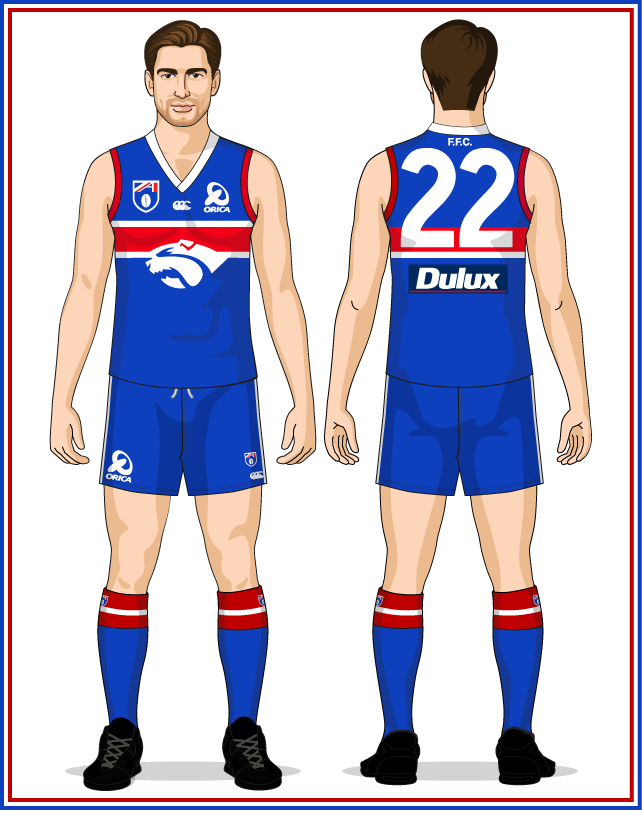
Western Bulldogs
View on GrokipediaHistory
1877–1924: Origins and VFA Dominance
The Footscray Football Club was established in 1877 in the industrial suburb of Footscray, an inner-western area of Melbourne known for its working-class population of factory workers and immigrants.[14] The club emerged amid the growing popularity of Australian rules football in Victoria, initially fielding teams in junior and local competitions against nearby sides such as the Yarraville Football Club and teams from surrounding boroughs.[15] These early years were marked by informal matches on public grounds, reflecting the community's passion for the sport as a form of recreation and social bonding in a rapidly urbanizing working-class enclave. In 1886, the club amalgamated with the Footscray Cricket Club to elevate its status, securing admission to the senior Victorian Football Association (VFA), which had been formed in 1877 as the governing body for organized senior football in the colony.[16] This merger provided access to better facilities, including the Western Oval, and allowed Footscray to compete against established VFA teams like Essendon and South Melbourne. Early influences included local figures such as Charlie Lovett, a pivotal player and administrator who helped shape the club's junior development, alongside stars like Fred English and the Anderson brothers, who brought skill and tenacity to the side during its formative VFA seasons.[16] The club's on-field progress was gradual, building a reputation for tough, physical play that resonated with its blue-collar supporters. Footscray's breakthrough came in the late 1890s, establishing VFA dominance with a hat-trick of premierships from 1898 to 1900, driven by a blend of homegrown talent and strategic recruitment.[4] Under coach Jim Cassidy, the team secured another flag in 1908, showcasing improved tactics and endurance in a competition increasingly professionalizing.[17] Further successes followed in 1913, 1919, 1920, 1923, and 1924, totaling nine VFA titles by the end of the era, often featuring representative players like Archie Roberts and Snowy Harris who donned the Victoria jumper in interstate carnivals against states such as South Australia and Western Australia.[4] These victories highlighted Footscray's rise from underdog to powerhouse, with the 1920s flags particularly notable for their consistency amid post-World War I challenges. A pinnacle moment arrived in 1924, when captain-coach Con McCarthy led the side to both the VFA premiership and an unofficial Championship of Victoria, defeating VFL premiers Essendon by 28 points in a high-stakes exhibition match that underscored Footscray's elite standing.[18] McCarthy's leadership emphasized disciplined team play, contributing to the club's appeal as a symbol of working-class resilience in Footscray, where matches drew fervent crowds from tanneries, railways, and factories.[17] The community's socioeconomic fabric—rooted in labor-intensive industries and tight-knit migrant networks—fostered unwavering loyalty, with the club serving as a cultural anchor that transcended the sport itself.[15] This era of VFA supremacy laid the groundwork for Footscray's transition to the Victorian Football League in 1925.1925–1954: VFL Entry and Inaugural Premiership
In January 1925, the Victorian Football League (VFL) admitted Footscray as its ninth team, alongside Hawthorn and North Melbourne, expanding the competition to 12 clubs after Footscray's dominant run of nine Victorian Football Association (VFA) premierships.[19] The club's entry followed a contentious period of debate among existing VFL clubs, who raised concerns over Footscray's aggressive recruitment tactics and its suburban location in Melbourne's west, fearing it would dilute gate receipts from inner-city venues.[19] Despite these hurdles, Footscray's strong local support and proven on-field success secured its place, with the club playing its inaugural VFL match on May 9, 1925, at the Western Oval against South Melbourne, losing by nine points under captain-coach Con McCarthy.[19] The early years were marked by integration challenges, as Footscray finished 11th in its debut season with just four wins from 17 games, struggling against the established powerhouses while adapting to the league's higher standard. Key figures emerged to shape Footscray's development, including half-forward Allan Hopkins, who debuted in the club's first VFL game at age 20 and quickly became its inaugural superstar, earning a Brownlow Medal in 1930 and multiple best-and-fairest awards through the 1930s.[20] Hopkins' versatility across the half-forward line and centre provided a foundation for the team's growth, though consistent success eluded them amid frequent lineup changes. Early rivalries intensified with clubs like Essendon, stemming from Footscray's 1924 upset victory over the VFL premiers in the Championship of Victoria, a charity match that heightened tensions upon the club's entry, and South Melbourne, whose proximity and the heated inaugural clash fueled ongoing local derbies.[19] These matchups often drew large crowds to the Western Oval, underscoring Footscray's role in broadening the VFL's appeal to Melbourne's western suburbs. The impact of World War II profoundly disrupted operations from 1939 to 1945, with over 170 club players enlisting in the armed forces, including future legends like Ted Whitten and Charlie Sutton, leading to depleted rosters and reliance on younger or reserve talent.[21] Despite the shortages, Footscray reached finals for the first time in 1938 and made six appearances between 1942 and 1953, suffering near-misses in semi-finals against teams like Melbourne and Essendon, which built resilience but highlighted the era's instability.[22] The war years saw reduced attendances and altered schedules across the VFL, yet Footscray's persistence laid groundwork for post-war momentum. Footscray's breakthrough came in 1954 under captain-coach Charlie Sutton, culminating in the club's inaugural VFL premiership after finishing second on the ladder with 11 wins, one draw, and six losses.[23] In the Grand Final on September 25 at the Melbourne Cricket Ground, attended by 80,897 fans, Footscray defeated Melbourne 15.12 (102) to 7.9 (51), a 51-point victory driven by full-forward Jack Collins' seven goals and dominant midfield play from Sutton and Harvey Stevens.[24] The win, Footscray's first after 29 seasons, sparked widespread celebrations in Melbourne's west, with ticker-tape parades and community events affirming the club's status as a suburban powerhouse.[23] This triumph not only validated the 1925 entry but also established a legacy of perseverance amid early adversities.1955–1989: Mid-Century Struggles and Merger Crisis
Following their 1954 premiership victory, the Footscray Football Club entered a prolonged period of decline, marked by inconsistent on-field performances and limited success in the Victorian Football League (VFL). The team failed to build on early momentum, recording their first wooden spoon in 1959 amid a broader slump that saw them miss finals from 1955 to 1960.[25] One rare highlight came in 1961, when Footscray reached the grand final under captain-coach Ted Whitten, though they lost to Hawthorn by 32 points.[26] Whitten, a club icon who debuted in 1951 and won five best-and-fairest awards, exemplified resilience during this era; he played 321 games for Footscray, transitioning from centre half-forward to half-back, and coached the side from 1957 to 1966 and again from 1969 to 1971, introducing innovative tactics like the flick pass to promote faster play.[26] The 1970s exacerbated these challenges, reflecting poor recruitment and coaching instability. Bob Rose, a former Collingwood premiership player, took over as coach from 1972 to 1975, guiding the team to 42 wins, 2 draws, and 44 losses in home-and-away games, including a finals appearance in 1974 where they suffered an elimination final defeat.[27] Financial pressures mounted alongside the industrial decline of Footscray's working-class western suburbs, where manufacturing jobs dwindled in the 1960s and 1970s, leading to high unemployment and reduced community support for the club.[28] Attendance at Western Oval, the club's home ground since 1925, began to drop as economic hardship hit local fans, with average crowds falling below 10,000 by the late 1970s.[29] The 1980s brought minor improvements, such as increased goal-scoring led by recruits like Simon Beasley, who booted 82 goals in 1985, but the club remained largely irrelevant, finishing near the bottom of the ladder and earning another wooden spoon in 1982 with just three wins.[30] Ongoing financial woes, including debts exceeding $1 million, persisted amid venue reliance on aging facilities like Western Oval, where maintenance costs strained resources. These struggles culminated in a near-fatal crisis in 1989, when VFL commissioner Ross Oakley pushed for a merger with the similarly cash-strapped Fitzroy Lions to form the "Fitzroy Bulldogs," retaining Fitzroy's colors and leadership while effectively erasing Footscray's identity.[6] The proposal, announced on October 3, 1989, sparked fierce community backlash from Footscray's loyal western suburbs supporters, who viewed it as an assault on their cultural heritage. A rally at Western Oval on October 7 drew 20,000 people, galvanizing the "Save the Dogs" or "Footscray Fightback" campaign led by lawyer Peter Gordon, which raised $1.1 million through door-to-door collections, raffles, and small donations from pensioners and workers.[31] Securing a crucial $1-1.5 million annual sponsorship from ICI Australia over three years, combined with a legal injunction, the club amassed over $1.6 million in three weeks, forcing the VFL to abandon the merger by October 25.[6] This survival, celebrated with a victory parade on October 28, preserved Footscray's independence and underscored the deep community ties that defined the club's endurance.[31]1990–2014: Revival and Path to Contention
Following the near-collapse averted by the abandoned merger proposal in 1989, the Footscray Football Club began a period of gradual revival through strategic changes aimed at stabilizing its operations and expanding its supporter base. Under coach Terry Wallace, who took over late in 1996 after Alan Joyce's tenure, the club implemented a more disciplined training regimen and focused on player development, leading to improved on-field performances in the late 1990s.[7][32] The team returned to finals contention in 1994 and 1995, marking the first such appearances since 1985, though they exited early in elimination finals against Essendon and Carlton, respectively. This momentum carried into 1997, when Footscray finished third on the ladder with a 15-7 record and defeated Sydney by 56 points in the qualifying final, only to suffer a heartbreaking one-point preliminary final loss to Adelaide at the MCG, denying them a grand final berth.[33][34] Key players like Chris Grant, who debuted in 1992 and became a versatile forward and captain, and Brad Johnson, a prolific goal-kicker and club leader, were instrumental in these successes, with Grant earning All-Australian selection in 1997 and Johnson booting 53 goals that season.[33][35] To address ongoing financial vulnerabilities and limited appeal confined to the Footscray area, the club underwent a significant rebranding at the end of 1996, officially changing its name to the Western Bulldogs in 1997 to target a broader western Melbourne audience and boost membership and sponsorship.[5][7] This shift, approved by members and the AFL, coincided with temporary home games at Princes Park from 1997 to 1999 to increase attendance, helping reduce accumulated debts from the early 1990s that had exceeded $5 million.[5][36] Off-field restructuring included community outreach programs emphasizing the club's multicultural roots in the western suburbs, which grew membership from around 15,000 in 1996 to over 20,000 by 2000, providing a more sustainable revenue stream.[5][37] The club also benefited from AFL equalization payments and sponsorship deals, gradually paying down debt through prudent budgeting and increased commercial partnerships.[38] The early 2000s saw sustained contention under coach Rodney Eade, who replaced Wallace in 2000 and guided the team to seven consecutive finals appearances from 2000 to 2006, building on the foundations laid in the 1990s. In 2008, the Western Bulldogs lost to top-seeded Hawthorn by 51 points in the qualifying final before falling to Geelong by 32 points in the semi-final.[39] The following year, 2009, they again reached the preliminary final, defeating Brisbane by 54 points in the semi-final but losing to St Kilda by 48 points, with Grant and Johnson continuing to anchor the midfield and forward line—Johnson kicked 47 goals in 2009 despite injury concerns. These near-misses highlighted the club's emergence as a consistent top-four threat, though premiership glory remained elusive.[40][41] In 2010, the Western Bulldogs relocated their primary home games to Docklands Stadium (later Etihad Stadium), moving from the aging Whitten Oval to access modern facilities, improved corporate amenities, and higher attendance potential in the Docklands precinct, which helped further stabilize finances through better match-day revenue. This venue shift, part of broader AFL infrastructure investments, allowed the club to host 10-12 home games annually at the 56,000-capacity stadium, drawing larger crowds and supporting ongoing debt reduction efforts that saw liabilities drop below $3 million by the mid-2000s. Community programs expanded during this era, focusing on youth development and western suburbs engagement, reinforcing the club's identity while fostering long-term viability.[37][42]2015–Present: Beveridge Era, 2016 Triumph, and Rebuild
Luke Beveridge was appointed as the Western Bulldogs' senior coach in November 2014, taking over ahead of the 2015 season after serving as an assistant at Hawthorn and St Kilda.[43] His coaching philosophy emphasized an "underdog" mentality, fostering a resilient, us-versus-the-world mindset that galvanized the team and connected with the club's working-class roots.[44] Under Beveridge, the Bulldogs built momentum through 2015, finishing seventh and reaching a semi-final, but it was 2016 that marked their breakthrough. The team stormed through the finals, winning three elimination matches before defeating Sydney by 22 points in the Grand Final, 13.11 (89) to 10.7 (67), securing the club's second VFL/AFL premiership after 62 years.[45] Key performers included midfielder Lachie Hunter, who amassed 29 disposals and two goals, while defender Jason Johannisen earned the Norm Smith Medal for his 33 disposals and dominant rebounding.[46] The following years brought challenges, with the 2017 season ending in a semi-final loss to West Coast amid injuries to key players like Lin Jong and Travis Cloke.[47] In 2018, the Bulldogs finished 10th outside the finals, plagued by further setbacks including Tom Liberatore's season-ending knee injury and captain Easton Wood's hamstring issues, which limited him to 12 games.[48] From 2019 to 2022, the team experienced a resurgence, making the finals in each season. They reached an elimination final in 2019 and 2020, before advancing to the 2021 preliminary final with a 71-point demolition of Port Adelaide, only to fall to Melbourne in the Grand Final.[49] The 2022 campaign ended in another elimination final defeat to Fremantle.[50] The 2023 season saw the Bulldogs finish ninth with 12 wins, missing finals narrowly. In 2024, they secured sixth place but were eliminated by Hawthorn in a 37-point loss. Midfielder Bailey Smith, sidelined all year by a pre-season ACL injury, was traded to Geelong in October.[51] The 2025 season replicated the ninth-place finish with a 14-9 record, boasting a percentage of 137—the highest for any non-finalist since 1963—highlighting strong scoring but inconsistency against top teams.[52] Throughout Beveridge's tenure, the club has focused on an ongoing rebuild centered on player development and youth integration, with talents like Jamarra Ugle-Hagan emerging as key contributors. This approach was underscored by the VFL affiliate Footscray's 2025 premiership win over Southport by 10 points, signaling depth in the development pipeline.[53]Club Identity
Nickname, Mascots, and Song
The Western Bulldogs' nickname "Bulldogs" was adopted around 1925 upon joining the VFL, symbolizing the breed's renowned tenacity and unyielding spirit, which resonated with the resilient, working-class identity of Footscray's industrial community.[54] A notable 1928 incident involved parading a live bulldog around Whitten Oval at three-quarter time during a match against Collingwood, further popularizing the already-established nickname among supporters.[54] The prefix "Western" was added in 1997 as part of a rebranding to encompass the broader western suburbs of Melbourne, broadening the club's appeal beyond its Footscray roots while retaining the core identity.[55] This evolution underscores the bulldog's enduring symbolism of grit and perseverance, tied to Footscray's history as a hub of migrant labor and blue-collar determination, where the club represented triumph over adversity for its local fans. The club's current official mascots—Woofer (red, energetic chaser of cats), Roxie (blue, footy-kicking music lover), Butch (green, prankster reader), and Barkly (pink, surfing socializer)—are anthropomorphic bulldogs designed to engage young supporters and embody the team's playful yet fierce persona.[56] On game days at Marvel Stadium or the Whitten Oval, they lead the team out, entertain crowds with dances and interactions during quarter breaks, and participate in pre-match parades to build excitement among families.[56] In community events, such as school visits, charity functions, and junior clinics across western Melbourne, the mascots promote physical activity, literacy programs, and club values like loyalty and resilience, often appearing alongside players to inspire the next generation of fans.[56] The Western Bulldogs' team song, titled "Sons of the West," was first used in the 1940s and adapted from the 1897 British music hall tune "Sons of the Sea," with the lyrics written to evoke the club's western heritage and battling ethos.[57] The lyrics, written to evoke the club's western heritage and battling ethos, are as follows:Sons of the West, red, white and blueTraditionally performed in the rooms immediately after victories by players and staff, with fans joining in at the ground, the song reinforces communal pride and unity, its rousing chorus echoing the working-class solidarity of Footscray's origins during premiership celebrations and milestone events.[57][58]
We come out snarling, Bulldogs through and through
Bulldogs bite and Bulldogs roar
We give our very best
But never fear our team will always pull together
Now is the time to show your loyalty
So come on you Bulldogs, Sons of the West.[58]
Home Grounds and Facilities
The Western Oval, now known as Mission Whitten Oval, has served as the spiritual home of the Western Bulldogs since 1884, when the club began hosting games there after initial play at local reserves in Footscray.[59] Renamed in 1995 to honor legendary player and coach Ted Whitten Sr., the venue hosted the club's VFL/AFL home games for generations until 1997, fostering deep community ties in the working-class suburb of Footscray through its role as a local gathering place for matches, events, and youth programs.[60] With a historical capacity of around 25,000 during its peak as an AFL venue, it remains the club's administrative headquarters and a symbol of its Footscray origins, even as primary matches shifted elsewhere.[61] Prior to establishing a permanent base at the Western Oval, the club utilized several historical venues in the Footscray area, including the Footscray Cricket Ground and various market reserves in the late 19th century, reflecting its grassroots beginnings in Melbourne's western suburbs.[16] For major blockbusters, the Bulldogs have occasionally played at the Melbourne Cricket Ground (MCG), such as pre-season clashes and milestone anniversary games, to accommodate larger crowds and national broadcast appeal.[62] Since 2000, the club has primarily played home games at Docklands Stadium, rebranded as Marvel Stadium in 2018, marking a significant shift from the intimate Whitten Oval to a modern, multi-purpose venue with a capacity of 53,355 and advanced features like a retractable roof.[63] This move allowed access to greater commercial opportunities and improved player facilities but drew criticisms for increasing operational costs and distancing the team from its traditional community base in Footscray.[64] Whitten Oval continues as the Bulldogs' primary training base, bolstered by substantial post-2016 investments in upgrades to support high-performance needs. The $78 million redevelopment, completed in 2024 with $36 million from the Victorian Government, includes the Victoria University High Performance Centre featuring the AFL's largest gym, an 1,800-square-meter indoor training field, a 25-meter pool, heat chamber, and athlete recovery areas, enhancing preparation for AFL, AFLW, VFL, and VFLW teams.[65][66] These facilities position Whitten Oval as the league's most comprehensive training precinct, integrating football operations with community access via upgraded stands and event spaces.[67]Guernsey Design and Uniform Evolution
The Western Bulldogs' guernsey design traces its roots to the Footscray Football Club's early days in the Victorian Football Association (VFA). Originally formed in 1877, the club wore a blue and white hooped uniform, reflecting simple, distinctive attire common in junior and local competitions of the era.[16] In the early 1880s, Footscray incorporated red elements by adding a red cap to honor their successful junior team, the Redwings, which had won the Clarke Cup; over time, red was fully integrated into the guernsey, evolving the color scheme to navy blue, red, and white.[16] Upon joining the Victorian Football League (VFL) in 1925, the club formalized its iconic home guernsey as a navy blue body with thick horizontal red and white hoops across the chest, a design that emphasized visibility and club identity on the larger league stage.[68] This hoop pattern became a hallmark, with minor adjustments over decades, such as a temporary shift to navy blue during World War II due to dye shortages in 1944, before reverting to royal blue in 1946.[68] Further refinements included the addition of a white collar in 1947, changed to blue by 1952, and the adoption of sleeveless versions as the primary uniform from 1961 to 1969 for improved mobility.[68] In 1975, the hoops were separated by a white band to enhance contrast for color television broadcasts, and by 1980, the bands widened while the collar was removed.[68] The 1997 rebranding to the Western Bulldogs prompted a significant evolution, with the addition of "Bulldogs" script in white above the hoops, replacing earlier club initials and aligning the uniform with the new name while retaining the traditional hoops.[68] This period also saw the introduction of alternate uniforms, including clash guernseys in the 2000s to address on-field color conflicts; a white clash design debuted in 2007, featuring blue and red accents for away games.[69] The 2010s brought further alternates, such as heritage throwbacks and indigenous round designs, though not without controversy—for instance, the 2016 indigenous guernsey sparked a dispute when Aboriginal artists claimed exploitation over licensing rights without fair compensation.[70] Manufacturer partnerships have influenced fabric and fit over time. The club switched from BLK to ASICS in 2017, adopting the latter's performance materials for better breathability and durability in modern guernseys.[71] By 2012, the home design reverted to a classic hoop style, emphasizing historical fidelity.[68] As of 2025, the home guernsey maintains the navy blue base with red and white hoops, now featuring red sleeve trims and a neckline trim as a nod to pre-1980s aesthetics, alongside a centenary logo commemorating 100 years in the VFL/AFL.[72] The clash (away) guernsey for the year is a white-based design with navy blue and red elements, also incorporating the 100-year emblem to celebrate the club's legacy.[73] Specialty variants, like the 2025 indigenous guernsey designed by Kamilya Lowana White, incorporate cultural motifs while adhering to the core color palette.[74]Banners and Symbols
The Western Bulldogs' banners and symbols play a central role in the club's match-day rituals and historical identity, embodying fan passion and team heritage during games at home venues like Whitten Oval. These elements, often crafted by dedicated supporters, include run-through banners that players charge through before matches, as well as flags and emblems that honor past successes. Integrating the club's traditional red, white, and blue palette, these symbols enhance the visual spectacle and foster a sense of unity among players and fans.[75] The club's premiership banners commemorate its two VFL/AFL triumphs in 1954 and 2016, serving as iconic artifacts of victory. The 1954 grand final banner, created for Footscray's (the club's former name) upset win over Melbourne, featured bold lettering and club motifs on a large fabric or paper sheet, typical of the era's handmade designs using durable materials like canvas reinforced with tape for display. It was prominently unfurled at Western Oval prior to a subsequent home match, marking the official celebration of the premiership. Similarly, the 2016 banner, prepared by the Western Bulldogs cheer squad at Whitten Oval just days before the grand final against Sydney, incorporated vibrant team colors and motivational phrases on lightweight, weather-resistant paper assembled with adhesive tape, reflecting modern fan-driven craftsmanship. This banner was run through by the team at the Melbourne Cricket Ground, and replicas or elements from it are preserved and occasionally displayed at Whitten Oval to evoke the drought-breaking triumph after 62 years.[76][77][78] Match-day team flags and run-through banners are a staple of home games, with fans and the cheer squad collaborating on creative designs that add humor and rivalry banter to the pre-game atmosphere. These banners, stretched across the field for players to burst through, often feature puns, inside jokes, and nods to opponents, held aloft by supporters using poles or hands. From 2014 to 2018, comedian and lifelong Bulldogs fan Danny McGinlay spearheaded the designs, infusing them with witty, fan-inspired content that transformed a standard tradition into a highlight—examples include cheeky references to rival teams that sparked pre-game buzz. McGinlay's approach emphasized brevity and impact, using bold text and simple graphics on large sheets, and he resumed the role in 2025 for the club's centenary season, continuing the legacy of fan-created expressions. Team flags, such as pole banners with the Bulldogs logo in red, white, and navy, wave from stands and sidelines, amplifying the visual energy.[79][80][81] Other enduring symbols trace the club's roots, including the "Big V" emblem from its Victorian Football Association (VFA) dominance between 1877 and 1924, when Footscray secured nine flags under the association's iconic large "V" logo, symbolizing Victorian pride and often incorporated into period guernseys and flags. This "Big V" represented regional competition and is referenced in historical displays at Whitten Oval to honor the pre-VFL era. In the modern AFL context, the club's symbols integrate the league's stylized football emblem alongside the bulldog mascot, appearing on official flags and banners to align with contemporary branding while preserving heritage elements like the snarling dog motif introduced in the 1920s.[82][18] Banner-raising ceremonies form a cherished tradition, particularly following premiership wins, where the flag is hoisted at the first home game to symbolize sustained success. For the 1954 flag, the ceremony at Western Oval involved past players and fans gathering to raise the banner amid cheers, establishing a ritual of communal pride. The 2016 equivalent occurred at Etihad Stadium (now Marvel Stadium) before a rematch with Sydney, with club icons like Gary Hincks participating in the unfurling, accompanied by speeches and the team song to mark the emotional end of a long wait. These events, often at Whitten Oval for subsequent honors, reinforce the banners' role as living symbols of resilience and achievement.[76][83][84]Governance and Corporate
Administrative Leadership
The administrative leadership of the Western Bulldogs has been marked by periods of crisis management and strategic evolution, particularly during the club's near-demise in the 1980s and subsequent rebranding efforts. In the late 1980s, Peter Gordon served as president from 1989 to 1996, spearheading the Fightback campaign in 1989 that raised over $1.6 million from supporters to avert a proposed merger with Fitzroy and secure the club's future in the AFL.[5][85] Susan Alberti, a key fundraiser during this era, later joined the board and served as vice president from 2012 to 2016, contributing to ongoing stability and community engagement initiatives.[86] Key CEOs during the 1980s and 1990s survival phase included Dennis Galimberti from approximately 1987 to 1996, who oversaw operational restructuring amid financial pressures, followed by Mark Patterson from 1997 to 2001, who managed the transition into the post-merger era.[87][88] Following the 1996 season, the club underwent significant governance changes as part of a rebranding to the Western Bulldogs, approved by the AFL Commission to broaden the club's appeal across Melbourne's western suburbs and attract sponsorships, thereby avoiding relocation or dissolution. David Smorgon, president from 1997 to 2012, led this overhaul, establishing a taskforce of business leaders that professionalized the board structure and emphasized corporate governance, including enhanced financial oversight and strategic planning influenced by AFL directives for sustainability.[89] Peter Gordon returned as president from 2013 to 2020, focusing on legacy projects and fan relations during a period of on-field success.[90] As of 2025, Kylie Watson-Wheeler holds the position of president, having been unanimously elected in December 2020 after serving as vice president; her leadership emphasizes diversity, community impact, and club momentum amid competitive challenges.[91] Ameet Bains serves as CEO and director, appointed in January 2018 with a background in law and business, guiding the club's operations through expansion of facilities and digital engagement.[91] The board comprises 10 directors, including vice president Jerril Rechter AM (appointed 2018), company secretary and COO Sue Clark (appointed 2018), and independent directors such as Luke Darcy (appointed 2020), Belinda Duarte AM (appointed 2019), Mark Evans (appointed 2016), Lisa Fitzpatrick AO (appointed 2018), Fiona McGauchie (appointed 2015), and Andrew Westacott (appointed 2023), reflecting a mix of business, legal, and community expertise to support strategic decision-making.[91] In recent years, the Bulldogs have made targeted appointments to bolster football department leadership during a rebuild phase. In December 2024, Sam Power was promoted from list manager to interim head of football following Chris Grant's departure, and confirmed in the permanent role of Executive Manager - Men's Football in February 2025, aiming to streamline recruitment and development strategies.[92][93] Matthew Egan joined as Coaching and Performance Manager in 2023, overseeing list management and coaching transitions. These roles report directly to the CEO and board, ensuring alignment with broader administrative goals.[94]Sponsors and Financial Overview
The Western Bulldogs have navigated a turbulent financial history marked by near-bankruptcy in 1989, when the club accumulated debts of $1.85 million amid declining on-field performance and economic pressures in the western suburbs of Melbourne. This crisis culminated in a proposed merger with Fitzroy, which was averted through a community-driven "Fightback 50" campaign that raised over $1.6 million in three weeks to secure the club's independence.[95][5][6] By the early 2000s, the club had cleared much of its debt through strategic cost-cutting, increased AFL distributions, and federal government assistance, including an $8 million package in 2004 that stabilized operations and supported infrastructure upgrades. The 2016 premiership victory sparked a commercial boom, boosting sponsorship revenue and leading to apparel partnerships shifting from BLK (2010–2016) to ASICS in 2017, which enhanced merchandise sales and brand visibility. Historical guernsey sponsors during the 1980s and 1990s included ICI (1990–1997) and Orica (1998–2000s), reflecting gradual improvements in commercial appeal as the club rebranded to the Western Bulldogs in 1997.[96][71] The COVID-19 pandemic severely disrupted finances from 2020 to 2022, with no crowds leading to forgone gate receipts and necessitating staff reductions and salary cap adjustments across the AFL; the Bulldogs mitigated losses through member loyalty programs that retained support and generated millions in deferred revenue, alongside government subsidies for recovery. By 2024, the club reported revenue of $59.45 million, including $18.16 million in AFL grants and distributions, yielding a net profit of $14.9 million despite ongoing investments in facilities and women's programs. As of November 2025, full 2025 financial results are pending release, but the club continues to report sustained profitability based on attendance recovery and media rights.[97][98][99] As of 2025, major sponsors include platinum partners such as Mars, McDonald's, Kapitol (featuring on the upper back of guernseys), Airport Toyota, and Bass Strait Beef, alongside official partners like Gatorade, Pepsi Max, and Melbourne Airport; VFL affiliates include Bendigo Bank and Champion as shorts sponsor. These partnerships underscore the club's post-COVID stability, with reports indicating sustained profitability and expanded commercial opportunities tied to the AFL's growing media rights and attendance recovery.[100][101][102]Football Operations
Current Men's Playing List
The Western Bulldogs' 2026 pre-draft AFL men's senior squad, as of November 2025, consists of 43 players, blending experienced leaders with emerging talent developed under coach Luke Beveridge. Marcus Bontempelli serves as captain, leading a midfield core that emphasizes contested ball-winning and transition play. The list reflects off-season adjustments following the 2025 season and trade period, including the departure of forward Jamarra Ugle-Hagan to Gold Coast in exchange for pick 74, and the arrival of defender Connor Budarick from Gold Coast. Earlier changes from the 2024 trade period included the departure of midfielder Bailey Smith to Geelong in a four-club deal that also facilitated the arrivals of James Harmes from Melbourne and Matthew Kennedy from Carlton.[103][104][105][106] The squad has undergone list management for 2026, with delistings of veterans Liam Jones, Jason Johannisen, and Anthony Scott, though these players featured prominently during the 2025 season.[107][108]Midfield
The Bulldogs' midfield remains a strength, anchored by captain Marcus Bontempelli (No. 4), who averaged 27.1 disposals and 6.3 clearances per game in 2025, alongside veterans Adam Treloar (No. 1) and Tom Liberatore (No. 21).[109][110] Emerging players like Ryley Sanders (No. 9) and Ed Richards (No. 20) provide depth, with Sanders contributing 35 games since his 2023 debut. James Harmes (No. 22) adds versatility after his 2024 trade arrival, while rookies such as Cooper Hynes (No. 6, selected at No. 20 in the 2024 National Draft) offer high potential in contested situations.[111]Forwards
Key forwards Aaron Naughton (No. 33) leads the tall options, supported by Sam Darcy (No. 10) who adds ruck-forward flexibility. Small forwards Cody Weightman (No. 3) and Rhylee West (No. 14) provide speed and pressure, combining for over 50 goals. Recent draftee Josh Dolan (No. 26) debuted in 2025, contributing as a developing small forward.[112][113]Defenders and Ruck
The defensive structure features Bailey Dale (No. 31) as a rebounding half-back, supported by Jedd Busslinger (No. 5, 2022 draftee) and Ryan Gardner (No. 43) in key posts. Rory Lobb (No. 7) transitioned effectively to defense in 2025, bolstering height. Ruckman Tim English (No. 44) remains the primary big man, averaging 35 hitouts per match. Depth includes versatile players like Buku Khamis (No. 24) and Joel Freijah (No. 27), with 2024 draftee Lachie Jaques (No. 11) adding intercept marking potential and recent trade arrival Connor Budarick (No. 35) providing utility. No major injuries impact the core group as of November 2025, following a season where the Bulldogs finished 9th.[111][114] The full 2026 pre-draft senior list, including rookies, is as follows (positions based on primary 2025 roles; games played reflect career totals as of end-2025 season):| No. | Player Name | Position(s) | Games (Career) | Status/Notes |
|---|---|---|---|---|
| 1 | Adam Treloar | Midfield | 258 | Veteran |
| 3 | Cody Weightman | Forward | 76 | Small forward |
| 4 | Marcus Bontempelli | Midfield | 258 | Captain, elite midfielder |
| 5 | Jedd Busslinger | Key Defender | 7 | 2022 draftee |
| 6 | Cooper Hynes | Midfield | 8 | 2024 National Draft No. 20 |
| 7 | Rory Lobb | Defender/Ruck | 199 | Traded from Fremantle 2023 |
| 8 | Matthew Kennedy | Midfield/Forward | 141 | Traded from Carlton 2024 |
| 9 | Ryley Sanders | Midfield/Forward | 35 | 2023 draftee |
| 10 | Sam Darcy | Forward/Ruck | 45 | Developing tall |
| 11 | Lachie Jaques | Defender | 0 | 2024 National Draft No. 29 |
| 12 | Harvey Gallagher | Defender/Midfield | 25 | 2023 draftee |
| 13 | Oskar Baker | Defender/Midfield | 48 | Rookie |
| 14 | Rhylee West | Forward | 81 | Small forward |
| 16 | Jordan Croft | Forward | 2 | Rookie |
| 17 | Nicholas Coffield | Defender | 64 | Traded from St Kilda 2024 |
| 18 | James O'Donnell | Defender/Forward | 48 | Rookie |
| 20 | Ed Richards | Midfield | 148 | Established |
| 21 | Tom Liberatore | Midfield | 257 | Veteran |
| 22 | James Harmes | Midfield/Forward | 174 | Traded from Melbourne 2024 |
| 23 | Laitham Vandermeer | Forward | 87 | Pressure forward |
| 24 | Buku Khamis | Defender/Forward | 41 | Versatile |
| 26 | Josh Dolan | Forward | 11 | 2024 draftee |
| 27 | Joel Freijah | Defender/Midfield | 36 | 2022 draftee |
| 29 | Lachlan Bramble | Defender | 77 | Rookie |
| 30 | Lachlan McNeil | Forward | 75 | Rookie |
| 31 | Bailey Dale | Defender | 178 | Rebounding defender |
| 32 | Arthur Jones | Forward | 18 | 2023 draftee |
| 33 | Aaron Naughton | Key Forward | 166 | Key forward |
| 34 | Bailey Williams | Defender/Midfield | 174 | Versatile |
| 35 | Connor Budarick | Defender/Midfield | 55 | Traded from Gold Coast 2025 |
| 36 | Luke Cleary | Defender | 23 | 2022 draftee |
| 37 | Michael Sellwood | Defender | 0 | Rookie |
| 38 | Riley Garcia | Forward | 39 | Small forward |
| 40 | Lachlan Smith | Ruck | 0 | Rookie |
| 41 | Zac Walker | Defender | 0 | Rookie |
| 42 | Sam Davidson | Midfield/Forward | 19 | 2023 draftee |
| 43 | Ryan Gardner | Defender | 54 | Key defender |
| 44 | Tim English | Ruck | 154 | Primary ruck |
Reserves Team History and Records
The Western Bulldogs' men's reserves team, known as Footscray Bulldogs in recent years to honor the club's heritage, has a storied history within the Victorian Football League (VFL), serving as a crucial pathway for player development since the club's entry into the senior competition. Upon Footscray's admission to the Victorian Football League (VFL) in 1925 from the Victorian Football Association (VFA), where the club had already established a strong reserves structure during its nine premiership-winning years in the senior VFA, the reserves side transitioned to compete in the newly formalized VFL seconds competition alongside the senior team's debut season.[19] This alignment allowed for integrated development, with the reserves team providing opportunities for emerging talent to gain experience at a semi-professional level while supporting the main AFL squad. Over the decades, the reserves team's structure evolved with changes in league affiliations to optimize player pathways. From 2000 to 2002 and again from 2013 onward, the Bulldogs fielded a stand-alone reserves team in the VFL, fostering direct control over development; between 2003 and 2012, they affiliated with the Bendigo Bombers (now Bendigo in the VFL), sharing resources and players to bridge the gap between rookie-listed prospects and AFL debuts.[117] This model has been integral to the club's talent pipeline, enabling seamless transitions for players honing skills away from the senior spotlight. The reserves competition, rebranded as the VFL in 1996, remains a key affiliate for AFL clubs like the Bulldogs, emphasizing physical conditioning, tactical growth, and injury recovery in a competitive environment. The team has secured nine VFL reserves premierships, underscoring its competitive legacy: 1936, 1945, 1962, 1988, 1994, 1998, 2014, 2016, and 2025.[4] These triumphs highlight periods of dominance, particularly in the late 20th century and the 2010s, when the side mirrored the senior team's resurgence. Notable early 2000s talents, such as Matthew Boyd—recruited via the 2002 rookie draft and who played extensively in the VFL before his AFL breakthrough—and Dale Morris, who transitioned from Werribee's VFL list to the Bulldogs in 2005, exemplify how the reserves program nurtured durable contributors to the senior side.[118] In recent seasons, the Footscray Bulldogs demonstrated resilience and growth. The 2024 campaign saw them reach the preliminary final, where they fell to Southport by 10 points (51-61), finishing strongly after a solid home-and-away record but narrowly missing the grand final.[119] Building on that momentum, 2025 proved triumphant in the club's centenary year, with Footscray claiming the premiership by defeating Southport 14.5 (89) to 11.13 (79) in a thrilling grand final at IKON Park on September 21. Key moments included a gritty second-half comeback, sparked by midfield dominance and accurate forward pressure, securing the club's ninth flag and third in the past 11 years amid a 13-game winning streak into the decider.[120][121] This victory not only celebrated historical roots but reinforced the reserves team's role in sustaining the Bulldogs' AFL contention through robust player alignment and development.Women's Teams and AFLW Participation
The Western Bulldogs were granted a licence in June 2016 to become one of eight inaugural teams in the AFL Women's (AFLW) competition, with their squad announced in February 2017 ahead of the league's debut season that August.[122][123] The club quickly established itself as a powerhouse, reaching the 2018 grand final where they defeated the defending premiers, Brisbane Lions, by six points at Ikon Park to claim their first and only AFLW premiership to date.[124][125] Under the leadership of head coach Tamara Hyett, appointed in 2024 and extended through 2027, the team features prominent players such as captain Ellie Blackburn, a three-time All-Australian and five-time club best and fairest winner who has been instrumental in the program's early success.[126][127][128][129] Other key contributors include versatile defender Isabel Huntington and emerging forward Kristie-Lee Weston-Turner, selected with the No. 1 pick in the 2023 draft.[127] The Bulldogs finished the 2025 season in 12th position on the ladder with a 5-7 record and 126.5% percentage, struggling with consistency amid injuries and a rebuilding phase.[130] The 2025 AFLW squad comprised 30 players across various positions, blending veterans and recent draftees; for instance, midfielders like Blackburn and Naomi Ferres anchor the engine room, while defenders such as Lauren Ahrens and Ellie Gavalas provide structure.[131] Recent additions include draftee Emma McDonald (No. 12 pick, versatile utility from Oakleigh Chargers) and international recruit Lou Stephenson (traded from Hawthorn), both on multi-year contracts, alongside rookies like Keeley Hardingham from the VFLW draft.[132] Approximately 25 players are on one- to three-year deals, with the club prioritizing retention of core talent post-2024.[133] The club's women's development program emphasizes grassroots pathways, with affiliations to the Western Jets in the Coates Talent League (formerly NAB League Girls), where invite-only academies like the Bulldogs Futures Academy identify and nurture under-18 talent from western Melbourne suburbs.[134][135] This structure feeds into the VFLW reserves side, which reached the 2024 grand final as runners-up, supporting the AFLW team's long-term sustainability.[136]Fanbase and Community
Membership Trends and Attendance
The Western Bulldogs have experienced significant fluctuations in membership numbers over their history, reflecting broader challenges and successes in the club's operations. In the 1980s, membership declined sharply amid financial difficulties and poor on-field performance, dropping to a low of 3,452 in 1987 from 8,433 the previous year.[137] By the 1990s, numbers stabilized around 10,000 annually, with figures such as 10,983 in 1990 and 10,650 in 1996, though the club faced ongoing viability concerns that prompted the 1997 rebranding from Footscray to Western Bulldogs.[137] This period marked a low point, with membership below 15,000 until a gradual uptick in the late 1990s. The 2010s and 2020s saw a marked surge, driven by competitive success, including the 2016 premiership, and the inclusion of the women's team in the AFLW competition starting in 2017. Post-2016, membership peaked at 47,653 in 2017, more than doubling from 39,459 the prior year, and continued climbing to records of 62,328 in 2024 and 65,584 in 2025.[138] The rebrand broadened appeal beyond Footscray, while AFLW participation boosted female and family engagement, contributing to four consecutive record-breaking years from 2022 onward.[139] Attendance patterns mirror membership trends, with home games averaging over 30,000 spectators in recent AFL seasons, such as 34,419 across 24 games in 2024.[140] Historically, at Whitten Oval (formerly Western Oval), the club's traditional home ground until the late 1990s, average crowds exceeded 20,000 during peak eras like the 1950s and 1960s, with a record of 42,354 in 1955.[141] Finals generate notable spikes; for instance, the 2024 elimination final against Hawthorn drew a record 97,828 at the MCG, the largest ever for an elimination match.[142] Overall home attendance reached a club high of 404,000 in 2025, up 10% from the previous record.[143] The Bulldogs' fanbase remains deeply rooted in western Melbourne suburbs like Werribee and Williamstown, where loyalty is strong among working-class communities.[144] This demographic is notably multicultural, with 42% of greater western Melbourne's population born overseas per the 2011 Census, reflected in the club's diverse supporter groups from Asian, African, and other diasporas.[145] Community programs emphasizing cultural inclusion have further solidified this base, enhancing engagement in a region known for its ethnic diversity.[146]Supporters and Rivalries
The Western Bulldogs' supporter base is deeply rooted in the working-class heritage of its original Footscray locale, where the club emerged as a symbol of community resilience among blue-collar families in Melbourne's industrial west.[147] This foundation has fostered a passionate, loyal following known for its unwavering support during challenging periods, contributing to steady membership growth through enduring fan devotion.[147] At home games, active fans congregate in "The Kennel," the designated standing area at Marvel Stadium's southern end, where they create an electric atmosphere with vocal encouragement and organized cheering.[148] The club's supporter groups play a central role in nurturing this fan culture, with the Bulldogs Supporters' Club serving as the primary organization for coordinating events, travel, and community engagement.[149] Other notable groups include the Ballarat Supporter Group, Barwon Bulldogs, and Bulldog Pride Cheer Squad, which focus on regional outreach and family-friendly activities to broaden the fanbase.[149] Reflecting Footscray's multicultural evolution, the club has developed initiatives like the GOAL Mentoring Program, which targets young people from culturally and linguistically diverse (CALD) backgrounds, including the Afghan community, to build connections through sport and leadership workshops.[150] These efforts, part of the broader CALDplay program, unite participants from regions such as Afghanistan with Australian-born youth, promoting inclusion and cultural exchange via football.[151] Key rivalries add intensity to the Bulldogs' matchups, beginning with Essendon, stemming from their shared Victorian Football Association (VFA) origins in the late 19th century, when suburban tensions fueled fierce contests between the clubs.[152] This historical animosity was epitomized in the 2000 "Super-Flood" game, a high-scoring Round 21 thriller at the MCG that highlighted their competitive edge.[153] Against Hawthorn, the rivalry has been sharpened by finals clashes, including the 2008 Qualifying Final where Hawthorn prevailed by 39 points en route to the premiership, and the 2024 Elimination Final, a 37-point Hawks victory that eliminated the Bulldogs from September action.[154] Hawthorn now leads their six finals encounters 5-1, underscoring the stakes in these encounters.[154] The matchup with West Coast Eagles carries a reputation for physicality, dating back to their inaugural 1987 meeting and marked by notable on-field incidents that have built a gritty interstate antagonism.[155] Bulldogs traditions emphasize communal spirit, with pre-game chants led by supporter groups invoking the club song "Sons of the Scray" to rally the crowd and honor Footscray's legacy.[149] Away game support is robust, as groups like the Western Australia Supporters organize gatherings for interstate fixtures, ensuring fans travel or convene locally to cheer, maintaining the club's underdog ethos regardless of venue.[149]Records and Achievements
Team Honours and Premierships
The Western Bulldogs, formerly known as Footscray, dominated the Victorian Football Association (VFA) era with nine premierships between 1898 and 1924, a period marked by several dynastic runs that solidified the club's early legacy. The team achieved a hat-trick of consecutive titles from 1898 to 1900, led by captains such as Arthur Armstrong and featuring key players like William Kruse, establishing Footscray as a powerhouse in the competition's formative years. Following a gap, successes resumed with single wins in 1908 and 1913, before a post-World War I resurgence delivered back-to-back premierships in 1919 and 1920. The VFA tenure concluded strongly with another pair of titles in 1923 and 1924, contributing to an overall record of 394 wins in 39 seasons.[4] Upon entering the Victorian Football League (VFL) in 1925, the club endured a long premiership drought until 1954, when Footscray claimed its first VFL flag by defeating Melbourne in the grand final. Played before 80,897 spectators at the Melbourne Cricket Ground, Footscray triumphed 15.12 (102) to 7.9 (51), a 51-point margin driven by strong forward play and defensive resilience after a tied three-quarter-time score. The second VFL/AFL premiership arrived in 2016, as the Western Bulldogs staged an improbable finals run, winning all four postseason games as underdogs before overcoming Sydney in the grand final by 22 points: 13.11 (89) to 10.7 (67). This victory, attended by 99,981 at the MCG, ended a 62-year flag drought and highlighted the team's depth and momentum under coach Luke Beveridge.[156][157] Beyond day premierships, the club secured four night series titles during the 1960s and early 1970s—1963, 1964, 1967, and 1970—in the VFL's end-of-season competition played under lights at Lakeside Oval, often featuring teams outside the top four. These wins provided additional silverware during a transitional decade, with the 1967 triumph over South Melbourne underscoring Footscray's competitive edge in non-traditional formats. The team also earned the McClelland Trophy in 1967, recognizing their strong home-and-away performance across senior and reserves grades.[158][4] The Western Bulldogs' AFL Women's (AFLW) team entered the competition in its inaugural 2017 season, finishing sixth with a 3-4 record amid the league's establishment phase. The 2018 campaign marked a breakthrough, as the Bulldogs topped the ladder with a 6-1 regular season before claiming the premiership with a 6-point grand final win over Brisbane (4.3 (27) to 3.3 (21)), their only loss coming early in the season. Subsequent years brought inconsistency: a slide to eighth in 2019 (3-4), a wooden spoon in the shortened 2020 season (2-5), and a qualifying final appearance in 2021 (5-4) followed by elimination. The team missed finals in 2022 and 2023 (both 3-6), showed improvement with a preliminary final berth in 2024, but ended 2025 in 12th place (5-7), focusing on rebuilding amid a competitive landscape.[159][160][161] The club's reserves side, competing in the VFL, has amassed nine premierships since 1925, reflecting sustained development pathways. Notable victories include 1936, 1945, and 1962 in the early decades, followed by a modern resurgence with titles in 1988, 1994, 1998, 2014, 2016 (aligning with the senior AFL flag), and most recently in 2025. In the 2025 grand final at IKON Park, Footscray defeated Southport by 10 points (14.5 (89) to 11.13 (79)), securing their third VFL premiership in 11 years and honoring retiring players like Taylor Duryea.[4][53]Individual Awards and Accolades
The Western Bulldogs have produced multiple Brownlow Medal winners, the AFL's highest individual honour for the fairest and best player across the home-and-away season. The club's Brownlow Medalists are: Allan Hopkins (1930), Norm Ware (1941), Peter Box (1956), John Schultz (1960), Gary Dempsey (1975), Kelvin Templeton (1980), Brad Hardie (1985), Tony Liberatore (1990), and Scott Wynd (1992). Dempsey won with 20 votes as a dominant ruckman for Footscray. Liberatore claimed the award in 1990 with 18 votes, earning All-Australian selection on the interchange bench that year despite an injury-interrupted finish to the season. Wynd won in 1992, amassing 20 votes and also earning All-Australian honours as a ruckman during Footscray's strong campaign.[162][163][164] In grand finals, Jason Johannisen earned the Norm Smith Medal in 2016, recognised for his 33 disposals, nine inside-50s, and seven rebound-50s that propelled the Bulldogs to their first premiership in 62 years.[165] Other notable AFL accolades include Coleman Medals for leading goalkickers, with Simon Beasley winning in 1985 after booting 82 goals in 22 games. Kelvin Templeton claimed back-to-back honours in 1978 and 1979, while Jack Collins won in 1954 and 1957.[166][167] Marcus Bontempelli has been a standout in recent years, earning All-Australian selection seven times (2016, 2019, 2020, 2021 as vice-captain, 2023 as vice-captain, 2024 as captain, and 2025) and securing the Leigh Matthews Trophy—the AFL Players' Association MVP award—three times (2021, 2023, 2024), joining Gary Ablett Jr. as one of only two players to achieve this feat.[168] The club's premier individual award, the Charles Sutton Medal for best and fairest, has been dominated by midfield stars in recent seasons. Marcus Bontempelli won in 2024 with 314 votes, following victories in 2017, 2019, and 2022. Ed Richards claimed his maiden Sutton Medal in 2025, edging Bontempelli with 299 votes to 286 after a career-best season that included All-Australian selection. The inaugural Simon Beasley Score Impact Award, introduced in 2025 to honour the player with the highest combined goals and goal assists, went to Aaron Naughton for his 79 contributions in the forward line.[169][170] In the AFL Women's competition, Ellie Blackburn has been a cornerstone, winning the club's best and fairest award five times (2018, 2021, 2022, 2023, 2024) and earning All-Australian honours three times (2018, 2021, 2022). In the 2020 season, she finished second in the Bulldogs' best and fairest count with 41 votes behind Isabel Huntington and was nominated for the AFLW Players' MVP award.[171]Club Records and Statistical Milestones
The Western Bulldogs hold several notable team records in the VFL/AFL, reflecting both peaks of dominance and periods of struggle. Their highest score came in a 33.15 (213) to 16.10 (106) victory over St Kilda in round 13 of 1978 at the Western Oval, a mark that showcased their offensive firepower during that era.[172] The club's longest winning streak spans 15 consecutive victories from rounds 14 to 18 of 1952 and rounds 1 to 9 of 1953, a run that underscored their premiership-winning form under coach Charlie Sutton.[173] In terms of adversity, the Bulldogs have claimed four wooden spoons in VFL/AFL history, finishing last in 1959, 1967, 1982, and 2003, with the latter marking a low point amid roster rebuilds.[174] Player milestones highlight the longevity and scoring prowess of Bulldogs legends. Brad Johnson holds the club record for most games played, appearing in 364 matches from 1994 to 2010, a testament to his versatility as a forward and captain during the club's 2000s resurgence.[175] For goals, Simon Beasley leads with 575 kicked across 178 games from 1981 to 1989 and a brief 1991 return, including a club-record 208 in the 1985 season alone, earning him multiple leading goalkicker awards.[176] More recently, Aaron Naughton has emerged as a key forward, amassing 166 career games and 286 goals by the end of the 2025 season, with his 23 appearances that year contributing 60 goals and positioning him among the club's rising statistical leaders.[177] Match records include standout victories that define eras of Bulldogs excellence. The largest winning margin is 108 points, achieved in a 21.13 (139) to 4.7 (31) thrashing of North Melbourne in round 3 of 2021 at Docklands Stadium, where Josh Bruce booted 10 goals in a dominant display.[172] In rivalry contexts, the Bulldogs hold a 114-point record win over Essendon, a 23.15 (153) to 5.9 (39) result in round 10 of 2019 at Marvel Stadium, part of a 21-goal scoring burst that halted Essendon's momentum.[178] Against Collingwood, the head-to-head ledger since 1980 shows the Magpies leading 43-27 overall, though the Bulldogs have secured key upsets, including a 48-point victory in their most recent encounter.[179] The reserves side, known as Footscray in the VFL, added to the club's legacy by securing the 2025 premiership with a thrilling 14.5 (89) to 11.13 (79) grand final win over Southport at Ikon Park, ending a nine-year flag drought and claiming their ninth VFL title overall. Cooper Craig-Peters earned the Norm Goss Medal for best-on-ground with two goals and 23 disposals, while Adam Treloar contributed 25 disposals in a match featuring 18 AFL-listed players, including retiring veteran Taylor Duryea.[121][180]| Category | Record | Details |
|---|---|---|
| Highest Team Score | 213 points | 33.15 vs St Kilda, R13 1978[172] |
| Longest Winning Streak | 15 games | 1952-53 seasons[173] |
| Wooden Spoons | 4 total | 1959, 1967, 1982, 2003[174] |
| Most Games (Player) | 364 | Brad Johnson, 1994-2010[175] |
| Most Goals (Player) | 575 | Simon Beasley, 1981-89/1991[176] |
| Largest Win Margin | 108 points | vs North Melbourne, R3 2021[172] |
| 2025 Reserves Premiership | 10-point win | 14.5 (89) def Southport 11.13 (79)[121] |
Historical Ladder Positions and Season Summaries
The Western Bulldogs, originally known as Footscray upon entering the Victorian Football League (VFL) in 1925, have experienced a varied trajectory in ladder finishes across their century-long history in the VFL/AFL. Early decades saw consistent mid-table positioning, with occasional pushes toward the top four, punctuated by their first premiership in 1954. Subsequent eras included prolonged struggles in the lower half of the ladder during the 1970s and 1980s, a resurgence in the late 2000s leading to multiple finals campaigns, and a modern period of contention highlighted by the 2016 premiership. Overall, the club has made 13 finals appearances in the men's competition, achieving a success rate of one premiership from those series, with runner-up finishes in 1961 and 2021.[181] From 1925 to the 1940s, the Bulldogs averaged approximately 6.3 on the ladder across 24 seasons, reflecting solid but unremarkable performance in a competitive 12-team league, with no finals appearances during this foundational era. The 1950s marked a peak, including second place and the 1954 premiership after defeating Melbourne in the grand final, though finishes reverted to mid-table (average 6.8) post-1954 amid roster transitions. The 1960s saw a brief high in 1961 (fourth place, grand final loss), but averaged 7.1 overall, transitioning into deeper struggles.[181] The 1970s and 1980s represented low points, with multiple bottom-three finishes (e.g., 12th in 1977 and 1982) and an average ladder position of 9.5 across 20 seasons, as the club grappled with financial and on-field challenges, securing zero finals berths. The 1990s continued this trend (average 9.3), though the rebranding to Western Bulldogs in 1997 coincided with slight stabilization. The 2000s brought revival, averaging 8.9 but featuring strong contention with third places in 2008 and 2009, leading to grand final appearances both years (losses to Geelong and St Kilda, respectively).[181] In the 2010s, the Bulldogs averaged 9.6 but showed marked improvement from 2015 onward, finishing seventh in 2015 (preliminary final) and 2016 (premiership win over Sydney), their second flag and first since 1954. The 2020s have sustained competitiveness, with an average of 7.8 through 2025, including seven finals series (2019–2025, excluding 2018), highlighted by the 2021 grand final loss to Melbourne. In 2025, they finished ninth with a 14–9 record, qualifying for an elimination final.[181]| Year | Ladder Position | Notes |
|---|---|---|
| 1925 | 6th | - |
| 1926 | 5th | - |
| 1927 | 6th | - |
| 1928 | 7th | - |
| 1929 | 7th | - |
| 1930 | 6th | - |
| 1931 | 5th | - |
| 1932 | 7th | - |
| 1933 | 6th | - |
| 1934 | 7th | - |
| 1935 | 6th | - |
| 1936 | 7th | - |
| 1937 | 6th | - |
| 1938 | 7th | - |
| 1939 | 7th | - |
| 1940 | 6th | - |
| 1941 | 7th | - |
| 1942 | 6th | - |
| 1943 | 7th | - |
| 1944 | 6th | - |
| 1945 | 7th | - |
| 1946 | 6th | - |
| 1947 | 7th | - |
| 1948 | 6th | - |
| 1949 | 7th | - |
| 1950 | 6th | - |
| 1951 | 7th | - |
| 1952 | 6th | - |
| 1953 | 7th | - |
| 1954 | 2nd | Premiership winners |
| 1955 | 7th | - |
| 1956 | 6th | - |
| 1957 | 7th | - |
| 1958 | 6th | - |
| 1959 | 18th | - |
| 1960 | 7th | - |
| 1961 | 4th | Grand final runners-up |
| 1962 | 7th | - |
| 1963 | 6th | - |
| 1964 | 7th | - |
| 1965 | 6th | - |
| 1966 | 7th | - |
| 1967 | 12th | - |
| 1968 | 11th | - |
| 1969 | 10th | - |
| 1970 | 9th | - |
| 1971 | 10th | - |
| 1972 | 9th | - |
| 1973 | 10th | - |
| 1974 | 9th | - |
| 1975 | 10th | - |
| 1976 | 9th | - |
| 1977 | 10th | - |
| 1978 | 9th | - |
| 1979 | 10th | - |
| 1980 | 9th | - |
| 1981 | 10th | - |
| 1982 | 12th | - |
| 1983 | 11th | - |
| 1984 | 10th | - |
| 1985 | 9th | - |
| 1986 | 10th | - |
| 1987 | 9th | - |
| 1988 | 10th | - |
| 1989 | 9th | - |
| 1990 | 10th | - |
| 1991 | 9th | - |
| 1992 | 10th | - |
| 1993 | 9th | - |
| 1994 | 10th | - |
| 1995 | 9th | - |
| 1996 | 10th | - |
| 1997 | 9th | - |
| 1998 | 10th | - |
| 1999 | 9th | - |
| 2000 | 10th | - |
| 2001 | 9th | - |
| 2002 | 10th | - |
| 2003 | 12th | - |
| 2004 | 11th | - |
| 2005 | 10th | - |
| 2006 | 9th | - |
| 2007 | 10th | - |
| 2008 | 3rd | Grand final runners-up |
| 2009 | 3rd | Grand final runners-up |
| 2010 | 4th | - |
| 2011 | 10th | - |
| 2012 | 15th | - |
| 2013 | 15th | - |
| 2014 | 14th | - |
| 2015 | 6th | Preliminary final |
| 2016 | 7th | Premiership winners |
| 2017 | 10th | - |
| 2018 | 13th | - |
| 2019 | 7th | Elimination final |
| 2020 | 7th | Elimination final |
| 2021 | 5th | Grand final runners-up |
| 2022 | 8th | Elimination final |
| 2023 | 9th | Elimination final |
| 2024 | 6th | Semi-final |
| 2025 | 9th | Elimination final (14 wins, 9 losses) |
Cultural Impact
Representation in Media and Popular Culture
The Western Bulldogs have been prominently featured in several documentaries that capture pivotal moments in the club's history. The 1997 documentary Year of the Dogs, directed by Michael Cordell, provides an intimate fly-on-the-wall account of the club's tumultuous 1996 season, highlighting the resilience of players like Tony Liberatore amid on-field struggles and off-field pressures in Footscray's working-class community.[182] The film, which aired on ABC Television, emphasizes the emotional highs and lows of the season, culminating in the club's narrow escape from the wooden spoon. Regarding the club's near-merger with Fitzroy in the late 1980s, the 1980 feature film The Club, adapted from David Williamson's play and directed by Bruce Beresford, satirically portrays the internal politics and merger threats faced by a Victorian Football League club, inspired by the era's VFL club dynamics. More recently, the 2024 documentary Fightback details the fan-led resistance to the 1989 merger proposal, featuring interviews with key figures from the era and underscoring the community's fierce loyalty that preserved the club's independence.[183] In television, the Western Bulldogs' 2016 premiership victory received extensive broadcast coverage, marking a historic breakthrough after 55 years without a flag. Channel Seven's telecast of the AFL Grand Final against Sydney, held at the Melbourne Cricket Ground on October 1, drew a peak audience of 5.16 million viewers nationwide, the highest for a non-rivalry grand final in a decade and amplifying the underdog narrative of the club's improbable finals run.[184] This coverage, including pre- and post-game analysis on networks like Fox Footy, celebrated the contributions of coach Luke Beveridge and players such as Lachie Hunter and Easton Wood, embedding the triumph in Australian sports broadcasting lore. Biographical and historical literature has also immortalized the club's legacy. The 1996 biography EJ: The Ted Whitten Story by Jim Main chronicles the life of the legendary Footscray captain and Victorian icon, detailing his 321 games for the club from 1951 to 1970, his Brownlow Medal win in 1961, and his enduring influence as a coach and broadcaster.[185] For club histories, Bulldogs Through & Through: The History of the Western Bulldogs, published in 2025 by Darren Arthur and Andrew Gigacz in partnership with the club, offers a comprehensive narrative from the Footscray origins in the 1880s through VFL entry in 1925 to modern AFL successes, including rare archival photos and player interviews that highlight themes of perseverance and community ties.[186] The Bulldogs' presence extends to music and visual arts, reflecting fan devotion. The official club song, "Sons of the West," adopted in the 1990s and sung to the tune of "Sons of the Sea," rallies supporters with lyrics proclaiming "We come out snarling, Bulldogs through and through," performed triumphantly after victories like the 2016 grand final.[58] In Footscray, street art commemorates the 2016 premiership through murals, such as the large-scale depiction of a bulldog holding the premiership cup on the southern wall of the Conway building and vibrant paintings on the Plough Hotel by artist Ero, which transformed local pubs into symbols of celebration during the finals campaign.[187] These artistic expressions, often community-driven, draw from the supporter culture's underdog spirit to foster a sense of local pride.Community Programs and Legacy Initiatives
The Western Bulldogs Community Foundation serves as the club's primary vehicle for off-field engagement, delivering programs that emphasize youth health and wellbeing, gender equity, and the prevention of family violence. Established to leverage the power of sport for social change, the foundation focuses on Melbourne's western suburbs, where it collaborates with partners like Victoria University to provide evidence-based initiatives evaluated annually for impact. For instance, the Ahead of the Game program targets young athletes by promoting mental health awareness and reducing stigma through workshops led by AFL and AFLW players, equipping participants with tools to prioritize emotional wellbeing.[188] In parallel, anti-violence efforts include the 2024 launch of a guide for footy clubs to combat gender-based violence, alongside collaborations such as the 2023 partnership with inTouch to address family violence in culturally diverse communities through training, outreach, and safe space creation.[189][190] Legacy initiatives underscore the club's commitment to long-term philanthropy, particularly through the E.J. Whitten Foundation, founded in 1995 by Ted Whitten Jr. following his father's death from prostate cancer. The foundation raises awareness and funds research into prostate cancer, partnering with institutions like the Epworth Medical Foundation to support the E.J. Whitten Prostate Cancer Research Centre, which advances treatments to extend and improve lives for affected men.[191][192] Following the 2016 AFL premiership, the club expanded its footprint with community hubs in the western suburbs, including a 2016 partnership with Victoria University to deliver targeted programs in health, education, and inclusion, reaching thousands in areas like Footscray and surrounding locales.[193] Multicultural initiatives highlight support for refugee and migrant communities, with programs like the settlement efforts in partnership with agencies such as AMES Australia, which had assisted over 18,000 migrants and refugees as of 2017 by fostering social cohesion through sport and cultural events. The CALDplay program, for culturally and linguistically diverse youth, introduces sports like AFL, netball, and volleyball to build skills, friendships, and confidence, culminating in events such as the 2025 Cultural Diversity Week Gala Day at the MCG.[194][195] Women's leadership in the AFLW is advanced via the Women's Health and Leadership Hub at Whitten Oval, redeveloped in 2024 to provide facilities for AFLW training while offering workshops on health, empowerment, and leadership for women and girls in the community, aiming to boost participation and equity.[196][197] In 2025, the club's community efforts gained momentum with the Footscray Bulldogs' VFL premiership victory on September 21, prompting celebratory events that integrated foundation programs, such as youth clinics and multicultural gatherings at Whitten Oval to share the success with local families and inspire future talent. Sustainability initiatives advanced through membership in the Sports Environment Alliance, committing to environmentally responsible practices across operations to minimize the club's ecological footprint while educating communities on green living.[120][198]References
- https://commons.wikimedia.org/wiki/File:Footscray_Football_Club_1954.jpg