Hubbry Logo
Force of mortalityForce of mortalityMain
Open search
Force of mortality
Community hub
Force of mortality
logo
7 pages, 0 posts
0 subscribers
Be the first to start a discussion here.
Force of mortality
Force of mortality
from Wikipedia

In actuarial science, force of mortality represents the instantaneous rate of mortality at a certain age measured on an annualized basis. It is identical in concept to failure rate, also called hazard function, in reliability theory.

Motivation and definition

[edit]

In a life table, we consider the probability of a person dying from age x to x + 1, called qx. In the continuous case, we could also consider the conditional probability of a person who has attained age x dying between ages x and x + Δx, which is

where FX(x) is the cumulative distribution function of the continuous age-at-death random variable, X. As Δx tends to zero, so does this probability in the continuous case. The approximate force of mortality is this probability divided by Δx. If we let Δx tend to zero, we get the function for force of mortality, denoted by :


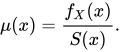
Since fX(x)=F 'X(x) is the probability density function of X, and S(x) = 1 - FX(x) is the survival function, the force of mortality can also be expressed variously as:

To understand conceptually how the force of mortality operates within a population, consider that the ages, x, where the probability density function fX(x) is zero, there is no chance of dying. Thus the force of mortality at these ages is zero. The force of mortality μ(x) uniquely defines a probability density function fX(x).

The force of mortality can be interpreted as the conditional density of failure at age x, while f(x) is the unconditional density of failure at age x.[1] The unconditional density of failure at age x is the product of the probability of survival to age x, and the conditional density of failure at age x, given survival to age x.

This is expressed in symbols as

or equivalently
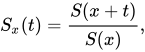
In many instances, it is also desirable to determine the survival probability function when the force of mortality is known. To do this, integrate the force of mortality over the interval x to x + t

.

By the fundamental theorem of calculus, this is simply

Let us denote

then taking the exponent to the base e, the survival probability of an individual of age x in terms of the force of mortality is

Examples

[edit]
  • The simplest example is when the force of mortality is constant:
then the survival function is
is the exponential distribution.
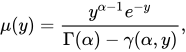
  • When the force of mortality is
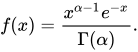
where γ(α,y) is the lower incomplete gamma function, the probability density function that of Gamma distribution
  • When the force of mortality is
where α ≥ 0, we have
Thus, the survival function is
where This is the survival function for Weibull distribution. For α = 1, it is same as the exponential distribution.
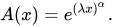
Using the last formula, we have
Then
where

See also

[edit]

References

[edit]
Revisions and contributorsEdit on WikipediaRead on Wikipedia
from Grokipedia
The force of mortality, denoted μx\mu_x, is a key concept in and representing the instantaneous rate of mortality at age xx, conditional on to that age. It is mathematically defined as μx=limΔx0+1ΔxPr(Tx+ΔxT>x)\mu_x = \lim_{\Delta x \to 0^+} \frac{1}{\Delta x} \Pr(T \leq x + \Delta x \mid T > x), where TT is the future lifetime , providing a continuous analog to discrete mortality probabilities. This measure is fundamental to survival models, as the survival function from age xx to x+tx+t is given by Sx(t)=exp(0tμx+udu)S_x(t) = \exp\left(-\int_0^t \mu_{x+u} \, du\right), enabling precise calculations of life expectancies, annuity values, and insurance premiums. In practice, μx\mu_x is estimated from life tables or census data and often modeled using parametric forms like the Gompertz law, μx=Bcx\mu_x = B c^x, which captures the exponential increase in mortality with age observed in human populations. For multiple lives, under independence, the joint force of mortality is the sum of individual forces, aiding in assessments of joint-life insurance and pension liabilities. Historically rooted in early life table constructions, such as those by Edmond Halley in the late 17th century, the force of mortality has evolved into a cornerstone of modern demographic forecasting and risk analysis, with applications extending to epidemiology and reliability engineering.

Definition and Interpretation

Mathematical Definition

The force of mortality, denoted as μx(t)\mu_x(t), represents the hazard rate for an individual aged xx after a duration tt, formally defined as the limit μx(t)=limΔt0Δtqx+tΔt,\mu_x(t) = \lim_{\Delta t \to 0} \frac{{}_{\Delta t}q_{x+t}}{\Delta t}, where Δtqx+t{}_{\Delta t}q_{x+t} denotes the probability of within the small interval Δt\Delta t for a life aged x+tx+t. Standard notation in actuarial contexts includes μ(t)\mu(t) to indicate the force at attained age tt for a general starting from birth, while μx(t)\mu_x(t) specifies the force at duration tt for a life initially aged xx; alternatively, μx+t\mu_{x+t} or μ(x+t)\mu(x+t) may denote the force at attained age x+tx+t. This formulation assumes a continuous-time model where the force of mortality is non-negative, μx(t)0\mu_x(t) \geq 0 for all t0t \geq 0, and integrable over [0,)[0, \infty) to ensure the corresponding survival probabilities are well-defined.

Intuitive Interpretation

The force of mortality represents the instantaneous rate at which mortality occurs at a given age, serving as the underlying "" that propels individuals toward over time. This captures the or vulnerability to at an exact moment, much like a in physics denotes the rate of change in , emphasizing the dynamic, point-specific rather than an aggregated measure. In demographic and actuarial contexts, it quantifies how quickly the population diminishes due to deaths at that precise instant, providing a continuous perspective on mortality dynamics. A useful analogy likens the force of mortality to the force of interest in finance, where both are continuous rates that compound over time to yield overall outcomes—here, survival probability instead of accumulated value. Just as a varying interest rate determines the growth of an investment through continuous compounding, the force of mortality integrates over an age interval to produce the probability of surviving that period, highlighting its role in modeling cumulative risk. This parallel underscores the force's utility in scenarios where mortality risk fluctuates smoothly with age, such as increasing vulnerability in later life stages. Unlike average mortality rates, which summarize deaths over fixed intervals like a year (e.g., the probability of within that year), the force of mortality excels at depicting varying within those intervals, avoiding the smoothing effect that can mask age-specific peaks in . For instance, while an annual rate might average a low early-year with a higher late-year , the force reveals the instantaneous escalation, enabling more precise predictions of trajectories in populations with heterogeneous mortality patterns. This distinction makes it particularly valuable for understanding why certain ages carry disproportionately higher compared to interval-wide averages.

Mathematical Relationships

Relation to Survival and Density Functions

In survival analysis, the force of mortality μx(t)\mu_x(t), also known as the hazard rate at age x+tx + t, is intrinsically linked to the Sx(t)S_x(t), which represents the probability that an individual aged xx survives an additional tt years, or Sx(t)=P(Tx>t)S_x(t) = P(T_x > t) where TxT_x is the future lifetime . The relationship derives from the instantaneous nature of the force, yielding the survival function as Sx(t)=exp(0tμx(u)du)S_x(t) = \exp\left(-\int_0^t \mu_x(u) \, du\right), assuming Sx(0)=1S_x(0) = 1. This exponential form arises because the probability of surviving a small interval dudu is approximately 1μx(u)du1 - \mu_x(u) \, du, and integrating over [0,t][0, t] multiplies these probabilities. Equivalently, the force of mortality can be expressed as the negative of the : μx(t)=ddtlnSx(t)\mu_x(t) = -\frac{d}{dt} \ln S_x(t). This characterization highlights how μx(t)\mu_x(t) fully determines Sx(t)S_x(t) and vice versa in continuous-time models, providing a complete description of the lifetime distribution from the perspective. The fx(t)f_x(t) of the future lifetime TxT_x, which gives the probability density of death at exact time tt after age xx, is directly tied to both the force and functions via fx(t)=μx(t)Sx(t)f_x(t) = \mu_x(t) S_x(t). This follows because the is the product of the instantaneous at tt and the probability of having survived up to tt, or equivalently, fx(t)=ddtSx(t)f_x(t) = -\frac{d}{dt} S_x(t). Substituting the expression yields fx(t)=μx(t)exp(0tμx(u)du)f_x(t) = \mu_x(t) \exp\left(-\int_0^t \mu_x(u) \, du\right). A key intermediary is the cumulative hazard function Hx(t)=0tμx(u)duH_x(t) = \int_0^t \mu_x(u) \, du, which accumulates the total exposure over the interval [0,t][0, t]. The then simplifies to Sx(t)=exp(Hx(t))S_x(t) = \exp(-H_x(t)), underscoring the force of mortality's role as the of the cumulative hazard, μx(t)=ddtHx(t)\mu_x(t) = \frac{d}{dt} H_x(t). This framework unifies the of lifetime in actuarial and demographic contexts.

Connection to Other Mortality Measures

The central death rate mxm_x, which represents the number of deaths between ages xx and x+1x+1 divided by the population exposed to risk in that interval, serves as a discrete measure closely approximating the . Precisely, mx=01lx+tμx+tdt01lx+tdtm_x = \frac{\int_0^1 l_{x+t} \mu_{x+t} \, dt}{\int_0^1 l_{x+t} \, dt}, where lx+tl_{x+t} denotes the number of survivors at age x+tx+t; this formula positions mxm_x as a weighted of μx+t\mu_{x+t} over the year, with weights given by the survivors. A widely used approximation is mxμx+0.5m_x \approx \mu_{x+0.5}, valid under assumptions of near-constant or slowly varying within the interval and introducing minimal error (typically less than 0.8% in parametric models like Gompertz). In life table construction, the one-year probability of death qxq_x connects directly to the force through the exact relation qx=1exp(01μx+tdt)q_x = 1 - \exp\left( -\int_0^1 \mu_{x+t} \, dt \right), which follows from the survival probability 1px=exp(01μx+tdt){}_1p_x = \exp\left( -\int_0^1 \mu_{x+t} \, dt \right). This integral-based formula enables conversion from a specified continuous force to discrete probabilities, essential for building empirical s from parametric mortality laws. Furthermore, the number of survivors lxl_x in a relates to the force via lx=l0exp(0xμudu)l_x = l_0 \exp\left( -\int_0^x \mu_u \, du \right), where l0l_0 is the initial ; inverting this yields μx=ddxlnlx\mu_x = -\frac{d}{dx} \ln l_x, facilitating derivation of the force from tabulated survivor data. The force of mortality differs from discrete measures like mxm_x and qxq_x by offering a continuous-time framework that inherently smooths irregularities in age-specific rates obtained from or vital data, where small event counts at certain ages can produce erratic patterns. By modeling μx\mu_x parametrically (e.g., via laws like Makeham or Gompertz), variability is reduced, enabling consistent between integer ages and more reliable projections beyond observed .

Properties and Derivations

Fundamental Properties

The force of mortality, denoted μx(t)\mu_x(t), is a non-negative function, satisfying μx(t)0\mu_x(t) \geq 0 for all t0t \geq 0, which ensures that it represents a valid instantaneous rate without implying negative probabilities of . A key integrability property is that the 0μx(t)dt=\int_0^\infty \mu_x(t) \, dt = \infty, reflecting the certainty of eventual over an infinite lifespan, while the over any finite interval remains finite. In human populations, the force of mortality typically exhibits a U-shaped pattern across the lifespan, with elevated levels in early infancy that decline to a minimum between ages 5 and 25, followed by a steady increase thereafter.

Derivation in Continuous Time

The force of mortality in continuous time arises from modeling the lifetime of an individual as a continuous TT, conditional on to age xx. Let TxT_x denote the future lifetime for a life aged xx, with conditional STx(t)=P(Tx>t)S_{T_x}(t) = P(T_x > t) and conditional probability density function fTx(t)f_{T_x}(t), both defined for t0t \geq 0. These functions describe the distribution of remaining lifetime given to age xx. Under the continuous-time assumption, the force of mortality μx(t)\mu_x(t) is derived as the instantaneous rate at which mortality occurs at time tt after age xx, given to that point. Specifically, it equals the ratio of the conditional to the conditional : μx(t)=fTx(t)STx(t).\mu_x(t) = \frac{f_{T_x}(t)}{S_{T_x}(t)}. This expression captures the hazard rate, representing the limit of the of death in a small interval [t,t+h)[t, t + h) divided by hh, as h0+h \to 0^+, conditional on survival to tt. The derivation assumes the density and survival functions are differentiable, ensuring the force of mortality is well-defined and continuous except possibly at finitely many points. An alternative derivation links the force of mortality to the of the . Integrating the force yields the cumulative hazard Λx(t)=0tμx(u)du\Lambda_x(t) = \int_0^t \mu_x(u) \, du, and the satisfies STx(t)=exp(Λx(t))S_{T_x}(t) = \exp(-\Lambda_x(t)), so μx(t)=ddtlnSTx(t)\mu_x(t) = -\frac{d}{dt} \ln S_{T_x}(t). This relationship highlights how the force encodes the entire distribution in continuous time. In modeling, the force of mortality can be interpreted as the intensity function of a non-homogeneous Poisson governing events. Here, the lifetime TxT_x is the waiting time until the first event in such a process with time-varying intensity μx(t)\mu_x(t), where the probability of an event in [t,t+dt)[t, t + dt) is approximately μx(t)dt\mu_x(t) \, dt given no prior event. This analogy underscores the deterministic nature of the intensity in standard continuous-time mortality models, without invoking stochastic extensions like Itô calculus.

Applications and Models

In Actuarial Science

In , the force of mortality, denoted as μx(t)\mu_x(t), serves as a core component in the valuation of life contingent products, particularly through its role in deriving the Sx(t)=exp(0tμx+sds)S_x(t) = \exp\left(-\int_0^t \mu_{x+s} \, ds\right), which underpins premium calculations for annuities and insurances. The net single premium for a whole life annuity-due payable continuously to a life aged xx, denoted aˉx\bar{a}_x, is computed as the expected of payments over the lifetime, given by aˉx=0eδtSx(t)dt,\bar{a}_x = \int_0^\infty e^{-\delta t} \, S_x(t) \, dt, where δ\delta is the force of interest; here, μx(t)\mu_x(t) influences the integrand via the survival probability Sx(t)S_x(t), enabling actuaries to price products that account for instantaneous mortality risk. This form allows for flexible mortality assumptions, such as constant force μ\mu yielding aˉx=1/(μ+δ)\bar{a}_x = 1/(\mu + \delta), which simplifies premium determination for term annuities under uniform demographic conditions. Reserve calculations for policies similarly integrate the force of mortality to ensure solvency and policyholder protection. Thiele's provides a retrospective or prospective framework for reserve evolution, expressed as ddttV=δtV+μx+t(btV)pt,\frac{d}{dt} \, {}_tV = \delta \, {}_tV + \mu_{x+t} (b - {}_tV) - p_t, where tV{}_tV is the prospective reserve at duration tt, δ\delta is the force of , μx+t\mu_{x+t} is the force of mortality, bb is the benefit payment upon , and ptp_t is the premium income rate; this equation links μ\mu directly to reserve dynamics by balancing interest accrual, mortality costs, and premiums. Solving this first-order numerically or analytically yields reserve trajectories that reflect mortality-driven outflows, essential for statutory reporting and asset-liability management in portfolios. Stochastic extensions of mortality modeling incorporate of mortality into projections for long-term liabilities, such as , where in μ(t)\mu(t) affects valuation. The Lee-Carter model parameterizes the logarithm of the central death rate mx,tm_{x,t} (which approximates the force of mortality μx,t\mu_{x,t}) as log(mx,t)=ax+bxkt+ϵx,t\log(m_{x,t}) = a_x + b_x k_t + \epsilon_{x,t}, with ktk_t following a to forecast declining mortality trends; this approach is applied in actuarial practice to estimate obligations by simulating survival probabilities and adjusting reserves for longevity risk. Such projections have been instrumental in quantifying the impact of mortality improvements on shortfalls, as seen in U.S. public analyses where Lee-Carter forecasts inform contribution rates and benefit adjustments.

In Demographic Analysis

In demographic analysis, the force of mortality, denoted as μ(x, t), serves as a key tool for understanding population dynamics by distinguishing between period and cohort perspectives. Period analysis employs a cross-sectional approach, estimating μ(x, t) at a fixed time t across different ages x to capture the current mortality regime experienced by the population at that moment, which reflects contemporaneous health and environmental conditions. In contrast, cohort analysis tracks μ(x, t) for individuals born in the same year (fixed cohort), incorporating both past and projected future rates as they age, thereby providing insights into the lifetime mortality experience of a specific generation. This distinction is crucial because period measures often underestimate longevity improvements compared to cohort measures, as the latter account for ongoing declines in mortality over time. Decomposition of the force of mortality into cause-specific components, where the total μ(x, t) equals the sum of cause-specific forces μ_i(x, t) under competing risks assumptions, enables demographers to quantify the contributions of individual or factors to overall mortality. This approach is particularly valuable in , as it allows assessment of the impact of interventions, such as reductions in cardiovascular -related μ_i(x, t), on population-level survival and trends. For instance, decomposing changes in μ(x, t) has revealed how declines in infectious causes have driven broader mortality improvements in low-mortality populations. For forecasting , apply techniques to estimate μ(x, t) from observed age-specific death rates, ensuring realistic projections free of erratic fluctuations. Kernel estimation, a non-parametric method, is commonly used to smooth these rates into a continuous force of mortality curve, facilitating accurate extrapolation in models like those employed by the for global population projections. Such techniques help predict future cohort trajectories by integrating historical patterns with assumed improvements, informing policy on aging populations and . The force of mortality also underpins the construction of life tables, which summarize these demographic patterns.

Historical Development and Examples

Historical Context

The concept of the force of mortality, denoting the instantaneous rate at which individuals succumb to at a given age, traces its early roots to the mid-18th century in the context of probability and calculations. Leonhard Euler's 1760 paper, "Recherches générales sur la mortalité et la multiplication du genre humain," implicitly incorporated hazard-like rates by modeling probabilities over continuous time to value life annuities, laying groundwork for later formalizations in . Similarly, Pierre-Simon Laplace's 1778 memoir on probabilities extended these ideas by applying analytical methods to contingencies, influencing the mathematical treatment of mortality risks in probabilistic frameworks. In the , the force of mortality received its first explicit mathematical formulation through Benjamin Gompertz's seminal 1825 work, where he proposed an exponential model for the increasing intensity of mortality with age, derived from empirical life tables to enhance actuarial computations for life contingencies. This Gompertz law marked a pivotal advancement, shifting mortality analysis from discrete tables to continuous functions that captured the accelerating risk of death. William Matthew Makeham extended this in 1860 by introducing a to the model, accounting for age-independent mortality causes like accidents, thereby improving fits to observed data across diverse populations. The saw the force of mortality integrated into standardized actuarial practices, with the Institute of Actuaries adopting it in the construction of English Life Table No. 8 during the 1920s, where it was used to graduate mortality data for assured lives and derive precise decrement measures. Post-World War II, further formalized its role, incorporating probabilistic variations in mortality processes, as exemplified in Nathan Keyfitz's contributions to mathematical that modeled random fluctuations in .

Classical Examples

The Gompertz model describes the force of mortality as μx(t)=Bct\mu_x(t) = B c^t, where B>0B > 0 is a representing the initial mortality level and c>1c > 1 governs the rate of exponential increase with age tt. This formulation captures the accelerating risk of death observed in adult populations, primarily driven by biological aging processes after infancy. The model's simplicity and empirical robustness have made it a cornerstone in actuarial and demographic analyses, with the exponential term ensuring the force remains non-negative for all ages. The Makeham model builds upon the Gompertz form by incorporating an age-independent component: μx(t)=A+Bct\mu_x(t) = A + B c^t, where A>0A > 0 represents a constant from extrinsic factors such as accidents or environmental risks that do not vary with age. This addition improves fit for populations where non-age-related deaths contribute significantly to overall mortality, particularly in younger adults. Like the Gompertz model, it maintains non-negativity and focuses on post-infancy patterns, with parameters estimated via maximum likelihood from data. Empirically, these models align well with mortality data, illustrating 's rise from approximately 0.001 at age 20 (reflecting low baseline in young adulthood) to around 0.1 at age 90 (indicating sharply elevated senescence-related hazards). For instance, U.S. actuarial tables show probabilities qxq_x near these values, approximating the force of mortality under small-interval assumptions. However, both models exhibit limitations in childhood, where mortality rates peak in infancy due to congenital defects and infections before declining, deviating from the assumed exponential trajectory and requiring separate parametric adjustments for early life stages.

References

Add your contribution
Related Hubs
User Avatar
No comments yet.