


Community hub
0 subscribers8 pages, 0 posts
Recent from talks
All channels
Be the first to start a discussion here.
Be the first to start a discussion here.
Be the first to start a discussion here.
Be the first to start a discussion here.
Contribute something
Welcome to the community hub built to collect knowledge and have discussions related to Fudge Rounds.
Nothing was collected or created yet.
Fudge Rounds
View on Wikipediafrom Wikipedia
 | |||||||||||
| Nutritional value per 1 cookie, 67g | |||||||||||
|---|---|---|---|---|---|---|---|---|---|---|---|
| Energy | 300 kcal (1,300 kJ) | ||||||||||
47 g | |||||||||||
| Sugars | 27 g | ||||||||||
| Dietary fiber | 2 g | ||||||||||
11 g | |||||||||||
| Saturated | 5 g | ||||||||||
| Monounsaturated | 3 g | ||||||||||
| Polyunsaturated | 1.5 g | ||||||||||
2 g | |||||||||||
| |||||||||||
| Other constituents | Quantity | ||||||||||
| Cholesterol | 5 mg | ||||||||||
| †Percentages estimated using US recommendations for adults.[1] | |||||||||||
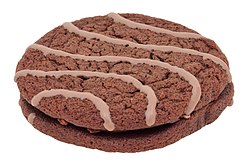
Fudge Rounds are fudgy, round snack cakes made by the Little Debbie company. A Fudge Round consists of two chewy chocolate cookies with light brown fudge creme in between, and light brown fudge strips on top.[2]
In popular culture
[edit]Fudge Rounds are mentioned in Oliver Anthony's 2023 song "Rich Men North of Richmond."[2]
See also
[edit]
References
[edit]- ^ United States Food and Drug Administration (2024). "Daily Value on the Nutrition and Supplement Facts Labels". FDA. Archived from the original on 2024-03-27. Retrieved 2024-03-28.
- ^ a b Vivenetto, Gina (18 August 2023). "Who is Oliver Anthony? His song 'Rich Men North of Richmond' is topping the country charts". Today. Retrieved 19 August 2023.
Well, God, if you're 5-foot-3 and you're 300 pounds / Taxes ought not to pay for your bags of fudge rounds [...] Fudge rounds are a Little Debbie snack cake with two chocolate cookies sandwiching a chocolate creme filling
External links
[edit]- Little Debbie Fudge Rounds Archived 2014-03-29 at the Wayback Machine - Official product page

Fudge Rounds
View on Grokipediafrom Grokipedia
History
Origins and launch
McKee Foods originated from O.D. McKee's acquisition of a Chattanooga, Tennessee bakery in 1934 during the Great Depression, initially operating as Jack's Cookie Company and focusing on affordable snack cakes sold for five cents each.[7] The Little Debbie brand launched on August 23, 1960, named after McKee's four-year-old granddaughter Debbie McKee-Fowler, with Oatmeal Creme Pies as the inaugural product sold in family packs for 49 cents.[3] By the mid-1960s, the brand had expanded to include 14 varieties, such as Nutty Buddy wafer bars and Swiss Cake Rolls, capitalizing on the demand for portable, pre-packaged treats amid post-war consumer shifts toward convenience foods.[3] Fudge Rounds were introduced in 1975, developed by Cliff Dildy, a McKee Foods product innovator who joined the company in 1967.[3] Dildy's creation featured two round chocolate cookies sandwiching a light fudge filling accented by fudge stripes, designed as a novel chocolate-centric snack with no direct market equivalents at the time.[3] The name "Fudge Rounds" directly reflected the product's circular shape and dominant fudge elements, positioning it within Little Debbie's growing lineup of indulgent yet accessible baked goods.[3] Upon launch, Fudge Rounds were packaged as individually wrapped units in cartons, facilitating easy distribution through McKee Foods' regional bakery network centered in the Southeastern United States.[3] This approach enabled rapid market penetration in Southern states, where the company's facilities and sales routes were concentrated, contributing to the brand's early momentum in competing with national snack cake producers like Hostess.[3]Evolution and variations
Fudge Rounds were introduced in 1975 by McKee Foods under the Little Debbie brand, consisting of two soft chocolate cookies sandwiching fudge creme and topped with fudge icing.[3] The core formula has seen minimal alterations since launch, preserving the original chocolate cookie-fudge-icing structure to sustain consumer familiarity amid competition from other snack cakes. In 2015, a fudge striping pattern was added to the icing topping, marking the most notable visual and textural update to enhance appeal without reformulating the base ingredients.[3] Packaging and sizing variations emerged to address diverse market demands, including Big Pack options with 12 individually wrapped 2-ounce units, larger than standard servings, available through major retailers.[8] A temporary Double Decker variation, incorporating a third cookie layer for increased heft, was offered around 2000 but discontinued thereafter. In contrast to related products like Fudge Brownies with English Walnuts, which were discontinued in 2022 after over 50 years of production due to unspecified factors, Fudge Rounds have continued without major reformulations.[9] Recent adjustments reflect responses to economic pressures, with consumer reports documenting shrinkflation—reductions in cookie diameter and creme filling—evident in purchases from 2022 to 2025, while prices remained stable or increased.[10][11] These changes, attributed to rising ingredient and production costs, have sparked discussions on platforms like Reddit, though the product retains its fundamental composition and ongoing availability in standard and larger packs.[12]Product description
Physical characteristics and composition
Fudge Rounds consist of two soft, chewy chocolate cookies sandwiching a smooth, fudge-like creme filling, with chocolatey icing stripes applied across the top surface. The round design facilitates handheld snacking, with each cookie approximately 3 inches in diameter and weighing about 1.2 ounces.[8][13] The cookies exhibit a moist, cake-like texture that contrasts with the denser, fudgy consistency of the creme, providing a balanced mouthfeel upon consumption. This structure emphasizes chocolate flavor throughout, from the outer layers to the interior and topping.[14][15] Standard packaging includes 8 individually wrapped units per box for freshness preservation, while larger formats such as 12-count big packs maintain the same per-unit dimensions and composition.[16][17]Ingredients and nutritional facts
Little Debbie Fudge Rounds are composed primarily of enriched bleached flour (wheat flour, niacin, reduced iron, thiamin mononitrate, riboflavin, folic acid), corn syrup, sugar, dextrose, palm oil, soybean oil, cocoa processed with alkali, whey, high fructose corn syrup, and lesser amounts of soybean lecithin, salt, corn starch, leavening agents (baking soda, sodium aluminum phosphate), natural and artificial flavors, mono- and diglycerides, polysorbate 60, sorbic acid (preservative), and colorings such as annatto extract and turmeric.[18][19] The product contains allergens including wheat, soy, milk, and eggs, and may contain peanuts or tree nuts.[17] A standard serving consists of one Fudge Round sandwich cookie, weighing approximately 34 grams.[20] Nutritional facts per serving are as follows:| Nutrient | Amount per Serving | % Daily Value* |
|---|---|---|
| Calories | 150 | |
| Total Fat | 7 g | 9% |
| Saturated Fat | 3 g | 15% |
| Trans Fat | 0 g | |
| Cholesterol | <5 mg | 1% |
| Sodium | 125 mg | 5% |
| Total Carbohydrates | 22 g | 8% |
| Dietary Fiber | 1 g | 4% |
| Total Sugars | 14 g | |
| Includes Added Sugars | 14 g | 28% |
| Protein | 1 g |
Manufacturing and distribution
Production process
Fudge Rounds are manufactured at McKee Foods' bakeries in Collegedale, Tennessee, where the company operates two primary production facilities alongside research and development centers.[22] This family-owned operation, which launched the Little Debbie brand in 1960, employs automated bakery processes to produce the snacks at scale.[3] The core steps include preparing chocolate cookie dough in industrial mixers, forming and baking the soft cookies in continuous ovens, pairing them with injected chocolatey creme filling, and topping the assembly with fudge icing before individual wrapping.[23] Production volumes for Fudge Rounds, introduced in 1975, reach millions of units annually as a staple in the Little Debbie lineup, supporting McKee Foods' overall output exceeding 5 billion snacks per year across its U.S. facilities.[3] [24] Quality control integrates monitoring during mixing, baking, filling, and packaging to ensure consistency, with preservatives like sodium propionate extending shelf life.[23] McKee Foods guarantees freshness for up to 60 days from the production date, a measure tied to its controlled manufacturing environment and ingredient formulations since the brand's inception.[25] Ongoing expansions, including a planned $500 million investment over 15 years in Collegedale operations announced in 2020, aim to enhance capacity for high-demand items like Fudge Rounds.[26]Packaging and availability
Fudge Rounds are individually wrapped to maintain freshness and facilitate portability, suitable for lunch boxes and on-the-go snacking.[8] They are offered in various pack formats, including family packs of 8 cookies totaling 9.5 ounces and big packs of 12 cookies weighing 24.1 ounces, with single-serve options also available.[13][8][27] These products are distributed nationwide across all 50 U.S. states through major grocery chains such as Kroger and Target, convenience stores including Dollar General and Casey's, wholesale clubs like BJ's, and online platforms like Amazon and Walmart.[7][28][29] Big packs cater to bulk purchases at wholesale outlets.[30] Geographic reach extends primarily to the United States, with limited availability in international markets such as Canada, Mexico, and Puerto Rico, as well as U.S. military bases abroad.[31] The snacks maintain year-round availability in retail channels, supported by McKee Foods' distribution network.[32]Commercial reception
Sales performance and popularity
Fudge Rounds stand out as Little Debbie's top-selling snack, dominating consumer preference metrics nationwide. Analyses of state-by-state popularity data identify Fudge Rounds as the most favored variety across the United States, leading in up to 20 states according to aggregated sales and search trends.[33] A 2023 review confirmed them as the national frontrunner, topping polls in 13 states and outpacing competitors like Oatmeal Creme Pies.[34][35] This popularity translates to robust economic performance for McKee Foods, the parent company, which generates approximately $1.9 billion in annual revenue primarily from Little Debbie products, including high-volume sellers like Fudge Rounds.[36] The snack's consistent demand supports McKee's shipment of over 900 million Little Debbie cartons yearly, reflecting sustained market penetration since the brand's expansion in the late 20th century.[37] Consumer taste tests reinforce Fudge Rounds' appeal, with rankings highlighting their moist chocolate cookies and rich creme filling as standout features. Publications like Sporked and The Kitchn have placed them among the top Little Debbie offerings, citing superior texture and flavor balance in blind evaluations.[38][39] Such acclaim evidences strong loyalty, as Fudge Rounds maintain staple status in household pantries and school lunches amid varying economic conditions, evidenced by steady Amazon best-seller positioning in snack cakes.[40]Marketing strategies
Little Debbie markets Fudge Rounds as an accessible chocolate treat, positioning the product within a broader brand narrative of everyday indulgence at budget prices, with standard packs retailing for under $3 to target cost-conscious families and drive high-volume sales over premium margins.[41][42] The brand's promotional efforts rely heavily on nostalgia, featuring the enduring mascot derived from a 1950s portrait of Debbie McKee-Fowler, granddaughter of founders O.D. and Ruth McKee, which has anchored advertising since the brand's 1960 launch.[43] Early television spots, including those awarded the Addy advertising prize in 1965 for creative excellence, emphasized homemade quality and family sharing, fostering long-term consumer loyalty through emotional ties rather than aggressive spending—McKee Foods allocated just $2.95 million to measured media in 2009, far below competitors like Hostess.[3][44] Subsequent campaigns reinforced themes of tradition and freshness, such as 1980s commercials with impressionist Rich Little promoting snack cakes as reliable family staples, and occasional holiday integrations like Christmas ads depicting products as joyful, shareable treats without heavy seasonal customization for Fudge Rounds.[3] Unlike rivals' pivot to digital platforms, Little Debbie's strategies have remained largely traditional, prioritizing in-store visibility, direct distribution to retailers, and word-of-mouth appeal over social media expansions, though a 2010 Facebook drive sought to build online engagement.[44] This approach sustains the product's image as a no-frills, value-driven option amid economic pressures.[41]Health and criticisms
Nutritional profile and health impacts
A standard serving of Little Debbie Fudge Rounds consists of one cookie weighing 57 grams, providing 260 calories, primarily from carbohydrates and fats.[17] This serving contains 37 grams of total carbohydrates, including 24 grams of sugars, accounting for approximately 57% of calories from carbs and 35% from fats (10 grams total fat, with 5 grams saturated).[45] Protein content is low at 2 grams, with negligible fiber and micronutrients such as vitamins or minerals, reflecting its composition as an ultra-processed snack dominated by refined sugars, wheat flour, palm oil, and additives.[18] The Environmental Working Group classifies it as an unhealthy ultra-processed food due to high levels of processing, added sugars, and ingredients like partially hydrogenated oils, which may contain trace trans fats despite labeling.[46]| Nutrient | Amount per Serving (57g) | % Daily Value |
|---|---|---|
| Calories | 260 | - |
| Total Fat | 10g | 13% |
| Saturated Fat | 5g | 25% |
| Total Carbohydrates | 37g | 13% |
| Sugars | 24g | - |
| Protein | 2g | 4% |
| Sodium | 140mg | 6% |