


Community hub
Recent from talks
Contribute something
Nothing was collected or created yet.
Ovenbird (family)
View on Wikipedia
| Ovenbirds | |
|---|---|

| |
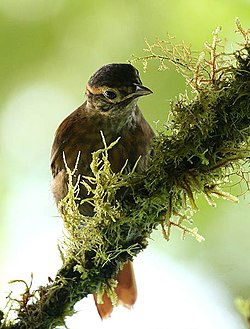
| Scaly-throated foliage-gleaner (Anabacerthia variegaticeps) | |
Scientific classification 
| |
| Kingdom: | Animalia |
| Phylum: | Chordata |
| Class: | Aves |
| Order: | Passeriformes |
| Parvorder: | Furnariida |
| Family: | Furnariidae Gray, 1840 |
| Subfamilies | |
Ovenbirds or furnariids are a large family of small suboscine passerine birds found from Mexico and Central to southern South America. They form the family Furnariidae. This is a large family containing around 321 species and 71 genera. The ovenbird (Seiurus aurocapilla), which breeds in North America, is not a furnariid – rather it is a distantly related bird of the wood warbler family, Parulidae.
The ovenbirds are a diverse group of insectivores which get their name from the elaborate, vaguely "oven-like" clay nests built by the horneros, although most other ovenbirds build stick nests or nest in tunnels or clefts in rock.[1] The Spanish word for "oven" (horno) gives the horneros their name. Furnariid nests are always constructed with a cover, and up to six pale blue, greenish or white eggs are laid. The eggs hatch after 15 to 22 days, and the young fledge after a further 13 to 20 days.[2]
They are small to medium-sized birds, ranging from 9 to 35 cm in length.[2] While individual species often are habitat specialists, species of this family can be found in virtually any Neotropical habitat, ranging from city parks inhabited by rufous horneros, to tropical Amazonian lowlands by many species of foliage-gleaners, to temperate barren Andean highlands inhabited by several species of miners. Two species, the seaside and the surf cinclodes, are associated with rocky coasts.
Taxonomy and systematics
[edit]The woodcreepers (formerly Dendrocolaptidae) were merged into this family, following analysis of sequences.[3] While confirming the overall phylogenetic pattern, other scientists instead opted for maintaining the woodcreepers as a separate family, while splitting the ovenbirds (as traditionally defined) into two families, Furnariidae and Scleruridae.[4]
The cladogram below showing the subfamilies of the ovenbirds is based on a molecular genetic studies that revealed that Sclerurinae was the first group to diverge[5][6] The species numbers are from the list maintained by the International Ornithologists' Union (IOC).[7]
| Furnariidae |
| ||||||||||||
The phylogeny of the Furnariidae is now well understood thanks to multiple analyses of nuclear and mitochondrial DNA.[8][9][10][11][12] Among other discoveries, the classification of several genera had to be revised.[13][14][15] The taxonomic arrangement presented below is based on molecular genetic studies of ovenbird relationships.[4][16][17][12] However, because ovenbirds and woodcreepers are treated here as a single family some taxonomic ranks were modified. For more detail see "List of ovenbird species".
Subfamily: Sclerurinae – miners and leaftossers
Subfamily: Dendrocolaptinae – woodcreepers
- Tribe: Sittasomini – "intermediate" woodcreepers[4]
- Genus Dendrocincla – woodcreepers (6 species)
- Genus Deconychura – long-tailed woodcreepers (3 species)
- Genus Sittasomus – olivaceous woodcreeper
- Genus Certhiasomus – spot-throated woodcreeper (genus introduced in 2010 for Deconychura stictolaema)[18]
- Tribe: Dendrocolaptini – "strong-billed" woodcreepers[4]
- Genus Glyphorynchus – wedge-billed woodcreeper
- Genus Nasica – long-billed woodcreeper
- Genus Dendrexetastes – cinnamon-throated woodcreeper
- Genus Dendrocolaptes – woodcreepers (5 species)
- Genus Hylexetastes – woodcreepers (3 species)
- Genus Xiphocolaptes – woodcreepers (4 species)
- Genus Dendroplex – straight-billed woodcreepers (2 species, formerly in Xiphorhynchus)
- Genus Xiphorhynchus – woodcreepers (13 species)
- Genus Lepidocolaptes – narrow-billed woodcreepers (11 species)
- Genus Drymornis – scimitar-billed woodcreeper
- Genus Drymotoxeres – greater scythebill[19]
- Genus Campylorhamphus – scythebills (6 species)
Subfamily: Furnariinae – Neotropical ovenbirds and allies
- Genus: Xenops – xenops (5 species)
- Genus Berlepschia – point-tailed palmcreeper
- Tribe Pygarrhichini[4]
- Genus Pygarrhichas – white-throated treerunner
- Genus Microxenops – rufous-tailed xenops[4][20]
- Genus Ochetorhynchus – earthcreepers (4 species formerly included in Upucerthia)
- Tribe Furnariini – horneros and allies
- Genus Pseudocolaptes – tuftedcheeks (3 species)
- Genus Premnornis – rusty-winged barbtail
- Genus Tarphonomus – earthcreepers (genus introduced in 2007 for 2 species formerly included in Upucerthia)[21]
- Genus Geocerthia – striated earthcreeper (genus introduced in 2009 for U. serrrana)[22]
- Genus Upucerthia – earthcreepers (4 species)
- Genus Cinclodes – cinclodes (15 species)
- Genus Furnarius – horneros (8 species)
- Genus Lochmias – sharp-tailed streamcreeper
- Genus Phleocryptes – wren-like rushbird
- Genus Limnornis – curve-billed reedhaunter[23]

- Tribe Philydorini – foliage-gleaners and allies
- Genus Megaxenops – great xenops
- Genus Anabazenops – foliage-gleaners (2 species)
- Genus Ancistrops – chestnut-winged hookbill
- Genus Cichlocolaptes – (2 species)
- Genus Heliobletus – sharp-billed treehunter
- Genus Neophilydor – foliage-gleaners (genus introduced in 2023 for 2 species formerly in Philydor)
- Genus Philydor – foliage-gleaners (3 species)
- Genus Dendroma – foliage-gleaners (2 species)
- Genus Anabacerthia – foliage-gleaners (5 species)
- Genus Syndactyla – foliage-gleaners (8 species)
- Genus Clibanornis – (5 species)[24]
- Genus Thripadectes – treehunters (7 species)
- Genus Automolus – foliage-gleaners (11 species)
- Tribe Synallaxini – spinetails and allies
- Genus Margarornis – treerunners (4 species)
- Genus Premnoplex – typical barbtails (2 species)
- Genus Aphrastura – rayaditos (3 species)[25]
- Genus Hellmayrea – white-browed spinetail
- Genus Sylviorthorhynchus – (2 species)
- Genus Leptasthenura – tit-spinetails (9 species)
- Genus Phacellodomus – thornbirds (10 species)
- Genus Anumbius – firewood-gatherer
- Genus Coryphistera – lark-like brushrunner
- Genus Pseudoseisura – cacholotes (4 species)
- Genus Pseudasthenes – false canasteros[26]
- Genus Spartonoica – bay-capped wren-spinetail
- Genus Asthenes – canasteros (29 species)
- Genus Certhiaxis – spinetails (2 species)
- Genus Mazaria – white-bellied spinetail[27]
- Genus Schoeniophylax – chotoy spinetail
- Genus Synallaxis – spinetails (37 species)
- Genus Siptornis – spectacled prickletail
- Genus Metopothrix – orange-fronted plushcrown
- Genus Xenerpestes – graytails (2 species)
- Genus Acrobatornis – pink-legged graveteiro
- Genus Limnoctites – reedhaunters (2 species)
- Genus Thripophaga – softtails (4 species)
- Genus Cranioleuca – typical spinetails (20 species)
- Genus Roraimia – Roraiman barbtail
The phylogenetic tree shown below is based on a large-scale genetic 2020 study of the suboscines by Michael Harvey and collaborators.[11] The tawny tit-spinetail (Leptasthenura yanacencis) has been moved to the genus Sylviorthorhynchus, the sulphur-bearded spinetail (Cranioleuca sulphurifera) has been moved to the genus Limnoctites and its English name changed to the sulphur-bearded reedhaunter, and the white-bellied spinetail (Synallaxis propinqua) has been placed in the monotypic genus Mazaria.[27] These changes are included in the tree shown below. The remaining paraphyletic genera are flagged in the tree by an asterisk.
In 2009, the large ovenbird family was divided into tribes by Robert Moyle and collaborators. The tribes as defined in the 2009 article do not fit well with the revised taxonomy of Harvey and are not included here. For example, the tribe Furnariini as defined in the 2009 article is not monophyletic in the Harvey phylogeny.[4] The species numbers in the cladogram are from the list maintained by the International Ornithologists' Union (IOC).[7]
| Furnariinae |
| ||||||||||||||||||||||||||||||||||||||||||||||||||||||||||||||||||||||||||||||||||||||||||||||||||||||||||||||||||||||||||||||||||||||||||||||||||||||||||||||||||||||||||||||||||||||||||||||||||||||||||||||||||||||||||||||||||||||||||||||||||||||||||||||||||||||||||||||||||||||||||||||||||||||||||||||||||||||||||||||||||||||||||
Fossil record
[edit]Furnariids boast a notable fossil record for a passerine family. Numerous fossils comprising multiple skeletal elements, including cranial remains, have facilitated the identification and description of five distinct fossil species. Among these, two have been classified within the extant genera Cinclodes and Pseudoseisura, while the remaining three belong into the extinct genus Pseudoseisuropsis. All fossil are of Pleistocene age.
- †Pseudoseisuropsis nehuen Noriega 1991, early Pleistocene of Argentina.[28]
- †Pseudoseisuropsis cuelloi Claramunt & Rinderknecht 2005, late Pleistocene of Uruguay.[29]
- †Pseudoseisuropsis wintu Stefanini et al. 2016, Early Pleistocene of Argentina.[30]
- †Cinclodes major Toni 1977, Pleistocene of Argentina.[31]
- †Pseudoseisura cursor Toni & Noriega, 2001, Pleistocene of Argentina.[32]
References
[edit]- ^ Remsen, J. V., Jr. 2003. Family Furnariidae (ovenbirds). Pages 162–357 in J. del Hoyo, A. Elliott and D. A. Christie eds. Handbook of the birds of the world, Vol. 8, broadbills to tapaculos. Lynx Edicions, Barcelona.
- ^ a b Willis, Edwin O. (1991). Forshaw, Joseph (ed.). Encyclopaedia of Animals: Birds. London: Merehurst Press. pp. 162–163. ISBN 978-1-85391-186-6.
- ^ Irestedt, Martin; Fjeldså, Jon; Johansson, Ulf S. & Ericson, Per G.P. (2002). "Systematic relationships and biogeography of the tracheophone suboscines (Aves: Passeriformes)". Molecular Phylogenetics and Evolution. 23 (3): 499–512. doi:10.1016/S1055-7903(02)00034-9. PMID 12099801.
- ^ a b c d e f g Moyle, R.G.; Chesser, R.T.; Brumfield, R.T.; Tello, J.G.; Marchese, D.J.; Cracraft, J. (2009). "Phylogeny and phylogenetic classification of the antbirds, ovenbirds, woodcreepers, and allies (Aves: Passeriformes: infraorder Furnariides)". Cladistics. 25 (4): 386–405. doi:10.1111/j.1096-0031.2009.00259.x. PMID 34879609.
- ^ Irestedt, Martin; Fjeldså, Jon; Johansson, Ulf S; Ericson, Per G.P (2002). "Systematic relationships and biogeography of the tracheophone suboscines (Aves: Passeriformes)". Molecular Phylogenetics and Evolution. 23 (3): 499–512. doi:10.1016/s1055-7903(02)00034-9. PMID 12099801.
- ^ Chesser, R.Terry (2004). "Molecular systematics of New World suboscine birds". Molecular Phylogenetics and Evolution. 32 (1): 11–24. doi:10.1016/j.ympev.2003.11.015. PMID 15186793.
- ^ a b Gill, Frank; Donsker, David; Rasmussen, Pamela, eds. (August 2024). "Ovenbirds, woodcreepers". IOC World Bird List Version 14.2. International Ornithologists' Union. Retrieved 3 January 2025.
- ^ Irestedt, Martin; Fjeldså, Jon; Ericson, Per G. P. (2004). "Phylogenetic Relationships of Woodcreepers (Aves: Dendrocolaptinae): Incongruence between Molecular and Morphological Data". Journal of Avian Biology. 35 (3): 280–288. doi:10.1111/j.0908-8857.2004.03234.x. ISSN 0908-8857. JSTOR 3677441.
- ^ Irestedt, Martin; Fjeldså, Jon; Ericson, Per G. P. (2006). "Evolution of the ovenbird-woodcreeper assemblage (Aves: Furnariidae) - major shifts in nest architecture and adaptive radiation". Journal of Avian Biology. 37 (3): 260–272. doi:10.1111/j.2006.0908-8857.03612.x.
- ^ Fjeldså, Jon; Irestedt, Martin; Ericson, Per G. P. (2004-09-14). "Molecular data reveal some major adaptational shifts in the early evolution of the most diverse avian family, the Furnariidae". Journal of Ornithology. 146 (1): 1–13. doi:10.1007/s10336-004-0054-5. ISSN 2193-7192. S2CID 11581358.
- ^ a b Harvey, M.G.; et al. (2020). "The evolution of a tropical biodiversity hotspot". Science. 370 (6522): 1343–1348. Bibcode:2020Sci...370.1343H. doi:10.1126/science.aaz6970. hdl:10138/329703. PMID 33303617. S2CID 228084618. A high resolution version of the phylogenetic tree in Figure 1 is available from the first author's website here.
- ^ a b Derryberry, E.P.; Claramunt, S.; Derryberry, G.; Chesser, R.T.; Cracraft, J.; Aleixo, A.; Pérez-Emán, J.; Remsen Jr, J.V.; Brumfield, R.T. (2011). "Lineage diversification and morphological evolution in a large-scale continental radiation: the Neotropical ovenbirds and woodcreepers (Aves: Furnariidae)". Evolution. 65 (10): 2973–2986. doi:10.1111/j.1558-5646.2011.01374.x. PMID 21967436.
- ^ CHESSER, R. TERRY; CLARAMUNT, SANTIAGO; DERRYBERRY, ELIZABETH; BRUMFIELD, ROBB T. (2009-08-28). "Geocerthia, a new genus of terrestrial ovenbird (Aves: Passeriformes: Furnariidae)". Zootaxa. 2213 (1): 64–68. doi:10.11646/zootaxa.2213.1.4. ISSN 1175-5334.
- ^ DERRYBERRY, ELIZABETH; CLARAMUNT, SANTIAGO; O'QUIN, KELLY E.; ALEIXO, ALEXANDRE; CHESSER, R. TERRY; REMSEN JR., J. V.; BRUMFIELD, ROBB T. (2010-04-01). "Pseudasthenes, a new genus of ovenbird (Aves: Passeriformes: Furnariidae)". Zootaxa. 2416 (1): 61. doi:10.11646/zootaxa.2416.1.4. ISSN 1175-5334.
- ^ Claramunt, Santiago; Derryberry, Elizabeth P.; Cadena, Carlos Daniel; Cuervo, Andrés M.; Sanín, Camilo; Brumfield, Robb T. (2013). "Phylogeny and Classification of Automolus Foliage-gleaners and Allies (Furnariidae)". The Condor. 115 (2): 375–385. doi:10.1525/cond.2013.110198. S2CID 59375772.
- ^ Irestedt, M.; J. Fjeldså & P. G. P. Ericson (2006). "Evolution of the ovenbird-woodcreeper assemblage (Aves: Furnariidae): major shifts in nest architecture and adaptive radiation". J. Avian Biol. 37 (3): 260–272. doi:10.1111/j.2006.0908-8857.03612.x.
- ^ Chesser, R. T.; Barker, F. K. & Brumfield, R. T. (2007). "Fourfold polyphyly of the genus formerly known as Upucerthia, with notes on the systematics and evolution of the avian subfamily Furnariinae". Mol. Phylogenet. Evol. 44 (3): 1320–1332. doi:10.1016/j.ympev.2007.04.014. PMID 17632018.
- ^ Derryberry, E.; S. Claramunt; R. T. Chesser; A. Aleixo; J. Cracraft; R. G. Moyle & R. T. Brumfield (2010). "Certhiasomus, a new genus of woodcreeper (Aves: Passeriformes: Dendrocolaptidae)" (PDF). Zootaxa. 2416: 44–50. doi:10.11646/zootaxa.2416.1.2. Archived from the original (PDF) on 2010-06-27. Retrieved 2013-03-29.
- ^ Claramunt, S.; E. P. Derryberry; R. T. Chesser; A. Aleixo & R. T. Brumfield (2010). "Polyphyly of Campylorhamphus with the description of a new genus for C. pucherani". Auk. 127 (2): 430–439. doi:10.1525/auk.2009.09022. S2CID 85649129.
- ^ The correct genus for former Xenops milleri
- ^ Chesser, R. T. & R. T. Brumfield (2007). "Tarphonomus, a new genus of ovenbird (Aves: Passeriformes: Furnariidae) from South America". Proceedings of the Biological Society of Washington. 120 (3): 337–339. doi:10.2988/0006-324X(2007)120[337:TANGOO]2.0.CO;2. S2CID 84357123.
- ^ Chesser, R. T.; S. Claramunt; E. P. Derryberry & R. T. Brumfield (2009). "Geocerthia, a new genus of terrestrial ovenbird (Aves: Passeriformes: Furnariidae)". Zootaxa. 2213: 64–68. doi:10.11646/zootaxa.2213.1.4. Archived from the original on 2013-04-14. Retrieved 2013-03-29.
- ^ Olson, S. L.; Irestedt, M.; Ericson, P. G. P. & Fjeldså, J. (2005). "Independent evolution of two Darwinian marsh-dwelling ovenbirds (Furnariidae: Limnornis, Limnoctites)" (PDF). Ornitologia Neotropical 16: 347–359. hdl:10088/1568. Archived from the original (PDF) on 2021-08-20. Retrieved 2013-03-29.
- ^ Claramunt, Santiago; Derryberry, Elizabeth P.; Cadena, Carlos Daniel; Cuervo, Andrés M.; Sanín, Camilo; Brumfield, Robb T. (2013). "Phylogeny and classification of Automolus foliage-gleaners and allies (Furnariidae)". The Condor. 115 (2): 375–385. doi:10.1525/cond.2013.110198. S2CID 59375772.
- ^ Rozzi, Ricardo; Quilodrán, Claudio S.; Botero-Delgadillo, Esteban; Napolitano, Constanza; Torres-Mura, Juan C.; Barroso, Omar; Crego, Ramiro D.; Bravo, Camila; Ippi, Silvina; Quirici, Verónica; Mackenzie, Roy; Suazo, Cristián G.; Rivero-de-Aguilar, Juan; Goffinet, Bernard; Kempenaers, Bart; Poulin, Elie; Vásquez, Rodrigo A. (2022-08-26). "The Subantarctic Rayadito (Aphrastura subantarctica), a new bird species on the southernmost islands of the Americas". Scientific Reports. 12 (1). Springer: 13957. Bibcode:2022NatSR..1213957R. doi:10.1038/s41598-022-17985-4. ISSN 2045-2322. PMC 9418250. PMID 36028531.
- ^ Derryberry, E.; S. Claramunt; K. E. O'Quin; A. Aleixo; R. T. Chesser; J. V. Remsen Jr. & R. T. Brumfield (2010). "Pseudasthenes, a new genus of ovenbird (Aves: Passeriformes: Furnariidae)" (PDF). Zootaxa. 2416: 61–68. doi:10.11646/zootaxa.2416.1.4. Archived from the original (PDF) on 2010-06-27.
- ^ a b Claramunt, Santiago (2014). "Phylogenetic relationships among Synallaxini spinetails (Aves: Furnariidae) reveal a new biogeographic pattern across the Amazon and Paraná river basins". Molecular Phylogenetics and Evolution. 78: 223–231. doi:10.1016/j.ympev.2014.05.011. PMID 24867462.
- ^ Noriega, J. I. (1991). "Un nuevo género de Furnariidae (Aves: Passeriformes) del Pleistoceno inferior-medio de la Provincia de Buenos Aires, Argentina". Ameghiniana. 28 (3–4): 317–323.
- ^ Claramunt, Santiago; Rinderknecht, Andrés (2005). "A new fossil furnariid from the Pleistocene of Uruguay, with remarks on nasal type, cranial kinetics, and relationships of the extinct genus Pseudoseisuropsis". The Condor. 107 (1): 114. doi:10.1650/7499. ISSN 0010-5422. S2CID 85702253.
- ^ Stefanini, M. Ignacio; Gómez, Raúl O.; Tambussi, Claudia P. (2016). "A new species of the Pleistocene furnariid Pseudoseisuropsis (Aves, Passeriformes)". Journal of Vertebrate Paleontology. 36 (3) e1100630. Bibcode:2016JVPal..36E0630S. doi:10.1080/02724634.2016.1100630. hdl:11336/44149. ISSN 0272-4634. S2CID 87281054.
- ^ Toni, E. P. (1977). "Un furnárido (Aves, Passeriformes) del Pleistoceno medio de la Provincia de Buenos Aires". Publicaciones del Museo Municipal de Ciencias Naturales de Mar del Plata Lorenzo Scaglia. 2: 141–147.
- ^ Toni, E. P.; Noriega, J. I. (2001). "Una especie extinta de Pseudoseisura Reichenbach 1853 (Passeriformes: Furnariidae) del Pleistoceno de la Argentina: comentarios filogenéticos". Ornitologia Neotropical. 12: 29–44.
Further reading
[edit]- Cheviron, Z. A.; Capparella, Angelo P.; Vuilleumier, François (2005). "Molecular phylogenetic relationships among the Geositta miners (Furnariidae) and biogeographic implications for avian speciation in Fuego-Patagonia". Auk. 122 (1): 158–174. doi:10.1642/0004-8038(2005)122[0158:MPRATG]2.0.CO;2. S2CID 86706398.
External links
[edit]
- Ovenbird videos on the Internet Bird Collection
- Ovenbird sounds in the xeno-canto collection
- A classification of the bird species of South America (Part 6)[permanent dead link] (SACC)
| International | |
|---|---|
| National | |
| Other | |
