
Hubbry Logo
Minimum-shift keyingMinimum-shift keyingMain
Open search
Minimum-shift keying
Community hub
Minimum-shift keying
logo
7 pages, 0 posts
0 subscribers
Be the first to start a discussion here.
Minimum-shift keying
from Wikipedia

In digital modulation, minimum-shift keying (MSK) is a type of continuous-phase frequency-shift keying that was developed in the late 1950s by Collins Radio employees Melvin L. Doelz and Earl T. Heald.[1] Similar to OQPSK, MSK is encoded with bits alternating between quadrature components, with the Q component delayed by half the symbol period.

However, instead of square pulses as OQPSK uses, MSK encodes each bit as a half sinusoid.[2][3] This results in a constant-modulus signal (constant envelope signal), which reduces problems caused by non-linear distortion. In addition to being viewed as related to OQPSK, MSK can also be viewed as a continuous-phase frequency-shift keyed (CPFSK) signal with a frequency separation of one-half the bit rate.

In MSK the difference between the higher and lower frequency is identical to half the bit rate. Consequently, the waveforms used to represent a 0 and a 1 bit differ by exactly half a carrier period. Thus, the maximum frequency deviation is δ = 0.5 fm where fm is the maximum modulating frequency. As a result, the modulation index m is 0.5. This is the smallest FSK modulation index that can be chosen such that the waveforms for 0 and 1 are orthogonal. A variant of MSK called Gaussian minimum-shift keying (GMSK) is used in the GSM mobile phone standard.

Mathematical representation

[edit]
MSK waveform can also be designed as OQPSK (i.e. in I/Q manner) with the sinusoidal pulse shaping.[4][5] Mapping changes in continuous phase. Each bit time, the carrier phase changes by ±90°.

The resulting signal is represented by the formula:[3][failed verification]

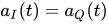
where and encode the even and odd information respectively with a sequence of square pulses of duration 2T. has its pulse edges on and on . The carrier frequency is .

Using the trigonometric identity, this can be rewritten in a form where the phase and frequency modulation are more obvious,

where bk(t) is +1 when and −1 if they are of opposite signs, and is 0 if is 1, and otherwise. Therefore, the signal is modulated in frequency and phase, and the phase changes continuously and linearly.
Properties

[edit]
Power spectral density of MSK, BPSK, and QPSK. The side-lobes of MSK are lower (−23 dB) than in both BPSK and QPSK cases (−10 dB). Therefore, the inter-channel interference is lower in MSK case. Moreover, the main lobe of the MSK signal is wider, which means more energy in the null-to-null bandwidth. However, this can be also the disadvantage where extremely narrow bandwidth is required (null-to-null bandwidth of QPSK is equal to 3dB-bandwidth, null-to-null bandwidth of the MSK signal is 1.5 times as large as the 3dB-bandwidth.[6]

Since the minimum symbol distance is the same as in the QPSK,[7][6] the following formula can be used for the theoretical bit-error ratio bound:
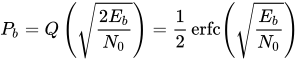
where is the energy per one bit, is the noise spectral density, denotes the Q-function and denotes the complementary error function.

Gaussian minimum-shift keying

[edit]
Power spectral densities of MSK and GMSK. Note that the decreasing of time-bandwidth negatively influences bit-error-rate performance due to increasing intersymbol interference.[8]

Gaussian minimum-shift keying, or GMSK, is similar to standard minimum-shift keying (MSK); however, the digital data stream is first shaped with a Gaussian filter before being applied to a frequency modulator, and typically has much narrower phase shift angles than most MSK modulation systems. This has the advantage of reducing sideband power, which in turn reduces out-of-band interference between signal carriers in adjacent frequency channels.[9]

However, the Gaussian filter increases the modulation memory in the system and causes intersymbol interference, making it more difficult to differentiate between different transmitted data values and requiring more complex channel equalization algorithms such as an adaptive equalizer at the receiver. GMSK has high spectral efficiency, but it needs a higher power level than QPSK, for instance, in order to reliably transmit the same amount of data. GMSK is most notably used in the Global System for Mobile Communications (GSM), in Bluetooth, in satellite communications,[10][11] and Automatic Identification System (AIS) for maritime navigation.

See also

[edit]

References

[edit]
Revisions and contributorsEdit on WikipediaRead on Wikipedia
from Grokipedia
Minimum-shift keying (MSK) is a binary digital modulation technique that represents a special case of continuous-phase (CPFSK), employing a of h=0.5h = 0.5 to achieve the minimum frequency separation necessary for orthogonal signaling while ensuring continuous phase transitions between symbols. It was developed in the late 1950s by engineers Melvin L. Doelz and Earl T. Heald at Collins Radio Company and patented in 1961. This results in a constant envelope signal, which is highly resilient to nonlinear distortion in power amplifiers, and provides excellent due to its compact power with low . MSK operates by modulating the instantaneous of a carrier with rectangular pulses, where the shifts between two values separated by Δf=1/(4Tb)\Delta f = 1/(4T_b) (with TbT_b as the bit duration), maintaining phase coherence over intervals. Mathematically, the transmitted signal can be expressed as s(t)=cos(2πfct+ϕ(t))s(t) = \cos\left(2\pi f_c t + \phi(t)\right), where ϕ(t)\phi(t) evolves linearly with time based on the bits, ensuring and a performance equivalent to binary (BPSK) in channels. Additionally, MSK is equivalent to offset quadrature (OQPSK) with half-sinusoidal on the in-phase and quadrature components, allowing for linear implementation despite its nonlinear nature. The technique's advantages include high power efficiency and reduced bandwidth requirements compared to discontinuous-phase modulations like standard FSK, making it suitable for bandwidth-constrained environments. A filtered variant, Gaussian minimum-shift keying (GMSK), further smooths the phase transitions using a Gaussian pre-filter to suppress spectral sidelobes, and has been integral to standards such as for . MSK's applications extend to and other wireless systems requiring robust, spectrally efficient transmission.

Introduction

Definition and Basics

Minimum-shift keying (MSK) is a binary modulation scheme classified as a form of continuous-phase (CPFSK) characterized by a of exactly 0.5. This corresponds to the minimum separation that permits coherent between the two transmitted frequencies, ensuring efficient spectral utilization while preserving the constant envelope property essential for power-efficient amplification. In MSK, symbols, represented as ±1, are shaped using half-sinusoidal to modulate the instantaneous , which inherently maintains phase continuity across transitions and results in a constant envelope signal resistant to nonlinear . The half-sinusoid , typically spanning one period, smooths the transitions between states, avoiding abrupt changes that could broaden the . Unlike conventional binary frequency-shift keying (FSK), which often exhibits phase discontinuities at symbol boundaries leading to wider spectral occupancy, MSK enforces continuous phase evolution, producing a smoother waveform with reduced out-of-band emissions. This continuity distinguishes MSK as a more spectrally compact alternative suitable for bandwidth-constrained environments. The basic signal structure of MSK can be viewed through an equivalent offset quadrature (OQPSK) representation, where the are orthogonal and staggered by half a period to achieve the continuous phase. This offset ensures that only one component changes at any transition instant, further contributing to the phase smoothness.

Historical Development

Minimum-shift keying (MSK) was invented in the late 1950s by Melvin L. Doelz and Earl T. Heald, engineers at Collins Radio Company. Their work addressed limitations in early (FSK) systems, particularly the inefficiencies of square-wave modulation that led to wider bandwidth occupancy and increased interference in radio communications. By minimizing the frequency shift to exactly half the rate (ΔF = f_i / 2), MSK achieved continuous phase transitions, enabling more compact spectral usage while maintaining constant signals suitable for power-limited transmitters. The technique was formalized in U.S. Patent 2,977,417, filed on August 18, 1958, and granted on March 28, 1961, to Collins Radio Company. This patent described MSK as a solution for low-bandwidth data transmission, such as teletypewriter signals at 60 words per minute with a ±11.5 Hz shift, outperforming prior reactance-shift methods in noise discrimination and . The primary motivation was to enhance in (VLF) systems, where bandwidth constraints were acute, allowing for better interference rejection without sacrificing data rates. During the , MSK saw early adoption in aeronautical and , leveraging Collins Radio's expertise in and defense systems. It was implemented in VLF skywave setups to maximize —up to 50 bits per second or 75 —under challenging conditions like multipath , supporting tactical voice and data links in and ground stations. This integration marked MSK's transition from conceptual innovation to practical deployment in bandwidth-scarce environments.

Modulation Fundamentals

Mathematical Representation

Minimum-shift keying (MSK) can be derived as a special case of continuous-phase (CPFSK), where the hh is set to 0.5 to ensure the minimum frequency separation that allows between signals while maintaining phase continuity. In CPFSK, the transmitted signal is generally expressed as s(t)=Acos(2πfct+2πhk=akq(tkT))s(t) = A \cos\left(2\pi f_c t + 2\pi h \sum_{k=-\infty}^{\infty} a_k q(t - kT)\right), where AA is the signal , fcf_c is the carrier , ak=±1a_k = \pm 1 are the , TT is the symbol duration, hh is the , and q(t)q(t) is the phase function, typically q(t)=tg(τ)dτq(t) = \int_{-\infty}^t g(\tau) d\tau with g(t)g(t) being a rectangular of duration TT and 1/2 (amplitude 1/(2T)1/(2T)). For MSK, substituting h=0.5h = 0.5 yields a frequency deviation of fd=h2T=14Tf_d = \frac{h}{2T} = \frac{1}{4T}, resulting in instantaneous frequencies of fc±fdf_c \pm f_d that correspond to the binary , ensuring the phase change over each symbol interval is ±π/2\pm \pi/2. The phase-continuous representation of the MSK signal emphasizes its constant envelope property and is given by s(t)=Acos[2πfct+ϕ(t)]s(t) = A \cos\left[2\pi f_c t + \phi(t)\right], where the instantaneous phase ϕ(t)\phi(t) is ϕ(t)=ϕk+π2Tbk(tkT)\phi(t) = \phi_k + \frac{\pi}{2T} b_k (t - kT) for kTt<(k+1)TkT \leq t < (k+1)T, with bk=±1b_k = \pm 1 representing the differentially encoded data bits and ϕk\phi_k the phase at the start of the kk-th interval (a multiple of π/2\pi/2 mod 2π2\pi to maintain continuity). This formulation arises directly from the CPFSK structure with h=0.5h = 0.5, as the phase increment per symbol is limited to π/2\pi/2 in magnitude, preventing abrupt jumps and enabling the signal to be represented as a linear frequency modulation over each bit period. MSK is mathematically equivalent to offset quadrature phase-shift keying (OQPSK) with sinusoidal pulse shaping, where the in-phase and quadrature components are staggered by half a symbol period T/2T/2. The time-domain signal in this quadrature form is s(t)=aI(t)cos(πt2T)cos(2πfct)aQ(t)sin(πt2T)sin(2πfct)s(t) = a_I(t) \cos\left(\frac{\pi t}{2T}\right) \cos(2\pi f_c t) - a_Q(t) \sin\left(\frac{\pi t}{2T}\right) \sin(2\pi f_c t), where aI(t)a_I(t) and aQ(t)a_Q(t) are the even and odd subsequences of the binary data symbols (±1)(\pm 1), respectively, and the half-sinusoidal pulses cos(πt/2T)\cos(\pi t / 2T) and sin(πt/2T)\sin(\pi t / 2T) (over 0t2T0 \leq t \leq 2T) ensure smooth transitions without amplitude variations. This representation highlights how the sinusoidal shaping aligns the phase trajectories of the OQPSK variant to match those of the CPFSK-based MSK, producing identical waveforms.

Phase and Frequency Characteristics

Minimum-shift keying (MSK) exhibits a continuous phase trajectory, a defining characteristic that distinguishes it from discontinuous phase modulations like conventional . In MSK, the phase changes linearly over each symbol interval of duration TT by an amount of ±π/2\pm \pi/2, depending on the binary data symbol, which ensures smooth transitions without abrupt jumps at symbol boundaries. This linear phase progression arises from the underlying continuous-phase frequency-shift keying (CPFSK) structure with a rectangular pulse shape, maintaining phase coherence across consecutive symbols. The modulation index in MSK is precisely 0.5, which dictates the frequency deviation and results in the instantaneous frequency alternating between fc+14Tf_c + \frac{1}{4T} and fc14Tf_c - \frac{1}{4T}, where fcf_c is the carrier frequency and TT is the symbol period. This minimum frequency separation minimizes spectral occupancy while preserving the continuous phase property. Additionally, the signal maintains a constant envelope with amplitude fixed at unity, regardless of the transmitted data sequence, which is a direct consequence of the phase-only modulation without amplitude variations. This constant envelope characteristic allows MSK to be amplified efficiently using nonlinear power amplifiers, reducing distortion and improving power efficiency in transmission systems. MSK can also be interpreted through its in-phase (I) and quadrature (Q) components, which are orthogonal and offset by half a symbol period T/2T/2. The I component modulates the cosine carrier, while the Q component modulates the sine carrier with a delayed data stream, ensuring that transitions in one component occur when the other is at zero, thereby preventing any amplitude fluctuations. This orthogonality underpins the equivalence of MSK to offset quadrature phase-shift keying (OQPSK) with half-sine pulse shaping, further reinforcing the constant envelope and continuous phase traits.

Key Properties

Spectral Properties

The power spectral density (PSD) of a minimum-shift keying (MSK) signal is given by G(f)=16Tπ2[cos(2π(ffc)T)116(ffc)2T2]2,G(f) = \frac{16 T}{\pi^2} \left[ \frac{\cos \left( 2\pi (f - f_c) T \right)}{1 - 16 (f - f_c)^2 T^2} \right]^2, where TT is the symbol duration and fcf_c is the carrier frequency (normalized for unit power). This expression arises from the continuous-phase nature of MSK, with a modulation index of 0.5, resulting in a compact spectrum characterized by smoother transitions compared to discontinuous phase modulations. The main lobe of the MSK PSD has a width of 0.78/T, containing approximately 90% of the signal power. The null-to-null bandwidth, defined as the width between the first spectral nulls, is 1.5/T, which is narrower than the 2/T null-to-null bandwidth of binary phase-shift keying (BPSK). This narrower main lobe contributes to MSK's spectral efficiency in bandwidth-constrained systems. MSK exhibits superior out-of-band emission control, with first side-lobes approximately 23 dB below the main lobe level, decaying faster than in quadrature phase-shift keying (QPSK), where the first side-lobes are only about 10 dB down. This rapid side-lobe suppression reduces adjacent channel interference, making MSK suitable for applications requiring minimal spectral regrowth. Additionally, the bandwidth containing 99% of the total power is approximately 1.2/T, significantly outperforming unfiltered QPSK which requires about 20/T for the same power containment.

Error Performance

The bit error probability PbP_b for minimum-shift keying (MSK) in an additive white Gaussian noise (AWGN) channel under coherent detection is given by Pb=Q(2EbN0),P_b = Q\left(\sqrt{\frac{2E_b}{N_0}}\right),
Add your contribution
Related Hubs
User Avatar
No comments yet.