


Community hub
Recent from talks
Contribute something
Nothing was collected or created yet.
EMD GP20
View on Wikipedia | This article includes a list of general references, but it lacks sufficient corresponding inline citations. (September 2012) |
| EMD GP20 | |||||||||||||||||||||||||||||||||||||||||||||||
|---|---|---|---|---|---|---|---|---|---|---|---|---|---|---|---|---|---|---|---|---|---|---|---|---|---|---|---|---|---|---|---|---|---|---|---|---|---|---|---|---|---|---|---|---|---|---|---|
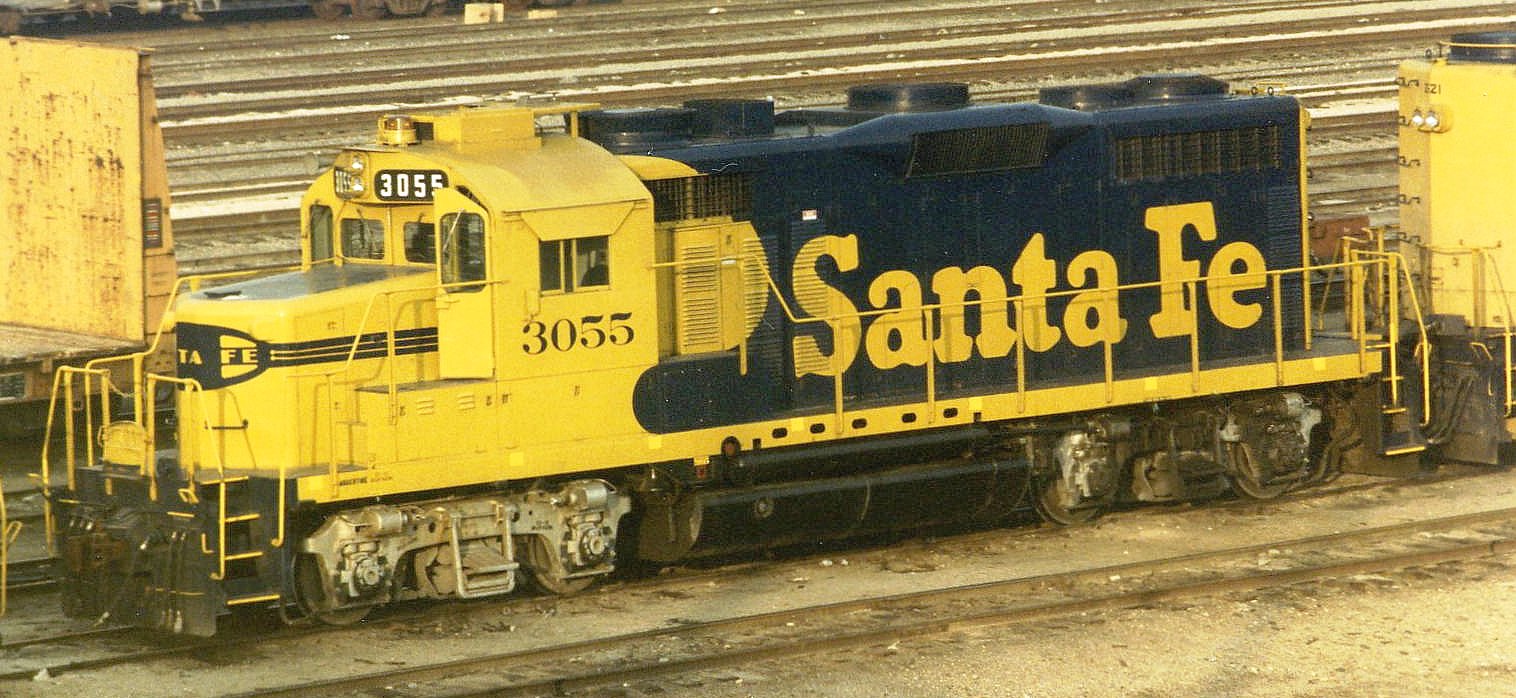
 ATSF 3055 in San Bernardino, California | |||||||||||||||||||||||||||||||||||||||||||||||
| |||||||||||||||||||||||||||||||||||||||||||||||
| |||||||||||||||||||||||||||||||||||||||||||||||
| |||||||||||||||||||||||||||||||||||||||||||||||
| |||||||||||||||||||||||||||||||||||||||||||||||
The EMD GP20 is a 4-axle diesel-electric locomotive built by General Motors' Electro-Motive Division between November 1959 and April 1962. Power was provided by an EMD 16-567D2 16-cylinder turbocharged engine which generated 2,000 horsepower (1,500 kW). EMD was initially hesitant to turbocharge their 567-series diesel engine, but was spurred on to do so following successful tests made by Union Pacific in the form of UP's experimental Omaha GP20 units. 260 examples of EMD's production locomotive model (with the EMD turbocharger) were built for American railroads.
The GP20 was the second EMD production locomotive to be built with an EMD turbocharged diesel engine, sixteen months after the six-axle (C-C) model SD24. Power output of the turbocharged SD24 was 33 percent higher than the 1,800 hp (1,340 kW) of the concurrent Roots blower-equipped SD18s with the same engine displacement, 400 hp (298 kW) per axle, but the power output of the turbocharged GP20 was only 11 percent higher than the 1,800 hp (1,340 kW) of the concurrent Roots blower-equipped GP18s with the same engine displacement 500 hp (373 kW) per axle, due to the limitations of the traction motors then available. Nevertheless, the turbocharged GP20 provided full rated power at all altitudes, which the Roots-blown GP18 could not provide.
EMD-type Turbo-Compressor (Turbocharger)
[edit]The turbocharger was the then-new EMD mechanically assisted turbo-compressor. During engine startup, and at lower power levels, during which there is not sufficient exhaust heat energy to drive the turbine fast enough for the compressor to supply the air necessary for combustion, the engine drives the compressor through a gear train and a freewheel. At higher power levels, the freewheel is disengaged, and the turbo-compressor operates as a true turbocharger. It is possible for the turbo-compressor to revert to compressor mode momentarily during commands for large increases in engine power. Turbocharging provides higher horsepower and good running characteristics at all altitudes. Turbocharging also improves fuel consumption and reduces emissions.
Previous Union Pacific experiments with turbocharging had used multiple Elliot[1] or Garrett AiResearch turbochargers feeding the usual pair of Roots blowers. EMD's mechanically assisted turbocharger eliminated the need for the pair of Roots blowers and also integrated the turbocharging function from two (Elliot) or four (AiResearch) smaller add-on turbochargers into one much larger, turbo-compressor (turbocharger) with intercooling.
The introduction of the EMD-type turbocharger was successful and all subsequent GP series were offered with this turbocharger, although not all models within a series were offered with turbocharging (e.g., the 38 models were Roots-blown).
Original buyers
[edit]| Railroad | Quantity | Road numbers | Notes |
|---|---|---|---|
| Electro Motive Division (demonstrators) | 4
|
5625–5628
|
to Southern Pacific 7234–7237 |
| Atchison, Topeka and Santa Fe Railway | 75
|
1100–1174
|
|
| Chicago, Burlington and Quincy Railroad | 36
|
900–935
|
to Burlington Northern Railroad 2036–2071 |
| Great Northern Railway | 36
|
2000–2035
|
High short hood; to Burlington Northern Railroad 2000–2035, 1700 gallon fuel tanks |
| New York Central Railroad | 15
|
6100–6114
|
no dynamic brake; to Penn Central 2100-2112; to Conrail same numbers |
| Southern Pacific Company | 34
|
7200–7233
|
|
| St. Louis Southwestern Railway | 20
|
800–819
|
|
| Union Pacific Railroad | 30
|
700–729
|
|
| Western Pacific Railroad | 10
|
2001–2010
|
High short hood; Second Order used Blomberg B trucks from traded-in FTs |
| Total | 260 |
Preservation
[edit]
- Western Pacific 2001, the very first GP20 built, is preserved at Western Pacific Railroad Museum at Portola, CA.
- KLIX 2003, originally Cotton Belt 815, is being stored at the Arkansas Railroad Museum in Pine Bluff, AR.
- Midland Railway 4079, originally Southern Pacific 7229, is on The Midland Railway in Baldwin City, Kansas.
References
[edit]- ^ "Elliot Turbochargers". Sinor Engine Company, Inc. Archived from the original on 2012-03-22.
Bibliography
[edit]- Pinkepank, Jerry A. (1973). The Second Diesel Spotter's Guide. Milwaukee, Wisconsin: Kalmbach Publishing. ISBN 978-0-89024-026-7.[page needed]
External links
[edit]- "Omaha GP20's, Union Pacific's GP9 turbocharging program". Utah Rails. August 29, 2015.
- "EMD Road Switchers: GP20". Utah Rails.
- http://www.trainweb.org/jaydeet/gp20.htm Robert Sarberenyi roster with phase information and fuel tank size

- photos of EMD GP20s rrpicturearchives.net

EMD GP20
View on GrokipediaDevelopment
Background and Origins
In the late 1950s, U.S. railroads faced increasing demands for diesel locomotives capable of delivering higher horsepower ratings while maintaining the same engine displacement, driven by the need to handle heavier freight loads and longer trains across varied terrains without expanding physical engine sizes. This push was particularly acute for roads operating in high-altitude regions, where naturally aspirated engines suffered power losses of up to 14% due to thinner air, prompting innovations in forced induction to boost performance efficiently.[5][2] Union Pacific Railroad led the way with experimental turbocharging of existing EMD GP9 units starting in December 1955, with initial work at its East Los Angeles shops and later expansions at Omaha in 1959, modifying twenty locomotives—ten with AiResearch turbochargers and ten with Elliott models—to evaluate real-world viability. These "Omaha GP20s," drawn from UP's 300-class GP9 fleet built in 1957, underwent extensive road testing in revenue service, including routes through challenging elevations like those near Salt Lake City, where they demonstrated reliable power gains and minimal maintenance issues compared to earlier aftermarket attempts. The tests provided critical feedback to EMD, confirming the potential of turbocharging their 16-cylinder 567 engine and highlighting the superiority of EMD's own developing design over competitors'.[5] Responding to these results, EMD accelerated its turbocharger program despite initial reluctance to alter the proven naturally aspirated 567 series. By mid-1959, EMD had completed nine pre-production GP20 prototypes, including units like UP 301 tested that March, which incorporated the new system and validated its integration into the GP series frame. This successful evaluation directly influenced production approval, marking a pivotal shift toward turbocharged "second-generation" diesels.[2][5]Production Overview
The EMD GP20, a four-axle road-switcher locomotive, was manufactured by the Electro-Motive Division (EMD) of General Motors at its primary assembly plant in La Grange, Illinois.[1][6] Prior to full production, EMD built four demonstrator units (5626-5629) in 1960, which were tested and later sold to the Southern Pacific Railroad as 7234-7237.[1] Production commenced in November 1959 with the delivery of the first units to the Western Pacific Railroad and continued until April 1962, spanning a total run of approximately 29 months.[1] During this period, EMD built 260 production GP20s, all equipped with a turbocharged 16-cylinder 567D2 diesel engine rated at 2,000 horsepower.[1][4] In addition to the factory-new units, Union Pacific Railroad undertook a pre-production program in 1959, rebuilding nine of its existing GP9 locomotives to GP20 specifications by installing EMD turbochargers on their 567C engines, resulting in equivalent 2,000-horsepower output.[7] These rebuilds, drawn from Phase III GP9s including units 300-301 (A-B-A sets) and others like 305, 308B, 311, 313, and 320, served as proof-of-concept demonstrators that influenced the full production model's design.[7] The base cost for a new GP20 was approximately $212,000 per unit in late 1959 dollars, reflecting the advanced turbocharging technology and robust construction for heavy freight service.[8] Production models exhibited minor variations between early and late runs to enhance crew ergonomics and operational efficiency. Early units, such as those delivered to Western Pacific (2001-2006) and Great Northern (2000-2011), featured a high short hood extending nearly to the cab height, which provided additional structural protection but limited forward visibility.[1] Later production incorporated a low short hood design, sloping downward from the cab for improved sightlines during switching and road operations, a change implemented starting with orders like Union Pacific's 700-729 in 1960.[1] Other adjustments included refined hood contours and optional dynamic brake configurations, with New York Central's 15 units notably omitting dynamic brakes to reduce weight and cost.[1] These evolutions ensured the GP20's adaptability across diverse railroad fleets while maintaining core standardization.[1]Design Features
Engine and Turbocharger
The EMD GP20 locomotive was powered by a 16-567D2 prime mover, a V16 two-stroke diesel engine developed by General Motors' Electro-Motive Division (EMD). This engine featured a bore of 8.5 inches and a stroke of 10 inches, delivering 2,000 horsepower at a maximum speed of 800 rpm.[1] The two-stroke design relied on port scavenging, where fresh air entered through intake ports in the cylinder walls near the bottom of the piston stroke and exited via poppet exhaust valves in the cylinder heads.[9] The engine's forced induction system centered on an innovative EMD mechanically assisted turbo-compressor, marking the first production use of turbocharging in a four-axle EMD road-switcher. This single-stage centrifugal compressor used exhaust gases to drive its turbine wheel, boosting intake air pressure for improved combustion efficiency across varying altitudes and loads, unlike the naturally aspirated Roots-blown predecessors.[1][4] At low throttle settings (1-5), a planetary gear train mechanically linked the compressor to the engine crankshaft provided initial boost and rapid spool-up, ensuring responsive performance during startup and light loads; above throttle 6, an electromagnetic clutch disengaged the mechanical drive, allowing the compressor to operate purely on exhaust energy for higher power output.[4][5] The Roots blower, driven by the crankshaft, continued to handle primary scavenging duties, pumping air at approximately 5 psi to purge exhaust gases from the cylinders before compression, with the turbocharger enhancing this air charge for greater power density.[9][5] The fuel system supported extended operations with a standard capacity of 2,350 US gallons in an underframe tank, though some units like those for the Great Northern Railroad had reduced 900-gallon tanks.[4] Fuel delivery involved mechanical injection timed to the two-stroke cycle, with engine starting accomplished via an air-start system using compressed air from an onboard compressor to spin the crankshaft. Compared to non-turbocharged GP models like the GP18, which used a similar 16-567 block rated at 1,800 hp via Roots blower alone, the GP20's turbocharging achieved 2,000 hp without enlarging the engine or altering the basic architecture, enabling higher power output in the same compact package.[1][4] This design innovation, inspired by Union Pacific's experimental turbocharged GP9 rebuilds, addressed limitations in high-altitude performance and fuel efficiency.[5]Structural and Electrical Components
The EMD GP20 is configured as a B-B hood unit locomotive, featuring four axles arranged in two two-axle trucks, with an overall length of 56 feet 2 inches and an operating weight of 240,000 pounds.[10] This design provided a robust frame capable of supporting the locomotive's diesel-electric powertrain while maintaining stability for road freight service on standard gauge tracks. The frame was constructed using standard EMD welded steel construction, which allowed for efficient integration of the hood, cab, and underframe components, contributing to the unit's durability in heavy-duty operations.[11] The GP20 utilized EMD Blomberg B trucks, each with a 9-foot wheelbase and equipped with 40-inch diameter wheels fitted with roller bearings for reduced friction and improved ride quality.[10] These trucks were cast designs that distributed the locomotive's weight evenly across the axles, with each axle load approximately 60,000 pounds, enhancing traction and minimizing wear on the rail infrastructure.[11] The Blomberg B's spring-and-equalizer suspension system further aided in absorbing track irregularities, making the GP20 suitable for varied terrain in freight hauling.[12] Electrically, the GP20's system centered on a GM D22 main generator directly coupled to the prime mover, which supplied power to four GM D47 traction motors—one per axle—for propulsion.[1] These motors operated on a 64-volt circuit, converting electrical energy into mechanical torque via pinion gears on the axles, with Delco electric-drive blowers providing cooling to prevent overheating during sustained operation. Dynamic braking was incorporated through resistor grids that dissipated energy as heat when the traction motors functioned as generators, allowing controlled retardation without relying solely on air brakes; these grids were housed in the locomotive's roof and sides for effective ventilation.[13] The cab design featured a standard EMD control stand, positioned for operation from the short hood end, which included throttle, reverser, and dynamic brake controls for intuitive handling by crews familiar with EMD equipment.[14] Early production units had a low short hood, but later builds, particularly for railroads like the Great Northern, incorporated a high short hood configuration to improve forward visibility and provide additional space for auxiliary equipment while enhancing crew protection in collisions.[15] This hood variation maintained the locomotive's streamlined profile without altering the overall structural integrity.[16]Operational Use
Original Purchasers
The EMD GP20 was purchased by eight Class I railroads between November 1959 and April 1962, with a total production of 260 units.[1] These locomotives were primarily intended for road freight service on secondary lines, where their four-axle configuration provided better performance on lighter rail compared to six-axle models, while the turbocharged 2,000-horsepower engine offered improved power for drag freights and branchline operations.[1] Orders varied in size, with the largest going to the Atchison, Topeka and Santa Fe Railway, reflecting the model's appeal for medium-haul freight duties in diverse terrains. The Atchison, Topeka and Santa Fe placed the largest order for 75 units, delivered in two batches during 1960 and 1961, painted in the distinctive blue-and-yellow "Kodachrome" scheme for visibility on mainline and secondary freight runs.[17][1] The Chicago, Burlington & Quincy ordered 36 units in early 1961, assigning them to general freight service across its Midwest network, with standard low short hoods for crew visibility.[18] Similarly, the Great Northern Railway acquired 36 high-hood variants in 1960, customized for snowy mountain routes in the Pacific Northwest to enhance crew protection and maintenance access.[1] Other significant buyers included the Southern Pacific, which took delivery of 34 units in 1962 and four former demonstrators (built August 1960) for freight assignments in California and the Southwest, initially in gray-and-red livery.[19][1] The St. Louis Southwestern Railway (Cotton Belt) ordered 20 units across late 1960 and early 1962 for regional freight in Arkansas and Texas.[20] The Union Pacific received 30 new units in mid-1960. UP also had nine GP9s rebuilt to GP20 standards by EMD in 1959, deployed on overland freights with low hoods and dynamic brakes.[7] The Western Pacific was the inaugural customer with 10 units starting in November 1959, featuring high short hoods and used for intermountain freight hauls in silver-and-orange paint.[8] The New York Central rounded out the buyers with 15 units in mid-1961, equipped without dynamic brakes for Eastern freight corridors.[21]| Railroad | Road Numbers | Build Dates | Notes |
|---|---|---|---|
| Atchison, Topeka and Santa Fe | 1100–1174 | May–July 1960; August–December 1961 | 75 units; low hoods; "Kodachrome" blue-and-yellow paint scheme.[17][1] |
| Chicago, Burlington & Quincy | 900–935 | February–April 1961 | 36 units; low hoods; black-and-gray scheme.[18][1] |
| Great Northern | 2000–2035 | April 1960; November–December 1960 | 36 units; high hoods; green-and-black "Empire Builder" scheme.[1] |
| Southern Pacific | 7200–7233; 7234–7237 (ex-demos) | January–April 1962; August 1960 (demos) | 38 units; low hoods; gray-and-red paint; demonstrators originally EMD 5625–5628.[19][1] |
| St. Louis Southwestern (Cotton Belt) | 800–809; 810–819 | December 1960–January 1961; December 1961–January 1962 | 20 units; low hoods; scarlet-and-gray scheme.[20][1] |
| Union Pacific | 700–729 | July–August 1960 | 30 new units; low hoods; yellow-and-gray scheme. (Nine separate GP9 rebuilds to GP20 standards in 1959)[7][1] |
| Western Pacific | 2001–2006; 2007–2010 | November–December 1959; July 1960 | 10 units; high short hoods; silver-and-orange scheme with winterization hatches.[8][1] |
| New York Central | 6100–6114 | July–August 1961 | 15 units; low hoods; no dynamic brakes; black-and-silver scheme.[21][1] |
Service Life and Rebuilds
The EMD GP20 locomotives primarily served in freight hauling roles during the 1960s through the 1980s, often assigned to branch lines, secondary road duties, and yard operations across various U.S. railroads.[7] Early in their careers, some units handled priority freight trains requiring higher speeds, while others supported limited passenger services before transitioning to more localized assignments.[22] Railroads like the Union Pacific and Atchison, Topeka & Santa Fe deployed them for general freight on regional routes, where their 2,000 horsepower output provided reliable performance for medium-duty tasks.[4] Rebuild programs extended the GP20's operational viability, with several railroads upgrading existing units to address wear and improve efficiency. The Union Pacific rebuilt 47 GP9s to "Omaha GP20" standards at its Omaha Shops starting in the 1960s by installing turbochargers on their 16-567C engines. Separately, nine other GP9s were rebuilt to true GP20 specifications (with turbocharged 16-567D2 engines) at EMD in 1959.[5] Similarly, the Milwaukee Road rebuilt GP9s into GP20s during the 1970s at its Milwaukee Shops, incorporating EMD 645-series engines for enhanced power without turbocharging, along with modifications like chopped noses and improved air filtration.[23] The Atchison, Topeka & Santa Fe conducted general overhauls in the late 1970s at San Bernardino Shops, renumbering units from the 1100 class to the 3100 class and updating components for better reliability and emissions compliance in Phase II and III programs.[17] Later rebuilds by other carriers, such as conversions to GP21s by Precision National Corporation, replaced original engines with 12-cylinder 645 models and modernized electrical systems.[7] Most GP20s were retired by the 1990s as railroads adopted higher-horsepower successors like the GP40, which offered greater efficiency for mainline service.[2] The Union Pacific began retirements in 1977, scrapping or selling units through 1984, with an average service life of 17 to 24 years.[7] Santa Fe units lasted longer, with the final ones stored in 1999 after mergers into the Burlington Northern Santa Fe.[2] Post-retirement, many were exported to short-line operators or leased internationally, allowing a portion to remain active into the 2000s on secondary railroads. As of 2025, a small number remain in service on short line railroads.[4][1] Operational challenges for the GP20 centered on the turbocharger's integration with the two-cycle 567 engine, leading to frequent maintenance needs and reliability concerns.[4] In hot climates, such as those encountered by Western Pacific and Union Pacific units in the Southwest, turbocharger failures were common due to overheating and exhaust system stress, prompting some fleets to derate power output for longevity.[7] Wrecks and early mechanical issues further shortened service for select units, though rebuilds mitigated these over time.[7]Preservation
Surviving Units
Several EMD GP20 locomotives have been preserved, primarily in museums, tourist operations, and static displays across the United States, reflecting their historical significance as early turbocharged road-switchers. As of 2025, at least six units remain extant, with varying degrees of operational capability. The first production GP20, Western Pacific 2001 (built November 1959, builder's number 25601), is preserved at the Western Pacific Railroad Museum in Portola, California, where it has been restored to operating condition for excursion service.[24] This unit, originally assigned to the Western Pacific Railroad, serves as a key exhibit highlighting the model's introduction of turbocharging technology. KLIX 2003 (ex-St. Louis Southwestern 815, built January 1962, builder's number 26948) is on static display at the Arkansas Railroad Museum in Pine Bluff, Arkansas.[25] Formerly owned by the Klamath Pacific Railroad, this unit remains at the museum site pending relocation to the Rock Island Railroad collection in Hernando, Mississippi.[25] Midland Railway 4079 (ex-Southern Pacific 7229, built April 1962, builder's number 27350), rebuilt to GP20E configuration in the 1970s, operates in tourist service at the Midland Railway Historical Association in Baldwin City, Kansas.[26] This locomotive, which lost its turbocharger during rebuilding, powers passenger trains on the association's heritage line.[26] Among former Atchison, Topeka and Santa Fe units, Blacklands Railroad 2036 (ex-ATSF 1152, built October 1961, builder's number 26858) remains in active freight service on the shortline between Mount Pleasant and Winfield, Texas.[27] Rebuilt to GP20u standards, it is leased from Pioneer Railcorp and represents one of the few GP20s still in revenue operations.[27] Blue Ridge Scenic Railway 4125 (ex-Southern Pacific 7207, built January 1962, builder's number 26822) is operational for tourist excursions based in Blue Ridge, Georgia.[28] This unit, acquired in the 1990s, hauls passenger trains along the former Georgia Northeastern route through the Appalachian foothills.[28] Iowa Northern 2000 (ex-Southern Pacific 7233, built April 1962, builder's number 27392), rebuilt to GP20E, is preserved as a static exhibit in a public park in Manly, Iowa, alongside a Rock Island caboose.[29] Donated by the Iowa Northern Railway in the early 2000s, it commemorates the railroad's history on former Rock Island trackage.[29]| Unit Number | Original Owner | Build Date (Builder's No.) | Current Location/Owner | Status |
|---|---|---|---|---|
| WP 2001 | Western Pacific | Nov 1959 (25601) | Western Pacific Railroad Museum, Portola, CA | Operational (excursions) |
| KLIX 2003 | St. Louis Southwestern | Jan 1962 (26948) | Arkansas Railroad Museum, Pine Bluff, AR | Static display |
| Midland 4079 | Southern Pacific | Apr 1962 (27350) | Midland Railway Historical Association, Baldwin City, KS | Operational (tourist) |
| Blacklands 2036 | ATSF | Oct 1961 (26858) | Blacklands Railroad, Mount Pleasant, TX | Operational (freight) |
| Blue Ridge 4125 | Southern Pacific | Jan 1962 (26822) | Blue Ridge Scenic Railway, Blue Ridge, GA | Operational (tourist) |
| Iowa Northern 2000 | Southern Pacific | Apr 1962 (27392) | Public park, Manly, IA | Static display |