Hubbry Logo
EMD GP30EMD GP30Main
Open search
EMD GP30
Community hub
EMD GP30
logo
8 pages, 0 posts
0 subscribers
Be the first to start a discussion here.
EMD GP30
EMD GP30
from Wikipedia
EMD GP30
A GP30, GP35, and GP20 run light in the late 1980s on California's Cajon Pass
Type and origin
Power typeDiesel-electric
Builder
ModelGP30
Build dateJuly 1961 – November 1963
Total produced948
Specifications
Configuration:
 • AARB-B
 • UICBo′Bo′
Gauge4 ft 8+12 in (1,435 mm)
Wheel diameter40 in (1.02 m)
Length56 ft 2 in (17.12 m)
Width10 ft 4 in (3.15 m)
Height15 ft 11 in (4.85 m)
Loco weight245,000 lb (111,130 kg)
Fuel capacity1,700–2,600 US gal (6,400–9,800 L; 1,400–2,200 imp gal)
Lubricant cap.243 US gal (920 L; 202 imp gal)
Coolant cap.251 US gal (950 L; 209 imp gal)
Sandbox cap.18 cu ft (0.51 m3)
Prime moverEMD 16-567D3
RPM:
 • RPM idle275
 • Maximum RPM835
Engine typeTwo-stroke V16 diesel
AspirationTurbocharger
GeneratorEMD D22
Traction motors4 × EMD D57
Cylinders16
Cylinder size8+12 in × 10 in (216 mm × 254 mm)
Gear ratio
  • 62:15
  • 61:16
  • 60:17
Loco brakeSchedule 26L Straight air, optional: dynamic
Performance figures
Maximum speed71–83 mph (114–134 km/h)
Power output2,250 hp (1,680 kW)
Career
LocaleNorth America
[1]
WC 715 at the National Railroad Museum in Green Bay, WI

The EMD GP30 is a 2,250 hp (1,680 kW) four-axle diesel-electric locomotive built by General Motors Electro-Motive Division of La Grange, Illinois between July 1961 and November 1963.[2] A total of 948 units were built for railroads in the United States and Canada (2 only), including 40 cabless B units for the Union Pacific Railroad.[3]

It was the first so-called "second generation" EMD diesel locomotive, and was produced in response to increased competition by a new entrant, General Electric's U25B, which was released roughly at the same time as the GP30. The GP30 is easily recognizable due to its high profile and stepped cab roof, unique among American locomotives.[3] A number are still in service today in original or rebuilt form.

History

[edit]

Development

[edit]

The GP30 was conceived out of the necessity of matching new competitor GE's U25B. The U25B offered 2,500 hp (1,860 kW) while EMD's GP20 and its 567D2 prime mover was only rated at 2,000 hp (1,490 kW). The U25B also featured a sealed, airtight long hood with a single inertial air intake for electrical cooling, with a pressurized cooling system which kept dust out of the engine and equipment area. Finally, the entire GE design was optimized for ease of access and maintenance. The U25B demonstrators were receiving much praise—and orders—from the railroads that tested them. Meanwhile, ALCO had been producing the 2,400 hp (1,800 kW) RS-27 since 1959, though it had not sold well.

EMD's engineering department pushed their DC traction system for an extra 250 hp (186 kW). The 2,250 hp (1,680 kW)[4] wasn't quite equivalent to the GE and ALCO offerings, but EMD hoped the railroads' familiarity with EMD equipment would improve their chances. The locomotive in which the 16 cylinder, 567D3 would be fitted, was improved along the lines of the U25B; sealed long hood, central air intake, and engineered for easier maintenance access. The frame and trucks of the GP20 were carried across; the extra equipment for the centralized air system required more space behind the cab, and since the locomotive was not going to be lengthened, extra space was achieved vertically by raising the height of the locomotive, giving room for the central air system, turbocharger and electrical cabinet all behind the cab.[3][page needed][4] This extra height behind the cab meant that the body style used for previous GP units was not suitable.

Since EMD wanted the new locomotive to be visibly modern and updated, they turned to the GM Automotive Styling Center at Troy, Michigan for help. The automobile stylists created the GP30's trademark "hump" and cab roof profile. The hump-like bulge started at the front of the cab and enveloped the air intakes for the central air system and the dynamic brake blister.[3][page needed] Units ordered without dynamic brakes were the same shape, but lacked the intakes to cool the dynamic brake resistor grids.

A high short hood could be ordered, but only holdouts Norfolk and Western Railway and Southern Railway received such units. EMD originally planned to name the locomotive the GP22, but EMD's marketing department decided to leapfrog GE's numbering to make the new locomotive seem more advanced.[5][page needed] Marketing literature claimed 30 distinct improvements from the GP20 and that this was the reason for the number.[5][page needed]

Sales and in service

[edit]

The GP30 successfully countered the GE threat and kept EMD in the dominant position in the North American diesel market. While losing a little power to the GE and ALCO competition, the solidity and reliability of the GP30—and the familiarity of railroad mechanical departments with EMD products—ultimately won many more orders for EMD. 948 were sold, in comparison to 476 U25Bs. In addition, the GP30 was only sold until the end of 1963, while the U25B was available until 1966.

An EMD GP30 originally owned by the Louisville and Nashville Railroad -- Oak Ridge, TN

Most major railroads ordered GP30s, and many smaller ones did too. The largest orders were from the SOU (120), UP (111), ATSF (85), and the B&O (77).

The sole purchaser of B units (by the mid-1960s generally an outdated concept) was the UP, who kept the practice of running its locomotives in matched sets much longer than others. Thirteen of those GP30B units were fitted with steam generators for heating passenger trains, the only GP30s to receive them. Prior to Amtrak, UP would use a GP30 and two boiler equipped GP30Bs on passenger trains when no E8s or E9s were available.

Some units for the GM&O, MILW and SOO were built using trucks from ALCO trade-ins and therefore ride on AAR type B trucks instead of the EMD standard Blomberg Bs. An indisputable tribute to the quality of the GP30 design is the fact that a good number are still in service as of 2015, which is a service lifespan of over 50 years and well in excess of the design life of 25–30 years for the average diesel locomotive. Furthermore, when life-expired, some railroads chose to give them major rebuilds instead of scrapping them.

Original buyers

[edit]

Cab-equipped 'A' units

[edit]
Railroad Quantity Road numbers Notes
Electro Motive Division (demonstrator) 2 5629 to Union Pacific Railroad 875
5639 to Seaboard Air Line Railroad 534, to Seaboard Coast Line Railroad 1343
Alaska Railroad 1 2000
Atchison, Topeka and Santa Fe Railway 85 1200–1284 Renumbered 3200–3284. Rebuilt versions called GP30u**upgraded at Cleburne, Texas shops.
Atlantic Coast Line Railroad 9 900–908 to Seaboard Coast Line Railroad 1300–1308
Baltimore and Ohio Railroad 77 6900–6976
Chesapeake and Ohio Railway 48 3000–3047
Chicago, Burlington and Quincy Railroad 38 940–977 to Burlington Northern Railroad 2217–2254
Chicago and Eastern Illinois Railroad 3 239–241
Chicago Great Western Railway 8 201–208 to Chicago & North Western Railway 802–809
Chicago, Milwaukee, St. Paul and Pacific Railroad 16 340–355 AAR type B trucks. Renumbered 1000–1015
Chicago and North Western Railway 14 810–832
Canadian Pacific Railway 2 8200–8201 Built by General Motors Diesel (GMD) in London, Ontario. Renumbered 5000–5001
Denver and Rio Grande Western Railroad 28 3001–3028
Great Northern Railway 17 3000–3016 to Burlington Northern Railroad 2200–2216
Gulf, Mobile and Ohio Railroad 31 500–530 AAR type B trucks
Kansas City Southern Railway 20 100–119
Louisville and Nashville Railroad 58 1000–1057
New York Central Railroad 10 6115–6124 to Penn Central 2188–2197, to Conrail same numbers
New York, Chicago and St. Louis Railroad 10 900–909 to Norfolk and Western 2900-2909, to Norfolk Southern same numbers
Norfolk and Western Railway 44 522–565 High short hood, operated long hood-forward
Pennsylvania Railroad 52 2200–2251 2250-2251 renumbered to Penn Central then Conrail 2198–2199, 2200–2249 to Penn Central then Conrail same numbers
Phelps Dodge Corporation 9 24–32 New Cornelia Branch mine
Reading Company 20 5501–5520 renumbered 3600–3619; to Conrail 2168-2187
Seaboard Air Line Railroad 34 500–533 to Seaboard Coast Line Railroad 1309–1342
Soo Line Railroad 22 700–721 AAR type B trucks. Eighteen to Wisconsin Central Limited, same numbers
Southern Pacific Railroad 8 7400–7407
Southern Railway 120 2525–2644 High short hood
St. Louis Southwestern Railway 10 750–759
Toledo, Peoria and Western Railway 1 700 To ATSF as 3285
Union Pacific Railroad 111 700–735, 800–874
Totals 908[4]

Cabless booster 'B' units

[edit]
Railroad Quantity Road numbers Notes
Union Pacific Railroad 40 700B–739B Thirteen units, 727B-739B, fitted with steam generators
Totals 40[4]

Rebuilds

[edit]
BNSF #2831, a GP39M, leading BNSF #1418, a GP10
BNSF #2472, a GP30u

The Burlington Northern Railroad was the most extensive user of rebuilt GP30s. Finding a need for modernized units of lower power, it sent GP30s—-both its own and units purchased from other railroads-—to be rebuilt to the specifications of the later GP39.[6] Seventy units were sent to EMD, 65 to Morrison Knudsen (now Washington Group International) and 25 to VMV for rebuilding, and the rebuilds are known as GP39E, GP39M, and GP39V respectively. The changes included new generators, Dash-2 modular electronic control systems and 567D3 engines upgraded with EMD 645-series power assemblies, rated at 2,300 hp (1,720 kW) and designated 12-645D3. Some of these units received new EMD spartan cabs. These units are still in service on locals and smaller lines throughout the BNSF Railway system.[citation needed]

BNSF #2745 a GP39E
BNSF #2745, a GP39E

The Atchison, Topeka and Santa Fe Railway (ATSF) had previously performed a similar upgrade in its own Cleburne, Texas shops, stripping the locomotives down to bare metal and rebuilding with new equipment. The 567D3 engines were upgraded to a 2500-horsepower rating by the use of 645-series power assemblies. The generators and traction motors were upgraded and control and electrical equipment was replaced. The trucks received Hyatt roller bearings and single-shoe brake systems. Rooftop air conditioners and new horns were added. The locomotives were repainted in the blue and yellow Yellowbonnet scheme, and designated GP30u (for upgraded). 78 of these survived until the BNSF merger, and were eventually all sold off. In 2016, BNSF traded Larry's Truck and Electric (LTEX) 26 GP38s for 24 of the ex-ATSF GP30us for their GP39-3 rebuild program. The Reading Blue Mountain and Northern Railroad acquired a total of six of the former BNSF/ATSF GP30us from LTEX and designates them as GP39RN locomotives.[7]

The Soo Line Railroad rebuilt three GP30s with CAT 3516 engines rated at 2,000 horsepower (1.49 MW). These were designated GP30C.[citation needed]

The Illinois Central Gulf Railroad rebuilt two GP30s in the early 1980s. These units were designated GP26. As of 2018, the units remain in service on the Cimarron Valley Railroad.[8]

The Chessie System rebuilt its GP30 units into GP30Ms, adding newer components, new traction motors and reducing their power to 2000 hp.[9] They lasted with CSX into the mid-to-late 1990s, long after Seaboard System GP30s had been sold, retired and scrapped, or turned into road slugs.

Preservation

[edit]

Many GP30s have been preserved by a variety of museums, societies and tourist railways. All preserved examples are cab units, as the cabless booster units have been scrapped. A number of these preserved locomotives are in operational condition. The following is a list of preserved GP30s in North America.

New Hope and Ivyland Railroad 2198
GP30s in preservation
Original railroad Original road number Preserved railroad Preserved road number Preservation organization Location Status Citations Notes
Baltimore & Ohio 6944 Baltimore & Ohio 6944 B&O Railroad Museum Baltimore, Maryland Operable [10]
Chesapeake & Ohio 4625 Branson Scenic Railway 99 Branson Scenic Railway Branson, Missouri Operating [11][12][13] South end locomotive
Canadian Pacific 5000 Canadian Pacific 5000 Alberta Railway Museum Edmonton, Alberta Preserved [14] One of only two GP30s built in Canada
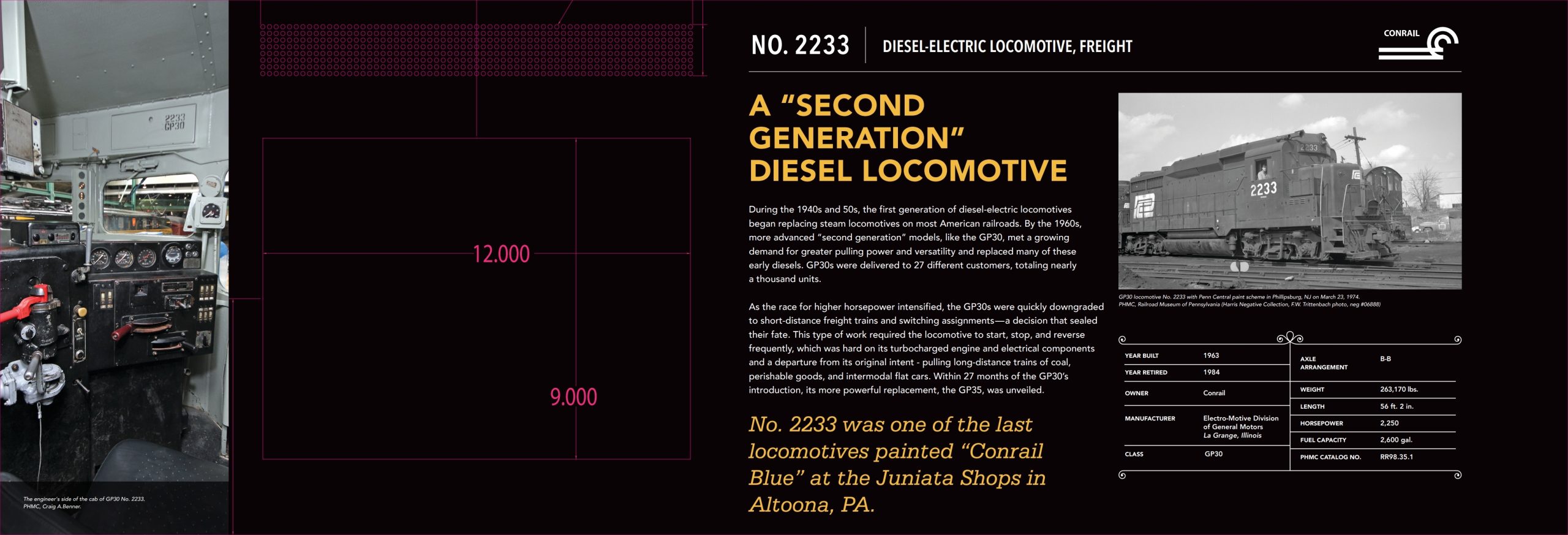
Pennsylvania Railroad 2233 Conrail 2233 Railroad Museum of Pennsylvania Strasburg, Pennsylvania Static display [15][16][13] Formerly operated on the West Shore Railroad in Lewisburg, PA between the late 1980s and early 2000s and was repainted in its original PRR colors during that time.
Cotton Belt 5006 Cotton Belt 5006 Arkansas Railroad Museum Pine Bluff, Arkansas Preserved [17][13]
Denver & Rio Grande Western 3006 Denver & Rio Grande Western 3006 Forney Transportation Museum Denver, Colorado Preserved [18]
Denver & Rio Grande Western 3011 Denver & Rio Grande Western 3011 Colorado Railroad Museum Golden, Colorado Preserved [19]
Pennsylvania Railroad 2250 New Hope & Ivyland 2198 New Hope & Ivyland New Hope, Pennsylvania Operating [20][13] Hauls daily tourist trains
Nickel Plate Road 900 Nickel Plate Road 900 Mad River & NKP Railroad Museum Bellevue, Ohio Preserved [21]
Nickel Plate Road 901 Nickel Plate Road 901 Lebanon Mason Monroe Railroad Cincinnati, Ohio Operating [22][23][24][25]
Nickel Plate Road 902 Nickel Plate Road 902 Cincinnati Scenic Railway Cincinnati, Ohio Operating [23][26][25]
Norfolk & Western 522 Norfolk & Western 522 Roanoke Chapter of the NRHS Roanoke, Virginia Under repair [27]
Norfolk & Western 536 Norfolk & Western 536 GSMR Dillsboro, North Carolina Static display On display along with U18B #1901 following filming of The Fugitive.
Reading 5513 Reading 5513 Reading Company Technical & Historical Society Hamburg, Pennsylvania Under repair [28][13] The first production GP30. Operational in the 1980s and 1990s and is currently being repaired.
Santa Fe 1235 RBMN 2535 Reading Blue Mountain and Northern Railroad Jim Thorpe, Pennsylvania Operating [7] Only preserved GP30u. Currently in active service at the Lehigh Gorge Scenic Railway.
Santa Fe 1269 GSMR 2467 Great Smoky Mountains Railroad Bryson City, North Carolina Operating Only preserved GP30-3.
Soo Line 700 Soo Line 700 Lake Superior Railroad Museum Duluth, Minnesota Operating [29][13] Restored for use on their North Shore Scenic Railroad.
Soo Line 703 Soo Line 703 Colfax Railroad Museum Colfax, Wisconsin Preserved [30][13]
Southern 2594 Southern 2594 Southeastern Railway Museum Duluth, Georgia Operable [31][13] Currently leased to the Tennessee Valley Railroad Museum.
Southern 2601 Southern 2601 North Carolina Transportation Museum Spencer, North Carolina Operable [32][13]
Union Pacific 844 Union Pacific 844 Nevada State Railroad Museum Boulder City Boulder City, Nevada Operating [33][34][13] Famously the engine that necessitated the renumbering of UP steam engine #844 to #8444 from 1962 to its retirement in 1989.
Union Pacific 849 Union Pacific 849 Western Pacific Railroad Museum Portola, California Preserved
Louisville and Nashville 1030 Waldens Ridge Railroad 1030 Southern Appalachia Railway Museum Knoxville, Tennessee Operating
Southern 2561 Waldens Ridge Railroad 2561 Southern Appalachia Railway Museum Knoxville, Tennessee Preserved
Southern 2608 Waldens Ridge Railroad 2608 Southern Appalachia Railway Museum Knoxville, Tennessee Preserved [35]
Pennsylvania Railroad 2249 Western Maryland Scenic 501 Western Maryland Scenic Cumberland, Maryland Stored, awaiting repairs [36][13]
Reading Company 5507 Western Maryland Scenic 502 Western Maryland Scenic Cumberland, Maryland Retired and stored, used as parts donor for 501 [37][13]
Soo Line 715 Wisconsin Central 715 National Railroad Museum Green Bay, Wisconsin On display [38][13]
Baltimore & Ohio 6955 Baltimore & Ohio 6955 Cincinnati Scenic Railway Cincinnati, Ohio Undergoing restoration [39] Successfully acquired and undergoing mechanical restoration. See facebook page for details.

See also

[edit]

References

[edit]
[edit]

Further reading

[edit]
Revisions and contributorsEdit on WikipediaRead on Wikipedia
from Grokipedia
The EMD GP30 is a four-axle (B-B ) diesel-electric with a prime mover rated at 2,250 horsepower (1,680 kW), produced by the Electro-Motive Division (EMD) of in , from July 1961 to November 1963, with a total of 948 units built, including 40 cabless booster variants known as GP30Bs. Introduced as EMD's competitive response to General Electric's U25B universal series locomotives, the GP30 represented the final evolution of the builder's venerable 567-series prime mover in a four-axle configuration, featuring a turbocharged 16-cylinder 567D3A engine that delivered improved power output over prior GP models while maintaining compatibility with existing EMD fleets. The design incorporated distinctive styling elements, including a low short hood, as standard equipment, an airtight for better maintenance access, and a semi-streamlined "humpback" profile developed with input from ' automotive styling team, which contributed to its visual uniqueness among mid-20th-century American diesels. Weighing approximately 260,000 pounds (118 metric tons) and equipped for multiple-unit operation, the GP30 was versatile for both freight hauling and yard switching duties, with options for high-short-hood configurations, steam generators for passenger service, and various hood modifications to suit customer preferences. Production was distributed among nearly 30 railroads, including major Class I carriers such as the Atchison, Topeka and Santa Fe (85 units), Southern Railway (120 units), and Union Pacific (111 units), as well as smaller lines like the Greenville & Western and Arkansas & Oklahoma, reflecting its broad appeal during a period of rapid dieselization in North American railroading. Despite its short three-year run, the model's durability has ensured a lasting legacy, with examples remaining in revenue service on lines like BNSF Railway more than six decades later, alongside nearly 20 preserved units, some operational for excursion runs, underscoring its role as a transitional workhorse bridging EMD's early turbocharged era and subsequent 645-series engine designs.

Design and Specifications

Overview and Dimensions

The EMD GP30 is a four-axle (B-B configuration) road-switcher diesel-electric rated at 2,250 horsepower, designed for versatile freight service on mainline and secondary routes. Built by the General Motors Electro-Motive Division (EMD), the model entered production in July 1961 and continued until November 1963, with a total of 948 units constructed, including 40 cabless GP30B variants. This production run marked a significant output for EMD's facility, reflecting the locomotive's popularity among North American railroads seeking an upgrade from earlier GP models without shifting to heavier six-axle designs. Key physical dimensions of the GP30 emphasize its compact yet robust build suitable for standard gauge tracks. The locomotive measures 56 feet 2 inches (17.12 meters) in length over the coupler pulling faces, 10 feet 2.5 inches (3.10 meters) in width at the cab, and 15 feet 3 inches (4.65 meters) in height to the top of the engine hood. Overall weight typically ranges from 248,000 to 260,000 pounds (112,500 to 118,000 kilograms), varying slightly by railroad specifications and equipment loads, which allowed for adaptability to different track conditions. Axle loading averages 62,000 pounds (28,100 kilograms) per , contributing to a balanced distribution across the Blomberg M , while the spans 41 feet (12.5 meters) between truck centers for stability during operations. Fuel and sand capacities support extended runs and traction in varied environments. The standard holds 1,700 U.S. gallons (6,400 liters), enabling long-haul efficiency, while the sand boxes provide 18 cubic feet (0.51 cubic meters) for improved wheel slip control on grades or wet rails. These features, combined with the model's low short hood design for improved crew visibility, positioned the GP30 as a reliable workhorse in mid-20th-century railroading. A high short hood option was available for enhanced safety, adopted by railroads such as the Norfolk and Western and Southern.

Powertrain and Performance

The EMD GP30's prime mover is the EMD 16-567D3, a turbocharged 16-cylinder with a displacement of 9,072 cubic inches (148.7 L) and a bore of 8.5 inches (216 mm) by stroke of 10 inches (254 mm). This engine delivers a continuous rating of 2,250 horsepower (1,680 kW) at 800 rpm, providing reliable power for freight hauling while maintaining efficiency through its uniflow-scavenged design. The power output drives the main generator, an EMD D22 DC model rated at 2,250 horsepower (1,680 kW) for traction, which converts into electrical power for the locomotive's system. Electrical power from the main generator supplies four EMD D57 DC traction motors, one per in the B-B , enabling precise control and torque distribution across the 40-inch (1,016 mm) wheels. These motors operate with a 62:15 gear ratio, supporting a maximum speed of 65 mph (105 km/h) suitable for mainline freight operations. Performance characteristics include a starting of 60,500 lbf (269 kN) at 25% and a continuous of 50,000 lbf (222 kN) at 9.3 mph (15 km/h), allowing the GP30 to handle heavy loads effectively in yard and drag service. In typical freight applications, the achieves of around 400–500 ton-miles per gallon, reflecting its optimized diesel-electric configuration for long-haul economy. Auxiliary systems support sustained operation, with two radiator fans providing cooling for and electrical components by circulating air through the rear-mounted radiators. The air brake system relies on a Gardner-Denver WBO , which delivers 296 cubic feet per minute (cfm) at 140 psi to maintain reservoir pressure for braking and other pneumatic functions. Additionally, the GP30 incorporates , where the traction motors function as generators to dissipate energy as heat in resistor grids, improving deceleration without excessive reliance on air brakes. The low short hood design integrates with the engine compartment to help mitigate operational noise.

Distinctive Features

The EMD GP30 featured a standard low short hood design that improved forward visibility for the crew, differing from the higher hoods of some earlier GP models. A high short hood option, measuring approximately (3.05 m) in effective height for the sealed long hood section, was available to provide a robust barrier for impact absorption while maintaining operational visibility, and was selected by certain railroads for added . The full-width body further supported impact absorption, marking a structural advancement in design for protection during accidents. A notable cab modification on the GP30 was the elevated roof "hump," a bulbous extension from the cab to the dynamic brake blister that housed the electrical cabinet, turbocharger, and air intake system, thereby improving headroom and forward visibility for the crew. Standard equipment included Leslie S-3 air horns mounted on the cab roof for signaling. These features contributed to the model's unique profile, influenced by General Motors' automotive styling for a modern appearance. Production of the GP30 occurred in four phases (Ia through Id) at EMD's plant, incorporating modular components such as the airtight sealed long hood and single rear section to streamline assembly and maintenance. Phase Ia units, built from to June 1962, featured wire-grill inertial air intake screens and flush grilles. Subsequent phases introduced variations, including louvered cab heater intakes in Phase Ib, a one-piece panel under intake grilles and extended left-hand cab side in Phase Ic (with the Ic variant adding a hatch), and taller intakes with wire ribs in Phase Id. Additional changes across phases encompassed dynamic hatch shapes, sideframe updates to box-shaped roller bearings, and rear sand hatch configurations, reflecting iterative improvements in functionality and crew accommodations.

History

Development Background

The development of the EMD GP30 was driven by intensifying competition in the diesel locomotive market, particularly General Electric's introduction of the U25B in 1959, a 2,500 hp four-axle model featuring a drive system that challenged Electro-Motive Division's (EMD) dominance following the first-generation GP7 through GP20 models. EMD, a division of , faced pressure to innovate beyond its existing 2,000 hp GP20 to retain market share against GE's higher-output offering and ALCO's competing RS-27. Conceptual work on the GP30 began in 1959–1960 as EMD engineers sought to create a more powerful and reliable successor, marking the transition to second-generation diesel technology with substantial redesigns in powertrain and carbody. Prototype testing commenced in 1961, with the first demonstrator unit (No. 5629) completed in of that year and subjected to initial trials from July to September before being returned to EMD for refinements. Production of customer units began in early 1962, with the first deliveries to the Reading Railroad in April 1962. Engineering goals centered on upgrading from the GP20 and related GP22 prototypes by boosting output to 2,250 hp through enhancements to the 16-cylinder 567-series engine, now designated the 567D3 with improved turbocharging for better reliability and performance under load. To achieve modern aesthetics and aerodynamics, EMD collaborated with ' Automotive Styling Center in , resulting in a distinctive "humpback" roofline that accommodated taller electrical cabinets while enhancing overall appearance. Key challenges addressed included optimizing engine breathing via the 567D3's advanced and central air intake system, which reduced dust ingress and improved combustion efficiency over earlier naturally aspirated or less refined turbo setups. The design also targeted reductions in noise and vibration through sealed and modular components, contributing to a smoother operating environment. Enhanced crew safety was prioritized in response to accident data highlighting visibility and crash protection issues, incorporating a low short hood for improved forward sightlines. Compared to predecessors like the GP18 and GP20, which relied on the less powerful 567C or D1/D2 engines and traditional arched-roof designs, the GP30 represented EMD's first major second-generation overhaul, integrating higher power density, filtered air systems, and ergonomic improvements for sustained heavy-haul service.

Production Phases

The production of the EMD GP30 spanned from 1962 to November 1963, during which Electro-Motive Division manufactured 948 units in a series of phases that incorporated refinements to enhance reliability and performance. These phases primarily involved modifications to the carbody, air intake systems, and accessory features, while retaining the core 16-cylinder 567D3A turbocharged engine rated at 2,250 horsepower across all variants. Production peaked at an average rate of about 79 units per month, with each costing approximately $250,000 in 1961 dollars. The initial Phase Ia, built from to June 1962, comprised 135 units featuring the original wire-grille inertial air intakes and flush radiator grilles. This phase established the baseline "humpback" profile with equal-length cab sides and fabricated cab heater intakes, but early units revealed minor field issues such as cooling system inefficiencies, prompting subsequent updates. Phase Ib, produced in 1962 with 199 units (split into Ib1 and Ib2), introduced revised air intakes including five stamped louver cab heater intakes to better address dust ingress problems observed in initial deployments, along with a 48-cell battery box for improved electrical capacity on some units. Phase Ic, spanning late 1962 to early 1963 and totaling 172 units (split into Ic1 and Ic2), added dynamic hatches and transitioned to a Phase II body style with larger radiator intakes for enhanced cooling efficiency, responding to ongoing feedback on thermal management. Minor turbocharger adjustments were implemented across these units to optimize the 567D3A engine's performance under varied loads, though the core remained consistent. The subsequent phases, including Id (171 units, January-March 1963) and later variants through November 1963, incorporated final grille tweaks such as protruding wire ribs on radiator intakes and extended cab sides on some orders for crew comfort. EMD's quality control efforts during production focused on rapid incorporation of these changes to mitigate early issues like cooling failures, ensuring progressive improvements without halting assembly lines. No export models were produced by EMD, but two demonstrators were built: EMD 5629 (sold to Union Pacific as 875) and EMD 5639 (sold to the Seaboard Air Line as 534).

Production and Deployment

Original Orders by Railroad

The EMD GP30 saw widespread adoption among North American railroads, with a total of 908 cab-equipped A-units ordered by 27 different carriers between 1961 and 1963. Among the largest purchasers were the Southern Railway, which acquired 120 units delivered in 1962, the with 112 A-units (part of a larger fleet that included booster units), the , which ordered 52 units in 1963, and the Baltimore & Ohio with 77 units. Order timelines varied, with the Reading Company placing the initial production order for 20 units built starting in early 1962, followed by the Atchison, Topeka and Santa Fe Railway's purchase of 85 units across multiple batches in 1962 and 1963. Railroads assigned road numbers reflecting their numbering conventions, often in dedicated series; for example, Union Pacific units 800–874 wore the carrier's distinctive yellow-and-gray scheme, while Southern Railway's fleet (2525–2644) featured the road's green livery with white lettering. EMD also produced two demonstrator units: 5629, which was leased to various railroads for evaluation before being sold to Union Pacific as road number 875; and 5639, sold to the Seaboard Air Line as 1343.

Initial Service Entry

The entered in 1962 following successful testing of demonstrator unit 5629 on the from July to September 1961. This unit, painted in UP colors, demonstrated the locomotive's capabilities across the UP network, including mainline routes, leading to UP's order for the first production batch of 75 units (UP 800-874) delivered in July and August 1962. These early GP30s were assigned to freight operations system-wide, including the from Omaha to , where they handled heavy train consists typical of mid-1960s railroading. Production of the GP30 from July 1961 to November 1963 totaled 948 units, nearly double the 478 locomotives built from 1959 to 1966, allowing EMD to maintain its market dominance against growing GE competition. Major buyers included the Union Pacific (112 units), Southern Pacific (57 units including subsidiaries), (52 units), and others, reflecting broad early adoption across Class I railroads. The model's sales success stemmed from its reliable 2,250 hp 16-567D3 and versatile road-switcher design, which integrated well into existing fleets for general freight service. Initial operator feedback highlighted the GP30's strong pulling power for freights averaging 100-125 cars, though the elevated dynamic brake "hump" and high hood reduced forward visibility during switching, prompting some railroads like the to request low-hood variants. Early field adaptations included minor enhancements to sanding systems for improved traction in yard operations, such as hump yards. Availability in initial service reached approximately 90%, attributed to the proven EMD 567-series prime mover, though minor electrical tweaks were needed for optimal performance. Geographic deployment focused on the U.S. Midwest and West, with Union Pacific and Southern Pacific units powering freights in and along transcontinental routes, while Eastern carriers like the assigned their GP30s (delivered February-May 1963) to key lines including the Keystone Route between and . This spread underscored the model's role in modernizing freight operations across diverse terrains during the early .

Operational History

Early Usage and Performance

The EMD GP30 served primarily in general freight operations, including drag freights and helper duties on steep grades during its initial two decades of service from the early through the 1980s. Railroads commonly operated these locomotives in multi-unit consists of two to four units to handle heavy loads, leveraging their 2,250 horsepower output from the turbocharged 16-567D3 engine for reliable pulling power. For instance, the Union Pacific deployed GP30s as helper locomotives on the challenging grades in northern , including the Park City Branch, where sets of two or three units assisted mainline trains navigating snowy and rugged terrain starting in the early 1970s. In regional applications, the GP30 proved versatile across diverse terrains and cargo types. The Southern Railway assigned its fleet to coal train operations in the Appalachian region, where the locomotives hauled loaded hoppers through hilly routes like those near , contributing to efficient bulk freight movement in the 1960s and 1970s. Similarly, the Atchison, Topeka and Santa Fe Railway utilized GP30s on transcontinental routes through the Southwest, powering fast freight trains over arid stretches and mountain passes such as Tehachapi, enhancing long-haul efficiency on its extensive network. Performance metrics highlighted the model's durability, with many units accumulating substantial mileage in ; for example, Union Pacific's GP30s logged extensive system-wide runs from Omaha to before shifting to secondary assignments by the late 1960s. Maintenance experiences underscored the GP30's operational reliability after initial adjustments, though turbocharger repairs proved costly in early years due to the novel turbocharged design. These issues were addressed through routine servicing, allowing units to achieve extended run times between overhauls, typically aligned with the 567-series engine's capability for around 1 million miles of service life. Compared to the preceding GP20, the GP30's turbocharging provided higher power output, with overall benefits in efficiency for certain operations. Economically, the GP30 facilitated railroads' shift to second-generation diesel power by countering General Electric's competitive U25B model, preserving EMD's market dominance and allowing operators to modernize fleets without extensive crew expansions for helper roles on grades. This transition supported cost-effective freight hauling amid post-dieselization saturation, as the model's higher output reduced the number of units needed for demanding assignments.

Long-Term Service and Challenges

The EMD GP30 demonstrated remarkable longevity, with many units serving well beyond 30 years, often exceeding 40 years in revenue freight operations. Among Class I railroads, only BNSF maintained GP30-derived locomotives on its active roster as of 2025, primarily through rebuilds into GP39M and GP39E configurations that extended their utility in yard and local service. As of 2025, BNSF continues to operate these units, with recent sightings of rebuilds in yard service. Shortline operators also continued to deploy surviving examples for low-density freight tasks, including carriers such as the Greenville & Western Railway, Arkansas & Oklahoma Railway, Indiana Northeastern Railway, and . Railroad mergers significantly influenced the GP30's deployment and preservation. Units originally acquired by the and New York Central transitioned to Penn Central following the 1968 merger, with examples like former NYC 6124 renumbered to PC 2197 and later serving under after its 1976 formation from bankrupt Northeastern carriers. 's 1999 split between Norfolk Southern and CSX further redistributed these locomotives, with many former GP30s allocated to NS and CSX fleets for continued drag freight and helper duties into the 1990s and early 2000s. Ongoing challenges for aging GP30s centered on the maintenance demands of their EMD 16-567D3 prime movers, which required frequent overhauls due to wear on components like cylinder liners, pistons, and turbochargers, compounded by the engine's two-stroke design prone to oil consumption and exhaust issues. Parts availability became more challenging in the 2000s as EMD reduced support for older 567-series engines, forcing operators to rely on aftermarket suppliers or cannibalization from retired units, which increased downtime and costs for fleets still in service post-1985. Despite the high short hood providing crew visibility, the locomotive's elevated carbody contributed to a higher center of gravity, potentially exacerbating instability in certain derailment scenarios, though robust four-axle design aided recovery in many incidents. Overall, many units achieved service lives of 40 years or more before retirement or rebuild. To enhance reliability on lighter rail networks, surviving GP30s received modern upgrades, including microprocessor-based slip control systems to mitigate starting adhesion issues on uneven track, improving and reducing damage during . These adaptations proved suitable for low-traffic routes, as seen with former Denver & Rio Grande Western units operating on the Cimarron Valley Railroad until their retirement in 2018 amid the line's operational shifts. In the 2020s, BNSF conducted a second wave of rebuilds on GP30-based units with updated electrical systems and emissions controls to comply with evolving regulations, thereby extending their roles in regional freight amid broader industry discussions on transitioning to hybrid and electric motive power. Many units faced attrition in the through due to stringent EPA emissions standards targeting pre-1973 non-road engines, accelerating retirements on high-volume mainlines while preserving them for secondary services.

Variants and Modifications

Booster B Units

The EMD GP30B was a cabless booster variant of the GP30 diesel-electric locomotive, designed to provide additional tractive effort in multiple-unit consists without the need for operator controls. Produced exclusively by the Electro-Motive Division (EMD) in 1963, a total of 40 units were built, all for the Union Pacific Railroad (UP), numbered 700B–739B and delivered between April and July. These boosters shared the same core specifications as the cab-equipped GP30 A-units, including a 16-cylinder 567D3 turbocharged prime mover rated at 2,250 horsepower, four axles on Blomberg B trucks, and an overall length of 56 feet 2 inches, with the absence of the cab structure offset by internal equipment placement to maintain dimensional parity. Intended primarily to augment power in heavy freight operations, the GP30B units were deployed as trailing or intermediate boosters in A-B-A configurations, allowing UP to form matched sets for enhanced pulling capacity on demanding routes like those across the Rockies. Of the 40 units, the first 27 (700B–726B) were configured for freight service with standard weights around 258,800 pounds, while the remaining 13 (727B–739B) included generators and larger 1,200-gallon tanks for duties, such as hauling troop trains during the era, with weights up to 272,100 pounds. This integration with A-units enabled efficient consists, but the cabless design restricted their use to non-leading positions, as they lacked visibility and control features essential for independent operation. The GP30B's production occurred during the later phases of GP30 manufacturing (Phases Ie and IIa), reflecting incremental improvements like higher radiator intakes and revised sand hatches, but the variant's limited appeal stemmed from the declining viability of B-units by the mid-1960s, as railroads favored versatile cab-equipped locomotives. By the 1970s, the units were relegated to secondary and local service as UP introduced more powerful models like the SD40 and SD45, exacerbating the cabless design's safety and operational limitations in an era of stricter crew visibility standards. All GP30B units were retired by 1989, with many stored and subsequently scrapped between 1981 and 1986 at facilities like Auto Shredding, while others had their engines harvested for rebuilding A-units or conversion into other models, such as GP39Ms; none remain in original B-unit configuration today.

Rebuild Programs

The , in collaboration with (EMD), launched a rebuild program in the early to convert worn GP30 and GP35 locomotives into GP39E units, utilizing cores from scrapped or surplus units. These rebuilds featured a 12-cylinder prime mover rated at 2,300 horsepower, along with updated electrical systems and components for improved reliability. The program produced a fleet of such units that entered service in the early , with examples like former Southern Railway GP30 No. 2597 rebuilt as BNSF No. 2754 continuing operations into the 2020s. In the 1980s, the Atchison, Topeka and Santa Fe Railway (ATSF) undertook its own in-house rebuilds at the Cleburne shops, transforming GP30s into GP30u models by installing new power assemblies, modernized wiring and control systems (including microprocessor-based upgrades), and D77 traction motors while upgrading to a 2,500 horsepower output. Similarly, the rebuilt 67 GP30 locomotives—34 from the Chesapeake and Ohio and 33 from the Baltimore and Ohio—into GP30M variants between 1981 and 1983, focusing on component refreshes including new traction motors to enhance performance and extend usability while to 2,000 horsepower. Technical modifications varied by program: the BN GP39E and ATSF GP30u involved swapping the original 16-567D3 for 12-645 series variants (2,300 hp for BN, 2,500 hp for ATSF), along with upgrades to alternators and traction systems for better power delivery and reduced wear; the Chessie GP30M retained an upgraded 16-567D3 derated to 2,000 horsepower for . Improved trucks, often with revised gearing and suspension, further enhanced stability and on varied rail networks across these programs. The Soo Line Railroad rebuilt three GP30s into GP30C units in the 1990s, replacing the EMD engine with Caterpillar 3516 diesels rated at 2,000 horsepower. More recent initiatives include BNSF's second-phase rebuild program, completed in the early 2020s, which addressed emissions compliance on surviving GP30-derived units through added control systems and component overhauls, ensuring ongoing viability under regulatory standards. Smaller shortline operators, such as the Knoxville & Holston River Railroad, conducted targeted overhauls in the 2010s on their GP30 rosters to maintain operational readiness for local freight service. These efforts have prolonged the of GP30s by two to three decades beyond their original design expectancy, with rebuilt examples powering BNSF mainline duties and numerous short lines as of 2025, thereby minimizing retirements and disposals. While some GP30B prime movers were harvested for A-unit rebuilds, no parallel rebuild programs were applied to the cabless booster units themselves.

Preservation

Static Preservation

Several EMD GP30 locomotives have been preserved as static displays in museums across , representing the model's role in the transition to second-generation diesel power during the early . As of 2025, approximately 15 to 20 units remain in non-operational preservation, primarily acquired from major U.S. railroads during fleet retirements in the and , with a few additions into the early . These exhibits often feature cosmetic restorations to original paint schemes, highlighting the locomotive's distinctive high-short-hood design and 2,250 horsepower output that bridged first- and second-generation diesels. No significant new static preservations have been reported since 2024. Prominent examples include No. 2233 (originally No. 2233), cosmetically restored in Conrail blue and housed at the in , emphasizing the PRR's adoption of the GP30 for freight duties in the Northeast. Additional static units include & Western No. 3011 at the in , and Wisconsin Central No. 715 at the in , both restored to their original liveries to illustrate regional freight operations. These preserved GP30s serve as educational exhibits on the of diesel-electric , particularly EMD's innovations in turbocharging and hood that improved reliability and over earlier models like the GP20. By focusing on major railroads such as the PRR and D&RGW, the displays underscore the GP30's widespread deployment in transitioning U.S. railroading from and first-generation diesels to more efficient second-generation fleets.

Operational Examples

Several EMD GP30 locomotives remain in operational condition for heritage and tourist operations, primarily at museums and short-line excursions where they power educational trips and fan events. As of 2025, approximately a dozen GP30s are maintained in running condition across U.S. tourist lines, an increase driven by volunteer restoration efforts, with no new acquisitions reported this year. Prominent examples include Soo Line No. 700, preserved at the Lake Superior Railroad Museum in , and utilized on the affiliated North Shore Scenic Railroad. Built in 1963, this unit was restored to operating condition in 2005 following its donation by Canadian National in 2001, and has been active since the 2010s for pulling excursion trains along 's north shore, including the popular Duluth Zephyr service. Baltimore & Ohio No. 6944, built in , is operational at the in , , where it pulls short excursion trains following restoration to its original B&O . This unit showcases the class's service on the B&O during the and . Southern Railway No. 2594, built in and owned by the Southeastern Railway Museum, is on lease and operational at the in , powering excursions such as the Missionary Ridge Local. Another key operational unit is former Union Pacific No. 844, a 1962-built GP30 now owned by the Nevada State Railroad Museum in . Donated by Union Pacific in 1989 after retirement, it was refurbished in original colors and serves occasional tourist runs on the museum's Nevada Southern Railway, including cab rides and short excursions through desert landscapes. This locomotive gained historical note for its numbering conflict with UP's famous , leading to temporary renumbering of the latter. Additional running examples include No. 902, restored in 2021 and operational at the Scenic Railway in , where it supports heritage passenger services following a comprehensive overhaul by the Nickel Plate Road Historical & Technical Society, and & Western No. 522 at the of Transportation in , used for occasional excursions. These units typically undergo periodic maintenance to meet (FRA) regulations for heritage operations, such as engine inspections and component refreshes using surplus parts from the 16-567D3 prime mover family, though sourcing remains challenging due to the model's age. These operational GP30s are employed for short-distance excursions, educational parades, and photography charters, emphasizing the locomotive's role in mid-20th-century railroading. In contrast, static displays of non-running GP30s, such as those at various regional museums, complement these active efforts by providing interpretive exhibits without motive power.

References

Add your contribution
Related Hubs
User Avatar
No comments yet.