


Community hub
Recent from talks
Contribute something
Nothing was collected or created yet.
Gaet'ale Pond
View on Wikipedia
Key Information


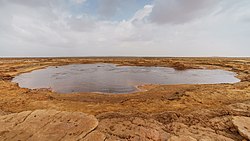
Gaet'ale Pond is a small hypersaline lake located near the Dallol crater in the Danakil Depression (Afar Region, Ethiopia). It is located over a hot spring of tectonic origin and has no apparent inlet or outlet streams. The water of Gaet'ale Pond has a salinity of 43%, making it the saltiest water body on Earth.[1]
Location and origin
[edit]Gaet'ale Pond is the largest of a series of small ponds located approximately 4 kilometres (2.5 mi) southeast of Dallol springs. It is crescent-shaped with a diameter of about 60 metres (200 ft).
According to residents of the nearby village of Ahmed'ela, an earthquake in January 2005 reactivated a thermal spring and the pond was created.[2] For this reason, its temperature of 50–55 °C (122–131 °F) is hotter than the environment.[3]
Composition of the water
[edit]The salts in the water of Gaet'ale Pond are mainly composed by calcium chloride at 2.72 mol/kg and magnesium chloride at 1.43 mol/kg. It also contains small amounts of Na+, K+ and NO−
2 ions. The total amount of dissolved solids content is 433 g/kg, or 43.3%. It also contains traces of iron(III) that form a complex with chloride, giving the water a characteristic yellow color.[1]
Bubbles of odourless gas are emitted from the lake surface. It is likely volcanically-produced carbon dioxide. Bird and insect corpses have been found around the pond, and it has been proposed that the gas may be harmful for small animals or humans.[3]
References
[edit]- ^ a b Perez, Eduardo; Chebude, Yonas (April 2017). "Chemical Analysis of Gaet'ale, a Hypersaline Pond in Danakil Depression (Ethiopia): New Record for the Most Saline Body of Water on Earth". Aquatic Geochemistry. 23 (2): 109–117. doi:10.1007/s10498-017-9312-z.
- ^ Master, Sharad (2016). "Gaet'ale - a reactivated thermal spring and potential tourist hazard in the Asale salt flats, Danakil Depression, Ethiopia". Journal of Applied Volcanology. 5: 1–9. doi:10.1186/s13617-015-0042-x. Retrieved 15 May 2020.
- ^ a b Fox-Skelly, Jasmin (4 August 2017). "In Earth's hottest place, life has been found in pure acid". BBC Future. Retrieved 27 March 2018.
External links
[edit]
Gaet'ale Pond
View on GrokipediaGeography and Formation
Location
Gaet'ale Pond is situated at coordinates 14°12′47.1″N 40°19′17.3″E in the Afar Region of Ethiopia, approximately 4 km southeast of the Dallol crater.[4] The pond lies within the Danakil Depression, a vast lowland expanse that ranks among the lowest and hottest inhabited places on Earth, with much of its terrain dropping to around 120 meters below sea level. This region experiences extreme aridity, receiving 100-200 mm of annual precipitation, and is marked by persistent volcanic activity due to its position in the northernmost segment of the East African Rift system.[2][5][6] Gaet'ale Pond is adjacent to expansive salt flats, such as the Asale salt flats, and surrounding hydrothermal fields, underscoring its placement in a highly active tectonic rift zone where the African, Arabian, and Somali plates diverge. It is located roughly 80 km northwest of the Erta Ale volcano, an active shield volcano known for its persistent lava lake.[4][2] Access to the pond is challenging owing to its remote desert setting; it can be reached via rugged, unpaved tracks from the town of Berahile, approximately 50 km to the southwest, typically requiring specialized 4x4 vehicles and guided tours due to the harsh environmental conditions and security considerations in the area.[7]Geological Origin
Gaet'ale Pond is situated within the Danakil Depression, part of the Afar Triple Junction, where the Nubian (African), Arabian, and Somali plates diverge, resulting in extensional tectonics, rifting, and associated hydrothermal activity.[2] This tectonic regime, initiated around 24 million years ago during the Oligocene with the separation of Arabia from Africa, forms the northernmost segment of the East African Rift System and drives ongoing volcanic and seismic processes in the region.[2][8] The pond originated as a dormant hot spring, potentially linked to earlier phreatic explosions such as one recorded in 1926 near the adjacent Dallol area, but it remained inactive until reactivation during the major seismo-volcanic crisis of 2004–2005.[8] This event involved a magnitude 5.5 earthquake and a 60 km-long magmatic dyke intrusion in the Dabbahu rift segment, approximately 200–250 km south of the site, which propagated stress and fluids northward, triggering hydrothermal resurgence at Gaet'ale.[2] Following reactivation, the feature initially manifested as a geyser approximately 3 meters high, fed by upwelling geothermal fluids through fractures in the underlying evaporite layers.[8] Over the subsequent 5–10 years, continuous hydrothermal discharge and localized dissolution led to its evolution into a stable hypersaline pond, roughly 70 meters in diameter by the early 2010s, aligned along a northwest-southeast trending fault lineament.[2][8] This development is underlain by basaltic volcanism from the Miocene Afar Traps and Stratoid Series, overlain by a 2 km-thick sequence of evaporites—including halite, sylvite, and gypsum—deposited during ancient marine incursions from an isolated arm of the Red Sea.[2]Physical Characteristics
Dimensions and Morphology
Gaet'ale Pond measures approximately 70 meters in diameter and forms a small, roughly circular hypersaline pool situated within the Danakil Depression.[2] Its water level lies about 1.5 meters below the surrounding salt flat, contributing to its compact scale amid the expansive evaporite landscape.[2] The pond's morphology is characterized by terraced edges resulting from salt precipitation, which create step-like ledges and a scalloped perimeter around the water body.[2] These terraces, often covered in a thin layer of halite up to 10 centimeters thick, give the pond a distinctive, amphitheater-like structure with white-to-yellow mineral crusts encircling the yellowish-orange water surface.[2] The surrounding terrain features a steep descent to the pond's edge, requiring cautious navigation along the evaporite slopes.[2] Bubbling occurs on the surface due to subsurface volcanic gases, and the pond has exhibited occasional small geyser activity, including jets up to 3 meters high in the years following its 2005 reactivation.[2] The pond's dimensions have remained relatively stable since its reactivation.[2] High thermal activity in the area promotes evaporation patterns that reinforce the terraced morphology.[2]Thermal and Hydrological Features
Gaet'ale Pond's water temperature is consistently maintained between 50°C and 55°C, primarily due to geothermal heating from underlying hot springs associated with the region's volcanic activity. This thermal regime results from the pond's position over a reactivated hydrothermal system, where subsurface fluids rise under pressure through evaporite layers.[8][2] The pond's hydrology is characterized by exclusive reliance on subsurface hydrothermal inputs, with no observable surface inflows or outflows. Continuous upwelling of these mineral-rich fluids sustains the pond's volume against losses from evaporation in the hyperarid Danakil Depression, where annual rainfall is less than 200 mm and air temperatures frequently exceed 40°C. This balance leads to a stable water level approximately 1.5 m below the surrounding salt flats, occasionally exhibiting minor variations. Bubbling activity, driven by dissolved gases including CO₂ and H₂S, is episodic, as no gas emissions were observed during sampling in January 2018.[2][8][3] Evaporation rates are exceptionally high, driven by the low humidity and elevated ambient temperatures of the region, fostering supersaturated conditions in the pond. This process contributes to the formation of evaporite terraces that reinforce the pond's edges. Visible bubbling throughout the water surface arises from dissolved gases, including CO₂ and H₂S, emanating from the hydrothermal source and causing intermittent jets or fountains that influence local water dynamics. These emissions, often episodic, can lead to slight fluctuations in water levels and pose hazards due to their toxicity.[8][2]Chemical Composition
Salinity and Acidity
Gaet'ale Pond is hypersaline, with total dissolved solids (TDS) measured at 433 g kg⁻¹ (43.3% salinity) in 2017, establishing it at that time as the saltiest natural water body on Earth, surpassing Don Juan Pond in Antarctica (maximum 40.2% salinity).[1] This was approximately 10 to 12 times the salinity of average seawater (about 3.5%).[1] A more recent 2018 analysis reported higher TDS of 682 g L⁻¹, with salinity inferred from extreme conductivity (> maximum measurable mS cm⁻¹) and dominant chloride content, confirming its continued hypersalinity.[3] The 2017 salinity was confirmed through ion chromatography and inductively coupled plasma optical emission spectrometry (ICP-OES) on water samples.[1] Earlier analyses from around 2011 reported much lower TDS values of 96.4 to 110.4 ppm, indicating significant increases over time, likely due to evaporation and hydrothermal inputs.[9] The 2018 study noted challenges in precise quantification due to the brine's viscosity and density.[3] In terms of acidity, a 2017 measurement reported a pH of 1.7 using a calibrated pH meter on fresh samples, but pH measurements in such hypersaline brines are challenging due to ionic strength effects on electrodes.[1] A 2018 in situ measurement yielded pH 6.2, with lab analysis of diluted samples (1:50) giving pH 3.4, suggesting temporal or methodological variations.[3] Prior 2011 measurements indicated a pH range of 3.5 to 3.95.[9] The pond's elevated temperatures, ranging from 50 to 60 °C, contribute to hypersaline conditions by accelerating evaporation.[1]Mineral and Elemental Content
The 2017 analysis showed the water dominated by chloride ions (Cl⁻) at 281 g kg⁻¹, with minor nitrate (NO₃⁻) at 3.9 g kg⁻¹ and no detectable sulfate (SO₄²⁻).[1] Major cations were calcium (Ca²⁺) at 109 g kg⁻¹ and magnesium (Mg²⁺) at 34.9 g kg⁻¹, with a Ca:Mg weight ratio of 3.1, highlighting calcium chloride (CaCl₂) and magnesium chloride (MgCl₂). Sodium (Na⁺) and potassium (K⁺) were trace at 1.3 g kg⁻¹ and 2.4 g kg⁻¹, respectively.[1]| Ion | Concentration (g kg⁻¹, 2017) |
|---|---|
| Cl⁻ | 281 |
| Ca²⁺ | 109 |
| Mg²⁺ | 34.9 |
| Na⁺ | 1.3 |
| K⁺ | 2.4 |
| NO₃⁻ | 3.9 |
| SO₄²⁻ | nd |