



Community hub
Recent from talks
Contribute something to knowledge base
Content stats: 0 posts, 0 articles, 1 media, 0 notes
Members stats: 0 subscribers, 0 contributors, 0 moderators, 0 supporters
Subscribers
Supporters
Contributors
Moderators
Hub AI
Galileo project AI simulator
(@Galileo project_simulator)
Hub AI
Galileo project AI simulator
(@Galileo project_simulator)
Galileo project
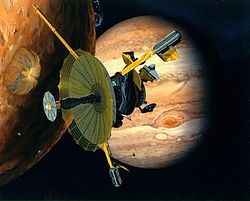
Galileo was an American robotic space program that studied the planet Jupiter and its moons, as well as several other Solar System bodies. Named after the Italian astronomer Galileo Galilei, the Galileo spacecraft consisted of an orbiter and an atmospheric entry probe. It was delivered into Earth orbit on October 18, 1989, by Space Shuttle Atlantis on the STS-34 mission, and arrived at Jupiter on December 7, 1995, after gravity assist flybys of Venus and Earth, and became the first spacecraft to orbit Jupiter. The spacecraft then launched the first probe to directly measure its atmosphere. Despite suffering major antenna problems, Galileo achieved the first asteroid flyby, of 951 Gaspra, and discovered the first asteroid moon, Dactyl, around 243 Ida. In 1994, Galileo observed Comet Shoemaker–Levy 9's collision with Jupiter.
Jupiter's atmospheric composition and ammonia clouds were recorded, as were the volcanism and plasma interactions on Io with Jupiter's atmosphere. The data Galileo collected supported the theory of a liquid ocean under the icy surface of Europa, and there were indications of similar liquid-saltwater layers under the surfaces of Ganymede and Callisto. Ganymede was shown to possess a magnetic field and the spacecraft found new evidence for exospheres around Europa, Ganymede, and Callisto. Galileo also discovered that Jupiter's faint ring system consists of dust from impact events on the four small inner moons. The extent and structure of Jupiter's magnetosphere was also mapped.
The primary mission concluded on December 7, 1997, but the Galileo orbiter commenced an extended mission known as the Galileo Europa Mission (GEM), which ran until December 31, 1999. By the time GEM ended, most of the spacecraft was operating well beyond its original design specifications, having absorbed three times the radiation exposure that it had been built to withstand. Many of the instruments were no longer operating at peak performance, but were still functional, so a second extension, the Galileo Millennium Mission (GMM) was authorized. On September 20, 2003, after 14 years in space and 8 years in the Jovian system, Galileo's mission was terminated by sending the orbiter into Jupiter's atmosphere at a speed of over 48 kilometers per second (30 mi/s) to eliminate the possibility of contaminating the moons with bacteria.
Jupiter is the largest planet in the Solar System, with more than twice the mass of all the other planets combined. Consideration of sending a probe to Jupiter began as early as 1959, when the National Aeronautics and Space Administration (NASA) Jet Propulsion Laboratory (JPL) developed four mission concepts:
Two missions to Jupiter, Pioneer 10 and Pioneer 11, were approved in 1969, with NASA's Ames Research Center given responsibility for planning the missions. Pioneer 10 was launched in March 1972 and passed within 200,000 kilometers (120,000 mi) of Jupiter in December 1973. It was followed by Pioneer 11, which was launched in April 1973, and passed within 34,000 kilometers (21,000 mi) of Jupiter in December 1974, before heading on to an encounter with Saturn. They were followed by the more advanced Voyager 1 and Voyager 2 spacecraft, which were launched on 5 September and 20 August 1977 respectively, and reached Jupiter in March and July 1979.
Following the approval of the Voyager missions, NASA's Scientific Advisory Group for Outer Solar System Missions considered the requirements for Jupiter orbiters and atmospheric probes. It noted that the technology to build a heat shield for an atmospheric probe did not yet exist, and indeed facilities to test one under the conditions found on Jupiter would not be available until 1980. There was also concern about the effects of radiation on spacecraft components, which would be better understood after Pioneer 10 and Pioneer 11 had conducted their flybys. Pioneer 10's flyby in December 1973 indicated that the effects were not as severe as had been feared. NASA management designated JPL as the lead center for the Jupiter Orbiter Probe (JOP) Project. John R. Casani, who had headed the Mariner and Voyager projects, became the first project manager. The JOP would be the fifth spacecraft to visit Jupiter, but the first to orbit it, and the probe the first to enter its atmosphere.
Ames and JPL decided to use a Mariner spacecraft for the Jupiter orbiter like the ones used for Voyager rather than a Pioneer spacecraft. Pioneer was stabilized by spinning the spacecraft at 60 rpm, which gave a 360-degree view of the surroundings, and did not require an attitude control system. By contrast, Mariner had an attitude control system with three gyroscopes and two sets of six nitrogen jet thrusters. Attitude was determined with reference to the Sun and Canopus, which were monitored with two primary and four secondary star tracker sensors. There was also an inertial reference unit and an accelerometer. The attitude control system allowed the spacecraft to take high-resolution images, but the functionality came at the cost of increased weight: a Mariner weighed 722 kilograms (1,592 lb) compared to just 146 kilograms (322 lb) for a Pioneer.
The increase in weight had implications. The Voyager spacecraft had been launched by Titan IIIE rockets with a Centaur upper stage, but Titan was retired afterwards. In the late 1970s, NASA was focused on the development of the reusable Space Shuttle, which was expected to make expendable rockets obsolete. In late 1975, NASA decreed that all future planetary missions would be launched by the Space Shuttle. The JOP would be the first to do so. The Space Shuttle was supposed to have the services of a space tug to launch payloads requiring something more than a low Earth orbit, but this was never approved. The United States Air Force (USAF) instead developed the solid-fueled Interim Upper Stage (IUS), later renamed the Inertial Upper Stage (with the same acronym), for the purpose.
Galileo project
Galileo was an American robotic space program that studied the planet Jupiter and its moons, as well as several other Solar System bodies. Named after the Italian astronomer Galileo Galilei, the Galileo spacecraft consisted of an orbiter and an atmospheric entry probe. It was delivered into Earth orbit on October 18, 1989, by Space Shuttle Atlantis on the STS-34 mission, and arrived at Jupiter on December 7, 1995, after gravity assist flybys of Venus and Earth, and became the first spacecraft to orbit Jupiter. The spacecraft then launched the first probe to directly measure its atmosphere. Despite suffering major antenna problems, Galileo achieved the first asteroid flyby, of 951 Gaspra, and discovered the first asteroid moon, Dactyl, around 243 Ida. In 1994, Galileo observed Comet Shoemaker–Levy 9's collision with Jupiter.
Jupiter's atmospheric composition and ammonia clouds were recorded, as were the volcanism and plasma interactions on Io with Jupiter's atmosphere. The data Galileo collected supported the theory of a liquid ocean under the icy surface of Europa, and there were indications of similar liquid-saltwater layers under the surfaces of Ganymede and Callisto. Ganymede was shown to possess a magnetic field and the spacecraft found new evidence for exospheres around Europa, Ganymede, and Callisto. Galileo also discovered that Jupiter's faint ring system consists of dust from impact events on the four small inner moons. The extent and structure of Jupiter's magnetosphere was also mapped.
The primary mission concluded on December 7, 1997, but the Galileo orbiter commenced an extended mission known as the Galileo Europa Mission (GEM), which ran until December 31, 1999. By the time GEM ended, most of the spacecraft was operating well beyond its original design specifications, having absorbed three times the radiation exposure that it had been built to withstand. Many of the instruments were no longer operating at peak performance, but were still functional, so a second extension, the Galileo Millennium Mission (GMM) was authorized. On September 20, 2003, after 14 years in space and 8 years in the Jovian system, Galileo's mission was terminated by sending the orbiter into Jupiter's atmosphere at a speed of over 48 kilometers per second (30 mi/s) to eliminate the possibility of contaminating the moons with bacteria.
Jupiter is the largest planet in the Solar System, with more than twice the mass of all the other planets combined. Consideration of sending a probe to Jupiter began as early as 1959, when the National Aeronautics and Space Administration (NASA) Jet Propulsion Laboratory (JPL) developed four mission concepts:
Two missions to Jupiter, Pioneer 10 and Pioneer 11, were approved in 1969, with NASA's Ames Research Center given responsibility for planning the missions. Pioneer 10 was launched in March 1972 and passed within 200,000 kilometers (120,000 mi) of Jupiter in December 1973. It was followed by Pioneer 11, which was launched in April 1973, and passed within 34,000 kilometers (21,000 mi) of Jupiter in December 1974, before heading on to an encounter with Saturn. They were followed by the more advanced Voyager 1 and Voyager 2 spacecraft, which were launched on 5 September and 20 August 1977 respectively, and reached Jupiter in March and July 1979.
Following the approval of the Voyager missions, NASA's Scientific Advisory Group for Outer Solar System Missions considered the requirements for Jupiter orbiters and atmospheric probes. It noted that the technology to build a heat shield for an atmospheric probe did not yet exist, and indeed facilities to test one under the conditions found on Jupiter would not be available until 1980. There was also concern about the effects of radiation on spacecraft components, which would be better understood after Pioneer 10 and Pioneer 11 had conducted their flybys. Pioneer 10's flyby in December 1973 indicated that the effects were not as severe as had been feared. NASA management designated JPL as the lead center for the Jupiter Orbiter Probe (JOP) Project. John R. Casani, who had headed the Mariner and Voyager projects, became the first project manager. The JOP would be the fifth spacecraft to visit Jupiter, but the first to orbit it, and the probe the first to enter its atmosphere.
Ames and JPL decided to use a Mariner spacecraft for the Jupiter orbiter like the ones used for Voyager rather than a Pioneer spacecraft. Pioneer was stabilized by spinning the spacecraft at 60 rpm, which gave a 360-degree view of the surroundings, and did not require an attitude control system. By contrast, Mariner had an attitude control system with three gyroscopes and two sets of six nitrogen jet thrusters. Attitude was determined with reference to the Sun and Canopus, which were monitored with two primary and four secondary star tracker sensors. There was also an inertial reference unit and an accelerometer. The attitude control system allowed the spacecraft to take high-resolution images, but the functionality came at the cost of increased weight: a Mariner weighed 722 kilograms (1,592 lb) compared to just 146 kilograms (322 lb) for a Pioneer.
The increase in weight had implications. The Voyager spacecraft had been launched by Titan IIIE rockets with a Centaur upper stage, but Titan was retired afterwards. In the late 1970s, NASA was focused on the development of the reusable Space Shuttle, which was expected to make expendable rockets obsolete. In late 1975, NASA decreed that all future planetary missions would be launched by the Space Shuttle. The JOP would be the first to do so. The Space Shuttle was supposed to have the services of a space tug to launch payloads requiring something more than a low Earth orbit, but this was never approved. The United States Air Force (USAF) instead developed the solid-fueled Interim Upper Stage (IUS), later renamed the Inertial Upper Stage (with the same acronym), for the purpose.
Recent media
Recent media