Hubbry Logo
Gargoyle ClubGargoyle ClubMain
Open search
Gargoyle Club
Community hub
Gargoyle Club
logo
8 pages, 0 posts
0 subscribers
Be the first to start a discussion here.
Gargoyle Club
Gargoyle Club
from Wikipedia

Gargoyle Club, 1940
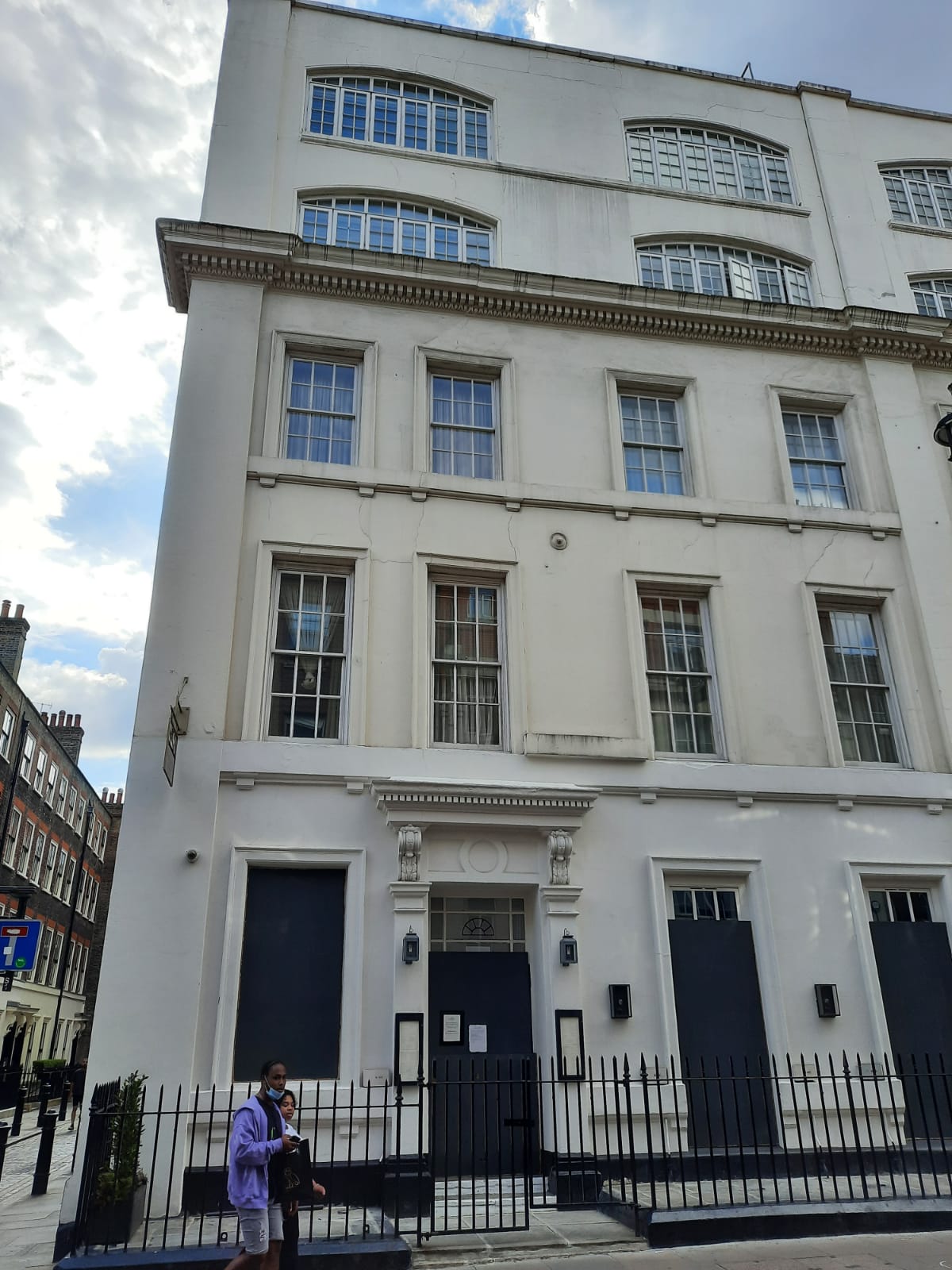
69 Dean Street in Soho, in which the Gargoyle Club was located

The Gargoyle Club was a private club on the upper floors of 69 Dean Street, Soho, London, at the corner with Meard Street. It was founded on 16 January 1925[1] by the aristocratic socialite David Tennant, son of the First Baron Glenconner. David was the brother of Stephen Tennant who was a prominent member of the social set called "Bright Young People" and of Edward Tennant, the poet who was killed in action in World War I.

Before Tennant

[edit]

This elegant house, 69 and 70 Dean Street,[2] a pair of Georgian residences, was built on the Pitt estate[3] in 1732–1735[4] by John Meard, the carpenter who helped standardise the Georgian town house.

  • Later occupants of No. 70[3] included :
  • Later occupants of No. 69[3] included :

"In 1834 No. 69 was taken by Vincent Novello, the composer and musical editor, and his son, Joseph Alfred, music seller and publisher, who were perhaps responsible for the erection of the back premises, with the wall still fronting Meard Street. Vincent's daughter, Clara, the singer, was also living here in 1840 and the painter, J. P. Davis, in 1842. In 1847 the firm of Novello became music printers also. It was probably in 1864–5 that the upper storeys were added to No. 69 to accommodate the printing works. In 1867 the firm removed to Berners Street but in 1871 the printing works returned to No. 69, and No. 70 was bought in 1875 for the storage of plates. Thenceforward the firm occupied both houses until 1898, when it moved to new printing works in Hollen Street."
Survey of London[3][5]

David Tennant

[edit]

David Tennant took a 50-year lease on the upper three floors, while an existing printing works[6][7][8] established by the Novello music publishing family remained housed beneath.[9] Here he created a private apartment, a very large ballroom, a Tudor Room, coffee room, drawing room and a 350-sq yds flat roof with a garden for dining and dancing, around which neighbouring chimneys were painted brilliant red. All who visited the club shared its intimately democratic and rickety external lift, four-person maximum, enclosed in shining metal like an art-nouveau cabin trunk,[10] located round the corner in Meard Street.

The charismatic Tennant was the self-appointed ringmaster to an arena where Bohemians could mingle comfortably with the upper crust, according to writer and film producer Michael Luke.[11][12]

Of the club's opening night The Daily Telegraph observed that its 300-strong list of members "probably contains more famous names in society and the arts than any other purely social club". Names on this list included Somerset Maugham, Noël Coward, Gladys Cooper, Leon Goossens, Gordon Craig, George Grossmith, Virginia Woolf, Duncan Grant, Nancy Cunard, Adèle Astaire, Edwina Mountbatten; an obligatory Guinness, Rothschild and Sitwell; MPs, and peers of the realm.[13]

Decor

[edit]
L'Atelier Rouge, Henri Matisse, 1911, oil on canvas, 162 x 130 cm., (64 in × 51 in), The Museum of Modern Art, New York City. Acquired through the Lillie P. Bliss Bequest[14][15]
Studio, Quai Saint-Michel, Henri Matisse, 1916, oil on canvas, 147.9 x 116.8 cm., (? in × ? in), The Phillips Collection, Washington D.C.[16]

Designed by Henri Matisse, Edwin Lutyens, and Augustus John,[17] the interior decor was theatrical – a fountain on the dance floor,[18][19] log fires in the dining room, wooden gargoyles suspended as lanterns – with a strong Moorish flavour. Henri Matisse was made an honorary member after advising on decor.[20] To complement the main club-room's elaborate coffered ceiling painted with gold leaf, like the Alhambra, he suggested covering the walls entirely with a mosaic of imperfectly cut glass tiles from an 18th-century chateau.[21] Matisse himself designed a stunning entrance staircase to this room in glittering steel and brass, which remained in use until the club's conversion into a studio complex in the mid-1980s.

The young Tennant bought two of Matisse's paintings in Paris for £600 and in the opinion of Anthony Powell they "lent an air of go-ahead culture to the club". These were the painter's daring and inventive The Red Studio from 1911 which was displayed in the bar[22] at the Gargoyle until 1941, offered to the Tate Gallery for £400 and declined, then in 1949 joined the MoMA permanent collection in New York where it still hangs.[23] The other Matisse, The Studio, Quai St Michel (1916), features his favourite model the voluptuous Lorette, naked on a couch, on the club's stairs.[22] Today she resides in Washington DC in The Phillips Collection,[24] after Tennant, feeling himself to be on the verge of ruin, sold it for "a derisory sum" to Douglas Cooper, who in turn sold it on.[25]

"The decor is bright but tasteful and Matisse gave his expert advice. Several of his drawings of ballet girls grace the upstairs bar which is a cheerful spot always crowded with people discussing art, politics or women in the liveliest way. ‘My unpaid cabaret,’ David Tennant calls them… The restaurant downstairs seats 140 and its ceiling and general design have been modelled on the Alhambra at Granada. The mirrors are particularly attractive, unless you have drunk too much gin!... The four-piece band led by Alec Alexander, suits the style of the club. It delivers lively, cheerful music that you can dance to without having your nerves torn to shreds. Alec knows all the members and seems to enjoy playing requests." – Stanley Jackson, 1946[26]

After Tennant

[edit]

In 1952 David Tennant sold the Gargoyle as a declining[27] concern[28][29] for £5,000 to caterer John Negus[30] and it remained popular among the generation of Francis Bacon, Antonia Fraser and Daniel Farson who would often go on from the Colony Room which was founded in 1948 by Muriel Belcher across at 41 Dean Street. For years the Gargoyle was one of the few places in London serving drinks at affordable prices after midnight. In 1955 the club was sold on to Michael Klinger[31] and Jimmy Jacobs[32] who relaunched it as a strip club[33][34] called the Nell Gwynne (variously advertised as a Theatre, Club, or Revue).[35][36][37][38][39][40][41] A 1960s ad shows the club as the Nell Gwynne by day and the Gargoyle Club at night.[42][43]

On 19 May 1979 in the Gargoyle's rooftop club space Hammersmith-born insurance salesman Peter Rosengard[44] started a weekly club night on Saturdays called the Comedy Store, in partnership with comedian Don Ward. It was modelled on the original in Los Angeles, and invited audiences to show approval or disapproval of the unknown acts performing by "gonging" them off.[45] The London Comedy Store made the reputations of many of the UK's upcoming "alternative comedians". Among the original line-up here were Alexei Sayle, Rik Mayall, Adrian Edmondson, French & Saunders, Nigel Planer and Peter Richardson who in 1980 led these pioneers to establish the breakaway Comic Strip team elsewhere in Soho.[46] All were to prove influential in reshaping British television comedy throughout the 1980s as stars of The Comic Strip Presents.[47]

In July 1982, among many themed weekly club-nights, came the first incarnation upstairs in the Gargoyle Club of the Batcave,[48] a Wednesday night fronted by Olli Wisdom,[49] lead singer in the house band, Specimen, and guitarist Jon Klein as art director. Visitors included Robert Smith, Siouxsie Sioux, Steve Severin, Foetus, Marc Almond and Nick Cave. The Nell Gwynne strip-teasers were still performing from 2.30 pm until late evening, when they could be seen exiting via the rickety lift, even as Batcavers queued to come up.

By the year's end, when the upper floors were sold off, the one-nighters such as Batcave moved on. The Comedy Store moved to a series of other venues, taking over 28a Leicester Square (previously the Subway club) in 1985. It had become a template for the new style of stand-up comedy clubs that opened around the land. Don Ward dissolved his business relationship with Rosengard in late 1981[50] while remaining CEO of Comedy Store interests. In 1984 Rosengard went on to manage the band Curiosity Killed the Cat.

The Mandrake

[edit]

A second private club became part of the story of 69 Dean Street during the postwar 1940s when an eccentric crowd started gathering in the Mandrake at No 4 Meard Street, a house only a few yards west of the Gargoyle's entrance with its tiny lift. An underground room was rented for a chess club by streetwise Teddy Turner and Bulgarian émigré Boris Watson (after a name change), though by 1953 one basement room beneath Meard Street had become six after knocking through walls underneath No 69, to include a reading room for the intellectuals. An advert claimed the Mandrake to be "London's only Bohemian rendezvous".[51] A year's membership cost half a guinea “in advance” and the bait was illustrated with a photograph of an artist sketching beside an image of a voluptuous nude. Pretty soon the offbeat broadcaster Daniel Farson was calling its barmaid Ruth Soho's equivalent of Manet's famous Suzon painted serving at A Bar at the Folies Bergère.

Regulars included Nina Hamnett, Brian Howard and Julian Maclaren-Ross for whom Watson would cash cheques in the form of credit behind the bar. Private membership clubs were allowed to stay open during the strict afternoon closing hours imposed on pubs by the licensing laws, as well as late into the early hours after the 10.30 pm closing time for pubs. One condition was that clubs were required to serve food with alcohol. Result: the Mandrake became notorious for its stale sandwiches piled behind the bar, in Watson's view available “for drinking with, not for eating”! Inevitably the drinkers grew to outnumber the thinkers. Soon a jukebox made its appearance along with live guitar and lute recitals, and impromptu jam sessions for jazz musicians such as pianist Joe Burns, bassists Wally Wrightman and Percy Borthwick, drummers Laurie Morgan and Robin Jones, trombonist Norman Cave, singer Cab Kaye and Ronnie Scott (later founder of Soho's pre-eminent jazz club), plus visitors such as the touring Duke Ellington band.[52] And the 1960s brought in the legendary painters and poets who were reinforcing Soho's reputation for general non-conformity. The kitchen was forced to upgrade and, according to Michael Luke, the Mandrake became "a launching pad for the Gargoyle – a place where loins could be girded and spirits stiffened for that challenging arena up above".[53]

By the 1970s the Mandrake had acquired a new pedimented entrance door on Meard Street, curiously now east of the Gargoyle's, just a couple of yards nearer to Dean Street. Its lease was then acquired by Soho's only Jamaican club owner, Vince Howard, who changed its name to Billy's. Vince Howard in the cover story of The Face magazine in February 1983[49] was described as "a Soho legend himself, straight out of Shaft, huge hats, fistfuls of rings and the only black man to own a venue in Soho." The publication also quoted his jeweller describing a mountainous ring he was making for the glamorous club owner: “18‑carat gold, 16 diamonds, it shone like a torch. I showed it to Vince and he said, I want more diamonds on it.” Howard spent some time trying to identify an audience, first with soul music, and then becoming a blatantly gay venue in those early days following liberation.

“A rather seedy gay club frequented by rough lesbians and even rougher trannies... It was owned by a 300-pound six-foot-four black convicted pimp named Vince who sported a huge black fedora, a long leather coat, and fingers the size of sausages with enough diamond rings to give Imelda Marcos cause for concern. And lest we forget, in those days Soho was not full of posh restaurants and membership clubs; it was a vice-infested square mile that housed a red light above every door and on every floor." – Chris Sullivan on Billy’s in his book, We Can Be Heroes (2012).[54]

Billy's changed its name to Gossip's[55] and became part of London's clubbing heritage by spawning scores of weekly club-nights that transformed Britain's music and fashion scene during the 1980s, crucially a Bowie night run by Steve Strange and Rusty Egan who teamed up at Billy's in 1978 and went on to open the hugely influential Blitz Club which kick-started the New Romantics movement.[56]

Reconstruction

[edit]

During the 1970s, the ground floor at No 69 had been occupied by A. Stewart McCracken Ltd Auction Rooms[57] and at No 70 was the Hostaria Romana restaurant.[58][59] More recently, 69–70 Dean Street became a bar in The Pitcher and Piano chain[60][61][62] and the pair of houses became Listed Grade II. Then in the run-up to their rebirth in 2008, the interiors of numbers 69 and 70 were completely rebuilt[63] by Soho House to create the Dean Street Townhouse hotel and restaurant.[64][65]

Prince Harry and Meghan Markle's first date took place at the Dean Street Dining Room[66] in the Dean Street Townhouse in 2016.[67]

Notable members of Tennant's club

[edit]

An extensive hand-written list of members is illustrated in Michael Luke's Gargoyle Years, between pages 84–85.[68]

References

[edit]
Revisions and contributorsEdit on WikipediaRead on Wikipedia
from Grokipedia
The Gargoyle Club was a situated on the upper floors of 69 in , , at the corner with Meard Street, renowned for its bohemian atmosphere and eclectic mix of artists, writers, and figures during the . Founded on 16 January 1925 by aristocratic socialite , son of the First , the club served as a venue for dancing, socializing, and hedonistic pursuits, featuring an opulent interior with Moorish-inspired decor, mirrored walls, and murals by , who was himself a member. Notable members included , , , , , Lucien Freud, , and the painter , who contributed to its artistic prestige and transformed it into a theatrical arena for London's cultural elite. The club epitomized ' spirit of excess and debauchery, hosting lively events that blended upper-class sophistication with bohemian abandon, though it later declined and was sold in 1952 amid changing social tastes. While celebrated for fostering creative exchanges, it was not without tensions, including occasional brawls linked to figures like , underscoring its raw, unpolished edge.

History

Building Origins and Pre-Club Use

The building at 69 , located at the corner with Meard Street in , , was constructed in the early 1730s as a Georgian . Specifically, numbers 69 and 70 were developed between 1732 and 1735 by the master carpenter John Meard the Younger, who contributed to several structures in the area during 's emergence as a desirable residential enclave for the . Originally designed as private homes for upper-class families, the four-storey property exemplified early with its symmetrical facade and period detailing, reflecting the speculative building boom in under developers like Meard. Prior to its conversion into the Gargoyle Club in 1925, 69 remained in residential use, housing notable occupants such as George Wandesford, 4th Viscount Castlecomer, in the mid-18th century, though it later saw various private tenancies amid 's evolving urban landscape.

Founding and Early Years

The Gargoyle Club was founded in 1925 by , an aristocratic socialite and younger son of the 1st , who transformed the upper floors and rooftop of 69 Dean Street in , , into a private members' venue. , influenced by his connections within 's artistic circles, envisioned the club as a discreet space for bohemian intellectuals, performers, and elites to mingle, dine, dance, and engage in late-night revelry away from more conventional society venues. The establishment operated under strict exclusivity, with admission limited to invited members and their guests, fostering an atmosphere of creative experimentation amid the post-World War I cultural shifts. In its early years through the late , the club distinguished itself through its interior, which Tennant personally curated with bold, modern artworks to evoke a sense of continental sophistication. Notable among these were paintings by , a close friend of Tennant who not only joined as a member but lent or sold works—including depictions of his studio—that adorned the walls, setting the apart from staid English clubs of the era. This artistic emphasis drew an initial clientele of writers, painters, and musicians seeking a nexus for intellectual discourse and jazz-infused entertainment, reflecting the era's fascination with and . The club's nascent operations emphasized informality and tolerance for unconventional behavior, with Tennant overseeing a program of cabaret performances, themed parties, and all-night sessions that attracted figures from the periphery and emerging theatrical talents. By the end of the decade, it had solidified as a symbol of Soho's burgeoning , though financial strains from high operational costs and economic pressures began to emerge, presaging later challenges. Despite these, the Gargoyle's early for fostering unpretentious artistic camaraderie endured, distinguishing it from rival establishments like the Forty Club or .

Peak Under David Tennant

The Gargoyle Club attained its greatest prominence during the late 1920s and 1930s under 's direction, evolving from a niche venue into London's premier bohemian frequented by aristocrats, artists, writers, and performers. Founded on 16 January 1925 at 69 in , the club quickly became a hub for the Bright Young People set, blending with creative elites in an atmosphere of uninhibited revelry, late-night dancing, and intellectual exchange. Its mirrored ballroom and opulent interiors, including commissioned or acquired artworks by such as (displayed until sold in 1942), contributed to its exotic, artistic appeal that drew discerning patrons seeking an escape from conventional social norms. By 1934, the Gargoyle had reached the zenith of its popularity, hosting regular events that showcased fencing exhibitions, performances, and informal gatherings where figures like demonstrated skills amid relaxed dress codes and eclectic company. Prominent members included , , (Tennant's initial inspiration for the club), , and later artists such as and , reflecting its role as a cultural crossroads that persisted into the 1940s with wartime New Year's celebrations. The club's exclusivity, limited to around 2,000 members including intellectuals like and , fostered an environment of cross-class mingling that sustained its reputation for decadence and innovation until post-war economic pressures began eroding its viability.

Post-Tennant Decline and Closure

Following David Tennant's sale of the club in 1952 amid financial difficulties, the Gargoyle continued under the management of caterer John Negus but entered a phase of diminished prestige and operational challenges. The venue limped along for roughly another decade, shifting away from its bohemian artistic roots toward more commercial entertainment formats. By the , the club's original splendor had faded, culminating in and a transformation into a that emphasized seedier attractions over cultural allure. This repurposing reflected broader shifts in Soho's , including economic pressures and evolving social tastes that eroded the demand for elite, private clubs. The upper floors, once adorned with modernist artworks, became associated with adult entertainment, further distancing the site from its interwar heyday. The operated in altered guises through the , including periods as a venue for and other performances, before ceasing club functions around 1978. Subsequent uses, such as the Nell Gwyn in the early , extended limited activity until final closure of such operations by December 1982, triggered in part by lease expirations on the premises. This marked the end of the Gargoyle's run as a institution, with the building later repurposed for non-entertainment purposes.

Later Occupancies and Transformations

Following the sale of the club in 1952, the premises at 69 underwent significant transformation, with the upper floors repurposed for performances under the name Nell Gwynne Club starting in 1955, operated by film producers and . This shift marked a departure from its earlier bohemian exclusivity, aligning with Soho's evolving entertainment landscape dominated by adult-oriented venues. The Nell Gwynne operated into the late 1970s, featuring live stripping acts documented in films such as Get 'Em Off! (1976), which captured performances amid the building's fading original decor. In 1979, the upstairs rooms above the Nell Gwynne were adapted to house , London's first dedicated venue for alternative , founded by Don Ward and Peter Rosengard. This incarnation launched careers of performers including , , and , hosting improvised and experimental shows that challenged traditional British humor amid the building's atmospheric, if dilapidated, interiors. The Comedy Store operated until the lease expired at the end of 1982, after which the freehold was offered for sale. The basement levels, meanwhile, emerged as Gossips in the early , previously known as Billy's, hosting themed that catered to subcultural scenes. Notably, from October 1982 to December 1985, it served as the location for the , a weekly event organized by Alexei Montrose and others, widely regarded as the origin point for the British goth movement with its fusion of music, , and theatrical ambiance. Upstairs spaces under the Gargoyle name continued sporadic club nights, including , , and film events, until their closure in December 1982. These uses reflected the building's adaptation to London's underground nightlife, though maintenance declined, contributing to a period of seedier repute before major redevelopment.

Reconstruction and Contemporary Revival

Following the Gargoyle Club's closure in 1978, the upper floors of 69 Dean Street served as the Nell Gwynne Club, a striptease establishment, during the 1980s. In 2009, the Soho House group acquired and renovated numbers 69 and 70 Dean Street, converting the Grade II-listed Georgian buildings into the Dean Street Townhouse, a 39-room boutique hotel with an accompanying public restaurant specializing in British classics. The renovation preserved historical features including original Georgian fireplaces and marble cladding, while updating the structure for modern use as a non-members hotel and dining venue. This project marked Soho House's initial foray into public-access accommodations, transforming the site into a contemporary social destination echoing Soho's bohemian legacy without reinstating the original club's private membership model.

Design and Features

Architectural Layout

The Gargoyle Club was situated on the upper three floors of a four-story Georgian spanning numbers 69 and 70 , constructed between 1732 and 1735 as two separate residences. The narrow vertical structure typical of 's 18th-century required members to ascend via a steel and brass staircase, designed with contributions from , or a tiny external elevator. David Tennant oversaw modernization by architect Edwin Lutyens, transforming the spaces into specialized areas: a accommodating 140 patrons on a lower upper-floor level, featuring fireplaces, Moorish mosaic elements, and a ceiling modeled after the in ; an upstairs bar; a with a central fountain, gold-leaf ceiling, and panels of antique French mirrored glass arranged in squares for reflective effect; a room and for socializing; a Tudor-themed room; and a rooftop garden utilized for dancing and outdoor dining. This arrangement facilitated a progression from formal dining and drinking to more recreational pursuits higher up, maximizing the building's constrained footprint.

Interior Decor and Artworks

The interior of the Gargoyle Club, located on the upper floors of 69 , featured a Moorish-inspired aesthetic characterized by extensive use of mirrored walls composed of fragmented 18th-century glass, creating a kaleidoscopic, reflective environment that enhanced the club's bohemian and theatrical ambiance. This design drew inspiration from , a club member who provided expert advice on the decoration to ensure a bright yet tasteful execution. Additional elements included a integrated into the dance floor for dramatic effect and log fires in the dining room to foster an intimate gathering space. Prominent artworks adorned the spaces, with Matisse contributing several drawings of girls to the upstairs bar, reflecting the club's affinity for modernist and performative themes. The Mirrored Mosaic Ballroom housed Matisse's (1911), an oil-on-canvas depiction of the artist's workspace, which remained on display from around 1928 until its sale by founder in 1942 to fund club operations amid financial strains. The downstairs restaurant, accommodating 140 seated guests, echoed Granada's in its ceiling and overall layout, augmented by strategic mirror placements to amplify . These decorative choices, blending opulence with , positioned the Gargoyle as a hub for artistic elites, though maintenance of such features contributed to escalating costs post-Tennant's tenure.

Membership and Social Dynamics

Admission and Exclusivity

Membership to the Gargoyle Club was by invitation and selection, reflecting founder David Tennant's vision of fostering interactions between affluent patrons and emerging artists, thereby limiting access to approximately 300 carefully vetted individuals from elite artistic, literary, and social circles. The annual subscription fee stood at four guineas, equivalent to roughly £4.2 in 1925 currency, with a concession allowing married couples to join jointly for , making it accessible yet prestigious for the era's creative and monied classes. Exclusivity was enforced through informal criteria emphasizing cultural prominence, social connections, and contributions to , rather than rigid formal qualifications, which cultivated a dynamic mix of bohemian talents and aristocrats without diluting the club's cachet. Physical access underscored this selectivity via a narrow, external from Meard , concealing the upper-floor venue from Soho's street-level bustle and reserving it for members and their approved guests. This arrangement prevented casual entry, preserving an atmosphere of intellectual and social intimacy amid the interwar period's hedonistic nightlife. While guests could attend with members, uninvited public admission was prohibited, reinforcing the club's status as a private haven that prioritized quality of company over mass appeal, a policy that sustained its allure through the 1930s despite economic pressures.

Notable Figures and Associations

The Gargoyle Club served as a nexus for London's bohemian and intellectual elite, drawing members and habitués from the arts, literature, and performing worlds during its operational span from to the . Artists such as , Lucian Freud, Matthew Smith, and were regular patrons, often engaging in the club's lively social scene amid its modernist decor. Performers including , , , and contributed to its reputation as a favored haunt for theatrical figures, with Astaire and Coward noted as members who embodied the era's glamorous nightlife. Literary associations were equally prominent, with writers like , , and frequenting the venue for its conducive atmosphere of debate and revelry; Thomas, in particular, joined in hedonistic escapades alongside figures such as . and also numbered among its distinguished visitors, reflecting the club's appeal to modernist intellectuals during the . The club's memberships extended to more controversial spheres, including political and intelligence figures; Sir Oswald Mosley, leader of the , was a member who hosted a fencing exhibition at the premises in the early 1930s. British diplomat , later exposed as a Soviet agent in the spy ring, applied for and received membership, frequenting the club into the post-war years alongside associates like Donald Maclean. These connections underscored the Gargoyle's role as a cross-section of elite society, unbound by ideological constraints.

Reputation, Impact, and Criticisms

Cultural Significance and Achievements

The Gargoyle Club epitomized the interwar fusion of bohemian artistry and aristocratic indulgence, serving as a pivotal venue for London's "Bright Young Things" in the 1920s and 1930s, where post-World War I elites mingled across class and ideological lines to pursue intellectual discourse, jazz-infused revelry, and modernist experimentation. Founded on 16 January 1925 by socialite David Tennant at 69 Dean Street in Soho, it quickly became a symbol of cultural liberation, hosting events like elaborate costume parties and late-night sessions with Alec Alexander's four-piece jazz band, which drew over 2,000 members by the 1940s. Its role in bridging highbrow aesthetics with nightlife innovation marked a departure from staid Edwardian clubs, influencing the trajectory of UK private membership venues by emphasizing experiential design over mere exclusivity. A hallmark achievement was the integration of fine art into its fabric, with not only as a member but as a collaborator on the interior: he advised on the Moorish-inspired ballroom, designed an steel-and-brass staircase, and supplied key works such as (1911), displayed in the bar until its sale in 1942 for £400 to what became the in New York, and Studio, Quai Saint-Michel (1916) adorning the stairwell. This artistic endowment elevated the club beyond transient entertainment, positioning it as a living gallery that hosted lively debates on and among figures like —a founding committee member—, and , thereby embedding modernist into London's social fabric. The club's roster of notable patrons underscored its cultural gravitas, including performers and , writers and , and artists and Lucien Freud, alongside aristocrats like Edwina Mountbatten and even spies such as . These associations amplified its impact, as the venue functioned as a creative incubator where cross-pollination among disciplines—evident in the theatrical staging of its mirrored, 140-seat restaurant and dance floor—fostered the era's ethos, leaving a legacy echoed in later clubs despite its wartime decline and 1952 sale. Annual membership at 4 guineas reflected its accessible yet discerning appeal, sustaining a civilized yet vibrant atmosphere that prioritized cultural exchange over mere dissipation.

Social Atmosphere and Lifestyle

The Gargoyle Club embodied a bohemian and rebellious social atmosphere, serving as a primary haunt for the Bright Young People—a post-World War I generation of aristocrats, artists, and intellectuals pursuing dissolute lifestyles through spectacular parties and anti-conventional pursuits. Accessed via a discreet lift to the upper floors of 69 , the club's intimate layout, including a orchestra-led , coffee room, drawing room, and rooftop terrace, facilitated all-hours operation and a sense of exclusivity that contrasted with larger, more formal venues like the Café de Paris. Lively music from Alec Alexander's four-piece band animated evenings, with members engaging in cheerful, crowded discussions on art, politics, and personal matters amid flowing alcohol and risqué behaviors. The lifestyle at the Gargoyle blended high-brow cultural appreciation with hedonistic excess, attracting a membership of around 2,000 that spanned elites like the , writers such as , and artists including and , for an annual subscription of four guineas. Daytime activities often involved business lunches for creative professionals, transitioning seamlessly into nocturnal revelry featuring imaginative menus with oysters and duck, quality liquor, and extravagant costume parties that spilled into after-hours gatherings at nearby hotels like the Cavendish. Despite composer Constant Lambert's quip labeling its patrons the "two hundred nastiest people," the venue maintained a relatively civilized tone, prioritizing cultured discourse over outright chaos, though instances of heavy drunkenness—exemplified by socialite Elizabeth Ponsonby's antics—highlighted its decadent undercurrents. This fusion of theatrical social dynamics bridged and bohemian elements, fostering interactions across class lines in a space that rejected staid Edwardian norms for vibrant, experimental . The club's rooftop garden, when operational, extended outdoor socializing, underscoring a lifestyle of unbridled creativity and indulgence that defined Soho's interwar scene.

Financial and Operational Challenges

The Gargoyle Club encountered significant financial strain during the era, as its bohemian allure waned amid shifting social priorities and reputational damage from members' controversial wartime activities, including John Amery's collaboration with . These pressures culminated in founder selling the club in 1952 for £5,000 to caterer John Negus, describing it as a declining enterprise burdened by tight finances that undermined its operational viability despite ongoing patronage from figures like . Post-sale, the venue struggled to sustain its original model, declaring by the early amid diminishing prestige and escalating costs, which prompted its repurposing as a known as Nell Gwynne.

Controversies and Declines

In 1942, amid financial pressures during , founder sold Henri Matisse's (1911), which had hung in the club, for £400; the Gallery declined to purchase it, and the painting was acquired by a North American buyer, later valued at millions and sparking an art-world scandal over its export from Britain. By 1952, the club faced mounting financial difficulties, prompting Tennant to sell it as a declining operation for £5,000 to caterer John Negus. Postwar economic challenges accelerated the decline; by the mid-1950s, membership waned as the bohemian elite shifted to newer venues, and by the , the club had declared , its once-lavish interiors deteriorating into a venue for seedy performances under names like Nell Gwynne. The site briefly hosted the goth club night in 1982, attracting figures like and , but lease expiry led to final closure that December. The building at 69 was later redeveloped into the Dean Street Townhouse hotel by the Soho House Group, opening in 2010.

References

Add your contribution
Related Hubs
User Avatar
No comments yet.