Community hub
Recent from talks
Contribute something
Nothing was collected or created yet.
Lucian Freud
View on Wikipedia
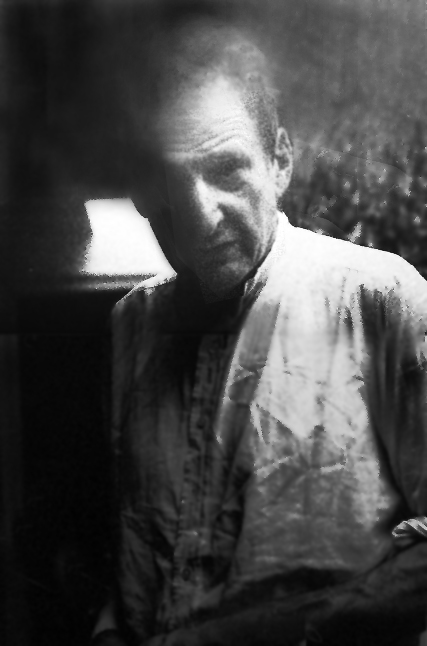
Lucian Michael Freud OM CH[1] (/frɔɪd/; 8 December 1922 – 20 July 2011) was a British painter and draughtsman, specialising in figurative art, who is known as one of the foremost 20th-century English portraitists.
Key Information


His early career as a painter was influenced by surrealism, and afterwards by expressionism, but by the early 1950s his often stark and alienated paintings tended towards realism.[2] Freud was an intensely private and guarded man, and his paintings, completed over a 60-year career, are mostly of friends and family. They are generally sombre and thickly impastoed, often set in unsettling interiors and urban landscapes. The works are noted for their psychological penetration and often discomfiting examination of the relationship between artist and model. Freud worked from life studies and was known for asking for extended and punishing sittings from his models.[3]
Early life and family
[edit]Born in Berlin (then part of the Weimar Republic) on 8 December 1922, Freud got the name "Lucian" from his mother in commemoration of the ancient writer Lucian of Samosata. Freud was the son of a German Jewish mother, Lucie (née Brasch), and an Austrian Jewish father, Ernst L. Freud, an architect who was the fourth child of Austrian psychoanalyst Sigmund Freud.[4] Lucian, the second of their three boys, was the elder brother of the broadcaster, writer and politician Clement Freud (thus uncle of Emma and Matthew Freud) and the younger brother of Stephan Gabriel Freud.
The family emigrated to St John's Wood, London, in 1933 to escape the rise of Nazism. Lucian became a British subject in 1939,[4][5] having attended Dartington Hall School in Totnes, Devon, and later Bryanston School,[6][7] for a year before being expelled owing to disruptive behaviour.[8]
Early career
[edit]Freud briefly studied at the Central School of Art in London, and from 1939 to 1942 with greater success at Cedric Morris' East Anglian School of Painting and Drawing in Dedham, relocated in 1940 to Benton End, a house near Hadleigh, Suffolk. He also attended Goldsmiths' College, part of the University of London, in 1942–43. He served as a merchant seaman in an Atlantic convoy in 1941 before being invalided out of the service in 1942. Because of his poor physical condition he avoided conscription, unlike his brothers.[9]
In 1943, the poet and editor Meary James Thurairajah Tambimuttu commissioned Freud to illustrate Nicholas Moore's poetry collection The Glass Tower. It was published in 1944 by Editions Poetry London and comprised, among other drawings, a stuffed zebra and a palm tree. Both subjects reappeared in The Painter's Room on display at Freud's first solo exhibition in 1944 at the Lefevre Gallery. In the summer of 1946, he travelled to Paris before continuing to Greece for several months to visit John Craxton.[10] In the early 1950s he frequently visited Dublin, where he would share Patrick Swift's studio.[11] He remained a Londoner for the rest of his life.
Freud was one of a number of figurative artists whom artist R. B. Kitaj later called the "School of London".[12][13] This group was a loose collection of artists who knew each other, some intimately, and worked in London at the same time in the figurative style. The group was active contemporaneously with the boom years of abstract painting and in contrast to abstract expressionism. Major figures in the group included Freud, Kitaj, Francis Bacon, Frank Auerbach, Michael Andrews, Leon Kossoff, Robert Colquhoun, Robert MacBryde, and Reginald Gray. Freud was a visiting tutor at the Slade School of Fine Art of University College London from 1949 to 1954.
Mature style
[edit]

Freud's early paintings, which are mostly very small, are often associated with German expressionism (an influence he tended to deny) and surrealism in depicting people, plants and animals in unusual juxtapositions. Some very early works anticipate the varied flesh tones of his mature style, for example Cedric Morris (1940, National Museum of Wales), but after the end of the war he developed a thinly painted very precise linear style with muted colours, best known in his self-portrait Man with a Thistle (1946, Tate)[14] and a series of large-eyed portraits of his first wife, Kitty Garman, such as Girl with a Kitten (1947, Tate).[15] These were painted with tiny sable brushes and evoke Early Netherlandish painting.[14]
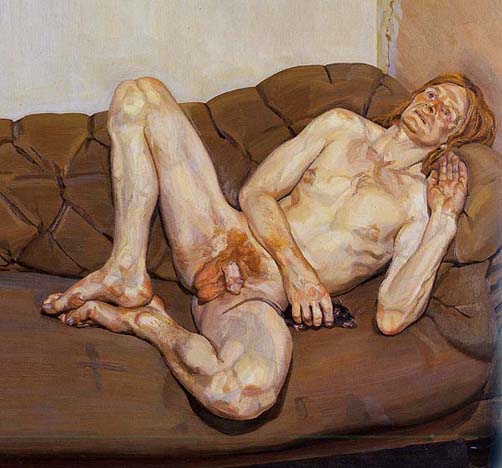
In the 1950s, Freud began to focus on portraiture, often nudes (though his first full-length nude was not painted until 1966),[16] to the almost complete exclusion of everything else, and by the middle of the decade he developed a much freer style using large hog's-hair brushes, concentrating on the texture and colour of flesh, and much thicker paint, including impasto. Girl with a White Dog (1951–52, Tate) is an example of a transitional work in this process, sharing many characteristics with paintings before and after it, with relatively tight brushwork and a middling size and viewpoint. Freud often cleaned his brush after each stroke when painting flesh, so that the colour remained constantly variable. He also started to paint standing up, which continued until old age, when he switched to a high chair.[16] The colours of non-flesh areas in these paintings are typically muted while the flesh becomes increasingly highly and variably coloured. By about 1960, Freud had established the style that he used, with some changes, for the rest of his career. The later portraits often use an over life-size scale, but are of mostly relatively small heads or in half-lengths. Later portraits are often much larger. In his late career he often followed a portrait with an etching of the subject in a different pose, drawing directly onto the plate, with the sitter in his view.[17]
Freud's portraits often depict only the sitter, sometimes sprawled naked on the floor or on a bed or alternatively juxtaposed with something else, as in Girl With a White Dog and Naked Man With Rat (1977–78).[18] According to Edward Chaney, "The distinctive, recumbent manner in which Freud poses so many of his sitters suggests the conscious or unconscious influence both of his grandfather's psychoanalytical couch and of the Egyptian mummy, his dreaming figures, clothed or nude, staring into space until (if ever) brought back to health and/or consciousness. The particular application of this supine pose to freaks, friends, wives, mistresses, dogs, daughters and mother alike (the last frequently depicted after her suicide attempt and, eventually, literally mummy-like in death), tends to support this hypothesis."[19]
The use of animals in his compositions is widespread, and often he features a pet and its owner. Other examples of portraits with both animals and people in Freud's work include Guy and Speck (1980–81), Eli and David (2005–06) and Double Portrait (1985–86).[20] He had a special passion for horses, having enjoyed riding at school in Dartington, where he sometimes slept in the stables.[21] His portraits solely of horses include Grey Gelding (2003), Skewbald Mare (2004), and Mare Eating Hay (2006). Wilting houseplants feature prominently in some portraits, especially in the 1960s, and Freud also produced a number of paintings purely of plants.[22] Other regular features included mattresses in earlier works, and huge piles of the linen rags he used to clean his brushes in later ones.[23] Some portraits, especially in the 1980s, have very carefully painted views of London roofscapes seen through the studio windows.[24]
Freud's subjects, who needed to make a very large and uncertain commitment of their time, were often the people in his life; friends, family, fellow painters, lovers, children. He said, "The subject matter is autobiographical. It's all to do with hope and memory and sensuality and involvement, really."[25] But the titles were mostly anonymous and the sitter's identity not always disclosed; the Duke and Duchess of Devonshire had a portrait of one of Freud's daughters as a baby for several years before he mentioned who the model was. In the 1970s, Freud spent 4,000 hours on a series of paintings of his mother, of which art historian Lawrence Gowing wrote, "it is more than 300 years since a painter showed as directly and as visually his relationship with his mother. And that was Rembrandt."[26]
Freud painted from life and usually spent a great deal of time with each subject, demanding the model's presence even while working on the background of the portrait. Ria, Naked Portrait 2007 required 16 months of work, with the model, Ria Kirby, posing all but four evenings during that time. With each session averaging five hours, the painting took approximately 2,400 hours to complete.[27] A rapport with his models was necessary, and while at work, Freud was reportedly "an outstanding raconteur and mimic".[27] Of the difficulty in deciding when a painting is completed, Freud said that "he feels he's finished when he gets the impression he's working on somebody else's painting".[27] Paintings were divided into day paintings, done in natural light, and night paintings, done under artificial light, and the sessions and lighting were never mixed.[28]
Freud began a painting by first drawing in charcoal. He then applied paint to a small area of the canvas, and gradually worked outward from that point. For a new sitter, he often started with the head as a means of "getting to know" the person, then painted the rest of the figure, eventually returning to the head as his comprehension of the model deepened.[27] A section of canvas was intentionally left bare until the painting was finished.[27] The finished painting is an accumulation of richly worked layers of pigment and months of intense observation.[27]
Later career
[edit]
Freud painted fellow artists, including Frank Auerbach and Francis Bacon, and many portraits of the performance artist Leigh Bowery. He also painted Henrietta Moraes, a muse to many Soho artists. A series of huge nude portraits from the mid-1990s depict Sue Tilley, or "Big Sue", some using her job title of "Benefits Supervisor" in the titles,[29] such as Benefits Supervisor Sleeping (1995), which Christie's sold in 2008 for $33.6 million, setting a world record auction price for a living artist.[30][31]
Freud's most consistent model in his later years was his studio assistant and friend David Dawson, the subject of his final, unfinished work.[32] Towards the end of his life he did a nude portrait of model Kate Moss. Freud was one of the best-known British artists working in a representational style, and was shortlisted for the Turner Prize in 1989.[33][34]

His painting After Cézanne, noteworthy because of its unusual shape, was purchased by the National Gallery of Australia for $7.4 million. Its top left section has been 'grafted' onto the main section below, and closer inspection reveals a horizontal line where the two sections were joined.[35]
In 1996, the Abbot Hall Art Gallery in Kendal mounted a major exhibition of 27 paintings and 13 etchings, covering Freud's output to date. In 1997, the Scottish National Gallery of Modern Art presented "Lucian Freud: Early Works", an exhibition of around 30 drawings and paintings done between 1940 and 1945.[36] In 1997, Freud received the Rubens Prize of the city of Siegen.[37] From September 2000 to March 2001, the Museum für Moderne Kunst Frankfurt showed 50 paintings, drawings and etchings from the late 1940s to 2000 in a larger overview exhibition despite Freud's considerable resentment of Germany.[38] All print media bore the motif of Freud's Sleeping by the Lion Carpet (1995–96), depicting the nude Sue Tilley.[39] In addition to some of his most important nude portraits of women, the 1992 large-format picture Nude with leg up (Leigh Bowery) was shown in Frankfurt. It was removed in the 1993 Metropolitan Museum New York exhibition.[40] The Frankfurt exhibition was realised in a personal dialogue between Freud and curator Rolf Lauter and is the only project Freud authorised in direct cooperation with a German museum.[41] The major retrospective at London's Hayward Gallery in 1988 was the focal point for the BBC Omnibus programme which saw one of the few conversations with Freud ever recorded, with Omnibus director Jake Auerbach.[42] The conversations were made possible by Duncan MacGuigan of Acquavella Galleries New York. This was followed by a large retrospective at Tate Britain in 2002. In 2001, Freud completed a portrait of Queen Elizabeth II. There was criticism of the portrayal in some sections of the British media.[43] In 2005, a retrospective of Freud's work was held at the Museo Correr in Venice scheduled to coincide with the Biennale. In late 2007, a collection of etchings was displayed at the Museum of Modern Art.[44]

Freud died in London on 20 July 2011 and is buried in Highgate Cemetery. Archbishop Rowan Williams officiated at the private funeral.[45]
Art market
[edit]In 2008, Benefits Supervisor Sleeping (1995), a portrait of civil servant Sue Tilley, sold for $33.6 million, at the time the highest price ever for a work by a living artist. At a Christie's New York auction in 2015, Benefits Supervisor Resting sold for $56.2 million.[46][47] On 13 October 2011, his 1952 Boy's Head, a small portrait of his neighbour Charlie Lumley, reached $4,998,088 at Sotheby's London contemporary art evening auction, making it one of the highlights of the 2011 auction autumn season.[48]
On 10 November 2015, Freud's 2004 painting The Brigadier, a portrait of Andrew Parker Bowles in his British Army uniform, sold for $34.89 million at Christie's, beating the $30 million presale estimate.[49]
Personal life
[edit]In the 1940s, Freud and fellow artists Adrian Ryan and John Minton were in a homosexual love triangle.[50] After an affair with Lorna Garman, in 1948 Freud married her niece Kitty Garman, the illegitimate daughter of sculptor Jacob Epstein and socialite Kathleen Garman.[51][52] They had two daughters, Annabel Freud and the poet Annie Freud, before their marriage ended in 1952.[53] Kitty Freud, later known as Kitty Godley (after her marriage in 1955 to economist Wynne Godley), died in 2011.[54]
In late 1952, Freud eloped with Guinness heiress and writer Lady Caroline Blackwood to Paris, where they married in 1953; they divorced in 1959.[53] During the late 1970s and '80s, Freud was in a relationship with painter Celia Paul.[55] Freud acknowledged 14 children, two from his first marriage and 12 by mistresses.[56] Writer Esther Freud and fashion designer Bella Freud are his daughters by Bernadine Coverley.[57]
From the 1970s until his death, Freud's home and studio was at 138 Kensington Church Street in Kensington, London, a house built in 1736–37. The building has been Grade II listed since 1984.[58] Freud was noted for his aversion to being photographed; he once kicked a photographer upon his departure from a private dinner.[59]
Selected solo exhibitions
[edit]
- 1994: Metropolitan Museum of Art, New York
- 2000: Museum für Moderne Kunst, Frankfurt
- 2002: Tate Britain, London
- 2003: Museum of Contemporary Art, Los Angeles
- 2004: Scottish National Gallery, Edinburgh
- 2005: Museo Correr, Venice
- 2006: Acquavella Galleries, New York
- 2007: Irish Museum of Modern Art, Dublin
- 2008: Museum of Modern Art, New York
- 2008: Gemeentemuseum Den Haag, The Hague
- 2010: Centre Georges Pompidou, Paris
- 2012: National Portrait Gallery, London
- 2012: The Modern, Fort Worth
- 2013: Kunsthistorisches Museum, Vienna
- 2016–2021: Irish Museum of Modern Art, Dublin
- 2019: Royal Academy of Arts
- 2022: National Gallery, London
References
[edit]- ^ "Lucian Freud, OM". The Daily Telegraph. London. 21 July 2011. Archived from the original on 12 January 2022. Retrieved 8 March 2020.
Freud was appointed a Companion of Honour in 1983, and a member of the Order of Merit in 1993.
- ^ "Lucian Freud 1922–2011. Tate. Retrieved October 2016
- ^ Smith, Roberta (14 December 2007). "Lucian Freud Stripped Bare". The New York Times. Retrieved 22 July 2011.
- ^ a b Spurling, John (13 December 1998). "Portrait of the artist as a happy man". The Independent. Retrieved 19 June 2010.
- ^ "No. 34708". The London Gazette. 13 October 1939. p. 6866.
- ^ "London Exhibition Showcases the Best of Bryanston Art and Design". Bryanston Art: Past and Present. Bryanston School. 12 October 2008. Archived from the original on 28 September 2011. Retrieved 25 July 2011.
- ^ "Lucian Freud (P '40) "Painted Life"". Bryanston. Bryanston School. 8 February 2012. Archived from the original on 13 November 2012. Retrieved 20 February 2012.
- ^ "Obituary: Lucian Freud, OM". The Daily Telegraph. London. 21 July 2011. Archived from the original on 12 January 2022. Retrieved 20 February 2012.
- ^ Feaver, William (2018). The Lives of Lucian Freud, Vol.1. London: Bloomsbury. pp. 122–30.
- ^ "From late 1946 to early 1947, he and Freud painted on Poros" – John Craxton Guardian Obituary
- ^ "He had met Freud by 1949...the acquaintance was well-developed by 1950 when we shared the ground-floor of a house in Hatch Street together. Lucian, who was staying in Ireland, used to come around in the mornings to paint, so that sometimes when I would surface around ten or eleven I would find them both at work in the studio next door." – Anthony Cronin, Patrick Swift (1927–83), IMMA Retrospective Catalogue, 1993; "Freud… came to Dublin in 1948… In September 1951, Kitty Garman wrote to her mother… She mentions Freud working on a painting in Paddy Swift's Hatch Street studio, Dead Cock's Head 1951" – Freud: Prophet of Discomfort Archived 19 January 2012 at the Wayback Machine, Mic Moroney, Irish Arts Review, 2007
- ^ "Art term: The School of London". tate.org. 10 April 2017. Retrieved 16 July 2019.
- ^ Kitaj's essay in the catalogue for The Human Clay exhibition, Hayward Gallery, London, 1976.
- ^ a b Tate, Man with a Thistle
- ^ Tate, Girl with a Kitten
- ^ a b NPG, II
- ^ NPG, "Etchings"
- ^ "Naked Man With Rat". Retrieved 9 February 2019.
- ^ Edward Chaney, 'Freudian Egypt', The London Magazine (April/May 2006), pp. 62–69, complete refs in Chaney, Edward (2006). Egypt in England and America: The Cultural Memorials of Religion, Royalty and Religion, Sites of Exchange: European Crossroads and Faultlines, eds. M. Ascari and A. Corrado. Amsterdam and New York: Rodopi, pp. 39–69.
- ^ "UBS Art Collection: A-Z". Archived from the original on 26 August 2014. Retrieved 19 November 2016.
- ^ Gayford, Martin "Freud's Animals" Archived 11 August 2011 at the Wayback Machine, Apollo, 2006-11-01. Retrieved 2009-06-05.
- ^ Tate, Two Plants 1977–80
- ^ NPG, VII; Tate, Standing by the Rags, 1988-9
- ^ NPG, IV & 25
- ^ "Lucian Freud" Archived 29 June 2011 at the Wayback Machine, British Council, 2009. Retrieved 18 December 2010.
- ^ Jones, Jerene (24 April 1978). "Is Lucian Freud's Relationship with Mother Odd, or Is It Art?". People. Retrieved 22 July 2011.
- ^ a b c d e f Gayford, Martin (22 September 2007). "Gayford, Martin. Lucian Freud: marathon man". The Daily Telegraph. London. Archived from the original on 12 January 2022. Retrieved 22 July 2011.
- ^ NPG, V
- ^ NPG, 33; Etching, Tate
- ^ "Freud work sets new world record". BBC News. 14 May 2008. Retrieved 14 May 2008.
- ^ Lucian Freud: From "Ingres of Existentialism" to Impasto Master BLOUINARTINFO.COM
- ^ Mark Brown, "Lucian Freud's final work to be shown in 2012 National Portrait Gallery show", The Guardian, 20 September 2011. Retrieved 29 January 2012.
- ^ Tate. "Turner Prize 1989 – Exhibition at Tate Britain – Tate". Retrieved 19 November 2016.
- ^ "Turner Prize 1985 artists: Terry Atkinson – Tate". Retrieved 19 November 2016.
- ^ Lampert, Catherine; Lauter, Rolf; (2001). Lucian Freud: After Cézanne, National Gallery of Australia, Canberra, 2001. Australia: National Gallery of Australia. p. 24. ISBN 0642541477.
- ^ Richard Calvocoressi, Lucian Freud: Early Works, Scottish National Gallery of Modern Art, 1997. ISBN 0-903598-66-3
- ^ Lauter, Rolf: Lucian Freud, in: 10x Malerei. Rubenspreis der Stadt Siegen in Werken der Sammlung Lambrecht-Schadeberg, Siegen 2002, ISBN 3-935874-03-0
- ^ The negative attitude towards Germany came on the one hand due to the National Socialists' forced flight of the family from their beloved Berlin to London, and on the other hand due to the theft of his portrait of Francis Bacon, which was stolen from the traveling exhibition in the Neue Nationalgalerie Berlin in 1988.
- ^ Lauter, Rolf (2001). "Lucian Freud, naked portraits". collections.britishart.yale.edu. Retrieved 4 February 2020.
- ^ Lauter, Rolf (ed.): Lucian Freud: Naked Portraits. Werke der 40er bis 90er Jahre [Lucian Freud: Naked Portraits. Works from the 1940s to the 1990s], Museum für Moderne Kunst, Frankfurt am Main, 29.09.2000-04.03.2001. ISBN 9783775790437
- ^ In 1987, the British Council organised a retrospective for the Hirshhorn Museum and Sculpture Garden in Washington, DC, which was subsequently shown in the Musée National d'Art Moderne in Paris, in the Hayward Gallery London and in the Neue Nationalgalerie in Berlin.
- ^ "Omnibus – Lucian Freud".
- ^ "Freud royal portrait divides critics". BBC News. 21 December 2001. Retrieved 26 February 2008.
- ^ Ayers, Robert (18 December 2007). "Curator's Voice: Starr Figura on Lucian Freud's Etchings". BLOUINARTINFO. Retrieved 23 April 2008.
- ^ Feaver, William (January 2015). "Freud, Lucian Michael (1922–2011)". Oxford Dictionary of National Biography (online ed.). Oxford University Press. doi:10.1093/ref:odnb/103935. (Subscription, Wikipedia Library access or UK public library membership required.)
- ^ "Lucian Freud (1922–2011), Benefits Supervisor Resting". christies.com. Retrieved 9 February 2019.
- ^ Katya Kazakina (14 May 2015), Freud's Lounging Naked Civil Servant Sells for $56.2 Million Bloomberg Business.
- ^ Sotheby's October 2011 Evening Sales of 20th Century Italian Art and Contemporary Art Total £39.5/$62/€45 Million Sotheby's Press Release Archived 3 March 2016 at the Wayback Machine.
- ^ "Lucian Freud portrait of Camilla's ex-husband sells for nearly $35m". The Guardian. 11 November 2015.
- ^ Brown, Mark (9 July 2021). "Lucian Freud's gay relationships explored in new exhibition". The Guardian. Retrieved 31 January 2025.
- ^ Hoban, Phoebe (2014). Lucian Freud: Eyes Wide Open. Boston: Houghton Mifflin Harcourt. p. 29. ISBN 978-0-544-11459-3.
- ^ Schoenberger, Nancy (2001). Dangerous Muse: The Life of Lady Caroline Blackwood. Knopf Doubleday Publishing Group. ISBN 978-0-307-82235-2.
- ^ a b "Face to face with Freud"[dead link]. The Sunday Times. 22 May 2005.
- ^ David Kamp, "Freud, Interrupted", Vanity Fair, February 2012, page 148.
- ^ Parker, Dian (6 March 2024). "'I Am No Longer Anyone's Model': Celia Paul on Why She Chose Art Over Love". Artnet News. Retrieved 9 March 2024.
- ^ David Kamp, "Freud, Interrupted", Vanity Fair, February 2012, page 147.
- ^ "Why Did My Mother Keep Me a Secret? | Vogue". 20 February 2025. Archived from the original on 20 February 2025. Retrieved 23 February 2025.
- ^ "138 Kensington Church Street, Non Civil Parish - 1239852". historicengland.org.uk. Historic England. Retrieved 16 December 2024.
- ^ Feaver, William (2021). The Lives of Lucian Freud: Fame: 1968-2011. New York: Knopf Doubleday Publishing Group. p. 155. ISBN 978-0-525-65767-5.
Further reading
[edit]| External videos | |
|---|---|
 Lucian Freud, Standing by the Rags, 1988–89, Smarthistory Lucian Freud, Standing by the Rags, 1988–89, Smarthistory |
- Calvocoressi, Richard (1997). Early Works: Lucian Freud. Scottish National Gallery of Modern Art. ISBN 0-903598-66-3
- Lauter, Rolf (2000), Lucian Freud: Naked Portraits. Works from the 1940s to the 1990s, Museum für Moderne Kunst, Frankfurt am Main, 29.09.2000-04.03.2001. ISBN 3-7757-9043-8 ISBN 9783775790437
- Feaver, William (1996). Lucian Freud: Paintings and Etchings. Abbot Hall Art Gallery. ISBN 0-9503335-7-3
- Feaver, William (2018). The Lives of Lucian Freud, Vol.1: Youth. London: Bloomsbury.
- Feaver, William (2022). The Lives of Lucian Freud, Vol.2: Fame. London: Bloomsbury.
- Feaver, William (2002). Lucian Freud. Tate. ISBN 0-8109-6267-5
- Feaver, William. "Freud, Lucian Michael (1922–2011)". Oxford Dictionary of National Biography (online ed.). Oxford University Press. doi:10.1093/ref:odnb/103935. (Subscription, Wikipedia Library access or UK public library membership required.)
- Gayford, Martin (2010). Man with a Blue Scarf: On Sitting for a Portrait by Lucian Freud. Thames & Hudson. ISBN 978-0-500-23875-2
- Gowing, Lawrence (1982). Lucian Freud. Thames & Hudson. ISBN 0-500-09154-4
- Gruen, John (1991). The Artist Observed: 28 Interviews with Contemporary Artists. a cappella books. ISBN 1-55652-103-0
- Hoban, Phoebe (2014) Lucian Freud: Eyes Wide Open Seattle: Amazon Publishing
- Hughes, Robert (1997). Lucian Freud, revised edition. Thames & Hudson. ISBN 0-500-27535-1
- Sharp, Jasper (2013). Lucian Freud (Exhibition Catalogue of the Kunsthistorisches Museum Vienna). Prestel. ISBN 978-3-7913-5332-6
- "NPG", National Portrait Gallery, Exhibition booklet for Lucian Freud Portraits, 2012
External links
[edit]
- 50 artworks by or after Lucian Freud at the Art UK site
- Lucian Freud exhibition (English), Press release/exhibition booklet, Kunsthistorisches Museum Wien, Vienna, 2014
- 2002 exhibition at Tate Britain including a room guide
- Freud at Tate Britain
- Essay by Kelly Grovier on Lucian Freud in The Observer 2006
- Charles Finch on Lucian Freud – MoMA: Museum of Modern Art, New York City
- (in French) Lucian Freud – Centre Pompidou, Paris
- Lucian Freud: L'Atelier (The Studio) / Centre Pompidou, Paris Video 2010
- Smee, Sebastian (31 July 2011). "Lucian Freud up close". The Boston Globe.
- Channel Four News Interview with Lucian Freud on the campaign to keep Titian paintings in Britain 2008
| International | |
|---|---|
| National | |
| Academics | |
| Artists | |
| People | |
| Other | |