Hubbry Logo
Transmission (mechanical device)Transmission (mechanical device)Main
Open search
Transmission (mechanical device)
Community hub
Transmission (mechanical device)
logo
8 pages, 0 posts
0 subscribers
Be the first to start a discussion here.
Transmission (mechanical device)
from Wikipedia
Not found
Revisions and contributorsEdit on WikipediaRead on Wikipedia
from Grokipedia
A mechanical transmission, also known as a gearbox or system, is a device or assembly of components that transfers or motion from a power source—such as an or motor—to an output element, such as wheels or machinery tools, while often modifying characteristics like speed, , direction, or type of motion (rotary to linear). These systems are fundamental in , enabling efficient operation across diverse applications from automotive to industrial equipment by ensuring power is delivered precisely where and how it is needed. Mechanical transmissions encompass a variety of types, each suited to specific requirements for distance, load, precision, and environmental conditions. Common types include gear drives, which use meshing gears (such as spur, helical, bevel, or planetary configurations) to achieve exact speed ratios and high torque transfer, often housed in gearboxes for compact, maintenance-free operation. Belt and pulley systems employ flexible belts (flat, V-shaped, or toothed) over pulleys to transmit power over longer distances with minimal noise and up to 98% efficiency, commonly found in conveyor systems and accessory drives. Chain and sprocket drives provide robust transmission for high-torque applications like hoists and bicycles, using roller chains that require lubrication and sprockets with 15-23 teeth for optimal performance at moderate speeds. Other variants, such as worm gears for significant speed reduction (ratios from 5:1 to 3600:1) and non-reversible motion, or shaft couplings (rigid or flexible) for connecting misaligned shafts, further expand their versatility. Key components within these systems include , shafts, bearings, clutches for engaging/disengaging power, and couplings to accommodate misalignment or . In practice, transmissions integrate with prime movers like electric motors or internal combustion engines to drive machinery in sectors such as , transportation, and production—for instance, planetary gear sets in turbines for high-ratio reductions or torque converters in for smooth power delivery. Their design prioritizes efficiency, durability, and adaptability, with ongoing advancements focusing on materials and configurations to minimize loss and enhance performance in modern applications.

Fundamentals

Purpose and Basic Principles

A mechanical transmission is a device that transmits mechanical power from an input source, such as an or motor, to an output mechanism, such as wheels, tools, or machinery, while modifying characteristics like , speed, or direction of rotation. It typically consists of systems involving , belts, chains, or other linkages that allow for efficient power transfer in machinery where the prime mover's output does not directly match the load's requirements. The primary functions of a mechanical transmission include altering rotational speed—either reducing it for increased or increasing it for higher —multiplying or reducing to suit operational needs, reversing the direction of , and providing clutching mechanisms to engage or disengage power flow. These capabilities ensure that machines can operate optimally under varying conditions, such as starting from rest or maintaining efficiency at different loads. For instance, in vehicles, transmissions allow engines to run at efficient speeds while adapting to road demands. At its core, the operation of a mechanical transmission relies on the principle of gear ratios, where the ratio is defined as the output speed divided by the input speed (or inversely for , where torque ratio equals input divided by output ). This leverages the provided by differing gear sizes or diameters, enabling speed and transformations. Power conservation under ideal conditions follows the equation P=T×ωP = T \times \omega, where PP is power, TT is , and ω\omega is , assuming negligible losses from or slippage. Conceptually, power enters via an input shaft connected to the prime mover, passes through intermediary elements like gear trains or belt drives that modify the output, and exits via an output shaft to the load, ensuring matched without stalling the source. Transmissions thus enable efficient power delivery in diverse machines, bridging mismatches between the prime mover's characteristics and the load's demands, a fundamental advancement that has underpinned mechanical engineering since early industrial applications.

Key Components

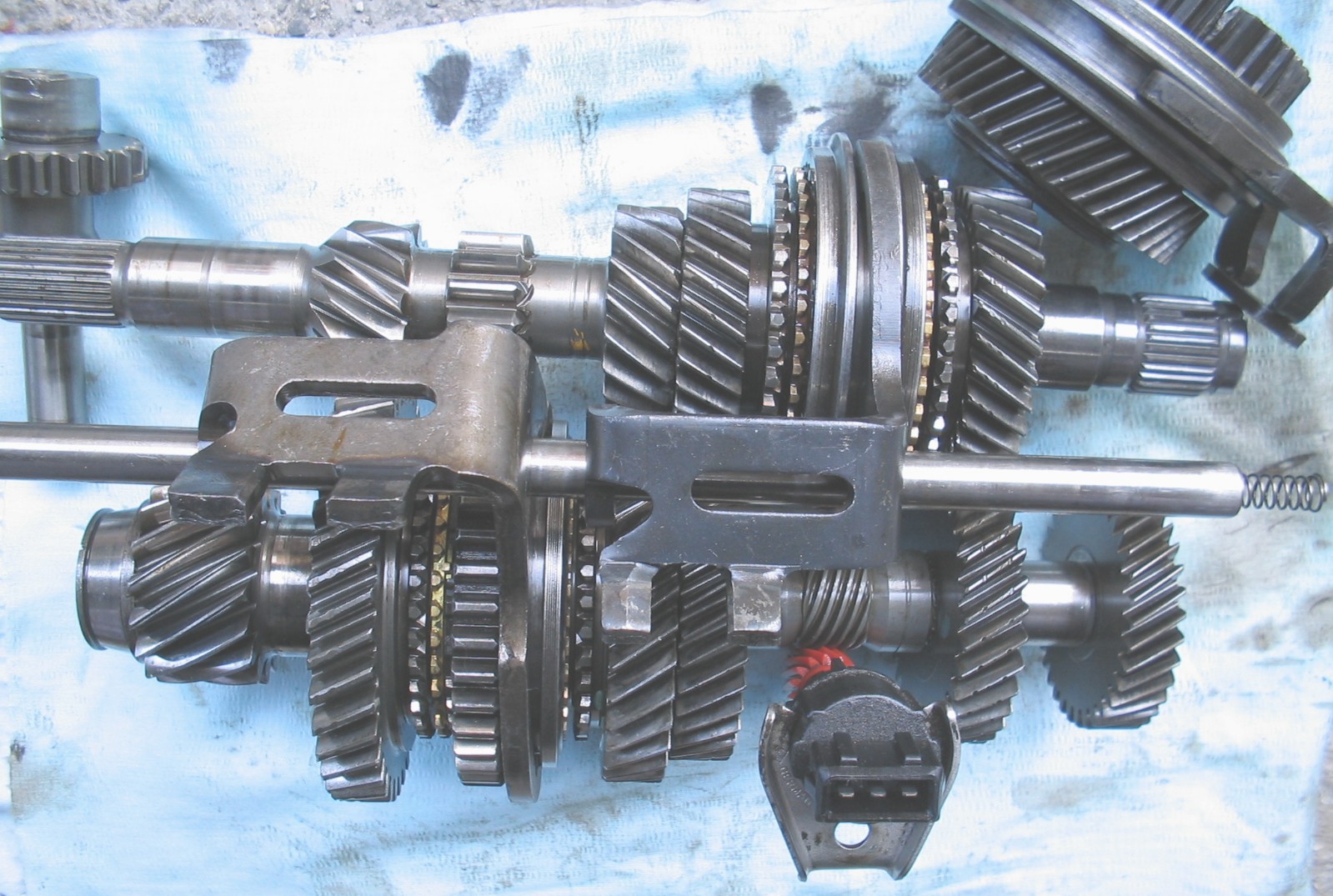
The core components of a mechanical transmission include shafts, gears, bearings, couplings, belts, pulleys, chains, sprockets, clutches, and housings, which collectively enable the transfer and modulation of rotational power from a power source to a load. In geared systems, the input shaft connects to the prime mover, receiving rotational force and transmitting it to the gear assembly, while the output shaft delivers the modified torque to the load. The countershaft (also known as the layshaft) serves as an intermediate component that meshes with input gears to facilitate ratio changes, particularly in multi-speed setups. Bearings, typically ball or roller types, support shafts within the transmission housing, reducing friction and ensuring smooth rotation under load. Gears form the heart of geared transmissions, with common types including spur for straight-line power transfer, helical for quieter operation due to angled teeth, bevel for angular motion redirection, and worm for high-ratio reductions in compact spaces. These are mounted on shafts and interact via meshing to achieve desired speed and outputs. In epicyclic systems, planetary gear sets consist of a central sun gear, multiple planet mounted on a carrier, and an outer ring gear, enabling multiple gear ratios within a single compact assembly by holding or rotating different elements. For belt and pulley systems, key components include flexible belts (flat, V-shaped, or toothed) that transmit power over , allowing for longer distances and misalignment tolerance with high efficiency. Pulleys are sized to provide the desired speed ratio based on their diameters. and sprocket drives use roller chains engaging with toothed (typically 15-23 teeth for optimal ) for robust, high-torque applications, requiring lubrication to minimize wear. Couplings connect shafts, with rigid types for precise alignment and flexible types (e.g., universal joints) to accommodate misalignment or . Clutches enable engaging or disengaging power; friction clutches use discs and pressure plates for gradual transmission, while dog clutches provide direct engagement in constant-mesh designs. Synchronizers, used in some multi-speed transmissions, align gear speeds during shifts to prevent grinding. In a generic geared transmission layout, the input shaft drives countershaft gears, which mesh with output shaft gears; synchronizers or clutches select ratios, and bearings maintain alignment. For belt or systems, the layout involves driving and driven pulleys or sprockets connected by the flexible element. The housing encases components in geared systems, providing support, alignment, and lubrication containment to minimize wear. In applications like automatic transmissions, additional components such as torque converters—featuring an , , , and lock-up in a fluid-filled housing—provide smooth power delivery.

Historical Development and Applications

Early Inventions and Uses

The earliest mechanical transmissions trace their origins to ancient civilizations, where simple gear trains were employed to harness and modulate power from natural sources. In the around the 3rd century BCE, Greek engineer developed the screw pump, a helical screw pump to lift , representing an early application of rotational mechanisms for handling in and drainage. These innovations laid foundational principles for gear systems, which soon appeared in water wheels used across the and Mediterranean for milling grain and powering basic machinery, with evidence of toothed wheels transmitting rotary motion appearing in and Roman engineering by the 1st century BCE. During the medieval era, advancements in gear technology expanded transmissions into more complex applications, particularly in and the Islamic world. By the 13th century, European gristmills commonly featured fixed-ratio gear trains connected to wheels, allowing operators to adjust the speed and for grinding operations through interchangeable wooden gears that provided consistent power modulation. mechanisms, such as those in Islamic water clocks from the , utilized intricate gear trains to regulate timekeeping and automate displays, demonstrating early precision in multi-stage . These fixed-ratio systems prioritized reliability over variability, enabling widespread use in mills and early automata across medieval society. In the , polymath advanced conceptual designs for gear systems in his extensive notebooks, sketching various configurations including epicyclic gears and ratchets for hoisting devices and theoretical machines, which illustrated potential for more dynamic power transfer though not always built. The marked significant milestones with the integration of transmissions into emerging power sources. French engineer Onésiphore Pecqueur patented the differential gear in 1828 for his steam carriage, a mechanism allowing wheels to rotate at different speeds during turns, fundamentally enabling controlled power distribution in early vehicles. Concurrently, refined transmissions in the late 18th century, introducing the sun-and-planet gear in 1781 to convert the engine's reciprocating motion into rotary output for industrial machinery, achieving two revolutions per cycle and facilitating power modulation in stationary engines. These developments transitioned transmissions toward vehicular applications in the early , as seen in steam-powered horseless carriages where geared systems modulated to wheels for . Specific innovations like rear-wheel chain drives in the late , as patented by Henry John Lawson in 1879 for his Bicyclette, further exemplified compact transmission mechanisms for human-powered vehicles, transmitting pedaling force to rear wheels via linked sprockets. Stationary engines, meanwhile, increasingly relied on such gears to adapt variable output for consistent mechanical work in factories and mills, setting the groundwork for broader industrial adoption.

Applications in Bicycles

Bicycle transmissions, adapted for human-powered propulsion, emphasize lightweight design and manual operation to optimize pedaling efficiency across varied terrains. Single-speed systems, including fixed-gear configurations without a freewheel, provide direct drive from the pedals to the rear wheel, eliminating the need for shifters and minimizing mechanical complexity; these were common in early bicycles and remain popular for urban cycling due to their simplicity and responsiveness. In contrast, multi-gear systems emerged in the late 19th century to address limitations in speed and climbing ability, with Henry John Lawson's 1880 "Bicyclette" introducing chain drive from the bottom bracket to the rear wheel, enabling variable ratios through early rotary chainring mechanisms patented in 1879. Key innovations in the early revolutionized for broader accessibility. Paul de Vivie, writing under the pseudonym Vélocio, developed the first practical system around 1905, allowing chain shifting across multiple sprockets on the rear wheel to achieve up to four speeds by 1908 in his "La Gauloise" design, which incorporated cable operation and tension arms for smoother transitions. Concurrently, internal hub gears advanced with the Sturmey-Archer 3-speed hub introduced in 1902 in , , enclosing planetary gears within the rear hub shell to provide discrete ratios without external , enhancing durability for everyday use. Bicycle transmissions typically employ either hub-integrated gearing or bottom bracket-based systems, each suited to different riding demands. Internal hub gears, like the model, house epicyclic gear sets inside the rear , offering sealed protection against weather and reduced maintenance, while gearing—often via front chainrings combined with rear derailleurs—allows for more ratios by varying both and cassette sizes. In hilly terrain, multi-ratio transmissions excel by enabling multiplication through low gears, where smaller chainrings or sprockets reduce pedaling resistance and amplify force to the wheel, facilitating climbs that would be arduous on single-speed setups. Modern bicycle transmissions have evolved to include high-capacity cassettes with 11 to 12 speeds standard on and bikes, providing wide gear ranges (e.g., 11-34T for or 11-52T for MTB) to fine-tune across diverse conditions. Electronic shifting systems, such as Shimano's Di2 introduced in 2009 for the Dura-Ace , use battery-powered servos for precise, instantaneous movement without cable stretch, improving reliability on long rides. drives in these systems achieve up to 98% under optimal conditions, with minimal energy losses from when properly lubricated, making them highly suitable for human-scale power output.

Applications in Automobiles

The integration of mechanical transmissions in automobiles began with early 20th-century designs aimed at simplifying operation for mass-market vehicles. The Ford Model T, introduced in 1908, featured a two-speed planetary transmission controlled by foot pedals, providing low and high forward gears plus reverse, which made shifting accessible without a conventional hand lever and contributed to its widespread adoption. By 1929, Cadillac advanced manual transmissions with the introduction of synchromesh technology in its Series 341 models, enabling smoother gear changes by synchronizing shaft speeds and eliminating the need for double-clutching, a feature that became standard in luxury vehicles. Following World War II, automobile transmissions evolved to meet demands for higher performance and convenience, with four-speed manual transmissions gaining prominence in the 1950s and 1960s for their balance of acceleration and cruising efficiency, as seen in models from Chevrolet and Pontiac using Borg-Warner units. Parallel to this, automatic transmissions rose in popularity; General Motors' Hydra-Matic, debuted in 1940 Oldsmobiles as the first fully automatic four-speed unit, used hydraulic fluid to shift gears without driver input, paving the way for postwar adoption in over 200,000 vehicles by 1948. Drive configurations influenced transmission design: rear-wheel-drive layouts, dominant until the 1970s, positioned the transmission longitudinally behind the engine for direct power delivery to the rear axle, optimizing torque in performance cars; front-wheel-drive systems, emerging prominently in the 1930s with Auto Union (Audi's predecessor) models like the DKW F1, integrated the transmission transversely with the engine and front differential for compact packaging and better interior space in smaller vehicles. Early all-wheel-drive experiments, such as those by Audi's forebears in the 1930s, incorporated differentials to split power between axles, enhancing traction but adding complexity to transmission mounting. In modern automobiles, multi-speed automatics dominate for their efficiency and refinement. The ZF 8HP, introduced in 2008 for BMW's 7 Series, exemplifies this trend as an eight-speed automatic with close-ratio , enabling rapid shifts and broad handling up to 1,000 Nm, now used across brands like and Rolls-Royce for improved drivability. Hybrid vehicles integrate transmissions like continuously variable transmissions (CVTs) or electronic CVTs (e-CVTs), as in Toyota's since 2004, where two electric motors and a blend power sources for seamless ratio adjustments without belts. Overdrive gears, typically with ratios around 0.7:1 in top , reduce engine RPM at speeds—such as dropping from 3,000 to 2,100 RPM at 70 mph—yielding fuel economy gains of 7-12% by minimizing aerodynamic drag and engine load.

Applications in Motorcycles and Industrial Machinery

In motorcycles, transmissions are typically designed for compactness and quick shifting to suit the agile nature of two-wheeled vehicles. Sequential manual transmissions with 5- or 6-speed configurations became standard in the mid-20th century, allowing riders to progress through gears in a linear sequence without reversing direction for most shifts. In the mid-20th century, transmissions evolved to include sequential manuals, with later designs like quick-change units in racing bikes for easier maintenance and customization in models like the CB series sport bikes. These transmissions often integrate a wet multi-plate , submerged in engine oil to provide cooling, reduce wear, and enable smoother engagement under high-revving conditions typical of motorcycle engines. The oil bath helps dissipate heat generated during rapid shifts and aggressive riding, enhancing durability in a space-constrained environment. Additionally, the standard foot-operated shift pattern—1st gear down from neutral, followed by 4 or 5 gears up—prioritizes intuitive access for the rider's left foot, improving safety and control during dynamic maneuvers. For automatic variants, belt-driven continuously variable transmissions (CVTs) emerged in scooters during the ; Honda's V-Matic system, introduced in the TACT 50cc model, used a centrifugal and for seamless speed adjustment without manual intervention, ideal for urban . The Hildebrand & Wolfmüller motorcycle of 1894 marked an early milestone with its belt-drive mechanism, representing one of the first integrated power transmission systems in a production two-wheeler, directly linking the engine to the rear wheel for basic speed control. In industrial machinery, transmissions handle heavy loads and variable speeds, with gearboxes commonly employed in conveyor belts for material handling, cranes for lifting operations, and wind turbines for energy conversion. Planetary (epicyclic) gears are particularly suited for these applications due to their high torque capacity in a compact form; for instance, Siemens' wind turbine systems, such as the SWT-2.3-82 model, utilize a three-stage planetary-helical gearbox to step up low rotor speeds to generator requirements while managing extreme loads up to several megawatts. Epicyclic gears gained prominence in factory settings during the 1920s, enabling efficient power distribution in early automated assembly lines and heavy equipment. Adaptations like variable speed drives further enhance precision in industrial contexts, such as for coordinated movements and pumps for flow regulation. These drives adjust motor speed electronically to match operational demands, reducing energy use and enabling fine-tuned control in automated processes. In , they support dynamic tasks requiring variable , while in pumps, they maintain consistent pressure without mechanical throttling.

Types of Transmissions

Fixed-Ratio Transmissions

Fixed-ratio transmissions are mechanical systems that maintain a constant gear between the input and output shafts, delivering unchanging speed reduction or and amplification without selectable gears or shifting mechanisms. These transmissions are designed for applications where operating conditions remain relatively consistent, directly matching the power source to the load requirements. Common types include direct drive, which provides a 1:1 for straightforward power transfer without speed or torque alteration; single reduction setups, often using a single pair of to achieve moderate speed decreases (e.g., ratios from 5:1 to 60:1); and simple gear trains, consisting of multiple in-line where the overall is the product of individual pairs. Worm exemplify single reduction types, enabling 90-degree power transmission between non-intersecting shafts while offering high torque multiplication in compact forms. differentials serve as fixed- variants, using conical to split between outputs at a set carrier-to-ring gear , allowing differential wheel speeds during turns without altering the primary reduction. In electric vehicles, fixed-ratio transmissions are prevalent due to the broad curve of electric motors, as seen in early models employing a single-speed 9.73:1 ratio to optimize and top speed. Industrial applications frequently utilize these as gear reducers in machinery like conveyors and machine tools, where consistent load matching is essential. Chain drives, providing fixed-ratio power transfer, were integral to early designs, linking the or wheel to the rear for reliable in agricultural tasks. The primary advantages of fixed-ratio transmissions lie in their and low , stemming from fewer components and no shifting apparatus, alongside high often exceeding 95% in helical or planetary configurations. However, they offer limited adaptability to varying speed or load demands, potentially leading to suboptimal performance in dynamic environments where or speed adjustments are needed. The gear ratio in these systems is fundamentally calculated as the output speed relative to input, determined by the number of teeth on the : Nout=Nin×TinToutN_{\text{out}} = N_{\text{in}} \times \frac{T_{\text{in}}}{T_{\text{out}}} where NN denotes rotational speed and TT the number of teeth on the input and output , respectively. This equation underscores the fixed nature of the speed-torque relationship in simple gear trains.

Manual Multi-Ratio Transmissions

Manual multi-ratio transmissions, also known as manual gearboxes, enable the driver to manually select discrete gear ratios to optimize and speed for varying conditions. These transmissions typically feature 4 to 6 forward , with the driver using a pedal to disengage the from the during shifts and a to engage the desired ratio. The operation relies on the driver coordinating release with accelerator input to match and transmission speeds, preventing gear clash. Early manual transmissions, often called crash boxes, were prevalent before the 1930s and used sliding-mesh designs with 4 to 6 speeds, requiring precise double-clutching to avoid grinding as lacked . These non-synchronous systems demanded skilled operation to slide teeth into slots without clash, making them noisy and challenging for everyday use. In contrast, modern synchronized manual transmissions, introduced widely after the 1928 invention of synchromesh by Earl A. Thompson for , employ cones or rings to equalize gear speeds automatically, allowing clash-free engagement across all forward . A key variant is the , which restricts shifts to sequential order—up or down one gear at a time—using a linear shift pattern without the traditional H-gate layout. This design, standard in motorcycles via foot-operated levers, provides intuitive operation for rapid changes and has been adapted for since the early 2000s. For instance, Porsche's GT3 models have employed six-speed sequential dog-type transmissions since 2005, enhancing shift speed in performance applications. Sequential systems in 1990s motorcycle often incorporated quick-shifters, enabling clutchless upshifts by momentarily cutting ignition to unload the gearbox, reducing shift times to under 50 milliseconds. Gear ratios in manual transmissions vary by application but prioritize torque multiplication in lower gears; a typical first gear ratio of around 3.5:1 amplifies torque for acceleration from standstill, often combined with a final drive ratio of 3.5:1 or higher for effective low-speed performance. These transmissions offer advantages such as direct driver control over gear selection, which enhances responsiveness, and high of 90-95% across gears due to minimal power loss in constant-mesh helical . However, disadvantages include increased driver fatigue from frequent and shift operations, particularly in urban or long-distance driving. The , a friction-based component interfacing the and input shaft, must be manually operated for every shift, contributing to this workload.

Semi-Automatic Transmissions

Semi-automatic transmissions, also known as automated manual transmissions (AMTs), are mechanical systems that automate certain aspects of gear shifting while requiring the driver to manually select gears, thereby bridging the gap between fully manual and automatic transmissions. These devices typically eliminate the need for a traditional clutch pedal by using servo mechanisms to engage and disengage the clutch, allowing for smoother operation in vehicles where driver control over gear selection is desired but physical effort is minimized. The primary types of semi-automatic transmissions include clutchless manuals and automated manuals with servo-actuated clutches. Clutchless manuals, such as the system introduced in 1999 on the , rely on electronic controls to manage engagement without a foot pedal, enabling sequential gear shifts via a or paddles. Automated manual transmissions (AMTs), the more common variant, incorporate electro-hydraulic or electro-mechanical actuators to control both the and gear selection process, with the driver inputting shift commands through a gear , buttons, or steering wheel paddles. In operation, semi-automatic transmissions function by integrating sensors and electronic control units (ECUs) that monitor vehicle speed, engine load, and throttle position to automate clutch modulation during shifts. For instance, when the driver selects a gear, the ECU signals the actuators to disengage the , move the selector fork to the desired gear position, and then re-engage the , all without interrupting power flow significantly. This contrasts with pure manual systems by reducing the coordination required between and accelerator, though the driver retains responsibility for timing shifts based on driving conditions. Early examples of semi-automatic transmissions date back to the Hudson Drive-Master introduced in 1942 on Hudson automobiles, which used a vacuum-operated servo to automate engagement while keeping manual gear selection via a shifter. In modern applications, particularly in commercial trucks, systems like the Eaton Twin Countershaft with 12 forward speeds automate and shift operations through electronic controls, improving and driver comfort in heavy-duty environments. These transmissions have seen widespread adoption in and for passenger cars and trucks due to their cost-effectiveness compared to full automatics. Advantages of semi-automatic transmissions include reduced driver fatigue and effort relative to fully manual systems, as the automation of clutch operation allows focus on gear selection and road conditions, leading to improved safety in demanding scenarios like urban traffic or long-haul trucking. However, they often suffer from shift lag—delays of 200-500 milliseconds during gear changes due to actuator response times—which can affect drivability and acceleration compared to more seamless automatic alternatives. Despite these drawbacks, advancements in actuator speed and ECU algorithms have mitigated lag in recent models, making AMTs a viable option for fuel-efficient vehicles.

Automatic Transmissions

Automatic transmissions are multi-speed mechanical systems that automatically select and shift gear ratios without intervention, providing seamless power delivery from the to the . The core operation relies on a , which serves as a between the and transmission, allowing the to launch smoothly from a stop by permitting controlled slip while multiplying during . This slip enables the to continue running without stalling, even as the is stationary or slowing. The body, acting as the hydraulic control center, directs pressurized transmission fluid to engage clutches and bands that hold or drive specific components, such as planetary gear sets, to achieve the desired gear ratio based on speed, throttle position, and other inputs from sensors. The most common subtype is the hydraulic automatic transmission, which uses a coupled with planetary gear arrangements for ratio changes. A seminal example is ' Turbo-Hydramatic 400, introduced in 1964 for models and widely adopted across GM vehicles by the late 1960s, featuring three forward speeds and a robust design that became a standard for rear-wheel-drive applications. These transmissions typically offer 4 to 10 forward speeds in modern iterations, allowing optimized across a wide range of operating conditions. To mitigate efficiency losses from slip—calculated as the percentage difference in rotational speeds between the input () and output () sides, given by slip=(input RPMoutput RPMinput RPM)×100%\text{slip} = \left( \frac{\text{input RPM} - \text{output RPM}}{\text{input RPM}} \right) \times 100\% —many include a lock-up clutch that mechanically couples the converter elements at higher speeds, eliminating slip and improving fuel economy by up to 10% in highway driving. An advanced subtype is the (DCT), which employs two separate clutches—one for odd-numbered gears and one for even-numbered gears—enabling pre-selection of the next gear for near-instantaneous shifts without interrupting power flow. Volkswagen's (DSG), launched in 2003 on the Golf R32, exemplifies this technology, offering faster acceleration than traditional hydraulics due to shift times under 0.1 seconds. While hydraulic automatics provide smooth, effortless operation ideal for everyday driving, they suffer from higher complexity and cost due to numerous hydraulic components, along with potential fluid-related issues. In contrast, DCTs enhance and but introduce higher upfront costs and occasional reliability concerns from electronic controls, though they excel in seamless driving with reduced driver input.

Continuously Variable Transmissions

Continuously variable transmissions (CVTs) provide an infinite number of gear ratios within a defined range, enabling seamless power delivery without discrete gear shifts. Unlike traditional transmissions with fixed ratios, CVTs use non-gear mechanisms to adjust the drive ratio continuously, optimizing speed for or . The primary mechanisms include belt-and-pulley systems, which employ variable-diameter pulleys connected by a flexible belt or ; toroidal drives, featuring rolling contact between discs and rollers for friction-based transfer; and hydrostatic types, which rely on hydraulic pumps and motors to vary fluid flow and achieve variable ratios. These designs allow for smooth acceleration and precise control over vehicle speed relative to engine RPM. Operation of a CVT involves actuators—typically hydraulic or mechanical—to adjust the pulley diameters or roller positions, altering the effective in real time. In a belt-and- CVT, for instance, the input pulley halves move axially to clamp the belt tighter, increasing its effective and reducing the output pulley's, which shifts the to match load demands and keep the at optimal RPM. Toroidal CVTs use tilting rollers to change contact points between input and output discs, providing a similar continuous adjustment via traction forces, while hydrostatic systems modulate oil pressure between a variable-displacement and motor for control. The first automotive CVT was introduced by in 1958 with the system on the , marking the debut of production belt-driven CVTs. Modern examples include electronic CVTs (e-CVTs) in hybrid vehicles, such as the 1997 , which integrates a planetary gear set with electric motors to simulate continuous ratios by varying motor speeds alongside the . CVTs offer advantages like smooth acceleration without shift interruptions and improved by maintaining the engine in its most effective operating range, often yielding 5-10% better economy than stepped automatics in passenger cars. However, they face disadvantages including torque limitations—typically up to 380 Nm for belt types due to slippage risks under high loads—and concerns over belt or durability, where excessive or torque can lead to premature wear or failure. In push-belt CVTs, developed by Van Doorne Transmissie in the from earlier prototypes, a push-belt composed of hundreds of articulated metal elements transmits power under compression between pulleys, enabling higher torque capacity (up to 300 Nm initially) than traditional rubber belts while maintaining flexibility. -based CVTs, such as those in Audi's , use linked plates for even greater strength (up to 400 Nm) and efficiency but are less flexible and more complex to manufacture, with push-belts dominating the market for their balance of and cost in compact applications.

Technical Considerations

Gear Design and Materials

Gear design in mechanical transmissions begins with the tooth profile, which is critical for ensuring smooth power transfer and minimizing wear. The involute profile, derived from the of a taut string unwrapping from a base circle, is the standard for most modern gears due to its ability to maintain constant velocity ratio during meshing and accommodate manufacturing variations. This profile allows for line contact between teeth, reducing sliding friction compared to earlier cycloidal designs. In helical gears, commonly used in automotive and industrial transmissions, the —typically between 15° and 45°—orients the teeth at an angle to the gear axis, promoting gradual engagement across multiple teeth and thereby reducing noise levels by up to 10-15 dB compared to straight spur gears at speeds of 1000-3000 RPM. Manufacturing processes for transmission emphasize precision to achieve required tolerances and surface finishes. Hobbing, a continuous indexing method using a helical cutter, is widely employed for generating profiles on and helical gears, offering efficiency for medium to high production volumes. Subsequent grinding refines the tooth flanks to sub-micrometer accuracy, removing heat-affected zones and ensuring profile conformity. Heat treatments, such as , are applied post-machining to enhance surface hardness; this thermochemical process diffuses carbon into low-alloy at 900-950°C, creating a case depth of 0.5-1.5 mm with surface hardness exceeding 58 HRC while maintaining a ductile core for impact resistance. Material selection for balances strength, weight, and cost, with low-alloy steels dominating automotive transmissions. AISI 8620, a nickel-chromium-molybdenum with 0.18-0.23% carbon, is favored for its response, providing bending strength up to 1000 MPa after and good core toughness for shock loads in differentials and gearboxes. In continuously variable transmissions (CVTs), composite materials like carbon fiber-reinforced thermoplastics are used for drive belts or pulleys to reduce inertia and improve efficiency, offering a tensile modulus over 100 GPa while weighing 50% less than equivalents. Wear resistance is further enhanced by (DLC) coatings, which exhibit hardness up to 3000 HV and friction coefficients below 0.1, extending gear life by 2-5 times in lubricated conditions. As of 2025, advancements in gear materials include lightweight alloys and high-performance composites for reduced weight and improved fuel efficiency, alongside sustainable options like biodegradable polymers for non-critical components. AI-assisted design tools are optimizing gear geometries to minimize friction, contributing to overall transmission efficiency gains. Standards from the American Gear Manufacturers Association (AGMA) guide load capacity calculations, incorporating factors like geometry, material properties, and dynamic effects to predict pitting resistance and bending fatigue limits; for instance, AGMA 2101-D04 specifies allowable stresses for spur and helical gears under continuous duty. Precision applications demand backlash minimization, achieved through techniques like profile grinding to tolerances under 5 μm or anti-backlash designs with spring-loaded adjustments, ensuring positional accuracy within 1 arcminute. Bending strength is evaluated using the Lewis form factor, an empirical geometry correction that accounts for tooth shape in stress analysis. The Lewis bending stress equation is given by: σ=WtF×Y×m\sigma = \frac{W_t}{F \times Y \times m} where σ\sigma is the , WtW_t is the tangential load, FF is the face width, YY is the Lewis form factor (dependent on number and ), and mm is the module. This formula treats the as a cantilever beam, providing a foundational metric for gear sizing, though modern AGMA methods refine it with factors.

Noise, Vibration, and Efficiency

Noise in mechanical transmissions primarily arises from gear whine, which is generated by the forced vibrations of the transmission case under the excitation of load gears at meshing frequencies. Gear rattle, another common noise source, results from torsional vibrations causing impacts between gears due to backlash, particularly in unloaded or lightly loaded gear pairs. These noise phenomena are evaluated through (noise, vibration, and harshness) testing, often adhering to standards like ISO 3744, which determines levels from measured on a surrounding surface. Vibration in transmissions includes torsional oscillations along shafts, which can lead to and amplify dynamic loads; these are typically mitigated by torsional vibration dampers that convert vibrational energy into heat. Such dampers, often viscous types, are attached to the or transmission output shaft to isolate and prevent rattle propagation. Efficiency in transmissions is influenced by losses such as in gear meshes and bearings, which account for approximately 2-5% power loss in manual transmissions under typical operating conditions. In s, additional churning losses occur due to fluid drag on rotating components, contributing significantly to overall parasitic losses that increase with speed. Synthetic oils and low-viscosity automatic transmission fluids can reduce these churning and losses by lowering drag resistance, thereby improving . To mitigate , helical gear designs are employed, offering gradual tooth engagement that reduces whine levels by up to 10-15 dB compared to spur gears through lower excitation. In modern electric vehicles, active noise cancellation systems use sensors and algorithms to generate counteracting , effectively reducing transmission whine and enhancing cabin comfort.

References

  1. https://en.wikiversity.org/wiki/Digital_Media_Concepts/Continuous_Variable_Transmission_%28CVT%29
Add your contribution
Related Hubs
User Avatar
No comments yet.