Community hub
Recent from talks
Contribute something
Nothing was collected or created yet.
Geoffrey Berman
View on Wikipedia
Geoffrey Steven Berman (born September 12, 1959) is an American attorney who served as the United States Attorney for the Southern District of New York from 2018 to 2020. He is the Global Chair of the litigation department at the law firm Fried, Frank, Harris, Shriver & Jacobson.
Key Information


Berman, a Republican, served as an Assistant United States Attorney for the Southern District of New York from 1990 to 1994. In January 2018, U.S. Attorney General Jeff Sessions announced Berman's appointment as interim U.S. Attorney for a statutory period of 120 days.[1] On April 25, 2018, the judges of the Southern District of New York, pursuant to , unanimously appointed Berman U.S. Attorney for an indeterminate term that extended "until the vacancy is filled",[2] which may or may not include the appointment of a presidential nominee approved by the Senate.[3][2]
On June 19, 2020, Attorney General William Barr announced in a press release that Berman was "stepping down" effective July 3 and that Jay Clayton, the chairman of the U.S. Securities and Exchange Commission, would be nominated as his replacement.[4][5] Hours later, Berman stated that he had not resigned and would not resign until "a presidentially appointed nominee is confirmed by the Senate."[6] At the time that Trump and Barr sought his ouster, Berman was reportedly investigating Trump's personal attorney Rudy Giuliani for alleged crimes relating to his activities in Ukraine.[7][8] On June 20, Barr told Berman that he had been fired by Trump at Barr's request and that the deputy U.S. Attorney Audrey Strauss would serve as acting U.S. Attorney. Berman then agreed to resign immediately.[8][9][10]
Early life
[edit]Geoffrey Steven Berman was born in Trenton, New Jersey, the son of Marie (Edelman) and Ronald Berman, a developer of Trenton real estate properties.[11][12] He graduated magna cum laude from the University of Pennsylvania with a Bachelor of Arts degree in political science and a Bachelor of Science in economics from the Wharton School in 1981.[13] He then studied law at Stanford Law School, where he obtained a Juris Doctor in 1984.[14] During law school, he was the Note Editor of the Stanford Law Review.[15]
Career
[edit]Berman began his career as a clerk for Judge Leonard I. Garth of the United States Court of Appeals for the Third Circuit.[13] From 1987 to 1990 he served as an associate to independent counsel Lawrence Walsh during the Iran–Contra affair investigation.[16] There, he was part of a team that prosecuted former CIA employee Thomas G. Clines for tax fraud.[citation needed]
Assistant United States Attorney (1990–1994)
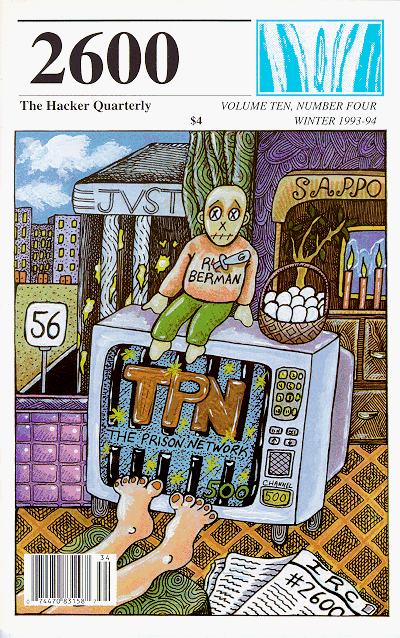
[edit]Berman served as an Assistant United States Attorney for the Southern District of New York from 1990 to 1994.[17] He worked on several tax and fraud cases as a prosecutor, including the Masters of Deception computer hacking case. As a result of Berman’s prosecution of that case, his effigy was stabbed on the front cover of 2600: The Hacker Quarterly, a computer hacking magazine.[18]
Private practice (1994–2018)
[edit]
Berman was subsequently engaged by Mudge Rose and Latham & Watkins, where he worked as a monitor to rid the New York Carpenter’s Union of the influence of organized crime.[14] From 1994 to 1997, Berman represented, pro bono, Maureen and Richard Kanka, defending the constitutionality of Megan’s Law in state and federal litigation. He married Joanne Karen Schwartz on August 20, 1994.[19]
Berman is a resident of New York, where he previously lived from 1984 to 2002. He then moved to Princeton, New Jersey, where he lived for 14 years. Berman was a shareholder at Greenberg Traurig, as was Rudy Giuliani.[20] It was reported that Giuliani supported Berman for U.S. Attorney in New Jersey, but that Giuliani supported a different candidate for U.S. Attorney for the Southern District of New York.[21][22]
Berman represented Philip Kwon, the deputy general counsel at the Port Authority of New York and New Jersey during the Bridgegate trial.[23] He denied that Kwon was ever told the lane closures were intended to punish anyone.[24]
United States Attorney (2018–2020)
[edit]
After President Donald Trump fired Preet Bharara as U.S. Attorney, Trump interviewed Berman for the position.[25] Berman had performed some part-time volunteer work for the Trump transition.[26] On January 3, 2018, Attorney General Jeff Sessions announced Berman's appointment as U.S. Attorney, along with 16 other former prosecutors to various offices around the country on an interim basis until the Senate could confirm them.[27][28]
The Trump administration never nominated Berman or most of the other interim appointments. On April 25, 2018, the Chief Judge of the Southern District of New York entered an order on behalf of a unanimous court appointing Berman U.S. Attorney pursuant to its authority under 28 U.S.C Section 546(d). Berman had the appointment indefinitely, until the Senate confirmed someone nominated by the president.[2] The U.S. Attorney's Office for the Southern District of New York, often called the "Sovereign District of New York", is known as highly independent.[29] Berman oversaw investigations into some of Trump's associates.[30][31][32][33]
In April 2018, Berman's office issued a search warrant of the office and hotel room of Michael Cohen, Trump's former lawyer, for possible bank fraud and campaign finance violations.[34][35][36] Since Berman was recused by the U.S. Attorney General's Office from the investigation, he was apparently not involved in the decision to raid Cohen's office.[37] That search was presumably conducted under the authority of Robert Khuzami, Berman's top deputy.[38]
On August 8, 2018, U.S. Representative Chris Collins, his son Cameron, and the father of Cameron's fiancée, Stephen Zarsky, were arrested by the FBI and charged by Berman with insider trading and making false statements.[39][40][41] Following the charges, House Speaker Paul Ryan kicked Collins off of the House Energy and Commerce Committee, and Collins suspended his reelection campaign.[42][43][44] Collins subsequently pleaded guilty to insider trading and lying to the FBI and was sentenced to 26 months in prison.[45]
On October 26, 2018, Berman charged Cesar Sayoc with sending a string of homemade incendiary packages to several present and former federal officials, including former President Barack Obama, former President Bill Clinton and former Secretary of State Hillary Clinton.[46] Sayoc pleaded guilty and was sentenced to 20 years in prison.[47]
In October 2018, Berman charged five doctors and one pharmacist with narcotics distribution, including prescribing opioids to individuals who had no medical need for them. Berman said at his press conference: “These doctors and other health professionals should have been the first line of defense against opioid abuse, but as alleged in today's charges, instead of caring for their patients, they were drug dealers in white coats."[48][49][50] Five of the defendants have either pleaded guilty or been convicted.[51]
In November 2018, Berman charged recording artist and performer Daniel Hernandez, better known as 6ix9ine, with six felony counts of racketeering and violence to aid racketeering. The most serious charge against Hernandez was "using or carrying a firearm during and in relation to, or possessing a firearm in furtherance of, a crime of violence, which was discharged", which can result in life in prison.[52] In January 2019 Hernandez pleaded guilty to the charges.[53] He was sentenced to two years in prison.[54]
On November 26, 2018, Berman announced the indictment of former Honduran Congressman Tony Hernández on drug trafficking and weapons charges. Hernández is the brother of former Honduras President Juan Orlando Hernández. On October 18, 2019, Tony Hernández was convicted at trial.[55][56]
On January 8, 2019, Berman charged Natalia Veselnitskaya, a Russian lawyer, with obstruction of justice in connection with a false and misleading declaration she submitted to a judge in the Southern District of New York. Berman said on announcing the indictment: "Fabricating evidence to affect the outcome of pending litigation not only undermines the integrity of the judicial process, but it threatens the ability of our courts and our government to ensure that justice is done."[57][58][59]
On March 25, 2019, Berman charged Michael Avenatti with extortion in connection with his threat to Nike that he would go public with damaging allegations against Nike employees unless Nike paid him over $20 million. Berman said on announcing the charges: "A suit and tie doesn't mask the fact that, at its core, this was an old-fashioned shakedown."[60][61] Avenatti was convicted on all counts on February 14, 2020.[62]
In April 2019, Berman brought the first ever drug trafficking charges against a pharmaceutical company and two of its executives, charging Rochester Drug Co-Operative and its former CEO, Laurence Doud III, with conspiring to distribute oxycodone and fentanyl and to defraud the DEA. In announcing the charges, Berman said, "This prosecution is the first of its kind: executives of a pharmaceutical distributor and the distributor itself have been charged with drug trafficking, trafficking the same drugs that are fueling the opioid epidemic that is ravaging our country. Our Office will do everything in its power to combat this epidemic, from street-level dealers to the executives who illegally distribute drugs from their boardrooms."[63][64]
In May 2019, Berman charged Avenatti with another indictment, alleging that he stole $300,000 from his client Stormy Daniels. Berman said: "Far from zealously representing his client, Avenatti, as alleged, instead engaged in outright deception and theft, victimizing rather than advocating for his client."[65]
In July 2019, Berman charged financier Jeffrey Epstein with sex trafficking of minors and conspiracy to commit sex trafficking of minors. Berman said at his press conference: "The alleged behavior shocks the conscience. And while the charged conduct is from a number of years ago, it is still profoundly important to the many alleged victims, now young women. They deserve their day in court, and we are proud to stand up for them in bringing this indictment."[66][67] Berman's prosecution resurfaced then-Labor Secretary Alexander Acosta's handling of Epstein's sex trafficking case a decade earlier. On July 12, Acosta resigned amid pressure from the case.[68]
On August 10, 2019, Epstein was found dead in his cell of an apparent suicide. Berman stated: "Today's events are disturbing, and we are deeply aware of their potential to present yet another hurdle to giving Epstein's many victims their day in Court. To those brave young women who have already come forward and to the many others who have yet to do so, let me reiterate that we remain committed to standing for you, and our investigation of the conduct charged in the Indictment—which included a conspiracy count—remains ongoing."[69]
On October 9, 2019, Berman announced charges against Lev Parnas, Igor Fruman and two others for campaign violations relating to the illegal use of straw donors and foreign money.[70] Berman said: "They sought political influence not only to advance their own financial interests but to advance the political interests of at least one foreign official—a Ukrainian government official who sought the dismissal of the U.S. Ambassador to Ukraine". Berman said the investigation was ongoing.[71]
On October 15, 2019, Berman announced the indictment of Halkbank, the largest state-owned bank in Turkey, for a multi-billion-dollar scheme to evade U.S. sanctions on Iran. In announcing the charges, Berman said: "The bank's audacious conduct was supported and protected by high-ranking Turkish government officials, some of whom received millions of dollars in bribes to promote and protect the scheme."[33][32][31] Turkish President Recep Tayyip Erdogan lobbied President Trump to quash Berman's investigation, as Erdogan's family and allies could be implicated by it.[72] In June 2019, Attorney General Barr pressed Berman to allow Halkbank to pay a fine and acknowledge some wrongdoing, and to end criminal investigations into senior Halkbank officials involved in the sanctions evasion.[72] Previously, acting Attorney General Matthew G. Whitaker rejected Berman's request to file criminal charges against the bank. Whitaker did so shortly after Erdogan had pressed Trump to quash the investigation.[72]
On November 19, 2019, Berman charged guards Michael Thomas and Tova Noel with creating false records, and with conspiracy, after video footage obtained by prosecutors revealed that Jeffrey Epstein had, against regulation, been in his cell unchecked for eight hours before being found dead on August 10, 2019.[73]
On January 27, 2020, at a press conference sponsored by Safe Horizon at the site of Jeffrey Epstein's New York mansion, Berman was asked whether Prince Andrew was cooperating with the SDNY's investigation into Epstein's coconspirators. Berman responded that to date Andrew had provided "zero cooperation".[74][75] On March 9, 2020, Berman said that Andrew had "completely shut the door" on voluntary cooperation and that his office was considering its options.[76][77]
On February 11, 2020, Berman announced charges against Lawrence Ray, who sex trafficked and extorted his daughter's college roommates. Berman said: "For so many of us, and our children, college is supposed to be a time of self-discovery and newfound independence, a chance to explore and learn, all within the safety of a college community. But as alleged, the defendant exploited that vulnerable time in his victims' lives".[78][79]
On February 25, 2020, it was reported and confirmed by an SDNY spokesperson that a search warrant was executed at the Manhattan offices of Peter Nygård amid a sex-trafficking investigation.[80]
On March 9, 2020, Berman announced the indictment of 27 people, including Jason Servis and Jorge Navarro, involved in doping racehorses across the country. Berman said, "The defendants who we charge today engaged in this conduct not for love of the sport and certainly not out of concern for the horses, but for money."[81]
On March 26, 2020, Berman announced the indictment of Venezuelan President Nicolás Maduro and other Venezuelan officials on charges of conspiracy to commit narco-terrorism and to import hundreds of tons of cocaine into the United States and related weapons offenses. Berman said: "As alleged, Maduro and the other defendants expressly intended to flood the United States with cocaine in order to undermine the health and well being of our nation. Maduro very deliberately deployed cocaine as a weapon."[82]
On April 30, 2020, Berman announced drug trafficking and weapons charges against Juan Carlos "The Tiger" Bonillo, the former head of the Honduras National Police. Berman stated that the indictment alleged that Bonillo conspired with convicted former Honduran congressman Tony Hernández and his brother, former Honduras President Juan Orlando Hernández.[83]
On April 30, 2020, Berman announced a deferred prosecution agreement against Bank Hapoalim, Israel's largest bank, for conspiring to hide assets and income in offshore accounts. Bank Hapoalim agreed to pay nearly $875 million. Berman said, "Israel's largest bank, Bank Hapoalim, and its Swiss subsidiary have admitted not only failing to prevent but actively assisting U.S. customers to set up secret accounts, to shelter assets and income, and to evade taxes. The combined payment approaching $1 billion reflects the magnitude of the tax evasion by the Bank's U.S. customers, the size of the fees the Bank collected to provide this illegal service, and the gravity of the illegal conduct."[84]
On June 12, 2020, Berman announced the unsealing of a complaint against Inigo Philbrick, an art dealer with galleries in London and Miami, charged with defrauding a client of over $20 million. Berman said: "You can't sell more than 100 percent ownership in a single piece of art, which Philbrick allegedly did, among other scams. When his schemes began to unravel, Philbrick allegedly fled the country. Now he is in U.S custody and facing justice."[85][86]
2020 ouster
[edit]In June 2020, CNN reported that Trump had been thinking about removing Berman from his position for two years. Under Berman, the SDNY investigated and prosecuted Trump's longtime personal attorney and "fixer" Michael Cohen in 2018. Trump also felt Berman's investigation of his personal attorney, Rudy Giuliani, was an effort to damage him politically.[87] That investigation of Giuliani's activities in Ukraine became publicly known in October 2019, and later was reported to include a broad range of potential crimes by Giuliani or his associates.[88][89] In May 2021, the SDNY publicly disclosed in a court filing that in November 2019 it covertly obtained search warrants for Giuliani's iCloud account, and for that of his and Trump's associate, Victoria Toensing, as part of the investigation.[90] In June 2020, the SDNY was also two months from indicting former Trump advisor Steve Bannon on fraud charges relating to fundraising for the Mexico–United States border wall.[91]
In a late-night news release on June 19, 2020, Attorney General William Barr announced that Berman would step down from his position. He said that Trump intended to nominate Jay Clayton, the chairman of the Securities and Exchange Commission, to take Berman's place as the Manhattan U.S. attorney, and that Trump, on his recommendation, had appointed Craig Carpenito, the U.S. attorney for the District of New Jersey, to serve as the acting U.S. attorney for the Southern District of New York, effective July 3, 2020, while the Senate takes up Clayton's nomination.[4][92][93]
Shortly after Barr's announcement, Berman denied having resigned and said that he had "no intention of resigning," saying that he was appointed by a court, not the president, and that he would remain in office until the Senate confirmed a replacement. He added that he learned about his supposed intention to step down from press reports. He vowed to ensure that the office’s "important cases continue unimpeded."[94] Because Berman was appointed by the United States District Court for the Southern District of New York under 28 U.S.C. Section 546(d), it was unclear whether either the Attorney General or the President could remove Berman as US Attorney without a Senate-confirmed successor in place.[95][96][97][98][99] It was also unclear whether Carpenito is legally eligible to replace Berman on an acting basis.[100]
The next day, June 20, Barr claimed that Trump had fired Berman, writing in a letter to Berman, "Because you have declared that you have no intention of resigning, I have asked the President to remove you as of today, and he has done so."[9][101] Barr wrote in his letter, "Unfortunately, with your statement of last night, you have chosen public spectacle over public service".[10] Barr added "By operation of law, the Deputy United States Attorney, Audrey Strauss, will become the Acting United States Attorney."[102][103] When asked by reporters, Trump said, "That's his [Barr's] department, not mine. ... I'm not involved."[104] Later that day Berman agreed to step down because, he said, Barr had respected "the normal operation of law" by appointing his deputy as interim U.S. attorney.[8] Barr also wrote to Berman, "Your statement also wrongly implies that your continued tenure in the office is necessary to ensure that cases now pending in the Southern District of New York are handled appropriately. This is obviously false."[8]
Senate Minority Leader Chuck Schumer of New York stated that the firing "reeks of potential corruption of the legal process."[105] Schumer said from the Senate floor, "But for Mr. Berman’s principled stand, the White House and the DOJ would have subverted the chain of succession at the SDNY to install a pliant U.S. Attorney from New Jersey in Mr. Berman’s place. Thankfully, due to Mr. Berman’s courage that plan was thwarted".[106] On June 20, 2020, House Judiciary Committee chair Jerry Nadler announced that the committee would "immediately open an investigation into this incident, as part of our broader investigation into Barr’s unacceptable politicization of the Department of Justice" and invited Berman to join two whistleblowers at an upcoming hearing about "a larger, ongoing, and wholly unacceptable pattern of conduct."[107] Speaker of the House Nancy Pelosi said that Berman's firing “cannot be explained by cause and instead suggests base and improper motives. ... Judiciary Chairman Nadler’s renewed call for Barr to testify before the House Judiciary Committee and the Committee’s decision to open an immediate investigation into this incident are justified and urgently needed."[108]
On July 9, Berman testified before a closed session of the House Judiciary Committee.[109] After his testimony was released, Representative Adam Schiff said that "Berman’s act of defiance" was a story "of great heroism".[110][111]
On August 20, 2020, the SDNY announced the indictment of Steve Bannon, Trump’s former campaign CEO, on wire fraud and money laundering charges.[112][113] The charges were based on his taking for his personal use funds that were supposed to be dedicated to the building of a wall on the southern border. Several articles questioned whether the charges would have been brought if Berman had not blocked Barr's attempt to appoint an ally to replace him. On January 20, 2021, Trump granted Bannon a pardon from the federal charges.[114][115][116] Berman refused to resign until his deputy was named to succeed him, which he said would ensure that the important cases of his office would continue without delay or interruption.[117][118]
On July 15, 2020, Stanford Law School announced Berman's appointment as the Edwin A. Heafey Jr. Visiting professor of Law for the fall 2020 term.[119][120]
On November 19, 2021, at Damian Williams's investiture ceremony as the new U.S. Attorney for the SDNY, Williams praised Berman’s service. As reported by the Associated Press, Williams "sparked sustained applause when he mentioned Geoffrey S. Berman, a Republican who served as U.S. attorney during much of Donald Trump’s presidential term. Berman became known in what prosecutors like to affectionately call the 'Sovereign District of New York' for standing up to Washington’s demands and left office in June 2020 after a standoff with then-Attorney General William Barr over investigations into Trump’s allies. Williams said Berman promoted him and 'when the hour demanded true courage and independence and a demonstration of what it means to be a Southern District of New York prosecutor, he showed all of America what that means.'"[121]
Return to private life
[edit]In December 2020, Fried, Frank, Harris, Shriver & Jacobson announced that Berman was joining the firm to head its white-collar defense, regulatory enforcement and investigations practice.[122][123]
In September 2022, Berman published a memoir, Holding the Line: Inside the Nation’s Preeminent US Attorney’s Office and its Battle with the Trump Justice Department. In it he describes numerous instances in which he says the Justice Department took politically motivated actions, such as suppressing investigations into Trump's allies or demanding investigations into people considered Trump's enemies.[124] As one example, he says that in September 2018 a senior Justice Department official told Berman's deputy that because the Southern District had pursued prosecution of two Trump loyalists, the office should issue charges against a prominent Democratic lawyer "to even things out", and should do so before Election Day.[125] The Senate Judiciary Committee announced plans to investigate Berman's allegations that the Justice Department during the Trump administration made politically influenced decisions to initiate criminal investigations against some people and block them against others.[126]
Notable civil cases and criminal prosecutions announced by Berman
[edit]- U.S. v Rafatnejad et al.[127][128]
- U.S. v New York City Housing Authority[129][130]
- U.S. v Christian Toro and Tyler Toro[131]
- U.S. v Freedman et al.[132]
- U.S. v Therese Okoumou[133]
- U.S. v MTA et al.[134][135]
- U.S. v City of Mount Vernon[136][137]
- U.S. v Collins et al.[39]
- U.S. v Hernandez et al.[52]
- U.S. v Cesar Altieri Sayoc[46]
- U.S. v Natalya Vladmirovna Veselnitskaya[57]
- U.S. v Michael Avenatti[138]
- U.S. v Rochester Drug Co-operative[139]
- U.S. v Doud[101]
- U.S. v Michael Avenatti[140]
- U.S. v Jeffrey Epstein[141][142]
- U.S. v Juan Antonio Hernández[143]
- U.S. v Lev Parnas and Igor Fruman[70]
- U.S. v Halkbank[144]
- U.S. v Tova Noel and Michael Thomas[73]
- U.S. v Lawrence Ray[145]
- U.S. v Jorge Navarro, Jason Servis et al.[146]
- U.S. v Nicolás Maduro et al.[147]
- U.S. v Juan Carlos Bonillo[148]
- U.S. v Bank Hapoalim[149]
- U.S. v Muge Ma[150]
- U.S. v William Sadleir[151]
- U.S v Inigo Philbrick[152]
Works
[edit]- Holding the Line: Inside the Nation's Preeminent US Attorney's Office and Its Battle with the Trump Justice Department. Penguin. September 13, 2022. ISBN 978-0-593-30030-5. OCLC 1338025853.
See also
[edit]References
[edit]- ^ United States Department of Justice (January 3, 2018). "Attorney General Sessions Appoints 17 Current and Former Federal Prosecutors as Interim United States Attorneys". Retrieved January 3, 2018.
- ^ a b c 28 U.S.C. § 546 28 U.S. Code § 546. Vacancies (United States Attorneys)
- ^ Weiser, Benjamin (April 25, 2018). "With No Nomination From Trump, Judges Choose U.S. Attorney for Manhattan". The New York Times. Retrieved September 17, 2018.
- ^ a b Chaitin, Daniel (June 19, 2020). "Geoffrey Berman resigning as Manhattan US attorney". Washington Examiner.
- ^ Barr, William (June 19, 2020). "Attorney General William P. Barr on the Nomination of Jay Clayton to Serve as U.S. Attorney for the Southern District of New York". Department of Justice. Retrieved June 19, 2020.
- ^ "Statement Of U.S. Attorney Geoffrey S. Berman On Announcement By Attorney General Barr". United States Department of Justice (Press release). June 19, 2020. Retrieved June 20, 2020.
- ^ Weiser, Benjamin; Rashbaum, William K.; Hong, Nicole; Haberman, Maggie; Benner, Katie (June 19, 2020). "Barr Abruptly Seeks to Fire U.S. Attorney Who Investigated Trump Associates". The New York Times. ISSN 0362-4331. Retrieved June 20, 2020.
- ^ a b c d Helderman, Rosalind S.; Nakashima, Ellen; Zapotosky, Matt; Kim, Seung Min (June 20, 2020). "Trump ousts Manhattan U.S. attorney who investigated president's associates". The Washington Post. Retrieved June 26, 2020.
- ^ a b Moreno, J. Edward (June 20, 2020). "Barr says Trump fired Manhattan US Attorney Berman". The Hill. Archived from the original on June 21, 2020. Retrieved June 20, 2020.
- ^ a b Schultz, Marisa (June 20, 2020). "AG Barr says Trump has fired SDNY federal prosecutor who refused to leave; president says he's 'not involved'". Fox News, MSN. Archived from the original on June 21, 2020. Retrieved June 21, 2020.
- ^ Shea, Kevin (September 11, 2018). "Ron Berman, developer who was 'all about Trenton,' passes away". NJ.com. Retrieved June 26, 2020.
- ^ "Ruth Edelman - Obituary". NJ.com. May 5, 2018. Retrieved June 26, 2020.
- ^ a b Smythe, Christie; Dolmetsch, Chris; Larson, Erik (January 4, 2018). "Giuliani Law Partner Named Top New York Federal Prosecutor". Bloomberg News. Retrieved January 7, 2018.
A native of Trenton, New Jersey, where his father was a real estate developer, Berman graduated from the University of Pennsylvania in 1981 and its Wharton School.
- ^ a b Schmitt, Rick (November 19, 2018). "Geoffrey Berman: At the Helm of the U.S. Attorney's Office, Southern District of N.Y." Stanford Law School. Retrieved January 20, 2019.
- ^ "Shareholder profile". Greenberg Traurig. Archived from the original on October 20, 2017. Retrieved October 20, 2017.
- ^ Feuer, Alan (August 14, 2017). "U.S. Attorney Candidate for Manhattan: A Canny Mind With Humor". The New York Times. Retrieved July 8, 2018.
- ^ Feuer, Alan (August 7, 2017). "Trump May Nominate a Giuliani Law Partner as U.S. Attorney in Manhattan". New York Times. Retrieved October 20, 2017.
- ^ "wi931.gif (400x638)". 2600 The Hacker Quarterly. Volume 10, Number 4, Winter 1993-94. 2600 Enterprises, Inc. Retrieved September 15, 2022.
- ^ "Weddings – Joanne Schwartz, Geoffrey Berman". New York Times. August 21, 1994. Retrieved November 8, 2017.
- ^ Jackson, Herb (August 7, 2017). "Report: NJ attorney Berman being considered for top federal prosecutor in Manhattan". Milwaukee Journal Sentinel. Retrieved January 7, 2018.
Geoffrey Berman of Princeton was listed as a potential U.S. Attorney for the Southern District of New York in a package of proposed candidates for New York judicial and prosecutorial vacancies sent to the state's U.S. senators in July, Buzzfeed said, citing a source familiar with the process.
- ^ Brodesser-Akner, Claude; Johnson, Brent (May 31, 2017). "It's a Christie vs. Giuliani fight to pick Trump's next U.S. attorney for N.J." NJ Advance Media. Retrieved October 20, 2017.
- ^ Feuer, Alan (August 14, 2017). "U.S. Attorney Candidate for Manhattan: A Canny Mind With Humor". The New York Times. ISSN 0362-4331. Retrieved January 5, 2018.
- ^ Seidman, Andrew (September 28, 2016). "Bridgegate testimony: Christie seemed to approve of retaliation against mayors". Philadelphia Inquirer. Retrieved October 31, 2017.
- ^ Bernstein, Andrea (September 30, 2016). "Here's the Unofficial List of Bridgegate Co-conspirators". WNYC News.
- ^ Kim, Seung Min; Bresnahan, John (October 19, 2017). "Trump personally interviewed U.S. attorney candidates". Politico. Retrieved January 3, 2018.
- ^ Weiser, Benjamin; Protess, Ben (April 16, 2018). "Independent New York Prosecutors Pose Potential Risk for Trump". The New York Times. Retrieved August 22, 2018.
- ^ Dienst, Jonathan; Connor, Tracy (January 3, 2018). "Sessions uses executive authority to appoint interim U.S. attorneys". NBC News. Retrieved January 3, 2018.
- ^ Zapotosky, Matt; Horwitz, Sari (January 3, 2018). "Sessions names 17 interim U.S. attorneys, including in premier Manhattan office". The Washington Post. Retrieved January 3, 2018.
- ^ Beale, Sara Sun (2011). "What Are the Rules if Everybody Wants to Play?". In Barkow, Anthony S.; Barkow, Rachel E. (eds.). Prosecutors in the Boardroom: Using Criminal Law to Regulate Corporate conduct. NYU Press. p. 206. ISBN 9780814787038.
Finally, in some multijurisdictional cases there have been turf battles rather than cooperation. For example, the U.S. Attorney's Office in the Southern District of New York ..... Press accounts have noted the perception that the "'Sovereign District of New York'...doesn't necessar[il]y play well with others."
- ^ Erica Orden; Evan Perez; Shimon Prokupecz (October 12, 2019). "Manhattan US attorney in the spotlight with another high profile investigation of Trump's inner circle". CNN. Retrieved June 7, 2020.
- ^ a b Scannell, Kara (March 9, 2020). "US Attorney Geoffrey Berman asserts independence from Justice Department". CNN. Retrieved June 7, 2020.
- ^ a b Orden, Erica; Scannell, Kara (February 15, 2020). "Attorney general's actions spark outrage and unease among US prosecutors". CNN. Retrieved February 18, 2020.
- ^ a b Spinelli, Dan (February 15, 2020). "Report: Barr Protected Turkish Bank From Prosecution to Appease Erdogan". Mother Jones. Retrieved February 17, 2020.
- ^ Terkel, Amanda (April 10, 2018). "U.S. Attorney Behind The Michael Cohen Raid Is A Trump Appointee". Huffington Post. Retrieved April 10, 2018.
- ^ Leonnig, Carol D.; Hamburger, Tom; Barrett, Devlin (April 9, 2018). "Trump attorney Cohen is being investigated for possible bank fraud, campaign finance violations". Washington Post. ISSN 0190-8286. Retrieved April 10, 2018.
- ^ Daly, Michael (April 11, 2018). "Trump Thought He'd Picked His Perfect U.S. Attorney in Geoffrey Berman. He Was Very Wrong". The Daily Beast. Retrieved July 8, 2018.
- ^ Karl, Jonathan; Margolin, Josh (April 10, 2018). "US attorney recused from Michael Cohen investigation". ABC News. Retrieved April 10, 2018.
- ^ Klasfeld, Adam (April 11, 2018). "Ex-SEC Chief Believed to Be Behind Trump Attorney Raid". courthousenews.com. Retrieved April 12, 2018.
- ^ a b "Congressman Christopher Collins And Others Charged In Manhattan Federal Court With Insider Trading And Lying To Federal Law Enforcement Agents". justice.gov (Press release). August 8, 2018. Retrieved August 14, 2018.
- ^ Feuer, Alan; Goldmacher, Shane (August 8, 2018). "New York Congressman Chris Collins Is Charged With Insider Trading". The New York Times. Retrieved August 14, 2018.
- ^ Merle, Renae (August 8, 2018). "Rep. Chris Collins charged with insider trading, federal prosecutors announce". Washington Post. Retrieved September 17, 2018.
- ^ Chaitin, Daniel (August 8, 2018). "Paul Ryan kicks Chris Collins off House committee following insider-trading indictment". Washington Examiner. Retrieved August 14, 2018.
- ^ Maegan Vazquez; Eric Bradner (August 12, 2018). "Chris Collins suspends re-election campaign following insider trading charges". CNN. Retrieved August 14, 2018.
- ^ Neumeister, Larry (February 26, 2019). "NY Prosecutor's Colleagues Say He's No Trump Puppet". Associated Press. ISSN 0362-4331. Retrieved March 3, 2019.
- ^ Caroline Kelly; Sheena Jones (January 18, 2020). "Former Rep. Chris Collins sentenced to 26 months in prison in insider trading case". CNN. Retrieved February 18, 2020.
- ^ a b "Cesar Altieri Sayoc Charged In 30-Count Indictment With Mailing Improvised Explosive Devices". www.justice.gov (Press release). November 9, 2018. Retrieved January 20, 2019.
- ^ Weiser, Benjamin; Watkins, Ali (August 5, 2019). "Cesar Sayoc, Who Mailed Pipe Bombs to Trump Critics, Is Sentenced to 20 Years". The New York Times. ISSN 0362-4331. Retrieved February 18, 2020.
- ^ Weiser, Benjamin (October 11, 2018). "Prescriptions for Millions of Opioid Pills Lead to Charges Against 5 Doctors". The New York Times. ISSN 0362-4331. Retrieved July 19, 2019.
- ^ "Manhattan U.S. Attorney Announces Charges Against 5 Doctors And 2 Other Medical Professionals For Illegally Distributing Oxycodone". www.justice.gov. October 24, 2018. Retrieved July 19, 2019.
- ^ "Manhattan U.S. Attorney Announces Charges Against 5 Doctors And 2 Other Medical Professionals For Illegally Distributing Oxycodone". www.justice.gov. October 11, 2018. Retrieved July 19, 2019.
- ^ "Fourth Manhattan Doctor Pleads Guilty To Accepting Bribes And Kickbacks From Pharmaceutical Company In Exchange For Prescribing Fentanyl Drug". www.justice.gov. August 16, 2019. Retrieved February 18, 2020.
- ^ a b "Recording Artist And Performer Tekashi 6ix 9ine And Five Other Members And Associates Of Violent New York City Gang Charged In Manhattan Federal Court With Racketeering And Firearms Offenses". www.justice.gov. November 19, 2018.
- ^ Flanagan, Andrew (February 1, 2019). "Rapper Tekashi 6ix9ine Pleads Guilty To Federal Charges". NPR.org.
- ^ Eric Levenson; Lauren del Valle (December 18, 2019). "Rapper Tekashi 6ix9ine sentenced to 2 years in prison for racketeering after flipping on gang associates". CNN. Retrieved February 18, 2020.
- ^ Ernst, Jeff; Malkin, Elisabeth (November 26, 2018). "Honduran President's Brother, Arrested in Miami, Is Charged With Drug Trafficking". The New York Times. ISSN 0362-4331. Retrieved May 3, 2020.
- ^ "Former Honduran Congressman Tony Hernández Convicted In Manhattan Federal Court Of Conspiring To Import Cocaine Into The United States And Related Firearms And False-Statements Offenses". www.justice.gov. October 18, 2019. Retrieved May 3, 2020.
- ^ a b "Russian Attorney Natalya Veselnitskaya Charged With Obstruction Of Justice In Connection With Civil Money Laundering And Forfeiture Action". www.justice.gov. January 8, 2019. Retrieved January 20, 2019.
- ^ Melber, Ari (January 10, 2019). "Meet The Federal Prosecutor Who Scares Trump More Than Mueller". The Beat with Ari Melber. MSNBC. Retrieved January 20, 2019.
- ^ Weiser, Benjamin; LaFraniere, Sharon (January 8, 2019). "Veselnitskaya, Russian in Trump Tower Meeting, Is Charged in Case That Shows Kremlin Ties". The New York Times. ISSN 0362-4331. Retrieved January 20, 2019.
- ^ Michael Avenatti told Nike 'company could die': US attorney, CNBC Television, March 25, 2019, retrieved July 19, 2019
- ^ Ax, Joseph; Pierson, Brendan (March 25, 2019). "Trump Foe Avenatti Charged With Trying to Extort $20 Million From Nike". Reuters. ISSN 0362-4331. Retrieved March 28, 2019.
- ^ Ruiz, Rebecca R. (February 14, 2020). "Michael Avenatti Is Convicted in Nike Extortion Trial". The New York Times. ISSN 0362-4331. Retrieved February 17, 2020.
- ^ Craig, Gary; Taddeo, Sarah (April 23, 2019). "Opioids crisis: News conference on criminal charges against former Rochester drug company execs". Rochester Democrat and Chronicle. Retrieved July 19, 2019 – via usatoday.com.
- ^ Rashbaum, William K. (April 23, 2019). "For First Time, Pharmaceutical Distributor Faces Federal Criminal Charges Over Opioid Crisis". The New York Times. ISSN 0362-4331. Retrieved April 24, 2019.
- ^ Winter, Tom; Fitzpatrick, Sarah; Li, David K.; Gregorian, Dareh (May 22, 2019). "Michael Avenatti charged with stealing almost $300K from Stormy Daniels". NBC News. Retrieved February 19, 2020.
- ^ PBS NewsHour (July 8, 2019), WATCH LIVE: Federal prosecutors announce charges against financier Jeffrey Epstein, retrieved July 19, 2019
- ^ "Jeffrey Epstein Charged In Manhattan Federal Court With Sex Trafficking Of Minors". www.justice.gov. July 8, 2019. Retrieved July 12, 2019.
- ^ Block, Kevin Breuninger, Valerie (July 12, 2019). "Trump's Labor Secretary Alex Acosta resigns amid pressure from Jeffrey Epstein sex traffic case". CNBC. Retrieved July 12, 2019.
{{cite web}}: CS1 maint: multiple names: authors list (link) - ^ "Statement Of Manhattan U.S. Attorney On The Death Of Defendant Jeffrey Epstein". www.justice.gov. August 10, 2019. Retrieved November 12, 2019.
- ^ a b "Lev Parnas And Igor Fruman Charged With Conspiring To Violate Straw And Foreign Donor Bans". www.justice.gov. October 10, 2019. Retrieved November 12, 2019.
- ^ "U.S. Attorney Geoffrey S. Berman Announces Charges Against Lev Parnas and Igor Fruman for Conspiring to Violate Straw and Foreign Donor Bans". www.justice.gov. October 11, 2019. Retrieved November 12, 2019.
- ^ a b c Lipton, Eric; Weiser, Benjamin (October 29, 2020). "Turkish Bank Case Showed Erdogan's Influence With Trump". The New York Times. ISSN 0362-4331. Retrieved October 29, 2020.
- ^ a b "United States of America v. Tova Noel and Michael Thomas". justice.gov. Retrieved June 26, 2020.
- ^ Hong, Nicole (January 27, 2020). "Prince Andrew Offers 'Zero Cooperation' in Epstein Case, Prosecutor Says". The New York Times. ISSN 0362-4331. Retrieved February 17, 2020.
- ^ Bowcott, Owen; Walker, Amy (June 8, 2020). "Prince Andrew in war of words with US prosecutors over Epstein". The Guardian. Retrieved June 26, 2020.
- ^ Sonia Moghe; Rob Picheta (March 9, 2020). "Prince Andrew has 'shut the door' on cooperating with Epstein investigation, prosecutor says". CNN. Retrieved May 3, 2020.
- ^ Feuer, Alan (March 9, 2020). "Prince Andrew Is Stonewalling in Epstein Case, Prosecutor Says". The New York Times. ISSN 0362-4331. Retrieved May 12, 2020.
- ^ Weiser, Benjamin; Rashbaum, William K. (February 11, 2020). "Sarah Lawrence Parent Accused of Sex Trafficking and Abusing Students". The New York Times. ISSN 0362-4331. Retrieved February 17, 2020.
- ^ Marcus, James D. Walsh, Ezra (February 11, 2020). "With Larry Ray's Arrest, Families of His Alleged Victims Breathe Sigh of Relief". Intelligencer. Retrieved May 3, 2020.
{{cite web}}: CS1 maint: multiple names: authors list (link) - ^ Mustian, Jim (February 26, 2020). "FBI raids Canadian fashion mogul following sex abuse claims". Associated Press. Retrieved March 9, 2020.
- ^ "Manhattan U.S. Attorney Charges 27 Defendants In Racehorse Doping Rings". www.justice.gov. March 9, 2020. Retrieved March 9, 2020.
- ^ Katersky, Aaron; Finnegan, Conor; Mallin, Alexander (March 26, 2020). "Federal prosecutors announce drug charges against Venezuela's Nicolas Maduro". ABC News. Retrieved March 26, 2020.
- ^ González, Marlon; Sherman, Christopher (May 1, 2020). "US Prosecutors Signal Honduras Leader Is Target in Drug Case". ABC News. The Associated Press. Archived from the original on May 3, 2020. Retrieved May 3, 2020.
- ^ Hendrix, Steve (May 1, 2020). "Israeli bank fined nearly $1 billion in U.S. tax evasion, money laundering cases". Washington Post. Retrieved May 3, 2020.
- ^ Bernstein, Jacob (March 13, 2020). "The Talented Mr. Philbrick". The New York Times. ISSN 0362-4331. Retrieved June 14, 2020.
- ^ Reyburn, Scott (June 13, 2020). "Art World Wunderkind Arrested Months After Fleeing the U.S." The New York Times. ISSN 0362-4331. Retrieved June 14, 2020.
- ^ Collinson, Stephen (June 20, 2020). "Attempt to fire powerful NY prosecutor appears to be latest move to protect Trump". CNN. Retrieved June 20, 2020.
- ^ Schmidt, Michael S.; Protess, Ben; Vogel, Kenneth P.; Rashbaum, William K. (October 12, 2019). "Giuliani Is Said to Be Under Investigation for Ukraine Work". The New York Times – via NYTimes.com.
- ^ Holliday, Rebecca Davis O’Brien, Rebecca Ballhaus and Shelby (November 25, 2019). "Federal Subpoenas Seek Information on Giuliani's Consulting Business". Wall Street Journal – via www.wsj.com.
{{cite news}}: CS1 maint: multiple names: authors list (link) - ^ Erica Orden (May 17, 2021). "Giuliani's attorneys argue recent search warrants are 'fruit of this poisoned tree' after 'illegal' iCloud search review in 2019". CNN.
- ^ Feuer, Alan; Rashbaum, William K.; Haberman, Maggie (August 20, 2020). "Steve Bannon Is Charged With Fraud in We Build the Wall Campaign". The New York Times – via NYTimes.com.
- ^ "Attorney General William P. Barr on the Nomination of Jay Clayton to Serve as U.S. Attorney for the Southern District of New York". United States Department of Justice Office of Public Affairs. June 19, 2020. Retrieved June 20, 2020.
- ^ Layne, Nathan; Lynch, Sarah N. (June 20, 2020). "U.S. prosecutor who has investigated Trump lawyer refuses to resign". Reuters. Retrieved June 26, 2020.
- ^ "Statement of US Attorney Geoffrey S. Berman". Twitter. Retrieved June 20, 2020.
- ^ Weiser, Benjamin (April 25, 2018). "With No Nomination From Trump, Judges Choose U.S. Attorney for Manhattan". The New York Times. ISSN 0362-4331. Retrieved June 20, 2020.
- ^ Geidner, Chris (June 19, 2020). "Tweet of Chris Geidner at Justice Collaborative". Twitter. Retrieved June 20, 2020.
- ^ "28 U.S. Code § 546 - Vacancies". LII / Legal Information Institute. Retrieved June 20, 2020.
- ^ Bharara, Preet (June 19, 2020). "Live Interview with Preet Bharara, Former US Attorney". CNN Tonight with Don Lemon at 11:49 PM ET.
The legal question is not crystal clear.
- ^ Vladeck, Steve (June 19, 2020). "Tweet of Law Professor Steve Vladeck". Twitter. Retrieved June 20, 2020.
Berman is the Acting U.S. Attorney by dint of a *judicial* appointment. There's a pretty good argument that, per the plain language of 28 U.S.C. § 546(d), he gets to keep serving in that post until the *vacancy* is filled (through Senate confirmation of a permanent successor).
- ^ Vladeck, Steve (June 20, 2020). "Tweet of Law Professor Steve Vladeck". Twitter. Retrieved June 20, 2020.
Because Berman was appointed under 546(d), even if the President can remove him, he can only be replaced by: 1) Someone nominated by the President & confirmed by the Senate; or 2) Someone *else* appointed by judges under 546(d). Carpenito is neither of those.
- ^ a b Feuer, Alan; Benner, Katie; Protess, Ben; Rashbaum, William K.; Hong, Nicole (June 20, 2020). "Trump Personally Fires U.S. Attorney Who Investigated His Associates". The New York Times. Retrieved June 20, 2020.
- ^ "READ: AG William Barr's letter telling US Attorney Geoffrey Berman he's been fired by Trump". CNN. June 20, 2020. Retrieved June 20, 2020.
- ^ Rogriguez, Eddy (June 20, 2020). "U.S. Attorney Geoffrey Berman Fired By Trump, William Barr Says In Letter". Newsweek. Retrieved June 20, 2020.
- ^ Goldiner, Dave (June 20, 2020). "Prosecutor fired: Barr says it was Trump's call, president says it was attorney general's decision". NY Daily news. Retrieved June 20, 2020.
- ^ Pengelly, Martin (June 20, 2020). "US attorney behind inquiries into Trump allies refuses to resign despite Barr announcement". The Guardian. Retrieved June 20, 2020.
- ^ "Schumer Floor Remarks Demanding A Full Investigation Into The Firing Of US Attorney For SDNY Geoffrey Berman | Senate Democratic Leadership". www.democrats.senate.gov. Retrieved February 10, 2021.
- ^ Nadler, Jerry (June 20, 2020). "Chairman Nadler Statement on Bill Barr's Purported Firing of SDNY Prosecutor". judiciary.house.gov (Press release). Retrieved June 21, 2020.
- ^ Pelosi, Nancy (June 20, 2020). "Pelosi Statement on Removal of the Acting U.S. Attorney for the Southern District of Manhattan". Speaker of the House Newsroom. Archived from the original on June 21, 2020. Retrieved June 21, 2020.
- ^ Fandos, Nicholas; Weiser, Benjamin (July 9, 2020). "Top Manhattan Prosecutor Ousted by Trump Details Firing". The New York Times. ISSN 0362-4331. Retrieved August 23, 2020.
- ^ "Barr Picks Replacement TRANSCRIPT: 7/10/20, The Rachel Maddow Show". MSNBC.com. July 11, 2020. Retrieved February 11, 2021.
- ^ "House Judiciary Committee Releases Transcript of Interview with Former SDNY Prosecutor Geoffrey Berman". U.S. House Judiciary Committee. July 13, 2020.
- ^ "Leaders Of 'We Build The Wall' Online Fundraising Campaign Charged With Defrauding Hundreds Of Thousands Of Donors". www.justice.gov. August 20, 2020. Retrieved August 21, 2020.
- ^ Mustian, Jim (August 21, 2020). "With Bannon arrest, 'Sovereign District' sends another salvo". Associated Press. Retrieved August 23, 2020.
- ^ Swanson, Ian (August 20, 2020). "Five takeaways on Bannon's indictment". TheHill. Retrieved August 21, 2020.
- ^ Brest, Mike (August 20, 2020). "Critics speculate Bannon prosecution shows why Trump and Barr sought SDNY US attorney's ouster". Washington Examiner. Retrieved August 21, 2020.
- ^ Blake, Aaron (August 20, 2020). "Analysis | Bannon's indictment raises more uneasy questions about William Barr's SDNY gambit". Washington Post. Retrieved August 21, 2020.
- ^ Orden, Erica; Scannell, Kara; Perez, Evan (June 20, 2020). "Powerful US attorney who investigated Trump associates refuses to step down after Barr tries to push him out". CNN. Retrieved August 21, 2020.
- ^ "Manhattan prosecutor relents after tense showdown with Barr". POLITICO. June 20, 2020. Retrieved August 21, 2020.
- ^ Ashe, Stephanie (July 15, 2020). "Former United States Attorney, Geoffrey Berman, to Teach Federal Criminal Law at Stanford Law School". Stanford Law School. Retrieved August 23, 2020.
- ^ Nakashima, Ellen (July 15, 2020). "Geoffrey Berman, ousted U.S. attorney in Manhattan, will teach at Stanford Law this fall". Washington Post. Retrieved August 23, 2020.
- ^ "New US attorney: Civil rights unit made for 'troubled times'". AP NEWS. November 20, 2021. Retrieved November 20, 2021.
- ^ O’Brien, Rebecca Davis (December 1, 2020). "Manhattan U.S. Attorney Fired by Trump Hired at Law Firm Fried Frank". The Wall Street Journal. ISSN 0099-9660. Retrieved December 1, 2020.
- ^ Weiser, Benjamin (December 1, 2020). "Federal prosecutor fired by Trump will lead firm's white-collar practice". The New York Times.
- ^ Pengelly, Martin (September 13, 2022). "Berman book prompts Senate panel to investigate Trump DoJ interference". The Guardian. Retrieved September 14, 2022.
- ^ Weiser, Benjamin (September 8, 2022). "Trump Pushed Officials to Prosecute His Critics, Ex-U.S. Attorney Says". The New York Times. Retrieved September 14, 2022.
- ^ Weiser, Benjamin (September 12, 2022). "Senate to Investigate Charge That Trump Meddled in Prosecutor's Office". The New York Times. Retrieved September 15, 2022.
- ^ "Nine Iranians Charged With Conducting Massive Cyber Theft Campaign on Behalf of the Islamic Revolutionary Guard Corps". www.justice.gov. March 23, 2018. Retrieved July 8, 2018.
- ^ Mak, Aaron (March 23, 2018). "Justice Department Indicts Iranian Hackers for Allegedly Stealing Research From Hundreds of Universities". Slate Magazine. Retrieved July 8, 2018.
- ^ "Manhattan U.S. Attorney Announces Settlement With NYCHA and NYC To Fundamentally Reform NYCHA Through the Appointment Of a Federal Monitor and the Payment By NYC Of $1.2 Billion Of Additional Capital Money Over the Next Five Years". www.justice.gov. June 11, 2018. Retrieved July 8, 2018.
- ^ Weiser, Benjamin; Goodman, J. David (June 11, 2018). "New York City Housing Authority, Accused of Endangering Residents, Agrees to Oversight". The New York Times. Retrieved July 8, 2018.
- ^ "Bronx Men Charged In Manhattan Federal Court With Explosives Charges". www.justice.gov. February 15, 2018. Retrieved July 8, 2018.
- ^ "Five Manhattan Doctors Indicted For Accepting Bribes And Kickbacks From A Pharmaceutical Company In Exchange For Prescribing Powerful Fentanyl Narcotic". www.justice.gov. March 16, 2018. Retrieved July 8, 2018.
- ^ "Woman Who Unlawfully Climbed The Statue Of Liberty Arrested For Trespassing, Interference With Government Agency Functions, And Disorderly Conduct". www.justice.gov. July 5, 2018. Retrieved July 8, 2018.
- ^ "U.S. Attorney Announces Suit Against The MTA And New York City Transit Authority For Failure To Make A Bronx Subway Station Accessible After A Full Renovation". www.justice.gov. March 13, 2018. Retrieved July 8, 2018.
- ^ Adler, Ben (March 13, 2018). "U.S. Attorney Berman sues MTA for disability violation". CSNY. Retrieved July 8, 2018.
- ^ "U.S. Attorney Announces Lawsuit Against The City Of Mount Vernon For Clean Water Act Violations". www.justice.gov. June 28, 2018. Retrieved July 10, 2018.
- ^ Eberhart, Christopher J. (December 11, 2019). "Feds sue Mount Vernon for sewage in rivers". Rockland/Westchester Journal News. Retrieved July 10, 2018.
- ^ "U.S. Attorney Announces The Arrest Of Michael Avenatti For Engaging In A Scheme To Extort A Public Company". www.justice.gov. March 25, 2019. Retrieved March 28, 2019.
- ^ "Manhattan U.S. Attorney And DEA Announce Charges Against Rochester Drug Co-Operative And Two Executives For Unlawfully Distributing Controlled Substances". www.justice.gov. April 23, 2019. Retrieved April 24, 2019.
- ^ "U.S. Attorney Announces Indictment Of Michael Avenatti For Aggravated Identity Theft, Engaging In A Scheme To Defraud A Former Client". www.justice.gov. May 22, 2019. Retrieved February 19, 2020.
- ^ Fedschun, Travis (July 8, 2019). "Jeffrey Epstein pleads not guilty after sex trafficking arrest, prosecutors claim he preyed on young girls". Fox News. Retrieved July 9, 2019.
- ^ "United States of America v. Jeffrey Epstein". justice.gov. Retrieved December 15, 2020.
- ^ "Former Honduran Congressman Tony Hernández Convicted In Manhattan Federal Court Of Conspiring To Import Cocaine Into The United States And Related Firearms And False-Statements Offenses". www.justice.gov. October 18, 2019. Retrieved November 12, 2019.
- ^ "Turkish Bank Charged in Manhattan Federal Court for Its Participation in a Multibillion-Dollar Iranian Sanctions Evasion Scheme". www.justice.gov. October 15, 2019. Retrieved February 17, 2020.
- ^ "Lawrence Ray Charged With Multiple Offenses, Including Extortion, Sex Trafficking, Forced Labor, And Money Laundering". www.justice.gov. February 11, 2020. Retrieved February 17, 2020.
- ^ "Manhattan U.S. Attorney Charges 27 Defendants In Racehorse Doping Rings". www.justice.gov (Press release). March 9, 2020. Retrieved March 10, 2020.
- ^ Wilkinson, Tracy; Wilber, Del Quentin (March 26, 2020). "U.S. indicts Venezuelan President Maduro on drug trafficking charges". Los Angeles Times. Retrieved March 26, 2020.
- ^ "Former Chief Of Honduran National Police Charged With Drug Trafficking And Weapons Offenses". www.justice.gov (Press release). April 30, 2020. Retrieved May 3, 2020.
- ^ "Israel's Largest Bank, Bank Hapoalim, Admits To Conspiring With U.S. Taxpayers To Hide Assets And Income In Offshore Accounts". www.justice.gov (Press release). April 30, 2020. Retrieved May 3, 2020.
- ^ "Chinese National Arrested For $20 Million Scheme To Fraudulently Obtain Loans Intended To Help Small Businesses During COVID-19 Pandemic". www.justice.gov (Press release). May 21, 2020. Retrieved May 25, 2020.
- ^ "Former Chairman And CEO Of Movie Production Company Arrested On Fraud Charges". www.justice.gov (Press release). May 22, 2020. Retrieved May 25, 2020.
- ^ "Former London And Miami Art Dealer Arrested For Fraud Scheme". www.justice.gov (Press release). June 12, 2020. Retrieved June 14, 2020.
External links
[edit]| International | |
|---|---|
| National | |