Hubbry Logo
Ghana CardGhana CardMain
Open search
Ghana Card
Community hub
Ghana Card
logo
8 pages, 0 posts
0 subscribers
Be the first to start a discussion here.
Ghana Card
Ghana Card
from Wikipedia
ECOWAS IDENTITY CARD
Ghana Card (with chip )
TypeIdentity card,
optional replacement for passport for national travel
Issued by Ghana
First issued1993
PurposeProof of identity
Valid in Ghana
EligibilityGhanaian citizenship
Expiration10 years

The Ghana Card is the national Identity card that is issued by the Ghanaian authorities to Ghanaian citizens – both resident and non-resident, legal and permanent residents of foreign nationals. It is proof of identity, citizenship and residence of the holder.[1] The current version is in ID1 format and biometric.[2] It is issued by the National Identification Authority of Ghana and Regarded as a property of the country as such.[3] In July 2023, through the initiative of the Vice President of Ghana, Dr. Mahamudu Bawumia, new card numbers were issued to newborn babies as part of pilot program to incorporate newborn babies unto the database.[4][5]

History

[edit]

In 1973, national identity cards were issued to citizens in the border regions of Ghana including Volta, Northern, Upper East and Upper West, Brong Ahafo, and parts of the Western Region.[6]

The project was discontinued three years later due to problems with logistics and lack of financial support. This was the first time the idea of national identification systems arose.[6] Again, in 1987, the Government of the Provisional National Defence Council (PNDC) through the National Commission for Democracy (NCD), revisited the national identity card concept by establishing committees including a Technical Implementation Committee.[6] Due to economic difficulties, the issue was not pursued.[6] Once again, in 2001, when the National Economic Dialogue was convened, the National Identification System (NIS) was seen as a major policy concern. As a result, a multisectoral Technical Committee consisting of stakeholder organisations was established to do the following:[6]

  • Study and review the 1991 National Identification report;
  • Establish the main principles and the conceptual procedures for an integrated national identification system for Ghana;
  • Identify and recommend specific technologies for such a system; and
  • Develop a plan of action and a time frame for the implementation of the system.[6]

The Technical Committee completed its assignment in 2002 and submitted a report to the Cabinet.[6] The report was accepted, but it had to form a basis for the government and state to:[6]

  • Cover all citizens including legally resident non Ghanaians;[6]
  • Help with crime prevention, healthcare, welfare services, disaster management;
  • Assist in the delivery of public services to targeted populations, banking services;
  • Create a credible voters register, social security;
  • Check the application and acquisition of passports and drivers’ licences; and
  • Aid with increased revenue collection.[6]

By 2003, the National Identification Secretariat was set up to implement and manage the National Identification System (NIS). The Act establishing the National Identification Authority was passed in 2006, with Prof. Ernest Dumor appointed as the Executive Secretary.[6][7] Under his tenure, the NIA was able to acquire a host of logistical items required for institutional building of the NIA.[6] The authority was able to acquire 1,510 Mobile Registration Workstations for the mass registration exercise that came with chargers and batteries from the NIA's technical partner SAGEM from France.

Pick-up trucks, vans and civilian buses were procured for the mass registration exercise. Drivers were recruited, interviewed and selected. Materials like cartridges, registration forms and writing materials were acquired.[6] Individuals were recruited, trained and selected as Mobile Registration Workstation Operators.

The National Identification Authority's Head Office was built and 97% of the building completed.[6] A pilot mass registration exercise was held to test the forms and equipment deployed for the exercise as well as the registration process as outlined by the Authority. This pilot registration exercise took place in two communities — Abokobi and Sege — in the Greater Accra Region, for 10 days from July 27 to August 4, 2007. The testing selection and training of staff for the Central and Western regions were executed successfully, with mass registration taking off in the Central Region on July 1, 2008.[6] By the end of July 2008, Prof. Kenneth Attafuah was appointed as the Executive Secretary and oversaw the execution of mass registration in the Western, Eastern and Volta Regions between August 2008 and July 2009.[6][8]

On July 22, 2009, Dr. William Ahadzie began his appointment as the Executive Secretary of the National Identification Authority (NIA).[6][9][10]

In 2019, the Automated Fingerprint Identification System (AFIS), the core platform technology for the NIS, which enables accurate and prompt fingerprint matching with real-time accessibility was launched by Authority and registration begun nationwide.[11][12]

National Identification Authority

[edit]

The National Identification Authority (NIA) was set up in 2003 under the Office of the President with the mandate to issue national ID cards and manage the National Identification System (NIS).[13] This resulted in the passing of the NIA Act, 2006 (Act 707) to give it the necessary legal premises on which to operate.[13] The National Identity Register Act, 2008 (Act 750) was also passed to give authorisation for collection of personal and biometric data and to ensure the protection of privacy and personal information of enrollees.[13]

The full mandate of the NIA included the establishment of a national data center so as to manage a national database, as well as to set up a system to collect, process, store, retrieve and disseminate personal data on the population (Ghanaian citizens – both resident and non-resident, and legally and permanently resident foreign nationals), ensure the accuracy, integrity and security of such data, and to issue and promote the use of national identity cards in Ghana.[13]

The Automated Fingerprint Identification System (AFIS), the core platform technology for the NIS, enables accurate and prompt fingerprint matching with real-time accessibility when completed.[13] The AFIS claims fingerprint identification accuracy of at least 99.9% and exceptional performance in terms of system processing speed.[13]

The NIA facilitates the integration of all public sector/ civil operation, law enforcement, corporate and business applications/systems to the NIS, and the provision of general identification services. The process of issuing current generation of identity cards started on July 4, 2011.[13] The setting up of the NIS is in response to providing up-to-date data that will facilitate the nation's development agenda.[13]

Card uses

[edit]

The Ghana Card, which uniquely identifies the individual based on biometric features, can be used by the individual for the verification and authentication of identity in the following situations:[1]

  1. Health Delivery: The personal identification number (PIN) and biometrics/personal information is cross-checked with the existing data in the National Identification System during a Ghana Card holder's National Health Insurance Scheme (NHIS) registration.[1]
  2. Passport Acquisition: Any time a Ghana Card holder applies for a passport, their personal identification number (PIN) is captured on the passport and their personal information cross-checked with the data in the National Identification System.[1] Ghanaian may not be able to acquire a passport if they do not possess the Ghana Card.[1] This is because only people who qualify to hold Ghanaian passports will be issued with one since the individual's nationality can be properly checked from the National Identification System.[1][14]
  3. Acquisition of Driver's License: The personal identification number (PIN) is one of the required items of information the Driver and Vehicle Licensing Authority (DVLA) demands as soon as the Ghana Card is issued to applicants.[1] The PIN is captured on a Ghana Card holder's driver's license and vehicle registration documents.[1] The personal information is also verified from the NIA to determine a person's true identity for license acquisition and establish the true identities of vehicle owners.[1] A time will come when a person may not be able to make a new registration or renewal at the DVLA without their Ghana Card.[1]
  4. Shipping and Clearing of Goods from the Port: All goods a Ghana Card holder exports out of Ghana or imports into Ghana are directly linked to their personal identification number (PIN) to eliminate fraud and theft in the shipping and clearing of goods at the ports and harbours of Ghana.[1]
  5. Receipt of Banking Services: A Ghana Card holder can use the card as an identity verification document when opening a bank account, withdrawing money from a bank, or receiving money transfers in Ghana.[1] It is easier for a Ghana Card holder to take a loan from the bank whether they work in an identifiable institution or not.[1] This is because their identity can be easily verified and the banks are confident that they can be traced in the event of loan default based on their PIN or biometric information stored on the Ghana Card.[1]
  6. Credit Information: The use of the Ghana Card can enable the banks in Ghana to easily establish a person's credit-worthiness from the Credit Referencing Agencies any time they apply for a loan. This may lead to a significant reduction in bank rates on loans since the banks can establish whether they are already servicing a loan from another bank, which in turn could result in a reduction in the incidence of bad debts.[1]
  7. Registration of Business: Business registration is linked to a Ghana Card holder's PIN to help identify them as the true owner of their business. The Registrar General's Department makes it a requirement for all business owners to provide their PIN on the Ghana Card during business registration.[1] This eliminates business registration fraud through the exposure of false identities and prevents multiple registrations of businesses for fraudulent purposes.[1]
  8. Education: The PIN of a Ghana Card holder's child is captured during enrollment into primary school and the number is used for admission into every school level until the child completes tertiary education.[1] This helps in tracking the progress of a Ghana Card holder's child in the educational sector for necessary policy interventions. It prevents a persons Ghana Card from by a replaced, and unqualified ones by some school authorities during admission.[1] Students who qualify for student loans are able to use the Ghana Card to establish their identities to eliminate fraud.[1] Data from the NIA database enables the Ministry of Education to plan effectively for the provision of targeted educational infrastructure and other resources for their community.[1]
  9. Job Search: The Ghana Card is used to establish a persons identity during job search. This boostes their chances of getting the job as employers will be sure they are dealing with the rightful owner of the certificates a person provides in support of their qualifications.[1]
  10. Disaster Management: Identification of true victims of disasters is often problematic because there are infiltrators who take advantage of the absence of credible identification system to benefit at the expense of the affected ones.[1] Data on a persons Ghana Card is used to establish whether they live in an area affected by a disaster to enable them to receive relief items.[1]
  11. Access to Social Services: The Ghana Card authenticates a persons entitlement to government services. Services such as LEAP payments and free National Health Insurance Scheme (NHIS) registration for persons below 18 years or above 70 years is made dependent on the presentation of the Ghana Card.[1]
  12. Protecting the Rights of Children: Child trafficking especially for forced labour is on the increase in Ghana and children get lost daily. It has been very difficult to establish the identities of children rescued from human traffickers or those found in the streets to re-unite them with their legal ascendant(s).[1] Since a Ghana Card holder's child's fingerprints and legal ascendant(s) information are stored in the national database, it is easier to return a Ghana Card holder's lost child to them when their live fingerprints are taken and matched into the NIS.[1]
  13. Electoral Registration: During voter registration, a Ghana Card holder's PIN is captured for the authentication of their citizenship, name, age and residence to determine whether they qualify to vote or not.[1][15]
  14. Travelling: The Ghana Card is used to validate a persons identity at airports, borders, police check posts and while booking tickets.[1] The emerging Ghana railway travel may require a person to carry their Ghana Card especially if e-tickets are introduced.[1]
  15. E-Commerce & Payment Industry: The Ghana Card is used in a multiplicity of situations – to register for offline services such as a loan or an insurance plan, while buying a car. There have been past issues raised about Know Your Customer norms for Cash Cards like E-zwich and ATM Cards.[1] The Ghana Card is likely to be made mandatory for the validation of all payments. Ghanaian companies currently offering m-commerce transactions such as Tigo Cash and the Airtel Zap service used for sending and receiving money, topping up airtime, transferring credit to others, paying utility bills as well as goods and services using the mobile phone opt for the Ghana Card as a verification document.[1]
  16. Pension Claims: As identity theft occurs when someone uses a persons personal information, such as Social Security number without their permission to commit fraud by claiming their benefits or that of a relation.[1] The Ghana Card identifies a Ghana Card holder as the rightful and only person authorized to receive their pension benefits. In the event of the Ghana Card holder's death, only their children or spouse named on their Ghana Card will benefit from their pension claim.[1]
  17. SIM Card Registration: With previous generations of ID Cards one of the key issues with the directive by the National Communications Authority for registration of all SIM cards for getting a mobile connection has been the verification of the individual getting the connection.[1] Particularly in urban areas, and with a migrant population in Ghana, authentication of individuals has been an issue; as a few people did not possess any ID at all.[1] So the Ghana Card has become the acceptable verification document for mobile connection.[1] In order to make it easier for consumers to check and know the number of SIM Cards registered with their Ghana Card, the National Communication Authority (NCA) on the 1st May ,2023 introduces a short code *402*1# of which if dial, it would display the number of SIMs registered.[16]
  18. Hire Purchase: The Ghana Card is used in establishing a persons identity when making hire purchase arrangements as it contains their digital picture and biometric information that conclusively establishes their identity in addition to their personal and residential information.[1]
  19. Insurance Claims: As a person needs to prove their identity in the event of any disaster for which they have to make insurance claims. The Ghana Card provides them with the necessary information they need to conclusively establish their identity.
  20. Remittances from Abroad: Identity theft happens in many ways: a thief obtains credit card receipts or bank statements from your wallet or trash; personal information is inadvertently provided over the phone or Internet; or other confidential information.[1] Before a person even realizes their personal information has been compromised, their credit and goods is claimed by fraudulent persons.[1] The use of the Ghana Card and PIN in claiming goods and monies sent from abroad has been designed to prevent unauthorized persons from claiming what is due to the Ghana Card holder.[1]

Appearance

[edit]

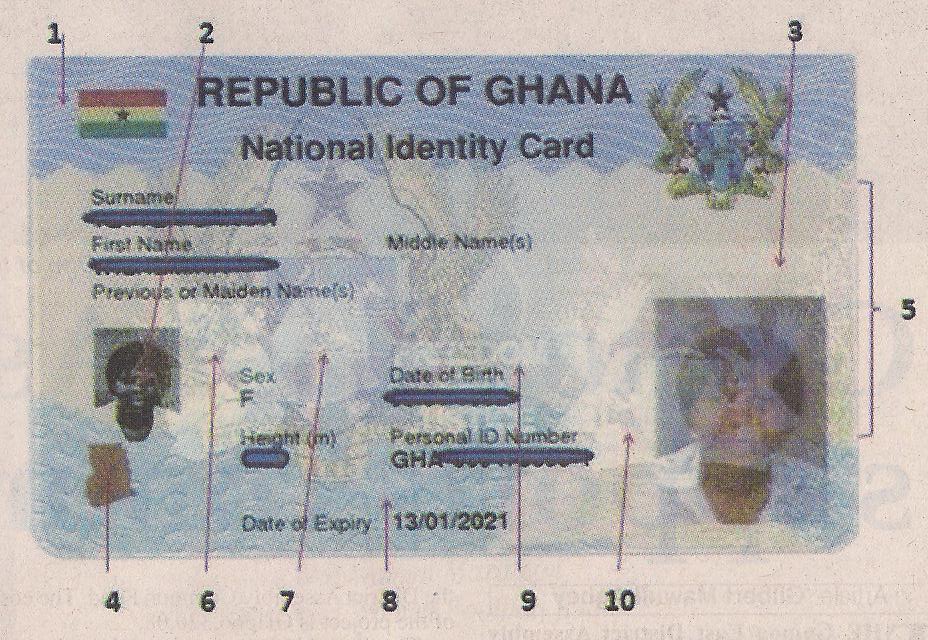
The Ghana Card (ID Card) is plastic and has the size of a credit card. The front contains the bearer's face the following fields written in English:[1]

Front

[edit]
Ghana Card (Ghanaian electronic ID Card) 2011 – (front)
  1. Guilloches that form a continuous fine pattern.
  2. Embedded ghost portrait of the cardholder which, if scratched on consistently, leaves a hold in the card.
  3. "REPUBLIC OF GHANA"
  4. Map of Ghana which changes colour depending on the tilt of the card.
  5. Double Rainbow that changes colour to yellow/green depending on tilt of the card.
  6. Ghana map with a star in the middle and a layer of stars attached to the left directly on ghost portrait depending on tilt of the card.
  7. Ghana map with a star in the middle super-imposed on the coat of arms depending on the tilt of the card.
  8. "REPUBLIC OF GHANA"
  9. "FREEDOM AND JUSTICE"
  10. Ghana's coat of arms super-imposed on main portrait.

NB: The ID card issued to citizens and non-citizens are the same apart from the national code in the Personal ID number (one reason that should make the Ghana Card usable by the EC). Visible inscriptions on front of the card:

i. “REPUBLIC OF GHANA” vi. Sex
ii. “National Identity Card” vii. Date of Birth
iii. Surname viii. Height
Iv. First name ix. Randomly generated Personal ID Number (PIN)
v. Middle Name(s) x. Date of Expiry (normally 10 years after the date of issue)
Visible Images
  • a. Ghana's national flag to the left top corner
  • b. Ghana’s coat of arms to the right top corner
  • c. Ghost portrait of cardholder
  • d. Main portrait of image of cardholder
  • e. Map of Ghana

Back

[edit]
Ghana Card (Ghanaian electronic ID Card) 2011 – (back)
Visible Inscriptions/features
  • a. THIS CARD IS THE PROPERTY OF THE GOVERNMENT OF THE REPUBLIC OF GHANA. IF FOUND PLEASE CONTACT THE NEAREST NIA OFFICE OR POLICE STATION
  • b. Holder’s signature
  • c. Serial Number
  • d. Flying eagle to the right of the card.
  • e. Holder’s biometric and personal information stored in a 2-D barcode which can only be read with a card reader.

NB: The Ghana Card contains second and third level security features by the NIA (National Identification Authority):

On the photo a micro-holographic reflecting stamp is placed. The back contains the machine readable zone. The microchip, inside the card contains biometric data such as fingerprints of the holder, the image, signature, etc. The data can be extracted from the chip with wireless RFID technology. The ID card serves as a travel document for national travel. The validity of the card is 10 years and is compulsory for citizens over 16.[2]

Issuing procedure

[edit]

The identity card is requested at the districts (and is issued for free to all Ghanaians) where a digital picture of the bearer's face and fingerprints are taken. The card should be picked up in person after 15 days, where the bearer identifies himself/herself with his/her fingerprints.

The National Identification Authority has started an online process to issue Ghana Cards[17] to individuals. This involves submitting the printed document at the NIA office. Barely 24 hours after the online registration took off, the NIA Shut down the registration site[18] because their servers could not handle the number of requests coming in.

Replacing Lost Cards

[edit]

When the identity card is lost, replacement procedures are as follows:

  • You first need to go to a police station and fill a form. You'll then be given a document to submit to the National Identification Authority(NIA) for the replacement, where you'll be asked to fill a form for card replacement.
  • Ghanaians and Non-Ghanaians replacing lost cards are required to pay an amount of GH¢30.15 and $60 respectively, through mobile money or bank payment.

You will be given a document to submit to the National Identification Authority (NIA) for the replacement. At the NIA office, you will have to take a form for card replacement. For Ghanaians, you Pay a current amount of GHC 30.15 via mobile money. Non-Ghanaians Replacing loss Non-Ghanaian Identity Card, You pay U$60 or its equivalent. The payment will be verified by the officers.[2]

Contact Address of the National Identification Authority-Ghana Card

[edit]

Address:

No.8 Nelson Mandela Avenue

Off Gulf House Street

South Legon, Accra, Ghana.

Digital Address: GA-237-1033

P.O. Box M680

Ministries Post Office

Accra, Ghana.

Contacts:

(+233) 302-99-9306-9

(+233) 73-8333

(+233) 242-43-8615

Email: info@nia.gov.gh[19]

See also

[edit]
[edit]

References

[edit]
Revisions and contributorsEdit on WikipediaRead on Wikipedia
from Grokipedia
The Ghana Card is a biometric card issued by Ghana's National Identification Authority (NIA) to all Ghanaian citizens, regardless of age, and to legally resident non-citizens, incorporating fingerprints, facial photographs, and a to enable secure verification of identity. Its primary purpose is to establish a that promotes economic, political, and social activities by facilitating access to services such as healthcare, , banking, taxation, and voting while minimizing through biometric . Mass issuance of the Ghana Card commenced in September following the establishment of the NIA in 2003, with the program designed to register every eligible individual from birth onward at no cost for in-country. By October 2025, the NIA has enrolled over 19 million and printed nearly 1.9 million cards in recent updates, achieving substantial coverage amid efforts to enable instant issuance and expand uses like electronic wallets for . The Ghana Card's rollout has been marked by achievements in biometric enrollment scale but also controversies, including implementation delays, high costs attributed to foreign technology partnerships, unverified biometric data linkages in related programs like SIM registration, and debates over mandatory usage mandates enforced by institutions such as the .

History

Establishment of the National Identification Authority

The National Identification Authority (NIA) was formally established as a by the National Identification Authority Act, 2006 (Act 707), which received presidential assent on 18 April 2006. The Act created the NIA as a body corporate with , the power to sue and be sued, and the capacity to hold and dispose of movable and immovable property in its corporate name. Its primary objects include registering persons in eligible for cards, creating and maintaining a National Identity Register, issuing identity cards with unique personal identification numbers, and providing related identification services to government agencies and other entities. Preceding the formal legislation, efforts to develop a national identification system began with the establishment of a National Identification Authority Secretariat in , following a to initiate ID card issuance. This secretariat laid groundwork for biometric registration and system planning, addressing long-standing gaps in Ghana's where fewer than 3% of births were documented as of the early 2000s. The 2006 Act formalized these initiatives by vesting oversight in a Governing Board, comprising a chairperson appointed by the President, nine other members including representatives from key ministries (such as Interior, , and ), the Registrar-General, and a CEO as secretary. The Board holds responsibility for policy direction, while the CEO manages day-to-day operations, supported by technical staff. The NIA's addressed systemic challenges in identity verification, including in public services and elections, by mandating a centralized biometric database. Funding initially derived from government appropriations, with provisions for fees from services and international partnerships to sustain operations. Subsequent , such as the National Identity Register Act, 2008 (Act 750), expanded the framework by defining the register's structure and requiring biometric data collection, though core establishment principles remained anchored in Act 707.

Initial Rollout and Pilot Phases

The initial rollout of the Ghana Card occurred on September 15, 2017, when the National Identification Authority (NIA) conducted a liveness test of the National Identification Register, verifying the biometric data of over 16 million previously enrolled individuals from earlier non-biometric efforts. During this pilot phase, the first Ghana Card was issued to President , demonstrating the system's capacity for instant biometric enrollment and card production, which took under 30 minutes per applicant. This phase followed a policy directive from the government on May 22, 2017, to revamp the longstanding National Identification System (NIS) project, which had originated in the 1970s but stalled due to funding and technical issues. The 2017 pilot emphasized testing the end-to-end process, including facial recognition, and iris scanning, and integration with a , in collaboration with Identity Management Systems (IMS), a of the Belgian firm Semlex, under a public-private agreement signed in 2018. It targeted a limited group for validation rather than mass enrollment, building on legacy data to avoid full re-registration initially, though challenges like from prior manual systems required ongoing verification. The rollout aligned with biometric standards for regional . By late 2017, the pilot confirmed the infrastructure for secure, chip-embedded cards with 2D barcodes for non-biometric users, setting the stage for broader phases while addressing privacy concerns through liveness detection to prevent spoofing. Early evaluations highlighted the need for expanded centers, as initial sites in Accra handled proof-of-concept enrollments before scaling to regional pilots in 2018. The project aimed to issue up to 88.9 million cards over 15 years, with the pilot validating the $1.2 billion phased investment.

Major Expansion and Integration Efforts

Following the initial pilot phases, the National Identification Authority (NIA) significantly scaled up Ghana Card registration efforts, achieving over 19 million enrollments for citizens aged 15 and above by October 2025. This expansion included resuming mass registration for first-time applicants aged 15 and older starting September 11, 2023, after earlier pauses due to logistical challenges. In the first half of 2025 alone, an additional 190,775 were registered, contributing to a total of approximately 19.05 million enrollments nationwide. These efforts focused on underserved regions and diaspora , with dedicated centers established to handle backlogs and increase coverage toward universal adult registration. A key milestone in 2025 was the extension of registration to children aged 6 to 14, launching on October 6 in 56 as part of a broader initiative to enroll 6.9 million minors under 15. This phase prioritizes biometric capture for future-proofing identity verification, addressing gaps in youth inclusion that previously limited the system's demographic reach. The NIA's strategy emphasized mobile registration units and school-based enrollment to minimize disruptions, building on prior adult-focused drives that had enrolled over 18 million by mid-2024. Integration efforts linked the Ghana Card to critical national systems, starting with mandatory use as the sole identification for banking transactions from July 1, 2022, to enhance security and reduce fraud in financial services. The card's PIN replaced the Taxpayer Identification Number (TIN) for individuals at the Ghana Revenue Authority, streamlining tax compliance and revenue collection. For electoral processes, proposals to integrate NIA databases with the Electoral Commission aimed to verify voter eligibility using Ghana Card biometrics, though implementation faced delays and criticism over potential disenfranchisement of unregistered citizens. Broader e-government applications include simplified access to health insurance, education records, and social services, with the card enabling secure authentication for over 18 million holders by verifying citizenship and residency data against multiple agency records. These integrations, while advancing digital efficiency, have revealed discrepancies like double registrations exceeding 100,000 cases detected in audits.

Organizational Oversight

Role and Structure of the National Identification Authority

The National Identification Authority (NIA) is a established under the National Identification Authority Act, 2006 (Act 707), as a body corporate with and a common seal, empowered to acquire property, enter contracts, and sue or be sued in its own name. Its core object is to create, maintain, and promote the use of cards, designated as Ghana Cards, to support economic, political, and social development in by enabling reliable identification and data sharing. The NIA's functions encompass registering Ghanaian citizens residing in Ghana or abroad, as well as legally and permanently resident non-citizens; collecting, verifying, and storing comprehensive personal and biometric in a national database; issuing, updating, replacing, and authenticating identity cards; and providing secure access to this for agencies, financial institutions, and other authorized entities while ensuring confidentiality and accuracy. It also develops biometric verification services and a national repository to align Ghana's system with international standards for identity management. Governance of the NIA is vested in a board appointed by the President in accordance with Article 70 of the 1992 Constitution, comprising a chairperson; one representative each from the Ghana Statistical Service, Social Security and National Insurance Trust, Births and Deaths Registry, Immigration Service, National Health Insurance Authority, and Revenue Agencies Governing Board; the NIA's Executive Secretary; and two other persons nominated by the President, at least one of whom must be female. Board members serve terms of up to three years, renewable once, with meetings held at least quarterly and a of six members required for decisions. The board provides strategic oversight, policy direction, and approval for operations, including protocols. Day-to-day management is led by the Executive Secretary, appointed by the President under Article 195 of the , who acts as the chief executive officer, board secretary, and accounting officer responsible for implementing board decisions, staff administration, and operational execution. The NIA employs additional staff appointed by or on behalf of the President and maintains a network of regional and district offices staffed by public officers to handle enrollment, verification, and issuance nationwide. Internal structure includes specialized directorates such as registration, for database and biometric systems, operations, , and legal services to support core functions.

Key Partnerships and Contracts

The Ghana Card project is executed under a Public-Private Partnership (PPP) between the National Identification Authority (NIA) and Identity Management Systems Ltd, a of the Margins Group, responsible for system design, biometric enrollment, card production, and issuance. This agreement, initiated prior to the 2017 rollout, encompasses operations to register and issue smart, chip-embedded biometric cards to Ghanaians domestically and abroad, with the NIA's contracted expenditure totaling $124 million as of official disclosures. The Margins ID Group has supported NIA efforts for over a decade, enabling mass registration phases and positioning the system as a multifunctional identity solution integrated with passports, driver's licenses, and . In September 2025, the NIA entered an exclusive two-year (MOU) with Trust Stamp, a firm, to deploy tokenized infrastructure for enhanced verification in and private sectors. Under this revenue-sharing arrangement, a joint team will develop long-term contracts for tokenization services, aiming to facilitate secure digital wallets and economic applications while maintaining NIA oversight of core data. The NIA has also partnered with Entrust for technologies supporting instant ID issuance and enrollment of millions of citizens, addressing scalability in high-volume operations. Ongoing engagements include discussions with entities like Visa and for payment integrations, alongside plans for additional PPPs with and private firms to extend verification services beyond core registration.

Technical Features

Biometric and Security Elements

The Ghana Card employs biometric identifiers—fingerprints, iris scans, and facial dimensions—to generate unique personal identities during enrollment. These modalities are selected for their proven reliability in distinguishing individuals, with fingerprints and iris patterns offering high uniqueness and facial dimensions providing supplementary verification. A dual-interface smart chip, with approximately 148 KB capacity, is embedded in the card to store encrypted biometric templates alongside . This chip supports both contact and contactless interfaces for , allowing integration with readers for real-time biometric matching via one-to-many verification processes. Physical security elements include UV-sensitive markings, aluminum watermarks, guilloche patterns, and a machine-readable zone (MRZ) for forgery resistance and international compatibility. Additional anti-tampering measures encompass tactile impressions for and , and custom holographic overlays to deter replication. The card's design customization ties security features to the holder's , rendering duplication ineffective for identity verification. Digital safeguards extend to Public Key Infrastructure (PKI) encryption, ISO/IEC 27001:2022 certified databases, and the Identity Verification Services Portal (IVSP) for secure, real-time checks. Lost or stolen cards can be deactivated instantly, while self-auditing production processes track issuance to prevent fraud. Verification typically requires matching live biometrics against stored templates using fingerprint scans or facial recognition, prohibiting non-biometric alternatives.

Card Design and Components

The Ghana Card is constructed from durable material, designed to withstand everyday use while maintaining integrity for security purposes. It adheres to the ID-1 standard format, with dimensions of 85.6 mm by 54 mm, equivalent to a standard size. The card incorporates an embedded contactless microchip compliant with international standards, which stores encrypted biometric data including ten fingerprints and a digital facial image for verification. This chip enables secure, offline biometric and integration with electronic systems. On the obverse side, the card features the holder's color photograph overlaid with a micro-holographic reflecting stamp, alongside printed details such as full name, date of birth, , nationality, unique 14-digit identification number, issue and expiry dates, and signature. The design includes the Ghanaian and national symbols for visual identification. The reverse side contains a machine-readable zone (MRZ) in two lines for automated scanning, a for quick data capture, and the exposed chip module for contactless reading. Security components include optically variable holograms, microtext printing, UV-fluorescent inks, and patterns, aligning with biometric ID specifications to deter and tampering. The artwork and production standards were developed by (formerly Morpho), ensuring compliance with ICAO Doc 9303 for machine-readable travel documents where applicable.

Registration and Issuance Processes

Enrollment Procedures

The enrollment process for the Ghana Card, managed by the National Identification Authority (NIA), requires applicants to complete an online pre-registration followed by in-person verification and biometric capture to ensure accurate identity establishment. First-time applicants must fill out an electronic application form via the NIA portal at register.nia.gov.gh, providing personal details such as name, date of birth, and contact information, after which a non-refundable fee is paid electronically. This step generates a unique reference for scheduling an interview, which can be virtual or in-person, and is mandatory to proceed. The portal may experience temporary unavailability due to high traffic or technical issues, in which case applicants are advised to retry or contact NIA. Eligibility for registration is limited to Ghanaian citizens, confirmed through mandatory documents including a birth certificate issued by the Births and Deaths Registry, a valid Ghanaian passport, or naturalization/registration certificates for acquired citizenship. Children under 6 years may use a baptismal certificate or parental declaration in lieu of a birth certificate, while additional supporting IDs like voter cards or SSNIT documents can aid verification but are not substitutes. Applicants must also provide a digital address code if residing in Ghana. During the subsequent interview at an NIA district office or premium center, original documents are presented—no photocopies are accepted—and personal information is reviewed, with vouching possible by one relative or two Ghana Card holders if primary documents are unavailable. Interviews are conducted in English, requiring interpreters for non-speakers. Biometric enrollment occurs at the interview or a booked appointment, involving capture of a facial photograph, all 10 fingerprints, and a by a Mobile Registration Worker (MRW) operator. Applicants verify the captured data on a printed slip before a verification officer authenticates the fingerprints to activate the card. For institutional or household registrations, which require a minimum of seven applicants, NIA conducts a pre-site survey to assess , followed by on-site biometric capture; fees apply here, starting at GHC 300 per person plus distance-based costs. Standard individual registrations at offices incur lower fees, such as GHC 125, while premium centers charge GHC 420 for expedited service. Upon successful verification, the Ghana Card is printed and issued, either instantly at premium centers or within weeks at standard locations, with applicants receiving a QR code post-interview to facilitate biometric booking if needed. The process emphasizes deduplication through biometric matching to prevent multiple registrations, contributing to the system's integrity despite occasional backlogs addressed by bulk card imports, such as 700,000 blanks received in February 2025. Replacements or updates follow a similar biometric verification but require purchasing a PIN code via CalBank or mobile shortcode *771#.

Card Replacement and Backlogs

The replacement of a lost, stolen, damaged, or defaced Ghana Card requires applicants to visit any National Identification Authority (NIA) regional or operational district office. For lost or stolen cards, individuals must first obtain a police report from any police station confirming the incident, then submit it along with required identification documents to an NIA office to initiate the process. Damaged or defaced cards necessitate presenting the original card for verification and retrieval by the registration officer. Applicants purchase a replacement scratch card—typically costing GHS 30 to GHS 110 depending on the service type—and undergo data capture, after which the card is issued, often instantly following backlog clearances. Prior to 2025, card replacements faced significant delays due to a nationwide backlog of unprinted cards, stemming from shortages of blank cards that halted printing operations from March 2023 to January 2025. This backlog encompassed over 640,000 pending records, including replacements, first issuances, and personal information updates, leading to waits of up to two years for affected applicants. The NIA received shipments of 700,000 blank cards in early 2025 to address the issue, printing 541,529 backlog cards in just 10 days by mid-2025. By September 2025, the entire backlog was cleared through renewed contracts with private partners, enabling instant issuance of replacement cards at all 292 registration centers nationwide. As of October 2025, replacements are processed and printed on the same day, resolving prior operational constraints.

Applications and Integration

Uses in Government and Civic Services

The Ghana Card serves as the primary national identity document for accessing various services in , enabling biometric verification and reducing fraud in . It facilitates identity proof for transactions involving state institutions, including platforms that require secure authentication for service delivery. In electoral processes, the mandates presentation of a valid Ghana Card or for , aiming to compile a credible voters' register through biometric linkage. This requirement, introduced to enhance integrity, was upheld for the general elections despite initial proposals to make the Ghana Card the sole identifier, which faced political opposition over accessibility concerns. For travel documentation, the is mandatory for applications, replacing multiple prior to streamline issuance and verify . It is similarly required for applications, integrating with the Driver and Vehicle Licensing Authority to ensure unique identity assignment. Compulsory national service enrollment through the Authority necessitates a valid Ghana Card for portal access and biometric verification, with non-possession barring graduates from participation as of February 2025. Monthly biometric checks using the card enforce ongoing compliance during service. In social welfare programs, the Ghana Card authenticates eligibility for services such as the Livelihood Empowerment Against Poverty (LEAP) cash transfers and enrollment in the National Health Insurance Scheme, linking beneficiaries to government databases for targeted aid distribution. It also supports access to education subsidies and other public entitlements by confirming residency and citizenship status.

Role in Financial and Digital Economy

The Ghana Card serves as the primary identification document for (KYC) processes in Ghana's financial sector, as mandated by the , which requires financial institutions to accept it exclusively for account openings, transactions, and compliance verification. This biometric-enabled ID facilitates streamlined onboarding for banking and non-bank , reducing identity verification costs and barriers to entry for populations by enabling digital checks against national databases. In mobile money and digital payments, the Ghana Card integrates with platforms to enhance and , supporting features like GhIPSS Instant Pay for instant transfers between wallets and bank accounts. As of September 2025, the National Identification Authority announced plans to launch the Ghana Card as an electronic wallet, allowing holders to conduct payments, including merchant transactions without sharing phone numbers or PINs, and even gold trading, thereby expanding access to digital . This development builds on existing linkages, such as biometric verification for registration, which has bolstered prevention and user confidence in a market where mobile money accounts outnumber traditional bank accounts. The card's role extends to broader digital economy advancement by enabling secure identity authentication for fintech innovations, including streamlined KYC in peer-to-peer lending and remittances, which has contributed to financial inclusion goals under Ghana's National Financial Inclusion and Development Strategy. By July 2025, integrations like tap-to-pay capabilities on POS devices accepting Ghana Card-linked mobile money have further promoted merchant adoption of digital payments, reducing cash dependency and supporting economic resilience amid high mobile penetration rates. Overall, these applications have deepened participation in the digital economy, with the Ghana Card cited as instrumental in linking identities to services like e-commerce and instant payment rails.

Integration with Other Systems

The Ghana Card has been integrated with Ghana's banking sector as the sole valid identification for all financial transactions at institutions regulated by the , effective July 1, 2022, requiring account holders to link their Ghana Card number to bank accounts to prevent unauthorized access and enhance transaction verification. This linkage facilitates seamless (KYC) processes and supports broader by serving as a for account opening and services. In September 2025, the National Identification Authority announced plans to embed e-wallet functionality into the Ghana Card, enabling it to operate as an and digital payment instrument, further integrating it with payment ecosystems. Electoral processes have incorporated the Ghana Card, with the Electoral Commission designating it as the primary document for starting in 2022, replacing the previous biometric voter ID card to reduce duplication and improve verification accuracy. Integration extends to issuance, where the Ghana Card's biometric data is cross-referenced by the to verify identity and expedite applications, minimizing in international travel documentation. The card links with telecommunications for mandatory SIM card registration, using its unique identifier to authenticate subscribers and curb anonymous mobile usage, while also interfacing with the National Health Insurance Scheme (NHIS) for claims processing and enrollment verification. Tax administration benefits from data sharing between the National Identification Authority and the , enabling better taxpayer identification and compliance tracking, though full interoperability remains in development. Social security and systems are targeted for expanded integration, with 2025 announcements indicating the Ghana Card will incorporate data and features to create a multipurpose platform. These connections, managed through the National Identification Authority's user agency framework, aim to harmonize identity data across government entities for operational efficiency.

Controversies and Challenges

Financial and Contractual Disputes

The National Identification Authority (NIA) of Ghana entered into a public-private partnership (PPP) for the Ghana Card project, structured to be cost-neutral to the government, with an initial startup contribution of $124 million intended to be recouped through fees over time. However, implementation revealed disputes over ownership, as key technology assets and design rights initially belonged to the vendor Margins Group rather than the government, necessitating additional payments by Ghana to acquire full control years after rollout. Contract award processes faced allegations of irregularities, including claims in 2018 by that the $1.2 billion budgeted for the project was fraudulent, though NIA's then-CEO Prof. Ken Attafuah countered that the actual total cost was $293 million, covering technical infrastructure, and denied receiving bribes to favor Margins Group in the tender. The original technical platform was supplied under a contract with (now ), which designed and built the system for NIA operations, leading to 2022 controversies when public scrutiny arose over artwork and design ownership, prompting NIA clarifications that the agreement included provisions. Financial strains escalated with production arrears, as by September 2023, NIA reported the government owing approximately $80 million in outstanding payments for production. This culminated in August 2025 when NIA disconnected the (GRA) from its identity verification platform over an alleged GH¢376 million debt for verification services, a move GRA refuted, asserting the figure was inflated or miscalculated and that existing taxpayer validations did not require continuous fees, though it called for amicable resolution to avoid service disruptions. Critics, including analyst Bright Simons, have argued the PPP model has resulted in net financial losses for due to opaque recoupment and vendor dominance, though NIA maintains the structure aligns with contractual obligations for scalability.

Fraud, Integrity, and Nationality Concerns

The National Identification Authority (NIA) has faced allegations of fraudulent issuance of Ghana Cards to non-citizens, including foreigners who allegedly use the cards for unauthorized access to services such as voter registration, prompting concerns over systemic vulnerabilities in the enrollment process. In August 2025, authorities arrested seven Nigerian nationals for attempting to obtain Ghana Cards through fraudulent means, with the NIA filing charges against them as part of a broader crackdown targeting non-Ghanaians. This incident followed reports of one individual already serving an eight-month jail term for similar offenses, alongside 13 ongoing cases, highlighting enforcement efforts against identity misrepresentation during registration. Integrity challenges include the proliferation of cards, as physical inspection alone cannot reliably distinguish fakes, leading the NIA to mandate use of its Institution Verification Service Platform (IVSP) for real-time authentication to mitigate risks of and financial loss. In July 2025, the CEO of the Ghana Association of Banks publicly questioned the registration process's robustness after documenting cases of cardholders unable to speak local languages or identify hometowns, raising doubts about biometric and documentation verification . The NIA responded by initiating probes and urging reports of suspected via official channels, while emphasizing the system's capacity to detect irregularities, though critics argue that such lapses undermine trust in the card as a secure identifier. Nationality concerns stem from instances of non-citizens, including foreign spouses and undocumented migrants, allegedly bypassing citizenship requirements to acquire cards, which has fueled debates over electoral integrity as the Ghana Card serves as a prerequisite for voter registration. In September 2025, fresh evidence emerged in the case of an Indian national accused of fraudulently obtaining Ghanaian citizenship documentation, exacerbating fears of lax border and residency verification enabling non-natives to claim national identity. The NIA has warned against illegal acquisitions by foreigners, requiring formal Interior Ministry approval for spouses with proof of genuine marriages, yet reports persist of cards issued to legal residents who exploit them beyond intended non-citizen limits, potentially diluting citizenship-based entitlements. While the NIA maintains that only verified legal residents receive non-citizen variants, these issues underscore gaps in cross-referencing birth records, passports, and residency proofs against biometric data.

Privacy, Ethical, and Operational Issues

The collection of biometric for the Card, including fingerprints and images, has raised significant concerns due to inadequate safeguards against potential misuse and breaches, as highlighted in analyses of the National Identification System. The National Identification Authority (NIA) has warned citizens against uploading details to unverified websites or portals, emphasizing personal responsibility for protection amid rising risks in , where financial losses from such incidents reached GHS 23.3 million in 2024. Institutions are prohibited from demanding photocopies of the card, as this practice violates protection regulations and increases risks of , with the NIA advocating biometric verification instead. Ethical issues stem from allegations of , including staff from applicants, leading to the dismissal of 10 NIA employees in 2023 for demanding unauthorized fees. The system's mandatory integration for services like banking and SIM registration has been criticized as a "force-in" approach, potentially excluding non-holders from essential goods without sufficient voluntary adoption incentives. Reports of illegal issuance to non-citizens, including foreigners unable to demonstrate local knowledge, undermine integrity and raise questions about equitable access and verification rigor. Operationally, the Ghana Card program faced severe backlogs, with over 541,000 unissued cards pending from March 2023 to January 2025 due to blank card shortages, delaying access to services like banking and . A 2025 NIA staff strike halted biometric verifications nationwide, creating bottlenecks in financial and digital services and exposing dependencies on centralized infrastructure. Integration challenges, such as flawed processes for linking cards to banking, have frustrated users, while uncollected cards pose risks due to the inability to mail them via Ghana's postal system. Biometric data from related 2022 SIM registrations was collected but never authenticated against the Ghana Card database, highlighting verification gaps that could enable .

Adoption and Impact

Enrollment Statistics and Coverage

The National Identification Authority (NIA) initiated Ghana Card enrollment in 2017, initially targeting Ghanaians aged 15 and above through district-based registration centers and mobile teams. By June 2021, the program had enrolled 15,581,283 individuals, achieving 84.44% of the contemporaneous target. Enrollment accelerated in subsequent years, reaching over 18 million by mid-2025, with 17,534,360 cards issued by July of that year. As of October 17, 2025, a total of 19,049,509 had been enrolled, reflecting sustained efforts to expand coverage amid estimated at approximately 35 million. This figure primarily encompasses adults and older minors, with 1,800,469 cards issued in recent phases, including targeted programs for younger demographics. Additionally, 21,780 non-citizens had registered for identification purposes. In September 2025, the NIA launched registration for children aged 6-14, targeting 6.9 million individuals to bridge gaps in youth coverage. Card issuance for this group commenced on October 6, 2025, distributing over 350,000 cards initially. These expansions address prior backlogs, supported by collaborations such as data sharing with the National Health Insurance Authority to facilitate printing and distribution for registered minors under 15.
Milestone DateEnrolled GhanaiansCards IssuedKey Notes
June 202115,581,283Not specifiedAchieved 84% of enrollment target
July 2025>18,000,00017,534,360Included 190,775 new registrations in first half of year
October 202519,049,5091,800,469 (recent phase)Focus on child enrollment; total issued higher overall
Coverage remains incomplete for infants under 6 and certain remote or populations, with ongoing mobile registration services aimed at universal inclusion as mandated by the National Identity Register Act. Enrollment rates have been bolstered by linking the card to like banking, voting, and , though challenges such as logistical delays persist in achieving full national penetration.

Achievements and Economic Benefits

The Ghana Card has enabled significant efficiency gains in delivery by serving as a unified identifier, reducing duplication across agencies. For instance, the integration of the card into systems like the Driver and Vehicle Licensing Authority (DVLA) and passport issuance has streamlined processes, eliminating the need for multiple identity documents. This merger of identification functions across state agencies has already yielded $30 million in savings as of November 2023, with projections estimating $1.5 billion in cost reductions over 15 years through avoided production of redundant cards and minimized service overlaps. In the financial sector, the card has driven inclusion by facilitating biometric verification for account openings, money transfers, and loan applications, bypassing traditional paperwork hurdles. This has expanded access for populations, with the system's applets allowing institutions to embed custom applications on the card, further cutting operational costs for service providers. Additionally, utilities like the Electricity Company of Ghana (ECG) have linked prepaid meters to Ghana Cards via , mobile numbers, and GPS, aiming to reduce losses from and inefficiencies to below 20% as of January 2025. Tax administration has benefited from enhanced compliance, as the digital ID links taxpayers to financial activities, boosting registration rates—particularly among females and younger demographics—and improving , though overall compliance effects remain mixed. By enabling precise tracking of economic transactions, the card supports broader formalization efforts, reducing evasion and fostering a more traceable without direct quantification of GDP uplift in available . These outcomes position the Ghana Card as a foundational element of digital infrastructure, underpinning in and governance systems.

Criticisms and Societal Effects

The collection of biometric data for the Ghana Card, including fingerprints, facial images, and iris scans, has elicited significant privacy concerns due to the risks of data breaches, unauthorized access, and potential mass surveillance from centralized storage without robust safeguards. Legal scholars highlight inadequate enforcement of data protection laws, noting that Ghana's framework falls short of international standards, potentially enabling misuse for political or commercial purposes. Organizations such as Privacy International and Access Now have criticized similar African digital ID systems, including Ghana's, for lacking informed consent mechanisms and fostering a "surveillance nightmare" absent strong regulations. Exclusionary effects have disproportionately impacted rural populations, the poor, and those with low , as enrollment requires access to registration centers and supporting documents often unavailable in remote areas. By mid-2025, while over 18 million cards had been issued, gaps persist in covering vulnerable groups, leading to barriers in accessing like banking and , which mandate the card for verification. Critics argue this exacerbates inequality, as non-enrollees—frequently from marginalized communities—face denial of and government benefits. Fraud vulnerabilities undermine the system's integrity, with reports of illegal issuance to non-citizens, including foreigners using forged documents for financial scams and voter registration. In 2025, the National Identification Authority (NIA) investigated such cases, resulting in one Nigerian national's sentencing and prosecutions of 13 others for identity fraud. Practices like photocopying cards, discouraged by the NIA under data protection rules, have facilitated duplication and impersonation, contributing to rising cyber fraud in linked services. Societally, these issues have eroded public trust in the Ghana Card as a verifier, sparking debates over amid allegations of lax checks allowing non-Ghanaians to obtain cards. Strikes by NIA staff in June 2025 halted verifications, delaying services and highlighting operational fragility that affects governance and social welfare delivery. While intended to curb "" names in public payrolls, persistent integrity lapses have fueled perceptions of against disputed ethnic or migrant groups, potentially deepening social divisions without commensurate benefits in reduction.

Future Developments

Planned Expansions and Multipurpose Features

The National Identification Authority (NIA) intends to evolve the Ghana Card into a multipurpose to enhance access to public and private services, with a focus on and digital transactions. In February 2025, the NIA outlined expansions to leverage the card's chip-embedded biometric features for broader , including seamless integration with payment systems and government platforms. A key planned feature is the rollout of an e-wallet functionality, announced in September 2025, which will enable the Ghana Card to serve as a and for cashless payments. This will allow direct linkage to accounts, bank accounts, and everyday purchases, building on existing biometric verifications for . Additional expansions include integration with electronic toll booth systems to facilitate contactless payments for motorists, reducing reliance on cash and improving traffic efficiency. The NIA also plans to amend regulations to support a "General Multipurpose Card" framework, incorporating advanced security like fingerprints, facial recognition, and UV features for expanded use cases. These developments will tie into the Ghana.gov platform's of 16,000 services by the end of 2025, using the Ghana Card for identity verification in transactions such as applications, banking, and land registries. The multipurpose enhancements aim to position the card as a for identity, though implementation depends on technological upgrades and policy approvals.

Technological and Policy Advancements

The Ghana Card features a dual-interface chip module supporting contact and contactless operations, along with biometric authentication via fingerprints and facial recognition to prevent duplication. Additional security elements include tactile impressions, ultraviolet features, and aluminum watermarks, enhancing tamper resistance and verification reliability. These technological integrations have enabled the card's use as a travel document within the Economic Community of West African States (ECOWAS) and supported multiple biometric applications for secure identity verification. In 2025, the National Identification Authority (NIA) announced plans to activate digital payments on the Ghana Card, transforming it into a multipurpose tool for financial transactions akin to an e-wallet, aimed at boosting . This builds on existing integrations with banking systems, where biometric verification via the card is mandatory for in-branch transactions. Proposals for upgrading to RFID-enabled cards have emerged to further streamline digitalization across public institutions, though implementation remains under consideration. Policy advancements include the resolution of a card issuance backlog from March 2023 to January 2025, caused by blank card shortages, enabling instant nationwide issuance by September 2025 through new supplier contracts. The NIA has expanded registration to children under parental urging for improved national planning and identification, while enforcing data protection measures such as prohibiting photocopying of cards. Complementary safeguards under Ghana's Data Protection Act incorporate encrypted databases and biometric protocols to mitigate privacy risks.

References

Add your contribution
Related Hubs
User Avatar
No comments yet.