Hubbry Logo
GinosarGinosarMain
Open search
Ginosar
Community hub
Ginosar
logo
8 pages, 0 posts
0 subscribers
Be the first to start a discussion here.
Ginosar
Ginosar
from Wikipedia
Yigal Allon Museum

Key Information

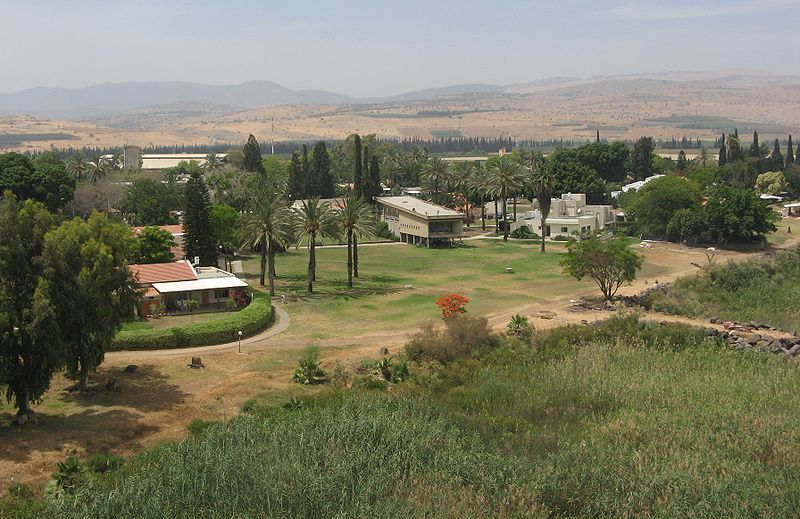
Ginosar (Hebrew: גִּנּוֹסַר) is a kibbutz in the Plain of Ginosar on the western shore of the Sea of Galilee in Israel. Located north of Tiberias on Highway 90, it falls under the jurisdiction of Emek HaYarden Regional Council. In 2023 it had a population of 784.[1]

History

[edit]

Roman period

[edit]

In the first century AD there was a flourishing town known by Greek and Latin speakers as Gennesaret, with one single mention in the New Testament (Matthew 14:34), for which but a few papyri use the form "Gennesar". The modern kibbutz takes its name from this ancient town, though it is not located at precisely the same site.

British Mandate

[edit]

Ginosar was founded on the eve of Purim in March 1937 by a group of young Socialist Zionists, on Palestine Jewish Colonization Association (PICA) land that had been leased to the settlement of Migdal.

The reason given for "squatting" was that the leased area needed close protection during the "disturbances" (1936–1939 Arab revolt in Palestine).[2] The original was built as a "Tower and Stockade" settlement, was closely aligned with the Mapai party,[3] and was the home of Yigal Allon, commander of the "Syrian Department" of the Palmach, and later a senior minister in the government of Israel.

State of Israel

[edit]

Ginosar was originally an agricultural community; now its primary source of income is from tourism. During a severe drought in 1986 the level of lake dropped to reveal the frame of a fishing boat that has since been carbon dated to 100 BCE to 70 CE, and is now known as the Sea of Galilee Boat. Using innovative techniques the boat frame was rescued, the boat was placed in a special tank, and it is displayed in the Beit Yigal Allon Museum.[4]

Notable people

[edit]
  • Yigal Allon (1918–1980), politician, commander of the Palmach, and general in the IDF
  • Barak Lufan (1987-2022), kayaker

References

[edit]
[edit]
Revisions and contributorsEdit on WikipediaRead on Wikipedia
from Grokipedia
Ginosar (Hebrew: גִּנּוֹסַר) is a kibbutz in northern Israel, situated on the western shore of the Sea of Galilee within the Lower Galilee region, approximately 10 kilometers north of Tiberias. Established in March 1937 by a group of young Socialist Zionist pioneers on land acquired from the Palestine Jewish Colonization Association, it was constructed as a tower and stockade (homa umigdal) settlement to assert Jewish presence and defense amid Arab unrest during the British Mandate era. Originally centered on agriculture, leveraging the fertile plains and lake access for fishing and crop cultivation, Ginosar has evolved into a mixed economy incorporating tourism and hospitality, including the Nof Ginosar Kibbutz Hotel. The kibbutz gained international prominence through the Yigal Allon Centre (also known as the Museum of the Sea of Galilee), which preserves and displays the Galilee Boat—a 1st-century BCE to 1st-century CE fishing vessel unearthed in 1986 near the kibbutz shore following a drought that lowered water levels, providing tangible archaeological evidence of ancient maritime activity in the region.

Geography and Location

Site and Environmental Features

Ginosar occupies a strategic position on the western shore of the , also known as Lake Kinneret, approximately 6 miles north of in northern . This location places it within the , a tectonic depression characterized by fertile alluvial soils deposited by the and its tributaries, which enhance agricultural potential through rich nutrient content and good drainage. The surrounding features gently sloping hills rising from the lakeside plain, with elevations around -200 meters below , contributing to a conducive to subtropical cultivation. The Sea of Galilee's freshwater, fed primarily by the , supports pisciculture, while the mild climate—with average annual temperatures of about 20°C and minimal frost—favors crops like bananas that require consistent warmth and irrigation from the lake. Proximity to ancient sites such as Capernaum, located a few kilometers to the north, and to the south, underscores the area's historical significance tied to its natural harbor and resource abundance. Environmental variability includes periodic droughts leading to low lake levels; in 1986, prolonged dry conditions dropped the water to historic lows, exposing submerged artifacts on the shoreline near Ginosar. More recently, in August 2025, blooms of the green alga caused localized red discoloration in the due to pigment production under sunlight, a natural phenomenon rather than a toxic event, though it prompted monitoring by authorities. These fluctuations highlight the lake's sensitivity to climatic patterns, including reduced inflows from upstream sources.

History

Ancient and Biblical Periods

Archaeological investigations in the vicinity of modern Kibbutz Ginosar, on the northwestern shore of the , have revealed evidence of settlement from the onward. Excavations initiated since 2003 uncovered remains of a village, including structural features and artifacts indicative of early agrarian and communal life in the fertile Ginosar Valley. Subsequent layers attest to an fortress, featuring defensive architecture such as walls and possibly a , reflecting strategic control over the lakeside plain during a period of regional conflicts and kingdom expansions in the ancient . The Second Temple period (circa 1st century BCE to 1st century CE) is represented by village remains, including , domestic structures, and economic indicators tied to and . A key find from this era is the "Ancient Galilee Boat," discovered in 1986 near Ginosar during a drought-induced drop in lake levels that exposed the vessel embedded in anaerobic mud. The 8.2-meter-long cedar-plank boat, suitable for and equipped with a mast step, underwent on multiple samples, confirming construction between 40 BCE and 70 CE; associated and nails further corroborate this timeframe and highlight the maritime reliance of local inhabitants. Byzantine-period (4th–7th centuries CE) occupation is evidenced by ruins, including stone foundations and features, pointing to organized Christian monastic activity amid the transition from Roman to early Islamic rule in ; field surveys in the Ginosar Valley also yielded Byzantine ceramics and tesserae supporting widespread settlement continuity.

Ottoman and British Mandate Era

During the Ottoman era, the Ginosar region featured underutilized terrain, including marshy areas prone to , with land primarily held under (state-leased) status or by absentee landlords and sparsely cultivated by tenant farmers. Ottoman reforms in the , such as the Land Code, enabled registration and sale of such properties, allowing Jewish organizations to acquire holdings legally from owners, often urban elites who had consolidated control post-reform. The (PICA), founded by , purchased the Ginosar site among other tracts in the , reflecting a pattern of Zionist land redemption from underproductive estates to counter neglect and enable development. This acquisition preceded settlement, as Ottoman and later British policies restricted but did not prohibit transfers, prioritizing formal deeds over customary use. Ginosar was founded on 11 March 1937, the eve of , as a (homa u'migdal) outpost by 28 Socialist Zionist youth, primarily from and , including future military leader . Established on PICA land amid the 1936–1939 , which involved widespread attacks on Jewish communities, the rapid erection of a defensive perimeter—stockade wall and watchtower—exploited a British legal loophole permitting construction as a fait accompli before permit denial. This method, part of 57 such settlements, aimed to secure strategic frontiers through self-defense and land cultivation against riot-induced insecurity. British Mandate authorities imposed restrictions on Jewish and settlement amid escalating violence, yet Ginosar pioneers persisted in draining malarial swamps via collective labor, introducing fishponds and crops to transform the site into viable farmland. Residents repelled assaults through armed watch shifts, underscoring the causal link between defensive necessities and communal , while British forces occasionally provided limited protection but prioritized appeasing unrest. By 1939, initial agricultural outputs, including bananas and vegetables, demonstrated the efficacy of Zionist reclamation efforts on previously neglected terrain.

Post-Independence Developments

During the 1948 Arab-Israeli War, Kibbutz Ginosar initially fell to invading Arab forces amid intense fighting in the region but was subsequently recaptured by Israeli defenders, exemplifying the kibbutz's frontline role in securing the nascent state's northern frontiers. The settlement's position in the battle zone underscored its strategic vulnerability and the residents' contributions to operations, which had used Ginosar as a pre-war training hub. Following independence, Ginosar maintained its defensive posture against persistent threats, including Syrian artillery shelling that began immediately after and peaked in the 1950s, prompting residents to rely on bomb shelters and reinforcing the 's integration into Israel's broader security apparatus near the volatile border. This proximity to amplified its military relevance, with members participating in national defense efforts amid recurrent incursions and tensions that shaped resilience. In response to the movement's systemic in the 1980s, Ginosar underwent partial reforms starting in the late , shifting toward differential income structures and individual incentives while preserving core communal security functions to adapt to national economic pressures. These changes mirrored broader transformations across Israeli kibbutzim, enabling sustained viability without abandoning the collective defense ethos forged in earlier conflicts. Post-October 7, 2023, amid heightened northern threats, the 's Center launched initiatives to recruit pre-army youth groups committed to bolstering settlements, reflecting ongoing adaptations to external perils through enhanced communal preparedness.

Economy and Infrastructure

Agricultural Operations

Agriculture in Kibbutz Ginosar centers on cultivation and , leveraging the subtropical climate near the for year-round production of high-value perishables that bolster Israel's domestic supply and export revenues. , a water-intensive crop, dominate operations across approximately 128 hectares (317 acres) of dedicated land, with the kibbutz utilizing advanced propagation to produce millions of high-quality seedlings annually through its Ginosar Agro enterprise. This focus yields consistent outputs, protected from frost via blue plastic bagging, contributing to national self-sufficiency in tropical fruits amid arid conditions. Aquaculture complements crop farming, drawing on the kibbutz's proximity to the Sea of for production and research at the local station, which spans 10 hectares and emphasizes nutritional optimization and intensification techniques. These efforts support Israel's broader fish self-reliance, with fisheries replenished periodically to counter and impacts, though Ginosar's specific yields integrate with regional outputs exceeding hundreds of thousands of tons annually. Post-1980s kibbutz-wide reforms, including Ginosar's adoption of differential pay over equal sharing, addressed collectivist model's inefficiencies by incentivizing individual productivity, correlating with financial stabilization across 72% of privatized kibbutzim by 2010. Empirical from the sector show output gains post-privatization, as shifted toward performance-based rewards, mitigating prior stagnation in labor motivation despite retained communal elements like mutual guarantees. Operations face vulnerabilities from droughts, pests, and high demands, with banana fields reliant on and reclaimed across the kibbutz's 430 total agricultural hectares. Ginosar's banana allocation equates to 25-40% of volumes designated for nearby Palestinian villages like Ein al-Beida, per 2012 assessments, sparking debates amid regional scarcity; however, such usage stems from pre-state legal land purchases and aligns with national priorities for in a water-stressed environment prone to climatic variability. Pest pressures, exacerbated by warming trends, necessitate vigilant monitoring, underscoring the empirical trade-offs of despite technological mitigations.

Tourism and Commercial Ventures

Kibbutz Ginosar has transitioned from an agriculture-focused economy to one centered on , leveraging its prime location on the western shore of the for visitor attractions and accommodations. The operates the Nof Ginosar and tourism village, offering options such as beachfront tents, country-style lodging, and lake-view rooms to accommodate tourists seeking recreation in a natural setting near the Kinneret. This development reflects practical adaptations to market opportunities, with expansions including the acquisition of adjacent land for hotel growth amid rising demand in the years leading up to 2020. Tourism activities emphasize water-based pursuits, including boat rentals, guided rides on the , swimming, and beach access, which draw both domestic and international visitors to the site's serene shoreline. The 1986 discovery of an ancient fishing boat, now exhibited at the on-site Museum, has significantly amplified interest, particularly among Christian pilgrims associating the artifact with biblical narratives of the region. Museum operations contribute to revenue through exhibit admissions and educational programs, supporting the kibbutz's economic viability as supplants traditional sectors. Recent initiatives, such as the introduction of Israel's first electric tourist ship departing from Ginosar in 2025, further enhance commercial offerings with eco-friendly excursions. This pivot to profit-oriented ventures, including and experiential , aligns with broader movements toward market integration for , prioritizing economic resilience over strict communal ideologies while preserving security and social structures.

Cultural and Archaeological Importance

Key Discoveries and Artifacts

In January 1986, during a severe that lowered water levels in the , brothers Moshe and Yuval Lufan—fishermen from —discovered the remains of an ancient fishing boat embedded in the mud along the northwestern shore near the kibbutz. The vessel, measuring 8.27 meters in length, 2.3 meters in beam, and 1 meter in depth, was constructed primarily from cedar planking with reinforcements of pine, acacia, and other local woods, featuring characteristic sewn repairs using Aleppo pine ropes threaded through mortise-and-tenon joints—a technique consistent with 1st-century CE woodworking practices in the . of organic samples from the hull confirmed its active use between approximately 50 BCE and 50 CE, aligning with the late Hellenistic to early Roman periods and providing material evidence of maritime activity on the lake during that era. The boat's excavation, conducted over 11 days by a team including archaeologists and over 30 international volunteers, involved encasing the fragile, waterlogged structure in for lifting and transport to prevent disintegration. Conservation efforts, spanning seven years from 1986 to 1993, utilized (PEG)—a synthetic wax solution heated and applied in a custom tank—to gradually displace trapped water from the wood fibers, stabilizing the artifact against shrinkage and cracking that typically afflicts waterlogged timbers upon drying. This empirical method, drawing on established protocols, preserved the hull's integrity without relying on unverified assumptions about its cultural associations, though it has popularly been termed the "Jesus Boat" due to its temporal overlap with events. Earlier excavations in the Ginosar area, led by archaeologist Claire Epstein between 1965 and 1966, uncovered Middle tombs containing pottery assemblages, including distinctive stepped-rim juglets indicative of burial customs from the early BCE. These finds, documented through stratigraphic analysis and artifact typology, demonstrate continuous human activity in the vicinity from the onward. Subsequent work since 2003 has revealed additional layered remains, including an fortress and Byzantine-era structures such as a , underscoring successive fortifications and settlements without interpretive emphasis on singular historical narratives.

Museums and Preservation Efforts

The Yigal Allon Centre, located in Kibbutz Ginosar, was founded in 1986 to house and display the Ancient Galilee Boat—a first-century CE fishing vessel discovered that year in the drying mudflats of the Sea of Galilee near the kibbutz—and other regional antiquities. The museum, operated by the kibbutz, features permanent exhibitions including archaeological artifacts from the Sanhedrin Trail, illustrating diverse cultures along the Galilee shore, and emphasizes the conservation of items like the boat, which underwent treatment with polyethylene glycol to prevent decay after extraction. Preservation efforts at the centre involve collaborations with Israeli authorities responsible for oversight, ensuring artifacts from local sites are documented and protected while facilitating public access; the boat's excavation, led by Shelomo Wachsmann, exemplifies early post-discovery handling that balanced recovery challenges with long-term conservation. Ongoing displays incorporate findings from excavations, supporting scholarly study of ancient maritime technologies without compromising structural integrity. Named for (1918–1980), the Israeli statesman and leader who advocated frontier settlement strategies as a defense minister, the museum integrates educational programs on historical technologies, such as boat construction techniques from the Roman period, through guided tours and interactive exhibits aimed at diverse audiences. These initiatives generate revenue for , whose economy has shifted toward visitor-funded operations, reflecting broader adaptations emphasizing self-sustaining models over historical communal subsidies.

Society and Demographics

Kibbutz Communal Structure

Kibbutz Ginosar was founded on February 25, 1937, by a group of young socialist pioneers as a tower-and-stockade settlement, embodying the core principles of collective ownership of property, equal labor without differential compensation, and democratic decision-making through general assemblies. This structure promoted a pioneering ethos of mutual aid and self-sufficiency amid frontier threats, with all production from agriculture and fisheries distributed equally to meet basic needs, while communal facilities handled dining, laundry, and initially child-rearing in dedicated children's houses to free adults for labor. However, the system's incentives, which decoupled individual effort from personal reward, empirically fostered free-rider behaviors, as evidenced by broader kibbutz data showing higher attrition rates among high-ability members who migrated to urban areas offering performance-based pay, with exit rates reaching 40-50% for second-generation youth in traditional collectives by the 1980s. To address motivational deficits and retention challenges, Ginosar, like approximately 75% of kibbutzim by the early , adapted through "renewal" reforms introducing differential salaries tied to productivity and expertise starting in the , alongside partial of housing and consumer goods. These changes preserved of major enterprises such as and while allowing members to retain personal earnings, which data from the indicates improved skilled labor retention by incentivizing contribution over shirking. Daily operations historically involved rotational assignments across farming, , maintenance, and security duties, with members rotating weekly to ensure equitable burden-sharing and skill diversification, particularly emphasizing armed self-defense patrols given the kibbutz's exposed lakeside position vulnerable to incursions. Such rotations underscored the collective's reliance on internal discipline rather than market signals, yet real-world outcomes revealed persistent inefficiencies, as equalitarian norms discouraged specialization and innovation, contributing to until incentive reforms. Today, while democratic forums persist for major decisions, individual autonomy in career and consumption has supplanted rigid communalism, reflecting causal pressures from human motivational realities over ideological purity. Kibbutz Ginosar was established in March 1937 by a small group of young Socialist Zionist pioneers, primarily Israel-born youth and graduates from programs, numbering in the dozens as typical for early tower-and-stockade settlements. The kibbutz population expanded alongside the broader movement, reaching several hundred residents by the mid-20th century amid waves of and communal expansion that saw Israel's population grow from 77,950 in 1960 to 111,200 by 1980. From the 1980s onward, Ginosar experienced demographic pressures reflective of the kibbutz-wide crisis, including member exodus driven by , high post-1985 stabilization, and structural rigidities that limited personal incentives and career mobility, leading to brain drain among educated youth such as economists and engineers. This contributed to a national kibbutz population peak of 129,000 in 1989 followed by decline into the 1990s, with Ginosar's numbers falling to around 472 by 2006 amid aging membership and low retention. Social reforms toward a hybrid model, incorporating of income and housing differentials permissible under "renewing " frameworks, correlated with demographic stabilization and growth at Ginosar, as evidenced by broader patterns where such changes enabled family expansion, return migration, and higher birth rates through relaxed communal constraints. By 2021, the had risen to an estimated 597, with tourism-related helping attract younger families to offset aging demographics in this lakefront community.

Notable Individuals

Residents and Contributors

(1918–1980), one of the founders of Kibbutz Ginosar in 1937, emerged as a key military leader in the , commanding operations that defended the kibbutz and surrounding settlements during the 1948 Arab-Israeli War. His tactical innovations, including the use of mobile infantry units based in kibbutzim for swift counterattacks, proved effective in repelling invasions and securing the northern frontier against Syrian and Iraqi forces. Allon, who resided in Ginosar throughout much of his life and was buried there, later transitioned to politics, serving as and briefly as in 1969. In the realm of archaeology, brothers Moshe and Yuval Lufan, fishermen and long-term residents of the kibbutz, discovered the Ancient Galilee Boat in 1986 while surveying the receding shores of the during a . The 1st-century CE vessel, excavated with assistance from local volunteers and antiquities experts, provided empirical evidence of ancient fishing techniques and boat construction in the region, dating to the Roman period through radiocarbon analysis. Their find, now displayed in the adjacent Museum, underscores contributions from ordinary kibbutz members to cultural preservation. Ginosar's communal structure, prioritizing collective labor and defense over individual acclaim, has yielded few widely recognized figures beyond Allon and the Lufans, reflecting the movement's historical focus on egalitarian anonymity rather than personal distinction. This contrasts with privatized kibbutzim, where economic reforms since the have incentivized individual initiative and led to higher rates of entrepreneurial and professional prominence among residents.

Controversies and Critiques

Resource Management Disputes

In water allocation disputes involving Ginosar, critics have highlighted disparities in freshwater distribution between Israeli agricultural operations and adjacent Palestinian communities. For instance, in 2012, the banana plantations at Ginosar received equivalent to 25-40% of the total water allocated to the nearby Palestinian village of Ein al-Beida, despite the kibbutz's smaller population. These claims, often amplified by NGOs such as and , frame allocations as inequitable, asserting that Israeli agriculture in the basin—encompassing sources—diverts resources from Palestinian needs. However, such critiques overlook Israel's legal entitlements stemming from pre-state land acquisitions and prioritize zero-sum redistribution over productivity metrics. Israeli water policy justifies prioritizing Ginosar-like operations through empirical efficiencies that maximize output per unit of water, rooted in technologies like —which originated in and reduces by up to 60%—and widespread adoption of treated wastewater reuse, achieving over 85% recycling rates for agriculture nationwide. Data indicate Israeli farms yield 2-5 times more crops per cubic meter than regional counterparts, including in Palestinian areas reliant on less advanced flood or furrow methods prone to 40-50% wastage. This efficiency underpins national imperatives, as Israel's self-sufficiency in staples like fruits and vegetables—bolstered by producers—avoids import vulnerabilities amid geopolitical isolation, with agricultural exports exceeding $1 billion annually in fresh produce. Ginosar's banana fields exemplify these dynamics, utilizing national grid water augmented by desalination inflows to the Sea of Galilee, which since 2022 have supplemented freshwater to sustain yields without depleting aquifers. Desalination now covers over 50% of Israel's domestic and agricultural needs, freeing basin resources for high-value crops while curbing overexploitation. Disputes have been resolved via centralized allocation by the Israel Water Authority, favoring users demonstrating verifiable productivity and compliance with quotas, rather than per-capita equity that could incentivize inefficiency. Ginosar's contributions to banana tissue culture exports and domestic supply underscore this approach, yielding economic returns that fund further innovations over redistributive concessions.

Ideological and Economic Challenges of Collectivism

The model at Ginosar, established in 1937 as part of Israel's , exemplified the ideological commitment to equal sharing and communal ownership, but encountered severe economic strains in the due to structural mismatches inherent in collectivism. By the late , the aggregate debt of Israeli kibbutzim exceeded $4 billion, with many, including those reliant on uniform wage structures and subsidized inputs, facing after the 1985 economic stabilization plan curtailed and reduced government support. This stemmed from overexpansion into capital-intensive industries without corresponding productivity gains, as equal remuneration decoupled individual effort from output, fostering where members shirked high-effort tasks without personal reward. Empirical analyses of kibbutz dynamics reveal that equal-sharing rules exacerbated and brain drain: high-ability individuals exited for market opportunities offering wage premiums, while lower- members remained, subsidized by collective resources, undermining long-term viability. In response, Ginosar and similar adopted differential pay and partial from the onward, correlating with productivity surges; studies indicate that exposure to labor market shifted member preferences toward pro-market policies, with reformed kibbutzim outperforming rigid collectives in output per worker. These reforms empirically validated first-principles critiques of collectivism, where enforced equality erodes incentives absent external capitalist buffers like Israel's broader economy, which provided subsidies and markets sustaining kibbutzim beyond their internal merits. While Ginosar's early successes in and defense contributions highlighted communal mobilization under existential threats, causal attribution favors surrounding individual-agency-driven institutions over collectivist ideology; without Israel's market-oriented growth, which absorbed outputs and mitigated failures, the model would have collapsed sooner, as evidenced by the rarity of outright bankruptcies only due to state interventions. This trajectory debunks notions of sustainable socialist utopias, revealing dependency on non-collectivist props and the superior alignment of individual incentives with economic realism.

References

Add your contribution
Related Hubs
User Avatar
No comments yet.