Hubbry Logo
Disco ballDisco ballMain
Open search
Disco ball
Community hub
Disco ball
logo
8 pages, 0 posts
0 subscribers
Be the first to start a discussion here.
Disco ball
Disco ball
from Wikipedia

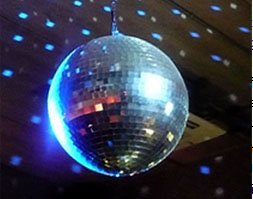
A mirrored disco ball

A disco ball (also known as a mirror ball or glitter ball) is a roughly spherical object that reflects light directed at it in many directions, producing a complex display. Its surface consists of hundreds or thousands of facets, nearly all of approximately the same shape and size, and each has a mirrored surface. Usually, it is mounted well above the heads of the people present, suspended from a device that causes it to rotate steadily on a vertical axis, and illuminated by spotlights, so that stationary viewers experience beams of light flashing over them, and see myriad spots of light spinning around the walls of the room.

Miniature glitter balls are sold as novelties and used for several decorative purposes, including dangling from the rear-view mirror of an automobile or Christmas tree ornaments. Glitter balls may have inspired a homemade version of the sparkleball, the American outsider craft of building decorative light balls out of Christmas lights and plastic cups.

A disco ball and spotlight in the Fishbowl of Currier House

History

[edit]

What are now usually called "disco balls" were first widely used in nightclubs in the 1920s.[1] They were patented in 1917.[2][3] An early example can be seen in the nightclub sequence of Berlin: Die Sinfonie der Großstadt, a German silent film from 1927. From the 1960s to the 1980s, these devices were a standard piece of equipment in discothèques, and by the turn of the millennium, the name "disco ball" had grown quite popular.[citation needed]

A Louisville, Kentucky company known as Omega Mirror Products claims to have made 90% of the disco balls used in the United States during the disco craze and remains a supplier.[4][2]

A mirrored ball can be seen above the bandstand in this 1919 photo of the Louisiana Five jazz band.
[edit]

The 1942 movie Casablanca featured a disco ball in a flashback sequence.

The 1967 movie To Sir, with Love featured a disco ball in the dance scene.

The English rock band Yes used a variant of the disco ball in their 1972 "Close to the Edge" tour. This was a slowly spinning vertical mirror disk mounted atop a tall ladder, with a single spotlight aimed at it, used for the opening and closing birds/waterfall-sounds sequences of the title song Close to the Edge.[5]

The Grateful Dead featured a disco ball in the band's 1977 concert documentary The Grateful Dead Movie. The film includes several sequences where glittery reflections from a disco ball fill San Francisco's Winterland Ballroom during a series of 1974 performances. "A twirling mirror ball overhead also adds some visual flash to the image," notes a reviewer.[6]

U2 also featured a lemon-shaped disco ball on their 1997–1998 PopMart Tour. The band entered the lemon disco ball at the end of the main set and emerged from the lemon disco ball at the start of their encore. The band also released promotional disco balls to promote the band's album Pop, the single "Discothèque", and lead singer Bono also sported the alter-ego of "Mirror Ball Man" during their 1992 Zoo TV Tour.

Introducing disco balls to a new concert demographic, the pop-punk band Paramore showcased dozens of spinning disco balls in 2014 as a glittering stage backdrop during the band's 37-city US Monumentour.[7][8] The same disco ball backdrop was used that year at the UK Reading and Leeds Festivals, where the band co-headlined. [9]

The UK television series Strictly Come Dancing and its US counterpart Dancing with the Stars award competition winners a "Glitter Ball Trophy".

Design and operation

[edit]

A mirror ball typically consists of a lightweight spherical core, commonly made of plastic, foam, or metal, which is uniformly covered with hundreds or thousands of small mirrored facets. These mirrored tiles are usually made of glass or reflective acrylic and are arranged in a tight mosaic to maximise light reflection. When a focused light source, such as a pinspot or stage spotlight, is directed at the ball, each mirror facet reflects a beam of light, producing a pattern of moving dots that spread across surrounding surfaces.

Most mirror balls are mounted on a rotating motor that slowly turns the sphere, enhancing the dynamic light effect. Standard rotation speeds range from 0.5 to 3 revolutions per minute, though variable-speed and remote-controlled motors are also available. The resulting visual effect depends on several factors: the intensity and angle of the light source, the distance between the light and the ball, and the size of the mirrored facets.[10]

Records

[edit]

English rock band Pink Floyd used a glitter ball on their A Momentary Lapse of Reason Tour of 1987 and The Division Bell Tour of 1994. The glitter ball used on the former was somewhat larger than normal but nowhere near as large as the glitter ball used on the 1994 tour. This particular glitter ball is one of the largest in the world: 4.90 metres in diameter, it rises to a height of 213 metres before opening to a width of 7.3 metres, revealing a 12 kilowatt Phoebus HMI lamp.[11] Both can be seen on the video of each tour, Delicate Sound of Thunder and Pulse, during the song "Comfortably Numb".

American singer-songwriter Madonna has used glitter balls in several of her tours. During The Girlie Show in 1993, she descended while sitting on one before performing "Express Yourself", and later in 2006, she used a 2-ton glitter ball that was embellished by 2 million dollars' worth of Swarovski crystals, which used a hydraulic system to open like flower petals for her entrance during her Confessions Tour.[12]

Despite claims that the world's largest disco ball can be found on the promenade in Blackpool, United Kingdom,[13] it is smaller than the Guinness World Record holder. The ball was made for the 2014 Bestival event in England and is 10.33 metres (33 ft 11 in) in diameter.[14]

References

[edit]
Revisions and contributorsEdit on WikipediaRead on Wikipedia
from Grokipedia
A disco ball, also known as a mirror ball, is a spherical ornament approximately 48 inches (120 cm) in , covered with hundreds of small, flat or mirrors arranged in facets that reflect directed in multiple directions, producing a sparkling, kaleidoscopic display across a room or dance floor. The device's origins trace back to the late , with the first documented mention of a similar mirrored sphere appearing in the 1897 publication The Electrical Worker, describing an electrified ornament for social gatherings. In 1917, Louis Bernard Woeste of , patented the "myriad reflector," an early version of the disco ball designed for use in theaters and dance halls to create a "dancing fireflies of a thousand hues" effect when illuminated. Production of these devices began in the by the Cincinnati-based firm Stephens and Woeste, which manufactured them for clubs, circuses, and ballrooms, though they faded in popularity during the . Revived in the by Louisville's National Products, the disco ball exploded in demand during the 1970s disco era, with supplying 90% of the U.S. market and producing up to 160,000 units annually at its peak, earning Louisville the nickname "disco ball capital of the world." Culturally, the disco ball became an enduring symbol of 1970s nightlife, prominently featured in the 1977 film , which helped fuel the opening of over 20,000 disco clubs across the . Its popularity waned after the 1979 backlash, but it experienced a resurgence in the 2020s, appearing in home decor, celebrity events, and college settings amid the . Today, authentic disco balls are still handmade in Louisville by artisans like Yolanda Baker, using aluminum spheres and glued mirror tiles.

History

Early Origins

In the , the first documented use of a mirrored resembling the modern disco ball occurred in 1897 at a party hosted by the National Brotherhood of Electrical Workers in . Attendees described a handmade , approximately 24 inches in and lined with small mirrors, suspended from the and illuminated by a carbon to create sparkling reflections across the room. This one-off creation, featured in the union's publication The Electrical Worker, marked an early experiment in using spherical reflectors for festive lighting effects. By the early 20th century, during the of the , these reflective spheres saw adaptations in American social venues such as dance halls, jazz clubs, and skating rinks, where they were employed as static decorations or slowly rotated by hand to produce a dazzling, immersive show that complemented the era's lively music and dancing. Often constructed with simple mirrored tiles on wooden or metal frames, these early versions provided a subtle, glittering ambiance without the complexity of motors, enhancing the festive atmosphere in Prohibition-era speakeasies and public ballrooms. These informal implementations laid the groundwork for more formalized developments in the following decade.

Patent and Early Development

The formal patenting of the modern disco ball, then termed the "Myriad Reflector," took place in 1917 when Louis Bernard Woeste, an inventor from , filed U.S. Patent No. 1,214,863. This design featured a spherical structure, approximately 27 inches in diameter, covered with small mirrors arranged to form a polyhedral reflector for dispersing light in multiple directions. Woeste's innovation, marketed through his Cincinnati-based company, addressed earlier limitations in light distribution by ensuring the mirrors were securely fixed and separated to avoid glare or uneven patterns, making it suitable for illuminating large venues. Production began in the 1920s by the Cincinnati-based firm Stephens and Woeste, which manufactured the 27-inch globes for clubs, circuses, and ballrooms. Popularity faded during the . In the 1940s, Omega National Products in , revived production for dance halls. During the 1920s and 1930s, the Myriad Reflector and similar mirror balls became staples in American ballrooms and theaters, drawing from German influences where rotating spheres enhanced dramatic lighting in dance halls. Iconic venues like the Cocoanut Grove in Los Angeles' Ambassador Hotel installed these balls above dance floors, where they reflected spotlights to create sparkling patterns during live performances. By this era, the devices had evolved commercially, with widespread adoption in clubs and halls for their ability to transform static spaces into vibrant, immersive environments. A key advancement in the was the integration of electric motors to drive rotation, allowing the balls to spin continuously and produce dynamic, "dizzying" light effects that synchronized with and movement in nightclubs. This motorized feature, often powered by simple synchronous motors, elevated the reflector's appeal beyond stationary chandeliers, turning it into an essential element for lively social gatherings. Precursors to Woeste's patented design included handmade prototypes crafted by electricians as early as for private parties, though these lacked the standardized spherical form and even mirroring.

Popularization in the Disco Era

The use of mirror balls in nightlife settings gained significant traction in European discothèques during the , where they enhanced the immersive atmosphere of emerging club culture influenced by postwar Parisian venues. Pioneering spots like the Whisky à in , opened in 1947 and emblematic of the discothèque trend, helped popularize such lighting elements as part of the shift toward record-spinning dance halls, though the balls themselves drew from earlier precedents in ballrooms. By the late , this European innovation spread to American clubs, becoming a staple in New York venues like , where rotating mirrored spheres synchronized with lights and music to create dynamic visual effects. The marked the peak of disco ball popularity, coinciding with the explosive rise of music and its associated club scene across the . Omega National Products, based in , emerged as the dominant manufacturer, producing approximately 90% of the disco balls used in the U.S. during this era of high demand, with the company employing up to 25 workers to handcraft thousands of units monthly. These spheres were integral to the sensory experience of discothèques, reflecting spotlights to scatter light across dance floors and symbolizing the era's exuberant, inclusive . Following the "Disco Sucks" backlash in the late 1970s—exemplified by the 1979 riot in , which fueled anti-disco sentiment rooted in cultural and social tensions—the popularity of disco balls waned sharply in the early 1980s as the genre itself declined. Production at Omega slowed, reflecting broader shifts away from disco aesthetics toward rock and new wave. However, the balls persisted into the through retro revivals and the burgeoning scene, where ravers in cities like and New York repurposed them for warehouse parties and festivals, bridging old-school glamour with modern EDM vibes.

Design and Construction

Materials and Components

Disco balls feature a spherical core constructed from materials to ensure stability and ease of suspension. Common core options include hollow spheres, which are durable and cost-effective for smaller models; for ultra-lightweight decorative pieces; and metal or for larger installations to provide structural integrity. Diameters typically range from 6 inches for or ornamental use to over 10 feet for professional stage and event applications, with weights scaling accordingly from a few pounds to over 100 pounds for the largest variants. The defining reflective elements are the small facets that cover the core's exterior, creating the signature sparkling effect. These are usually triangular or square mirrors, with each facet measuring approximately 1-2 cm per side. Traditional designs employ mirrors for superior reflectivity, while modern iterations often utilize shatter-resistant acrylic or alternatives, which are lighter and safer for high-traffic environments like nightclubs and parties. Hundreds to thousands of these facets are applied, covering the majority of the surface to maximize dispersion. Supporting components enhance functionality and safety, particularly for operational use. Mounting hardware, such as chains, cables, or clamps, allows secure suspension from ceilings or systems. Larger disco balls incorporate internal frames, often reinforcements within a fiberglass shell, to resist deformation under weight and rotation.

Manufacturing Process

The manufacturing process of disco balls begins with the formation of the core sphere, which serves as the structural foundation. Traditional metal cores, such as those produced by Omega National Products in , consist of aluminum shells manufactured by shaping sheet metal into hemispheres that are then welded or screwed together for durability and stability. Alternatively, modern lightweight variants use plastic cores formed through injection molding of foam, where expanded beads are heated and molded into uniform spheres to reduce weight while maintaining shape. Surface preparation follows, involving the application of adhesive primers to the core to ensure strong bonding and prevent peeling during rotation. The core facet attachment phase is labor-intensive and typically done by hand to achieve precise coverage. At National Products, workers start by preparing mirror sheets glued to heavy cloth backing, which are scored, broken into squares, and cut into strips of workable length. These strips are then applied to the aluminum core beginning with a central "belly band" around the , followed by sequential rows upward and downward to ensure even distribution of approximately 2,000 to 5,000 mirror facets per standard 12-inch , avoiding light hotspots from uneven spacing. This gluing process, often performed with music playing to maintain rhythm, takes less than 30 minutes for a 12-inch in skilled hands. For larger balls, facet sizes increase—such as 1-inch squares for 20-inch or bigger diameters—to accommodate scale while preserving reflectivity. Finishing involves quality checks for alignment and , followed by balancing the sphere for smooth and application of protective coatings to resist dust accumulation and heat from lighting. The completed balls are then packaged for shipment, with modern productions occasionally incorporating acrylic facets over for enhanced safety in high-traffic venues. Omega National Products played a pivotal role in scaling U.S. production during the 1970s disco era, employing up to 30 workers who each assembled 25 balls daily, outputting over 160,000 units annually and supplying 90% of the domestic market before competition from imports reduced operations. As of 2024, long-time artisan Yolanda Baker, who had handcrafted tens of thousands of balls over 48 years, retired, marking a significant moment for the company's manual tradition. Today, as of 2025, the process at Omega Mirror Products remains largely manual where applicable, emphasizing craftsmanship for consistent light dispersion, though production may have adapted following her departure.

Operation and Physics

Mechanism of Operation

Disco balls are suspended from ceilings using dedicated electric motors designed for slow, continuous , typically at speeds ranging from 0.5 to 3 to produce dynamic light patterns across a . These motors are commonly AC-powered with low wattage consumption of 3.5 to 7 watts, and often include features like safety hanging rings and chains (or cables) to ensure secure operation and prevent accidents during use. In operation, the rotating disco ball is illuminated by 2 to 4 external spotlights, utilizing LED or sources with output ranging from 500 to 2000 lumens, positioned at 45 to 90 degree angles relative to the ball for optimal reflection and coverage. This setup directs focused beams onto the ball's surface, causing the mirrors to scatter beams in all directions as it turns. The smooth facets, typically or molded , facilitate balanced rotation without excessive vibration. Maintenance protocols for disco balls emphasize periodic cleaning of the mirror facets with a soft, lint-free cloth to remove accumulated and restore reflectivity, avoiding materials that could scratch the surfaces. Motors benefit from regular of internal bearings using manufacturer-recommended grease to minimize and extend , while electrical inspections should check connections and components for signs of wear or overheating to uphold standards.

Principles of Light Reflection

The disco ball's visual effects arise primarily from the principles of specular reflection occurring across its numerous small facets, which collectively produce an overall diffuse scattering of light. Each facet functions as a miniature plane mirror, adhering to the law of reflection, where the angle of incidence equals the angle of reflection for incoming light rays. This causes incident light from a spotlight or other source to bounce off at precise angles, directing narrow beams outward in a multitude of directions rather than diffusing them broadly from a single surface. As the disco ball rotates, these reflected beams sweep across surrounding surfaces, generating dynamic patterns such as starbursts or cascading waterfalls of . The alters the orientation of each facet relative to the light source, continuously shifting the projection angles and creating the of movement; the intensity and complexity of these patterns increase with higher facet density, as more mirrors yield a greater number of light points, and with faster rotational speeds measured in (RPM). The mirrors on a disco ball typically reflect the entire evenly, preserving the of the incident light, though colored gels or filters on the spotlights can modify the hues of the projected beams for artistic effect. Light intensity from each reflected beam diminishes qualitatively with distance from the ball, following the , where the illumination falls off proportionally to the square of the distance, ensuring the effects are most vibrant in closer proximity to the installation. The core spherical structure, often made from lightweight materials like or , provides the necessary support to maintain the even distribution of these facets without distorting the reflections.

Cultural Significance

In Music and Nightlife

The disco ball became an iconic fixture in clubs, particularly at venues like in , where it hung from the ceiling to scatter shimmering light across the dance floor, enhancing the euphoric atmosphere of the era's nightlife. Opened in 1977, symbolized a space of inclusivity and liberation, attracting a diverse crowd including members of the LGBTQ+ community who found in its glittering reflections a for unbridled joy and social escape amid broader societal constraints. The rotating orb's prismatic effects amplified the sensory overload of pounding basslines and strobe lights, fostering a sense of communal transcendence on the dance floor. In live music performances, the disco ball extended its influence beyond clubs into concert tours, where bands incorporated it to evoke similar immersive experiences. During the Grateful Dead's 1974 shows, as captured in their 1977 concert documentary, a disco ball contributed to the band's evolving light shows, blending with disco-era flair to energize audiences during extended jams. U2 elevated the concept on their 1997-1998 , featuring a massive 40-foot lemon-shaped mirror ball that served as both a stage prop and entry point for the band, its reflections syncing with the show's LED screens to create a pop culture spectacle across stadiums. Similarly, Daft Punk integrated a giant disco ball into their 2013 album launch event in , , where it hovered over a circular dance floor, projecting lights onto thousands and marking a high-energy return to live . Contemporary nightlife continues to embrace the disco ball in festivals and bars, with installations adapting the classic design for modern contexts. At , large-scale versions like the 2018 ORB—an approximately 83-foot-diameter (25-meter) inflatable mirrored sphere—have served as pieces, reflecting the landscape and participants to promote communal reflection and amid the event's radical self-expression ethos. Since the , integrations of LED technology have made disco balls more prevalent in these settings, offering energy-efficient alternatives to traditional incandescent lighting while allowing programmable colors and patterns for enhanced visual dynamism in EDM festivals and urban bars. In 2024-2025, disco balls have experienced a revival in home decor and , popularized through trends and featured in publications exploring disco's lasting mania. This evolution maintains the orb's role as a timeless emblem of rhythmic immersion, echoing its earlier appearances in 1920s clubs where it first glittered over bandstands.

In Film, Television, and Other Media

The disco ball made one of its earliest appearances in cinema in the 1942 film , where it features in a flashback sequence depicting a lively scene, functioning as a reflector to scatter light across the dance floor during Rick and Ilsa's romantic encounter. This predisco-era use highlighted the ball's role in creating atmospheric glamour in social settings, long before its association with nightlife. During the height of disco culture, the disco ball became a central visual element in (1977), suspended above the dance floor at the fictional Odyssey 2001 club, where it casts shimmering reflections that underscore themes of and communal joy for protagonist Tony Manero and his peers. In television, the long-running music Soul Train incorporated an original mirrored disco ball starting in the 1970s, illuminating performers and dancers in episodes that celebrated Black music and dance, thereby embedding the object in the era's vibrant on-screen energy. In later media, the disco ball often serves as a nostalgic or parodic symbol. Animated series like frequently reference it for comedic effect, such as in the Season 11 couch gag where the family home transforms into a complete with a spinning disco ball and velvet ropes, or in episodes featuring retro dance scenes that mock 1970s excess. On reality television, the BBC's introduced the Glitterball Trophy in 2004—a scaled-down, mirrored disco ball awarded to annual winners—evoking the sparkle of competitive ballroom dancing while nodding to its cultural roots. In video games, the Just Dance series integrates disco balls into its mechanics and aesthetics, notably as an anthropomorphic character named Discoball in , which aids in story mode narratives, and in visual effects like the logo's transformation into a spinning ball in .

Notable Examples and Records

Famous Installations

One of the most notable disco ball installations in live music history was the 16-foot-diameter mirror ball featured during Pink Floyd's in 1994. Constructed by , this massive prop was suspended above the stage and dramatically deployed mid-concert during the performance of "," where it opened to a width of 24 feet while rising to a height of 70 feet, scattering light across stadium audiences of tens of thousands. Its engineering and visual impact marked it as one of the largest of its kind at the time, influencing subsequent concert stage designs by emphasizing scalable, interactive light elements in large-scale rock productions. The Music and Arts Festival has showcased annual custom disco ball variants as key elements of its immersive setups, beginning prominently with the "The Dome" by designer Héctor Serrano. This installation consisted of a structure filled with hundreds of color-changing reflective balls, hosting silent s for festivalgoers and creating dynamic light patterns synchronized with . Subsequent years have included variants like the "Disco Shark" in the Yuma Tent, a rotating mirrored shark-shaped fixture that has become a recurring highlight, blending novelty with traditional reflection principles to elevate event experiences.

Guinness World Records

The largest disco ball ever created measures 10.33 meters (33 feet 10 inches) in diameter and was unveiled by at the Desert Island Disco during the festival at Robin Hill Country Park, , , on September 7, 2014. This inflatable structure, covered in 2,500 mirrored tiles, surpassed the previous record and was verified by adjudicator Mark McKinley during the event, which featured a performance by the band . Prior to Bestival's achievement, the record was held by a mirrored disco ball measuring 9.98 meters (32 feet 9 inches) in , constructed by BSG Luxury Group for Russia and unveiled in 2012. This earlier record highlighted advancements in large-scale mirror ball production for promotional events. recognizes disco balls under the category of largest mirrored disco ball, emphasizing as the key metric for certification.

References

Add your contribution
Related Hubs
User Avatar
No comments yet.