


Community hub
Recent from talks
Contribute something
Nothing was collected or created yet.
Global South Fellowship of Anglican Churches
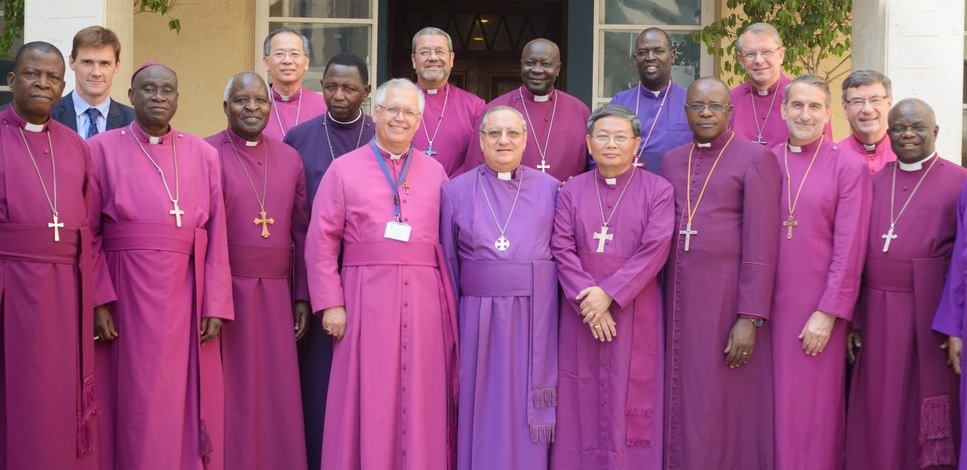
View on WikipediaThe Global South Fellowship of Anglican Churches (GSFA), formerly known as Global South (Anglican), was originally started as a communion of 25 Anglican churches, of which 22 are provinces of the Anglican Communion, plus the Anglican Church in North America and the Anglican Church in Brazil. The Anglican Diocese of Sydney was also officially listed as a member.[1] Currently, the GSFA is a fellowship of 12 churches, 10 of which are provinces of the Anglican Communion.[2] The GSFA claims to represent some 75% of the world's 110 million Anglicans.[3][4][5] This claim is disputed, and peer-reviewed research published in the Journal of Anglican Studies in 2016 indicates a lower percentage.[6]
Key Information


The provinces identified with the Global South represent most of the Southern Hemisphere and Third World provinces within the Anglican Communion, including all those from Africa, the largest from South America, most from Asia and two Oceania provinces. Global South provinces are characterized by their theological traditionalism on matters of sexual ethics and life issues, and by their evangelicalism in churchmanship.
The GSFA excludes the Episcopal Anglican Church of Brazil, the Anglican Church of Australia and the Anglican Church in Aotearoa, New Zealand and Polynesia, despite the fact that some Australian and New Zealand dioceses were already represented in their meetings, and the Asian provinces of Japan and Korea. The Anglican Church of Southern Africa has previously been represented at meetings. The Diocese of South Carolina, which left the Episcopal Church in October 2012, was accepted into Global South in August 2014 with the Global South temporarily caring for the diocese until 2018, when the now-Anglican Diocese of South Carolina formally joined the Anglican Church in North America following the two formal votes.[7]
History
[edit]The Global South encounters started in 1994. The Global South standing gained impetus concerning the controversies over the acceptance of non-celibate homosexuality, as the blessing of same-sex unions and the allowing of non-celibate homosexual clergy was being promoted by the Episcopal Church in the United States and the Anglican Church of Canada. The apex of the controversy took place with the consecration of Gene Robinson, a partnered homosexual, as bishop of the Episcopal Church in 2003. The Global South churches have since then vigorously opposed the legitimacy of any acceptance of same-sex relationships within the Anglican Communion.[8][9][10]
Several of the Global South primates attended the Global Anglican Future Conference (GAFCON) that took place in Jerusalem in 2008, as an alternative to the Lambeth Conference.[11] Mouneer Anis the Presiding Bishop of Jerusalem and the Middle East, personally objected to attending GAFCON 2008, believing that "the Global South must not be driven by an exclusively Northern agenda or Northern personalities."[12]
Following this conference, the Global South supported the creation of the Anglican Church in North America, in 2009, as a province in formation of the Anglican Communion and a theologically conservative alternative in the United States and Canada in opposition to what were viewed as revisionist departures that had taken place in these provinces concerning specifically human sexuality and the interpretation of the Bible. Archbishop Robert Duncan of the Anglican Church in North America was present at the Global South Primates Encounter that took place in Singapore, on 19–23 April 2010. The final statement declared: "We are grateful that the recently formed Anglican Church in North America (ACNA) is a faithful expression of Anglicanism. We welcomed them as partners in the Gospel and our hope is that all provinces will be in full communion with the clergy and people of the ACNA and the Communion Partners."[13]
The Global South issued a letter to the Crown Nominations Commission of the Anglican Communion, on 20 July 2012, signed by 13 primates and representatives of other three churches, including the Anglican Church of Southern Africa, expressing the wish that the new Archbishop of Canterbury will remain faithful to the orthodoxy of the Anglican faith and work for the unity of the worldwide Anglican Communion.[14]
The 7th Global South Conference, held in Cairo, Egypt, on 8–11 October 2019, reuniting 101 delegates and observers of 18 Anglican provinces, proposed the creation of the Global South Fellowship of Anglican Churches, with the GSFA Covenantal Structure, which was then approved on their official communiqué.[15] The 8th Global South Conference, also held in Cairo, except that online, on 14–17 October 2021, with the presence of 90 delegates from 16 provinces and a diocese, endorsed the Global South Fellowship of Anglican Churches "as a global body of orthodox Anglicans within the Anglican Communion. It retains its geographical anchorage in the provinces of the traditional "Global South", nurtures its koinonia in the Gospel".[16] It was also decided that in the next conference, "membership in the Global South Fellowship will be based on assent to the Fundamental Declarations of the Covenantal Structure and agreement with the conciliar structures that bind us together as an ecclesial body." On the same occasion, Justin Badi Arama, Archbishop of South Sudan, was elected as chairman.[17]
On 9 February 2023, the Global South Fellowship questioned Justin Welby's "fitness to lead" the Anglican Communion following the Church of England's vote on same-sex blessings.[18] A day later, the Church of Uganda said they did not recognize the authority of the Archbishop of Canterbury.[19] On 20 February 2023, some primates within the fellowship released a statement declaring that it had broken communion with and no longer recognized Justin Welby as primus inter pares of the Anglican Communion,[20][21] de facto marking a schism within the Anglican Communion.[22][23][24] In March, 2023, the Anglican Church of Southern Africa, although not an "ordinary member" of the GSFA, released a statement saying that, while they could not approve of blessings or marriage for same-sex couples, they accepted Archbishop Makgoba's proposal to form a subcommittee to "prepare formal prayers suitable for providing pastoral care to couples in same-sex civil unions."[25][26][27] However, while they approved a subcommittee to draft pastoral prayers for consideration, a proposal to bless same-sex unions was rejected by the majority of their bishops.[28]
Membership
[edit]The GSFA claims to represent some 75% of the world's 110 million Anglicans.[3][4] This claim is disputed, and peer-reviewed research published in the Journal of Anglican Studies in 2016 indicates lower numbers.[6]
Provinces
[edit]The Global South Fellowship of Anglican Churches' website lists the following provinces, which are also part of the Anglican Communion, as ordinary members:[2]
- The Episcopal / Anglican Province of Alexandria
- Church of Bangladesh
- The Anglican Church of Chile
- Province of the Anglican Church of Congo
- The Church of the Province of the Indian Ocean
- The Church of the Province of Myanmar (Burma)
- Church of the Province of South East Asia
- Province of the Episcopal Church of South Sudan
- Province of the Episcopal Church of Sudan
- Church of Uganda
Ordinary members of the Global South Fellowship of Anglican Churches not part of the Anglican Communion:
Associate members:
- Church of Confessing Anglicans New Zealand
- Diocese of the Southern Cross
- Anglican Network in Europe (ANiE)
See also
[edit]
References
[edit]- ^ "Who We Are". GSFA. Archived from the original on Apr 1, 2023. Retrieved 2023-02-22.
- ^ a b "About Us". www.thegsfa.org. Retrieved 2025-05-19.
- ^ a b Carter, Joe (2023-02-22). "The FAQs: Anglican Communion Splits over 'Blessing' of Same-Sex Marriages". The Gospel Coalition. Retrieved 2025-10-17.
- ^ a b "Justin Welby rejected as leader by conservative Anglicans over same-sex blessings". 2023-02-20. Retrieved 2025-10-17.
- ^ Bumgardner, David (2025-10-17). "A house divided: The Anglican communion's great reset". Baptist News Global. Retrieved 2025-10-18.
- ^ a b Muñoz, Daniel (May 2016). "North to South: A Reappraisal of Anglican Communion Membership Figures". Journal of Anglican Studies. 14 (1): 71–95. doi:10.1017/S1740355315000212. ISSN 1740-3553.
- ^ "Diocese of South Carolina votes to join ACNA". GAFCON. Archived from the original on 2023-02-22. Retrieved 2023-02-22.
- ^ Brown, Andrew (2016-01-08). "The Anglican schism over sexuality marks the end of a global church". The Guardian. ISSN 0261-3077. Retrieved 2023-02-22.
- ^ Sherwood, Harriet; correspondent, Harriet Sherwood Religion (2016-01-14). "Anglican church avoids split over gay rights – but liberals pay price". The Guardian. ISSN 0261-3077. Retrieved 2023-02-22.
{{cite news}}:|last2=has generic name (help) - ^ Morgan, Timothy C. "Anglican Division over Scripture and Sexuality Heads South". News & Reporting. Retrieved 2023-02-22.
- ^ "The Global Anglican Future Conference (GAFCON), June 15-22, 2008, The Holy Land". globalsouthanglican.org. 2007-12-31. Archived from the original on 2007-12-31. Retrieved 2023-02-22.
- ^ "Middle East Presiding Bishop will not attend GAFCON". Thinking Anglicans. 2008-05-21. Retrieved 2023-02-15.
- ^ "Global South Anglican - Fourth Trumpet from the Fourth Anglican Global South to South Encounter". globalsouthanglican.org. 2010-10-10. Archived from the original on 2010-10-10. Retrieved 2023-02-22.
- ^ "Global South Primates' letter to the Crown Nominations Commission". Episcopal News Service. 2012-07-30. Retrieved 2023-02-22.
- ^ when the 7th trumpet sounded in Cairo, the Anglican Church in Brazil was officially received as a member Province and Archbishop Miguel Uchoa was also received into the Council of primates of the GSFA"The Seventh Trumpet: Communiqué from the 7th Global South Conference, Cairo 2019". Anglican Ink. 2019-10-15. Retrieved 2023-02-22.
- ^ "8th Global South Conference". GSFA. Archived from the original on 2023-02-22. Retrieved 2023-02-22.
- ^ "Communiqué from the 8th Global South Conference, 2021" (PDF). GSFA. Archived from the original (PDF) on 2023-03-15. Retrieved 2023-02-22.
- ^ Arama, Justin Badi (2023-02-09). "Global South archbishops question Welby's "fitness to lead" the Anglican Communion following synod vote on gay blessings". Anglican Ink. Retrieved 2023-02-22.
- ^ "Church of Uganda starts process to split from Canterbury". The Independent Uganda. 2023-02-10. Retrieved 2023-02-22.
- ^ "Group of global Anglican church leaders ousts Welby over gay blessing reform". The Independent. 2023-02-20. Retrieved 2023-02-22.
- ^ Paulsen, David (2023-02-20). "Global South archbishops reject Welby's leadership role, vow to 're-set' Anglican Communion". Episcopal News Service. Retrieved 2023-02-22.
- ^ Carter, Joe (February 22, 2023). "The FAQs: Anglican Communion Splits over 'Blessing' of Same-Sex Marriages". The Gospel Coalition. Retrieved 2023-02-22.
- ^ Lawless, Jill (February 20, 2023). "Some Anglican bishops reject leader Welby over gay marriage". ABC News. Associated Press. Archived from the original on 2023-02-22. Retrieved 2023-02-22.
- ^ "Anglican group rejects Archbishop of Canterbury as schism widens". France 24. 2023-02-21. Retrieved 2023-02-22.
- ^ Serfontein, Anli (6 March 2023). "Bishops in Southern Africa agree to prayers but not blessings for same-sex couples". The Church Times. Retrieved 2023-03-06.
- ^ Paulsen, David (2023-03-06). "Southern Africa bishops OK prayers for same-sex couples, won't offer blessings, marriage". Episcopal News Service. Retrieved 2023-03-06.
- ^ "South Africa: Anglican Bishops to Publish Prayers for Same-Sex Couples". allAfrica. Anglican Church of Southern Africa. 2023-03-08. Retrieved 2023-03-08.
- ^ Conger, George (2023-03-05). "Southern Africa bishops reject same-sex blessings". Anglican Ink. Retrieved 2023-08-04.
External links
[edit]Global South Fellowship of Anglican Churches
View on GrokipediaOrigins and Historical Development
Precursor Global South Initiatives (1994–2010)
The first South-to-South Encounter of Anglican leaders from the Global South convened in Limuru, Kenya, in April 1994, marking the inception of collaborative efforts among provinces in Africa, Asia, and Latin America to address perceived erosions of orthodox doctrine within the broader Anglican Communion, including inconsistencies in scriptural authority and episcopal oversight.[5] This gathering, attended by representatives from emerging Anglican heartlands, emphasized mutual accountability and fidelity to historic formularies amid rapid church growth in the developing world, where membership was expanding due to evangelistic priorities rooted in biblical literalism.[6] The second Encounter, held in Kuala Lumpur, Malaysia, from February 10–15, 1997, produced the Kuala Lumpur Statement on Human Sexuality, unanimously adopted by 80 delegates from southern hemisphere provinces, which reaffirmed biblical prohibitions on homosexual practice as contrary to Anglican moral norms and rejected theological innovations diverging from Scripture, the creeds, and the Thirty-Nine Articles.[7][8] This document critiqued Western Anglican trends toward revisionism, attributing them to cultural accommodation rather than scriptural fidelity, and called for renewed commitment to evangelism and doctrinal unity among the majority of global Anglicans located in the South.[9] Tensions intensified following the November 2003 consecration of Gene Robinson as a non-celibate homosexual bishop in the Episcopal Church (USA), prompting Global South primates to issue statements, such as the May 2004 Kuala Lumpur communique, condemning the action as a breach of communion boundaries and underscoring the need for alternative relational commitments to preserve orthodoxy.[9] Subsequent meetings, including the third South-to-South Encounter in Egypt in October 2005 with 103 delegates from 20 provinces, and primates' gatherings like the 2006 Kigali assembly, fostered a coalition of leaders from key provinces—such as Nigeria, Uganda, Kenya, and Southeast Asia—whose churches by the late 2000s represented the numerical majority of the Communion's approximately 80 million members, driven by demographic shifts southward.[10][3] These initiatives laid the groundwork for structured resistance to perceived liberal hegemony without yet formalizing a separate entity.[6]Formal Establishment and Covenant Formation (2011–2023)
The Global South Anglican network, comprising provinces primarily from Africa, Asia, and Latin America, intensified efforts to formalize a distinct orthodox fellowship during the 2010s in response to perceived doctrinal impairments within the Anglican Communion's instruments of unity. Primates from these provinces met in Cairo, Egypt, in early 2014, issuing a statement that reaffirmed adherence to historic Anglican formularies and resolved to engage selectively with Communion bodies only where scriptural fidelity was upheld, signaling a strategic withdrawal from structures viewed as compromised by theological revisionism.[11] This gathering built on prior consultations, marking a shift from ad hoc coalitions toward institutionalized cooperation among like-minded leaders.[12] By 2023, the network had evolved into the Global South Fellowship of Anglican Churches (GSFA), with primates issuing invitations in January for orthodox provinces to commit as full covenant members, emphasizing mutual accountability and shared mission.[13] The Church of Nigeria and Church of Uganda, representing over 20 million Anglicans combined, were among the early adopters, providing numerical and influential backbone to the emerging structure amid ongoing Communion fractures. This growth accelerated following the Church of England's General Synod vote on February 9, 2023, approving prayers of blessing for same-sex couples, which GSFA primates condemned as a violation of Lambeth Resolution I.10 and indicative of leadership failure at Canterbury, prompting vows to "re-set the Communion" through alternative governance.[14][15] The formal establishment culminated in the adoption of the Cairo Covenant on October 19, 2023, at All Saints' Cathedral in Cairo, during an assembly of orthodox leaders under the theme "I will make you as a light to the nations."[16] This document outlined a covenantal framework for doctrinal unity, ecclesiastical recognition, and collaborative mission, enabling members to affirm their bonds while "walking together apart" from provinces endorsing revisionist positions on human sexuality and scriptural authority. The covenant's provisions for primates' council oversight and dispute resolution provided the structural rigor absent in prior informal networks, positioning the GSFA as a parallel instrument for the majority of global Anglicans committed to orthodoxy.[17]Key Milestones and Expansion (2024–Present)
The first assembly of the Global South Fellowship of Anglican Churches (GSFA) convened from June 11 to 15, 2024, at St. Mark's Conference Centre in Cairo, Egypt, marking the inaugural gathering under its new covenantal structure. Approximately 200 archbishops, bishops, clergy, and lay delegates participated, representing 40 nations.[18][19][20] By mid-2024, 11 Anglican provinces had completed synodical processes to become fully covenanted members of the GSFA, with three additional provinces advancing through similar procedures; these entities collectively represent about two-thirds of the global Anglican population of approximately 85 million.[3] On March 21, 2025, GSFA Chairman Justin Badi Arama issued a pastoral letter announcing the appointment of Rev. Canon Charles Raven as Development Officer to facilitate ongoing expansion and administrative strengthening.[21] From October 20 to 24, 2025, the GSFA hosted a bishops' formation retreat at Lweza Training and Conference Centre in Kampala, Uganda, attended by newly consecrated bishops and their spouses from eight provinces, focused on leadership equipping and affirmation through structured sessions.[22][23]Theological Commitments and Doctrinal Stance
Adherence to Scriptural Authority and Orthodox Creeds
The Global South Fellowship of Anglican Churches (GSFA) maintains that the Holy Scriptures of the Old and New Testaments constitute the inspired, infallible Word of God, containing all things necessary for salvation and serving as the supreme rule of faith and practice for Anglican doctrine and discipline.[24] This commitment echoes Article VI of the Thirty-Nine Articles, which declares the Scriptures sufficient for salvation and godly living, and aligns with the Jerusalem Declaration's assertion that the Bible is to be received as God's authoritative revelation, interpreted in its plain and canonical sense.[25] The GSFA's Cairo Covenant (2019) reinforces this primacy, positioning Scripture as the foundational instrument for covenantal unity among member provinces, rejecting any subordination of biblical teaching to contemporary cultural pressures.[24] In addition to scriptural authority, the GSFA affirms the ecumenical creeds as essential expressions of orthodox Christian belief. The Apostles' Creed is recognized as the baptismal symbol, while the Nicene Creed (as expanded at Constantinople in 381 AD) stands as the sufficient statement of the faith for the Church's public worship and teaching.[26] These creeds, alongside the Athanasian Creed, delineate core doctrines such as the Trinity, the incarnation, and the resurrection, ensuring fidelity to the apostolic deposit as articulated in early church councils.[27] The GSFA further upholds the historic episcopate as a mark of catholic continuity, with bishops in apostolic succession exercising oversight in collegiality and accountability to scriptural norms.[26] The two dominical sacraments—Baptism and the Eucharist—are affirmed as ordained by Christ as ordinary means of grace, efficacious for believers when received in faith, consistent with Anglican formularies that derive their validity from divine institution rather than human merit.[24] This framework, collectively termed the "four instruments" of Scripture, creeds, sacraments, and episcopate, forms the unchanging theological baseline for GSFA membership and discernment.[26]Positions on Sexuality, Marriage, and Human Anthropology
The Global South Fellowship of Anglican Churches (GSFA) upholds marriage as the exclusive, faithful, and lifelong union of one man and one woman, grounded in biblical texts such as Genesis 2:24, which describes the one-flesh union as foundational to human complementarity.[18] This position aligns with Lambeth Resolution 1.10 from the 1998 Lambeth Conference, which GSFA leaders have repeatedly affirmed as the authoritative Anglican teaching on marriage and sexuality, rejecting any departure as incompatible with Scripture.[28][29] On human sexuality, GSFA maintains that sexual relations are ordained solely within heterosexual marriage, viewing homosexual practice as contrary to apostolic teaching and Anglican formularies like the Book of Common Prayer and Thirty-Nine Articles.[28] The fellowship explicitly opposes liturgical or pastoral blessings of same-sex unions, as demonstrated in their February 20, 2023, Ash Wednesday statement condemning the Church of England's General Synod decision to permit such prayers, which they described as an innovation departing from historic faith.[28] Similarly, GSFA rejects the ordination or licensing of clergy in non-celibate same-sex relationships, insisting that such actions undermine doctrinal unity and require repentance for restored communion.[18] Regarding human anthropology, GSFA emphasizes a biblical framework where sexual dimorphism—male and female as created by God (Genesis 1:27)—defines identity, with embodiment integral to gender and culminating in marital union.[30] Their June 2024 Assembly communique highlighted teaching Scripture to counter contemporary gender identity challenges, fostering an unshakeable identity rooted in Christ (Ephesians 1) rather than cultural revisions.[18] Member provinces adhering to these positions represent approximately 75% of actively practicing Anglicans worldwide, correlating with sustained growth in Global South attendance amid evangelism and orthodoxy, in contrast to Western provinces where post-2000 liberal shifts on sexuality have coincided with average annual membership declines of 2-5% in bodies like the Episcopal Church and Church of England.[31][32]Critique of Theological Revisionism
The Global South Fellowship of Anglican Churches (GSFA) identifies theological revisionism as the prioritization of contemporary human experience and cultural pressures over the unchanging authority of Scripture, resulting in innovations that undermine orthodox doctrine. This approach, according to GSFA statements, accommodates societal shifts—particularly on issues like sexuality and marriage—while diluting the gospel's transformative power, as Scripture's plain teaching is treated as negotiable rather than foundational.[33] Revisionism thus fosters institutional erosion by eroding the church's distinct witness, as conforming to transient cultural norms reduces its capacity to convict and convert, a causal dynamic rooted in the biblical principle that faithfulness to God's word sustains vitality while compromise invites decline.[34] Empirical evidence supports this critique through stark growth disparities: revisionist bodies like The Episcopal Church (TEC) have seen baptized membership drop by over 25% since 2013, with average Sunday attendance stabilizing at approximately 410,000 in 2023 amid ongoing numerical contraction averaging 40,000 members lost annually since 2012.[35][36] Similarly, the Church of England (CofE) experienced a post-COVID loss of one in five regular worshippers, contributing to long-term attendance erosion despite minor recent upticks to 1.02 million regular attendees in 2024.[37][38] In causal terms, these declines correlate with doctrinal shifts that blur scriptural boundaries, diminishing evangelistic efficacy as churches prioritize affirmation over repentance and renewal. By contrast, provinces aligned with orthodox commitments—predominantly in the Global South—drive the Anglican Communion's expansion by roughly 1 million baptized members yearly, pushing total membership toward 100 million as of 2025, with sub-Saharan Africa alone accounting for substantial gains.[39][32] This pattern underscores a first-principles reality: adherence to scriptural primacy preserves the gospel's inherent potency for human flourishing and societal transformation, whereas revisionist accommodation yields conformity without conviction, verifiable in retention shortfalls and stalled outreach. Revisionists counter that such innovations promote inclusivity and justice, ostensibly broadening appeal and advancing human dignity; however, data refute growth claims, as liberal-leaning denominations exhibit higher attrition rates and lower conversion yields compared to biblically faithful counterparts.[40] For instance, while TEC and CofE grapple with closures—one in three UK churches potentially shuttering by decade's end—Global South Anglicanism thrives amid demographic pressures, suggesting that true gospel fidelity, not cultural mirroring, sustains communal resilience and missional fruitfulness.[41][39]Organizational Framework
Covenantal Structure and Membership Criteria
The Global South Fellowship of Anglican Churches (GSFA) functions through a covenantal structure that mandates mutual commitments to orthodox Anglican doctrine, scriptural authority, and relational accountability among members, distinguishing it from the Anglican Communion's looser relational bonds via instruments like the Lambeth Conference or Primates' Meetings. Adopted on October 15, 2021, this structure comprises three sections: doctrinal foundations rooted in historic creeds and Anglican formularies, conciliar governance mechanisms, and practical protocols for walking together in mission and discipline.[42] Full participation requires formal assent to all sections via synodical processes, ensuring provinces or dioceses affirm the Cairo Covenant (2019) as the basis for shared faith, including adherence to biblical teaching on marriage and sexuality, while rejecting revisionist innovations.[43] This covenant emphasizes first-order unity in essentials—mutual recognition of ministries and eucharistic fellowship—over secondary differences, fostering a self-governing body independent of Canterbury's primacy.[1] Membership criteria prioritize verifiable synodical affirmation to maintain doctrinal integrity and operational unity. Full (ordinary) membership is open to Anglican provinces or recognized dioceses that submit Form A, attesting assent to the entire covenantal structure, accompanied by proof of provincial synod or standing committee approval; dioceses seeking affiliation must notify their archbishop and standing committee.[44] As of June 2024, 11 provinces had achieved full membership through these processes, enabling voting rights in assemblies and eligibility for leadership roles.[3] Associate (observer) status applies to entities not yet ready for full commitment or outside standard recognition, requiring Form C assent to the covenant and limited participation in mission partnerships, with guidance toward eventual full integration; non-ecclesial bodies like mission societies may join as mission partners via partial assent to doctrinal sections.[44] Governance operates collegially through the Primates' Council, which handles executive functions in consultation with members, alongside periodic Assemblies for broader synodical deliberation every four to five years, a Bishops' Council for episcopal oversight, and a Faith and Order Commission for doctrinal matters.[45] [46] Decision-making avoids hierarchical centralization, relying instead on consensus-driven processes that respect provincial autonomy while enforcing covenantal discipline, such as addressing impairments to communion through relational restoration or, if necessary, limitation of participation.[42] This framework promotes accountable interdependence, contrasting with the Anglican Communion's consultative model by embedding enforceable mutual obligations.[1]Provinces, Dioceses, and Affiliated Entities
The Global South Fellowship of Anglican Churches (GSFA) encompasses full covenanted provinces predominantly from Africa, Asia, and Latin America, supplemented by associate dioceses and mission partners. As of June 2024, eleven provinces had ratified the GSFA Covenant through synodical approval to achieve full membership status, including the Church of Nigeria (Anglican Communion), Church of Uganda, Anglican Church of Kenya, Church of Rwanda, Province of the Episcopal Church of South Sudan, Church of the Province of Central Africa, Church of the Province of West Africa, Province of the Episcopal Church of South Sudan (noted for overlap in reporting), Anglican Church of South America, Church of the Province of South East Asia, and the Anglican Church of North America (ACNA).[3][47] These entities form the core, emphasizing representation from regions comprising the numerical majority of global Anglicans. Membership demographics underscore the GSFA's dominance in Anglican numbers, with full member provinces collectively accounting for roughly 75% of the world's approximately 85 million Anglicans, based on aggregated provincial self-reports and GSFA statements.[20] African provinces alone contribute disproportionately, as evidenced by the Church of Nigeria's reported over 18 million baptized members and the Church of Uganda's approximately 11 million adherents.[48][49] Comparable figures from other members, such as the Anglican Church of Kenya (around 5 million) and the Province of South America (over 100,000 across dioceses), amplify this concentration in the Global South.[50]| Province | Region | Reported Membership (Approximate) |
|---|---|---|
| Church of Nigeria | Africa | 18 million+[48] |
| Church of Uganda | Africa | 11 million[49] |
| Anglican Church of Kenya | Africa | 5 million[50] |
| Anglican Church of North America | North America | 1 million[51] |
Leadership Roles and Decision-Making Processes
The leadership of the Global South Fellowship of Anglican Churches (GSFA) is vested in a Primates Council, comprising the archbishops or presiding bishops of member provinces, which provides strategic direction on doctrine, mission, and governance.[42] The Council is chaired by an elected Chairman, a role held since 2019 by Archbishop Justin Badi Arama, Primate of the Episcopal Church of South Sudan, who is selected preferably from traditional Global South provinces to ensure representation of the fellowship's core constituencies.[46][42] A Steering Committee, including the Chairman, Deputy Chairman, Secretary, Treasurer, and three additional members elected from the Primates Council, supports operational oversight between meetings.[42] Decision-making occurs primarily through the GSFA Assembly, convened every three to four years with participation from bishops, clergy, and laity across member entities, where policies and disciplines are established by majority vote of a quorum.[42] Between assemblies, a Board of elected representatives handles interim matters with simple majority decisions, while doctrinal disputes are addressed by a Council of Bishops' Faith and Order Commission in consultation with the Primates Council.[42] Amendments to the covenantal structure require a two-thirds majority at the Assembly.[42] Elections for key positions, such as the Chairman and Board members, occur at assemblies, with terms extending until the subsequent gathering and eligibility for up to two re-elections to promote continuity while allowing for periodic renewal reflective of the Global South's diverse provincial makeup.[42][19] Accountability mechanisms enforce fidelity to the GSFA Covenant, enabling the Primates Council and Board to suspend or remove members for violations of orthodox doctrine, thereby linking authority distribution to adherence to shared confessional standards.[42]Major Activities and Gatherings
Assemblies and Primates' Meetings
The first major primates' gathering of the Global South Fellowship of Anglican Churches (GSFA) occurred in Cairo, Egypt, from October 14 to 16, 2023, where leaders coordinated on the organization's emerging covenantal framework amid Anglican divisions.[53] This meeting involved primates from member provinces, emphasizing strategic alignment for orthodox Anglican witness.[54] The inaugural GSFA Assembly under the new covenantal structure convened June 11–15, 2024, at St. Mark's Conference Centre in Cairo, drawing 13 active primates, 44 bishops, 46 clergy, and 36 lay delegates from provinces across Africa, Asia, and Latin America.[18][3] Daily sessions incorporated morning prayer, Bible study led by primates, and plenaries on mission-oriented topics, providing a platform for relational fellowship and forward planning despite external pressures.[20] Subsequent high-level coordination continued with the third GSFA Bishops Formation Retreat, held October 19–24, 2025, at Lweza Training and Conference Centre in Kampala, Uganda, attended by bishops and spouses focused on leadership equipping and mutual support.[55][2] This event underscored ongoing commitment to episcopal renewal as a basis for collective strategy.[56]Issued Statements and Pastoral Guidance
In the Ash Wednesday Statement issued on February 20, 2023, GSFA Primates expressed profound sorrow over the Church of England's General Synod decision to permit blessings for same-sex unions, interpreting it as a definitive departure from the historic faith and doctrine of the Anglican Communion on marriage and sexuality.[28] The primates declared they could no longer recognize the Archbishop of Canterbury as an instrument of unity or the Church of England as the Communion's "Mother" Church, committing instead to walk apart from provinces embracing such revisionism while prioritizing "charitable orthodoxy"—a posture of bold adherence to scriptural truth coupled with humble repentance in their own contexts.[28] They called explicitly for repentance among revisionist leaders and provinces, pledging to extend pastoral oversight to orthodox Anglican entities disconnected from heterodox oversight.[28] Subsequent pastoral letters from GSFA Chairman Justin Badi Arama have reinforced this framework, addressing persistent doctrinal drifts in Western provinces. In his September 2025 letter, Badi urged GSFA members to seek the good of the broader Anglican household through prayer and covenantal fidelity, critiquing the Church in Wales's election of an openly lesbian archbishop as further evidence of innovation harming Communion unity, and affirming the GSFA Covenant as a biblically grounded alternative to maintain orthodox Anglican identity without schism.[57] Earlier letters, such as that from September 2024, echoed calls for repentance amid ongoing synodical approvals of same-sex blessings, emphasizing humble self-examination alongside firm resistance to erosion of scriptural authority on human anthropology.[58] A statement on October 3, 2025, responding to the appointment of the Rt Revd Dame Sarah Mullally as Archbishop of Canterbury, lamented the selection as a missed chance for reform, citing her prior endorsement of same-sex blessings as emblematic of continued divergence from Anglican formularies.[59] It reiterated an invitation to repentance and renewal via the GSFA's covenanted structure, adopting a tone of bold humility by expressing prayers for Mullally's leadership while underscoring the imperative of realignment with orthodox doctrine to restore trust.[59] These communiqués consistently frame pastoral guidance as rooted in scriptural realism, urging orthodox provinces to embody repentance internally while extending grace externally, without compromising on core convictions.[28][57]Formation and Training Initiatives
The Global South Fellowship of Anglican Churches (GSFA) conducts bishops' formation retreats to equip leaders with biblical grounding and mission-oriented skills. A notable example is the Bishops Formation Retreat held from October 18 to 24, 2025, at Lweza Training and Conference Centre in Kampala, Uganda, which gathered Anglican bishops from Global South provinces to focus on Christ-centered leadership and spiritual maturity.[22][60] This event built on prior retreats, such as the inaugural one in Entebbe, Uganda, in February 2024, emphasizing practical training in scriptural authority and evangelistic resilience amid doctrinal challenges.[61] GSFA's training extends to clergy and laity through linkages and exchange programs among affiliated theological colleges, promoting unity in mission and fidelity to orthodox Anglican doctrine. These initiatives prioritize scriptural fidelity as the foundation for formation, fostering resilience in evangelism and pastoral oversight.[42] Participation draws from provinces across dozens of nations, reflecting the GSFA's demographic base in the Global South, where such programs aim to build long-term capacity for doctrinal health and church growth.[22]Relations Within Global Anglicanism
Engagement with the Anglican Communion Instruments
The Global South Fellowship of Anglican Churches (GSFA) maintains selective and critical engagement with the Anglican Communion's Instruments of Communion—the Archbishop of Canterbury, Lambeth Conference, Anglican Consultative Council, and Primates' Meeting—assessing them as impaired in fostering doctrinal unity due to leadership influenced by Western revisionism despite the Global South's numerical predominance.[28][62] GSFA provinces, representing approximately 75-85% of global Anglicans, argue that these Instruments marginalize orthodox voices in decision-making, as evidenced by outcomes prioritizing geographic and institutional primacy over covenantal fidelity to historic Anglican formularies.[28][63] At the Lambeth Conference of 2022, held from July 26 to August 8, GSFA-affiliated bishops participated but abstained from receiving Holy Communion alongside others, citing the absence of true ecclesial communion amid unresolved doctrinal divergences; this action underscored their view of the gathering as partial rather than fully representative.[64][63] During the conference, GSFA leaders issued reaffirmations of Lambeth Resolution I.10 (1998) on human sexuality, attended by bishops from provinces such as Alexandria and others, involving over 40,000 worshippers in associated events, to witness orthodoxy without endorsing the Instruments' perceived equivocations.[63] In its Ash Wednesday Statement of February 20, 2023, the GSFA Primates' Council explicitly critiqued the Instruments, declaring "no confidence" in the Archbishop of Canterbury's unifying role or the Instruments' capacity for coherent leadership, attributing this to accommodations of revisionist positions that contradict Scripture and Anglican tradition.[28][65] The statement pledged continued presence within the Communion to preserve its inheritance but advocated reconfiguration, positioning the GSFA's 2019 Cairo Covenant as a parallel instrument to realign relationships on biblical foundations rather than Canterbury-centered authority.[28][3] This approach reflects a causal prioritization of fidelity to core Anglican texts—the Bible, Thirty-Nine Articles, and 1662 Book of Common Prayer—over institutional continuity, with GSFA viewing the Instruments' structure as enabling minority Western influence to override the Global South's demographic weight in shaping Communion-wide guidance.[62][66] Subsequent communiqués, such as the June 2024 assembly outcome, reaffirmed this stance, endorsing covenanted accountability as essential for authentic unity amid the Instruments' perceived failures.[3]Interactions with GAFCON and Other Conservative Networks
The Global South Fellowship of Anglican Churches (GSFA) maintains cooperative relations with GAFCON, characterized by overlapping provincial memberships and shared commitments to orthodox Anglican doctrine, while preserving distinct operational models. GAFCON operates primarily through periodic conferences and a primates' council, fostering a movement-based fellowship, whereas the GSFA emphasizes a covenantal framework for structured governance and mutual accountability among its members.[67] This complementarity has enabled joint advocacy, as evidenced by mutual endorsements in responses to doctrinal developments in Western provinces. In February 2023, the GSFA issued its Ash Wednesday Statement condemning the Church of England's approval of blessings for same-sex unions, declaring impaired communion with Canterbury and calling for a reordering of Anglican structures. GAFCON echoed this position in June 2023, explicitly referencing the GSFA's prior declaration and affirming that both organizations no longer recognize the Archbishop of Canterbury as a focus of unity. These aligned stances underscored their collaborative intent without formal merger, with the GSFA expressing anticipation for working with GAFCON primates to shape alternative networks.[28][68] By October 2025, GAFCON advanced toward establishing rival Communion instruments, announcing a reconfiguration of global Anglicanism centered on scriptural authority and provincial autonomy, which implicitly builds on GSFA's covenantal initiatives. While some orthodox Anglican commentators have critiqued potential redundancies between the two, citing duplicated efforts in representation, their combined influence extends to approximately 85% of global Anglicans, enhancing coordinated mission and doctrinal fidelity across conservative networks.[69][70]Divergences from Canterbury-Centered Leadership
The Global South Fellowship of Anglican Churches (GSFA) formally rejected the unique leadership role of the Archbishop of Canterbury in February 2023, following the Church of England's General Synod approval of blessings for same-sex couples on February 9, 2023.[71] In a statement issued from Cairo, GSFA primates declared they could no longer recognize Archbishop Justin Welby as the "first among equals" in the Communion, citing his failure to uphold orthodox doctrine amid perceived capitulation to revisionist pressures.[71] This marked a doctrinal break, attributing the erosion of traditional Anglican teaching—particularly on human sexuality and marriage—to Canterbury's relational primacy, which GSFA leaders argued has prioritized consensus over scriptural fidelity.[72] GSFA's position elevates the primacy of Holy Scripture as the ultimate authority, superseding the historic instruments of unity centered on Canterbury, which are seen as compromised by Western theological innovations.[62] This stance traces a causal chain from Canterbury's influence to the adoption of practices diverging from biblical norms, such as the 2023 blessings, which GSFA views as enabling further revisionism rather than preserving the faith once delivered.[73] The fellowship's Cairo Covenant, adopted in October 2021 and reaffirmed in subsequent assemblies, explicitly prioritizes covenantal fidelity to Scripture and the historic creeds over deference to Canterbury's convening role.[74] In October 2025, GSFA reiterated this divergence upon the appointment of Sarah Mullally as Archbishop, expressing "no confidence" in Canterbury-led instruments and representing provinces encompassing approximately 85% of global Anglicans.[75] Empirical trends underscore GSFA's critique: Anglican membership in Western provinces, including the Church of England, has shown consistent decline in active attendance, with reports documenting drops in weekly worshippers from over 1 million in 2000 to under 700,000 by 2019, amid broader secularization and doctrinal shifts.[76] Conversely, Global South Anglican churches have driven overall Communion growth to around 100 million members by 2025, adding roughly 1 million annually, primarily through adherence to orthodox teachings in regions like Africa and Asia.[77][32] This numerical disparity suggests a causal link between revisionist leadership under Canterbury and stagnation in the West, contrasted with vitality in scripturally grounded models.[72] Progressive voices within the Communion, such as those from the Episcopal Church and Anglican Church of Canada, advocate maintaining Canterbury's role through inclusive dialogue and relational bonds to foster unity despite doctrinal variances.[78] However, GSFA counters that such approaches have empirically failed to resolve impairments, as evidenced by persistent membership erosion in revisionist provinces—e.g., the Episcopal Church's decline from 2.3 million in 2000 to under 1.6 million by 2020—while orthodox adherence correlates with sustained expansion, indicating that scriptural primacy better sustains missional effectiveness.[76][34]Controversies and Debates
Conflicts Over Doctrinal Innovations in Western Provinces
The consecration of Gene Robinson, an openly partnered homosexual, as Bishop of New Hampshire by the Episcopal Church (TEC) on November 2, 2003, marked a pivotal doctrinal flashpoint that elicited strong resistance from Global South Anglican leaders.[79] Primates from Global South provinces had warned TEC of the consequences prior to the event, emphasizing that such an action would impair communion across the Anglican world.[80] In response, entities like the Province of Southeast Asia declared a break in communion with TEC on November 20, 2003, citing the consecration's violation of scriptural prohibitions on same-sex relations and its threat to orthodox unity. This event breached agreed moratoria on consecrating non-celibate gay clergy, as later reiterated in Anglican Instruments, and catalyzed broader realignment efforts among conservative provinces.[81] Subsequent TEC innovations, including the authorization of same-sex marriage rites in 2015, deepened the rift, with Global South voices framing these as causal drivers of division rather than benign diversity. Orthodox critiques highlighted empirical fallout, such as TEC's membership drop from approximately 2.3 million in 2003 to under 1.9 million by 2007—a 6% decline amid stagnant U.S. population growth—attributed by conservative analysts to alienation of biblically faithful members.[82] Proponents within TEC, however, defended the moves as prophetic extensions of justice and inclusivity, aligning with evolving societal norms on human dignity.[83] These tensions underscored a fundamental disagreement: whether innovations reflect contextual adaptation or departure from the Bible's depiction of marriage as a union between one man and one woman, as affirmed in Lambeth Resolution 1.10 (1998).[84] The Church of England's (CofE) approval of blessings for same-sex couples via General Synod motions in February 2023 intensified orthodox pushback, serving as a direct catalyst for GSFA's covenantal framework. GSFA's initial response condemned the blessings as doctrinally incoherent, arguing that Anglican liturgy embodies teaching and that endorsing same-sex unions contradicts God's Word on sexual ethics, thereby impairing fellowship with GSFA-associated provinces.[84] In its Ash Wednesday statement, GSFA primates declared CofE disqualified as the historic "Mother Church," rejected walking together with revisionist bodies, and committed to collaborating with orthodox networks like GAFCON for Communion oversight and renewal grounded in historic faith.[28] This stance echoed earlier Global South resistance, positioning doctrinal fidelity—not mere tolerance of difference—as the basis for unity, with GSFA's 2019 Cairo Covenant formalizing mutual accountability among adherent provinces to firewall such innovations.[42] CofE advocates countered by portraying the blessings as pastoral accommodations short of liturgical change, aimed at affirming committed relationships without altering marriage doctrine.[62]Accusations of Schism and Division
The Global South Fellowship of Anglican Churches (GSFA) has consistently framed its establishment and covenantal structure as a necessary reconfiguration of the Anglican Communion to restore fidelity to biblical teaching, rather than an act of schism. In a February 20, 2023, primates' statement, GSFA leaders declared that actions by provinces like the Church of England—such as proposals for blessing same-sex unions—constituted a departure from orthodox Anglican faith, prompting a "reset" through voluntary covenanted commitments among aligned provinces to preserve doctrinal integrity without severing ties outright.[62] This perspective positions reconfiguration as a response to perceived revisionism in Western churches, emphasizing that unity impaired by innovation cannot be maintained at the expense of truth.[85] Critics aligned with Canterbury, including Archbishop Justin Welby, have accused GSFA of undermining Communion unity by rejecting his role as "first among equals" and forming parallel structures, actions seen as exacerbating fragmentation.[15] Some Anglican commentators have labeled these moves as divisive, arguing that GSFA's non-recognition of Welby prioritizes exclusion over Christ's unconditional unity.[86] However, empirical data on Anglican demographics counters narratives of GSFA-induced division: the Communion's membership has grown to approximately 85-110 million, with annual increases of over 1 million adherents concentrated in Global South provinces, while Western churches experience stagnation or decline due to factors including secularization and lower birth rates.[77][32] This shift underscores that sustained vitality resides in orthodox Global South networks, representing roughly 75-80% of global Anglicans, rather than implying schism as the causal driver.[87] Certain observers have portrayed GSFA's rise as a "power grab" by leveraging numerical strength to dominate Communion instruments, potentially marginalizing minority Western voices.[88] This view is rebutted by GSFA's emphasis on covenantal charity—offering an inclusive framework for orthodox provinces to collaborate without imposing uniformity—and the reality that demographic majorities in the Global South reflect organic growth from conversions, high fertility, and mission focus, not coercive centralization.[62] Such majorities, spanning 12 full member provinces and additional networks by 2024, align with causal patterns of adherence to historic doctrine fostering expansion, whereas critiques often overlook how Western innovations have already eroded relational bonds.[2]Responses to Criticisms of Exclusivity or Power Dynamics
Proponents of the Global South Fellowship of Anglican Churches (GSFA) rebut accusations of exclusivity by underscoring its empirical representation of Anglicanism's demographic core, encompassing approximately 75% of the world's active Anglicans primarily through provinces in Africa, Asia, and Latin America.[20][89] This majority stake, they argue, stems from organic growth tied to adherence to historic Anglican formularies rather than contrived exclusion, as sub-Saharan Africa alone accounts for over 55% of global Anglicans amid broader southern expansion.[90] GSFA communiqués emphasize an open framework of covenanted relationships extended to any orthodox province willing to affirm biblical faith, positioning the fellowship as a steward of shared inheritance rather than an elitist enclave.[75] Critics from minority liberal constituencies in Western provinces, such as the Episcopal Church in the United States, contend that GSFA structures marginalize progressive voices by conditioning fellowship on rejection of doctrinal innovations like same-sex blessings, thereby skewing power toward conservative majorities.[91] In response, GSFA primates highlight internal synodical accountability in member provinces, where decisions reflect grassroots consultations among millions of laity and clergy, not top-down imposition; they frame orthodoxy as a unifying baseline inclusive of all faithful adherents, irrespective of geography.[84] This counters claims of dominance by noting that Western revisionist bodies, representing under 10% of communicants, retain autonomy but forfeit covenantal parity through unilateral departures from Lambeth resolutions.[62] Causally, the fellowship's influence reflects theological fidelity driving membership vitality—evident in southern provinces' annual net gains of millions—contrasted with numerical stagnation or decline in innovation-tolerant northern churches, rendering power redistribution a byproduct of fidelity rather than opportunistic maneuvering.[77][32] GSFA documents reject ambition-driven narratives, asserting joint stewardship among orthodox primates as a restorative mechanism grounded in scriptural authority, not hegemonic intent.[92]Influence and Broader Impact
Demographic Representation and Numerical Strength
The Global South Fellowship of Anglican Churches (GSFA) draws its membership from provinces concentrated in Africa, Asia, and other developing regions, where Anglican adherence has expanded amid demographic shifts and evangelistic efforts. Originating from an initial coalition of 25 provinces within the Anglican Communion, GSFA had secured 11 fully covenanted provincial members by June 2024, alongside associate dioceses and networks.[18][3] These entities align with the broader Global South's dominance in Anglican demographics, as sub-Saharan Africa alone hosted over 55% of the world's Anglicans by the late 2000s, a proportion that has grown with annual Communion-wide increases of approximately one million members.[90][77] GSFA-aligned primates and provinces claim to embody roughly 85% of global Anglican active participation, measured by average Sunday attendance across an estimated 85-100 million total adherents, far outpacing the 1-2% attendance share of Canterbury-focused Western bodies.[51][93] This scale is anchored in powerhouse provinces such as Nigeria (approximately 12 million active baptized members), Uganda, Kenya, and Rwanda, which collectively dwarf the numerical footprint of liberal-leaning counterparts like the Episcopal Church of the United States, whose baptized membership contracted from about 2.3 million in the early 2000s to 1.55 million in 2023.[94][35] Such disparities highlight empirical patterns of vitality in the Global South versus stagnation in the North, where secular trends have eroded rolls despite institutional emphasis on cultural adaptation over membership metrics.[32]| Province Example | Estimated Active Members (millions) | Region |
|---|---|---|
| Church of Nigeria | ~12 | Africa[94] |
| Episcopal Church (USA) | ~1.55 | North America[35] |