



Community hub
God Bless
View on Wikipedia
God Bless is an Indonesian rock band founded in Jakarta in 1973 by Ahmad Albar, Jockie Soerjoprajogo, Fuad Hassan, Donny Fattah, and Ludwig Lemans. It continues to be active and has received several awards from the Indonesian music industry.
Key Information


History
[edit]God Bless was founded by Ahmad Albar (vocals), Jockie Soerjoprajogo (keyboard), Fuad Hassan (drums), Donny Fattah (bass), and Ludwig Lemans (guitar) in 1973.[1] They had their first concert on 5 May 1973 at Taman Ismail Marzuki, which was followed on 16 August with the Summer 28 concert, the first (and, as of 2004, largest) open-air concert in Indonesia.[1] During that period they also played at the Jakarta Fair, held near the National Monument.[2] That same year the band acted in Ambisi (Ambition); Lemans left the band not long after to return to the Netherlands.[1]
In 1975, the band opened for British rock band Deep Purple when the latter played in Jakarta.[3] They released their first album, Huma di Atas Bukit (Rice Field on a Hill), the following year.[1] The titular song for the progressive rock album, an adaptation of "Firth of Fifth", from Genesis' 1973 album Selling England by the Pound, went on to be used as the theme song to Sjumadjaja's film Laila Majenun (Laila is Possessed).[1][4]
Four years later, God Bless released Cermin (Mirror), which included more ballads and showed influences from Deep Purple and Van Halen;[1][4] Abadi Soesman contributed a bit.[5] The band, in an off-again on-again state for the next several years, released their third album, Semut Hitam (Black Ants) in 1988;[1] the album went on to be their most successful.[5] This was followed by Raksasa (Monster; 1989), and Apa Kabar? (What's Up?; 1997).[6]
God Bless performed a "duel" with Padi on 9 November 2011, a band twenty years younger; held in the Hard Rock Cafe Jakarta, the duel was witnessed by over 200 people, greater than the capacity of the venue.[4] In 2003 Jockie left the group and replaced by Iwang Noorsaid and Abadi Soesman on Keyboard ; initially reported as being over creative differences, in October 2011 Jockie revealed that it was after a fight over Albar's drug habits.[6] Jockie, once a drug user himself, was asked to tell Albar to stop using drugs; in response, Albar reportedly pulled a gun on him.[7] Jockie was soon replaced by Abadi Soesman.[5] Guitarist Ian Antono confirmed that a pistol was involved, but he thought it could be a toy; he stated that the argument flared up when Jockie insulted Albar's family.[8]
In 2007, Yaya Moekito (1957–2025) joined the band as a drummer.[5] After Albar was imprisoned for drug possession in November 2007 and paroled in July 2008,[9][10] in mid-2009, God Bless played at the Jakarta Fair and released another album, 36th.[5][2] In late 2009 the band was pictured on the cover of Rolling Stone Indonesia.[3] The following year, the band went on a cross-country tour, playing in nine cities and accompanied by Nidji, Gigi, Andra and The BackBone, and Naif.[3] The band also played in the 2010 Djakarta Artmosphere festival.[11]
On 14 June 2011, God Bless performed at the Hard Rock Cafe with Jibriel to celebrate founder's day; the latter group consists of two of Albar's sons, one of Jockie's, one of Antono's, and Albar's nephew Bagoes.[12] In July, the band played at the Hard Rock Cafe Jakarta to celebrate its 40th anniversary.[5] The following month, from 22 to 24 July 2011, the band performed at the InterMusic Java Rockin' Land alongside The Cranberries and Neon Trees.[13] On 20 October 2011 Jockie posted on his Facebook wall that he was upset that the band continued to play songs written by him without paying royalties.[6]
Drummer Yaya Moektio died from tuberculosis on 8 December 2025, at the age of 68.[14] Bassist Donny Fattah died from sarcopenia, vascular blockage, and autoimmune diseases on 7 March 2026, at the age of 76.[15]
Themes
[edit]Tertiani Z.B. Simanjuntak, writing for The Jakarta Post, notes that God Bless often advocated the rights of the poor and working classes.[4]
Accolades
[edit]In a 2009 issue of Rolling Stone Indonesia, two of God Bless' songs were ranked as being among the 150 best Indonesian songs of all time: "Kehidupan" ("Life"), was ranked 8th, while "Rumah Kita" ("Our Home") was ranked 22nd.[16]
In August 2011, Kompas reported that Mira Lesmana and Riri Riza had spent two years producing a documentary about the band, to be titled Rockumentary.[17]
Discography
[edit]Albums
[edit]- God Bless (1975)
- Cermin (1980)
- Semut Hitam (1988)
- Raksasa (1989)
- Apa Kabar (1997)
- 36th (2009)
- Cermin 7 (2016)
- God Bless Live at Aquarius Studio (2019)
- Anthology 50th Year Anniversary (with Tohpati & Czech Symphony Orchestra) (2023)
Compilations
[edit]- The Story of God Bless (1990)
- 18 Greatest Hits of God Bless (1992)
- The Greatest Slow Hits (1999)
Singles
[edit]- Vonis (1991)
- Untuk Indonesiaku (2020)
- Mulai Hari Ini (2021)
References
[edit]- Footnotes
- ^ a b c d e f g Theodore KS 2004, Achmad Albar, Sang Ikon.
- ^ a b The Jakarta Post 2009, God bless 'em.
- ^ a b c Leo 2010, Godfather of Rock.
- ^ a b c d Simanjuntak 2002, Old rockers meet.
- ^ a b c d e f The Jakarta Post 2011, Keep on Rocking.
- ^ a b c Yudono 2011, Yockie, Tondongan.
- ^ Maullana and Kamil 2011, Wawancara dengan Yockie 3.
- ^ Maullana and Sofyan 2011, Ian Antono: Malu.
- ^ The Jakarta Post 2008, Singer Ahmad Albar.
- ^ The Jakarta Post 2008, Ahmad Albar gets.
- ^ Dass 2011, At a glimpse: Music.
- ^ Maullana and Kamil 2011, God Bless Bikin.
- ^ Setiawati 2011, The Cranberries channel.
- ^ "Kronologi Meninggalnya Yaya Moektio Eks Drummer God Bless". detikpop. 8 December 2025. Retrieved 9 December 2025.
- ^ "Sebelum Meninggal, Donny Fattah God Bless Berjuang Melawan 3 Penyakit". Kompas. 7 March 2026. Retrieved 7 March 2026.
- ^ Rolling Stone Indonesia 2009, 150 Lagu Indonesia.
- ^ Maullana and Sofyan 2011, God Bless Tunggu.
- Bibliography
- "150 Lagu Indonesia Terbaik Sepanjang Masa" [150 Best Indonesian Songs of All Time]. Rolling Stone Indonesia (in Indonesian) (56). Jakarta: 43, 49, 51, 89. December 2009. Archived from the original on 16 March 2012.
- "Ahmad Albar gets eight months in drug case". The Jakarta Post. 25 June 2008. Archived from the original on 31 December 2012. Retrieved 7 January 2011.
- Dass, Felix (15 May 2011). "At a glimpse: Music from the decades". The Jakarta Post. Archived from the original on 27 August 2011. Retrieved 7 January 2011.
- "God bless 'em, those legendary rockers are back". The Jakarta Post. 18 June 2009. Archived from the original on 27 August 2011. Retrieved 7 January 2011.
- "Keep on rocking". The Jakarta Post. 26 June 2011. Archived from the original on 29 August 2011. Retrieved 7 January 2011.
- Leo, P.J. (25 July 2010). "Godfather of Rock". The Jakarta Post. Archived from the original on 15 September 2014. Retrieved 7 January 2011.
- Maullana, Irfan; Kamil, Ati (15 June 2011). "God Bless Bikin Jibriel "Keteteran"" [God Bless makes Jibriel "Keteteran"]. Kompas (in Indonesian). Archived from the original on 3 February 2012. Retrieved 7 January 2011.
- Maullana, Irfan; Kamil, Ati (26 October 2011). "Wawancara dengan Yockie 3: Dan di Situlah Dia Mengambil "Beceng"" [Interview with Yockie 3: And then He Took a Pistol]. Kompas (in Indonesian). Archived from the original on 29 December 2011. Retrieved 6 January 2011.
- Maullana, Irfan; Sofyan, Eko Hendrawan (8 June 2011). "God Bless Tuggu Kabar Miles dan Riri Riza" [God Bless is Waiting for News from Miles and Riri Riza]. Kompas (in Indonesian). Archived from the original on 15 April 2012. Retrieved 7 January 2011.
- Maullana, Irfan; Sofyan, Eko Hendrawan (8 June 2011). "Ian Antono: Malu, Kita Ini Sudah pada Tua-tua" [Ian Antono: Shameful, We're All Already Old]. Kompas (in Indonesian). Archived from the original on 21 January 2012. Retrieved 7 January 2011.
- Setiawati, Indah (24 July 2011). "Cranberries channel the past in Ancol". The Jakarta Post. Archived from the original on 22 June 2009. Retrieved 7 January 2011.
- Simanjuntak, Tertiani Z.B. (10 November 2002). "Old rockers meet youth idols on stage". The Jakarta Post. Archived from the original on 15 September 2014. Retrieved 7 January 2011.
- "Singer Ahmad Albar released from jail". The Jakarta Post. 11 July 2008. Archived from the original on 22 June 2009. Retrieved 7 January 2011.
- Theodore KS (19 March 2004). "Achmad Albar, Sang Ikon" [Achmad Albar, the Icon]. Kompas (in Indonesian).
- Yudono, Jodhi (20 October 2011). "Yockie, Todongan Pistol dan Hengkang dari Godbless" [Yockie, Gun to His Head and Running from Godbless]. Kompas (in Indonesian). Archived from the original on 23 December 2011. Retrieved 6 January 2011.
External links
[edit]| International | |
|---|---|
| National | |
| Artists | |

God Bless
View on GrokipediaHistory
Formation and Early Influences (1973)
God Bless was established in Jakarta on May 5, 1973, by vocalist Ahmad Albar—who had recently returned to Indonesia after several years in the Netherlands—keyboardist Jockie Soerjoprajogo, guitarist Fuad Hassan, bassist Donny Fattah, and drummer Ludwig Lemans.[1][6] Albar's time abroad exposed him to Western rock scenes, prompting his vision for a professional band that could rival international acts while incorporating Indonesian sensibilities. The group's inaugural public performance occurred on May 5–6, 1973, at Taman Ismail Marzuki cultural center in Jakarta, marking an early milestone in Indonesia's emerging rock scene amid the New Order regime's cultural restrictions on Western music.[7] Early influences drew heavily from British and American hard rock and progressive rock, including bands like Deep Purple for their riff-driven energy and Genesis for complex arrangements, which Albar and Soerjoprajogo adapted to local audiences through covers and original compositions emphasizing guitar solos and keyboard textures.[8] This fusion reflected broader trends in Southeast Asian rock during the early 1970s, where expatriate experiences and smuggled records shaped hybrid styles despite government censorship of "decadent" foreign sounds.[9] The band's formation capitalized on Jakarta's underground music community, with members leveraging prior gigs in local groups to build a repertoire focused on high-energy performances that tested rudimentary amplification systems available at the time.[7] Initial rehearsals emphasized technical proficiency, with Soerjoprajogo's keyboard work providing melodic foundations influenced by Hammond organ sounds prevalent in prog rock, while Albar's versatile vocals bridged soulful delivery and raw power akin to hard rock frontmen.[8] Challenges included limited access to quality instruments and venues, as Indonesia's music infrastructure lagged behind global standards, yet the core lineup's commitment laid groundwork for rapid evolution, evidenced by their quick integration into Jakarta's festival circuit by late 1973. These foundational elements positioned God Bless as pioneers in professionalizing Indonesian rock, distinct from amateur beat groups of the 1960s.[6]Breakthrough and 1970s Era
God Bless achieved their breakthrough with the release of their self-titled debut album on May 5, 1975, which introduced a fusion of hard rock and progressive elements to Indonesian audiences, drawing influences from Western acts such as Deep Purple, Kansas, and Genesis.[10][11] The album, featuring tracks like originals alongside adapted covers, marked a pivotal moment in domestic rock history by elevating the genre from niche underground appeal to mainstream recognition amid Indonesia's burgeoning music scene of the era.[11][12] Throughout the mid-to-late 1970s, the band dominated live performances across Jakarta and beyond, solidifying their status as pioneers who bridged international rock styles with local sensibilities.[11] Their sets often included high-energy renditions of global hits by bands like Emerson, Lake & Palmer and Kin Ping Meh, which resonated with youth navigating post-New Order cultural shifts, fostering a dedicated fanbase and influencing subsequent Indonesian groups.[11] This period of relentless touring and stage presence, without additional studio albums until the 1980s, underscored their role in institutionalizing rock as a viable concert draw rather than mere recording novelty.[11] Key to their 1970s prominence were core members including vocalist Ahmad Albar and keyboardist Jockie Soerjoprajogo, whose contributions to songwriting and arrangement propelled the band's raw energy and technical prowess.[11] While commercial metrics like exact sales figures remain sparsely documented, contemporaneous accounts highlight their outsized impact, with performances drawing thousands and earning acclaim as Indonesia's leading rock outfit by decade's end.[11] This era laid the groundwork for their enduring legacy, though internal dynamics foreshadowed later challenges.1980s Hiatus and Internal Challenges
Following the release of their second studio album Cermin on November 10, 1980, God Bless entered an extended hiatus that lasted until 1988, marked by reduced group activities and no new recordings as a collective.[13] This period reflected broader internal challenges, including persistent lineup instability, as the band had already undergone multiple personnel shifts since its formation, with core members like vocalist Achmad Albar, guitarist Ian Antono, and bassist Donny Fattah navigating tensions over creative direction and individual commitments.[11] Over its history, God Bless experienced exactly 15 lineup changes, many occurring amid such lulls, which disrupted cohesion and contributed to the pause in collaborative output.[14] During the hiatus, members pursued separate endeavors, further straining band unity; Albar, for instance, focused on solo work, releasing personal material that highlighted diverging artistic paths within the group.[1] These internal dynamics were compounded by the evolving Indonesian music landscape under the New Order regime, where rock acts faced implicit pressures on lyrical content and performance, though God Bless's established popularity mitigated outright bans. The resulting fragmentation delayed new material until the band's partial reunion in 1988 for the album Semut Hitam (Black Ants), released via Logiss Records, which signaled a tentative stabilization amid ongoing personnel flux.[13] This eight-year gap underscored how recurrent member departures and solo pursuits eroded momentum, yet the core lineup's resilience laid groundwork for later revivals.[11]Reunions and 1990s–2000s Developments
Following the commercial success of Raksasa in 1989, God Bless entered a prolonged hiatus throughout most of the 1990s, during which core members pursued individual endeavors, including guitarist Eet Sjahranie's formation of the band Edane in 1991.[1] The group released compilation albums such as The Story of God Bless in 1990 and 18 Greatest Hits of God Bless in 1992, which sustained interest in their catalog amid the band's dormancy. A brief reunion occurred in 1997, culminating in the album Apa Kabar, but it dissolved shortly thereafter as Sjahranie prioritized Edane.[15] In the 2000s, God Bless staged a nostalgic reformation in 2002, assembling a lineup featuring vocalist Ahmad Albar, guitarist Ian Antono, bassist Donny Fattah, keyboardist Abadi Soesman, drummer Inang Noorsaid, and keyboardist Iwang Noorsaid; Iwang departed later that year, followed by Inang in 2003, who was replaced by Gilang Ramadhan.[16] This revival aligned with post-Suharto cultural shifts enabling greater celebration of Indonesia's rock heritage, emphasizing retrospection over new material.[17] Activities stalled in late 2007 when Albar faced drug-related charges, leading to his detention until mid-2008. The band reconvened post-release, delivering television performances such as on Kick Andy in February 2009 with Albar, Antono, Fattah, percussionist Yaya Moektio, and Soesman, and issuing the anniversary album 36th in May 2009 to mark their enduring legacy.[15]2010s–Present: Anniversaries and Revivals
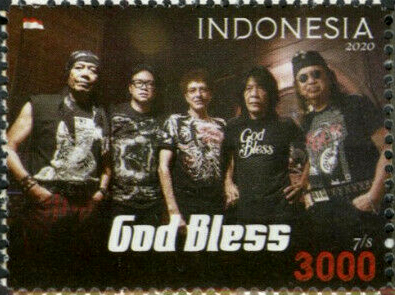
God Bless sustained performances into the 2010s, appearing at the Djakarta Artmosphere festival in 2010 and delivering a collaborative set with the younger band Jibriel at Hard Rock Cafe Jakarta on June 14, 2011, to commemorate the venue's 40th anniversary.[18][19] These events highlighted the band's role in bridging generational rock audiences amid nostalgic revivals.[20] The 45th anniversary was marked by a two-night concert on November 3 and 4, 2018, in Jakarta, featuring exclusive renditions of their seminal tracks to celebrate nearly five decades of influence in Indonesian rock.[21] National recognition followed in 2020 with the issuance of a 3,000-rupiah commemorative stamp depicting the band as part of Indonesia's "Popular Music" series, underscoring their pioneering status.[22] The 50th anniversary in 2023 featured the release of Anthology: 50th Years Anniversary Celebration, an album reinterpreting classics with guitarist Tohpati and the Czech Symphony Orchestra.[23] A centerpiece event was the November 10 concert at Istora Senayan, Jakarta, titled "God Bless 50th Anniversary Live Concert with Tohpati Orchestra," opened by Padi Reborn and attended by thousands.[24] Complementing these, a retrospective exhibition curated by musician Sir Dandy ran at Bentara Budaya Jakarta in February 2024, displaying artifacts from the band's five-decade career.[2] Plans for biopic films chronicling their history were also announced, extending the revival through multimedia storytelling.[25]Musical Style and Themes
Core Musical Elements and Influences
God Bless's core musical style fuses hard rock with progressive rock elements, characterized by riff-heavy guitar work, intricate keyboard arrangements, and dynamic shifts in tempo and mood that evoke the complexity of 1970s Western prog ensembles.[11] [8] Their sound often features powerful, blues-inflected vocals from frontman Ahmad Albar, layered over driving rhythms and extended instrumental passages, as heard in tracks like "Rock di Udara" from their 1975 debut album, which blends psychedelic flourishes with hard-edged riffs.[26] This foundation draws directly from Anglo-American rock traditions, prioritizing technical proficiency and stage energy over pop accessibility. Key influences include British hard rock pioneers Deep Purple, whose organ-driven aggression and guitar virtuosity shaped God Bless's early heavy sound, and progressive acts like Genesis, which informed their experimental structures and symphonic leanings.[8] [27] Bands such as Kansas, Jethro Tull, and Emerson, Lake & Palmer further contributed to the prog-related aspects, evident in the debut's ambitious compositions that mirror these groups' fusion of classical motifs with rock instrumentation.[27] By the late 1970s and into albums like Cermin (1980), influences from Van Halen introduced more melodic hard rock and balladry, softening some prog excesses while retaining high-energy solos from guitarist Ian Antono.[11] Later lineup changes, including keyboardist Abadi Soesman's addition, incorporated jazz harmonies and fusion textures, expanding the palette beyond pure rock into improvisational solos and modal explorations, though this remained secondary to their rock core.[11] Overall, God Bless maintained a distinctly Indonesian adaptation of these Western imports, emphasizing live performance prowess and cultural resonance without diluting the raw power of hard rock foundations.[8]Lyrical Content and Social Commentary
God Bless's lyrics frequently incorporated themes of social critique, human struggle, and resistance against oppression, mirroring Indonesia's socio-political landscape during the New Order regime and subsequent eras. Songs like "Semut Hitam" (Black Ants), released in 1993, explicitly addressed violations of social, political, and economic rights prevalent in the 1990s, using metaphors of ants symbolizing the oppressed masses enduring systemic injustice.[28] The track's imagery of collective endurance and defiance, including verses depicting "loneliness in prison," underscored the alienation and hardship faced by dissidents under authoritarian rule.[29] [30] Other works, such as "Kehidupan" (Life) composed by Yockie Suryo Prayogo in the 1970s, explored existential and societal hardships through hard rock intensity, with Achmad Albar interpreting it during live performances as a reflection on life's relentless challenges amid inequality.[7] The band's broader lyrical approach emphasized power dynamics and interpersonal revenge, critiquing cycles of conflict where "there is no peace being praised at all," as evident in tracks from their early albums that resonated with youth disillusioned by elite struggles.[11] This focus on raw, undiluted social realism distinguished God Bless from contemporaries, fostering an ideology of resistance that influenced underground scenes.[30] The band's commentary extended to patriotic undertones blended with cautionary narratives, as seen in popular songs whose lyrics gained traction among Indonesian youth for articulating frustrations with corruption and unfulfilled promises of development.[11] While not overtly revolutionary, these elements positioned God Bless as vocal critics of societal ills, with strong, direct phrasing that avoided abstraction and prioritized empirical depictions of daily oppressions.[2] Their enduring appeal lies in this unvarnished portrayal, which continued to evoke nostalgia and relevance in reunions, prompting audiences to reflect on persistent issues like economic disparity.[7]Band Members
Founding and Core Members
God Bless was established in Jakarta in 1973 by vocalist Ahmad Albar, a musician of Arab descent who had recently returned from several years in the Netherlands and sought to form a rock group blending Western influences with local sounds.[31] [11] Albar assembled the initial lineup, which included Jockie Soerjoprajogo on keyboards, Fuad Hassan on drums, Donny Fattah on bass guitar, and Ludwig Lemans on lead guitar.[1] [32] This formation marked the band's debut performances and early recordings, emphasizing hard rock elements inspired by British and American acts.[33] Some accounts note slight variations in the earliest personnel, with keyboardist Deddy Dores occasionally cited in place of or alongside Jockie Soerjoprajogo during initial rehearsals, though Jockie quickly became integral to the group's sound through his arrangements and compositions.[34] Guitarist Ian Antono joined shortly after formation, contributing to the band's breakthrough tracks and solidifying as a key creative force by the mid-1970s.[2] Drummer Fuad Hassan and bassist Donny Fattah provided the rhythmic foundation, with Hassan's precise style supporting Albar's powerful vocals and Fattah's bass lines anchoring the heavy guitar riffs.[1] Ahmad Albar has remained the band's enduring frontman and primary songwriter, appearing in nearly all lineups over five decades and embodying its identity through his charismatic stage presence and lyrics addressing social issues. Long-term core members include Ian Antono, whose guitar work defined the band's signature riffs from the 1970s onward, and Donny Fattah, whose bass contributions persisted through multiple eras despite lineup shifts.[14] Keyboardist Abadi Soesman, joining in 1979, later emerged as a stabilizing force, participating in reunions and anniversaries while adding progressive elements to the instrumentation.[35] Jockie Soerjoprajogo's early involvement shaped foundational tracks before his departure, but his influence lingered in the band's orchestral leanings.[33] These individuals formed the nucleus amid over 15 documented lineup changes, driven by internal disputes and musical pursuits, yet Albar's vision sustained the group's legacy.[14]Lineup Changes and Contributions
God Bless experienced numerous lineup changes throughout its history, with over 15 distinct formations documented across its five decades. Early adjustments occurred shortly after formation in 1973, when keyboardist Deddy Dores departed and was replaced by Jockie Soerjoprajogo, whose classically influenced piano work elevated the band's sound from standard hard rock toward more sophisticated arrangements, as evidenced in their debut album's keyboard-driven tracks.[36] Drummer Fuad Hassan was succeeded by Teddy Sudjaja in 1975, who contributed to the band's rhythmic foundation on albums like Nonstop Rock (1977), bringing a steady, powerful style that supported extended live improvisations.[37] Guitarist Ian Antono joined in the mid-1970s, adding lead guitar prowess and vocal harmonies that defined the band's peak commercial era, including hits from Semut Hitam (1977); his departure after that album led to temporary replacements like young session players, though he rejoined for reunions, influencing the group's hard rock edge with technical solos inspired by international acts.[35][38] Keyboardist Jockie Soerjoprajogo's exit in 2003 stemmed from a dispute with vocalist Achmad Albar, prompting further shifts; Abadi Soesman then took over keyboards, maintaining continuity in live performances during the 2000s revivals with progressive elements carried over from Jockie's tenure.[39][35] In the 1980s hiatus and subsequent reunions, additional changes included guitarist Eet Sjahranie's stint from 1989 to 1997, whose contributions to albums like Anak Manusia (1996) introduced fusion influences, blending jazz-rock with the band's core hard rock style.[35] Drummers like Inang (2000s) and others filled gaps amid internal conflicts, ensuring the band could tour despite instability, with Albar and bassist Donny Fattah providing the enduring spine. These shifts, often driven by personal disputes and creative differences, allowed God Bless to adapt while preserving its foundational rock identity, though they contributed to irregular album releases.[40][41]Discography
Studio Albums
God Bless's debut studio album, self-titled God Bless, was released in 1975 by Pramaqua Records, marking the band's entry into Indonesia's rock scene with hard rock anthems like "Rock di Udara" and "Kehidupan," which showcased influences from British and American heavy rock pioneers.[42] The album featured the original lineup including Ahmad Albar on vocals and Jockie Soerjoprajogo on guitar, establishing their raw, guitar-driven sound amid Indonesia's emerging music industry constraints under the New Order regime.[11] After internal challenges and a shift in personnel, the band issued their second studio effort, Cermin, in 1980 via Jakarta Central, exploring introspective themes through tracks reflecting social mirrors and personal reflection, with Albar's soaring vocals over progressive-tinged riffs.[1] This release bridged their early aggression with more melodic structures, though commercial success was limited by distribution issues.[11] A hiatus followed until 1988, when Semut Hitam emerged under Billboard Indonesia, revitalizing the band's career with aggressive hard rock assaults critiquing societal ants in the system, featuring Donny Fattah's bass grooves and new energy post-reunions.[1] The title track became a staple, underscoring their resilience amid 1980s economic shifts in Indonesia.[11] Capitalizing on momentum, Raksasa followed in 1989 via Logiss Records, introducing guitarist Eet Sjahranie and delving into epic, monster-themed narratives with heavier production and keyboard accents by Abadi Soesman, reflecting the band's evolution toward symphonic elements while maintaining raw power.[11][33] Apa Kabar?, released in 1997 by Logiss, addressed national inquiries post-Suharto amid reformasi, blending rock with subtle fusion via Soesman's keyboards and Albar's enduring voice, though lineup flux diluted some cohesion.[43][44] The sixth studio album, 36th (also known as 36 Tahun Berkarya), arrived in 2009 under Nagaswara, commemorating over three decades with mature reflections on legacy tracks like "Prahara Timur Tengah," incorporating orchestral hints and updated production to appeal to nostalgic audiences.[45][11]| Album Title | Release Year | Key Label |
|---|---|---|
| God Bless | 1975 | Pramaqua |
| Cermin | 1980 | Jakarta Central |
| Semut Hitam | 1988 | Billboard Indonesia |
| Raksasa | 1989 | Logiss |
| Apa Kabar? | 1997 | Logiss |
| 36th | 2009 | Nagaswara |
Live Albums and Compilations
God Bless's live recordings primarily consist of a single dedicated live album, God Bless Live at Aquarius Studio, released on December 23, 2019. This seven-track album captures performances of signature songs such as "Raksasa" and "Panggung Sandiwara," recorded at the Aquarius Studio in Jakarta, highlighting the band's continued vitality with founding members including Ahmad Albar on vocals and guitar. The release, lasting approximately 33 minutes, emphasizes raw energy and audience interaction typical of their hard rock style, serving as a milestone in their later-period output amid anniversary celebrations.[46][47] The band's compilation albums aggregate selections from their discography, often focusing on commercial successes and thematic retrospectives. The Story of God Bless (1990) compiles eight tracks including "Huma Di Atas Bukit," "Musisi," and "Rumah Kita," drawing from early and mid-period material to narrate the band's evolution.[48][49] 18 Greatest Hits of God Bless (1992) features 18 songs such as "Semut Hitam" and "Menjilat Matahari," prioritizing high-impact tracks from albums like Semut Hitam and Raksasa.[50][51] The Greatest Slow Hits (1999) curates slower, ballad-oriented pieces, reflecting a subset of their lyrical introspection.[52] Most recently, Anthology 50th Year Anniversary (with Tohpati & Czech Symphony Orchestra) (2023) reinterprets classics like "Rumah Kita" with orchestral enhancements, marking the band's 50th anniversary through symphonic arrangements.[53]| Title | Type | Release Year | Key Details |
|---|---|---|---|
| God Bless Live at Aquarius Studio | Live | 2019 | 7 tracks; studio audience recording in Jakarta.[46] |
| The Story of God Bless | Compilation | 1990 | 8 tracks; retrospective of core hits.[48] |
| 18 Greatest Hits of God Bless | Compilation | 1992 | 18 tracks; commercial peak selections.[50] |
| The Greatest Slow Hits | Compilation | 1999 | Ballad-focused collection.[52] |
| Anthology 50th Year Anniversary (with Tohpati & Czech Symphony Orchestra) | Compilation | 2023 | Orchestral versions of classics.[53] |