


Community hub
Recent from talks
Contribute something
Nothing was collected or created yet.
Grabouw
View on Wikipedia
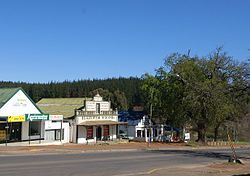
Grabouw (/xrʌˈboʊ/ khrub-OH,[2] Afrikaans: [χraˈbœu]) is a town located in the Western Cape province of South Africa. Grabouw is located some 65 km south-east of Cape Town, over Sir Lowry's Pass from Somerset West, along the N2 highway. The town is the commercial centre for the vast Elgin Valley, the largest single export fruit-producing area in Southern Africa, which extends between the Hottentots-Holland, Kogelberg, Groenland, and Houwhoek Mountains.[3] The town's population has grown rapidly, with 44,593 people in 2019 from 21,593 as listed by the 2001 census.
Key Information


History
[edit]Pre-colonial history
[edit]The original inhabitants of the area were the Khoikhoi pastoralists and the San hunter gatherers. The indigenous people of the region, the Chainouqua Khoi, inhabited a large area on both sides of the Hottentots Holland Mountains. They traded with early European settlers, but were later dispossessed from their lands by the Dutch colonists, who began to move into the area in the late 1600s and took the Chainouqua land for farming.[4][5][6] Fortunately, the Khoikhoi names for some of the region's specific land-forms are recorded, and include Houtema, which is thought to have been the name for the Palmiet River, and Gantouw which was the name for Sir Lowry's Pass.[7]

Early colonial era
[edit]The original Chairouqua name for the region where Grabouw is located is unfortunately not known. However a wide range of different names sprung up in colonial times. The town's location was first a stopping point for wagons on the route eastwards from Cape Town, along the route which the N2 highway now follows. The area was known at the time as "Koffiekraal". Another colonial name for the area was "Groenland" ("Greenland" in Dutch) - a name given by early European settlers to various parts of the region, but which now applies only to the mountainous area to the north. The town itself was created on the farm "Grietjiesgat", bought in 1856 by Wilhelm Langschmidt, a painter from Cape Town, who started the community around his wife's little trading store. Langschmidt named the village after the German town Grabow where he was born. It was initially spelt as "Grabau".[8][9]


Agricultural revolution
[edit]In the early 1900s, the village and surrounding area underwent an agricultural revolution, that had a profound effect on the Grabouw's development. This was the beginning of deciduous fruit farming, which became the town's main economic activity and correlated with a large growth in the town's population.
The local suffragist farmer Antonie Viljoen is recorded as the first purchaser of apple trees in the area. However it was in fact his farm workers who first successfully farmed them, on their own plots, and through their own private initiative. In 1903 the Italian South African Molteno family also began to farm in the area - including two brothers who - together with Viljoen's "Oak Valley" farms - helped to build the town's deciduous fruit industry. Another influential pioneer for this period in Grabouw's history was a local woman farmer - Kathleen Murray. She was extremely active also in Grabouw community development (and later became an enthusiastic member of the Black Sash movement). These enterprises turned Grabouw into the hub of Southern Africa's largest single export fruit-producing area. Other influential pioneers were the Beukes family and the Franco-Italian immigrant Edmond Lombardi, who created an apple-juice drink he called "Appletiser", on his nearby farm Applethwaite, and introduced it to the market in 1966.[10]
Fueled by the agricultural development of the surrounding region, the town became an economic hub, and gained its first local council in 1923. Full municipal status was granted in 1956.[11][12][13][14][15]
Modern developments
[edit]By the end of the 20th century, a significant shift began in Grabouw's economic focus, with a move towards viticulture and tourism. A large and thriving wine industry has developed across the valley, and wines from the region have won several international awards.
The Elgin valley is South Africa's coolest climate wine-growing region and a range of other geographic factors (for example, its proximity to the Atlantic Ocean, cool temperatures, plentiful winter rainfall, prevailing wind directions, and altitude) have created a set of conditions for wine growing which are markedly different to those in surrounding areas. Of the many varietals grown in the region, special attention has been paid to Sauvignon Blanc and Pinot Noir.[16][17][18][19][20]
Grabouw and its surrounding valley is historically significant for South Africa's wine history also because, of all the country's regions, it had one of the earliest movements towards Black ownership of vineyards and wineries. The Elgin winery Thandi was in fact the country's second post-Apartheid winery with significant black involvement (after New Beginnings in Paarl).[21]
Economy
[edit]The town's economy is based on servicing the surrounding agricultural industry, with the Elgin Valley being intensively used for viticulture and the cultivation of apples, pears, plums and other deciduous fruit.
This agricultural region produces 65% of South Africa's apple exports.[22] One of the biggest factories in Grabouw is Appletiser which provides the popular Appletiser soft drinks. Altogether, this has earned it the reputation worldwide as the "valley of apples".
The wine industry is an increasingly important component of the town's economy. The surrounding agricultural region has undergone a move from deciduous fruit farming to viticulture, and this has had an effect on Grabouw, as the region's population hub.
Tourism is also of importance to the economy. The N2 highway through the valley is extremely busy during the holiday season.
Education
[edit]The town has a number of schools:
Attractions
[edit]

Situated by the Palmiet river in the fertile Elgin valley, Grabouw is surrounded by the Hottentots Holland and Groenland mountains to the north, and the Kogelberg Biosphere Reserve to the south. Several routes for exploring the surrounding mountains begin from the town.
There is wine and cider tasting on the surrounding farms. A brandy tasting and cellar tour is also available from Oude Molen Distillery which is just outside the town. There is also the annual Elgin Festival, which takes place on the last week-end in October and boasts a wide range of flower displays, fruit, wines and a great variety of local products.
Within the town, the Elgin Apple Museum is one of the oldest remaining buildings in Grabouw. It is situated on the banks of the Palmiet River. The Museum depicts the history of the fruit industry in the region. The nearby Grabouw Country Club has scenic views overlooking the Eikenhof dam and pine-covered mountains. Applethwaite Farm and Church, was built in the early 1960s by Edmond Lombardi, the founder of Appletiser.[23]
The church was built for the use of the farming community and is interesting because of the Italian marbles and wood carvings of the Stations of the Cross.
List of Suburbs
[edit]Notable people
[edit]- Wilhelm Langschmidt (1805-1866) - A German-born South African painter and drawing master of 59 Long Street, Cape Town.
- Antonio Viljoen (1858-1918) - An influential liberal Afrikaner politician and progressive farmer of the Cape Colony, South Africa.
- Kathleen Murray - Political activist, member of Black Sash movement.
- Louis Kreiner - former Mayor of Cape Town
- Sol Kreiner - former Mayor of Cape Town and brother of Louis.
- Edmond Lombardi - Entrepreneur who created "Appletiser" apple-juice drink.
- René Santhagens - The distillery pioneer born in Batavia in 1864.
- Edward Molteno (1877-1950) and Harry Molteno (1880-1969) - Sons of Cape Prime Minister, John Molteno. Pioneering and successful fruit exporters.
- Adrian Kuiper (1959-) - Former South African international cricketer and a farmer.
- Mzwandile Makwayiba - South African trade unionist
- Karin Kortje - Gospel, R&B and Pop singer. Third season winner of South African Idols.
- Ronelda Kamfer - Afrikaans-speaking South African poet.
- Luyanda Qolo - Former athlete that represented South Africa in 2011 IAAF World Cross Country Championships - Junior men's race in Spain.
- Mojowise - A rapper, song writer and actor, two times Media and Arts Music Awards nominee.
- Aphiwe Dyantyi - South African professional rugby union player.
Climate
[edit]The town experiences a very mild Mediterranean climate, more moderate than most other Western Cape locales, with abundant rainfall, mostly in the winter months, although strong summer south-easterly winds can sometimes bring squalls. This wind is known as the "Black South-Easter" for its gusting winds and showers.
References
[edit]- ^ a b c d "Main Place Grabouw". Census 2011.
- ^ Service delivery | Grabouw residents fed up - YouTube. 23 March 2022. Event occurs at 0:07. Retrieved 30 September 2024.
- ^ Grabouw & Elgin: Overberg Municipality Website
- ^ E. Boonzaier: The Cape Herders: A History of the Khoikhoi of Southern Africa New Africa Books, 1996. p.78. ISBN 978-0-864863119
- ^ G. Theal: History of the Boers in South Africa; Or, the Wanderings and Wars of the Emigrant Farmers from Their Leaving the Cape Colony to the Acknowledgment of Their Independence by Great Britain. Greenwood Press. 1970. ISBN 0-8371-1661-9.
- ^ D. Horner, Prof. F. Wilson: A Tapestry of People: The Growth of Population in the Province of the Western Cape. A Southern Africa Labour and Development Research Unit Working Paper Number 21. Cape Town: SALDRU, University of Cape Town. 2008. ISBN 978-0-9814123-2-0
- ^ C.Stuart: Sasol Roadside Guide: Cape Town - Port Elizabeth : Discovering Nature Along the, Issue 2 Struik, 2005, p.98. ISBN 1868728617
- ^ R. Beck, P. van der Merwe: The Migrant Farmer in the History of the Cape Colony. Ohio University Press. 1995. ISBN 0-8214-1090-3.
- ^ G. de Beer, A. Paterson, H. Olivier: 160 Years of Export. PPECB. Plattekloof, South Africa. 2003. ISBN 0-620-30967-9
- ^ D. Jansen, K. Leresche: Exploring the Cape Winelands. CTP. Penstock Publishing, South Africa. 2015. ISBN 1928283071. Route 9: The Elgin Wine Region pp.142-153.
- ^ S. Stander: Tree of Life. The Story of Cape Fruit. S&W Ltd. Cape Town. 1983.
- ^ M.Coburn: The Overberg: Inland from the Tip of Africa. Struik, 2005. p.18.
- ^ History of Grabouw
- ^ Appletiser USA website Archived 2009-01-07 at the Wayback Machine
- ^ "Oak Valley". Archived from the original on 2016-12-17. Retrieved 2016-12-22.
- ^ Elgin Valley Wines Archived 2010-07-18 at the Wayback Machine
- ^ Elgin - Wine Searcher
- ^ "Winds of change for SA's fruit industry".
- ^ Elgin Wine Route - South Africa Directory Site
- ^ Wines of Elgin
- ^ A. Domine (ed.): Wine. pg 752-769, Ullmann Publishing, 2008. ISBN 978-3-8331-4611-4.
- ^ "Grabouw". Retrieved 2008-06-10.[permanent dead link]
- ^ "Elgin Apple Museum". Archived from the original on 2013-04-06. Retrieved 2016-12-22.

External links
[edit]Municipalities and communities of Overberg District Municipality, Western Cape | ||
|---|---|---|
District seat: Bredasdorp | ||
| Cape Agulhas | .svg) | |
| Overstrand | ||
| Swellendam | ||
| Theewaterskloof | ||
| International | |
|---|---|
| National | |
| Other | |

Grabouw
View on GrokipediaGeography
Location and topography
Grabouw is situated in the Western Cape province of South Africa, within the Theewaterskloof Local Municipality of the Overberg District Municipality.[5] The town lies approximately 65 kilometers southeast of Cape Town, accessible via the N2 highway over Sir Lowry's Pass.[6] Its geographic coordinates are 34°09′00″S 19°01′00″E.[7] The elevation of Grabouw averages around 332 meters above sea level.[8] The town occupies a position in the Elgin Valley, a broad upland basin known for its fertile soils and moderated climate conducive to horticulture.[9] Topographically, Grabouw is nestled between the Hottentots Holland Mountains to the west and the Groenlandberg Mountains to the east, with the Kogelberg range further influencing the regional landscape.[10] The terrain features undulating hills, moderate plains, and steeper slopes ascending to adjacent peaks, part of the Cape Fold Belt formation.[11] The Palmiet River traverses the valley, shaping local hydrology and supporting alluvial deposits in the lower areas.[9]Climate and environment
Grabouw experiences a warm-summer Mediterranean climate classified as Köppen Csb, characterized by mild, wet winters and warm, dry summers.[12] Average annual temperatures range from lows of about 6°C in winter to highs of 26°C in summer, with extremes rarely falling below 1°C or exceeding 30°C.[13] Precipitation totals approximately 738 mm annually, concentrated in the winter months from May to August, supporting the region's deciduous fruit orchards while minimizing summer drought stress.[14] The local environment features the critically endangered Elgin Shale Fynbos and least-threatened Kogelberg Sandstone Fynbos ecosystems, part of the Cape Floral Region, which harbor unique biodiversity adapted to the area's nutrient-poor soils and fire-prone conditions.[4] Intensive apple and fruit farming in the Elgin Valley has led to environmental pressures, including pesticide residues like endosulfan detected in surface and groundwater, posing risks to aquatic life and downstream irrigation quality.[15] Urban wastewater return flows from nearby areas contribute to nutrient pollution in rivers such as the Palmiet, threatening export crop standards and necessitating treatment improvements.[16] Wildfires, exacerbated by dry summers and informal settlement expansion, have periodically devastated vegetation and structures, as seen in the 2022 Knoflokskraal fire that destroyed homes in the Elgin-Grabouw area.[17] Restoration initiatives, including fynbos rehabilitation, aim to mitigate habitat loss amid agricultural intensification.[18]History
Indigenous and pre-colonial period
The Grabouw region, encompassing the Elgin Valley in South Africa's Western Cape, was primarily occupied by Khoikhoi pastoralists during the pre-colonial period. These indigenous groups, part of the broader Khoisan peoples, had migrated southward into the Cape Peninsula and adjacent areas around 2,000 years ago, establishing seasonal grazing patterns in the fertile lowlands and river valleys suitable for their cattle and sheep herds. The Khoikhoi economy centered on transhumant pastoralism, moving livestock between coastal and inland pastures to exploit the Mediterranean climate's wet winters and dry summers, while supplementing with hunting and plant gathering in the fynbos-dominated landscape.[19][20] San hunter-gatherer bands coexisted alongside the Khoikhoi, inhabiting the more arid mountainous zones such as the Hottentots Holland ranges surrounding Grabouw. The San relied on foraging wild plants, trapping small game, and hunting larger animals with poison-tipped arrows, maintaining a mobile lifestyle that left evidence in rock art depictions of eland hunts and trance dances found in nearby shelters. Interactions between Khoikhoi and San involved both exchange—such as San providing tracking expertise for hunts—and occasional conflict over resources, though symbiotic relations predominated in the low-density populations of the region. Archaeological evidence indicates human presence in the Overberg for at least 10,000 years, with Khoikhoi pastoralism representing a later adaptation around the turn of the Common Era.[21][22] No large permanent settlements existed, as both groups' lifestyles emphasized mobility to avoid overgrazing and ensure water access, with temporary kraals of woven reed huts serving as bases during grazing seasons. The absence of intensive agriculture reflected the nutrient-poor soils and seasonal rainfall, limiting population densities to a few hundred per clan in the broader Overberg. European explorer accounts from the mid-17th century, upon crossing Sir Lowry's Pass, first documented these groups' presence, noting their use of the Palmiet River and similar waterways for watering stock—features that defined the area's pre-colonial ecological niche.[23]Colonial establishment and early farming
During the early colonial period under British rule in the Cape Colony, the Grabouw area functioned primarily as a transit point for ox-wagons en route eastward from Cape Town, facilitating trade and travel across the Hottentots Holland Mountains. An early infrastructure development included the construction of the Oude Brug over the Palmiet River in 1811, followed by a replacement bridge upstream in 1852. A post office opened at Palmiet River on 1 January 1846, marking initial administrative establishment in the vicinity, though the postmaster position remained vacant until 1857.[24] The formal founding of Grabouw occurred in 1856 when Wilhelm Langschmidt, a German immigrant and former painter who had returned to mercantile pursuits, acquired the farm Grietjiesgat (also referred to as Palmiet farm). Langschmidt established a trading store on the property, which served as the core around which the village developed, and named the settlement Grabow after his birthplace in Mecklenburg, Germany—a name later adapted to Grabouw. This trading outpost supported emerging settler communities drawn to the fertile Elgin Valley for agricultural opportunities.[24][25] Early farming in the region involved mixed agriculture leveraging the valley's temperate climate and rich soils, initially focused on subsistence crops and livestock to sustain local settlers and traders. Deciduous fruit production, particularly apples and pears, emerged as a cornerstone by the late 19th century, with pioneering plantings attributed to early landowners; for instance, the Molteno family contributed to initial orchard development along the Palmiet River. Commercial scale intensified around 1898 when Sir Antonie Viljoen purchased Oak Valley estate, introducing systematic vine propagation alongside fruit trees and black wattle for charcoal production, laying groundwork for the area's export-oriented horticulture.[25][26]Industrial agricultural growth
The extension of the railway line to Elgin on 1 August 1902 marked a pivotal advancement for agricultural commercialization in the Grabouw area, enabling efficient transport of perishable fruit to Cape Town and export ports. This infrastructure development shifted farming from subsistence and local sales to large-scale production oriented toward international markets, particularly for deciduous fruits such as apples and pears suited to the valley's cool climate.[27] In the early 1900s, the Molteno brothers—Edward (1877–1950) and Harry (1880–1969)—emerged as key architects of this growth, acquiring extensive lands in the Elgin Valley and establishing orchards that pioneered systematic fruit cultivation and export operations. Their initiatives expanded the region's output, positioning Elgin as the world's largest single fruit exporter by leveraging family capital and expertise from their Cape political lineage. Concurrently, Sir Antonie Viljoen advanced commercial deciduous fruit farming at Oak Valley Estate, founded in 1898, including early vine propagation by 1908, which diversified production and supported infrastructural investments like irrigation from local rivers.[25][28] By the 1930s, varietal innovations such as the introduction of Golden Delicious apples in 1930 by the Molteno brothers further industrialized operations, enhancing yield quality and market competitiveness amid growing global demand. This era's emphasis on export infrastructure, including packhouses and river-based irrigation systems, solidified Grabouw's role as Southern Africa's premier fruit-producing hub, with Elgin contributing substantially to national deciduous fruit volumes.[29][25]Apartheid-era developments and labor dynamics
During the apartheid era (1948–1994), Grabouw's agricultural sector, centered on deciduous fruit production in the Elgin Valley, experienced significant expansion driven by state policies favoring white-owned commercial farming. Government subsidies, irrigation developments such as those along the Palmiet River, and infrastructure investments enabled the scaling of apple and pear orchards, with export volumes rising as international markets for South African fruit grew in the 1960s and 1970s. By the 1980s, Grabouw had emerged as a key packing and cold-storage hub, supporting the industry's shift toward high-value exports, though this growth relied heavily on subsidized inputs and protected markets under apartheid economic strategies.[16] Labor dynamics in Grabouw's farms reflected apartheid's racial hierarchy and influx control laws, which classified workers by race and restricted black Africans' permanent urban or farm residence. Permanent farm laborers were predominantly Coloured individuals, permitted to live on farms under paternalistic arrangements but denied land ownership or independent bargaining power; black African workers, drawn seasonally from rural homelands like the Eastern Cape and Transkei, comprised up to 30–40% of the harvest workforce in peak periods, housed in single-sex migrant hostels to enforce family separation and labor discipline. These hostels, often rudimentary and overcrowded, perpetuated the migrant labor system inherited from earlier colonial practices, with workers contracted for 3–6 months under the Native Labour Regulation Act amendments, facing pass law enforcement that criminalized overstaying.[30][31] Wages remained suppressed, with farm workers earning approximately R50–R100 per month in the 1980s (adjusted for inflation, far below urban minima), excluding non-monetary rations that tied families to farm dependency; absenteeism controls and evictions for union activity were common, as farms fell outside industrial conciliation machinery until partial reforms in the late 1980s. Strikes erupted sporadically, such as localized actions in the Western Cape fruit belt during the 1970s and 1980s, but repression under security laws limited organization, with Coloured workers facing intra-community divisions fostered by apartheid's preferential treatment over black Africans. This system ensured cheap, docile labor for white farmers, contributing to productivity gains—such as yields increasing from 20–30 tons per hectare in apples by the 1990s—but at the cost of systemic exploitation and social dislocation.[32][33]Post-1994 transitions and service challenges
Following the end of apartheid in 1994, Grabouw's local governance transitioned through the establishment of transitional local councils, with the Grabouw Transitional Local Council replacing prior structures by October 1994 to integrate previously segregated administrative areas.[34] This culminated in the formation of the Theewaterskloof Local Municipality on December 5, 2000, which amalgamated Grabouw with surrounding towns like Caledon and Villiersdorp under a unitary democratic framework aimed at equitable service provision and developmental priorities.[34] The restructuring emphasized extending basic services to underserved township areas, such as Pineview and Knoflokskraal, while addressing land reform in the Elgin Valley's apple orchards, though redistribution efforts yielded limited success, with many projects failing to sustain commercial viability due to inadequate post-transfer support and skills gaps.[16] [35] Service delivery challenges intensified despite policy commitments like free basic water and cost-recovery models introduced in the early 2000s, as municipal financial losses mounted from unpaid household debts and aging infrastructure.[36] Recurrent protests highlighted failures, including a 2014 riot driven by unmet demands for housing, sanitation, and roads, exacerbated by alleged political interference and corruption; similar unrest in 2016 involved arson at municipal buildings over service neglect.[37] [38] [39] More recently, in January 2025, Knoflokskraal residents blockaded the N2 highway with burning tires to demand water and sanitation upgrades, underscoring persistent gaps in informal settlements.[40] These incidents reflect broader issues of nepotism, weak oversight, and cadre deployment prioritizing loyalty over competence, leading to operational breakdowns rather than apartheid-era backlogs alone.[41] Water supply remains critically strained, with vandalism and cable theft at pump stations disrupting flows as recently as August 2025, while bulk upgrades like the Grabouw rising main pipeline—intended to address capacity shortfalls—face delays amid funding shortfalls.[42] [43] Sewage treatment works in Grabouw and downstream facilities consistently fail, discharging untreated effluent into rivers and contributing to pollution hotspots, as evidenced by elevated E. coli levels and ammonia in monitoring data.[44] [16] Garbage management falters with overflowing landfills and illegal dumping, while electricity disruptions compound vulnerabilities, particularly after storm damage in 2023 that overwhelmed repair capacities.[44] [45] Political instability, including four municipal managers since 2021 and R300 million in irregular expenditure for 2023/24, has perpetuated these deficits, with investigations into missing flood relief funds highlighting governance erosion.[44] Efforts like intergovernmental pollution interventions in Grabouw persist, but systemic mismanagement—rooted in accountability lapses post-democratization—continues to undermine delivery.[46]Demographics
Population trends and statistics
According to the 2001 South African census, Grabouw's population stood at 21,582 residents.[47] By the 2011 census, this had increased to 32,897, reflecting an annual growth rate of approximately 3.8% over the decade, driven primarily by in-migration for seasonal agricultural labor in the surrounding Elgin Valley orchards and farms.[48] [47] Municipal mid-year population estimates (MYPE) for 2018 recorded 38,703 inhabitants, with growth slowing to 2.4% per annum from 2011 amid ongoing rural-urban pull factors and limited formal housing expansion.[48] The 2022 census, aggregating data from wards 8 through 14 in Theewaterskloof Local Municipality that encompass Grabouw, reported 50,148 residents, maintaining the 2.4% annual growth trajectory from 2011 at the municipal level.[49] This equates to a population density of over 6,800 persons per km² in the core urban area, given Grabouw's compact footprint of roughly 7 km².[47] [48] The following table summarizes key population milestones:| Year | Population | Annual Growth Rate (prior period) | Source |
|---|---|---|---|
| 2001 | 21,582 | - | Census 2001[47] |
| 2011 | 32,897 | 3.8% (2001–2011) | Census 2011[48] |
| 2018 | 38,703 | 2.4% (2011–2018) | MYPE[48] |
| 2022 | 50,148 | 2.4% (2011–2022) | Census 2022[49] |