


Community hub
Recent from talks
Contribute something
Nothing was collected or created yet.
HD 197027
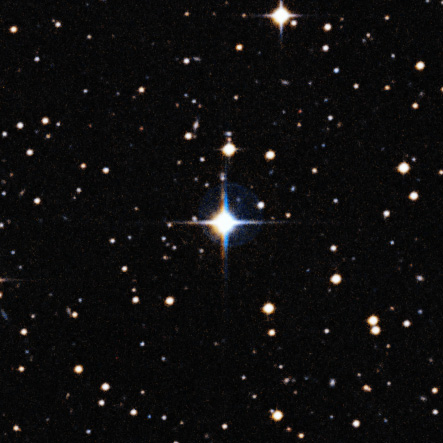
View on Wikipedia HIP 102152 Credit: ESO/Digitized Sky Survey 2 | |
| Observation data Epoch J2000.0 Equinox J2000.0 (ICRS) | |
|---|---|
| Constellation | Capricornus[1] |
| Right ascension | 20h 41m 54.6336s[2] |
| Declination | −27° 12′ 57.415″[2] |
| Apparent magnitude (V) | 9.15±0.02[3] |
| Characteristics | |
| Evolutionary stage | main sequence[2] |
| Spectral type | G3 V[4] |
| U−B color index | +0.30[5] |
| B−V color index | +0.65[3] |
| Astrometry | |
| Radial velocity (Rv) | −43.9±0.3[6] km/s |
| Proper motion (μ) | RA: +175.628[2] mas/yr Dec.: −15.593[2] mas/yr |
| Parallax (π) | 12.7715±0.0164 mas[2] |
| Distance | 255.4 ± 0.3 ly (78.3 ± 0.1 pc) |
| Absolute magnitude (MV) | 4.74[1] |
| Details | |
| Mass | 0.97[7] M☉ |
| Radius | 1.08+0.07 −0.05[8] R☉ |
| Luminosity | 1.19[1] L☉ |
| Surface gravity (log g) | 4.40±0.02[9] cgs |
| Temperature | 5718±5[9] K |
| Metallicity [Fe/H] | −0.020±0.005[9] dex |
| Rotational velocity (v sin i) | 1.78±0.12[9] km/s |
| Age | 6.92±0.69[9] Gyr |
| Other designations | |
| CD−27°14976, CPD−27°7079, HD 197027, HIP 102152, SAO 189585[10] | |
| Database references | |
| SIMBAD | data |
.jpg)
HD 197027 (HIP 102152) is a star in the constellation Capricornus. It has an apparent magnitude of 9.15,[3] making it readily visible through a telescope but not to the naked eye. The object is located at a distance of 255 light years but is approaching the Solar System with a heliocentric radial velocity of −44 km/s.[6]
HD 197027 has a stellar classification of G3 V, indicating that it is an ordinary G-type main-sequence star like the Sun. It has only 97% the mass of the Sun[7] but 108% of its radius.[8] It shines at 119% the luminosity of the Sun[1] from its photosphere at an effective temperature of 5,718 K,[9] similar to the Sun's 5,778 K. HD 197027's metallicity – elements heavier than helium – is similar to the Sun.[9] At an older age of 6.92 billion years, it spins with a projected rotational velocity of about 2 km/s.[9]
Since its measured properties of this star are very similar to those of the Sun, it has been considered a candidate older solar twin.[11] The abundances of 21 elements overall are more similar to the Sun than any other known solar twin. [citation needed] Its Iron Abundance is −0.03 with an error value of 0.02 Fe/H. (The value comes from the Hipparcos Extended Catalog.)[12]
References
[edit]- ^ a b c d Anderson, E.; Francis, Ch. (2012). "XHIP: An extended hipparcos compilation". Astronomy Letters. 38 (5): 331. arXiv:1108.4971. Bibcode:2012AstL...38..331A. doi:10.1134/S1063773712050015. XHIP record for this object at VizieR.
- ^ a b c d e f Vallenari, A.; et al. (Gaia collaboration) (2023). "Gaia Data Release 3. Summary of the content and survey properties". Astronomy and Astrophysics. 674: A1. arXiv:2208.00211. Bibcode:2023A&A...674A...1G. doi:10.1051/0004-6361/202243940. S2CID 244398875. Gaia DR3 record for this source at VizieR.
- ^ a b c Høg, E.; Fabricius, C.; Makarov, V. V.; Urban, S.; Corbin, T.; Wycoff, G.; Bastian, U.; Schwekendiek, P.; Wicenec, A. (March 2000). "The Tycho-2 catalogue of the 2.5 million brightest stars". Astronomy and Astrophysics. 355: L27–L30. Bibcode:2000A&A...355L..27H. ISSN 0004-6361.
- ^ Houk, N. (1982). Michigan Catalogue of Two-dimensional Spectral Types for the HD stars. Volume_3. Declinations -40_ƒ0 to -26_ƒ0. Bibcode:1982mcts.book.....H.
- ^ Paunzen, E. (May 2022). "Catalogue of stars measured in the Geneva seven-colour photometric system". Astronomy & Astrophysics. 661: A89. arXiv:2111.04810. Bibcode:2022A&A...661A..89P. doi:10.1051/0004-6361/202142355. eISSN 1432-0746. ISSN 0004-6361.
- ^ a b Gontcharov, G. A. (November 2006). "Pulkovo Compilation of Radial Velocities for 35 495 Hipparcos stars in a common system". Astronomy Letters. 32 (11): 759–771. arXiv:1606.08053. Bibcode:2006AstL...32..759G. doi:10.1134/S1063773706110065. eISSN 1562-6873. ISSN 1063-7737. S2CID 119231169.
- ^ a b Talawanda R. Monroe; et al. (Aug 2013). "High Precision Abundances of the Old Solar Twin HIP 102152: Insights on Li Depletion from the Oldest Sun". Astrophysical Journal Letters. 774 (2): L32. arXiv:1308.5744. Bibcode:2013ApJ...774L..32M. doi:10.1088/2041-8205/774/2/l32. S2CID 56111132.
- ^ a b Stassun, Keivan G.; et al. (9 September 2019). "The Revised TESS Input Catalog and Candidate Target List". The Astronomical Journal. 158 (4): 138. arXiv:1905.10694. Bibcode:2019AJ....158..138S. doi:10.3847/1538-3881/ab3467. ISSN 0004-6256.
- ^ a b c d e f g h dos Santos, Leonardo A.; et al. (August 2016), "The Solar Twin Planet Search. IV. The Sun as a typical rotator and evidence for a new rotational braking law for Sun-like stars", Astronomy & Astrophysics, 592: 8, arXiv:1606.06214, Bibcode:2016A&A...592A.156D, doi:10.1051/0004-6361/201628558, S2CID 53533614, A156.
- ^ "HD 197027". SIMBAD. Centre de données astronomiques de Strasbourg. Retrieved 2013-09-07.
- ^ "The life cycle of a Sun-like star (annotated)". European Southern Observatory 28 August 2013.
- ^ "HD 197027 Star Distance, Age, Colour and other Facts". Universe Guide. 10 January 2024. Retrieved 2024-01-19.
