


Community hub
Recent from talks
Contribute something
Nothing was collected or created yet.
HP 3000
View on Wikipedia

The HP 3000 series[1] is a family of 16-bit and 32-bit minicomputers from Hewlett-Packard.[2] It was designed to be the first minicomputer with full support for time-sharing in the hardware and the operating system, features that had mostly been limited to mainframes, or retrofitted to existing systems like Digital's PDP-11, on which RSTS/E, IAS, and Unix were implemented. First introduced in 1972, the last models reached end-of-life in 2010, making it among the longest-lived machines of its generation.
The original HP 3000 hardware was withdrawn from the market in 1973 to address performance problems and OS stability. After reintroduction in 1974, it went on to become a reliable and powerful business system, one that regularly won HP business from companies that had been using IBM's mainframes. Hewlett-Packard's initial naming referred to the computer as the System/3000, and then called it the HP 3000.
The HP 3000 originally used a 16-bit CISC stack machine processor architecture, first implemented with Transistor-transistor logic, and later with Silicon on Sapphire chips beginning with the Series 33 in 1979.[3][4] In the early 1980s, HP began development of a new RISC processor, which emerged as the PA-RISC platform. The HP 3000 CPU was reimplemented as an emulator running on PA-RISC and a recompiled version of the MPE operating system. The RISC-based systems were known as the "XL" versions, while the earlier CISC models retroactively became the "Classic" series. The two sold in tandem for a short period, but the XL series largely took over in 1988. Identical machines running HP-UX instead of MPE XL were known as the HP 9000.
HP initially announced the systems would be designated to be at end-of-life at HP in 2006, but extended that several times to 2010. The systems are no longer built or supported by the manufacturer, although independent companies support the systems.
History
[edit]HP 2000
[edit]While looking for a computer system to control ever-more-complex test equipment, HP briefly considered buying Digital Equipment Corporation (DEC). They were ultimately unimpressed with Ken Olsen's demands and did not attempt a deal.[5] They later found a small company, DSI, working for Union Carbide, that had essentially "stretched" DEC's PDP-8 from 12 to 16-bits. HP purchased DSI and merged it into its Dymec division. The DSI design became the basis for the HP 2116A, introduced in 1966, initially marketed as a "test and instrumentation computer".[6]
To their surprise, HP found that the machine was selling well in the business market and other non-lab uses.[7] This led to a series of updated versions with better input/output to handle business workflows while removing some of the expansion capability needed only in the lab setting. The much smaller 2114 was particularly popular in non-lab settings.[8] All of the 211x models were later updated to use semiconductor memory instead of core memory, leading to the 2100 family of 1971.[9]
In 1968, the line was expanded with the HP 2000, a series of machines that were made up of collections of parts from the HP 211x lines, with most systems using a low-end 2114 CPU as a terminal controller and high-end CPU like the 2116 as the main processor. The systems ran HP Time-Shared BASIC and could support between 16 and 32 users simultaneously depending on the model. The machines were an immediate success, quickly becoming one of the best-selling systems in the time-sharing market, and propelling HP to become the third-largest minicomputer vendor.[9]
Alpha and Omega
[edit]As the success of the HP 2000 series became clear, in 1969 the designers in Cupertino Lab decided to begin the development of machines dedicated to the office role, as opposed to the HP 2000, which was made up of various bits and pieces never originally designed for the task. Two basic systems were outlined, the "Alpha" was essentially an HP 2100 built using newer components and improved memory handling, while "Omega" was a much larger 32-bit design that would support large numbers of users.[10]
Initially, the two systems were to be released at about the same time. However, almost all development took place within Omega, and few, if any, engineers were active on Alpha during 1969. In contrast to the 16-bit Alpha, Omega would be a 32-bit computer with up to 4 MB of main memory shared among up to four central processing units (CPUs). The CPUs were designed to be programmed in a high level language, like the successful models from Burroughs that were programmed in a custom systems programming language rather than assembler. Support for multiprogramming and memory protection would be built in.[10]
As development continued, the project appeared to be too large for HP to complete using internal funding. This would require the company to take on external debt, which management considered too risky. In the fall of 1970, Tom Perkins was promoted to Corporate Development and decided to cancel the Omega project. This resulted in several employees wearing black-velvet armbands to mourn the death of the project, and some dismay over being reassigned to "just another 16-bit machine."[10]
By this time, the small amount of development on Alpha had changed the nature of the project significantly. Originally conceived as an updated HP 2100, it had become essentially a small Omega, adopting its virtual memory and stack machine design that supported high level languages, but limited to a 16-bit design with a maximum of 64 kWord main memory (128 kB), only a single accumulator, and lacking Omega's powerful input/output systems.[10]
When the plan to continue the development of Alpha was presented, George Newman, who replaced Perkins as the General Manager of the computer division, was concerned that the team was once again designing a machine that could not be delivered. Management was eventually convinced of the merits of the design, and the External Reference Specifications were published in July 1970.[10]
MPE
[edit]Prior minicomputers were generally used in a fashion similar to modern microcomputers, used by a single user, and often dedicated to a single particular task like operating machinery. This was true for many contemporary designs like the PDP-8 and Data General Nova. It was the HP 2000's ability to perform timesharing that made it a success in a market filled with otherwise similar machines. The ability to support multiple users running different programs was previously limited to mainframe computers, and a further expansion of this capability was a key design concept for the original Omega.[11]
When Alpha emerged as an Omega-like design, it initially followed the same model of multi-user support, which was in turn based on the HP 2000 concept. In this model, the main CPU does not handle user interaction, which is the task of the front-end processor. This allows the main operating system to be greatly simplified, simply loading up user programs as they appear from the front-end, running them in a round-robin fashion with other users' programs, and then delivering the results. In most respects this was a batch processing system, with much of the complexity of multi-user support being isolated in the separate front-end processor.[11]
As development re-started on Alpha, this concept was re-examined and the decision was made to expand the operating system to support multiprogramming directly. This resulted in the system becoming three-in-one, with the main portion being dedicated to timesharing but also offering real-time support and batch mode. The resulting system, ultimately known as Multi-Programming Executive (MPE), would be among the most advanced of its era.[11] When the ten groups within the operating system team came together to describe their section of the system, they found that it was too large to fit in memory, let alone have room for user programs. To make it fit, the programmers began a marathon effort to shrink the system requirements.[12]
Announcement and initial marketing
[edit]The system was announced at the Fall Joint Computer Conference in November 1971.[a] By early 1972, the system was up and running with three prototype machines completed. However, MPE development was by this time far behind schedule. This led to a February 1972 memo outlining the development schedule with various features being delivered over time.[13] Ultimately the realtime support was dropped, and none of the dates on the memo were met.[14]
Meanwhile, a turf war had broken out between the engineering lab and the marketing department, who were actively trying to sell the system. It got to the point where "People from marketing were banned from the lab."[15] Engineers continued to provide performance estimates to marketing, which would pass these along to customers, even though the engineers were aware they were inaccurate.[15]
Increasing concern among upper management led to the May 1972 formation of the Systems Management Group, who would work within the engineering labs as an internal marketing team and drive the development according to customer needs. Among the changes implemented, Jim Peachy was hired to do performance testing on the system. Peachy had previously worked on the first timesharing systems at Dartmouth College, and had since worked at General Electric and Memorex. After only three days he pronounced that there was "absolutely no way" the machine would meet the performance requirements being quoted by sales.[16]
First deliveries, recall
[edit]As a result of the MPE delays, the ship date was pushed back from August to November 1972, and MPE was reduced solely to timesharing support, with additional features slated to arrive through 1973.[16]
The November date was held firm, and eventually, someone put up posters claiming "November is a happening", referring to the contemporary "happening" movement in performance art.[16] The first machine was shipped to the Lawrence Hall of Science in Berkeley on November 1, although as one engineer, Frank Hublou, noted, "they should have put it on the truck, drove it around the block, and brought the machine back."[16]
After setup, it was found the machine would only support one or two users before slowing to a crawl, and it crashed every 10 to 20 minutes. Hublou's statement came true when the machine was "immediately returned."[17] In a training session that December, a new version of MPE was able to run four users and crashed only once every two hours. The system was continually patched to keep it running as new bugs were found.[17] Machines continued to be shipped, both to customers as well as companies that were considering purchases. These invariably ended poorly, unable to support more than four users. The schedule for MPE features continued to be pushed back,[17] and the estimated number of machine sales continued to be reduced.[18]
By this time, the development of an HP 2000 replacement had been underway for 5 years and had cost the company $20 million. The problems were not going unnoticed and ultimately ended up with Bill Hewlett. Hewlett asked Barney Oliver to take over the division, but he refused, and Paul Ely was sent instead in his place. Ely quickly ended production of the machines and, in a move still mentioned in historical works to this day, recalled all of the machines that had been shipped out. Dave Packard sent a memo to everyone on the team, today known simply as the "Wow Ouch memo".[18]
Ed McCracken went back to the customers and told them point-blank that the machines would not be available until the fall of 1973, and that the machines would only support four to six users. Some accepted the offer of an HP 2000 in place of their orders, while others broke down and cried.[18] One customer threatened to sue the company, but were put off by the personal intervention of Hewlett who stated he would do everything in his power to fix the problems.[19]
Re-release
[edit]The system then entered a six-month period of redevelopment of both MPE and the hardware. MPE emerged as MPE-8, officially ending real-time support. The hardware improved to run about 30% faster than the original model and was priced 20% less. As a result of these changes, the new system was able to run eight users.[b] Shipping re-started in November, a year after the original date.[19]
After another year, an updated version shipped. This new "CX" model replaced core memory with semiconductor memory and replaced the wire wrapped CPU boards with surface mounted components. MPE-C added COBOL and RPG languages, perhaps the first mini to offer the former. As part of the CX release, HP shipped IMAGE, a $10,000 database system written to the CODASYL standards. This was later bundled with the systems for free. IMAGE is the primary reason the HP 3000 eventually became a success.[20]
Overview
[edit]Early 3000 models had large cabinets with front panels, while later models were made that fit into desks using only terminal consoles for diagnostics, with bootstrap routines in ROM. By 1984 HP introduced the HP3000 Series 37, the first model that ran in offices without special cooling or flooring requirements.[21] Models ranged from a system sometimes used by a single user, to models that supported over 2,000 users.
The HP 3000 was one of the last proprietary minicomputer systems whose manufacture was curtailed by its vendor, outlasting the PDP-11-descended Digital Equipment Corporation VAX, which was acquired by Compaq and then ultimately by Hewlett-Packard. After almost 30 years, a five-year phase-out period for the now-named HP e3000 series servers was originally announced in November 2001. HP then extended this phase-out period twice.[22] No more new e3000s are being sold by HP, although used systems continue to be sold for upgrades on a third-party reseller market. Support from HP to customers for the HP 3000 continued through December 31, 2010. Many third party firms continue to support the system for customers throughout the world. Some customers continue to use the HP 3000 in companies worldwide, especially in manufacturing and e-commerce industries,[23] while others have migrated to business server systems made by HP and others.[24]
For those unable or unwilling to migrate, a homesteading strategy emerged immediately after HP's announcement of the end of system sales.[25] In 2012, the Stromasys company released a product doing full HP3000 hardware emulation on x86-64 servers running Red Hat Linux or CentOS.[26] That product operates as a virtualized instance of the HP 3000 server hardware. Starting in 2003, HP began a plan to sell a license for the 3000's operating system,[27] which can let 3000 customers run their software on this Stromasys product, known as the HPA/3000.
Software pioneering
[edit]The key development that led to the tremendous success of the HP 3000 was the bundling of the HP-developed network database management system (DBMS) called IMAGE (now called TurboIMAGE/SQL) that was reputedly inspired by the TOTAL DBMS developed by Cincom Systems, Inc. IMAGE was an award-winning database anointed by Datamation within two years of the database's introduction.[28] It was the first database management system included with a business-class minicomputer. By bundling IMAGE with the server, HP created an ecosystem of applications and development utilities that could rely upon IMAGE as a data repository in any HP 3000.
Classic memory segments and 64K barrier
[edit]Code (reentrant) and data reside in separate variable-length segments, which are 32,768 "halfwords" (16-bit words) (or, 65,536 bytes). The operating system, known as MPE (for Multi-Programming Executive), loads code segments from program files and segmented Library (SL) files as needed, up to 256 segments in one process.
There could be as much as 64KB of memory in a code segment, but calling a routine was based on segment number and routine number within a segment, so a program could theoretically have about 32,385 routines. With 8 bits to specify segment, and 16 bits within a segment a program could have effectively have a 24 bit address or 16MB. This was compared to most 16 bit computers like the PDP-11 or IBM System/34 that had 64KB of address space for code and data. The bigger limitation was the data segment and stack segment, which were also 64KB. Shared library routines did not permit cross-process global data since each process had its own data segment. Some procedures worked around this by requiring the caller to pass in an array from their own stack or data segment to hold all state information, similar to modern object-oriented languages where methods are applied to objects passed and allocated by the caller.
A process could allocate and use multiple extra data segments (XDS) of up to 64KB each. While the Classic architecture imposed a limit of 65,535 extra data segments system-wide, other limitations would usually restrict that to a somewhat smaller limit.
Systems programming was done in SPL (System Programming Language), an ALGOL-like language, but allowing inline assembler, and other direct access to the instruction set. The standard terminals for the HP 3000 were the HP 2640 series, which supported block mode data entry from forms (like IBM's mainframe-based CICS), as well as character mode. By the 1980s the computer had gained the ability to use both PCs and Macs as system terminals.
Classic and PA-RISC 3000 hardware
[edit]The HP 3000 family's generations were divided into the "Classic" (16-bit) and then "XL" (later IX – 32-bit) families following the introduction of systems based on HP's PA-RISC chips for 3000s in early 1987. These newer XL systems were not binary compatible with the Classics, but would transparently run Classic code via an emulator, one that HP integrated into the MPE XL operating system. (Classic code could optionally be translated to native PA-RISC code via OCTCOMP, the Object Code Translator/COMPiler ... such code ran at native speed, but was still subject to Classic stack and memory size limitations).
The earlier "Classic" machines were based on a custom CISC processor. From about 1988 onward, HP 3000s using PA-RISC processors began shipping in volume. By 1995 these PA-RISC systems effectively displaced the older family of machines from use. As with all technology shifts, there remained a significant residue of older machines in service. Even today, original Classic 3000s work in production in a few locations.
HP 3000 and many HP 9000 machines used the HP Precision Bus.
The PA-RISC based HP 3000's operating system was written primarily in Modcal, HP's extended version of Pascal. Large portions of the earlier MPE V operating system, written in SPL, are still used as part of MPE XL and MPE/iX on PA-RISC. A few subsystems (e.g., TurboIMAGE) are written in PSPL (Portable SPL). A small portion of MPE XL and MPE/iX is written in PA-RISC assembly language.
The 3000 series operating system was originally styled the Multi-Programming Executive, MPE (later called MPE XL and then, after POSIX compliance was added in versions 5.0-5.5, MPE/iX). The earliest versions of the system used only HP's proprietary SPL systems programming language and BASIC. These System 3000s used a command-line interpreter, with a three-level hierarchical file system, and utilities such as compilers would resemble "run fortran.pub.sys" rather than allowing programs to be run as keyword commands. Later the systems gained a wide range of languages including COBOL and FORTRAN, Pascal, C, and even a version of RPG to assist in winning business away from IBM.
People who used the HP 3000 noticed from the 1970s onward that machines were more reliable compared to other mainframe and minicomputers of the time.[29] The ability to recover from power failures - automatically and seamlessly when power was restored - was a notable feature that sold many systems versus IBM computers.[30] At times the HP 3000 suffered from peripheral support delays or gaps caused by HP's decision to delay supporting, or not support at all, some peripherals on the HP 3000 platform—some of which were supported on the identical HP 9000 hardware.[31]
Use of stack instead of registers
[edit]Most current computer instruction sets are based on a general-purpose register model. The processor and memory architecture of the classic HP 3000 were based on a stack machine model, like HP's well-known line of RPN calculators. It was said[by whom?] to be inspired by the famous stack-based Burroughs Large Systems. Rather than having a small number of registers, for example only an AX and BX register in the case of the HP 1000, operands would be pushed on the same stack used to store local variables and return addresses. So rather than
LOAD AX, 0X0001
LOAD BX, 0X0002
ADD AX, BX
you would have
LDI 1
LDI 2
ADD
The 16-bit microcoded machines (Series I, II, III, 30, 33, 39, 40, 42, 44, 48, 52, 58, 64, 68, 70, 37, ...) implement a 16-bit word addressed, byte-addressable, segmented with separate code and data segments, stack instruction set architecture (ISA). Most of the ~214 instructions are 16 bits wide. Stack operations pack 2 per 16-bit word and the remaining few are 32 bits wide.
CISC implementations
- III: 4 top of stack registers, 175 ns microinstruction cycle time → 5.7 MHz
- 30, 33: silicon on sapphire,[4] 2 top of stack registers, 90 ns microinstruction cycle time → 11 MHz, instructions take 3-7 cycles
- 40, 42, 44, 48: Schottky TTL, 4 top of stack registers, 105 ns microinstruction cycle time → 9.5 MHz
- 64, 68: ECL, 8 top of stack registers, 75 ns microinstruction cycle time → 13 MHz, 8KB cache, 60KB WCS, 2 16-bit ALUs
- 37: ~8,000-gate CMOS gate array, 4 top of stack registers
Later 32-bit models used HP's PA-RISC general register-based RISC architecture.
PA-RISC implementations
- PA-RISC 1.0 Series 925, 930, 935, 949, 950, 955, 960, 980
- PA-RISC 1.1 Series 917, 920, 922, 927, 937, 947, 948, 957, 958, 967, 977sx, 987, 990, 991, 992, 995, 918, 928, 968, 978, 988
- PA-RISC 2.0 Series 996, A and N class and the 9x9 series
HP's exit from the 3000 ecosystem
[edit]After the enterprise computing market shifted toward commodity Unix systems from a wide range of vendors—systems that HP had also been promoting—in November 2001 Hewlett-Packard announced that a period it called the end-of-life for the HP 3000 would wrap up at the end of 2006, and that no new systems would be sold by HP after 2003. In early 2006, Hewlett-Packard announced that limited vendor support for the HP 3000 would be extended by two years for certain clients or geographic regions. In September 2007, HP once more extended its support for the systems, offering Mature Product Support without Sustaining Engineering (ending its creation of software patches). Some patches had been built and tested inside HP, but lacked customer base testing by the end of 2008. HP made these patches available after the end of 2010.[32] By 2011, HP had extended a special provision to 3000 customers that granted them free access to patches,[33] unlike the rest of HP enterprise line, which was forced in 2010 to adopt a "pay for patching" support program instead of free patches.
Independent support
[edit]A group of independent vendors has assumed systems and software support for existing customers who have left the ranks of HP's 3000 support business. Several have pledged to continue support for their own software until customers stop using the server. Others, offering comprehensive support, are citing 2016 and later as their end of support dates.[34] A consultants directory is maintained by Robelle Software,[35] and other independent consultants are available through a listing at the OpenMPE website.[36] Open source software resources, including commodity tools, for the 3000's MPE/iX operating system are maintained in a website by Applied Technologies.[37]
The HP 3000 has enjoyed one of the longest lifetimes for any business computer system. These enterprise-grade computers have outlasted the highly regarded PDP-11 and VAX series, although OpenVMS operating system is still being offered on Alpha, IA-64, and x86-64 based systems.
In January 2012, Stromasys announced the development of Charon/HPA-3000, which enables secure transfer of HP3000 systems to a state-of-the-art environment. Stromasys's solution virtualizes the hardware of an existing HP3000 system, and enables the MPE/iX operating system, third-party applications, and user-developed software to run without any modification whatsoever, on industry-standard Intel servers. Their offering includes a two-user evaluation copy delivered in a VMWare package.[38]
Multiple independent vendors have purchased HP3000's Operating System Source Code,[39] MPE/iX and are committed to supporting both hardware and software solutions for HP3000 systems.
Beechglen Development, Inc. began hosting HP3000 systems in 2002. In 2012 Beechglen introduced HP3000 compatible custom fibre channel disc arrays using current technology SSD and SATA hard drives, effectively replacing SCSI tape and SCSI disc devices. As of January 2020, Beechglen is the only vendor that has developed and offers 2028 MPE CALENDAR intrinsic patches for the MPE/iX Operating system allowing intrinsic dates beyond December 31, 2027. They continue evaluating and testing third-party applications for compatibility.[40]
Relative performance of HP 3000 systems
[edit]| HP 3000 System | Relative Performance |
|---|---|
| Series 30, 33 | 0.5 |
| Series III | 0.6 |
| Series 37, 37XE | 0.6 |
| Micro 3000 RX | 1.3 |
| Micro 3000 GX, LX, RX | 1.3 |
| Series 39, 40, 44 | 1.0 |
| Series 42, 48 | 1.3 |
| Series 42XP, 52, 58 | 1.7 |
| Series 64 | 3.2 |
| Series 68 | 4.0 |
| Series 70 | 4.4 |
| Series 920 | 1.9 |
| Series 922 | 3.2 |
| Series 932 | 5.0 |
| Series 948 | 10.7 |
| Series 958 | 13.3 |
| Series 925 | 2.9 |
| Series 935 | 5.9 |
| Series 949 | 11.7 |
| Series 950 | 6.5 |
| Series 955 | 10 |
| Series 960 | 14.7 |
| Series 980/100 | 22.0 |
| Series 980/200 | 37.0 |
| Series 980/300 | 49.0 |
| Series 980/400 | 59.0 |
| Series 917LX | 10.0 |
| Series 937 | 10.0 |
| Series 947 | 10.0 |
| Series 957 | 16.0 |
| Series 967 | 20.0 |
| Series 977SX | 26.0 |
| Series 987 | 32.0 |
| Series 987/150 | 45.0 |
| Series 987/200 | 60.0 |
| Series 918LX, RX | 10.0 |
| Series 928 | 14.0 |
| Series 968 | 21.0 |
| Series 978 | 25.0 |
| Series 987/150 | 32.0 |
| Series 939SK | 28.0 |
| Series 959KS/100 | 35.0 |
| Series 987/150 | 45.0 |
| Series 987/200 | 60.0 |
| Series 959KS/200 | 62.0 |
| Series 988 | 39.0 |
| Series 959KS/300 | 86.0 |
| Series 959KS/400 | 110.0 |
| Corporate Business System 990 | 28.0 |
| Corporate Business System 992/100 | 35.0 |
| Corporate Business System 992/200 | 60.0 |
| Corporate Business System 992/300 | 81.0 |
| Corporate Business System 992/400 | 100.0 |
| Corporate Business System 991 | 33.0 |
| Corporate Business System 995/100 | 42.0 |
| Corporate Business System 995/200 | 71.0 |
| Corporate Business System 995/300 | 96.0 |
| Corporate Business System 995/400 | 118.0 |
| Corporate Business System 995/500 | 139.0 |
| Corporate Business System 995/600 | 160.0 |
| Corporate Business System 995/700 | 180.0 |
| Corporate Business System 995/800 | 200.0 |
| a-class A400-100-110 | 17.0 |
| a-class A500-100-140 | 24.0 |
| a-class A400-200-140 | 42.0 |
| a-class A400-100-150 | 37.0 |
| a-class A500-100-200 | 49.0 |
| a-class A500-200-200 | 84.0 |
| n-class N4000-100-220 | 69.0 |
| n-class N4000-100-330 | 100.0 |
| n-class N4000-100-440 | 138.0 |
| n-class N4000-200-440 | 254.0 |
| n-class N4000-300-440 | 353.0 |
| n-class N4000-400-440 | 438.0 |
| n-class N4000-300-550 | 446.0 |
| n-class N4000-400-550 | 553.0 |
| n-class N4000-100-380 | 115.0 |
| n-class N4000-200-380 | 207.0 |
| n-class N4000-100-500 | 154.0 |
| n-class N4000-200-500 | 284.0 |
| n-class N4000-300-500 | 399.0 |
| n-class N4000-400-500 | 499.0 |
| n-class N4000-300-750 | 606.0 |
| n-class N4000-400-750 | 768.0 |
See also
[edit]Notes
[edit]References
[edit]Citations
[edit]- ^ "HP 3000 Computer System summary description" (PDF). Hewlett-Packard. February 1973.
- ^ Computerworld, "Midis Challenge Medium-Size Systems", June 25, 1975, p. S/6.
- ^ Leonard E. Shar (August 1976). "Series II General-Purpose Computer Systems: Designed for Improved Throughput and Reliability" (PDF). Hewlett-Packard Journal. 27 (12). Retrieved December 29, 2021.
- ^ a b Richard C. Edwards (September 1979). "SOS Technology Yields Low-Cost HP 3000 Computer System" (PDF). Hewlett-Packard Journal. 30 (9). Archived from the original (PDF) on January 18, 2024. Retrieved December 29, 2021.
- ^ Leibson 2017.
- ^ Crosby 1995a, p. 9.
- ^ Crosby 1995a, pp. 9–10.
- ^ Crosby 1995b, pp. 2, 4.
- ^ a b Crosby 1995b, p. 6.
- ^ a b c d e Edler 1995, p. 17.
- ^ a b c Edler 1995, p. 21.
- ^ a b Edler 1995, p. 23.
- ^ Edler 1995, p. 24.
- ^ Edler 1995, p. 25.
- ^ a b Edler 1995, p. 26.
- ^ a b c d Edler 1995, p. 30.
- ^ a b c Edler 1995, p. 34.
- ^ a b c Edler 1995, p. 38.
- ^ a b Edler 1995, p. 39.
- ^ Edler 1995, p. 41.
- ^ "3000 NewsWire: First 3000 steps: chasing HP's Mighty Mouse". 3000newswire.blogs.com. August 21, 2012. Retrieved March 21, 2013.
- ^ "3000 NewsWire: HP extends 3000 support through 2010". 3000newswire.blogs.com. Retrieved March 21, 2013.
- ^ "3000 NewsWire: A Baker's Dozen More Years of 3000 Use". 3000newswire.blogs.com. July 7, 2010. Retrieved March 21, 2013.
- ^ "3000 NewsWire: 34 colleges start testing 3000 migration code". 3000newswire.blogs.com. December 23, 2010. Retrieved March 21, 2013.
- ^ "Staying on the HP 3000". Robelle. Retrieved March 21, 2013.
- ^ "Charon-HPA: Virtual HP3000". Stromasys.ch. Retrieved March 21, 2013.
- ^ "HP proposes new MPE emulator licenses" (Press release). 3000newswire.com. Retrieved March 21, 2013.
- ^ "3000 NewsWire: HP list starts to list toward history". 3000newswire.blogs.com. July 30, 2007. Retrieved March 21, 2013.
- ^ "3000 NewsWire: 3000 Memoir Project: Jousts with IBM". 3000newswire.blogs.com. September 27, 2012. Retrieved March 21, 2013.
- ^ Paul Edwards (August 2012). "My easy magic made mainframes look hard" (PDF). 3000 Newswire: 20.
- ^ Larry Nichoalds; Jim Hawkins (July 1999). "Announcing DLT4000/DLT7000 Differential Tape Support on MPE/IX". Hewlett-Packard. Archived from the original on March 30, 2005.
- ^ "Beta Patch List". Hewlett-Packard. Archived from the original (Excel spreadsheet) on June 1, 2014.
- ^ "3000 NewsWire: HP opens patch, diagnostics door for 2011" (Press release). 3000newswire.blogs.com. Retrieved March 21, 2013.
- ^ "3000 NewsWire: 3000 News for Some of Your Futures". 3000newswire.blogs.com. January 28, 2010. Retrieved March 21, 2013.
- ^ "Robelle Consultants Corner". Robelle.com. Retrieved March 21, 2013.
- ^ "HP 3000 Consultants | OpenMPE News". Openmpe.wordpress.com. May 20, 2010. Retrieved March 21, 2013.
- ^ Brian Edminster. "Welcome to THE portal for Free and Open Source software for your HP3000!". MPE-OpenSource. Retrieved March 21, 2013.
- ^ "CHARON-HPA: Virtual HP 3000". Stromasys.
- ^ "HP announces source code licensees".
- ^ "MPE/IX Release 7.5 Patch Revision 2028 – Beechglen Development Inc".
- ^ "Re: AICS Research Relative Performance Chart". HP3000-L Mailing List. May 4, 2017. Retrieved May 27, 2021.
Only accessible from networks inside the U.S.A.
Bibliography
[edit]- Edler, Christopher (November 1995). "The Strongest Castle: The Rise, Fall and Rise of the HP 3000" (PDF). The Analytical Engine. 3 (1). Computer History Association of California: 16. ISSN 1071-6351.
- Leibson, Steve (2017). "HP: The Accidentally, On-Purpose Computer Company". HP9825.COM.
- Crosby, Kip (May 1995). "HP's Early Computers Part One, an interview with Barney Oliver" (PDF). The Analytical Engine. 2 (3). Computer History Association of California: 5–14. ISSN 1071-6351.
- Crosby, Kip (August 1995). "HP's Early Computers Part Two, an interview with Joe Schoendorf" (PDF). The Analytical Engine. 2 (4). Computer History Association of California: 5–14. ISSN 1071-6351.
External links
[edit]- HP 3000 Marketing Video, 1994 – YouTube
- 3000 NewsWire – blog: HP3000 news, technical papers, historical archives
- The History of the HP3000, by Bob Green
- HP3000 FAQ
- Portal for MPE-based ports and software for open source
- MPE tech manuals, VEsoft papers, technical proceedings from HP3000 user group meetings at the Wayback Machine (archived 2014-04-28)
- Adager's technical paper library for IMAGE, HP3000 software and VEsoft papers on the system
- HP list of beta-test patches available in 2009
- HP 3000 hardware and software manuals : PDF scans – Bitsavers
- HP Computer Museum: PDF scans of manuals
- HP 3000 General Information Manual: September 1979, October 1984
- Hewlett-Packard Journal: Dec. 1987 at the Wayback Machine (archived 2023-10-22) – two articles on MPE XL and the HP 3000 emulation on HP Precision Architecture, "MPE XL: The Operating System for HP's Next Generation of Commercial Computer Systems" and "HP 3000 Emulation on HP Precision Architecture Computers"
- HP 3000 Performance (text file)
- "HP SYSTEM/3000 system description" promotional material, November 1971 at the Wayback Machine (archived 2006-02-14)
- November 19, 2001: HP Sunsets Its Proprietary e3000 Server Line at the Wayback Machine (archived 2006-10-16)
- November 14, 2001 Hewlett-Packard phases out server line
- Continued support of HP e3000 installations
- HP e3000 transition program FAQ
- Classic Genealogy and PA-RISC Systems Performance Spreadsheets
- SIMH Hewlett-Packard 3000 simulator (Series III)
- US Patent 3,820,079 for the Alpha system
Pictures
[edit]


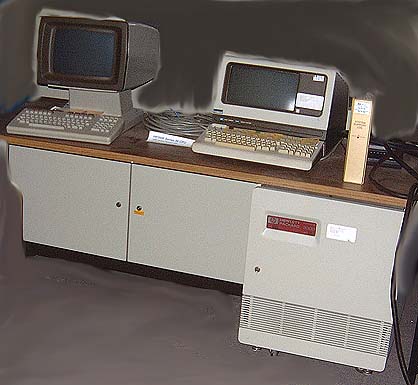

HP 3000
View on GrokipediaOverview
Introduction
The HP 3000 was Hewlett-Packard's first commercial data processing minicomputer, introduced in 1972 and designed specifically for multi-user business environments to handle administrative and commercial applications.[2] It represented HP's initial foray into enterprise computing, emphasizing time-sharing, batch processing, and real-time operations for concurrent users.[1] Development of the HP 3000 began in 1968, leading to its initial production and market release in late 1972.[2] However, early units faced performance and stability issues, prompting a full recall in 1973 and a redesigned re-release later that year.[4] The system continued to evolve through multiple generations into the 2000s, with HP providing support until December 2008.[8] The HP 3000 achieved notable significance, becoming the first computer installed in the White House in 1978 during the Carter administration to manage tasks such as database assembly and correspondence tracking.[2] Its longevity spanned over 35 years, solidifying HP's position in the enterprise market and influencing business computing practices.[1] At its core, the HP 3000 employed a 16-bit architecture and the proprietary Multi-Programming Executive (MPE) operating system, enabling support for up to hundreds of terminals in advanced configurations for multi-user access.[2][9]Key Features
The HP 3000 series distinguished itself through its multi-user and multi-programming architecture, which enabled efficient resource sharing among concurrent processes via virtual memory. This design utilized code and data segmentation, where code segments were re-entrant and shareable across users without duplication in memory, while data segments remained dynamic and private; the Multiprogramming Executive (MPE) operating system automatically swapped segments between disc and main memory as needed, supporting programs larger than physical RAM limits.[10][11][12] Time-sharing capabilities allowed multiple interactive users to access the system simultaneously, initially supporting up to 16 users with responsive performance in early models, and scaling to as many as 400 concurrent users in later configurations through expanded terminal support and dynamic resource allocation.[4][12] These features, powered by the MPE OS, facilitated simultaneous transaction processing, batch jobs, and program development without compromising efficiency.[13] From its inception, the HP 3000 incorporated robust built-in security measures, including hierarchical user accounts, group-level access controls, and file-level protections enforced through passwords, lockwords, and capability sets that restricted operations to authorized users only.[14][12] Memory protection hardware further ensured isolation by checking segment bounds and trapping unauthorized system calls, preventing interference between users or processes.[10] A hallmark of the HP 3000 was its forward-compatible design, maintaining object-code portability across generations from the original 16-bit Classic systems to 32-bit PA-RISC implementations, where software could run via emulation or recompilation under enhanced MPE variants like MPE/iX.[3] This preserved long-term investments in applications without requiring wholesale rewrites. The system integrated native database management and transaction processing tools, exemplified by the IMAGE/3000 database, a network-structured system that supported concurrent read/write access, high-volume transactions, and security via embedded password controls directly within the MPE environment.[5][3] Complementary utilities like QUERY/3000 enabled efficient data retrieval, optimizing the platform for business-oriented workloads such as order processing and inventory management.[12]History
Origins
The development of the HP 3000 can be traced to Hewlett-Packard's earlier experiences with multi-user computing systems, particularly the HP 2000 time-sharing system introduced between 1968 and 1970. The HP 2000, built around the HP 2116 computer, was primarily oriented toward educational and scientific applications, supporting multiple simultaneous users through a BASIC interpreter and emphasizing accessible time-sharing capabilities.[15] This foundation influenced the HP 3000's focus on multi-user environments, shifting the emphasis from education to broader commercial utility while retaining the goal of efficient resource sharing among users.[15] In 1969, HP's Computer Group, formed from the merger of the Dymec and Datamec divisions, initiated the project under the codenames Alpha for hardware development and Omega for software. The Alpha phase aimed to create a 16-bit minicomputer as an evolution of the HP 2100 series, incorporating improved memory addressing to support multiprogramming. The parallel Omega effort targeted a more ambitious 32-bit architecture with up to 4 MB of memory, but it was canceled in 1970 due to escalating costs and technical challenges in semiconductor availability.[16] Key contributors included Ron Matsumoto, who led the software team in designing the operating system, and Bill Foster, responsible for language implementations such as SPL, FORTRAN, and BASIC.[16] The primary design goals centered on business data processing, positioning the HP 3000 as a direct competitor to IBM's System/3, which dominated small-scale commercial computing in the late 1960s. HP prioritized system reliability and uptime over raw processing speed, drawing from lessons in the HP 2000 to ensure stable multi-user operations for transaction processing and batch jobs in enterprise settings.[17] This reliability focus was evident in hardware choices like robust error-checking mechanisms and software structures that minimized downtime, making the system suitable for critical business applications. Rather than adapting emerging systems like UNIX, which was still experimental and not commercially licensed at the time, HP's Computer Group opted to develop a proprietary operating system tailored to the machine's architecture. This decision led to the creation of the Multi-Programming Executive (MPE), a custom real-time OS designed for seamless integration with the hardware, supporting time-sharing, batch processing, and real-time tasks in a single environment.[16]Launch and Early Challenges
The HP 3000 was announced on November 3, 1971, during HP's annual sales meeting, marking the company's entry into the business computing market. Marketed as a versatile system for mid-sized enterprises, it targeted organizations requiring integrated engineering, scientific, and data processing capabilities, such as order entry and payroll alongside research tasks.[19] Priced from $100,000 to $300,000 depending on configuration, the system was positioned to compete in the growing minicomputer segment for business applications.[19] Initial customer deliveries commenced in November 1972, with the first unit installed at the Lawrence Hall of Science at the University of California, Berkeley.[16] By mid-1973, approximately two dozen systems had been shipped, but early adopters encountered significant operational difficulties. In 1973, HP withdrew all HP 3000 units from the market following reports of severe performance shortcomings, including slow input/output operations, frequent operating system crashes under multi-user loads, and hardware malfunctions such as unreliable fixed-head disc mechanisms that led to data loss.[16] These issues stemmed from the initial MPE operating system's instability and hardware design flaws that prevented the system from meeting its performance specifications.[16] The recall halted sales and required extensive redesign efforts to address both software and hardware deficiencies. Following the fixes, including refinements to the MPE operating system for better stability, the HP 3000 was re-released in 1974 under the new designation HP 3000 Series II, featuring enhanced reliability and expanded capabilities.[20] This iteration incorporated improved memory management and I/O efficiency, allowing resumption of marketing with renewed confidence in its business viability.[20]Evolution and Growth
Following its initial launch, the HP 3000 experienced steady maturation through iterative hardware expansions that enhanced performance and scalability. The Series III, introduced in June 1978, incorporated a faster central processing unit utilizing silicon-on-sapphire integrated circuit technology, delivering improved computational speed and reliability over the prior Series II models while maintaining compatibility with the MPE operating system.[21] This upgrade addressed growing demands for multi-user business processing, enabling broader adoption in data-intensive environments. In the 1980s, further series expansions solidified the platform's versatility. The Series 37, launched in 1984, marked the introduction of 32-bit addressing in the HP 3000 family, supporting up to 1 GB of virtual memory and facilitating more sophisticated applications under the new MPE XL operating system. Complementing this, the Series 39, introduced in 1983, provided mid-range configurations with enhanced memory management and I/O throughput.[22] By the late 1980s, these developments had evolved the HP 3000 into a comprehensive family of expandable systems, with models ranging from entry-level to high-end configurations that shared backward compatibility. Market adoption accelerated throughout the 1980s, reflecting the system's reliability and adaptability. By 1989, more than 30,000 HP 3000 installations operated worldwide, spanning diverse sectors including finance for transaction processing and manufacturing for inventory and production control.[23][24] This growth underscored its role as a cornerstone of business computing, with users leveraging its multi-programming executive for real-time operations. Key adaptations in the 1990s further propelled the platform's longevity. The shift to PA-RISC processors, beginning with volume shipments around 1988 and peaking in the early 1990s, introduced reduced instruction set computing for superior performance in transaction-heavy workloads, effectively modernizing the architecture without disrupting legacy software.[25] Concurrently, networking integrations evolved from the foundational HP-IB interface bus—standard since the 1970s for peripheral connectivity—to Ethernet support in later models, enabling seamless local area network integration and distributed data processing across enterprise environments.[26][3]Operating System
MPE Development
The Multi-Programming Executive (MPE) operating system for the HP 3000 originated in the Omega project, launched by Hewlett-Packard in 1970 as an ambitious effort to build a 32-bit mainframe computer. The Omega initiative envisioned advanced capabilities such as virtual memory and segmented code/data architecture, but it was canceled later that year due to excessive technical risks and development costs. Key software concepts from Omega, including the core MPE design, were salvaged and adapted for the follow-on Alpha project, resulting in the initial release of MPE in November 1972 with the debut of the HP 3000 computer.[27] The 1972 MPE release proved highly unstable, supporting just 2 concurrent users and suffering crashes every 10-20 minutes, which led to a full product recall in 1973 amid customer dissatisfaction. Hewlett-Packard responded with an extensive redesign of both hardware and software, releasing MPE V in 1974 as a more reliable iteration that supported up to 8 users with crashes reduced to about 2 per day. This version established MPE as a viable system for business data processing, often positioned as a cost-effective alternative to systems like the IBM 1130.[27] As the HP 3000 hardware advanced into the 1980s, MPE continued to evolve; MPE XL emerged as a major update tailored for the PA-RISC processor architecture, with initial shipments in 1988 after developmental delays. MPE XL maintained near-identical user interfaces, management tools, accounting, and security to prior versions while introducing compatibility modes to run legacy Classic MPE programs via emulation. Building on this, MPE/iX, introduced in 1988 to incorporate POSIX standards for enhanced portability and Unix-like functionality, without disrupting backward compatibility. The final iteration, MPE/iX 7.5, was released in September 2002, marking the end of major development as HP shifted focus away from the platform.[27][28] At its core, MPE provided virtual memory management through distinct code and data segments, enabling efficient multitasking by swapping segments and pages between main memory and disk storage under the control of a dedicated virtual memory manager. This segmented approach allowed programs to operate in a larger address space than physical memory permitted, supporting resource sharing across multiple processes.[12] MPE's job and stream management system facilitated concurrent execution of batch jobs and interactive sessions, using a scheduler to prioritize and dispatch processes for both time-sharing and real-time operations. This design ensured balanced resource allocation, allowing users to submit batch streams while maintaining responsive interactive access, a key enabler for mixed workloads in enterprise environments.[12] The operating system's security model employed a strict hierarchical organization of accounts, groups, and users to enforce access controls and resource protection. Accounts served as top-level containers, each containing multiple groups that organized users and their permissions; capabilities such as account manager or operator were assigned to regulate actions like file access, process execution, and system modifications, providing layered security without relying on a single superuser paradigm.[29]Software Innovations
The IMAGE database management system, released in November 1974, represented a pioneering software innovation for the HP 3000, marking the first DBMS implemented on a minicomputer platform.[30] Developed by a team including Jon Bale, Fred White, and Bob Mayer starting in 1972, IMAGE adhered to CODASYL standards for network data modeling, providing robust data access methods through intrinsic commands callable from SPL, FORTRAN, and COBOL.[30] Its features included multilevel security at the database, dataset, and data item levels, extensible access methods for indexed sequential and random files, and built-in fault detection for data integrity, making it particularly suited for business applications requiring reliable, multi-user data handling without the complexity of larger mainframe systems.[30] Although based on the CODASYL network model rather than a pure relational structure, IMAGE's set-oriented queries and pointer-based chaining offered relational-like capabilities for enterprise data management, influencing subsequent DBMS designs in minicomputer environments.[31] HP's compilers for COBOL and the proprietary Systems Programming Language (SPL) were optimized specifically for the MPE operating system on the HP 3000, facilitating efficient development of portable enterprise applications. The COBOL II compiler, available from the mid-1970s, generated native object code tailored to MPE's virtual memory and file system intrinsics, enabling high-performance execution for business data processing tasks such as report generation and transaction handling.[32] SPL, introduced with the initial HP 3000 systems in 1973, served as a block-structured, ALGOL-like language designed for systems-level programming while supporting modular segmentation to leverage MPE's multiprogramming features.[33] This optimization allowed developers to create reusable, machine-dependent code that integrated seamlessly with HP 3000 hardware, promoting portability across system series for enterprise software like inventory management and financial systems without extensive rewrites.[34] In the 1980s, HP AdvanceNet emerged as a key innovation for transaction processing on the HP 3000, serving as an architectural framework that enabled distributed, high-throughput operations across networked systems. Announced in 1985 and built on the ISO OSI seven-layer model, AdvanceNet integrated protocols like TCP/IP and X.25 to support services such as Network File Transfer (NFT) and Remote File Access (RFA), achieving transfer rates up to 40,000 bytes per second for database interactions.[35] Its Network Interprocess Communication (NetIPC) facility allowed seamless program-to-program data exchange between HP 3000 processes, both locally and remotely, which laid groundwork for modern transaction processing monitors by providing reliable message passing and resource coordination in multivendor environments.[35] This capability was instrumental for enterprise applications requiring concurrent online transaction processing, batch jobs, and data communications, enhancing the HP 3000's role in coordinated corporate networks.[36] The HP 3000 demonstrated early networking prowess through ARPANET connectivity in the late 1970s, supporting foundational protocols for email and file transfer that predated widespread commercial internet adoption. By 1979, the system incorporated an Intelligent Network Processor (IMP) interface with two dedicated boards in the main cabinet, enabling direct linkage to ARPANET hosts for packet-switched communications.[37] This setup facilitated implementation of ARPANET protocols, including the ARPA File Transfer Protocol (FTP) for remote file exchanges and early email mechanisms integrated into MPE.[37] Such connectivity allowed HP 3000 users in research and business settings to participate in collaborative data sharing over the precursor to the modern internet, with full TCP/IP support prototyped by 1981 to ensure interoperability during the NCP-to-TCP transition.[38]Architecture
Processor Design
The HP 3000 Classic series employed a 16-bit complex instruction set computing (CISC) processor architecture that utilized a stack-based design rather than general-purpose registers, enabling efficient handling of operands through push and pop operations on a hardware-implemented stack. This architecture supported over 200 microcoded instructions, with specific implementations featuring 214 instructions tailored for business-oriented computing, including extensive support for decimal arithmetic such as 28-digit packed binary-coded decimal (BCD) operations to facilitate applications in languages like COBOL.[39][12][40] Central to the design was the operand stack, which served as the primary mechanism for data manipulation, reducing instruction complexity by implicitly operating on the top-of-stack (TOS) and next-to-top-of-stack (NOS) elements; for instance, an ADD instruction would pop two operands from the stack, perform the addition, and push the result back onto the stack. Instructions varied in length—typically 8 bits for stack operations (which could be packed two per 16-bit word), 16 bits, or 32 bits—allowing compact encoding while accommodating diverse operations. The instruction set included dedicated opcodes for input/output (I/O) control, such as privileged instructions for direct data transfers to the stack top, and control flow mechanisms like unconditional branches (BR) and dispatch (DISP) operations, optimized to support multi-programming environments by enhancing process switching and resource allocation efficiency.[39][12][41] In the 1990s, the HP 3000 transitioned to the PA-RISC architecture, a 32-bit (later extensible to 64-bit) reduced instruction set computing (RISC) design under Hewlett-Packard's Precision Architecture, which replaced the original CISC processors while preserving backward compatibility through hardware and software emulation of the Classic instruction set on the new systems. This shift, beginning with the Series 900 models, recompiled the MPE operating system and emulated legacy code to maintain support for existing business applications without requiring source code modifications.[3][39]Memory Management
The classic HP 3000 systems implemented memory management through a segmented virtual addressing scheme designed to facilitate efficient multiprogramming under the MPE operating system. Each process supported up to 1024 segments, tracked via segment tables including the Code Segment Table (CST) and Stack Table, which mapped logical addresses to physical memory locations or disk storage for absent segments. This model allowed for dynamic loading and sharing of code segments across processes while isolating private data.[42] A key constraint in these systems was the 64K barrier arising from 16-bit intra-segment addressing, limiting each segment to a maximum of 64 KB. Segments were categorized into code (reentrant and shareable, up to 32 KB in early designs), data (for global variables), and stack (for temporary storage and parameters, also capped at 32 KB initially), enabling modular program organization but requiring careful partitioning to fit within these bounds.[11] To circumvent the 64K limitation for programs exceeding single-segment capacity, developers employed workarounds such as segment linking, which connected multiple code segments via the Segment Transfer Table (STT) for seamless procedure calls, and overlays, where inactive code portions were swapped out to disk. Later classic models introduced 32-bit extensions, including extra data segments (each up to 64 KB) allocatable beyond the primary stack, expanding effective data space while maintaining backward compatibility.[43] The shift to PA-RISC processors in the Series 900 systems marked a significant evolution, introducing a flat 32-bit virtual address space of 4 GB per process under MPE/iX, which removed the per-segment 64K limit for native applications and supported larger contiguous allocations. Compatibility with classic 16-bit software was preserved through hardware-assisted emulation, allowing segmented code to run transparently within the expanded address space.[44][25]Hardware
Classic Series
The Classic Series of the HP 3000 comprised the foundational hardware lineup from 1972 through the 1980s, built around a 16-bit CISC stack machine architecture implemented initially with transistor-transistor logic (TTL). These systems were designed for commercial data processing, emphasizing multiprogramming, time-sharing, and compatibility with the MPE operating system. Early models faced significant challenges, including delivery delays and reliability issues, but subsequent iterations improved performance and expandability, supporting growing business needs with modular configurations. The Series I, introduced in November 1972 for initial customer deliveries, featured core memory configurable from 32 KB to a maximum of 128 KB in 32 KB modules, with a 960 ns cycle time and support for up to 16 simultaneous users via time-sharing. Storage options included 1 MB fixed-head disks or 4.9 MB removable cartridge drives, connected through early I/O interfaces. However, due to slipped schedules for key peripherals and operating system instability, Hewlett-Packard suspended marketing by mid-1973 and recalled all delivered units for free upgrades to the enhanced Series II configuration.[11][45] The Series II and III, launched in 1976 and 1978 respectively, addressed prior shortcomings with semiconductor (MOS) memory expandable from 128 KB to 512 KB in 64 KB increments and a faster CPU cycle time of 700 ns, delivering approximately 0.3 to 0.5 MIPS of performance. These models supported up to 63 terminals for multi-user environments and included standard 50 MB disk drives, enabling more reliable batch and real-time processing for mid-sized enterprises.[46] In the 1980s, the Series 37, 39, and 48 marked significant scaling for the line, offering 512 KB to 4 MB of RAM using 64K or 256K DRAM chips and CPU performance ranging from approximately 0.5 MIPS in the entry-level Series 37 to 1 MIPS in the Series 39 and about 1.3 MIPS in the Series 48. The Series 37, for instance, accommodated up to 28 terminals in compact office setups, while the Series 48 handled over 100 terminals (up to 152 total, with 120 point-to-point), facilitating larger distributed workloads.[47][48][13] Peripherals integral to the Classic Series utilized the HP-IB interface for high-speed data transfer at up to 1 MB/s, connecting devices such as disk drives (e.g., the 7914P with 132 MB capacity or 7925M at 120 MB), magnetic tape units (e.g., the 7974A cartridge drive at 1600 bpi and 50 ips, or 7978A at dual densities up to 6250 bpi), and console terminals like the 2392A display model for operator interaction. These components, often housed in dedicated cabinets, allowed configurations with up to 16 disk drives and 8 tape units in higher-end models like the Series 48, emphasizing reliability through error-correcting memory and modular expansion.[48]PA-RISC Series
The PA-RISC series marked a significant evolution in HP 3000 hardware, transitioning from the earlier CISC-based Classic designs to RISC architecture for improved performance and scalability starting in the early 1990s. Introduced in 1990, the Series 900 lineup, including models such as the 918, 928, 968, 978, and 988 LX/RX, featured PA-RISC 1.1 processors operating at clock speeds ranging from 34 MHz to 96 MHz, with standard memory configurations of 32 MB to 64 MB expandable up to 512 MB. These systems utilized CMOS single-chip processors with integrated floating-point units, enabling higher throughput for business applications while maintaining backward compatibility with prior HP 3000 software ecosystems.[49][50] Subsequent models in the 1990s and 2000s, such as the A180 and A400, built on this foundation with more advanced PA-RISC implementations, including the PA-7300LC processor in the A180 running at 180 MHz and supporting up to 2 GB of RAM. The A400, released around 2000, offered 64-bit addressing and enhanced I/O capabilities, achieving performance levels exceeding 100 MIPS in typical workloads, along with support for Gigabit Ethernet interfaces for faster network connectivity in enterprise environments. These upgrades allowed the PA-RISC series to handle larger datasets and more concurrent users, positioning the HP 3000 as a robust platform for transaction processing and database operations.[51][52] To ensure seamless adoption, the PA-RISC series incorporated the Native Mode Handler (NMH), which facilitated running Classic-era software through a compatibility mode that emulated the 16-bit instruction set on the new 32-bit RISC hardware without requiring recompilation. This mode preserved investments in legacy MPE V applications while allowing native 32-bit PA-RISC programs to execute directly for optimal speed. Configurations emphasized reliability, with rack-mounted chassis for space-efficient data center deployment and clustering options via High Availability Cluster/iX, enabling failover between systems to minimize downtime in mission-critical setups.[53][54][55]Performance and Applications
System Performance
The classic HP 3000 systems, based on 16-bit and early 32-bit processors, provided performance in the range of 0.1 to 1 MIPS, with early models like the Series 37 achieving around 0.1 MIPS and later ones such as the Series 68 reaching 1 MIPS, while the highest-end classic configurations up to approximately 1 MIPS.[13][56] These systems were well-suited for online transaction processing (OLTP) in business environments supporting dozens of concurrent users, but their scalability was limited by 64K-word memory segments and the inherent constraints of the stack architecture, which restricted high-volume workloads without extensive configuration.[57] With the transition to PA-RISC processors in the 900 Series starting in the late 1980s, performance scaled significantly, reaching up to approximately 4 MIPS in late models like the Series 98x systems, based on relative performance scaling.[58] Clustering capabilities, such as those enabled by HP AdvanceNet and later High Availability Cluster/iX, allowed configurations to handle over 1000 transactions per second in OLTP scenarios, enhancing scalability for enterprise applications.[59][60] Benchmark results for PA-RISC HP 3000 systems showed performance in the 30-50 range for mid-1990s models.[61] Relative to contemporaries, these systems were typically 1.5 to 3 times slower in raw CPU-intensive tasks compared to VAX or IBM mainframes like the VAX 9000 or IBM 3090, but they excelled in I/O-bound business processing due to optimized multi-user support and lower latency in transaction handling.[3][62] The stack architecture of the HP 3000 introduced some overhead in instruction execution—uncomplicated operations took 1-2 microseconds—due to packed 8-bit instructions and dynamic stack management, yet it provided efficiency in multi-user environments by minimizing procedure call overhead and enabling seamless context switching for OLTP workloads.[37][63] This design prioritized reliability and concurrency over peak single-threaded speed, making it particularly effective for the era's commercial data processing needs. Third-party emulations have extended usability for legacy applications into the 2020s.[7]Notable Uses
The HP 3000 found early adoption in government applications, marking significant milestones in public sector computing. In 1978, it became the first computer installed in the White House during the Carter administration, supporting administrative functions such as assembling databases, tracking correspondence, developing press release systems, and compiling congressional issues and concerns.[2] Planning for this installation began as early as 1976 under the incoming Carter team to address interim computing needs.[64] NASA's Earth Resources Research Services Analysis Center (ERRSAC) utilized the HP 3000 running IDIMS software for processing LANDSAT imagery, including a June 1978 scene to classify land use and forest cover types in Worcester County, Maryland, producing maps and acreage statistics.[65] In industry, the HP 3000 supported critical operations in manufacturing and aerospace. Boeing's Electronic Support Division deployed an HP 3000 Series CI for a custom manufacturing system, handling production processes in the mid-1970s.[66] The system's time-sharing capabilities made it suitable for research and educational environments. It supported connectivity to the ARPANET, the precursor to the modern internet, through a specialized Intelligent Network Processor (INP) interface and TCP protocol implementation developed under DARPA funding, allowing packet-based communication with the network via X.25 framing.[37] Universities adopted the HP 3000 for time-sharing applications, leveraging its multilingual batch and interactive modes to serve multiple users in academic computing labs.[67] Due to its reliability for business-critical tasks, many HP 3000 installations persisted for legacy COBOL-based applications in finance well into the 2010s, handling transaction processing and accounting even after HP discontinued new sales in 2001 and official support ended in 2010.[68]Decline and Legacy
HP Discontinuation
In November 2001, Hewlett-Packard announced the phaseout of its HP 3000 series, with new sales of e3000 servers ending on October 31, 2003, and general support services concluding on December 31, 2006.[69] This timeline was extended in 2005, providing basic reactive support through at least December 31, 2008, along with customized support packages on a case-by-case basis.[70] Further extensions allowed HP to deliver patches for critical defects until 2010.[71] The discontinuation stemmed from HP's strategic pivot to Itanium processors and platforms supporting HP-UX and Linux, amid a steady decline in the HP 3000's market share against Unix and Windows servers.[6] The proprietary MPE/iX operating system and PA-RISC architecture had lost favor with independent software vendors, who increasingly prioritized open standards.[6] To facilitate customer transitions, HP offered migration tools like the AMXW suite, which automated the porting of COBOL, SPL, C, FORTRAN, and Pascal applications from HP 3000 to HP 9000 systems running HP-UX.[72] HP also engaged in discussions about releasing the MPE/iX source code as open source but deferred the decision until 2008 and ultimately chose not to proceed.[8] The phaseout affected thousands of active HP 3000 systems globally, prompting many organizations to evaluate alternatives while relying on HP's extended patch support for security and stability.[6]Independent Support
Following Hewlett-Packard's cessation of official support, several third-party vendors have emerged to sustain HP 3000 operations, offering hardware spares, operating system patches for MPE/iX, and consulting services. Companies such as Allegro Consultants, Beechglen Development, Pro3K, and The Support Group have provided these services since around 2008, enabling organizations to maintain reliability in mission-critical applications without full system migrations.[73][74][75][76] Emulation solutions have become a cornerstone of independent support, allowing HP 3000 workloads to run on modern x86 hardware. Stromasys's CHARON-HPA/3000 emulator virtualizes the PA-RISC architecture, supporting unmodified MPE/iX versions up to 7.5 and facilitating seamless transitions from aging physical systems while preserving legacy software functionality.[7][77] The HP 3000 community remains active through dedicated resources and collaborative efforts. The 3000 NewsWire serves as a primary hub for news, migration advice, and homesteading strategies, fostering knowledge sharing among users worldwide. User groups, including the HP3000 Appreciation Society on social platforms, continue to connect enthusiasts and professionals for troubleshooting and best practices. Open-source initiatives, such as the SIMH emulator project, provide tools for testing and basic emulation but do not replicate the full proprietary MPE/iX environment.[78][79][80] As of 2025, some HP 3000 systems continue to operate in legacy environments, particularly in industries reliant on stable, long-term data processing. For example, as of November 2025, multiple N-Class HP 3000 systems remain in use at 3M for manufacturing applications with MANMAN software, expected to operate for several more years.[81] Independent support efforts now emphasize cybersecurity enhancements, including patch management and vulnerability assessments, to address evolving threats without disrupting established workflows.[82][83]References
- ftp://ftpmirror.your.org/pub/misc/bitsavers/pdf/datapro/datapro_reports_70s-90s/HP/M11-472-60_7312_HP_3000.pdf