Hubbry Logo
HahajimaHahajimaMain
Open search
Hahajima
Community hub
Hahajima
logo
8 pages, 0 posts
0 subscribers
Be the first to start a discussion here.
Contribute something
Hahajima
Hahajima
from Wikipedia

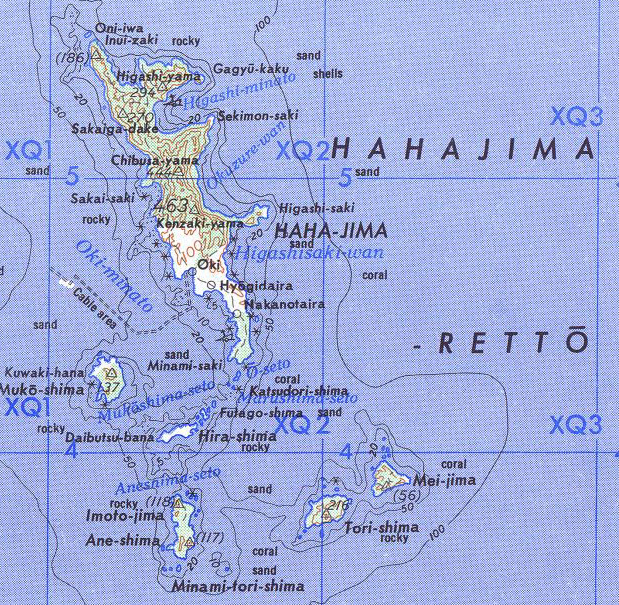
Hahajima, Haha Jima, or Haha-jima (母島; meaning Mother Island) is the second-largest island within the Bonin or Ogasawara Islands SSE of the Japanese Home Islands. The steeply-sloped island, which is about 21 km2 (8 sq mi) in area, has a population of 440.[1] It is part of Ogasawara Village in Ogasawara Subprefecture, which is approximately 1,000 km (620 mi) south of Tokyo, Japan.

Key Information

The highest peaks Hahajima are Chibusayama (lit. Breast Mountain), approximately 462 metres (1,516 ft), and Sakaigatake, 443 metres (1,453 ft). It is part of an archipelago that includes Chichijima approximately 50 km (31 mi) to the north and the nearby smaller islands such as Anejima and Imōtojima and Mukōjima. The group forms the Hahajima Rettō (母島列島; formerly the "Baily Group").

History

[edit]
View of the southern tip of Hahajima, the Minamizaki peninsula
Oki village, Mukōjima in the distance

Micronesian tools and carvings suggest prehistoric visits or settlement but the island was long uninhabited before its rediscovery, sometimes—but probably mistakenly[2]—credited to Bernardo de la Torre during his failed 1543 attempt to find a northern route back to Mexico from the Philippines. Captain James Coffin, of the whaler Transit originally named the largest island in the group "Fisher Island", which became Hahajima, and the second largest "Kidd Island", after the owners of his vessel. The islands came to be known as the "Coffin Islands". (Hahajima was also called Hillsborough Island.) Hahajima was settled by Europeans before becoming part of Japan.

During the Pacific War, the Japanese government removed the local civilian population and fortified the island. It was attacked several times by the US bombers. First on December 4, 1944 when Navy search planes of Fleet Air Wing One joined with Seventh Air Force bombers to attack installations on the island as well as Iwo Jima. Four days later there was another attack by Fleet Air Wing One. Then on December 10, B-25 Mitchells from the 2nd Marine Aircraft Wing struck at shipping moored at Hahajima.[3] The remains of defensive fortifications are now one of the island's tourist attractions.

The population, which was 1,546 in 1904 and 1,905 in 1940, is now only 450. A single road connects the abandoned village of Kitamura (北村) at the north end of the island to the village of Okimura (沖村) – formerly "Newport", at the southern end of the island, where the harbor is located. The island can be reached by ferry in about two hours from Chichijima. The economy of Hahajima is based on commercial fishing, tourism as well as a state-run rum distillery.

Education

[edit]
Haha-jima Elementary School and Junior High School (小笠原村立母島小中学校)

Ogasawara Village operates the island's public elementary and junior high school, Ogasawara Village Municipal Haha-jima Elementary School and Junior High School (小笠原村立母島小中学校).[4] Tokyo Metropolitan Government Board of Education operates Ogasawara High School[1] Archived 2020-02-15 at the Wayback Machine on nearby Chichijima.

Ecology

[edit]

Hahajima is of considerable interest to malacologists because of its endemic land snail fauna, including the eponymous Lamprocystis hahajimana. Due to the widespread presence of invasive species including goats (which destroy habitat) and rodents, flatworms and the rosy wolfsnail (which eat the native snails), it was feared that many of the endemics had become extinct.[5]

But most if not all of the endemic land snail species seem to persist on the remote Higashizaki peninsula on the eastern coast. This is a quite pristine expanse of ground, scenic but very hard to reach (one has to climb Mt. Chibusa before descending to the peninsula). It consists of sheer seacliffs surrounding a plateau with Chinese fan palm (Livistona chinensis), pandanus and broadleaf (e.g. Persea kobu, a wild avocado) forest, and appears to be untouched by invasive species at present. It has been proposed that access to the area should be monitored, so that visitors will not inadvertently contribute to destroying this unique area.[5]

Snails

[edit]

All of these snails are endemic at least to the Bonin Islands.

Birds

[edit]

Among birds, the Bonin white-eye (Apalopteron familiare), a gaudy-colored passerine, now only occurs on Hahajima.[6] The extinct Bonin grosbeak (Chaunoproctus ferreorostris) is sometimes said to have occurred in the Hahajima Group (though not on Haha-jima itself), but this seems not to be true. Columba janthina nitens, the Bonin subspecies of the Japanese wood-pigeon, used to occur on Haha-jima. While it is not precisely known when it vanished from this island,[7] the taxon apparently became completely extinct during the 1980s, but was rediscovered in 1998. The island has been recognised as an Important Bird Area (IBA) by BirdLife International.[8]

References

[edit]
Revisions and contributorsEdit on WikipediaRead on Wikipedia
from Grokipedia
Hahajima, also known as Haha-jima or "Mother Island," is the second-largest island in Japan's remote , a subtropical island chain located approximately 1,000 kilometers south of in the western . Covering an area of about 21 km² with steep volcanic terrain rising to a highest of 463 meters at Mount Chibusa, the island features dramatic sea cliffs, subtropical rainforests, and cloud forests that support exceptional , including over 90% endemic and unique avian fauna such as the Bonin white-eye. As part of the World Natural Heritage site of the Ogasawara Islands, Hahajima is renowned for its pristine ecosystems, which harbor critically endangered like the and serve as a key habitat for migratory birds and marine life, including green sea turtle nesting grounds. With a small resident population of around 420 people (as of August 2025) primarily engaged in , , and conservation, the island remains largely undeveloped and accessible only by a two-hour ferry from neighboring . Geologically, Hahajima formed through volcanic activity during the epoch, part of the broader Ogasawara subduction zone where the Pacific Plate sinks beneath the Philippine Sea Plate, resulting in basalt-dominated landscapes with precipitous ridges and limited flatland suitable for . The island's isolation has fostered a high rate of , with roughly 50% of its native plant unique to the Ogasawara chain, including rare ferns and flowering plants like the Hahajima , thriving in its humid, temperate subtropical climate. Endemic animals face threats from such as black rats and green anoles, which have impacted native and birds, prompting ongoing conservation efforts by Japan's Ministry of the Environment to protect habitats like the island's primary forests and coastal zones. Human history on Hahajima began with permanent settlement in the early , following initial of the Ogasawara Islands in 1830 by a diverse group of Westerners, Pacific Islanders, and Japanese adventurers who established stations and farms on the uninhabited lands. The island's population grew modestly through the late , supported by agriculture and sulfur mining, until formal incorporation into in 1876 under the Meiji government, which naturalized early foreign residents and promoted development. During , in 1944, Japanese authorities forcibly evacuated all approximately 500 residents from Hahajima to the mainland amid fears of U.S. invasion, leaving the island under military control until Japan's defeat. Postwar, the islands fell under U.S. administration from 1945 to 1968, during which time ecological restoration began and only limited repopulation occurred; full return to Japanese sovereignty in June 1968 allowed original inhabitants to resettle, though the population has since stabilized at low levels due to the island's isolation and emphasis on environmental preservation. Today, Hahajima functions as a key destination within Ogasawara National Park, offering trails to viewpoints like the Higashi-zaki cliffs and in surrounding coral reefs, while strict regulations limit visitor numbers to minimize human impact on its fragile ecosystems. The local economy relies on sustainable practices, including guided nature tours that highlight endemic and the island's role in global conservation, as well as a initiative launched in 2023 aiming to power the island with by 2028, underscoring its status as a "Galápagos of the " for studies. Ongoing challenges include effects on sea levels and management, but collaborative efforts between local communities and international organizations continue to safeguard Hahajima's unparalleled natural and .

Geography

Topography and Geology

Hahajima, the second-largest island in the Ogasawara Archipelago, is a volcanic landmass formed through subduction-related arc volcanism as part of the Izu-Bonin-Mariana (IBM) arc system. The island's geological origins trace back to the Eocene period, approximately 45 million years ago, when primitive arc lavas erupted in the forearc region, contributing to the formation of the Bonin Ridge. These ancient volcanic activities produced extensive lava flows and associated pyroclastic deposits, with evidence of early caldera-like structures preserved in the exposed rocks of the island and nearby seamounts. Although the island shows no signs of recent eruptions, its bedrock consists primarily of andesitic and basaltic volcanics from this proto-arc phase, shaped by tectonic rifting and uplift over millions of years. The topography of Hahajima is characterized by rugged, steeply sloping terrain rising from the sea, with a total land area of about 20 km². The island's highest point is Mount Chibusa (Chibusayama), reaching an elevation of 463 meters, offering panoramic views of the surrounding Pacific Ocean when ascended via well-maintained trails. Flanked by smaller islets such as Minami-jima to the south and Higashi-jima to the east, Hahajima forms part of the Hahajima subgroup within the broader Ogasawara Islands, located at approximately 26°39′N 142°10′E and roughly 1,000 km south of Tokyo. This isolation, as part of Tokyo's Ogasawara Subprefecture, underscores its remote position in the subtropical northwestern Pacific. Dominant landforms include dramatic coastal cliffs plunging into the ocean, which encircle much of the island and contribute to its jagged silhouette, alongside limited flat coastal plains that support settlements like Okimura village. Higher elevations are blanketed in subtropical rainforests, where dense canopies of endemic trees thrive on the nutrient-poor volcanic soils derived from weathered lava flows. These features reflect the interplay of , uplift, and climatic influences over geological time, creating a of precipitous ridges and sheltered bays.

Climate

Hahajima experiences a subtropical , moderated by the warm waters of the , which transports heat northward and maintains consistently mild conditions with no distinct seasons. The annual average temperature is approximately 23.2°C, with minimal diurnal and seasonal fluctuations; winter lows rarely fall below 16°C, while summer highs can reach 30°C or more. Recorded extremes include a minimum of 10.9°C and a maximum of 33.6°C, though such outliers are infrequent. Precipitation totals around 1,600 mm annually, distributed relatively evenly across the year but with elevated levels during the wetter months from to , when often exceeds 77% and fosters a persistently muggy atmosphere. provide regular breezes, yet the island remains exposed to Pacific storms, ensuring no occurrences of or . This even rainfall pattern, combined with high averaging 70-80%, creates a stable environment conducive to year-round greenery. The season, spanning to October, brings the most intense weather, with storms occasionally intensifying rainfall and winds; Hahajima lies in a where typhoons frequently develop or pass nearby. data through 2025 show overall stability in patterns, but projections indicate a slight uptick in typhoon intensity due to warming surface temperatures and increased atmospheric moisture. For example, in July 2025, Typhoon Shanshan struck the Ogasawara Islands with central pressures of 980 hPa and winds up to 108 km/h. This climatic regime supports Hahajima's lush subtropical vegetation by providing ample moisture and warmth, yet the combination of heavy rains and typhoons exacerbates on the island's steep volcanic slopes.

History

Discovery and Early Settlement

Archaeological evidence, including Micronesian tools and carvings, suggests possible prehistoric visits or temporary settlements by Micronesian peoples in the Ogasawara Islands, though no permanent habitation is confirmed prior to modern times. The first documented European encounter occurred on October 2, 1543, when Spanish explorer Bernardo de la Torre sighted the island during his voyage , marking it as part of the Bonin (Ogasawara) on early charts. Japanese followed in the 17th century; in 1675, under orders from the , Shimaya Ichizaemon led an expedition that mapped the southern islands, naming the largest Haha-jima, or "Mother Island," after its position relative to smaller islets likened to daughters. The island remained uninhabited until the early , when activities drew transient visitors. In , American whaler Captain James Coffin landed on Hahajima, naming a bay Coffin Harbor, but no settlement ensued at that time. Permanent human occupation began in , when a group of about 25 settlers from , led by Matteo Mazarro—a born in Ragusa (modern )—arrived on the British vessel . This multicultural party included Europeans, Americans like Nathaniel Savory, and Pacific Islanders from , , and other Polynesian and Micronesian regions, establishing stations and basic at sites like Kitamura. By the mid-, the community had grown into a diverse society blending European, Hawaiian, and Polynesian influences, with intermarriages fostering a unique creole culture centered on subsistence farming, , and trade with passing ships. Japanese interest intensified in the late , culminating in a claim by the Meiji government in 1875 and formal incorporation in 1876, which asserted sovereignty over the Ogasawara Islands following diplomatic negotiations with Western powers. Initial Japanese settlers arrived in 1876, numbering around 37, primarily from and the , initiating organized agriculture such as sugarcane cultivation. In the , government-backed expeditions conducted detailed surveys and mapping to facilitate resource development, including timber and sugar industries, which spurred further immigration. By 1904, Hahajima's population had exceeded 1,500, driven by these waves of Japanese migrants establishing farms and infrastructure.

World War II and Postwar Developments

In the lead-up to , began fortifying Hahajima and the broader Ogasawara Islands in as part of its militarization efforts in the Pacific, constructing gun batteries and deploying and personnel to establish the island as a strategic military outpost. By 1944, amid advancing U.S. forces, the Japanese military ordered the forced evacuation of all civilian residents from Hahajima to the mainland, viewing them as a potential burden during anticipated battles. This evacuation was precipitated by intensified U.S. air raids on the , including strikes in December 1944 aimed at neutralizing Japanese threats to [Mariana Islands](/page/Mariana Islands) bases, which destroyed much of the island's infrastructure such as wharves, buildings, and agricultural facilities. Hahajima's had reached approximately 1,905 by 1940. Following Japan's defeat in 1945, Hahajima fell under U.S. as part of the administration of the Ogasawara Islands, which lasted until 1968 and severely restricted civilian resettlement to maintain strategic control. During this period, only a limited number of pre-war residents of Western descent, known as the Ōbeikei, were permitted limited returns to nearby in 1946, leaving Hahajima's civilian population near zero through the 1950s amid ongoing military use. The island's reversion to occurred on June 26, 1968, under the U.S.-Japan Agreement Regarding the Return of the and Other Islands, allowing full resettlement; around 200-300 original and new inhabitants returned to Hahajima in the initial years, though numbers stabilized at low levels due to isolation and preservation focus. In the postwar era, Hahajima has seen significant modern developments focused on and global recognition. The Ogasawara Islands, including Hahajima, were designated a World site in 2011 for their unique evolutionary processes and . In August 2025, a demonstration project was launched to supply via solar panels and storage batteries, aiming for zero-emission operations on the island (as of November 2025). These initiatives build on the 1968 reversion by integrating environmental recovery with to support long-term resilience.

Population and Society

Demographics

As of 2025, Hahajima has a resident of 417, reflecting a gradual decline from 454 in 2021. The island spans approximately 21 square kilometers, resulting in a of about 20 inhabitants per square kilometer. The demographic composition is predominantly ethnic Japanese, though the island's history includes multicultural roots from early 19th-century settlers of European, , and Chinese descent, whose descendants have since assimilated into Japanese society. There are no significant immigrant communities at present. The exhibits an aging profile typical of remote Japanese islands, with a relatively low proportion of young residents and ongoing challenges related to out-migration among youth. Efforts by local authorities, including subsidies and community programs, aim to attract young families to counteract this trend and support population stability. distribution aligns closely with national averages, though specific breakdowns for Hahajima are not separately reported in recent censuses. Settlement is concentrated in the southern village of Okimura, which serves as the administrative and economic center with such as offices and basic infrastructure. The northern village of Kitamura, once home to around 600 residents before , was abandoned following the 1944 forced evacuation and subsequent , exacerbated by environmental factors including . Overall trends indicate a slow depopulation driven by geographic isolation and limited opportunities, partially offset by inbound migration linked to and eco-related enterprises, which has helped maintain relative stability in recent years. Data for 2025 is sourced from the .

Education

Following the abolition of Hahajima Elementary School in 2025, primary and on Hahajima is provided solely by the Hahajima School, a facility serving students from first through . This single institution caters to all local K-9 students, with enrollment standing at 28 as of May 2024, reflecting the island's small population of school-age children. Class sizes are notably small, averaging 4.7 students per class across six classes, which allows for personalized instruction but highlights resource constraints typical of remote island settings. The curriculum places a strong emphasis on , leveraging the Ogasawara Islands' World Heritage status to integrate local into core subjects. Students participate in structured field trips and a progressive six-year program that explores the islands' unique , from subtropical forests to endemic species, fostering a deep connection to conservation principles. Facilities are basic, with limited advanced equipment due to logistical challenges of island transport, though the natural surroundings serve as an open-air classroom for hands-on learning in science and . Hahajima lacks a local high school, requiring students pursuing upper secondary education to commute to Ogasawara High School on nearby , operated by the Tokyo Metropolitan Government Board of Education. This involves a regular journey of about two hours one way, with discounts available to facilitate weekly or temporary boarding arrangements on . Access to higher education, such as universities, necessitates further to , often via extended and flight connections from , posing significant barriers for residents. The island's remoteness amplifies educational challenges, including inconsistent access to specialized resources and extracurricular opportunities, which distance learning programs have helped address since their expansion in following the 2020 . These initiatives enable remote instruction through online platforms when in-person classes are disrupted by weather or transport issues. In 2025, national advancements in digital infrastructure, such as the approval of electronic textbooks for official use in schools, are enhancing connectivity and resource availability even in isolated areas like Hahajima.

Economy and Infrastructure

Economic Activities

The economy of Hahajima relies primarily on , which serves as the main driver of local livelihoods through small-scale fleets operated under the oversight of the Ogasawara Hahajima Fisheries Cooperative. Targeting pelagic species such as , , , and , the industry adheres to sustainable quotas enforced by Japan's national fisheries regulations to prevent . These operations, often involving multi-day expeditions, contribute significantly to the island's self-sufficiency in protein sources while exporting surplus catches to . Complementing fishing, small-scale manufacturing includes the Ogasawara Rum distillery, established in 1992 on Hahajima using locally grown sugarcane and molasses derived from historical post-war agricultural revival efforts. This facility produces traditional rum, along with flavored variants like passion fruit liqueur, providing a niche export product that leverages the island's subtropical climate. Agriculture remains limited, focused on self-sufficiency through cultivation of tropical fruits such as papaya, guava, and passion fruit, as well as vegetables, on small plots unsuitable for large-scale farming due to terrain and soil constraints. Emerging initiatives, particularly , are addressing the island's energy needs amid its isolation. A Metropolitan Government-led project, launched in 2025, features two solar plants with a combined 1.5-megawatt capacity, aiming to supply approximately 50% of Hahajima's —serving its approximately 420 residents (417 as of August 2025)—for half the year by reducing diesel generator reliance. Employment is predominantly in primary sectors like and , alongside services, reflecting the island's resource-based economy. Hahajima faces economic challenges from high import dependency for essential goods and fuels, exacerbated by vulnerability to fluctuating global prices and logistical costs from its remote location over 1,000 km south of . Tourism provides supplementary income through service roles, though it remains secondary to resident-driven industries.

Tourism and Access

Hahajima is accessible primarily by ferry from , the largest in the Ogasawara , via the Hahajima Maru operated by Ogasawara Kaiun Co., Ltd. The journey typically takes about two hours, though it can extend to four hours depending on conditions, with fares around 4,900 yen as of November 2025. There is no on the , making travel the sole means of arrival, and sailings are limited to one round trip per day on most days, often subject to weather disruptions. Tourism on Hahajima emphasizes eco-friendly experiences, drawing visitors to its pristine natural and historical sites. Popular attractions include trails leading to Mount Chibusa (Chibusayama), the island's highest peak at 462 meters, offering panoramic views of subtropical forests and endemic flora. Snorkeling and diving sites around the island's reefs highlight diverse , including tropical fish and sea turtles, while World War II ruins, such as abandoned bunkers and gun emplacements from Japanese defenses during , provide historical insights into the Pacific theater. Guided nature walks promote sustainable eco-tourism, focusing on for like the Bonin honeyeater and minimizing environmental impact through regulated access. Visitor numbers to Hahajima have grown post-COVID, recovering toward pre-pandemic levels, as part of broader Ogasawara rebound. Accommodations are modest, consisting of about 10 inns and guesthouses with no luxury hotels, emphasizing simple, nature-oriented stays that align with the island's remote character. To address concerns, visitor quotas and mandatory guided tours are enforced in sensitive areas like the Sekimon region, ensuring preservation of the World Heritage site's . The island's infrastructure supports basic visitor needs with three small supermarkets and two restaurants offering local , such as fresh and island-grown produce. In remote areas, composting toilets are utilized to promote by reducing water usage and preventing in the fragile . provides an economic boost to the local community, complementing primary industries like .

Ecology

Biodiversity

Hahajima, part of the Ogasawara Islands, exhibits exceptional driven by its long isolation from continental landmasses, estimated at over 30 million years, which has fostered high levels of through and . The island's native flora includes 441 documented taxa of vascular , with approximately 36% (161 taxa) being endemic, particularly among woody species where endemism reaches up to 70%. Notable endemic plants include boninensis, a scrambling shrub characteristic of the island's dry forests, and pentapetalum, known locally as Hahajima-no-botan, which thrives in damp mountain forests. These species contribute to the subtropical moist forests that dominate much of the island's interior, supporting a diverse of ferns and orchids adapted to the humid, volcanic soils. Avian diversity on Hahajima features several endemic birds, with the Bonin white-eye (Apalopteron familiare) being a prominent example; this , restricted to the Hahajima island group, maintains a stable population of approximately 14,700 mature individuals as of recent estimates. Classified as Least Concern by the IUCN, its persistence reflects the relative intactness of the island's forested habitats, including the Higashizaki Peninsula where populations remain stable according to surveys up to 2024. Land snails represent another highlight, with over 90% of the approximately 60 indigenous on Hahajima belonging to unique genera shaped by the island's isolation; examples include Mandarina hahajimana and Lamprocystis hahajimana, arboreal that exhibit diverse shell morphologies and are confined to specific forest microhabitats. These gastropods, totaling over 100 across the Ogasawara archipelago with high representation on Hahajima, underscore the island's role as a global hotspot for molluscan . The island's ecosystems further enhance its biotic richness, encompassing subtropical rainforests with towering trees like Elaeocarpus sylvestris reaching 20 meters in height, alongside coastal zones featuring shrublands and limited wetlands that serve as transitional habitats for endemic and reptiles. Surrounding marine waters, integral to Hahajima's , host vibrant reefs with 226 of hermatypic corals and support 23 cetacean , including sperm whales and bottlenose dolphins, which utilize the area for breeding and foraging. This interplay of terrestrial and marine elements positions Hahajima as a key site for studying insular evolution, where the subtropical climate—warm and humid year-round—sustains these interconnected habitats.

Conservation Efforts

Hahajima's ecosystems face significant threats from invasive species and historical habitat degradation. Feral goats, introduced in the past, caused extensive deforestation and soil erosion on surrounding uninhabited islands in the Hahajima group until their complete eradication was achieved by fiscal year 2011 through targeted hunting and trapping efforts led by the Tokyo Metropolitan Government on islands like Ototojima. Invasive rats (Rattus spp.) continue to prey on native seeds, insects, and seabird eggs, with eradication programs successfully completed on surrounding uninhabited islands in the Hahajima archipelago, though populations persist on the main island. The green anole (Anolis carolinensis), an invasive lizard established on Hahajima between 1968 and 1972, preys heavily on endemic insects, contributing to declines in native arthropod diversity and threatening pollination services for plants. Additionally, the New Guinea flatworm (Platydemus manokwari) has invaded the island, posing risks to native land snails through predation, with ongoing prevention measures focusing on quarantine to limit further spread. Past logging activities during the early 20th century further exacerbated habitat loss, reducing primary forest cover and fragmenting ecosystems for endemic species. To counter these threats, Hahajima benefits from robust protection measures integrated into broader Ogasawara Islands initiatives. Designated as part of the in 2011, the island's management emphasizes control, habitat restoration, and restricted development to preserve its unique biodiversity. The Ogasawara National Park, established in 1972, encompasses approximately 90% of the archipelago's land area, including most of Hahajima, enforcing strict regulations on and resource extraction to safeguard subtropical forests and coastal habitats. Eradication and control programs target key invasives, such as the use of rodenticides for rats on peripheral islands and manual removal efforts for the green anole, with monitoring to assess ecological recovery. Ongoing conservation initiatives involve collaborative research and sustainable practices. The University of Tokyo's Koishikawa Botanical Garden leads monitoring and restoration projects, including propagation and replanting of over 60 individuals of endangered species like the endemic shrub back into Hahajima habitats since the . To achieve zero-emission goals, a demonstration project launched in August 2025 supplies 100% renewable to the entire island via panels and storage batteries, reducing reliance on diesel generators and minimizing environmental impacts from energy production. Tourism restrictions play a vital role in preventing new invasives, with mandatory shoe cleaning and inspections upon arrival by to eliminate soil-borne pests and seeds. Composting programs promote waste reduction, supporting ecosystem health by limiting landfill use and . These efforts have yielded notable successes in recovery. Following eradication, native vegetation, including the endangered monocarpic herb Lobelia boninensis, has shown signs of rebound on Hahajima and nearby islands, with increased seedling establishment in restored areas. In 2025, assessments identified new taxa of endemic to Hahajima, including C. hahajimensis, a species threatened by habitat specificity and invasive pressures, guiding targeted protection strategies. Overall, these interventions have stabilized populations of several endemics, demonstrating the effectiveness of integrated conservation in this isolated subtropical environment.

References

Add your contribution
Related Hubs
Contribute something
User Avatar
No comments yet.