


Community hub
Recent from talks
Contribute something
Nothing was collected or created yet.
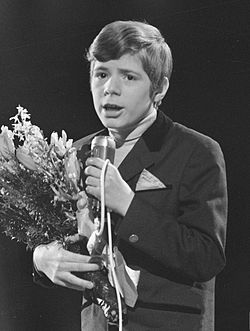
Heintje Simons
View on Wikipedia
Key Information


Hendrik Nikolaas Theodoor "Heintje" Simons (born 12 August 1955) in Heerlen,[2] later known as Hein Simons, is a Dutch schlager singer and actor.[3]
Background
[edit]Heintje was born the son of a coal miner who had to retire because of silicosis, reducing the family to near poverty. The family opened a small café where Heintje used to sing along with the jukebox.[4] When he was 11, he entered a local singing contest. He beat 30 competitors to win the contest. Producer Addy Kleijngeld heard about him and went to audition him at his home. After hearing only a few notes, he took him on as a client and became his manager. Upon becoming wealthy, Heintje moved his family back to his father's birthplace, Neu Moresnet, Kelmis, Liège, Belgium.[4]
He became famous as a child singer, with hit song "Mama" (written by Cesare Andrea Bixio, Bruno Cherubini and Bruno Balz)[5] in 1968, and as a child actor, with his appearances in numerous German films in the 1960s and 1970s (some of these were dubbed into English and also Afrikaans). He enjoyed success with English songs, notable of which is "I'm Your Little Boy".[3] In 1971, The Los Angeles Times described him as, "the hottest property in Europe."[4] The same article quoted the Frankfurter Allgemeine Zeitung as saying of him, "No one is bigger in German show business."[4]
His 1967 recording of "Mama" sold over one million copies, and was awarded a gold record.[6] The following year his debut album Heintje went on to sell over two million copies, resulting in a platinum record award. Other records selling over a million units included "Du sollst nicht weinen", "Heidschi bumbeidschi" and the seasonal album, Weihnachten mit Heintje. His sales in 1968 and 1969 alone totaled over 10 million.[6]
At the age of 20 he also recorded in Afrikaans; his single "Jou Hart Is Weer Myne" reached number 4 on the South African Official Chart in 1975. He was so popular in South Africa that he performed in concert there in the mid 1970s; a 1983 appearance that he made at a concert for South African troops stationed in Namibia attracted negative publicity in his native Netherlands for violating that nation's cultural boycott of the South African apartheid system, leading to him being reprimanded by the United Nations and by Namibian pastor Zephania Kameeta, who called his performance "an immoral [show of] support for apartheid".[7][8][9] In a subsequent interview, he brushed off the criticism, remarking that he was opposed to apartheid, but said, regarding his appearance in South Africa, that he was there as a singer and that it was not his business to get involved in politics. He told the Limburgsch Dagblad:
I am a singer and come to South Africa as an artist. I know that large Dutch companies still do fantastic business with this country. There can be no question of a real boycott. Why should I be the only victim? Besides, I love this country. The nature is incredibly beautiful and the people are very pleasant.[10]
Heintje also gained great popularity in China in the 1980s. As China introduced its "Gaige Kaifang" policy, his 1970 film Heintje-Einmal wird die Sonne wieder scheinen was among the first wave of movies from the capitalist First World to be imported into China and made available to the general urban population. Heintje-Einmal wird die Sonne wieder scheinen, like most of other foreign films imported into China in the 1980s, received unprecedented popularity among Chinese viewers, with the majority of them having never encountered Western culture before under communist rule. His song "Kleine Kinder Kleine Sorgen" in the movie was so popular that it became an important part of an entire generation of Chinese 80s memory. On two occasions (2010 and 2015), Heintje was invited by Beijing Television as guest performer to sing "Kleine Kinder Kleine Sorgen" on BTV's Chinese New Year Gala.[11]
Heintje continued to sing as an adult, billed as "Hein Simons", and is particularly popular in German-speaking countries.[12] More than 40 million Heintje records have been sold worldwide. He has remained in Neu-Moresnet, Kelmis, Liège, Belgium, his father's birthplace. He was married from 1981 to 2014[13] and has three children.[12]
In 2017 he re-launched his career with a CD and video Ich war Heintje performing duets with recordings of his younger self,[14] and leading to a Christmas album Heintje und Ich.[15][16]
In March 2024, he was diagnosed with melanoma, a form of black skin cancer.[17]
Discography
[edit]Filmography
[edit]- 1967 Die Luemmel Der Ersten Bank
- 1968 Zum Teufel mit der Penne
- 1969 Heintje – ein Herz geht auf Reisen
- 1969 Hurra, die Schule brennt!
- 1970 Heintje – einmal wird die Sonne wieder scheinen
- 1970 Heintje – mein bester Freund
- 1971 Morgen fällt die Schule aus
References
[edit]- ^ Interview with Hein Simons 2022-01-01
- ^ Interview with Hein Simons 2022-01-01
- ^ a b "Das erste Mal – Heintje, wie geht es Mama?" (in Dutch). NZZ Folio, The magazine of the Neue Zürcher Zeitung. August 2001. Retrieved 25 July 2015.
- ^ a b c d "Europe's Top Singer Faces Crisis at 15" (11 March 1971) Los Angeles Times
- ^ "Heintje – "Heintje" (1968, LP)". discogs. 1968. Retrieved 28 December 2013.
- ^ a b Murrells, Joseph (1978). The Book of Golden Discs (2nd ed.). London: Barrie and Jenkins Ltd. pp. 222–223. ISBN 0-214-20512-6.
- ^ ""SCHENDING VAN CULTURELE BOYCOT": Heintje en Hermans naar Zuid-Afrika" [“VIOLATION OF CULTURAL BOYCOTT”: Heintje and Hermans to South Africa]. De Volkskrant (in Dutch). Amsterdam, Netherlands. 2 March 1983. Retrieved 6 May 2025.
- ^ "Stichting is boos over reis Heintje en Heimans naar Zuid-Afrika" [Foundation is angry about Heintje and Heimans' trip to South Africa]. Algemeen Dagblad (in Dutch). Rotterdam, Netherlands. 2 March 1983. Retrieved 6 May 2025.
- ^ "W.F. Hermans en Hein(tje) schenden boycot van Zuid-Afrika" [W.F. Hermans and Hein(tje) violate boycott of South Africa]. Trouw (in Dutch). Amsterdam, Netherlands. 2 March 1983. Retrieved 6 May 2025.
- ^ "Hein Simons—op tournee door Zuid-Afrika—bilijft tegen apartheid: 'Ik ben zanger en bemoei me niet met politiek" [Hein Simons—on tour in South Africa—continues to oppose apartheid: 'I am a singer and do not get involved in politics']. Limburgsch Dagblad (in Dutch). Sittard, Netherlands. Retrieved 6 May 2025.
- ^ ""Heintje" goes China: Fernsehshow zur chinesischen Neujahrsfeier". Belgischer Rundfunk (in German). 10 December 2009. Retrieved 9 December 2021.
- ^ a b "da music" (in German). Da-music.de. Retrieved 28 December 2013.
- ^ "Heintjes Frau und die Mutter seiner drei Kinder lässt ihn sitzen" [Heintje's wife and mother of his three children leaves him]. Blick (in German). 28 April 2014. Retrieved 11 December 2017.
- ^ Hein Simons Comeback in Brendenburg on YouTube
- ^ "Hein Simons: "Weihnachten mit Heintje" als Duett-Album". schlagerplanet.com. 17 August 2018. Retrieved 13 November 2018.
- ^ "Hein "Heintje" Simons stürmt Schlager-Charts". MDR. 5 February 2019.
- ^ "Ex-child star Heintje has been diagnosed with cancer". Bluewin. 7 March 2024. Retrieved 6 May 2025.
External links
[edit]

| International | |
|---|---|
| National | |
| Artists | |
| People | |
Heintje Simons
View on GrokipediaEarly Life and Background
Birth and Family Origins
Hendrik Nikolaas Theodoor Simons, professionally known as Heintje, was born on August 12, 1955, in Bleijerheide, a mining district within the municipality of Kerkrade in the Dutch province of Limburg.[4][1] This region, situated near the German border in the heart of Europe's coal-producing South Limburg coalfield, was characterized by industrial labor and economic dependence on mining during the mid-20th century.[5] Simons was born into a working-class family directly tied to the local coal industry; his father was a coal miner who retired prematurely due to silicosis, an occupational lung disease resulting from prolonged inhalation of silica and coal dust, which severely impaired respiratory function and left the family in near poverty.[6] To sustain themselves amid financial strain, the family operated a modest snack bar, reflecting the precarious economic conditions faced by many mining households in post-war Netherlands when declining coal demand and health risks eroded traditional livelihoods.[6] Specific details on his mother's occupation or the names of his parents remain undocumented in primary accounts, while no verified records indicate siblings or extended family structures beyond this immediate context.[2]Initial Musical Interests and Discovery
Heintje Simons, born Hendrik Nikolaas Theodoor Simons on August 12, 1955, in Bleijerheide near Kerkrade, Netherlands, developed an early affinity for music through exposure to jukebox recordings in his family's small café. At around age nine in 1964, he was particularly influenced by the songs of Italian child singer Robertino Loreti, whose style shaped his initial vocal approach. A friend of his father, who owned a local bar, mentored the young Simons and arranged opportunities for him to perform in pubs within the Limburg coalmine district, fostering his budding interest in singing.[2][7] In 1965, at age ten, Simons entered a local talent contest in Schaesberg (now Schin op Geul), where he performed the song "Mama" and caught the attention of Dutch singer Willy Alberti, who praised his potential and reportedly tipped off record producers about the boy's voice. This performance marked one of his earliest documented public appearances, highlighting his precocious talent amid competition from other young contestants.[2][1] Shortly thereafter in 1965, Simons was discovered by Addy Kleijngeld, a producer at the CNR record label, following the tip from Alberti. Kleijngeld visited the Simons family home in Bleijerheide, where the boy auditioned by singing "O sole mio" in their café; impressed by the clarity and emotional delivery of the ten-year-old's voice, Kleijngeld initiated weekly vocal rehearsals in Helmond and facilitated his first recordings. As an incentive during these sessions, Kleijngeld progressively rewarded Simons with parts of a pony—starting with a leg after the first song—culminating in the full animal, named Addy after the producer; these early singles achieved modest local success in the Netherlands prior to national breakthrough.[2][1][7]Rise to Fame
Breakthrough Single "Mama"
Heintje Simons, then aged 12, recorded "Mama" as his debut single in 1967, a German-language adaptation of the 1940 Italian song "Mamma" originally composed by Cesare Andrea Bixio with lyrics by Bixio Cherubini and adapted by Bruno Balz.[8] The track, released by Ariola Records in Germany that year, featured Simons' clear, boyish soprano voice accompanied by orchestral arrangements emphasizing sentimental themes of maternal longing.[9] Initially performed in Dutch contexts before gaining traction across borders, the recording captured widespread appeal through its nostalgic evocation of family bonds, aligning with post-war European schlager traditions.[7] Upon release, "Mama" entered the German singles charts on January 15, 1968, peaking at number 2 and maintaining a position for 52 weeks, though it never reached the top spot.[10] The single's endurance reflected its commercial dominance, with sales exceeding 1 million copies in Germany alone, marking it as a million-seller and propelling Simons to instant fame as a child prodigy in the schlager genre.[10] Its chart trajectory underscored a phenomenon driven by radio play and family-oriented media exposure rather than aggressive promotion, as Simons' youth and unassuming delivery resonated amid a market favoring mature interpreters.[11] The breakthrough elevated Simons from local Dutch talent shows to international recognition, spawning covers and adaptations while establishing his image as the archetypal filial singer; subsequent performances, including a 1967 television appearance, amplified its viral spread via word-of-mouth and broadcasts.[12] Critics noted the song's formulaic sentimentality but acknowledged its empirical pull, evidenced by sustained airplay and sales unmarred by vocal immaturity critiques common to child artists.[7] This success laid the foundation for Simons' rapid ascent, influencing his pivot to film and further recordings while highlighting the era's appetite for wholesome, apolitical pop escapism.[2]Early Performances and Public Debut
Heintje Simons' early public performances began shortly after the release of his single "Mama" in late 1967, which achieved rapid commercial success in the Netherlands and neighboring regions. His formal debut on a major platform occurred on December 21, 1967, during a live television appearance on the German program Goldene Schuß, hosted by Vico Torriani, where he performed selections including "Mama" to an audience that propelled his visibility across German-speaking markets.[2] This broadcast, arranged following his discovery by CNR producer Addy Kleijngeld, showcased his clear countertenor voice and marked the transition from local café singing to professional engagements.[7] In the ensuing months of 1968, Simons expanded his early performances to include Dutch television via a promotional short film titled Lausbub mit Stimme, which highlighted his youthful appeal and vocal talent.[2] He also undertook initial live concerts in the Netherlands, particularly in the Limburg coalfields area near his hometown of Kerkrade, where audiences responded enthusiastically to renditions of his emerging hits. These appearances, often in modest venues, drew crowds of several hundred and laid the groundwork for larger tours, with Simons accompanied by Kleijngeld's orchestra arrangements.[13] By mid-1968, demand for live shows had grown, leading to performances in Germany that capitalized on the Schlager music scene's enthusiasm for child prodigies; one documented event included a May 1 television spot on the show When the White Lilac Blooms Again.[14] These early outings emphasized sentimental ballads suited to his unchanged boyish voice, averaging 20-30 minute sets focused on 2-3 songs, and consistently sold out small theaters, reflecting organic grassroots popularity rather than manufactured hype.[2]Peak Career Achievements
Major Hits and Chart Success
Heintje's debut single "Mama", released in November 1967, marked his initial chart entry at number 9 in the Netherlands and achieved a peak of number 3 on the German singles chart, where it was named the top-selling single of 1968.[5][15] The track sold over one million copies worldwide, earning gold certification in Germany for 500,000 units.[16] Follow-up releases solidified his success, with "Ich bau dir ein Schloss" (1968) reaching number 1 in the Netherlands and garnering gold status in Germany for 500,000 sales.[5][16] "Heidschi Bumbeidschi" also topped the Dutch charts and hit number 1 in Germany in January 1969, exceeding one million units sold.[5][17] "Du sollst nicht weinen" (1968) likewise reached number 1 in Germany and surpassed one million sales.[17] His third German chart-topper, "Ich sing' ein Lied für dich" (1969), further extended his streak of twelve total entries on the German singles chart.[17][5] Albums contributed significantly to his commercial dominance; the self-titled Heintje (1968) debuted at number 1 in Germany and sold over two million copies, securing platinum certification.[17] The holiday release Weihnachten mit Heintje (1968) peaked at number 2 on the German album chart and achieved sales exceeding 750,000 units.[18][16] Across eleven Dutch singles hits and broader European markets, Heintje's recordings amassed over 40 million units sold globally by the early 1970s.[5][7]| Single | Release Year | Netherlands Peak | Germany Peak | Notable Sales |
|---|---|---|---|---|
| "Mama" | 1967 | 9 | 3 | 1,000,000+ worldwide; 500,000 Germany (gold)[16] |
| "Ich bau dir ein Schloss" | 1968 | 1 | - | 500,000 Germany (gold)[16] |
| "Heidschi Bumbeidschi" | 1968 | 1 | 1 | 1,000,000+[17] |
| "Du sollst nicht weinen" | 1968 | - | 1 | 1,000,000+[17] |
| "Ich sing' ein Lied für dich" | 1969 | - | 1 | -[17] |
Album Releases and Sales Figures
Simons released his debut studio album Heintje in 1968 through Ariola Records, which topped the German album charts and ultimately sold 2.5 million copies by 1972, earning five gold certifications from the Bundesverband Musikindustrie (BVMI).[16] The album featured covers of popular schlager and folk songs, including the hit single "Mama," and contributed significantly to his early commercial breakthrough in Europe.[2] His second studio album, Ich sing' ein Lied für dich, followed in 1969 and also reached number one on the German charts, with sales totaling 750,000 units and three BVMI gold certifications by 1972.[16] This release included the title track single, which earned an Edison Award in 1970 for its chart performance.[16] The holiday album Weihnachten mit Heintje, released in late 1968, achieved 1.25 million sales by 1972, supported by two gold certifications, reflecting strong seasonal demand in German-speaking markets.[16] Another early release, Dein schönster Tag (1970), sold 250,000 copies and received one gold certification.[16] These albums formed the core of Simons' peak-era output, with cumulative certifications across his catalog reaching 40 gold records and 10 platinum awards by 1972, underscoring his dominance in the European schlager genre during childhood stardom.[16] Sales figures, primarily from German and Dutch markets, highlight the localized nature of his success, though exports to countries like South Africa added to totals exceeding 10 million records overall by 1970.[2]| Album Title | Release Year | Reported Sales (by 1972) | BVMI Certifications |
|---|---|---|---|
| Heintje | 1968 | 2,500,000 | 5 Gold |
| Weihnachten mit Heintje | 1968 | 1,250,000 | 2 Gold |
| Ich sing' ein Lied für dich | 1969 | 750,000 | 3 Gold |
| Dein schönster Tag | 1970 | 250,000 | 1 Gold |
International Tours and Recognition
Simons achieved significant recognition in Germany shortly after his Dutch breakthrough, debuting on the television program Goldene Schuß on December 21, 1967.[2] His German-language version of "Mama" propelled him to stardom there, leading to awards such as the Golden Lion on September 1968 in Essen for "Zwei kleine Sterne" and another on March 1, 1969, in Wiesbaden for "Heidschi Bumbeidschi".[2] He also received the Golden Europe Award in Wiesbaden in 1969, reflecting his rapid ascent in the German market where his records sold millions.[2] Expanding beyond Europe, Simons made television appearances in the United Kingdom on Stew Pot on August 8, 1970, earning gold records for over one million singles sold there.[2] In the United States, he performed on The Chevy Show on September 17 and 20, 1970, followed by coast-to-coast specials on November 14, 1970, and undertook a tour comprising ten shows in 1971.[2][7] These efforts marked early attempts at Anglo-American penetration, though sustained chart success remained limited outside German-speaking regions. International accolades included a platinum disc awarded in Cannes on January 20, 1970, for two million album sales across Europe.[2] Simons recorded in multiple languages, including English ("I'm Your Little Boy"), Japanese, and later Afrikaans, contributing to global sales exceeding 60 million records.[7] He earned 45 gold records in Europe (for 250,000 units each) and a dozen platinum certifications, underscoring his broad appeal during the peak years.[7]Acting Ventures
Film Roles
Simons debuted in film with a supporting role as Jean in the 1968 West German comedy Zum Teufel mit der Penne (To Hell with School), directed by Werner Jacobs, featuring alongside Peter Alexander in a story centered on prankish schoolboys evading academic troubles. [19] The production, the second installment in the commercially successful Lümmel von der ersten Bank series, drew over three million viewers and received the Goldene Leinwand award for box-office performance in 1969.[20] His first starring vehicle arrived in 1969 with Heintje – Ein Herz geht auf Reisen (Heintje: A Heart Goes on a Journey), also helmed by Jacobs, in which he portrayed Heinz Gruber, an orphaned boy neglected by his aunt and drawn to the companionship of a horse stable owner named Teichmann amid family conflicts and travel adventures.[21] [22] The musical drama emphasized Simons' vocal performances and similarly earned the Goldene Leinwand that year, reflecting strong audience appeal in German-speaking markets.[20] Later that year, Simons returned to the Lümmel franchise in Hurra, die Schule brennt! (Hurrah, the School is Burning!), directed by Ernst Hofbauer, playing a schoolboy in chaotic antics involving a staged school fire to skip classes, which culminated in another Goldene Leinwand award for its 1970 release metrics.[20] [23] In 1970, he headlined two musical features: Heintje – Einmal wird die Sonne wieder scheinen (Heintje: Once the Sun Will Shine Again), directed by Wolfgang E. Struck, depicting a boy's optimistic journey through hardship with songs of hope; and Heintje – Mein bester Freund (Heintje: My Best Friend), where he enacted Heintje Fleming's quest to reunite with his absent race-car-driver father, blending sentimentality and light adventure.[24] [25] Simons' early film phase concluded in 1971 with Morgen fällt die Schule aus (Tomorrow the School is Out), the sixth Lümmel entry under Kurt Nachmann's direction, featuring him as a youthful participant in schoolboy escapades postponing education through clever schemes.[20] These roles, produced between 1968 and 1971, leveraged his child-singer persona in family-oriented German productions, prioritizing musical interludes over complex dramatic depth.[7] Decades later, as an adult, he took minor parts, including a bar patron in the 2019 crime drama The Golden Glove.[26]Television and Other Media Appearances
Heintje Simons frequently appeared on German television in the late 1960s, capitalizing on his breakthrough hit "Mama" to perform on popular variety shows. On December 21, 1967, he debuted as a guest on Vico Torriani's Goldene Schuß, a German TV program hosted by the Swiss entertainer.[2] He returned for a second appearance on the same show on December 6, 1968.[2] In 1968, Simons performed on the ARD broadcast When the White Lilac Blooms Again ("Wenn der weiße Flieder wieder blüht") on May 1, showcasing his vocal talents to a national audience.[4] In 1969, Simons served as an honored guest on the German quiz show Was bin ich?, hosted by Robert Lembke, airing on November 25.[27] Expanding internationally, he made his American television debut on September 17, 1970, on The Chevrolet Show alongside Gene Kelly, invited by MGM Records executive Mike Curb; he appeared again on the program on September 20.[2] Later that year, on November 14, 1970, Simons participated in four episodes of the Coast to Coast TV Specials in the United States.[2] In England, he performed "I'm Your Little Boy" on August 8, 1970, during Stew Pot, hosted by Ed Stewart.[2] Domestically, Simons featured on Dutch television, including a September 5, 1970, special on KRO (Ned.1) for composer Robert Stolz's 90th birthday, where he sang two songs.[2] He also attended the Grand Gala du Disque Populaire in 1970, a televised music awards event in the Netherlands recognizing his chart success. By 1973, as his voice began changing, he guested on Peter Alexander's Wunschkonzert on German TV on December 2.[2] These appearances underscored his prominence in European and transatlantic media during his peak as a child performer, often blending singing with light entertainment formats.[2]Later Career and Transitions
Challenges of Adolescence and Voice Change
As Heintje Simons approached his 14th birthday in 1969, puberty brought the onset of vocal mutation, a common physiological change in adolescent males where the larynx enlarges, causing the voice to deepen and potentially crack unpredictably during the transition. In spring 1969, Simons awoke to discover his once-clear, bell-like soprano had shifted to a croaky, rough timbre, fundamentally altering the sound that defined his early hits.[28] This abrupt "Stimmbruch" (voice break) eliminated the high-pitched purity essential to his sentimental Schlager style, which had captivated audiences with its childlike innocence and emotional resonance. The immediate personal impact was profound; family members, including his mother, reacted with distress, reportedly crying upon hearing the changed voice, underscoring the emotional toll of losing a defining trait tied to his identity as a child star.[28] Professionally, the mutation challenged Simons' ability to replicate the vocal delivery of songs like "Mama," as his deepening baritone—while still functional for performance—lacked the ethereal quality that fueled his rapid rise to fame from 1967 onward.[29] Although he adapted by recording and touring in a lower register, achieving modest continued success into the early 1970s, the shift marked a caesura in his career trajectory, with popularity waning as fans mourned the irreplaceable youthful timbre.[26] [28] Adapting to this change required vocal retraining and stylistic evolution, yet the unpredictable nature of pubertal voice mutation—often spanning months of instability—compounded pressures on a teenager already navigating intense public scrutiny and performance schedules.[30] While some accounts emphasize the voice break as a career-ending blow, Simons maintained output post-1969, suggesting resilience amid the transition; however, it initiated broader adolescent struggles, including identity reconfiguration from prodigy to maturing artist and heightened vulnerability to external factors like management dependencies.[29] By the mid-1970s, these early challenges foreshadowed further professional hurdles, though the voice change itself symbolized the finite shelf-life of child stardom reliant on unaltered physical attributes.Adult Career as Hein Simons
Following the voice change during puberty around 1972, Simons experienced a decline in popularity and largely withdrew from the spotlight, transitioning to the adult stage name Hein Simons to reestablish his career in schlager music.[1] Early adult efforts included the 1976 single "Weit Ist Der Weg Nach Santa Cruz," marking his initial attempt at a mature sound.[31] In 1978, the single "Und Das Alles Nur Weil Wir Uns Lieben" achieved commercial success, topping charts in the Netherlands and signaling a partial revival.[31] A more sustained comeback occurred in the late 1980s and 1990s, bolstered by winning a talent contest in the Dutch town of Alkmaar, which reignited interest in his performances.[1] The 1989 album Herzensmelodie gained traction, particularly in German-speaking regions including former East Germany after the Berlin Wall's fall, with tracks like the title song receiving airplay.[31] In 1995, for his 40th birthday, Simons released a techno remix of his childhood hit "Mama," which saw moderate radio play but did not replicate past sales peaks.[31] From 1996, Simons collaborated with manager and songwriter Ingrid Reith, who provided lyrics while he contributed compositions, yielding consistent output including the 1998 single "Ich Schenk Dir Meine Liebe" and a duet with his daughter Gina, "Ein Bisschen Sonnenschein."[31] Subsequent releases encompassed Noch Einmal Mit Gefühl (1999), featuring covers like "Tulpen Aus Amsterdam"; the Afrikaans album Mayday (2003) tied to a South African tour; Frauen Sind Was Wunderbares (2004), which ranked second in a RTL-Music.de poll for most successful albums; and Ich Sag' Danke (2005), a fan tribute released for his 50th birthday.[31] Later works included the Christmas album Weihnachten mit Hein Simons (2007), Alles Halb So Schlimm (2009), Einfach Ich (2011) with spiritual church concerts, Thuis (2014)—his first new Dutch material in 41 years—and the jubilee album Vertrau Auf Dein Herz (2015) with 12 original tracks.[31] Simons maintained a focus on live performances in German-speaking countries, earning the Goldene Antenne award in 2010 for contributions to radio entertainment, and occasionally ventured into Afrikaans and Chinese-language recordings, such as a 2010 rendition of "Kleine Kinder, Kleine Sorgen" for China's BTV Global Gala.[31] His adult output emphasized emotional, family-oriented schlager themes, though it did not achieve the multimillion sales of his youth, prioritizing steady fan engagement over chart dominance.[31]2017 Career Relaunch and Recent Projects
In 2017, Hein Simons initiated a career relaunch by releasing the album Heintje und ich on Telamo Musik & Unterhaltung GmbH, which paired his adult vocals with archival recordings of his childhood performances to create duet-style tracks of his classic hits.[32][33] The album featured re-recorded versions of songs including "Ich sing ein Lied für dich," "Oma so lieb," "Mamatschi," and "Mama," marking a nostalgic return to his Schlager roots after years of lower-profile activity.[34] A promotional music video for the updated "Mama" included appearances by Simons' mother, adding a personal dimension to the release.[35] The project garnered media attention, including a December 2017 television segment on SKB TV in Brandenburg, Germany, where Simons discussed his transition from child star to adult artist and the motivations behind revisiting his early catalog.[36] An appearance on the German program Brisant in October 2017 further highlighted the album's concept of bridging his "Heintje" persona with his current identity.[37] Subsequent releases built on this momentum, with a Christmas-themed extension Heintje und ich: Weihnachten in 2018 incorporating seasonal tracks alongside reinterpreted originals. A gold edition of Heintje und ich followed in 2018, expanding the tracklist to 18 songs.[38] Later projects included the 2022 album Neue Lieder, featuring 15 new compositions, and singles such as "Wo meine Sonne scheint" (2019), "Wenn dein Herz tanzt" (2022), and "Das Geburtstagslied" (scheduled for 2025 release).[39][40] These efforts reflect Simons' ongoing engagement in the Schlager genre, emphasizing fresh interpretations over radical stylistic shifts.Personal Life
Marriage and Family
Hein Simons married Doris Uhl in 1981.[7][41] The couple had three children: sons Pascal, born in 1982, and Hendrik, born in 1992; and daughter Gina, born in 1989.[7][41][42] The marriage lasted 33 years until their divorce in 2014, reportedly due to Uhl's involvement with another man.[43] Following the separation, the children remained with Simons, who continued to reside with them on the family horse ranch in Neu-Moresnet, Belgium.[1][42] As of 2025, his two sons lived on the ranch with him, while his daughter maintained close family ties.[44]Residences and Lifestyle
Hein Simons has resided primarily in Neu-Moresnet, a district of Kelmis in the Liège province of Belgium, since his family's relocation there in the late 1960s to accommodate his early career demands under less restrictive child labor regulations.[2] The family purchased a villa named O sole mio in Moresnet as their initial home in the area.[2] In adulthood, Simons acquired and operates a Pferdehof (horse farm or riding stable) on the same property in Neu-Moresnet, located near the borders of Germany and the Netherlands, which serves as his principal residence and a secondary business venture alongside music.[45] He has described himself as a lifelong "Pferdemensch" (horse person), tracing his affinity for equestrian activities back to owning a pony as a child, and the farm provides stabling and riding facilities.[45][46] Simons maintains a low-profile rural lifestyle centered on family and the horse farm, supplemented by renting vacation apartments on the Belgian property and additional units on Gran Canaria for passive income.[43] This arrangement reflects a deliberate shift from his child stardom to a stable, self-sustaining routine emphasizing equestrian pursuits over public performance, though he occasionally engages in fan events and tours.[43][45]Health Issues
Recent Diagnoses and Impacts on Career
In 2023, Hein Simons, known professionally as Heintje, was diagnosed with malignant melanoma, a form of skin cancer, initially detected as a suspicious spot on his nose during a routine medical examination.[47] He has reported the condition as largely under control following treatment, with a recent medical review confirming no progression.[48] Concurrently, Simons has faced progressive hearing loss, exacerbated by decades of stage performances, which he described in August 2025 as causing him "great concern" and requiring hearing aids.[49] These health challenges have significantly curtailed Simons' performing activities. In 2025, he canceled all scheduled concerts, citing inability to perform reliably on stage due to auditory impairments that hinder pitch accuracy and audience interaction, despite ongoing demand for appearances.[50] Simons expressed internal conflict over the decision, noting in interviews that he continues studio work where possible but views live performances as untenable without risking substandard quality.[51] The hearing issues, in particular, signal a potential involuntary end to his live career at age 70, shifting focus to non-performing endeavors amid his history of health setbacks including prior heart problems and a pulmonary embolism.[52]Legacy and Cultural Impact
Achievements and Enduring Popularity
Heintje Simons achieved massive commercial success as a child singer, selling over 40 million records worldwide during his early career peak in the late 1960s and early 1970s.[7] His debut single "Heintje's Boogie" in 1967 marked his breakthrough, followed by the international hit "Mama," which topped charts in Germany and the Netherlands.[5] Additional million-selling singles included "Du sollst nicht weinen" and "Heidschi bumbeidschi," the latter reaching number one in the Netherlands, contributing to a total of 11 chart entries there.[5] Simons received the Edison award, a prestigious Dutch music prize recognizing outstanding industry achievements, underscoring his impact on the schlager genre.[16] His debut album sold over two million copies, earning a platinum certification, while seasonal releases like Weihnachten mit Heintje further boosted his sales through enduring holiday appeal.[53] These accomplishments established him as a prominent figure in German-speaking markets and South Africa, where his recordings in multiple languages, including Dutch, German, English, and Afrikaans, broadened his reach.[11] Despite the challenges of adolescence, Simons maintains enduring popularity, particularly among nostalgic audiences in Europe, evidenced by an active international fan club and ongoing tours.[54] His music continues to attract 95,400 monthly listeners on Spotify, reflecting sustained interest in his schlager hits.[55] Cultural references to his child stardom highlight his lasting influence on youth entertainment and popular music, with fans appreciating the innocence and melody of tracks like "Mama" across generations.[56] Recent projects, including duets and compilations, reinforce his legacy, ensuring his catalog remains a staple in schlager collections.[54]Reception and Criticisms of Child Stardom
Heintje Simons' emergence as a child star in 1967 with the single "Mama" garnered immense popularity, particularly in German-speaking countries, where the song's sentimental lyrics about maternal love topped charts and sold over one million copies within months.[13] His debut album, Heintje, released in 1968, achieved sales of two million units, contributing to overall record sales exceeding ten million by 1970.[13] [2] This success extended to film roles in musicals such as Heintje – Ein Herz geht auf Reisen (1969) and Einmal wird die Sonne wieder scheinen (1970), which were distributed internationally and reinforced his image as a wholesome, emotive performer appealing to family audiences.[2] Awards underscored the favorable reception, including two Golden Lion awards in 1968 and 1969, a Golden Europe in 1969, and an Edison Award in 1970, alongside forty gold records and ten platinum discs by 1972.[2] Critics and media at the time praised his clear, boyish voice and stage presence, positioning him as one of the era's most successful youth entertainers in Schlager music, with performances on major TV shows like Goldene Schuß drawing large viewership.[2] In 2019, he received a Legend Award from Smago! magazine as the most successful child star of his generation, reflecting enduring retrospective appreciation.[16] Criticisms of Simons' child stardom were limited and often centered on the transient nature of his appeal tied to his prepubescent voice, which broke in 1972, abruptly curtailing his initial fame and highlighting the challenges of puberty for young singers reliant on unchanged vocals.[2] Some observers noted the schmaltzy, overly sentimental style of his songs and films, which portrayed themes of family reconciliation and school aversion—evident in titles like Hurra, die Schule brennt! (1969), translating to "Hooray, the School is Burning!"—potentially reinforcing anti-educational sentiments for young audiences.[13] Strict Dutch child labor regulations further complicated his early career, preventing frequent performances in the Netherlands and necessitating a shift to Germany, where oversight was less restrictive, raising implicit questions about the balance between commercial exploitation and childhood welfare, though no evidence of abuse or mismanagement surfaced.[2] Unlike many child stars, Simons avoided major scandals, with his family's involvement in managing opportunities cited as a stabilizing factor.[2]Influence on Schlager Music and Youth Entertainment
Heintje Simons exerted a notable commercial influence on Schlager music through his breakthrough as a child singer, achieving sales exceeding 10 million records by 1970 and earning 40 gold records alongside 10 platinum discs by 1972.[2] His 1967 single "Mama" surpassed one million copies sold, securing a gold certification, while the follow-up "Heidschi Bumbeidschi" similarly reached one million units, topping German charts and broadening the genre's appeal beyond its typical adult audience of sentimental, orchestral pop.[16][2] This youthful interpretation of Schlager's folk-inflected style, characterized by simple, emotive lyrics and accessible melodies, demonstrated the genre's potential for massive youth-oriented marketing in Europe during the late 1960s, contributing to its sustained popularity in German-speaking markets.[57] In youth entertainment, Simons' rapid ascent as a multifaceted child star—spanning music, film, and television—highlighted the entertainment industry's capacity to propel pre-teen performers to international prominence, paving the way for subsequent young talents in Schlager and related light entertainment formats.[56] His starring roles in family-oriented films, such as Heintje - Ein Herz geht auf Reisen (1969), drew over three million viewers and earned a Goldene Leinwand award, reinforcing wholesome, narrative-driven content that integrated music with visual media for young audiences.[2] Appearances on programs like the American Chevrolet Show (1970) further exemplified his role in exporting European youth pop culture, influencing the development of child-centric Schlager acts that followed, including performers who emulated his charming, innocent persona.[2] Simons' trajectory underscored the era's shift toward exploiting vocal purity and family-friendly themes in Schlager, though it also spotlighted challenges like puberty-related voice changes curtailing many such careers.[11]Discography
Studio Albums
Heintje Simons' debut studio album, Heintje, was released in 1968 on Ariola Records in Germany, containing tracks such as "Mama" and "Du Sollst Nicht Weinen".[58] This Schlager-focused release capitalized on his breakthrough single "Mama" from the previous year and marked his entry into long-form recording.[59] Subsequent early studio albums included "Heintje" Singt in 1969 on Polydor, featuring additional interpretations of popular songs in his characteristic youthful style.[59] These initial releases, primarily in German, emphasized sentimental and folk-influenced Schlager material suited to his child performer image, with production centered in Europe amid his rising international fame. After retiring the "Heintje" persona in the mid-1970s and reemerging as Hein Simons in adulthood, he issued multiple studio albums from the 1990s onward, shifting toward mature Schlager themes. Notable examples include:| Title | Year |
|---|---|
| Die Heimat Darf Du Nie Vergessen | 1994 |
| Ich Schenk Dir Meine Liebe | 1998 |
| Heute Und Ein Bisschen Gestern | 2001 |
| Rück Ein Stückchen Näher | 2002 |
| Von Herz Zu Herz | 2003 |
| Alpenrosen | 2004 |
| Frauen Sind Was Wunderbares | 2004 |
| Wahre Liebe | 2005 |
| Ich Sag Danke | 2005 |
| Willkommen In Meinem Leben | 2006 |
| Ein Mutterherz Soll Niemals Weinen | 2006 |
| Männer Sind Einfach Zu Gut | 2006 |
Notable Singles and Compilations
Heintje Simons achieved international fame as a child singer with his debut single "Mama", released in October 1967, which sold over 1,000,000 copies and earned a gold record in Germany.[2] The song, a German adaptation of an Italian original, topped charts in several European countries and marked his breakthrough in the schlager genre.[5] Follow-up single "Ich bau' dir ein Schloss" in 1968 also sold 1,000,000 units, securing another gold certification in Germany.[2] Other notable singles from his early career include "Heidschi Bumbeidschi", released on October 14, 1968, which reached number 1 on the German charts and contributed to his string of 12 entries on those charts, three of which hit the top position.[61][5] "Du sollst nicht weinen" followed in 1969 as another million-seller, while the English-language "I'm Your Little Boy" in 1970 sold 1,000,000 copies in the UK, earning gold status there and totaling 2,000,000 singles sold across markets.[2] Later hits like "Und Das Alles Nur Weil Wir Uns Lieben" in 1978 topped the Dutch charts, signaling a comeback phase.[2] Compilations of Simons' work have sustained his popularity, with "You Are the Best of All" remastered and reissued, featuring tracks like "Mama" and "When the Summer Comes".[62] "Meine Besten", released in 2010, collected popular songs from his recent years, while "Das Beste: Seine schönsten Volkslieder" in 2013 included previously unreleased 1968 recordings, digitally remastered for modern audiences.[2] Additional best-of collections, such as "Das Neue Best Of Album" in 2018, highlight his enduring appeal in schlager music.[63]Filmography
Feature Films
Simons entered the film industry following his breakthrough as a singer, starring in West German musical comedies that integrated his vocal performances with simple, family-oriented narratives often centered on themes of youth, family separation, and reconciliation. These productions, primarily directed by Werner Jacobs, were commercially successful in German-speaking markets, with several earning the Goldene Leinwand award for high attendance.[20] His films include:- Zum Teufel mit der Penne (1968), a school comedy where Simons portrayed a mischievous student amid classroom antics and romantic subplots.[20]
- Heintje – Ein Herz geht auf Reisen (1969), in which he played an orphaned boy neglected by his aunt, finding refuge with a horse stable owner and emphasizing themes of loyalty and adventure.[21][20]
- Hurra, die Schule brennt! (1969), a chaotic tale of schoolboys causing mayhem, featuring Simons in a lead youthful role with musical interludes.[20]
- Heintje – Einmal wird die Sonne wieder scheinen (1970), depicting Simons as a boy aiding his imprisoned father by living with a grandfather, blending sentimentality and optimism through song.[25][20]
- Morgen fällt die Schule aus (1971), the sixth installment in the Lümmel von der ersten Bank series, where Simons joined a group of prankster students in escalating school disruptions.[64][20]