



Community hub
Recent from talks
Knowledge base stats:
Talk channels stats:
Members stats:
Heliosphere
The heliosphere is the magnetosphere, astrosphere, and outermost atmospheric layer of the Sun. It takes the shape of a vast, tailed bubble-like region of space. In plasma physics terms, it is the cavity formed by the Sun in the surrounding interstellar medium. The "bubble" of the heliosphere is continuously "inflated" by plasma originating from the Sun, known as the solar wind. Outside the heliosphere, this solar plasma gives way to the interstellar plasma permeating the Milky Way. As part of the interplanetary magnetic field, the heliosphere shields the Solar System from significant amounts of cosmic ionizing radiation; uncharged gamma rays are, however, not affected. Its name was likely coined by Alexander J. Dessler, who is credited with the first use of the word in the scientific literature in 1967. The scientific study of the heliosphere is heliophysics, which includes space weather and space climate.
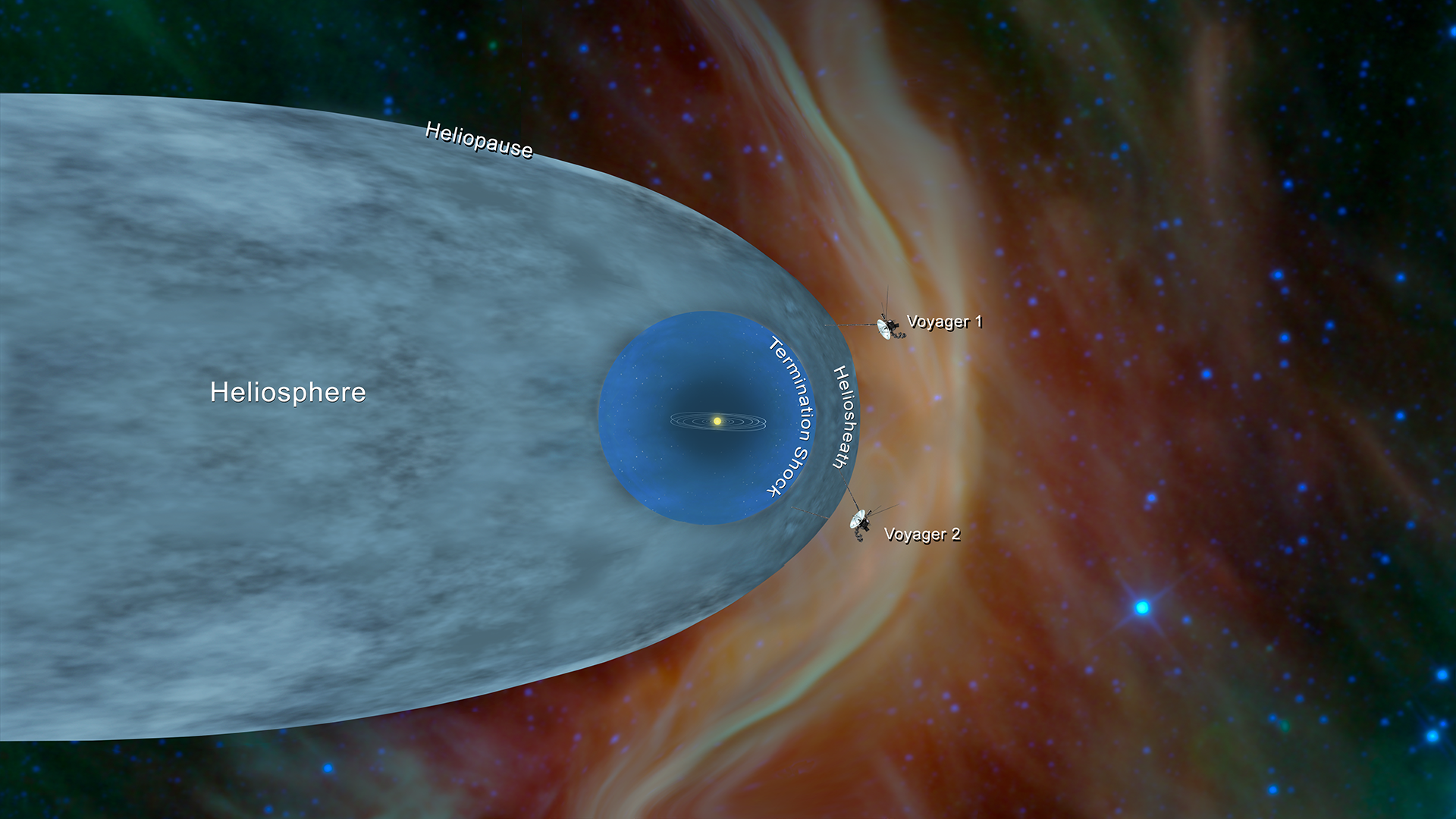
Flowing unimpeded through the Solar System for billions of kilometers, the solar wind extends far beyond even the region of Pluto until it encounters the "termination shock", where its motion slows abruptly due to the outside pressure of the interstellar medium. The "heliosheath" is a broad transitional region between the termination shock and the heliosphere's outmost edge, the "heliopause". The overall shape of the heliosphere resembles that of a comet, being roughly spherical on one side to around 100 astronomical units (AU), and on the other side being tail shaped, known as the "heliotail", trailing for several thousands of AUs.
Two Voyager program spacecraft explored the outer reaches of the heliosphere, passing through the termination shock and the heliosheath. Voyager 1 encountered the heliopause on 25 August 2012, when the spacecraft measured a sudden forty-fold increase in plasma density. Voyager 2 traversed the heliopause on 5 November 2018. Because the heliopause marks the boundary between matter originating from the Sun and matter originating from the rest of the galaxy, spacecraft that depart the heliosphere (such as the two Voyagers) are in interstellar space.
The heliosphere is thought to change significantly over the course of millions of years due to extrasolar effects such as closer supernovas or the traversing interstellar medium of different densities. Evidence suggests that up to three million years ago Earth was exposed to the interstellar medium due to it shrinking the heliosphere to the Inner Solar System, which possibly had impacted Earth's past climate and human evolution.
Despite its name, the heliosphere's shape is not a perfect sphere. Its shape is determined by three factors: the interstellar medium (ISM), the solar wind, and the overall motion of the Sun and heliosphere as it passes through the ISM. Because the solar wind and the ISM are both fluid, the heliosphere's shape and size are also fluid. Changes in the solar wind, however, more strongly alter the fluctuating position of the boundaries on short timescales (hours to a few years). The solar wind's pressure varies far more rapidly than the outside pressure of the ISM at any given location. In particular, the effect of the 11-year solar cycle, which sees a distinct maximum and minimum of solar wind activity, is thought to be significant.
On a broader scale, the motion of the heliosphere through the fluid medium of the ISM results in an overall comet-like shape. The solar wind plasma which is moving roughly "upstream" (in the same direction as the Sun's motion through the galaxy) is compressed into a nearly-spherical form, whereas the plasma moving "downstream" (opposite the Sun's motion) flows out for a much greater distance before giving way to the ISM, defining the long, trailing shape of the heliotail.
The limited data available and the unexplored nature of these structures have resulted in many theories as to their form. In 2020, Merav Opher led the team of researchers who determined that the shape of the heliosphere is a crescent that can be described as a deflated croissant.
The solar wind consists of particles (ionized atoms from the solar corona) and fields like the magnetic field that are produced from the Sun and stream out into space. Because the Sun rotates once approximately every 25 days, the heliospheric magnetic field transported by the solar wind gets wrapped into a spiral. The solar wind affects many other systems in the Solar System; for example, variations in the Sun's own magnetic field are carried outward by the solar wind, producing geomagnetic storms in the Earth's magnetosphere.
Hub AI
Heliosphere AI simulator
(@Heliosphere_simulator)
Heliosphere
The heliosphere is the magnetosphere, astrosphere, and outermost atmospheric layer of the Sun. It takes the shape of a vast, tailed bubble-like region of space. In plasma physics terms, it is the cavity formed by the Sun in the surrounding interstellar medium. The "bubble" of the heliosphere is continuously "inflated" by plasma originating from the Sun, known as the solar wind. Outside the heliosphere, this solar plasma gives way to the interstellar plasma permeating the Milky Way. As part of the interplanetary magnetic field, the heliosphere shields the Solar System from significant amounts of cosmic ionizing radiation; uncharged gamma rays are, however, not affected. Its name was likely coined by Alexander J. Dessler, who is credited with the first use of the word in the scientific literature in 1967. The scientific study of the heliosphere is heliophysics, which includes space weather and space climate.
Flowing unimpeded through the Solar System for billions of kilometers, the solar wind extends far beyond even the region of Pluto until it encounters the "termination shock", where its motion slows abruptly due to the outside pressure of the interstellar medium. The "heliosheath" is a broad transitional region between the termination shock and the heliosphere's outmost edge, the "heliopause". The overall shape of the heliosphere resembles that of a comet, being roughly spherical on one side to around 100 astronomical units (AU), and on the other side being tail shaped, known as the "heliotail", trailing for several thousands of AUs.
Two Voyager program spacecraft explored the outer reaches of the heliosphere, passing through the termination shock and the heliosheath. Voyager 1 encountered the heliopause on 25 August 2012, when the spacecraft measured a sudden forty-fold increase in plasma density. Voyager 2 traversed the heliopause on 5 November 2018. Because the heliopause marks the boundary between matter originating from the Sun and matter originating from the rest of the galaxy, spacecraft that depart the heliosphere (such as the two Voyagers) are in interstellar space.
The heliosphere is thought to change significantly over the course of millions of years due to extrasolar effects such as closer supernovas or the traversing interstellar medium of different densities. Evidence suggests that up to three million years ago Earth was exposed to the interstellar medium due to it shrinking the heliosphere to the Inner Solar System, which possibly had impacted Earth's past climate and human evolution.
Despite its name, the heliosphere's shape is not a perfect sphere. Its shape is determined by three factors: the interstellar medium (ISM), the solar wind, and the overall motion of the Sun and heliosphere as it passes through the ISM. Because the solar wind and the ISM are both fluid, the heliosphere's shape and size are also fluid. Changes in the solar wind, however, more strongly alter the fluctuating position of the boundaries on short timescales (hours to a few years). The solar wind's pressure varies far more rapidly than the outside pressure of the ISM at any given location. In particular, the effect of the 11-year solar cycle, which sees a distinct maximum and minimum of solar wind activity, is thought to be significant.
On a broader scale, the motion of the heliosphere through the fluid medium of the ISM results in an overall comet-like shape. The solar wind plasma which is moving roughly "upstream" (in the same direction as the Sun's motion through the galaxy) is compressed into a nearly-spherical form, whereas the plasma moving "downstream" (opposite the Sun's motion) flows out for a much greater distance before giving way to the ISM, defining the long, trailing shape of the heliotail.
The limited data available and the unexplored nature of these structures have resulted in many theories as to their form. In 2020, Merav Opher led the team of researchers who determined that the shape of the heliosphere is a crescent that can be described as a deflated croissant.
The solar wind consists of particles (ionized atoms from the solar corona) and fields like the magnetic field that are produced from the Sun and stream out into space. Because the Sun rotates once approximately every 25 days, the heliospheric magnetic field transported by the solar wind gets wrapped into a spiral. The solar wind affects many other systems in the Solar System; for example, variations in the Sun's own magnetic field are carried outward by the solar wind, producing geomagnetic storms in the Earth's magnetosphere.