Hubbry Logo
HeliportHeliportMain
Open search
Heliport
Community hub
Heliport
logo
8 pages, 0 posts
0 subscribers
Be the first to start a discussion here.
Heliport
Heliport
from Wikipedia
Not found
Revisions and contributorsEdit on WikipediaRead on Wikipedia
from Grokipedia

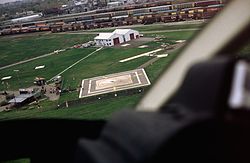
A heliport is an airport or designated area used or intended for the landing and takeoff of helicopters.
Heliports differ from conventional airports by accommodating vertical takeoff and landing aircraft, often in space-constrained locations such as urban rooftops, hospitals, or offshore platforms, and typically feature a touchdown and lift-off area (TLOF) surrounded by a final approach and takeoff area (FATO), with optional safety areas and support infrastructure like fueling stations and hangars.
Design standards, established by authorities like the Federal Aviation Administration (FAA) and International Civil Aviation Organization (ICAO), classify heliports into categories such as general aviation, transport, and hospital facilities to ensure safe operations for single-rotor, tandem, or coaxial helicopters.
These facilities support diverse applications, including emergency medical evacuations, executive transport, and industrial access, with regulations emphasizing obstacle clearance, lighting, and wind indicators to mitigate risks inherent to rotorcraft operations.

Definition and Classification

Core Definition

A heliport is an area of land, water, or structure used or intended to be used for the landing and takeoff of helicopters. This definition, established by the U.S. (FAA) under 14 CFR Part 1, emphasizes the functional purpose without mandating additional infrastructure, though practical implementations often include such elements. Heliports differ from helipads, which designate only the specific landing surface itself, typically a marked or prepared pad for vertical operations. In contrast, heliports may incorporate one or more helipads alongside supporting features like fueling stations, hangars, passenger terminals, or maintenance areas to facilitate sustained activity. The term extends to specialized variants, such as helidecks on offshore platforms or structures, but excludes temporary or unprepared sites like helispots used in . Heliports serve as for vertical-lift , enabling access to urban rooftops, remote terrains, or offshore locations inaccessible to fixed-wing planes. FAA 150/5390-2D provides standards for their design, focusing on safety surfaces, markings, and load-bearing capacities tailored to helicopter rotor dynamics and weights, with maximum gross weights up to 20,000 pounds for typical civil applications.

Types and Distinctions

A heliport is defined by the (FAA) as an identifiable area located on land, water, or a structure used or intended for the landing and takeoff of s, including designated associated areas such as approach/departure paths and transition surfaces, with facilities for support services like ing, , and handling. In contrast, a helipad refers solely to the load-bearing surface itself—typically paved or marked—upon which a lands and takes off, without implying broader or operational support. A helistop is a minimal heliport variant lacking amenities such as storage, repairs, or storage, designed primarily for occasional landings without sustained operations. These distinctions arise from regulatory needs to differentiate basic landing zones from facilities enabling regular, serviced traffic, as outlined in FAA 150/5390-2D, which emphasizes and scalability. Heliports are broadly classified by location and operational environment into onshore and offshore types. Onshore heliports operate on land or elevated structures like building rooftops, accommodating diverse uses from general aviation to emergency medical services; design criteria, per FAA standards, require a touchdown and liftoff (TLOF) area sized to the largest helicopter's overall length (typically 1:1 ratio), a final approach and takeoff (FATO) area at least 1.5 times the rotor diameter, and safety areas to mitigate hazards like debris dispersion. Offshore heliports, often termed helidecks, are situated on marine platforms, ships, or oil rigs, facing unique challenges like wave motion and saltwater corrosion; International Civil Aviation Organization (ICAO) Annex 14 Volume II specifies helidecks with circular or rectangular FATOs suited to helicopter undercarriage, plus netting barriers to prevent falls into the sea, reflecting empirical data from North Sea operations where such features reduced incident rates by containing rotor strikes. Further distinctions exist by intended use and scale. Transport heliports support scheduled commercial services with passenger terminals and hangars, as in FAA's classification for community vertical flight access, requiring robust pavement (e.g., Portland cement concrete for high-cycle durability) and integrated air traffic control. Hospital or medical heliports prioritize rapid access for air ambulances, often elevated on urban rooftops with reinforced structures to handle medical equipment loads up to 20,000 pounds, and proximity to emergency departments to minimize ground transport times—studies from U.S. trauma centers show such facilities cutting response delays by 30-50% in congested areas. Private or general-use heliports, conversely, may be simpler unprepared sites like fields, lacking certification but still bound by basic safety zones to avoid urban encroachments. ICAO further categorizes by performance class (e.g., Class 1 for helicopters with assured safe landing capability), influencing safety area dimensions based on rotorcraft dynamics and failure probabilities derived from historical crash data.

Historical Development

Origins in Helicopter Technology

The origins of the heliport are rooted in the technological advancements of the late and early that enabled practical vertical takeoff and landing (VTOL) capabilities in , distinguishing them from requiring runways. Prior experimental vertical flight devices, such as tethered models from the 19th and early 20th centuries, operated under constraints that limited free flight and thus did not demand specialized landing infrastructure. The pivotal breakthrough came with Igor Sikorsky's VS-300, which completed its first untethered, controlled flight on September 14, 1939, in , incorporating a single main rotor with cyclic pitch control for stability and maneuverability. This design resolved key engineering challenges like torque reaction and hovering precision, allowing operations from confined, unprepared surfaces and laying the groundwork for sites optimized for rather than airstrips. During World War II, military adoption accelerated the need for designated landing zones, though early operations predominantly used improvised areas such as fields, clearings, or vessel decks to leverage the helicopter's VTOL flexibility. The Sikorsky R-4, certified by the U.S. Army in May 1942 as the first helicopter produced in quantity (with 100 units built), saw deployment for tasks including liaison, rescue, and evacuation in remote or contested environments, such as Burma in 1944, where pilots touched down on uneven terrain without permanent facilities. These applications highlighted requirements for surfaces resistant to rotor downwash erosion and clear of obstacles, prompting the conceptualization of tailored pads. The term "heliport," derived from "helicopter" and "airport," first appeared around 1944 to describe such venues, anticipating post-war civilian uses like urban shuttles. Postwar visions of widespread helicopter commuting further drove heliport development, with early trials demonstrating the limitations of ad-hoc sites. In January 1947, the U.S. conducted experimental helicopter mail flights in the area using nine aircraft, which landed and took off from midtown rooftops and other urban spots, revealing risks from wind gusts, debris, and inadequate marking that necessitated purpose-built . Thus, the heliport emerged as a direct causal outcome of technology's maturation, enabling safe, repeatable operations in space-constrained environments through features like hardened pavements and visual aids absent in fields.

Expansion and Standardization Post-1940s

The post-World War II era witnessed accelerated expansion of heliports as helicopters transitioned from predominantly military applications to civilian roles, including urban passenger transport, , and industrial support. Early developments focused on establishing dedicated landing sites to accommodate growing commercial operations, with initial urban heliports appearing in major cities during the . For instance, the Port of New York Authority initiated rooftop heliport construction atop its headquarters in 1950, marking one of the first such facilities designed for regular aerial access in a dense urban environment. Concurrently, police departments and port authorities began operational heliports to support emergency and logistical needs, laying the groundwork for broader infrastructure integration. In the United States, companies like drove expansion by launching scheduled services in the , prompting plans for multiple urban heliports in areas such as , Manhattan's East Side, and Newark to facilitate short-haul commuter flights. Similar ambitions emerged internationally, with British cities advancing schemes for centrally located heliports throughout the and early 1960s to enable rapid vertical transport amid post-war urban reconstruction. However, realization rates were low; many proposals faltered due to high construction costs, noise concerns, and immature reliability, resulting in a patchwork of facilities rather than systematic networks. By the mid-1960s, heliport counts grew modestly, supported by advancements that extended range and , though commercial airline fleets still featured limited helicopters—only 19 in U.S. operations by the late . Standardization efforts gained traction as heliport proliferation highlighted inconsistencies in design and safety. , formed in 1958, issued its first Heliport Design Guide (AC 150/5390-1) in November 1964, offering advisory criteria for site preparation, pavement, markings, and wind indicators to ensure compatibility with single- and multiengine helicopters. These guidelines emphasized structural integrity for projected loads up to 50,000 pounds by 1960 and beyond, urging cities to plan resilient facilities amid anticipated growth. Subsequent iterations, such as AC 150/5390-2 series, refined these standards, addressing controversies over site-specific adaptations while prioritizing obstacle clearance and emergency access. Internationally, while ICAO's dedicated heliport provisions in Annex 14 Volume II emerged later in 1990, earlier standards from 1951 influenced basic physical characteristics and operations. This framework supported safer integration into airspace, though private and limited-use heliports often deviated, reflecting the era's emphasis on practical over uniform implementation.

Design and Infrastructure

Site Selection Criteria

Site selection for heliports prioritizes safety, operational efficiency, and minimal environmental disruption, guided by standards from aviation authorities such as the (FAA) and the (ICAO). Primary considerations include ensuring unobstructed approach and departure paths, stable terrain resistant to erosion from rotor downwash, and adequate separation from obstacles to mitigate and collision risks. Sites must accommodate the design helicopter's rotor diameter (D), typically the largest expected user, with clear zones scaled accordingly—such as a final approach and takeoff area (FATO) of at least 1D and transitional surfaces sloping at 2:1 over 250 feet (76 m). Terrain suitability demands level ground with maximum slopes of 2% for and liftoff areas (TLOF) and 1.5–2% for drainage to prevent , favoring paved surfaces like over asphalt for weight distribution and resistance. Soil stability must support the heaviest anticipated loads, with assessments for turf areas prone to downwash-induced degradation; in challenging environments like swamps, additional stabilization or specialist rescue provisions are required. Elevated sites, such as rooftops, necessitate a 3–6 meter air gap above structures to facilitate and reduce , which should be limited to 1.75 m/s standard deviation via or analysis. Airspace clearance forms a core criterion, requiring alignment of preferred approach/departure paths with predominant winds and separation of secondary paths by at least 135 degrees to avoid crosswinds exceeding safe limits. limitation surfaces include an 8:1 approach slope extending 4,000 feet (1,219 ) and 500 feet (152 ) wide at height, with a 210-degree -free sector featuring a 5:1 falling ; penetrations demand aeronautical studies and marking with red/white stripes or lights. Proximity to electromagnetic sources like MRI machines requires markings, such as a 6-foot , to alert pilots of potential interference. Noise abatement and compatibility influence site choice, with FAA-recommended helicopter protection zones (HPZ) of 280 feet (85 m) for or heliports and 400 feet (122 m) for operations to discourage residential or assembly uses within them. ICAO guidance emphasizes routing paths away from populated areas and limiting effects to three diameters from structures. Environmental factors extend to control, glare minimization via shielded lighting, and drainage systems capable of handling 200 liters of fuel spill within two minutes on a 1:100 . Accessibility and support infrastructure round out criteria, balancing proximity to service areas—such as hospitals for medevac—with sufficient distance to mitigate urban disturbances like traffic or exhaust plumes, which must vent 20–30 meters above the site. Property sizing should exceed airside needs to include fueling, parking, and disability-compliant access, with wind indicators placed outside safety areas for visibility up to 500 feet (152 m). Future-proofing for instrument procedures and multi-helicopter compatibility, per ICAO performance classes (PC1–3), ensures scalability without compromising one-engine-inoperative landing safety. Zoning ordinances and local approvals, informed by FAA Form 7480-1 notices, verify airspace impacts before development.

Pavement and Markings

The touchdown and lift-off area (TLOF) of a heliport requires a load-bearing pavement designed to support the design helicopter's under both static conditions—applied through the full contact area of wheels or skids—and dynamic conditions, equivalent to 150% of that weight concentrated on the main undercarriage or aft skids. For ground-level installations, is the preferred material due to its resistance to rutting and erosion from rotor , with a roughened (broomed) finish to ensure skid resistance; asphalt surfaces are less suitable owing to deformation risks under repeated loads. Elevated TLOFs, common in rooftop or settings, utilize aluminum, plating, or with non-slip coatings, designed per standards to handle equivalent dynamic loads plus support column stresses. Pavement construction incorporates drainage gradients to prevent ponding: for and hospital TLOFs, longitudinal slopes range from 0.5% to 2% (negative preferred), while transverse slopes are limited to 0.5% to 1.5%; and takeoff areas (FATOs) allow up to 5% slopes on non-load-bearing portions for rapid runoff, with shoulders graded at 3% to 5%. Unpaved FATOs or safety areas may employ stabilized turf or aggregate bases (e.g., mixed into the top 12 inches of ) for light-use heliports serving small helicopters, but these must minimize loose debris generation under , per construction specs in FAA AC 150/5370-10. Pavement thickness and preparation follow FAA AC 150/5320-6 guidelines, factoring in and expected traffic volume, with heavier transport heliports requiring thicker sections to avoid fatigue failure. Markings delineate operational boundaries and capacities, using high-visibility paints or retroreflective materials compliant with FAA AC 150/5340-1M for durability and reflectivity. The TLOF is identified by a centered white equilateral triangle-in-circle "H" symbol (proportioned per Figure 4-1 of AC 150/5390-2D), optionally with a 1-foot black bar indicating preferred direction; heliports substitute a red "H" with white cross overlay on a white background for identification. Weight and size limitations are marked adjacent to the "H" using 18- or 36-inch numerals (e.g., "9" for 9,000 pounds capacity or "D40" for 40-foot overall dimension), painted black on white rectangles to guide pilot selection of appropriate . FATO perimeters, if paved and load-bearing, feature 12-inch dashed white lines; unpaved FATOs use in-pavement retroreflective markers spaced 5 feet apart. Taxiways employ 6-inch yellow centerlines on paved surfaces or elevated blue/yellow markers on unpaved ones, spaced 10-15 feet, to define hover or ground paths without exceeding 35 feet width for safety. Parking circles are outlined in 12-inch yellow lines encompassing 0.83 times the helicopter's , with optional 18-inch positioning circles (TDPCs) for precise alignment. All markings prioritize contrast against the pavement color, with indicators (e.g., lighted tetrahedrons) placed to avoid interference, ensuring under varying conditions.

Lighting and Safety Features

Heliport lighting primarily consists of perimeter lights delineating the and lift-off area (TLOF) and, optionally, the and take-off area (FATO), using green omnidirectional fixtures to enhance visibility during . According to FAA Advisory Circular 150/5390-2D (effective January 5, 2023), TLOF perimeter lights employ FAA type L-852H in-pavement or L-860H elevated models, with a minimum average intensity of 10 candelas from 0 to 15 degrees and 5 candelas from 16 to 90 degrees, spaced no more than 25 feet (7.6 meters) apart, requiring at least four lights per side for square or rectangular TLOFs. These lights must conform to color standards in SAE AS 25050 for green and be installed per AC 150/5340-30, using load-bearing bases to withstand helicopter operations. Floodlights supplement perimeter lighting by illuminating the TLOF, FATO, and adjacent parking areas, particularly for transport heliports, with mounting on nearby structures directed downward and equipped with pilot-controllable switches to mitigate . Approach lighting includes optional white or landing direction lights spaced 10 to 30 feet apart along the preferred path, extending 20 to 60 feet from the TLOF edge, and flight path alignment lights for guidance. Wind indicators, such as segmented cone windsocks conforming to AC 150/5345-27, must be illuminated for night operations and positioned outside the safety area to remain visible from 500 feet. ICAO Annex 14, Volume II, aligns closely, specifying TLOF perimeter lights inset or elevated no higher than 25 cm, spaced at intervals not exceeding 5 meters, with floodlights for surface illumination and an illuminated . Safety features encompass designated safety areas surrounding the FATO, extending laterally by 0.28 to 0.50 times the rotor diameter (D) of the largest intended helicopter, cleared of obstacles, load-bearing structures, and flammable materials to accommodate excursions or emergencies. For elevated heliports more than 30 inches above ground, safety nets at least 5 feet wide with load capacities of 25 pounds per square foot for general aviation or hospital use and 50 pounds per square foot for transport operations provide fallback protection, installed at or below the TLOF/FATO level without permanent railings that could pose hazards. Perimeter fencing or barriers outside the safety area, combined with caution signage and access controls, prevent unauthorized entry, while electromagnetic interference zones are marked with 6-foot-diameter compass roses in blue and white paint. Fire safety integrates access for hoses and extinguishers at fueling points, adhering to NFPA 418 guidelines for heliport fire protection, though FAA standards defer to local fire authorities for specific provisions. Obstacles within approach/departure paths are marked with frangible red or white lights not exceeding 2 inches in height, ensuring compliance with AC 70/7460-1 for obstruction evaluation.

Operational Procedures

Airspace and Path Management

Airspace and path management for heliports focuses on defining protected flight corridors for helicopter approaches and departures, ensuring obstacle-free zones that accommodate vertical maneuvers while minimizing collision risks with terrain, structures, or other . These measures establish imaginary clearance surfaces and designated paths, adapting airport-like protections to helicopters' hover and low-speed capabilities, which allow steeper approaches than but still demand clear lines of sight and altitude buffers. (FAA) standards in Advisory Circular 150/5390-2D mandate notification under 14 CFR Part 157 for heliport construction and Part 77 for potential obstructions to navigable airspace, requiring aeronautical studies to evaluate impacts. Approach and departure paths represent the primary flight tracks for and takeoff, typically straight or curved to align with site constraints and . At minimum, heliports must provide two such paths, with one oriented to predominant wind directions and additional paths separated by at least 135 degrees to enable flexible operations. For (VFR), these paths extend 4,000 feet with an 8:1 glide slope, widening to 500 feet at 500 feet above the final approach and takeoff (FATO) area; curved variants require a minimum radius of 886 feet and segment lengths ensuring safe turn geometry. Transitional surfaces extend laterally at a 2:1 slope from path edges, 250 feet from the centerline, to shield against side encroachments. Traffic patterns at heliports often deviate from standard rectangles due to lower volumes and vertical flexibility, with helicopters operating at 500 feet above ground level (AGL)—closer and lower than fixed-wing patterns—and using straight-in, departure, or abbreviated rectangular circuits to expedite operations and avoid noise-sensitive areas. Pilots must deviate as needed for , prioritizing wind-aligned entries and ground references, while prior permission is required (PPR) at controlled sites to coordinate paths. (ICAO) Annex 14, Volume II, aligns with these by prescribing obstacle limitation surfaces to delineate protected volumes around heliports, emphasizing physical characteristics that prevent penetrations without evaluation. Ground-level protections complement aerial management via the Heliport Protection Zone (HPZ), extending 280 feet (/hospital) or 400 feet (transport) from FATO edges beneath paths at an 8:1 , restricting uses like residences to reduce surface risks from crashes or falling . Ongoing includes annual obstacle surveys for growth (e.g., trees) and frangible designs for unavoidable fixtures, with per AC 150/5190-4 recommended to enforce height limits and compatible land uses. Instrument procedures, where applicable, invoke stricter Surfaces under Chapter 6 of the FAA circular, ensuring climb gradients and visibility minima.

Standard Uses and Traffic Patterns

Heliports serve operations, accommodating helicopters with a (MTOW) of 12,500 pounds or less for private, corporate, aerial tourism, and public safety missions such as and . heliports support scheduled passenger and services with larger helicopters exceeding 12,500 pounds MTOW, often in remote or offshore environments like oil platforms. heliports enable air functions, facilitating rapid patient transport from accident scenes or inter-facility transfers, with designs incorporating direct access for medical personnel and equipment. Unlike fixed-wing airports, heliport traffic patterns emphasize direct vertical capabilities, typically featuring straight-in approaches and departures aligned with predominant winds to minimize exposure time and noise. Where circuit patterns are used—such as at busier sites or for —helicopters operate at approximately 500 feet above ground level, flying tighter rectangles closer to the final approach and takeoff area (FATO) than , which circle at 1,000 feet or higher. Approach and departure paths require at least two designated routes separated by a minimum of 135 degrees, each providing an 8:1 transitional for obstacle clearance over a 4,000-foot length, expanding to 500 feet wide at 500 feet height. Curved paths, optional for or sites, maintain a minimum of 886 feet to accommodate , , or noise abatement while preserving the 8:1 . Operations assume one per FATO at a time, with pilots coordinating via prior permission required (PPR) protocols at non-public sites to manage sequencing and avoid conflicts.

Regulatory Standards

International Guidelines (ICAO)

The (ICAO) establishes global Standards and Recommended Practices (SARPs) for heliports primarily through Annex 14, Volume II — Heliports, which prescribes specifications for physical characteristics, obstacle limitation surfaces, and associated facilities and technical services to ensure safe operations. These standards apply to both onshore and offshore heliports, defining a heliport as an or defined area on a structure used for arrival, departure, and surface movement. The 5th edition, effective July 2020, bases design requirements on the critical design helicopter's largest dimensions and maximum take-off mass, excluding direct regulation of flight operations (governed by Annex 6, Part III). Physical characteristics outlined in Annex 14, Volume II include dimensions for the and take-off area (FATO) and touch-down and lift-off area (TLOF), tailored to categories by size and class to accommodate safe and hovering. Obstacle limitation surfaces establish clear zones around the heliport to mitigate risks from terrain or structures, with specified heights and slopes to protect approach and departure paths. Visual aids encompass markings for FATO and TLOF boundaries, indicators, and systems for night or low-visibility operations, ensuring pilots can identify safe zones. Rescue and fire-fighting services are mandated based on heliport category, requiring and response times proportional to the largest helicopter's load and capacity. Complementary guidance appears in the Heliport Manual (Doc 9261, 5th edition, 2021), which elaborates on Annex 14 implementation for offshore (e.g., platforms and vessels) and onshore environments, incorporating best practices for design, operations, and like performance-based approaches. ICAO member states must comply with these SARPs or notify differences via their national aeronautical information publications, promoting harmonized without overriding local adaptations for terrain or usage. Updates to Annex 14, developed by the Aerodrome Design and Operations Panel, reflect empirical data on dynamics and analyses to refine clearances and lighting intensities.

National Implementations (e.g., FAA)

In the United States, the (FAA) provides non-mandatory guidance for heliport design and operation via (AC) 150/5390-2D, Heliport Design, issued May 1, 2023, which recommends standards tailored to with single rotors while noting applicability to tandem-rotor types. This document specifies sizing for key areas, such as a touchdown and lift-off (TLOF) area at least equal to the rotor diameter (D) of the largest design , a and takeoff (FATO) area of 1.5 times the overall length including rotors (OD), and safety areas extending beyond these to mitigate risks like or wind effects. Unlike , heliports require no FAA , but 14 CFR Part 157 mandates notification for construction, substantial alteration, or deactivation to allow hazard evaluation and obstruction charting. Compliance with AC 150/5390-2D becomes effectively binding for federally funded or public-use facilities through incorporation into state building codes, standards, and local , as evidenced by varying state adoption rates documented in FAA-related studies. In the , the (EASA) enforces Certification Specifications for Heliports Design (CS-HPT-DSN), established via ED Decision 2019-012-R on September 23, 2019, which apply to surface-level (VFR) heliports regardless of public access. These specs detail physical characteristics like load-bearing surfaces, obstacle limitation surfaces with graded slopes (e.g., 1:8 for approach surfaces), and visual aids including indicators and lighted perimeters, enabling national authorities to issue certifications under Regulation (EU) No 965/2012. CS-HPT-DSN aligns closely with ICAO Annex 14 but adds EU-specific rigor, such as mandatory rescue and firefighting services scaled by helicopter size categories (H1 to H4). Canada's requires certified heliports to meet Standard 325 under the Canadian Aviation Regulations (), updated as of August 29, 2025, which prescribes minimum physical specifications including non-combustible TLOF surfaces, frangible markings, and lighting for night operations. Public-use heliports must obtain certificates per 305, ensuring compliance with clearance (e.g., 150-foot transitional surfaces) and operational notifications, with advisory circulars like AC 305-002 providing guidance on rooftop designs and combustible material restrictions. These standards support certification for over 1,000 registered heliports, emphasizing integration with . National variations reflect differing emphases: the U.S. prioritizes advisory flexibility to accommodate diverse private uses, while EASA and impose prescriptive to standardize across borders.

Recent Updates and Legislation

In April 2025, the (ICAO) adopted amendments to its standards, introducing mandatory requirements for international heliports, including the implementation of management systems to enhance operational and oversight. These changes also address heliport and operations, incorporating provisions for vertical flight procedures and improved navigation aids to accommodate evolving demands. The U.S. (FAA) issued (AC) 150/5390-2D, Heliport Design, on January 5, 2023, providing updated standards for planning, , and marking of heliports serving single-rotor, , or coaxial helicopters, with emphasis on approach/departure surfaces, obstacle clearance, and wind indicators. This AC supersedes prior versions and integrates lessons from empirical data, such as mitigation and pavement load-bearing capacities tailored to helicopter weights up to 30,000 pounds. In December 2024, the FAA released Engineering Brief (EB) 105A, Vertiport Design, as supplemental guidance to AC 150/5390-2D, adapting heliport infrastructure for aircraft by specifying revised landing area geometries, charging infrastructure classifications, and enhanced markings for low-altitude operations. These updates, effective immediately as non-binding guidance, prioritize compatibility with advanced air mobility while maintaining core heliport safety parameters like final approach and takeoff (FATO) dimensions. The FAA Reauthorization Act of 2024 (H.R. 3935) mandates a strategy for integrating advanced aviation technologies, including provisions for heliport upgrades to support unmanned and hybrid operations within the , with implementation timelines extending through 2028. At the state level, Florida's Senate Bill 1662, enacted in 2025, incentivizes vertiport development by streamlining permitting for facilities compatible with existing heliports, aiming to bolster infrastructure for vertical flight without altering federal design baselines.

Safety and Risk Assessment

Built-in Safety Measures

Heliports are designed with designated zones to minimize risks from operational excursions, including the and liftoff (TLOF) area, and takeoff (FATO) area, and surrounding area. The TLOF, typically paved and load-bearing to support the helicopter's , ensures a stable landing surface free of protrusions that could damage undercarriage or . The FATO encompasses the TLOF and provides additional clearance for maneuvering, with dimensions scaled to the largest intended helicopter's overall length and diameter—often at least 1.5 times the diameter in width and length for single-main- aircraft. The area extends beyond the FATO by at least one-third of the helicopter's main diameter or 20 feet (6 meters), whichever is greater, and must remain free of obstacles to accommodate potential skids or drifts during low-visibility or gusty conditions. Obstacle limitation surfaces are integral to heliport layout, defining conical or transitional volumes above and around the FATO where penetrations are restricted to prevent collisions during approach or departure. These surfaces, informed by helicopter performance data, ensure vertical and horizontal clearances—such as 0.25:1 slopes for approach paths—accounting for rotor downwash and pilot reaction times. Ground-level safety features include perimeter fencing at least 4 feet (1.2 meters) high to deter unauthorized access and reduce foreign object debris (FOD) risks, often supplemented by frangible markers for wires or low obstacles. Surfaces incorporate anti-slip treatments, such as grooved concrete or textured asphalt, to enhance traction under wet or oily conditions, with load capacities verified to exceed 2,000 pounds per square foot (96 kPa) for typical light helicopters. International standards from ICAO reinforce these measures, mandating a safety area around the FATO extending at least 3 meters (10 feet) or one-quarter of the helicopter's diameter, whichever is larger, to buffer against ground effect turbulence and excursions. Cleared approach and departure paths, evaluated for terrain and structures, incorporate visual cues like segmented circles to guide pilots away from hazards, reducing controlled flight into terrain probabilities based on empirical helicopter accident analyses showing 20-30% of incidents tied to spatial disorientation or obstacle strikes. These built-in elements collectively lower accident rates by enforcing deterministic clearances derived from helicopter dynamics, rather than relying solely on pilot skill.

Empirical Accident Data

A review of U.S. data from 1977 to 1986 documented 2,695 total accidents, of which 106 occurred at heliports, comprising 4% of the aggregate. These heliport incidents equated to roughly 3-5% of annual accidents during the period, with an overall accident rate of 10.1 per 100,000 flight hours in the later years (1983-1986). Design-related mishaps at dedicated heliports averaged about 2% annually, predominantly involving obstacle strikes to rotors or during takeoff, , or hover operations. Compliance with heliport design standards ( 150/5390-2) correlated with less than 1% such incidents. A historical analysis of civil accidents at U.S. designated vertical lift infrastructure sites, including heliports, recorded 185 incidents from 1965 to 2013, averaging under 4 per year nationwide. Primary causal factors were obstruction encounters and inadequate site sizing or layout, rather than infrequent issues like or surface ; pilot assessments often overlooked flaws, leading to misattribution of error. Facility design deficiencies contributed to approximately 4% of all civil accidents across landing sites, but only 2% at purpose-built heliports. Proximity risk assessments indicate heliports pose minimal hazard to adjacent areas, with modeled exposure yielding one within 1 mile of a site handling 400 annual operations occurring once every 495 years. Broader U.S. accident rates have declined steadily, reaching 2.99 per 100,000 flight hours in 2024—the lowest in 25 years—with fatal rates similarly dropping to historic lows, though heliport-specific recent data remains limited. In specialized operations like air ambulances, fatal during phases fell to 6% of total incidents in 2016-2021, compared to 9% in 2010-2015, reflecting regulatory and procedural enhancements. These patterns underscore that while low-volume, heliport cluster around preventable environmental and infrastructural mismatches rather than inherent operational volatility.

Controversies and Criticisms

Noise and Environmental Claims

Helicopter operations at urban heliports generate levels that frequently elicit community complaints, with empirical measurements showing peaks exceeding 80-90 dB(A) during , contributing to sleep disturbance and reduced for nearby residents. A 2021 study of the London Heliport found that emissions propagated over distances up to 2 kilometers, correlating with self-reported annoyance rates among locals that outpaced model predictions based on levels. In , heliport-facilitated flights drew 17,733 complaints in the first nine months of 2021, underscoring persistent tensions despite mitigation efforts like flight curfews. The U.S. Federal Aviation Administration's Heliport Model (HNM), developed in the and updated periodically, forecasts exposure contours but has been critiqued for underestimating subjective impacts from the broadband, impulsive character of rotor , which differs from steady-state fixed-wing sources. Environmental claims against heliports center on both acoustic and atmospheric effects, though data specific to landing sites remains sparser than for en-route flights. Helicopter engines at heliports emit , nitrogen oxides, and particulates during idling and hover phases, with aggregate operations in dense areas like linked to localized air quality degradation per analyses—though such advocacy groups may amplify impacts relative to broader urban emissions sources. Noise propagation from heliports disturbs , prompting behavioral changes such as elevated and foraging avoidance in avian within 500 meters, as documented in proximity studies to air tour operations. Federal assessments acknowledge these effects but note insufficient standardized protocols for heliport-specific evaluations, leading to variable regulatory responses. Critics, including residents and environmental organizations, contend that heliports exacerbate cumulative urban burdens without commensurate technological offsets, such as quieter designs adopted post-2010 in some models. Empirical and exposure data, however, indicate that while annoyance is widespread, quantifiable health outcomes like remain rare outside occupational contexts, suggesting claims sometimes outpace causal evidence from long-term monitoring. Proponents counter that heliports enable efficient emergency and medical evacuations, where trade-offs align with net societal benefits, though independent verification of such balances is limited by inconsistent baseline studies.

Urban Development Conflicts

Urban heliports often clash with surrounding land-use priorities, where proposals for high-density residential, commercial, or recreational development encroach on required clear zones, approach paths, and safety buffers, prompting disputes and regulatory interventions. These conflicts stem from fundamental incompatibilities: helicopters demand unobstructed vertical and horizontal clearances to mitigate risks like from tall structures or visual obstructions during low-altitude maneuvers, while urban expansion prioritizes maximizing buildable space in land-scarce cities. Federal aviation authorities, such as the FAA, recommend strict height restrictions around heliports to preserve imaginary surfaces defining safe operational envelopes, a measure implemented in several U.S. case studies to avert development-induced hazards. A prominent example occurred in in April 2025, when operators of the London Heliport formally objected to a developer's plan for a 35-storey mixed-use tower immediately adjacent to the facility, warning of deadly from building wakes that could destabilize helicopters during takeoff and landing, particularly for . The objection highlighted how such vertical developments could violate Civil Aviation Authority safety guidelines by altering airflow patterns and reducing pilot margins for error in a confined urban . Similar safety-driven opposition has arisen elsewhere, as in , where heliport managers emphasized the tower's proximity—mere meters from flight paths—as a direct threat to operational viability without compensatory mitigations like redesigned approaches, which are often infeasible in built environments. In , the West 30th Street Heliport has exemplified land-use tensions since its establishment, with critics arguing that its commercial operations within infringe on public recreational space designated for non-aviation development, leading to repeated calls for relocation or downsizing amid broader redevelopment pressures. Zoning courts have upheld municipal authority over such sites; for instance, a 1986 Connecticut Supreme Court ruling in Helicopter Associates v. City of Stamford affirmed that local nonconforming use regulations could limit heliport expansions without preempting state aeronautics oversight, prioritizing community land-use plans over aviation claims unless federally mandated. Likewise, a 2018 Massachusetts Appeals Court decision in a private heliport case supported a town's prohibition under local bylaws, citing inadequate buffers from residential zones and potential noise propagation as valid grounds for denial, illustrating how empirical risk assessments—factoring in crash probabilities and population densities—inform judicial outcomes. These precedents underscore that while heliports serve critical functions, urban frameworks often prevail when development conflicts reveal causal risks unsupported by compensatory infrastructure.

Applications and Societal Impact

Primary Use Cases

Heliports serve as for helicopter emergency medical services (HEMS), where rooftop or ground-level facilities at s enable swift patient evacuations and inter-facility transfers, particularly in urban or remote areas where ground ambulances face delays. , heliports are classified as private-use facilities providing , supporting air ambulances that can reduce mortality risks by up to 25% for critically injured patients through faster transport times compared to ground vehicles. For instance, in , heliports facilitate connections between regional s and specialized urban centers for in emergencies such as trauma or cardiac events. Corporate and executive transportation represents another core application, with heliports integrated into business operations to link headquarters with remote plants, construction sites, or offshore installations, minimizing travel time for personnel and executives. guidelines highlight helicopters' role in corporate in-house systems, often involving dedicated heliports with fueling and support for frequent short-haul flights. These facilities are prevalent in industries like and , where heliports enable efficient crew rotations without reliance on larger airports. Tourism and sightseeing operations leverage heliports for aerial tours and shuttle services, particularly in scenic or congested destinations, with helicopters capturing 5–20% in tourist mobility for flights of 50–100 km serving 30–40 passengers daily. Public heliports near landmarks, such as those at , support these activities by providing quick access points for inbound flights, enhancing visitor experiences in areas inaccessible by road. Public safety and utility uses include , , and search-and-rescue missions, where heliports act as staging areas for rapid deployment during disasters, as evidenced by increased operations—up to 34 per day—during events like floods or industrial emergencies. Offshore heliports, common in oil and gas sectors, further extend these capabilities by supporting and evacuation from platforms, underscoring heliports' versatility in high-risk environments.

Economic and Efficiency Benefits

Heliports provide substantial efficiency gains through point-to-point transport, which circumvents road congestion and enables vertical landings in urban or remote locations inaccessible to ground vehicles. In urban settings like , flights from to typically take 15-20 minutes, compared to over 60 minutes by car or rail during , yielding direct time savings for passengers and cargo. This advantage extends to , where emergency medical systems (HEMS) offer shorter prehospital times than ground EMS for distances exceeding 50 kilometers, enhancing response efficacy in trauma cases. In offshore applications, helicopters from dedicated heliports reduce crew transfer times to oil platforms to under an hour, versus 8-12 hours by sea, minimizing downtime and operational disruptions in the energy sector. Economically, heliports drive activity via operations, maintenance, and ancillary services, generating employment and multiplier effects. In , heliport usage contributed $78 million in annual economic impact as of 2024, including $50 million in direct operator spending on fuel and supplies and $20 million in indirect effects from employee expenditures, according to analysis by the . Smaller facilities demonstrate scalable benefits; the DeSoto Heliport in supported 37 jobs, $1.8 million in , and $7.1 million in total output in 2017, per a study using FAA-guided input-output modeling that accounts for on-site, visitor, and construction impacts. In and sectors, heliports facilitate revenue through aerial tours and executive shuttles, with the global helicopter market exceeding $500 million in yearly earnings as of recent industry assessments. Offshore heliports underpin oil and gas , where helicopter services enable efficient crew rotations and supply chains critical to industry productivity, correlating with broader economic expansions in during high-demand periods. These benefits arise from helicopters' unique capabilities, though realization depends on usage volume and integration.

Future Integration with Advanced Aviation

The integration of heliports with advanced aviation technologies, particularly electric vertical takeoff and landing () aircraft and (UAM) systems, is anticipated to leverage existing infrastructure while requiring targeted upgrades for electrification, automation, and higher operational throughput. Vertiports, specialized facilities for eVTOL operations, are often classified by regulators as extensions of heliports, enabling dual-use or hybrid designs that accommodate both conventional helicopters and battery-powered air taxis. This approach minimizes the need for entirely new by retrofitting heliports with features such as high-voltage charging stations, automated systems, and reinforced landing pads capable of handling eVTOL downwash patterns distinct from helicopter rotors. Regulatory frameworks are evolving to support this convergence, with the U.S. (FAA) issuing Brief 105A on December 27, 2024, which supplements 150/5390-2D for heliport design and explicitly addresses vertiport planning for vertical takeoff and landing (VTOL) aircraft. The guidance emphasizes performance-based standards for , including blast deflection, fire suppression for lithium-ion batteries, and integration with to prevent conflicts with manned and unmanned operations. Updated FAA vertiport standards released on January 15, 2025, further refine these requirements, mandating considerations for eVTOL-specific noise profiles, which are quieter than traditional helicopters, and rapid recharge cycles to enable frequent short-haul flights. By December 31, 2025, the FAA is required to publish a comprehensive performance-based vertiport design , facilitating broader adoption. Practical implementations demonstrate feasibility, as seen in the transformation of the Cruise Terminal helipad into the ' first hybrid heliport, approved by the General Agency on April 23, 2025, to support Archer Aviation's services. In , Atlantic Aviation began installing chargers at the East 34th Street Heliport on October 18, 2024, to prepare for integration, while the received a new operator on December 9, 2024, tasked with upgrades for UAM infrastructure. These projects highlight cost efficiencies, with existing heliports potentially reducing vertiport development expenses by 30-50% compared to greenfield sites, though challenges persist in scaling for projected UAM demand, including congestion and grid capacity for charging fleets. Commercial operations at such hybrid facilities are slated to commence as early as 2026, with forecasts indicating s could handle intra-city passenger transport by 2035, complementing rather than replacing heliports.

References

Add your contribution
Related Hubs
User Avatar
No comments yet.