Hubbry Logo
Compass roseCompass roseMain
Open search
Compass rose
Community hub
Compass rose
logo
8 pages, 0 posts
0 subscribers
Be the first to start a discussion here.
Contribute something
Compass rose
Compass rose
from Wikipedia

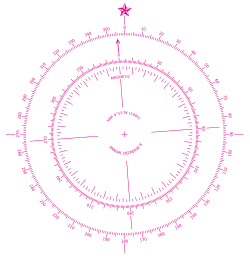
A common compass rose as found on a nautical chart showing both true north (using a nautical star symbol) and magnetic north with magnetic variation. Also notice the correspondence between the 32-point rose (inner circle) and the modern 0–360° graduations.
Compass rose with the eight principal winds.

A compass rose or compass star, sometimes called a wind rose or rose of the winds, is a polar diagram displaying the orientation of the cardinal directions (north, east, south, and west) and their intermediate points. It is used on compasses (including magnetic ones), maps (such as compass rose networks), or monuments. It is particularly common in navigation systems, including nautical charts, non-directional beacons (NDB), VHF omnidirectional range (VOR) systems, satellite navigation devices ("GPS").

Types

[edit]

Linguistic anthropological studies have shown that most human communities have four points of cardinal direction. The names given to these directions are usually derived from either locally-specific geographic features (e.g. "towards the hills", "towards the sea") or from celestial bodies (especially the sun) or from atmospheric features (winds, temperature).[1] Most mobile populations tend to adopt sunrise and sunset for East and West and the direction from where different winds blow to denote North and South.

Classical

[edit]

The ancient Greeks originally maintained distinct and separate systems of points and winds. The four Greek cardinal points (arctos, anatole, mesembria and dusis) were based on celestial bodies and used for orientation. The four Greek winds (Boreas, Notos, Eurus, Zephyrus) were confined to meteorology. Nonetheless, both systems were gradually conflated, and wind names came eventually to denote cardinal directions as well.[2]

In his meteorological studies, Aristotle identified ten distinct winds: two north–south winds (Aparctias, Notos) and four sets of east–west winds blowing from different latitudes—the Arctic Circle (Meses, Thrascias), the summer solstice horizon (Caecias, Argestes), the equinox (Apeliotes, Zephyrus) and the winter solstice (Eurus, Lips). Aristotle's system was asymmetric. To restore balance, Timosthenes of Rhodes added two more winds to produce the classical 12-wind rose, and began using the winds to denote geographical direction in navigation. Eratosthenes deducted two winds from Aristotle's system, to produce the classical eight-wind rose.[citation needed]

The Romans (e.g. Seneca, Pliny) adopted the Greek 12-wind system, and replaced its names with Latin equivalents, e.g. Septentrio, Subsolanus, Auster, Favonius, etc. The De architectura of the Roman architect Vitruvius describes 24 winds.[3]

Classical 12-wind rose, with Greek (blue) and Latin (red) names (from Seneca)

According to the chronicler Einhard (c. 830), the Frankish king Charlemagne himself came up with his own names for the classical 12 winds.[4] During the Migration Period, the Germanic names for the cardinal directions entered the Romance languages, where they replaced the Latin names borealis with north, australis with south, occidentalis with west and orientalis with east.[5]

The following table gives a rough equivalence of the classical 12-wind rose with the modern compass directions (The directions are imprecise since it is not clear at what angles the classical winds are supposed to be with each other; some have argued that they should be equally spaced at 30 degrees each; for more details, see the article on Classical compass winds).[citation needed]

Wind Greek Roman Frankish
N Aparctias (ἀπαρκτίας) or
Boreas (βoρέας)
Septentrio Nordroni
NNE Meses (μέσης) Aquilo Nordostroni
NE Caicias (καικίας) Caecias Ostnordroni
E Apeliotes (ἀπηλιώτης) Subsolanus Ostroni
SE Eurus (εὖρος) Vulturnus Ostsundroni
SSE Euronotus (εὐρόνοτος) Euronotus Sundostroni
S Notos (νότος) Auster Sundroni
SSW Libonotos (λιβόνοτος) Libonotus
or Austroafricus
Sundvuestroni
SW Lips (λίψ) Africus Vuestsundroni
W Zephyrus (ζέφυρος) Favonius Vuestroni
NW Argestes (ἀργέστης) Corus Vuestnordroni
NNW Thrascias (θρασκίας) Thrascias or Circius Nordvuestroni

Sidereal

[edit]

The sidereal compass rose demarcates the compass points by the position of stars ("steering stars"; not to be confused with zenith stars)[6] in the night sky, rather than winds. Arab navigators in the Red Sea and the Indian Ocean, who depended on celestial navigation, were using a 32-point sidereal compass rose before the end of the 10th century.[7][8][9] In the Northern Hemisphere, the steady Pole Star (Polaris) was used for the N–S axis; the less-steady Southern Cross had to do for the Southern Hemisphere, as the southern pole star, Sigma Octantis, is too dim to be easily seen from Earth with the naked eye. The other thirty points on the sidereal rose were determined by the rising and setting positions of fifteen bright stars. Reading from North to South, in their rising and setting positions, these are:[10]

Point Star
N Polaris
NbE "the Guards" (Ursa Minor)
NNE Alpha Ursa Major
NEbN Alpha Cassiopeiae
NE Capella
NEbE Vega
ENE Arcturus
EbN the Pleiades
E Altair
EbS Orion's belt
ESE Sirius
SEbE Beta Scorpionis
SE Antares
SEbS Alpha Centauri
SSE Canopus
SbE Achernar
S Southern Cross

The western half of the rose would be the same stars in their setting position. The true position of these stars is only approximate to their theoretical equidistant rhumbs on the sidereal compass. Stars with the same declination formed a "linear constellation" or kavenga to provide direction as the night progressed.[11]

A similar sidereal compass was used by Polynesian and Micronesian navigators in the Pacific Ocean, although different stars were used in a number of cases, clustering around the east–west axis.[12][6]

Mariner's

[edit]

In Europe, the Classical 12-wind system continued to be taught in academic settings during the Medieval era, but seafarers in the Mediterranean came up with their own distinct 8-wind system. The mariners used names derived from the Mediterranean lingua franca, composed principally of Ligurian, mixed with Venetian, Sicilian, Provençal, Catalan, Greek and Arabic terms from around the Mediterranean basin.

32-wind compass with traditional names (and traditional color code)
  • (N) Tramontana
  • (NE) Greco (or Bora)
  • (E) Levante
  • (SE) Scirocco (or Exaloc)
  • (S) Ostro (or Mezzogiorno)
  • (SW) Libeccio (or Garbino)
  • (W) Ponente
  • (NW) Maestro (or Mistral)

The exact origin of the mariner's eight-wind rose is obscure. Only two of its point names (Ostro, Libeccio) have Classical etymologies, the rest of the names seem to be autonomously derived. Two Arabic words stand out: Scirocco (SE) from al-Sharq (الشرق – east in Arabic) and the variant Garbino (SW), from al-Gharb (الغرب – west in Arabic). This suggests the mariner's rose was probably acquired by southern Italian seafarers; not from their classical Roman ancestors, but rather from Norman Sicily in the 11th to 12th centuries.[13] The coasts of the Maghreb and Mashriq are SW and SE of Sicily respectively; the Greco (a NE wind), reflects the position of Byzantine-held Calabria-Apulia to the northeast of Arab Sicily, while the Maestro (a NW wind) is a reference to the Mistral wind that blows from the southern French coast towards northwest Sicily.[citation needed]

The 32-point compass used for navigation in the Mediterranean by the 14th century, had increments of 1114° between points. Only the eight principal winds (N, NE, E, SE, S, SW, W, NW) were given special names. The eight half-winds just combined the names of the two principal winds, e.g. Greco-Tramontana for NNE, Greco-Levante for ENE, and so on. Quarter-winds were more cumbersomely phrased, with the closest principal wind named first and the next-closest principal wind second, e.g. "Quarto di Tramontana verso Greco" (literally, "one quarter wind from North towards Northeast", i.e. North by East), and "Quarto di Greco verso Tramontana" ("one quarter wind from NE towards N", i.e. Northeast by North). Boxing the compass (naming all 32 winds) was expected of all Medieval mariners.[citation needed]

Depiction on nautical charts

[edit]

In the earliest medieval portolan charts of the 14th century, compass roses were depicted as mere collections of color-coded compass rhumb lines: black for the eight main winds, green for the eight half-winds and red for the sixteen quarter-winds.[14] The average portolan chart had sixteen such roses (or confluence of lines), spaced out equally around the circumference of a large implicit circle.

The cartographer Cresques Abraham of Majorca, in his Catalan Atlas of 1375, was the first to draw an ornate compass rose on a map. By the end of the 15th century, Portuguese cartographers began drawing multiple ornate compass roses throughout the chart, one upon each of the sixteen circumference roses (unless the illustration conflicted with coastal details).[15]

The points on a compass rose were frequently labeled by the initial letters of the mariner's principal winds (T, G, L, S, O, L, P, M). From the outset, the custom also began to distinguish the north from the other points by a specific visual marker. Medieval Italian cartographers typically used a simple arrowhead or circumflex-hatted T (an allusion to the compass needle) to designate the north, while the Majorcan cartographic school typically used a stylized Pole Star for its north mark.[16] The use of the fleur-de-lis as north mark was introduced by Pedro Reinel, and quickly became customary in compass roses (and is still often used today). Old compass roses also often used a Christian cross at Levante (E), indicating the direction of Jerusalem from the point of view of the Mediterranean sea.[17]

The twelve Classical winds (or a subset of them) were also sometimes depicted on portolan charts, albeit not on a compass rose, but rather separately on small disks or coins on the edges of the map.

The compass rose was also depicted on traverse boards used on board ships to record headings sailed at set time intervals.

Modern depictions

[edit]
A 16-point compass rose on the grounds of a library serves both as a pedagogical device and public art.
Compass Rose in Galicia, Spain

The contemporary compass rose appears as two rings, one smaller and set inside the other. The outside ring denotes true cardinal directions while the smaller inside ring denotes magnetic cardinal directions. True north refers to the geographical location of the North Pole while magnetic north refers to the direction towards which the north pole of a magnetic object (as found in a compass) will point. The angular difference between true and magnetic north is called variation, which varies depending on location.[18] The angular difference between magnetic heading and compass heading is called deviation which varies by vessel and its heading. North arrows are often included in contemporary maps as part of the map layout. The modern compass rose has eight principal winds. Listed clockwise, these are:

Compass point Abbr. Heading Traditional wind
North N Tramontana
North-east NE 45° (45°×1) Greco or Grecale
East E 90° (45°×2) Levante
South-east SE 135° (45°×3) Scirocco
South S 180° (45°×4) Ostro or Mezzogiorno
South-west SW 225° (45°×5) Libeccio or Garbino
West W 270° (45°×6) Ponente
North-west NW 315° (45°×7) Maestro or Mistral

Although modern compasses use the names of the eight principal directions (N, NE, E, SE, etc.), older compasses use the traditional Italianate wind names of Medieval origin (Tramontana, Greco, Levante, etc.).

Four-point compass roses use only the four "basic winds" or "cardinal directions" (North, East, South, West), with angles of difference at 90°.

Eight-point compass roses use the eight principal winds—that is, the four cardinal directions (N, E, S, W) plus the four "intercardinal" or "ordinal directions" (NE, SE, SW, NW), at angles of difference of 45°.

Twelve-point compass roses, with markings 30° apart, are often painted on airport ramps to assist with the adjustment of aircraft magnetic compass compensators.[19]

16-point compass rose from 1753 Dutch map

Sixteen-point compass roses are constructed by bisecting the angles of the principal winds to come up with intermediate compass points, known as half-winds, at angles of difference of 2212°. The names of the half-winds are simply combinations of the principal winds to either side, principal then ordinal. E.g. North-northeast (NNE), East-northeast (ENE), etc. Using gradians, of which there are 400 in a circle,[20] the sixteen-point rose has twenty-five gradians per point.

Thirty-two-point compass roses are constructed by bisecting these angles, and coming up with quarter-winds at 1114° angles of difference. Quarter-wind names are constructed with the names "X by Y", which can be read as "one quarter wind from X toward Y", where X is one of the eight principal winds and Y is one of the two adjacent cardinal directions. For example, North-by-east (NbE) is one quarter wind from North towards East, Northeast-by-north (NEbN) is one quarter wind from Northeast toward North. Naming all 32 points on the rose is called "boxing the compass".

The 32-point rose has 1114° between points, but is easily found by halving divisions and may have been easier for those not using a 360° circle. Eight points make a right angle and a point is easy to estimate allowing bearings to be given such as "two points off the starboard bow".[21]

Use as symbol

[edit]
  • The NATO symbol uses a four-pointed rose.
  • Outward Bound uses the compass rose as the logo for various schools around the world.
  • An 8-point compass rose was the logo of Varig, the largest airline in Brazil for many decades until its bankruptcy in 2006.
  • An 8-point compass rose is a prominent feature in the logo of the Seattle Mariners Major League Baseball club.
  • Hong Kong Correctional Services's crest uses a four-pointed compass rose.
  • The compass rose is used as the symbol of the worldwide Anglican Communion of churches.[22]
  • A 16-point compass rose was IBM's logo for the System/360 product line.
  • A 16-point compass rose is the official logo of the Spanish National University of Distance Education (Universidad Nacional de Educación a Distancia or UNED).[23]
  • A 16-point compass rose is present on the seal and the flag of the Central Intelligence Agency of the federal government of the United States (the CIA).
  • Tattoos of eight-pointed stars are used by the Vor v Zakone to denote rank.
  • The rationality-focused community blog LessWrong uses a compass rose as its logo.[24]
[edit]

See also

[edit]

References

[edit]
[edit]
Revisions and contributorsEdit on WikipediaRead on Wikipedia
from Grokipedia
A compass rose, also known as a or rose of the winds, is a circular figure displayed on maps, nautical charts, and compasses that illustrates the cardinal directions—north, east, , and west—along with intermediate points to indicate orientation and facilitate . It typically features an outer ring graduated in degrees from and an inner ring or arrow pointing to magnetic north, allowing users to measure bearings relative to both geographic and magnetic poles. The compass rose traces its origins to ancient representations of wind directions, where early Mediterranean cultures classified into eight principal categories, later subdivided into 16 or 32 points for greater precision in . This evolved into the modern during the 13th century with the adoption of the in , as the pivoting needle was paired with a directional card marked by these points. By the , it appeared on portolan charts—detailed Mediterranean maps—where rhumb lines radiated from central compass roses to plot courses, marking a shift from wind-based to magnetic orientation. One of the earliest surviving depictions of a compass rose on a map is found in the 1375 Catalan Atlas, created by Jewish cartographer Abraham Cresques for the crown of Aragon, featuring multiple 32-point roses that highlighted advanced navigational knowledge of the era. Over time, compass roses became both functional tools and decorative elements in cartography, often adorned with fleur-de-lis symbols for north or elaborate flourishes symbolizing exploration and precision. In contemporary nautical charts produced by organizations like NOAA, they remain essential for plotting true and magnetic headings, with each chart including at least one rose per section to account for local magnetic variation.

Historical Development

Origins in Ancient and Medieval Navigation

The compass rose traces its conceptual origins to ancient systems of wind direction, particularly the Greek Anemoi, personified deities representing the cardinal and intercardinal winds. In Greek mythology, the four principal winds were Boreas (north, associated with winter and cold), Zephyrus (west, linked to spring and gentle breezes), Notus (south, tied to summer storms and humidity), and Eurus (east, connected to autumn and unwholesome heat); these were expanded to eight principal winds by including Kaikias (northeast), Apeliotes (southeast), Lips (southwest), and Skeiron (northwest), each with distinct mythological roles as sons of the dawn goddess Eos and the Titan Astraeus. Aristotle elaborated on this in his Meteorology (Book II, Chapter 6), describing a wind rose with ten or twelve directions based on observational geography, while Pliny the Elder noted that over twenty Greek authors had composed treatises on winds, influencing Roman adaptations that often favored a twelve-point system for architectural and navigational planning. These wind roses served as diagrammatic tools for orienting buildings and voyages, emphasizing environmental and divine associations rather than precise magnetism. The transition to medieval navigation involved integrating these wind systems with the magnetic , first invented in during the around 200 BCE as a device for , though its navigational application emerged later in the by the for maritime steering. Chinese mariners refined it into a floating needle compass aligned with cardinal directions, enhancing reliability over star or landmark-based methods. The technology spread westward through Arab traders in the Islamic world by the late , where it merged with existing wind lore; Islamic scholars adapted it for astronomy and seafaring, transmitting knowledge to via Mediterranean commerce in the . This diffusion facilitated the evolution of wind roses into practical aids, as European sailors combined the device's magnetic north with traditional wind headings for . In 13th-century , particularly in Italian maritime centers, s emerged as the first nautical maps incorporating s as circular diagrams with radiating lines for rhumb , reflecting influences from both Chinese technology and Islamic cartographic traditions. These charts overlaid directions on coastal outlines, initially using eight principal winds doubled to sixteen points for greater precision in plotting courses. The integration created proto- roses, where the magnetic needle's orientation aligned with wind names, allowing sailors to maintain headings in fog or night. A key artifact is the Carta Pisana, dated around 1300 and preserved in the , recognized as the earliest surviving featuring a with sixteen points emanating from two central hubs, derived from the eight classical winds for enhanced directional accuracy. This chart exemplifies the merger, marking the shift from mythological wind deities to instrumental tools in the Mediterranean.

Evolution in Cartography and Instrumentation

The revival of Ptolemy's Geography in the 15th century profoundly influenced European cartography, promoting a systematic orientation of maps with north at the top and facilitating the expansion of compass roses from basic 8- or 16-point designs to more precise 32-point configurations for enhanced navigational accuracy. By the mid-16th century, these 32-point roses became standard on nautical charts, dividing the circle into 11.25-degree increments to align with rhumb lines for plotting courses. During the Age of Exploration, compass roses played a crucial role in Portuguese and Spanish voyages, as seen on the 1502 Cantino planisphere, where a single, ornate central rose with 32 points guided transatlantic and Indian Ocean routes while accounting for emerging awareness of magnetic variations. Christopher Columbus's observation of magnetic declination on September 13, 1492—when the compass needle deviated from the North Star—prompted early adjustments in rose alignments on exploratory maps, highlighting the need for variation corrections in open-sea navigation. The compass rose evolved from static chart elements to integral components of physical instruments, with engravings on pivoting compass cards appearing in dry compasses by the to provide stable directional references amid ship motion. By the , these detailed 32-point roses were incorporated into dry-card designs and early liquid-filled compasses, where alcohol damping reduced oscillation and improved readability for mariners. This integration marked a shift toward more reliable , bridging cartographic ideals with practical seafaring tools. In the , the British Admiralty standardized compass roses on hydrographic charts, mandating uniform 32-point designs overlaid with rhumb lines—curved paths of constant bearing, or loxodromes—to enable precise and course plotting on global surveys. These reforms, driven by expanded imperial navigation needs, ensured consistency across Admiralty publications, reducing errors in determination and supporting the era's and trade routes.

Design Elements

Core Components and Directions

The core components of a compass rose revolve around its directional points, which provide navigational reference by dividing the 360° horizon into discrete segments. The four cardinal directions—north (N), east (E), (S), and west (W)—form the foundational structure. These terms derive from ancient Indo-European linguistic tied to solar orientation, where one faces the rising sun: east originates from a Proto-Indo-European word meaning "dawn" or "morning light," reflecting the direction of sunrise; stems from a root associated with the "sun," as it lies to the right in this orientation; west comes from a term meaning "evening" or "to set," indicating sunset; and north arises from a root denoting "left" or "below," positioning it to the left when facing east. Intercardinal points, also known as ordinal directions, bisect the angles between cardinals, yielding northeast (NE), southeast (SE), southwest (SW), and northwest (NW). These compound names logically combine the adjacent cardinals, such as NE for the midway point between north and east, facilitating coarser angular precision in early . Compass roses expand beyond these eight points to 16 or 32 divisions using rhumb lines—straight lines of constant bearing that radiate from the center like spokes. In a 16-point rose, each segment spans 22.5°, adding points like north-northeast (NNE) and east-northeast (ENE) by halving the intercardinal intervals. The 32-point system further refines this to 11.25° per point, incorporating names such as north by east (N by E) and east by north (E by N); naming follows a starting from the nearest cardinal or intercardinal, using "by" for quarter-points (e.g., N by E) and double compounds for halves (e.g., NNE). This hierarchical naming, known as "boxing the compass," allows sailors to articulate precise headings verbally. At the center of the compass rose lies the pivot point, representing the compass needle's fulcrum, around which the directional lines converge. North is conventionally marked with a symbol, a stylized lily adopted from medieval European to denote the primary direction, while is often indicated by a , evoking navigational or religious significance in traditional designs. The geometric foundation of these divisions relies on equal angular partitioning of the full circle. For a with p points, the angle θ for the nth point (where n ranges from 0 to p-1, starting at north) is given by: θ=n×360p\theta = \frac{n \times 360^\circ}{p} For instance, in a 32-point , each division measures 11.25° (360°/32), enabling fine-grained bearings essential for maritime precision.

Stylistic Variations and Ornamentation

Compass roses exhibit significant stylistic variations across regions and eras, reflecting cultural aesthetics and artistic traditions while maintaining their fundamental directional purpose. In medieval European portolan charts, designs often incorporated elaborate flourishes inspired by contemporary illumination, featuring intricate radiating lines and decorative elements like symbols marking north. These styles emphasized opulence, with compass roses serving as focal points on hand-drawn maps to denote wind directions and bearings. In contrast, Ottoman nautical charts displayed roses influenced by , utilizing intricate geometric patterns characterized by interlocking stars, polygons, and arabesques that symbolized mathematical precision and divine order. These designs avoided figurative representations, instead prioritizing symmetrical motifs derived from and constructions, as seen in works like those referenced in early modern Ottoman . Such patterns highlighted cultural preferences for abstraction and repetition, distinguishing them from the more narrative European styles. Ornamental motifs further diversified compass rose aesthetics, with applied to central elements for visual prominence and symbolic , evoking celestial or divine guidance. Colors played a key role in tradition; for instance, frequently denoted in European conventions, signifying warmth or danger, while and highlighted other directions in portolan traditions. Symbolic icons, such as anchors representing maritime safety or alluding to astral navigation, were integrated into the petals or surrounding frames, adding layers of meaning tied to seafaring lore. Variations in production medium influenced ornamentation profoundly. Hand-drawn compass roses on medieval parchment allowed for personalized flourishes, including illuminated details and irregular asymmetries that reflected the artisan's skill. By the Renaissance, printed engravings enabled more standardized yet detailed designs, as exemplified in Gerard Mercator's 1569 , where copperplate techniques produced precise, scalable compass roses with rhumb lines radiating from ornate centers, facilitating mass reproduction while preserving artistic intricacy. These shifts from manual to mechanical methods enhanced consistency without sacrificing decorative appeal. Although 20th-century adaptations trended toward simplified minimalist forms in and , historical pre-digital styles prioritized rich ornamentation to blend with cultural expression.

Types

Classical Compass Roses

The classical compass rose refers to the traditional 32-point directional diagram that became the standard in Western during the and persisted through the Age of Sail. This design divides the full 360° circle into 32 equally spaced points, each separated by 11.25°, achieved by successively halving the angles from the original 16 principal wind directions derived from traditions. The points are labeled with compound names combining cardinal and intercardinal terms, such as "Oost-Noord-Oost" (east-northeast) in Dutch maritime nomenclature, reflecting linguistic adaptations across European seafaring cultures. From the 16th to the , the 32-point compass rose appeared ubiquitously on nautical charts across and the Atlantic world, serving as a critical tool for mariners engaged in —estimating position based on course, speed, and time—and plotting rhumb lines for constant-bearing voyages. These roses enabled precise course-setting on charts where straight-line rhumb lines approximated great-circle paths for practical sailing, particularly during the era of transoceanic and . Key features of classical compass roses included dual orientations to account for : an outer ring or marker for aligned with geographic meridians, and an inner ring for magnetic north to note local variation. Degree markings from 0° to 360° were typically inscribed around the perimeter, allowing conversion between point-based directions and angular measurements for instrument and plotting. A prominent example is the compass rose on Gerardus Mercator's 1569 , where multiple ornate 32-point roses are depicted with spiraling rhumb lines radiating outward, illustrating constant-direction paths across the projected globe and underscoring the rose's role in advancing navigational . This design influenced subsequent charts, blending functionality with artistic embellishment to aid sailors in visualizing routes over vast distances.

Sidereal and Specialized Variants

The sidereal compass rose represents a specialized aligned with stellar north, primarily using the () as a reference point rather than , facilitating precise astronomical observations and non-magnetic . Developed in traditional systems influenced by astronomy, it features divisions such as 16 or 32 points corresponding to the rising azimuths of key stars, allowing navigators to track hourly stellar positions for orientation during voyages or celestial studies. By the late , such roses were documented in Pacific contexts, where they organized star-based directional knowledge into a radial framework centered on prominent constellations like those around . Polar variants of the compass rose address the unreliability of magnetic compasses near the geomagnetic poles, where becomes extreme and convergence complicates readings. These designs orient to grid north—a aligned with along meridians of —to enable accurate mapping in high-latitude regions. For instance, during Antarctic expeditions in the 1910s, such as Robert Falcon Scott's British Expedition (1910–1913), charts incorporated grid-north roses to support sledge navigation and , often supplemented by sun compasses for directional fixes when magnetic instruments failed due to proximity to the . This approach ensured reliable plotting of routes across ice shelves, mitigating errors in . In , gyrocompass roses emerged in the as non-magnetic alternatives, leveraging gyroscopic principles to maintain alignment independent of aircraft attitude or magnetic interference. The gyro fluxgate compass, introduced during , combined a fluxgate for magnetic detection with a for stabilization, displaying directions on a slaved gyro indicator with a rotating rose card marked in 5-degree increments. This system, pivotal in guiding U.S. bombers on long-range missions, corrected for and provided heading stability at speeds up to 300 mph, marking a significant advancement over liquid-filled magnetic compasses. Meteorological wind roses constitute another specialized form, diagramming prevailing directions and frequencies rather than cardinal bearings, typically divided into 8 or 16 points to represent sectors like north, northeast, and east. Originating in the but standardized in the 20th for environmental analysis, these polar plots use spoke lengths to indicate percentage frequency (e.g., 30% from the west) and color-coded segments for speed ranges (e.g., 1–4 knots in light shades), aiding in dispersion modeling and site planning. Unlike navigational roses, they prioritize empirical over fixed orientations, with 16-point versions offering finer resolution for complex patterns.

Mariner's Compass Roses

Mariner's compass roses are specialized designed for maritime use, featuring typically 32- or 64-point configurations printed or painted on lightweight, pivoting cards that rotate freely above a magnetic needle within a protective housing. These roses prioritize durability against ship vibrations, moisture, and impacts, often constructed with or synthetic materials for the card and encased in gimbaled to maintain level orientation during rough seas. Readability is enhanced through bold, high-contrast markings visible from a distance, allowing helmsmen to quickly ascertain headings amid the demands of steering a vessel. The historical development of mariner's compass roses traces back to the , when -mounted designs emerged in European shipping to shield the instrument from weather and crew interference while providing stable reference for ocean crossings. By the , refinements included larger cards for better visibility on deck, as seen in naval vessels. Advancements continued into the with liquid-filled bowls to dampen needle oscillations, and by , versions incorporated anti-magnetic corrections using soft iron spheres and Flinders bars to counteract distortions from steel hulls and onboard equipment. Luminous markings, utilizing radium-based paint for self-illumination, were introduced in the early to enable night readings without external lights, though earlier illumination relied on hooded oil lamps within the . Unique features of mariner's compass roses include integrated deviation cards, which tabulate magnetic errors caused by the ship's ferrous materials and vary by heading, allowing adjustments for accurate after compass swinging procedures. Labeling often simplifies traditional nomenclature—replacing ornate names or initials with numerical degrees (0° to 360°) or abbreviated points—for faster interpretation during maneuvers, reducing reliance on memorized terms. These elements ensure reliability in dynamic maritime environments, where even minor errors could lead to navigational hazards. A notable example is the mariner's compass rose employed during Captain James Cook's 18th-century Pacific voyages aboard and Resolution, where its 32-point design facilitated precise and coastal charting across vast, uncharted expanses, contributing to the mapping of regions like the and .

Applications in Navigation and Mapping

Depictions on Nautical Charts and Maps

Compass roses are typically positioned in the margins or open areas of nautical charts to avoid obscuring critical navigational features such as hazards or aids to . They consist of concentric circles, with the outer ring aligned to —defined by the geographic —and the inner ring oriented to magnetic north, the direction indicated by a . The angular difference between these rings represents the local , or variation, provided for a specific reference date on the chart; for example, charts may note an annual change rate of approximately 0.1° to account for the shifting . These depictions serve essential functions in navigation, including orienting rhumb lines—paths of constant compass bearing that appear as straight lines on charts—and measuring bearings for plotting courses between waypoints. Navigators use the roses to convert between true and magnetic directions, applying variation corrections to ensure accurate steering. On polar region charts, where meridians converge, compass roses often include indications of grid north, a fixed system overlaid on the to simplify direction-finding independent of the converging lines; this distinction between inner (magnetic or grid) and outer (true) elements remains key for such specialized applications. Many nautical charts employ the classical 32-point compass rose structure for finer in direction measurement. Historical conventions for nautical charts were advanced in the by organizations like the U.S. Coast Survey (predecessor to NOAA's Office of Coast Survey), which promoted uniformity across American waters. Roses were scaled proportionally to the chart's overall size for legibility, typically placed at intervals to cover the chart's extent without overlap. As of 2025, depictions have evolved in Electronic Nautical Charts (ENCs) governed by (IHO) standards, particularly the S-57 specification, where compass roses are rendered as interactive graphical elements within Electronic Chart Display and Information Systems (ECDIS). These digital roses incorporate metadata attributes for magnetic variation, including reference years and annual change rates, enabling real-time computation based on the vessel's position, date, and geomagnetic models without manual adjustment. This interactivity enhances precision in dynamic environments.

Modern and Digital Representations

In modern systems, the compass rose has evolved into dynamic, interactive elements integrated with (GPS) and Electronic Chart Display and (ECDIS) technologies. In Garmin's GPSMAP marine chartplotters, a compass rose is displayed around the vessel icon, oriented to the boat's heading and updated in real-time using GPS data for accurate directional guidance. ECDIS systems incorporate compass roses to indicate magnetic variation, allowing navigators to apply corrections for the difference between true and magnetic north, often derived from the World Geodetic System 1984 (WGS84) datum standard for positional accuracy. These digital roses can be rotatable in 3D views within compatible apps, enabling users to simulate vessel orientation and adjust for automatically via satellite inputs, enhancing precision in electronic . Digital representations of the compass rose have simplified for user interfaces in mobile applications, featuring 8- or 16-point icons that animate to show heading changes. For instance, in , the compass widget rotates to reflect the user's direction, aiding pedestrian and vehicular since its integration in early mobile versions. These variations prioritize for quick readability on small screens, often overlaying the rose on maps to provide contextual orientation without overwhelming visual clutter. In , compass roses appear in heads-up displays (HUDs) compliant with (FAA) standards for electronic flight decks, projecting heading and course data directly into the pilot's forward view to maintain . Automotive applications extend this to dashboard integrations and (AR) overlays in 2020s electric vehicles (EVs), such as Audi's Q4 e-tron, where dynamic AR windshields project navigational cues including directional indicators akin to a compass rose, fusing real-world views with GPS-derived headings for enhanced driver assistance. Post-2020 developments incorporate (AI) to refine compass rose functionality in drone , compensating for disruptions like geomagnetic storms that can distort magnetic sensors. AI algorithms enable resilient autopilots in GPS-denied environments, adjusting directional displays in real-time based on predictive models of solar activity. Additionally, (VR) simulations for navigation training feature interactive compass roses, as seen in maritime VR setups for unmanned surface vessels, where users manipulate 3D roses overlaid on virtual charts to practice heading adjustments and low-cognitive-load operations.

Symbolic and Cultural Roles

Use as a Heraldic and Artistic Symbol

The compass rose serves as a heraldic charge symbolizing direction, guidance, and , often blazoned as a multi-pointed mullet conjoined to an annulet to denote orientation on maps and emblems. In this context, it represents the cardinal points and navigational precision, drawing from its origins in medieval where it marked winds and bearings. A notable heraldic application appears in the emblem of the , adopted in 1988, which centers a red St. George's cross within a compass rose, with radiating points signifying the global outreach of the church and spiritual direction across the world. Related to historical , the compass rose features prominently in commemorative tied to seafaring achievements. The 50-meter-diameter pavement compass rose in front of Lisbon's Monument to the Discoveries, constructed in 1960 of black and red lioz , embeds a 14-meter at its core, tracing the maritime routes of 15th- and 16th-century explorers like and symbolizing Portugal's role in the Age of Discovery. This design evokes the navigational tools used by navigators, blending heraldic symbolism with national pride in expansion and orientation. Modern coastal emblems, such as those in nautical-themed city seals, incorporate stylized compass roses to represent maritime heritage and guidance, as seen in various municipal arms along European shorelines. Architecturally, the compass rose motif adorns sacred and public spaces as a symbol of cosmic order and divine direction. In , —the largest church in the country—the north transept's , known as the "Compass Rose," exemplifies Gothic style from the cathedral's construction phase (1220–1288), its radiant tracery diffusing light to evoke navigational paths and heavenly guidance. Similarly, the wind rose encircling the Egyptian in , , added in 1852 under , labels 16 wind directions in Italian, serving as both a practical meteorological marker and a metaphorical of universal orientation within the heart of . These inlaid designs in pavements and facades underscore the motif's role in monumental architecture, guiding viewers toward themes of journey and stability. In fine arts, the compass rose embodies metaphors of life's voyage, discovery, and moral direction, particularly during the when cartographic illustrations merged scientific utility with artistic expression. Emerging on portolan charts around 1300, it symbolized humanity's mastery over the unknown, with ornate designs in gold and color reflecting the era's humanistic pursuit of knowledge and exploration. By the , Romantic artists invoked the compass rose to capture the spirit of adventure and the sublime allure of uncharted territories, using it in engravings and illustrations to evoke the exploratory zeal of voyages like those of , as seen in period nautical artworks that romanticized navigation's perils and triumphs. As of 2025, stylized compass roses continue as emblems in organizational logos, denoting global connectivity and purposeful direction. The adventure education network , founded in 1941 and operating worldwide, adopts a simple 16-point compass rose as its core logo, representing personal growth through experiential challenges and navigational metaphors for life's paths. This usage highlights the motif's enduring artistic appeal in contemporary design, linking historical symbolism to modern themes of and unity. In , the compass rose serves as a recurring motif symbolizing guidance, orientation, and the complexities of choice. Ursula K. Le Guin's 1982 short story collection The Compass Rose uses the device to structure narratives exploring speculative worlds, where directions represent personal and societal pathways amid uncertainty and transformation. Similarly, Dan Brown's thriller (2003) invokes the compass rose as a historical of and , linking it to ancient wind roses and the plot's quest for concealed truths, with the symbol denoting the thirty-two directional winds. In film and television, the compass rose enhances themes of adventure and mystery. The Pirates of the Caribbean franchise (2003–2017) prominently features Captain Jack Sparrow's enchanted compass, a prop with a detailed compass rose etched on its face, which points not to magnetic north but to the holder's deepest desire, driving the narrative of treasure hunts and piracy. The 2006 film adaptation of The Da Vinci Code extends the novel's symbolism, portraying the compass rose as a cartographic icon tied to hidden meridians and esoteric knowledge, underscoring motifs of disorientation and revelation in the protagonists' pursuit of ancient secrets. Video games frequently incorporate the compass rose into mechanics for exploration and immersion. The series (2007–present) integrates a compass interface for open-world navigation, including sequences and historical settings, where the rose-like directional indicator aids player orientation across vast maps. In (2018), the Wild Rose cosmetic set includes a themed compass variant, central to and treasure quests, evoking romanticized while facilitating multiplayer voyages.

References

Add your contribution
Related Hubs
Contribute something
User Avatar
No comments yet.