


Community hub
Recent from talks
Contribute something
Nothing was collected or created yet.
Hialeah Gardens, Florida
View on Wikipedia
Hialeah Gardens is a city in Miami-Dade County, Florida, United States. The city is part of the Miami metropolitan area of South Florida. The population was 23,068 at the 2020 US census,[2] up from 21,744 in 2010. The population density is mostly made up of single-story development.
Key Information


History
[edit]The municipality sprouted from humble beginnings at Walter C. Ohlerts Tourist Camp. By way of 26 unanimous votes, the town of Hialeah Gardens achieved incorporation in December 1948.
In February 1949, Hialeah Gardens adopted its first building code, its first traffic ordinance, and the first laws regarding hunting. Hialeah Gardens served mainly as a rural community in which one of its main industries was raising horses. This existed until 1968 when the city adopted an aggressive land use and zoning master plan to lead the growth of the city. Only a small number of small businesses existed along the Okeechobee Road corridor. The city's close proximity to major roadways, such as Okeechobee Road (U.S. Route 27 / State Road 25) and the Palmetto Expressway (State Road 826), provided the opportunity for Hialeah Gardens to become one of the fastest growing municipalities in the county.
Geography
[edit]Hialeah Gardens is located northwest of downtown Miami at 25°52′42″N 80°20′53″W / 25.87833°N 80.34806°W (25.878342, –80.348072).[5] It is bordered to the north and east by the city of Hialeah and to the southwest by the town of Medley. U.S. Route 27 (Okeechobee Road) runs along the border with Medley, leading southeast 10 miles (16 km) to its southern terminus at U.S. Route 1 in eastern Miami, and northwest 22 miles (35 km) to Interstate 75 at the former Andytown.
According to the United States Census Bureau, Hialeah has a total area of 3.67 square miles (9.5 km2). 3.22 square miles (8.3 km2) of it are land, and 0.45 square miles (1.2 km2) of it (12.21%) are water.[1]
Surrounding areas
[edit]- Unincorporated Miami-Dade County, Hialeah
- Unincorporated Miami-Dade County


 Hialeah
 - Unincorporated Miami-Dade County, Medley

 Hialeah
 - Medley


 Hialeah
 - Medley


Demographics
[edit]| Census | Pop. | Note | %± |
|---|---|---|---|
| 1950 | 121 | — | |
| 1960 | 172 | 42.1% | |
| 1970 | 492 | 186.0% | |
| 1980 | 2,700 | 448.8% | |
| 1990 | 7,713 | 185.7% | |
| 2000 | 19,297 | 150.2% | |
| 2010 | 21,744 | 12.7% | |
| 2020 | 23,068 | 6.1% | |
| U.S. Decennial Census[6] | |||
2020 census
[edit]| Race | Number | Percentage |
|---|---|---|
| White (NH) | 1,117 | 4.84% |
| Black or African American (NH) | 51 | 0.22% |
| Native American or Alaska Native (NH) | 3 | 0.01% |
| Asian (NH) | 102 | 0.44% |
| Pacific Islander or Native Hawaiian (NH) | 1 | 0.00% |
| Some Other Race (NH) | 57 | 0.25% |
| Two or more races/Multiracial (NH) | 63 | 0.27% |
| Hispanic or Latino (any race) | 21,674 | 93.96% |
| Total | 23,068 |
As of the 2020 United States census, there were 23,068 people, 7,132 households, and 5,657 families residing in the city.[8]
2010 census
[edit]| Hialeah Gardens Demographics | |||
|---|---|---|---|
| 2010 Census | Hialeah Gardens | Miami-Dade County | Florida |
| Total population | 21,744 | 2,496,435 | 18,801,310 |
| Population, percent change, 2000 to 2010 | +12.7% | +10.8% | +17.6% |
| Population density | 6,690.1/sq mi | 1,315.5/sq mi | 350.6/sq mi |
| White or Caucasian (including White Hispanic) | 92.9% | 73.8% | 75.0% |
| (Non-Hispanic White or Caucasian) | 4.1% | 15.4% | 57.9% |
| Black or African-American | 2.2% | 18.9% | 16.0% |
| Hispanic or Latino (of any race) | 94.9% | 65.0% | 22.5% |
| Asian | 0.7% | 1.5% | 2.4% |
| Native American or Native Alaskan | 0.1% | 0.2% | 0.4% |
| Pacific Islander or Native Hawaiian | 0.0% | 0.0% | 0.1% |
| Two or more races (Multiracial) | 1.4% | 2.4% | 2.5% |
| Some Other Race | 2.7% | 3.2% | 3.6% |
As of the 2010 United States census, there were 21,744 people, 6,344 households, and 5,123 families residing in the city.[9]
2000 census
[edit]In 2000, 47.5% had children under the age of 18 living with them, 64.7% were married couples living together, 15.7% had a female householder with no husband present, and 13.0% were non-families. 9.7% of all households were made up of individuals, and 4.7% had someone living alone who was 65 years of age or older. The average household size was 3.38 and the average family size was 3.56.
In 2000, the city population was spread out, with 27.7% under the age of 18, 8.1% from 18 to 24, 32.9% from 25 to 44, 20.9% from 45 to 64, and 10.5% who were 65 years of age or older. The median age was 34 years. For every 100 females, there were 92.9 males. For every 100 females age 18 and over, there were 88.1 males.
In 2000, the median income for a household in the city was $38,858, and the median income for a family was $39,804. Males had a median income of $25,540 versus $20,862 for females. The per capita income for the city was $14,043. About 10.9% of families and 13.3% of the population were below the poverty line, including 16.4% of those under age 18 and 21.0% of those age 65 or over.
As of 2000, Hialeah Gardens has the highest percentage of Spanish speakers of any city in the United States (neighboring Hialeah is the second). As of 2000, 95.69% of the population spoke Spanish at home as a first language, while those who spoke only English as a mother tongue made up 4.31% of the population.[10]
Education
[edit]Miami-Dade County Public Schools serves Hialeah Gardens.
From 2007 to 2009 construction began on 3 new schools in the Area along Hialeah Gardens Blvd and Okeechobee. West Hialeah Gardens Elementary School opened in the 2007–2008 school year and was used to Alleviate nearby Hialeah Gardens Elementary School and Ernest R Graham Elementary School. Hialeah Gardens Middle opened in 2008–2009 school year to alleviate Jose Marti Middle School in neighboring West Hialeah as well as Mater Academy Middle School and Youth Co-Op Charter School. Hialeah Gardens High was opened in the Fall of 2009 to alleviate Barbara Goleman Senior High in Miami Lakes
Hialeah Gardens High School serves Hialeah Gardens.
Mater Academy Middle/High School also serves the Hialeah Gardens area
Notable people
[edit]- Albert Almora, baseball player for the New York Mets
- Manny Machado, baseball player for the San Diego Padres
- Omar Mateen, perpetrator of the Pulse nightclub shooting, buried in Hialeah
- Zack Moss, American football player
References
[edit]- ^ a b "2022 U.S. Gazetteer Files: Florida". United States Census Bureau. Retrieved December 27, 2022.
- ^ a b "P1. Race – Hialeah Gardens city, Florida: 2020 DEC Redistricting Data (PL 94-171)". U.S. Census Bureau. Retrieved December 27, 2022.
- ^ "U.S. Census website". United States Census Bureau. Retrieved January 31, 2008.
- ^ "US Board on Geographic Names". United States Geological Survey. October 25, 2007. Retrieved January 31, 2008.
- ^ "US Gazetteer files: 2010, 2000, and 1990". United States Census Bureau. February 12, 2011. Retrieved April 23, 2011.
- ^ "Census of Population and Housing". Census.gov. Retrieved June 4, 2015.
- ^ "Explore Census Data". data.census.gov. Retrieved February 8, 2022.
- ^ "S1101 HOUSEHOLDS AND FAMILIES - 2020: Hialeah Gardens city, Florida". United States Census Bureau.
- ^ "S1101 HOUSEHOLDS AND FAMILIES - 2010: Hialeah Gardens city, Florida". United States Census Bureau.
- ^ "MLA Data Center Results of Hialeah Gardens, FL". Modern Language Association. Retrieved October 30, 2007.
External links
[edit]
Municipalities and communities of Miami-Dade County, Florida, United States | ||
|---|---|---|
| Cities | 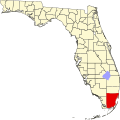 | |
| Towns | ||
| Villages | ||
| CDPs |
| |
| Unincorporated communities | ||
| Indian reservation | ||
| Footnotes | ‡This populated place also has portions in an adjacent county or counties | |
| International | |
|---|---|
| National | |
| Geographic | |

Hialeah Gardens, Florida
View on GrokipediaHistory
Founding and Early Development
Hialeah Gardens originated as part of the broader prairie lands in northwestern Miami-Dade County, which were initially settled and developed in the early 1920s alongside the adjacent city of Hialeah. Aviation pioneer Glenn Curtiss and cattleman James Bright acquired the high, well-drained terrain in 1921, envisioning it for agricultural and aviation uses, with early infrastructure including water and electricity supplied by the developers.[5] Although the area shared in Hialeah's foundational growth, Hialeah Gardens remained unincorporated rural territory focused on small-scale farming and livestock until mid-century pressures prompted formal separation.[1] The city was incorporated on December 1, 1948, through a unanimous vote of 26 residents seeking autonomy from Hialeah's expanding regulations. A primary catalyst was Hialeah's enactment of ordinances fining residents for livestock-related nuisances, such as horse defecation in streets, which threatened the area's semi-rural character and animal-keeping practices.[5] This incorporation allowed Hialeah Gardens to establish its own governance, preserving local customs while positioning it for independent expansion amid South Florida's post-World War II population surge.[6] In the immediate aftermath, foundational municipal structures were implemented, including the adoption of the first building code in February 1949 to regulate construction and support orderly growth.[6] Early development emphasized residential subdivisions tailored to returning veterans, exemplified by projects like Suntan Villages launched in 1948, which accelerated housing amid the regional boom driven by economic opportunities and infrastructure improvements.[5] By the early 1950s, these efforts laid the groundwork for transformation from agrarian outpost to suburban community, though population remained modest initially, reflecting gradual integration into the Miami metropolitan framework.[1]Incorporation and Mid-Century Growth
Hialeah Gardens was incorporated as a town on December 1, 1948, through a unanimous vote of 26 residents seeking municipal independence amid regional pressures from neighboring Hialeah.[5] The incorporation established basic governance structures in a predominantly rural area characterized by agricultural activities, particularly horse breeding and farming.[1] By the 1950 U.S. Census, the town's population stood at just 121, reflecting its sparse settlement and limited infrastructure at the outset.[7] In February 1949, shortly after incorporation, Hialeah Gardens enacted its inaugural building code, traffic ordinance, and regulations on hunting to formalize land use and public safety in the expanding but still agrarian community.[6] These measures addressed immediate needs in a locale reliant on livestock and open spaces, yet population growth remained modest through the 1950s and into the early 1960s, with the town retaining its rural character centered on equestrian industries.[1] Economic and residential expansion was constrained by the absence of major roadways and industrial development until later decades, keeping resident numbers low compared to adjacent urbanizing areas like Hialeah.[8]Immigration-Driven Expansion
Hialeah Gardens incorporated on December 1, 1948, through a unanimous vote of 26 residents, primarily to avoid annexation by neighboring Hialeah and its regulatory fines on unincorporated areas.[6] Initially a small rural enclave of under 1,000 residents focused on agriculture and basic residential development, the community adopted its first building code in February 1949 to manage modest expansion.[6] The Cuban Revolution of 1959 triggered waves of exiles fleeing the Castro regime, with many settling in Miami-Dade County's northwest corridor, including Hialeah Gardens, due to established family networks, affordable housing, and proximity to Miami's ports of entry.[9] This influx initiated rapid demographic shifts, as Cuban immigrants—often skilled professionals and entrepreneurs displaced by nationalization—purchased land, built single-family homes, and established small businesses, converting farmland into dense suburban neighborhoods. By the 1960s, population estimates reached approximately 7,700, reflecting chain migration where initial arrivals sponsored relatives under U.S. family reunification policies.[10] Sustained growth continued through subsequent Cuban migration episodes, such as the 1980 Mariel boatlift and later balsero crises, amplifying the foreign-born share to 71.3% of residents (16,100 individuals) by 2023, predominantly from Cuba and other Latin American countries.[11] The 1980 census tallied 19,280 inhabitants, rising to 21,744 in 2010 and 23,068 in 2020, with annual growth averaging 0.68% from 2000 onward, driven more by net international migration than natural increase given the community's low birth rates among established households.[10][12] This expansion strained infrastructure but fostered economic vitality through immigrant labor in local manufacturing and retail, while annexations in later decades incorporated adjacent lands to accommodate housing demand.[6] Over 94% of the population identifies as Hispanic, with Cuban ancestry dominant, underscoring immigration's role in reshaping the city's cultural and spatial fabric from rural outpost to urban enclave.[6]Geography
Location and Boundaries
Hialeah Gardens is located in the northwestern portion of Miami-Dade County, Florida, approximately 12 miles (19 km) northwest of downtown Miami.[13] The city's approximate geographic center lies at coordinates 25°51′54″N 80°19′28″W, with an average elevation of 7 feet (2 m) above sea level. [14] It forms part of the Miami metropolitan area, positioned just west of the larger city of Hialeah.[6] The municipality covers a total area of 3.69 square miles (9.56 km²), comprising 3.26 square miles (8.44 km²) of land and 0.43 square miles (1.11 km²) of water, according to U.S. Census Bureau delineations.[15] Its boundaries adjoin Hialeah to the east and south, Miami Lakes to the west, and Medley to the north, facilitating connectivity via major roadways such as the Palmetto Expressway (SR 826).[16] The city's limits have expanded through annexations, with U.S. Census maps reflecting configurations prior to recent incorporations of adjacent parcels.[17]
Physical Geography
Hialeah Gardens occupies flat, low-lying terrain characteristic of southeastern Florida's coastal lowlands, with minimal topographic relief. Elevations range from near sea level to approximately 10 feet (3 meters), averaging about 7 feet (2.1 meters) above mean sea level. This subdued landscape reflects the broader physiography of Miami-Dade County, where the city lies on the transitional zone between urbanized coastal plains and the adjacent Everglades wetlands to the west.[18][19] The region's bedrock is dominated by the Miami Limestone, a late Pleistocene oolitic limestone formation that forms a porous, karstic substrate prone to dissolution features such as solution holes. This unit, part of the broader Hawthorn Group in South Florida stratigraphy, underlies thin surficial deposits and supports the Biscayne Aquifer, a highly transmissive limestone aquifer that serves as the primary source of potable water for the area. Soils are typically shallow, consisting of sandy and marly sediments overlying the limestone, with historical land cover including hydric soils in low-elevation sloughs and better-drained quartz sands in former pine flatwoods.[20][21] Hydrologically, the flat terrain and proximity to the Everglades result in a high water table, often within a few feet of the surface, exacerbating flood vulnerability during heavy rainfall or storm surges. Urban development has involved extensive drainage modifications, including canals and pumps, to manage groundwater and surface runoff, though the karst geology facilitates rapid infiltration and seasonal fluctuations in aquifer levels.[22][23]Climate and Environmental Factors
Hialeah Gardens features a tropical monsoon climate (Köppen classification Aw), with consistently high temperatures, high humidity year-round, and a pronounced wet season driven by the North American monsoon and Atlantic hurricane influences.[24] Average annual temperatures hover around 76°F (24°C), with daily highs typically ranging from 77°F (25°C) in January to 90°F (32°C) in August and lows from 60°F (16°C) to 78°F (26°C) over the same period.[25] The city receives approximately 60 inches (152 cm) of precipitation annually, concentrated between May and October, when monthly totals often exceed 8 inches (20 cm), compared to drier conditions from November to April averaging under 2.5 inches (6 cm) per month.[26]| Month | Avg. High (°F) | Avg. Low (°F) | Avg. Rainfall (in) |
|---|---|---|---|
| January | 77 | 60 | 2.1 |
| April | 82 | 67 | 2.8 |
| July | 89 | 77 | 9.0 |
| October | 86 | 73 | 7.8 |
Government and Politics
Municipal Structure
Hialeah Gardens employs a mayor-council form of government, characterized as a council-strong mayor system wherein the mayor holds significant executive authority.[32][33] All legislative powers are vested in the city council, which serves as the primary policy-making body.[32] The city council comprises five members, elected directly by registered voters of the city.[34] Following elections, the council selects a chairperson, vice-chairperson, and financial director from among its members by majority vote during its organizational meeting.[35] The council approves the annual budget, authorizes major expenditures, enacts ordinances and resolutions, and exercises all governmental, corporate, and proprietary powers of the municipality.[35] Each council member appoints one individual to serve on city boards or committees, with appointees required to be registered voters or local business proprietors and serving at the council's discretion without compensation.[35] The mayor functions as the chief executive officer, responsible for enforcing city ordinances, managing administrative operations, and representing the city in intergovernmental affairs.[32] Elected separately by city voters, the mayor leads executive functions, including oversight of departments such as public works, police, and finance, though specific appointment powers are outlined in the city charter.[36] The mayor also participates in external bodies like the Florida League of Cities, influencing state-level policy relevant to municipal interests.[36] As a home rule municipality under Florida law, Hialeah Gardens derives its governance framework from its city charter, accessible via official code repositories, which delineates the separation of powers between branches.[37]Electoral and Voting Patterns
Hialeah Gardens exhibits a pronounced Republican voting preference in federal elections, consistent with the political inclinations of its predominantly Hispanic, Cuban-American electorate, which has increasingly rejected Democratic policies associated with socialism. In the 2024 presidential election, Donald Trump secured 76% of the vote in the city, compared to 24% for Kamala Harris, contributing to Miami-Dade County's overall Republican shift where Trump won by 11 points countywide—the first GOP presidential victory there since 1988.[38] [39] This pattern echoes 2020 results in surrounding Hialeah-area precincts, where Trump outperformed Joe Biden amid strong Latino support driven by economic concerns and opposition to progressive immigration stances. Municipal elections in Hialeah Gardens are nonpartisan and held every four years for the mayor and five city council seats, with the council appointing a city manager to handle daily operations. Voter turnout in these contests tends to be lower than in federal races, focusing on local issues like infrastructure and public safety rather than national partisan divides. The current mayor, Yioset De La Cruz, has held office since 2017, reflecting continuity in leadership amid the city's conservative-leaning governance.[40] [41] Voter registration data from city precincts, such as those at Hialeah Gardens Community Hall (Precinct 349) and Hialeah Gardens Middle School (Precinct 358), show a mix but with growing Republican advantages, mirroring Miami-Dade's 2025 flip to majority GOP registration—the first since the 1980s.[42] [43] This realignment stems from empirical shifts among working-class Latino voters prioritizing economic stability and anti-communist sentiments over traditional Democratic allegiances.[44]Policy Priorities
The policy priorities of Hialeah Gardens center on fiscal responsibility, public safety, recreational development, and efficient municipal governance, as outlined by Mayor Yioset De La Cruz. The city has prioritized maintaining a financially sound budget, which has facilitated property tax reductions alongside expansions in public services.[45] This approach reflects a commitment to cost-effective administration without compromising essential functions, enabling reinvestment in community infrastructure.[45] Public safety ranks prominently, with increased funding for additional police officers to enhance resident protection and deter crime in a densely populated urban suburb.[45] The Hialeah Gardens Police Department supports this through dedicated public services, including community outreach and enforcement activities.[46] Complementing safety efforts, the expansion of parks and recreational facilities serves as a proactive measure to engage youth and reduce street-related risks, aligning with the city's family-oriented demographic.[45] Governance efficiency is another key focus, aiming for streamlined operations that deliver high productivity and prioritize resident needs over bureaucratic expansion.[45] The Public Works Department implements related policies by maintaining streets, rights-of-way, and utilities, ensuring reliable infrastructure support.[47] Long-term growth is guided by the city's Comprehensive Plan, adopted in 2007 and updated through 2025, which establishes land development regulations for zoning, site plans, and sustainable urban expansion.[48][49] These priorities underscore a pragmatic, resident-first strategy tailored to the city's Cuban-American majority and suburban context.Demographics
Population Dynamics
The population of Hialeah Gardens grew from 19,203 in the 2000 census to 21,744 in 2010, reflecting a 13.2% increase driven by regional migration patterns in Miami-Dade County.[12] This expansion continued at a slower pace, reaching 23,068 by the 2020 census, a 6.1% rise from 2010 levels, consistent with broader suburban development and economic opportunities in the area.| Census Year | Population | Percent Change |
|---|---|---|
| 2000 | 19,203 | — |
| 2010 | 21,744 | +13.2% |
| 2020 | 23,068 | +6.1% |
Ethnic and Cultural Composition
Hialeah Gardens features an overwhelmingly Hispanic or Latino population, which constituted 96.2% of the city's 22,349 residents in 2022 according to American Community Survey estimates.[11] Non-Hispanic whites comprised 3.6%, while Black or African American residents accounted for 0.1%, Asians for less than 0.5%, and other groups including Native Americans and multiracial individuals formed the remainder.[52] These figures underscore a demographic homogeneity driven by historical migration patterns from Latin America, particularly since the mid-20th century waves of Cuban exiles settling in Miami-Dade County.[11] Within the Hispanic majority, Cuban ancestry predominates, representing 74.74% of the Hispanic population per 2021 American Community Survey data, reflecting the city's proximity to Hialeah and its role as an extension of the Cuban exile community established post-1959 revolution.[53] Central American origins followed at 9.06%, with smaller shares from South American, Mexican, Puerto Rican, and other subgroups; this composition aligns with broader South Florida trends but shows less diversification than in nearby urban centers.[53] The ethnic breakdown, derived from self-reported census responses, indicates limited intermarriage or assimilation into non-Hispanic categories, maintaining distinct cultural enclaves.[54] Spanish is spoken at home by approximately 95% of households, far exceeding English-only usage at around 4%, which sustains a cultural environment steeped in Latin American traditions such as family-centric social structures and Cuban-influenced cuisine and music.[11] This linguistic dominance, consistent with patterns observed in earlier decennial censuses, fosters community cohesion through shared heritage but can pose barriers to broader integration, as evidenced by lower English proficiency rates among older immigrants.[54] Religious affiliation data is sparse at the municipal level, though the Hispanic Catholic majority—typical of Cuban-American demographics—shapes local observances, with churches serving as cultural hubs amid minimal reported adherence to other faiths.[11]Socioeconomic Indicators
The median household income in Hialeah Gardens was $60,855 in 2023 dollars, based on the 2019-2023 American Community Survey (ACS) estimates.[55] Per capita income during the same period stood at $27,939.[55] These figures reflect a working-class profile, with household incomes approximately 80% of the Miami-Fort Lauderdale-West Palm Beach metropolitan area median of $73,481.[56] Poverty affected 15.2% of the population in Hialeah Gardens according to 2019-2023 ACS data, exceeding the national rate by about 30-40% relative to recent U.S. benchmarks around 11-12%.[56] [57] Unemployment remained low at 2.9% in 2023, aligning with broader post-pandemic recovery trends in South Florida.[58] Educational attainment for residents aged 25 and older showed 79.6% having completed high school or higher, while 19.9% held a bachelor's degree or advanced credential, per 2019-2023 ACS estimates.[56] Homeownership rate was 60.1% in 2023, with median owner-occupied housing value at $319,200.[11] [2]| Indicator | Value (2019-2023 ACS unless noted) | Source |
|---|---|---|
| Median Household Income | $60,855 | U.S. Census Bureau QuickFacts[55] |
| Per Capita Income | $27,939 | U.S. Census Bureau QuickFacts[55] |
| Poverty Rate | 15.2% | Census Reporter[56] |
| Unemployment Rate | 2.9% (2023) | HomeSnacks (ACS-derived)[58] |
| High School Graduate or Higher (25+) | 79.6% | Census Reporter[56] |
| Bachelor's Degree or Higher (25+) | 19.9% | Census Reporter[56] |
| Homeownership Rate | 60.1% (2023) | Data USA[11] |
Economy
Key Industries and Businesses
The primary economic drivers in Hialeah Gardens center on logistics and distribution, bolstered by the city's proximity to major transportation arteries including the Palmetto Expressway, Florida's Turnpike, and Miami International Airport. In 2023, the transportation and warehousing sector employed 1,814 residents, representing the largest industry by workforce size.[3] This sector benefits from extensive industrial parks and facilities such as Prologis Hialeah Gardens 200 and 300, which provide warehousing space at key intersections like U.S. 27 and the Turnpike.[59][60] Health care and social assistance follows closely, with 1,715 workers engaged in these fields, reflecting demand from the aging local population and regional medical needs. Construction employs 1,140 individuals, supporting ongoing development in residential, commercial, and industrial spaces, including automotive repair, plumbing, electrical services, and engineering firms prevalent in the area.[3][6] Manufacturing constitutes a foundational industry, encompassing firms in textiles, electronics, and food processing; notable operations include Blue Bell Creameries and Cummins facilities. These businesses leverage the area's zoning shifts from rural agriculture in the mid-20th century to industrial use by 1968, fostering small-to-medium enterprises rather than dominant corporate headquarters.[4][61]Labor Market and Income Data
The median household income in Hialeah Gardens was $60,855 in 2023, reflecting modest economic conditions typical of Miami-Dade County's suburban enclaves.[11] Per capita income stood at $25,396, underscoring lower individual earnings amid a population heavily reliant on multi-earner households.[56] The poverty rate affected 15.2% of residents for whom status was determined, higher than national averages but consistent with regional patterns influenced by immigration and service-oriented employment.[11] Employment among residents totaled 11,700 in 2023, a 4.46% decline from 12,200 the prior year, signaling potential vulnerabilities in local job retention amid broader economic shifts.[11] The unemployment rate hovered around 3.2%, with an employment-to-population ratio of 96.8%, aligning with low regional friction in labor markets but limited by sector concentration.[62]| Industry | Employed Residents (2023) |
|---|---|
| Transportation & Warehousing | 1,814 |
| Construction | 1,148 |
| Retail Trade | 1,061 |