Hubbry Logo
Florida ReefFlorida ReefMain
Open search
Florida Reef
Community hub
Florida Reef
logo
8 pages, 0 posts
0 subscribers
Be the first to start a discussion here.
Florida Reef
Florida Reef
from Wikipedia
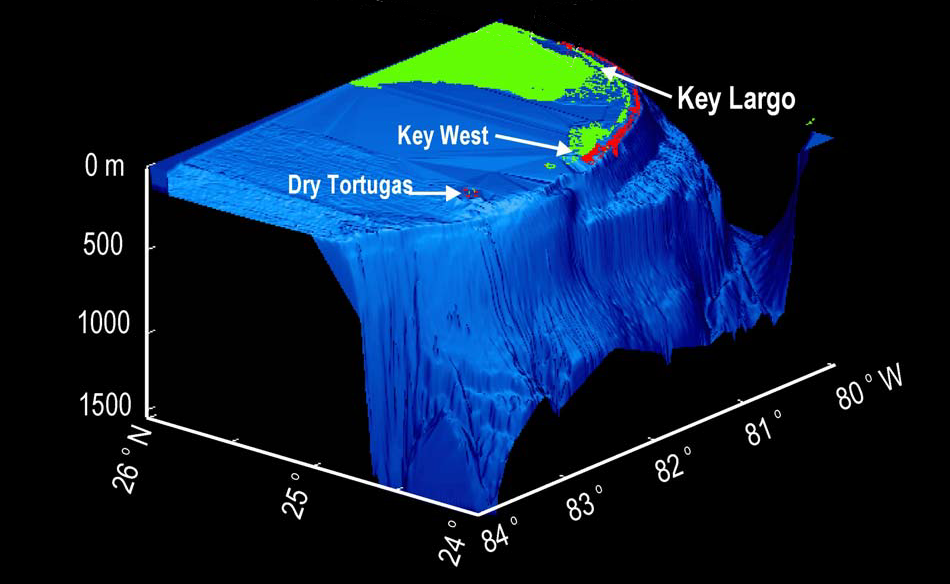
Three-dimensional map of southern Florida showing the Florida Reef in red.

The Florida Reef (also known as the Great Florida Reef, Florida reefs, Florida Reef Tract and Florida Keys Reef Tract) is the only living coral barrier reef in the continental United States.[1] It lies a few miles seaward of the Florida Keys, is about 4 miles (6 to 7 km) wide and extends along the 20-metre (66 ft) depth contour 270 km (146 nmi; 168 mi) from Fowey Rocks just east of Soldier Key to just south of the Marquesas Keys. The system encompasses more than 6,000 individual reefs. Florida waters are home to over 500 marine fish and mammal species along with more than 45 species of stony corals and 35 species of octocorals.[2]

Geography

[edit]

The barrier reef tract forms a great arc, concentric with the Florida Keys, with the northern end, in Biscayne National Park, oriented north-south and the western end, south of the Marquesas Keys, oriented east-west. The rest of the reef outside Biscayne National Park lies within John Pennekamp Coral Reef State Park and the Florida Keys National Marine Sanctuary.

Isolated coral patch reefs occur northward from Biscayne National Park as far north as Stuart, in Martin County. In 2024, Florida created the Kristin Jacob Coral Aquatic Preserve to protect the reefs north of Biscayne National Park.[3] Coral reefs are also found in Dry Tortugas National Park west of the Marquesas Keys. The reefs are 5,000 to 7,000 years old, having developed since sea levels rose following the Wisconsinan glaciation.[4]

The densest and most spectacular reefs, along with the highest water clarity, are found to the seaward of Key Largo (in and beyond John Pennekamp Coral Reef State Park) and Elliott Key (the northernmost 'true' Florida Key) where the two long keys help protect the reefs from the effects of water exchange with Florida Bay, Biscayne Bay, Card Sound and Barnes Sound. The bays and sounds (all between the Florida Keys and the mainland) tend to have lower salinity, higher turbidity and wider temperature variations than the water in the open ocean. Channels between the Keys allow brackish water from the bays to flow onto the reefs (especially in the middle Keys), limiting their growth.[5] Microstructural abnormalities in large benthic foraminifera from the Florida Keys indicate carbonate chemistry stress that is also consistent with long-term environmental decline on the reef tract[6] A 2024 study found that the best habitat for Acropora palmata restoration occurs in areas with low chlorophyll‑a levels, moderate wave exposure, and stable salinity, including Biscayne Bay, the Upper Keys, western‑lower Keys, and Dry Tortugas, while conditions in the middle Keys are generally less suitable.[7]

Reef structure and communities

[edit]

The Florida Reef consists of two ridges separated from the Florida Keys by the Hawk Channel. Closest to the Keys is a sand ridge called White Bank, covered by large beds of sea grass, with patch reefs scattered across it. Further out to sea on the edge of the Florida Straits is the second ridge forming the outer reefs, covered by reefs and hard banks composed of coral rubble and sand.[8]

Almost 1,400 species of marine plants and animals, including more than 40 species of stony corals and 500 species of fish, live on the Florida Reef. The Florida Reef lies close to the northern limit for tropical corals, but the species diversity on the reef is comparable to that of reef systems in the Caribbean Sea.[8]

The Florida Museum of Natural History defines three communities on the Florida reefs. The hardbottom community lies closest to the Florida Keys and consists primarily of algae, sea fans (gorgonians) and stony corals growing on limestone rock that has a thin covering of sand. The stony corals in hardbottom communities include smooth starlet coral (Siderastrea radians), mustard hill coral (Porites astreoides), golfball coral (Favia fragum), elliptical star coral (Dichocoenia stokesii) and common brain coral (Diploria strigosa). Hardbottom provides habitat for anemones, mollusks, crabs, spiny lobsters, seastars, sea cucumbers, tunicates and various fish, including grunts (Haemulon spp.), snappers (Lutjanus spp.), groupers (Epinephelus spp.), Atlantic blue tang (Acanthurus coeruleus), Ocean surgeon (Acanthurus bahianus) and Great barracuda (Spyraena barracuda).[9]

Boulder star coral (Montastraea annularis) on Molasses Reef

Second is the patch reef community. Patch reefs form in shallow water (three to six meters deep), some in Hawk Channel and some on the outer reef, but mainly on White Bank between Hawk Channel and the outer reefs. Patch reefs start from corals growing on a hard bottom, but grow upward as new corals establish themselves on the skeletons of dead corals. Most of the structure of patch reefs is formed from star (Montastraea annularis, Siderastrea siderea) and brain corals (Diploria spp.). Other corals attach wherever there is an opening. Patch reefs may grow up to the surface of the water, and spread outwards. Dome-type patch reefs (such as Hen and Chickens), found in Hawk Channel and on White Bank, are round or elliptical, and are generally less than three meters high, but may reach up to nine meters high. Dome-type patch reefs are surrounded by sand which is kept clear due to browsing by long-spined sea urchins and grass-eating fish. Linear-type patch reefs are found on the outer reefs, and are linear or curved. They occur in single or multiple rows, trending the same direction as the bank reefs on the outer reefs. Linear-type patch reefs often include elkhorn coral, which is rare on the dome-type patch reefs. As dead coral skeletons age and are weakened by the activities of boring sponges, worms, and mollusks and by wave action, parts of a patch reef may collapse. Patch reefs provide habitat for spiny lobsters and for many species of fish, including Bluehead wrasse (Thalassoma bifasciatum), damselfish (Chromis spp.), Ocean surgeon, French and queen angelfish (Pomacanthus spp.), white, caesar and spanish grunts (Haemulon ssp.), yellowtail and other snappers, redband and stoplight parrotfish (Sparisoma ssp.), sergeant major (Abudefduf saxatilis), tomtate (Haemulon aurolineatum), trumpetfish (Aulostomus maculatus), filefish, groupers, snappers, bar jack (Caranx ruber), great barracuda, pufferfish, squirrelfish, cardinalfish, and green morays (Gymnothorax funebris).[10]

Elkhorn coral (Acropora palmata) on Molasses Reef

Third is the bank reef community. Bank reefs are larger than patch reefs and are found on the outer reefs. Bank reefs consist of three zones. The reef flat is closest to the keys, and consists of coralline algae growing on fragments of coral skeletons. Further out to sea are the spur and groove formations, low ridges of coral (the spurs) separated by channels with sand bottoms (the grooves). The shallowest parts of the spurs support fire corals and zoanthids. Starting at five or six feet deep, Elkhorn, star, and brain corals are the most important members of the community. Various types of gorgonians are also common. Beyond the spur and groove zone is the forereef, which slopes down to the deeps. The upper forereef is dominated by star coral. At greater depths plate-like corals dominate, and then as the available light fades, sponges and non-reef building corals become common. Bank reefs provide habitat for various fishes, including French angelfish, blue and queen parrotfish, Queen triggerfish (Balistes vetula), rock beauties (Holacanthus tricolor), Goatfish (Parupeneus cyclostomus), porkfish (Anisotremus virginicus) and snappers. The sand found around and in the Florida Reef is composed of shell, coral skeleton and limestone fragments.[11]

In 2025, large‑scale planting of nursery‑grown corals began in the Florida Keys, aiming to expand restoration.These efforts involve growing corals in protected nursery environments until they are strong enough to be transplanted into degraded reef areas.[12] Sediment analyses over time show a shift on the Florida Reef Tract, with coral debris tripling in the Middle Keys over a 37-year period, indicating major changes in reef framework production.[13]

Other common species of hard coral found on the Florida Reef include Ivory Bush Coral (Oculina diffusa), which is the dominant coral in the patch reefs along the Florida coast north of the Florida Keys, staghorn coral (Acropora cervicornis), lettuce coral (Agaricia agaricites), grooved brain coral (Diploria labyrinthiformis), boulder star coral (Monstastrea annularis), great star coral (M. cavernosa), clubbed finger coral (Porites porites) and massive starlet coral (Siderastrea siderea).[14]

Individual reefs

[edit]

Notable individual reefs in the Florida reef system include:

Threats to the reefs

[edit]
Staghorn coral (Acropora cervicornis) on Looe Key

Coral reefs are among the most biologically diverse ecosystems on the planet, supporting approximately 4,000 species of fish and 800 species of hard coral per unit area, more than any other marine habitat. Their ongoing global decline affects ecological balance, as well as the social, cultural, and economic health of human communities. In Florida, coral reefs face several stressors, including overfishing, disease, rapid coastal development, and climate change.[15] As of the late 2010s, scientists with the National Oceanic and Atmospheric Administration (NOAA) estimated that only about 2% of Florida's original coral cover remained, following decades of cumulative stress from pollution, overfishing, disease, and climate change.[16] Animals known as polyps, which create the fundamental structure of a reef, die from ingesting tiny bits of trash floating throughout the ocean called microplastics. Overfishing is also threatening reef fish populations, which feed on the algae that will smother corals. Fluctuating ocean temperatures caused by global warming presents the largest threat to coral reefs.The sudden warming or cooling of the water stresses the corals, causing them to lose their nutrients and turn white, a process known as bleaching. With the destruction of these complex yet fragile ecosystems comes a wide range of global consequences such as extinction of marine species, endangerment to the fishing industries, and severe coastal erosion. Elevated nutrient enrichment and altered freshwater inputs, particularly from historical water-management practices affecting Florida Bay, have contributed to algal overgrowth and declining coral health on the Florida Reef Tract.[17]

In common with coral reefs throughout the Caribbean and the world, the Florida Reef exhibits some signs of stress and deterioration. Precht and Miller state that the numbers of Elkhorn and Staghorn corals (Acropora ssp.) are declining to an extent that is unprecedented in several thousand years. Between 1981 and 1986, Staghorn corals declined by 96% at Molasses Reef. Between 1983 and 2000 at Looe Key, Elkhorn corals declined by 93% and Staghorn corals by 98%. A joint reef monitoring program conducted by the United States Environmental Protection Agency, Florida Marine Research Institute and National Oceanic and Atmospheric Administration recorded a loss of 6% to 10% living corals at 40 sampling stations from 1996 to 2000.[18] Long-term monitoring of Florida's coral reefs has shown that stony coral recovery has been minimal in many regions, with some areas exhibiting no measurable regrowth for over 15 years due to repeated disturbances and chronic stressors.[19]

Elevated temperatures can damage coral reefs, causing coral bleaching. The first recorded bleaching incident on the Florida Reef was in 1973. Incidents of bleaching have become more frequent in recent decades, in correlation with a rise in sea surface temperatures. In July 2023, recordbreaking early and rapid warming resulted in widespread coral bleaching and death.[20] Rescue efforts, such as relocating corals to tanks or to deeper waters have helped some bleached corals recover. Oceanographer Jamison Grove at the NOAA stated that these efforts must be accompanied by reductions in greenhouse gas emission to save the reef.[21] The Florida Aquarium and Florida Fish and Wildlife Conservation Commission have tested a protective device known as the "Coral Defender", which shields young corals from predatory fish and invertebrates. Early trials suggest that the device can significantly improve survival rates for nursery‑reared corals once they are placed in existing reefs.[22] White band disease has also adversely affected corals on the Florida Reef.[23] While hurricanes often can cause localized damage to Elkhorn and Staghorn corals, Precht and Miller state that the severe and widespread loss of those corals on the Florida Reef cannot be attributed to hurricane damage. In addition to coral loss, the degradation of Florida's reefs has led to the flattening of reef structures and a decline in fish populations, particularly in areas near intense coastal development, as the loss of habitat affects reef fish that rely on coral for food, shelter, and reproduction.[24] Other possible causes of the losses of corals on the Florida Reef include epizootic diseases, eutrophication, predation, sedimentation, overfishing, ship groundings, anchor dragging, commercial lobster and crab traps moved by storms, pollution, development on the Keys, growing numbers of visitors to the Keys and the reefs and the growth of seaweed on the coral.[25] In January 2010, the Florida Reef Tract experienced an extreme cold-water anomaly in which temperatures fell below 16 degrees C, which resulted in greater coral tissue morality than prior years.[26] In recent years, considerable effort has been made to make corals resilient to rising temperatures. Researchers from the Florida Aquarium and the University of South Florida are collaborating on a new initiative to protect the Florida Keys' coral reefs. More than 1,000 juvenile elkhorn corals that have been genetically modified to resist environmental stress are being planted at seven locations in the Florida Keys. Before being planted, they are housed in specialized tanks to acclimate to the ocean's temperature. Only a few percentage may survive, but those that do can develop further in the future, according to Cindy Lewis, director of the Keys Marine Laboratory.[27] NOAA's Mission: Iconic Reefs, aims to restore approximately three million square feet of coral habitat across seven key reef sites in the Florida Keys National Marine Sanctuary by the year 2040. The project includes large‑scale coral planting, removal of harmful algae, and long‑term monitoring to ensure restored areas continue to thrive in the future.[28]

Long-spined sea urchin (Diadema antillarum)

The long-spined sea urchin (Diadema antillarum), which browses on seaweed on and around reefs, was sharply reduced in numbers on the Florida Reef (and throughout the Caribbean) in the 1980s. While populations of this sea urchin have somewhat recovered elsewhere, its numbers are still very low on most of the Florida Reef, with the exception of the Dry Tortugas. As a consequence, there has been no effective check of the growth of seaweed on reef corals. However, the severe die-off of Elkhorn and Staghorn corals occurred before the die-off of the sea urchins, so that the proliferation of seaweed following the loss of the sea urchins was not the cause of the die-off of the corals, but may be retarding recovery by the corals.[29]

Researchers studying Florida's coral reefs have found that juvenile coral populations remain low even in areas where conditions appear suitable for growth. A major factor contributing to this is the widespread presence of thick, sandy algae mats (referred to as LSAT), particularly in flat reef zones. These mats trap sand and form dense layers that make it difficult for young corals to attach and survive. Although fish that feed on algae are abundant and usually help maintain reef health by controlling harmful algae, they cannot remove the LSAT because the underlying silt blocks light and reduces oxygen levels, creating unfavorable conditions for coral larvae to settle. Furthermore, only certain algae species, such as crustose coralline algae (CCA), support coral recruitment, but these beneficial algae are scarce in these degraded reefs. Other algae types, like Dictyota, do not aid coral growth and may even hinder it.[30] Recent ecological surveys show that following major disturbances, juvenile coral assemblages on the Florida Reef Tract exhibit a shift toward higher octocoral recruitment relative to stony corals.[31] Studies of reef-building corals have shown that bacterial communities in Montastraea annularis can vary significantly across small spatial scales, which suggests complex microbial drivers of coral health and stress response[32] Research in 2024 identified specific environmental factors that predict where Coral restoration is most likely to succeed. Applying these findings can help conservationists focus their efforts on areas with conditions most favorable for coral growth in turn, improving restoration success rates[7]

Another threat to the Florida Reef is the ongoing rise in sea level. The sea level has risen almost six inches (15 cm) at Key West since 1913, and one foot (30 cm) since 1850. This rise in sea level increases the volume of water in Florida Bay significantly, and increases the exchange of water between the Bay and the water over the reefs. The lower salinity, higher turbidity and more variable temperature of the water from Florida Bay adversely affects the reefs. A continued rise in sea level would likely intensify the effect.[33]

A perceived deterioration of the reefs became a concern in the 1950s. Early attempts to protect the reefs led to the establishment in 1960 of a protected area that became John Pennekamp Coral Reef State Park. The creation of Biscayne National Monument (which later became Biscayne National Park) in 1968 protected the northern part of the Florida Reef. In 1990 the Florida Keys National Marine Sanctuary was established, bringing all of the Florida reef into federal or state protection.[34]

Coral reproduction on the Florida Reef has drastically declined, with many species failing to produce new offspring in the wild due to low population density, disease, and environmental stress.[35]

Human use

[edit]

Human use of the reefs has grown tremendously in the past century. One measure of the growth is that registrations for recreational boats in Monroe County increased by 1000% from 1964 to 2006.[36]

Recreational use of the Florida Reef and surrounding waters is popular and important to the economy of southern Florida, and in particular, of Monroe County. In 2000-2001 artificial and natural reefs in South Florida[37] and Monroe County had 28 million person-days of recreational use by residents and tourists, including scuba diving, fishing and viewing (as, for example, by snorkeling). These activities generated $4.4 million in sales, generated almost $2 million in local income and provided more than 70,000 full- and part-time jobs. The estimated asset value of the reefs was $8.5 billion. About two-thirds of the activity was related to natural reefs.[38]

In Monroe County for the period of June 2000 to May 2001 almost 5.5 million person-days of reef related activities resulted in $504 million in sales, which generated $140 million in income for 10,000 full- and part-time jobs. Almost two-thirds of the activity was by residents, and about half the activity involved fishing, with one-third involving snorkeling and one-sixth scuba diving. [39]

In Dade County for the period from June 2000 to May 2001 a little over 6 million person-days of reef related activities resulted in $1,297 million in sales, which generated $614 million in income for 19,000 full- and part-time jobs. The activity was about evenly split between residents and tourists. As in Monroe County, about half the activity involved fishing, with one-third involving snorkeling and one-sixth scuba diving.[40]

In a more general sense, the reef acts as a layer of protection for human settlements against tropical storms, hurricanes, and erosion.[21]

Shipwrecks and lighthouses

[edit]

The Florida Current (which merges with the Antilles Current near the northern end of the barrier reef to form the Gulf Stream) passes close to the Florida Reef through the Straits of Florida. Ships began wrecking along the Florida Reef almost as soon as Europeans reached the New World. From early in the 16th century Spanish ships returning from the New World to Spain sailed from Havana to catch the Gulf Stream, which meant they passed close to the Florida Reef, with some wrecking on the reefs. In 1622, six ships of the Spanish treasure fleet, including the Nuestra Señora de Atocha, wrecked during a hurricane in the lower Keys. In 1733, 19 ships of the Spanish treasure fleet wrecked during a hurricane in the middle and upper keys. In the 19th century the Straits became the major route for shipping between the eastern coast of the United States and ports in the Gulf of Mexico and the western Caribbean Sea. The combination of heavy shipping and a powerful current flowing close to dangerous reefs made the Florida Reef the site of many wrecks. By the middle of the 19th century, ships were wrecking on the Florida Reef at the rate of almost once a week (the collector of customs in Key West reported a rate of 48 wrecks a year in 1848).[41] Between 1848 and 1859 at least 618 ships were wrecked on the Florida Reef.[42] The Assistant United States Coast Surveyor reported that in the period from 1845 through 1849 almost one million (United States) dollars' worth of vessels and cargos were lost on the reef.[43] The chief motivation for the Florida Railroad, the first railroad to connect the Atlantic and Gulf coasts of Florida, was to allow goods to be transferred between ships in the Atlantic and in the Gulf of Mexico, thus avoiding the dangerous passage along the Florida Reef. Salvaging wrecks on the reefs was the principal occupation in the Florida Keys through much of the 19th century, helping make Key West the biggest and richest city in Florida for a while.[44]

Some of the reefs in the Florida Reef are named after ships that wrecked on them. Fowey Rocks is named after HMS Fowey, which, however, actually wrecked on Ajax Reef. Looe Key is named after HMS Looe. Alligator Reef is named after the USS Alligator.[45] Carysfort Reef is named after HMS Carysfort, which ran aground on the reef, but did not sink.[46]

Carysfort Reef Light

Soon after the United States acquired Florida from Spain in 1821, it began building lighthouses along the Florida coast. The first lighthouses marking the Florida Reef were the Cape Florida Light, at the northern end of the Reef, the Dry Tortugas Light (on Bush Key), marking the western end of the Reef, and the Key West Light, all first lit in 1825. A light ship was placed at Carysfort Reef in 1825, as well. Garden Key Light, also in the Dry Tortugas, was added in 1826, and Sand Key Light (six nautical miles from Key West), was added in 1827. Large stretches of the Florida Reef remained unprotected by lighthouses, however. Keeping lights in operation along the Florida Reef proved difficult. The Carysfort Reef light ship was often blown out of position, and one time even onto a reef. The first light ship had to be replaced after just five years due to dry rot. The Cape Florida lighthouse was burned by Seminoles in 1836, and was not repaired and re-lit until 1847. The Key West and Sand Key lighthouses were destroyed by a hurricane in 1846. Starting at Carysfort Reef in 1852, skeletal tower lighthouses were built on submerged reefs to place lights as close to the outer edge of the Florida Reef as possible. With the completion of the American Shoal Light in 1880 there were finally navigation lights visible along the full length of the Florida Reef.[47]

In order to provide better charts for ships sailing along the Florida Reef, the Florida Keys, including the reef, and the waters to the west of the Keys, including Biscayne Bay and Florida Bay, were surveyed in the 1850s. The United States Army Corps of Topographical Engineers established a base camp on Key Biscayne in 1849. The triangulation survey was conducted by the United States Coast Survey with men detailed from the United States Army and United States Navy. In 1855 Alexander Dallas Bache, Superintendent of the U.S. Coast Survey, assumed personal direction of the survey. In 1851 the U.S. Coast Survey sent Louis Agassiz to study the Florida Reef.[48] His report on the reefs was published in 1880.[49]

Notes

[edit]

References

[edit]
[edit]
Revisions and contributorsEdit on WikipediaRead on Wikipedia
from Grokipedia
The Florida Reef Tract is the only barrier reef in the continental and North America's most extensive shallow ecosystem, extending over 350 miles from the Dry Tortugas in the to the St. Lucie Inlet along Florida's southeastern coast. Composed primarily of stony corals that have accumulated over thousands of years, it features barrier reefs with characteristic spur-and-groove formations, patch reefs, and hardground habitats paralleling the shoreline. This subtropical system ranks as the third-largest barrier reef ecosystem globally, after Australia's and Belize's Mesoamerican Reef. The reef tract harbors over 40 species of reef-building corals—such as elkhorn (Acropora palmata) and staghorn (Acropora cervicornis)—along with more than 500 species of fishes, , and , fostering complex food webs and providing essential habitat for . Ecologically, it serves as critical nursery grounds for commercially important fisheries, buffers coastlines against and surges, and supports substantial economic activity through and recreation. Despite its significance, the Florida Reef Tract has undergone marked degradation, with coral cover declining due to recurrent bleaching driven by rising sea temperatures, a persistent outbreak of stony coral tissue loss disease affecting over 20 of its approximately 45 stony species since 2014, and localized stressors like and . Intense marine heatwaves, including the record-breaking 2023 episode, have triggered widespread mortality, particularly among heat-sensitive branching corals, pushing some populations toward and underscoring the reef's vulnerability to climatic shifts.

Geography and Geology

Location and Physical Extent

The Florida Reef Tract extends approximately 350 miles (563 km) from Dry Tortugas National Park in the Gulf of Mexico westward of the Florida Keys to the St. Lucie Inlet along the southeastern Atlantic coast of Florida. This configuration positions the reef system parallel to the Florida coastline, typically lying 1 to 8 miles (1.6 to 13 km) offshore, forming a discontinuous barrier that separates nearshore waters from the open ocean. It constitutes the only living coral barrier reef in the continental United States, distinguishing it from scattered patch reefs or deeper formations elsewhere along U.S. coasts. The physical layout encompasses varying reef morphologies, including linear outer ridge complexes, discrete bank reefs, and scattered patch reefs within the broader tract. These features occur predominantly in shallow waters ranging from 5 to 30 feet (1.5 to 9 meters) deep, conducive to growth along the 20-meter (66-foot) isobath in many areas. The system's orientation and proximity to shore are influenced by the Florida Current, a swift western that enhances water circulation and nutrient delivery parallel to the reef axis. This dynamic positions the tract as a transitional zone between the protected Hawk Channel and the deeper Atlantic shelf.

Formation and Geological History

The Florida Reef Tract originated during the early epoch, approximately 8,000 years ago, as post-glacial sea-level rise following the Pleistocene glaciation flooded shallow carbonate platforms composed of lithified remnants from earlier reef systems. These platforms, primarily Key Largo Limestone and Miami Limestone formations of Pleistocene age, provided stable substrates at depths suitable for settlement in the tectonically quiescent southeastern Florida shelf. planulae, dispersed from source populations, colonized these surfaces amid rising waters that reached near-modern levels by around 7,000 years , initiating vertical and lateral framework accretion in subtropical conditions favoring precipitation. Reef development proceeded through incremental deposition, with massive species exhibiting linear extension rates of 1–5 mm per year and branching forms up to 10 cm annually under optimal conditions, though net reef accretion averaged 2–3 mm per year historically due to and cementation dynamics. This buildup occurred atop the uneven , filling topographic lows and forming a discontinuous barrier tract extending over 350 km, influenced by persistent warm currents and minimal siliciclastic input from the stable . The process reflected causal linkages between eustatic sea-level forcing and local sedimentological responses, with aragonitic skeletons and algal encrustations contributing to framework rigidity in oligotrophic waters. Holocene stabilization ensued as sea-level rise decelerated after a mid- highstand around 5,000–4,000 years ago, enabling lateral expansion and patch-reef infilling, though core-derived sequences document intermittent phases linked to centennial-scale fluctuations of 1–2 meters. of palmata frameworks confirms accretion pulses tied to these eustatic variations, with submerged relict reefs at -10 to -15 m preserving evidence of during accelerated rise phases circa 9,000–7,000 years ago. Such records underscore the reef tract's dependence on relative sea-level trajectories within a low-subsidence , culminating in a mature structure by late times.

Biological Features

Coral Species and Reef Structures

The Florida Reef Tract supports approximately 45 species of scleractinian corals, which form the primary structural framework of the ecosystem. Prominent framework-building taxa include elkhorn coral (Acropora palmata), staghorn coral (Acropora cervicornis), boulder star coral (Orbicella franksi), and massive star coral (Orbicella faveolata), alongside brain corals such as symmetrical brain coral (Pseudodiploria strigosa) and boulder brain coral (Colpophyllia natans). These species, particularly the branching Acropora forms, historically prevailed prior to the 1990s, comprising a significant portion of the reef's Holocene framework and contributing up to 64.8% of relative coral abundance in geological records. Reef structures exhibit zonation influenced by depth, wave exposure, and substrate type, including fore-reef slopes, back-reef lagoons, and spur-and-groove formations. Fore-reef zones, seaward of the main reef crest, feature steep slopes dominated by massive growth forms like star corals, transitioning to plate-like morphologies at depths beyond 10 meters. Back-reef lagoons, positioned leeward of the crest, consist of shallower rubble platforms and patch reefs with lower relief, supporting encrusting and massive corals amid sediment accumulation. Spur-and-groove configurations, prevalent along exposed bank and patch reefs, manifest as linear coral ridges (spurs) extending perpendicular to wave fronts, separated by sediment-channeled grooves; these arise from differential erosion and coral accretion under high-energy conditions. NOAA's Coral Reef Evaluation and Monitoring Project (CREMP) surveys quantify live coral cover variations by zone, with higher percentages historically recorded in spur-and-groove s (up to 25% in pre-1980s baselines for framework species) compared to back-reef areas, underscoring the role of these corals in vertical accretion and stabilization. Such zonation patterns enhance reef resilience by distributing growth forms adapted to specific hydrodynamic regimes, with branching corals in shallow spurs facilitating rapid framework construction.

Biodiversity and Ecological Communities

The Florida Reef supports over 520 species of , more than 260 of which are reef-associated, including commercially and ecologically significant groups such as groupers (Epinephelus spp.), snappers ( spp.), and (Scaridae family). These contribute to complex trophic dynamics, with piscivores like groupers preying on smaller reef fish and maintaining balances observed in long-term surveys. Invertebrate communities play integral roles in nutrient cycling and habitat provision, encompassing lobsters (), queen conchs (Lobatus gigas), and diverse sponges (Porifera phylum). Lobsters and conchs exert grazing pressure on , mitigating overgrowth that could otherwise compete with reef primary producers, while sponges filter at high volumes, enhancing and serving as refugia for and crustaceans. These invertebrates form foundational links in webs, with sponges alone supporting myriad symbiotic microbes that organic . Symbiotic dinoflagellates known as , hosted within reef-building corals, underpin primary productivity by converting sunlight into fixed carbon via , supplying up to 90% of the host's energy needs in nutrient-limited tropical waters. This mutualism recycles nutrients efficiently, with excess photosynthates fueling higher trophic levels. Herbivorous fish, particularly , regulate macroalgal proliferation through intense grazing, preserving space for symbiotic algae and preventing phase shifts to algae-dominated states as evidenced in exclusion experiments. Adjacent seagrass beds (Thalassia testudinum and associates) and mangrove fringes provide critical nursery habitats for reef fish juveniles, with monitoring data indicating higher densities of snapper and grouper recruits in these connected ecosystems compared to open reef zones. These habitats facilitate ontogenetic migrations, where juveniles grow in protected shallows before recruiting to reefs, sustaining adult populations per visual census and tagging studies. Long-term NOAA observations confirm their role in resilience, as habitat connectivity buffers against localized reef stressors.

Major Reef Components

Key Individual Reefs and Formations

The Florida Reef Tract encompasses distinct individual reefs and formations along its 358-kilometer span from the southeastern Atlantic coast to the . These include linear outer barrier segments, spur-and-groove structures, and isolated patch and pinnacle features, mapped through bathymetric surveys revealing depths from shallow platforms to steep fore-reefs exceeding 30 meters. At the northeastern terminus near Miami-Dade County, Fowey Rocks forms part of the southeast continental reef tract, characterized by linear ridges parallel to the shoreline and separated by sandy deposits, with morphologies transitioning from nearshore patch reefs to exposed outer barriers. In adjacent to this area, dense clusters of patch reefs occupy shallow channels and lagoons, typically in waters 2 to 9 meters deep, interspersed among beds and hardbottom habitats. Further southwest near , Carysfort Reef presents a unique double-reef profile, with an inner shallow reef supporting proliferant coral heads and an outer deeper ridge, located east of the island chain in depths averaging 10 to 20 meters. Molasses Reef, southeast of , exemplifies a protruding outer reef with prominent spur-and-groove , featuring elongated spurs up to 100 meters long separated by sediment-filled grooves, and prominent boulder coral outcrops rising from the seafloor. In the middle Keys, Looe Key Sanctuary Preservation Area, positioned 10 kilometers south of Ramrod Key, showcases a classic spur-and-groove system with pinnacle-like pinnacles exhibiting steep drop-offs from 5-meter crests to fore-reef walls descending beyond 25 meters. The western extremity at consists of atoll-like reef formations encircling seven low-lying coral and sand islands, situated 110 kilometers west of , with annular reef flats and lagoonal patches surrounding the historic fortifications in waters averaging 10 to 20 meters deep.

Human History and Utilization

Exploration and Early Interactions

The indigenous and peoples of southern demonstrated awareness of the Florida Reef through archaeological evidence of marine resource utilization, including tools and middens containing fish bones, conch shells, and artifacts from offshore species like and harvested from reef-adjacent waters. European exploration of the Florida Reef began with Juan Ponce de León's 1513 expedition, during which he navigated the outer reefs and , naming the chain Los Martires for their rocky, hazard-like appearance resembling gallows, which posed significant navigational dangers evidenced by his route along Hawk Channel between the reefs and the mainland. In the early , following U.S. acquisition of , initial economic interactions involved harvesting reef-associated resources, with sponge fishing emerging in the by the 1820s after storms revealed washed-up specimens, developing into a mid-century industry using hook-and-line methods from shallow waters. Similarly, harvesting, targeting and loggerhead species for meat and shells, became a staple activity from the early 1800s, relying on foraging grounds and employing techniques like turning turtles at sea. Scientific mapping and study advanced in the late , with conducting expeditions aboard the in 1891 and subsequent years, documenting reef geology, elevations, and challenges along the Florida Reef tract to establish early ecological baselines. These efforts built on prior U.S. coastal surveys, providing foundational data on reef structures amid growing recognition of their biological complexity.

Shipwrecks, Lighthouses, and Navigation

The Florida Reef has been a notorious hazard to maritime navigation since European exploration, with shallow waters, hidden reefs, shifting sands, and strong currents contributing to frequent shipwrecks. A prominent example is the , in which 11 ships laden with silver and gold from the wrecked along the east coast of during a hurricane on July 31, , scattering debris across the reefs near modern-day Vero Beach and . These incidents were exacerbated by sudden storms and human errors in navigating the treacherous straits between and . To mitigate such dangers, the U.S. government constructed a series of offshore skeletal iron lighthouses in the late to mark the Florida Reefs. The Fowey Rocks Lighthouse, completed in 1878 off , and the American Shoal Lighthouse, first lit on July 15, 1880, near Looe Key, were designed to the same specifications to guide vessels through the hazardous areas. These structures, along with others like Carysfort Reef Lighthouse established in 1852, provided critical visual aids for safe passage, particularly as traffic increased, thereby reducing the incidence of groundings and collisions compared to earlier eras reliant on less precise coastal markers. Many of these historical shipwrecks have since integrated into the , functioning as artificial habitats that attract and support . For instance, wrecks like the San Pedro, lost in a 1733 hurricane near Islamorada, have developed into sites colonized by corals, , and , observed through diver assessments and ecological studies. While not deliberate artificial reefs, these submerged hulls enhance local densities and provide structure in areas where natural reef degradation has occurred.

Economic Contributions

Tourism and Recreation

The Florida Reef supports substantial tourism through diving and , with Southeast Florida reefs alone attracting approximately 1.65 million recreational trips annually as of 2017 estimates. These activities generate an economic output of over $900 million statewide, including $902 million in total impacts from expenditures on gear, charters, and related services. In the , diving participants numbered about 739,000 in 2007-2008, contributing to 2.8 million dive days and $54 million in direct spending at operations. Key destinations include John Pennekamp Coral Reef State Park, established in 1963 as the United States' first undersea park, which draws visitors for snorkeling, scuba excursions, and glass-bottom boat tours across its 70 square nautical miles. The park recorded 628,005 visitors in fiscal year 2018, bolstering local outfitters and coastal economies through fees and ancillary spending. Broader reef tourism in South Florida sustains 71,000 jobs tied to visitor activities like these, with diving and snorkeling valued at $1.1 billion annually. Studies on reef carrying capacity emphasize limits to preserve structural integrity, estimating sustainable levels at 4,000 to 6,000 dives per site per year before significant increases in breakage and disturbance from human activity. Exceeding these thresholds, as observed in high-use areas, correlates with accelerated wear on reef frameworks, prompting assessments of visitation to balance economic benefits with ecological thresholds. In the Keys, where recreation-tourism drives 58% of the local and $2.3 billion in annual sales, such data inform efforts to sustain participation without compromising reef viability.

Fisheries and Commercial Exploitation

The commercial fisheries associated with the Florida Reef target key species including the spiny lobster (Panulirus argus), stone crab (Menippe mercenaria), and reef fish such as red snapper (Lutjanus campechanus) and groupers (Epinephelus spp.), which support dockside values exceeding $100 million annually statewide when combining landings from these sectors. In 2023, spiny lobster landings alone were valued at $38.7 million, while stone crab contributed $40.8 million, with reef fish like red snapper adding $16.2 million; these figures reflect harvests from reef-adjacent waters, including the Florida Keys region where trap-based methods predominate for crustaceans. Recreational angling for reef fish supplements commercial yields, enhancing overall protein supply for Florida's coastal populations, though commercial operations drive export-oriented markets. Historical patterns of exploitation in the fishery trace to mid-20th-century booms, particularly from the 1950s onward, when trap innovations expanded harvests to meet rising demand, providing essential local protein amid but risking stock depletion through unchecked effort. Management interventions, including trap certificate limits and minimum size requirements enforced by the Fish and Wildlife Conservation Commission since the 1970s, have since balanced extraction rates with reproductive capacity, averting sustained while sustaining yields around 5-6 million pounds annually in recent decades. These measures directly link regulated harvests to stable levels, supporting causal chains from productivity to human nutritional and economic reliance. Aquaculture initiatives hold potential for supplementing wild fisheries, particularly for high-value species like , though commercial viability remains constrained by larval rearing challenges and high costs, with experimental efforts yielding limited output compared to capture fisheries. Florida's broader sector generated $71.6 million in farm-gate sales as of 2018, ranking the state ninth nationally, and contributes to $394 million in exports for 2024, where reef-derived products like lobster enhance values through processed forms. Export modeling underscores fisheries' role in diversifying revenue, with comprising a notable share destined for markets in and .

Environmental Threats

Climatic and Natural Stressors

The Florida Reef Tract is subjected to recurrent physical disturbances from hurricanes, which produce extreme wave forces exceeding 10 meters in height and associated storm surges that fracture coral colonies, dislodge substrates, and redistribute sediments. During the , four major storms—Dennis, Katrina, Rita, and Wilma—successively struck or passed near the , causing widespread breakage of branching corals like Acropora cervicornis and A. palmata, with damage assessments documenting up to 50% reduction in live coral cover at impacted sites and extensive rubble fields impeding regrowth. Oceanographic variability, particularly anomalies linked to the El Niño-Southern Oscillation (ENSO), drives thermal stress events that expel coral endosymbionts ( spp.), resulting in bleaching and subsequent mortality from energy deficits. ENSO warm phases elevate regional temperatures by 1-2°C above seasonal norms, amplifying bleaching risk; for instance, the 2023-2024 El Niño contributed to prolonged heat stress exceeding 8 Degree Heating Weeks across the reef tract, correlating with 97.8-100% colony mortality for species in surveys of over 50,000 individuals spanning nearly 400 reefs in the and Dry Tortugas. Stony coral tissue loss disease (SCTLD), an infectious outbreak first observed in September 2014 off Miami-Dade County, manifests as rapid, band-like tissue necrosis progressing at rates up to 1 cm per day, affecting over 20 of Florida's approximately 45 reef-building coral species with case mortality rates often exceeding 60% in susceptible taxa like Montastraea faveolata. The disease has persisted as an endemic threat, spreading via water currents and potentially bacterial agents, independent of acute or stressors. Post-disturbance monitoring reveals variable resilience, with historical records post-hurricanes showing initial structural recovery through macroalgal stabilization of rubble and of broadcast-spawning within 5-10 years at less-impacted sites, though full stony coral cover restoration remains limited by successive events and competitive exclusion. Empirical surveys after 2005 disturbances documented partial regrowth of framework-building in protected shallows, underscoring inherent regenerative capacity under reduced compounding pressures.

Local Anthropogenic Factors

Nutrient runoff from agricultural activities, septic systems, and in the has elevated and levels in coastal waters, promoting algal blooms that smother corals and reduce light penetration. Monitoring data from the Coral Reef Evaluation and Monitoring Project (CREMP) indicate dissolved inorganic concentrations exceeding 0.5 μmol/L at nearshore sites, correlating with macroalgal cover increases of up to 20% on patch reefs since the 1990s. Recreational boating inflicts direct physical damage through drops and propeller scarring, with surveys revealing that 57% of shallow-water reef sites in the exhibit scars or bottom paint residues from such impacts. damage disrupts colonies, creating persistent scars that hinder regeneration and increase susceptibility to , as quantified in grounding assessments where affected areas show 30-50% live loss per incident. Overfishing has depleted herbivorous fish populations, such as and surgeonfish, which control algal growth; fishery-independent surveys report reductions of 50-70% in exploited areas compared to no-take zones, per assessments from the Southeast Fisheries Science Center. This decline exacerbates phase shifts to algae-dominated states, independent of temperature anomalies, as evidenced by higher densities correlating with 15-25% lower macroalgal abundance in protected sectors. Coastal development, including and urban expansion, elevates sedimentation rates to peaks of 106 g/day/m² near sites like Dania Beach, smothering recruits and reducing settlement success by up to 80% in exposure experiments. Water quality indices from fixed monitoring stations, such as those in the National Marine Sanctuary, document localized spikes (Secchi depths <5 m) tied to stormwater discharge, distinct from offshore baselines.

Conservation and Management

Protective Measures and Policies

The Florida Keys National Marine Sanctuary (FKNMS) was designated by Congress on November 16, 1990, under the National Marine Sanctuaries Act, covering 2,900 square nautical miles along the Tract and imposing restrictions on vessel groundings, anchoring on live coral, pollutant discharges, and introductions to safeguard reef integrity. Earlier federal designations included the National Marine Sanctuary in 1975 and Key National Marine Sanctuary in 1979, which addressed localized reef degradation and were later integrated into FKNMS. State-level protections began post-1960s with the establishment of John Pennekamp Coral Reef State Park in 1963, the nation's first underwater park spanning 70 square nautical miles and prohibiting reef organism harvest to preserve . Fishing regulations within FKNMS feature 24 Sanctuary Preservation Areas (SPAs) and ecological reserves, including the 151-square-nautical-mile Tortugas Ecological Reserve established in as a no-take zone prohibiting all resource extraction to support population replenishment based on surveys and modeling. These zones, marked by yellow buoys and enforced via permitting, cover about 6% of the and align with and Wildlife Conservation Commission rules limiting gear types, sizes, and seasons for like snapper and in adjacent waters. International protections include listings of (Acropora palmata) and (A. cervicornis) under Appendix II of the Convention on International Trade in Endangered Species () since 2017, requiring permits for trade to curb overharvesting while allowing sustainable commerce. Enforcement involves joint operations by NOAA's sanctuary staff, the Florida Fish and Wildlife Conservation Commission, and U.S. Coast Guard patrols using dedicated vessels, with over 1,000 annual boardings and citations logged to deter violations; compliance monitoring via vessel tracking and has correlated with fewer reported boundary encroachments in protected zones per patrol data.

Restoration Initiatives and Outcomes

The Florida Coral Rescue program, established by the Florida Fish and Wildlife Conservation Commission (FWC) in partnership with NOAA and the Association of Zoos and Aquariums (AZA), employs divers to collect thousands of healthy coral colonies from reefs threatened by stony coral tissue loss disease (SCTLD) and transfer them to onshore aquariums, laboratories, and nurseries for genetic banking and propagation. This "Noah's Ark" approach preserves genetic diversity by safeguarding approximately 3,000 corals across 25 facilities in 14 states, including selections of potentially resilient varieties for breeding heat- and disease-resistant strains to support future replanting and reef recovery. The Coral Restoration Foundation (CRF), in collaboration with partners, has led coral gardening and outplanting efforts under the Mission: Iconic Reefs initiative, launched in 2022 to target seven historically significant reef sites in the using disease-resistant genotypes of staghorn (Acropora cervicornis) and elkhorn (Acropora palmata) corals. These efforts involve microfragmentation techniques to propagate corals in offshore nurseries before outplanting, with over 30,000 corals deployed across the sites by 2023 despite challenges from marine heat waves. In 2025, CRF documented natural spawning events of nursery-reared staghorn and elkhorn corals, enabling larval collection and propagation to enhance and resilience against ongoing stressors. NOAA, partnering with CRF and other entities, has supported large-scale restoration through the Mission: Iconic Reefs, outplanting thousands of corals annually while integrating genomic screening for heat-tolerant strains; cumulative efforts have exceeded 100,000 corals restored across projects since 2020, though exact figures vary by partner reporting. Post-2023 bleaching survival rates for outplanted staghorn corals averaged below 22% at surveyed Mission: Iconic sites, with elkhorn rates under 5%, reflecting empirical field data from heat-stressed conditions but highlighting gains in from propagated lines that outperformed wild stocks in lab trials. NOAA's 2025 strategies emphasize spawning-based to produce diverse larvae for outplanting, aiming to bolster population recovery amid observed 97-100% mortality of Acroporid corals on many reefs during the 2023-2024 . Local innovations include probiotic applications to combat stony coral tissue loss disease (SCTLD), with field trials in 2025 demonstrating slowed lesion progression in great star corals (Montastraea cavernosa) by up to 50% compared to untreated controls on northern reefs, marking the first wild application success without full cures. These microbial interventions, tested via paste application, preserved tissue integrity in empirical studies but require ongoing calibration for broader efficacy. Experimental sunshade structures and shading protocols at select sites have yielded localized reef cover increases of 10-20% in shaded test plots by mitigating solar stress, though scalability remains limited by deployment costs and storm vulnerability in uncontrolled field conditions. Overall, these initiatives have achieved modest cover enhancements in protected nursery-to-reef transitions, with metrics improved by 15-30% in propagated populations relative to remnant wild corals.

Debates and Controversies

Climate Change Impacts and Skepticism

Coral bleaching in the Florida Reef Tract has been correlated with marine heatwaves, including the 2023 event where sea surface temperatures averaged above 31°C for weeks, triggering near-total bleaching at surveyed sites and high mortality in species such as elkhorn (Acropora palmata) and staghorn (A. cervicornis) corals. Degree heating weeks exceeded thresholds for severe stress across the Keys, with NOAA data indicating hotspots persisting from July into fall. These episodes expel symbiotic zooxanthellae algae, reducing coral energy acquisition and increasing disease susceptibility, though not all bleached colonies perish if conditions ameliorate. Historical records show analogous in the 1990s, with the 1990 mass bleaching event tied to 30-day mean temperatures of 30.2°C—a threshold met in 14 of 27 subsequent years through —yet followed by partial recoveries in live cover at select reefs, as documented in long-term monitoring. Carbonate budget reconstructions from 1996–2019 across 46 sites reveal episodic accretion despite repeated stressors, with some areas maintaining net growth phases amid variability. Satellite-derived bleaching hotspot data from NOAA Watch underscore cyclical influences from El Niño-Southern and mesoscale eddies, which amplify short-term anomalies beyond monotonic warming trends. Critics of predominant narratives emphasize coral adaptation through , citing evidence of heritable heat tolerance in Acropora populations, where inshore genotypes exhibit elevated under experimental warming, suggesting evolutionary shifts favor resilient strains over static models. Empirical studies of differential tolerance in threatened staghorn corals indicate genotypic variation enabling recovery post-bleaching, challenging projections of inevitable by prioritizing observed plasticity. systems globally endured warm intervals, including early post-glacial phases with sea surface temperatures 1–2°C above modern baselines in regions like the , facilitating reef expansion without human mitigation. Such precedents imply that local oceanographic and biological feedbacks, rather than isolated CO2-driven causality, often dominate outcomes, with symbiotic algae potentially deriving photosynthetic benefits from elevated dissolved CO2 via reduced carbon acquisition costs, though bleaching thresholds typically override these under acute heat. Mainstream assessments from agencies like NOAA, while data-rich, frequently amplify existential risks, potentially reflecting institutional incentives toward alarmism over nuanced variability.

Policy Effectiveness and Economic Trade-offs

The establishment of no-take zones within the Florida Keys National Marine Sanctuary (FKNMS) has yielded mixed ecological outcomes, with studies documenting increased biomass and larger individual sizes in protected areas compared to fished zones, yet at the expense of displaced effort and elevated operational costs for harvesters. For instance, proposed expansions of spatial in 2022 were projected to eliminate 42 jobs statewide, including 28 directly tied to harvesting, underscoring regulatory constraints on local livelihoods without commensurate guarantees of broader recovery. These restrictions, enforced by federal oversight, have prompted critiques of overreach, as they limit access to traditional fishing grounds while socioeconomic monitoring reveals persistent revenue pressures on stakeholders reliant on reef-adjacent activities. Debates surrounding policy efficacy often contrast federal command-and-control measures with property rights-based alternatives, where privatized or leased could incentivize through direct for . Analyses from market-oriented conservation frameworks argue that assigning defined to sections—via mechanisms like transferable quotas or exclusive use zones—has historically outperformed open-access federal regimes in fisheries by aligning individual incentives with long-term , potentially reducing the $4.4 billion annual economic footprint of the FKNMS by minimizing displacement without equivalent gains. from analogous systems supports this, showing voluntary private investments in maintenance yield higher compliance and cost efficiencies than blanket prohibitions, as operators bear the direct costs of degradation under rights-based systems. Trade-offs are evident in data favoring localized, incentive-driven approaches over uniform federal edicts; for example, community-led voluntary programs have demonstrated superior adaptability to site-specific threats, fostering economic resilience in and sectors that contribute over 43,000 jobs, whereas rigid often amplifies short-term losses without proportional offsets in vitality. Cost-benefit evaluations highlight that market mechanisms, such as payments for services tied to private monitoring, generate net positives by internalizing externalities, contrasting with regulatory models where burdens—estimated in millions annually for FKNMS alone—divert funds from proactive conservation. This underscores a causal for policies empowering local property holders, where empirical yields verifiable improvements in compliance and resource metrics over top-down interventions prone to unintended economic distortions.

References

Add your contribution
Related Hubs
User Avatar
No comments yet.