
Recent from talks
History of Gibraltar
Knowledge base stats:
Talk channels stats:
Members stats:
History of Gibraltar
The history of Gibraltar, a small peninsula on the southern Iberian coast near the entrance of the Mediterranean Sea, spans over 2,900 years. The peninsula was a place of reverence in ancient times, and it later became "one of the most densely fortified and fought-over places in Europe". Gibraltar's location has given it an outsized role in the history of Europe. Its fortified town, established in the Middle Ages, has hosted garrisons that have fought in numerous sieges and battles over the centuries. The Rock of Gibraltar is a limestone monolith and fortress in Gibraltar that has held historical and military significance and has become a tourist attraction.
Gibraltar was first inhabited over 50,000 years ago by Neanderthals. Gibraltar's recorded history began around 950 BC, with the Phoenicians among the first to recognise and worship the genius loci of the place. There is also evidence that shrines to Hercules were built on the Rock of Gibraltar. The Romans named the jutting protrusion of limestone Mons Calpe (the "Hollow Mountain"); they regarded it as one of the twin Pillars of Hercules. Gibraltar became part of the Visigothic Kingdom of Hispania following the collapse of the Roman Empire and came under Muslim Moorish rule in 711 AD. It was permanently settled for the first time by the Moors and was renamed Jebel Tariq (meaning "the Mount of Tariq"). This phrase was later corrupted into Gibraltar. The Christian Crown of Castile annexed Gibraltar in 1309, but lost it to the Moors in 1333. Gibraltar was retaken by the Castilians in 1462. It later became part of the unified Kingdom of Spain, and it remained under Spanish rule until 1704. Gibraltar was captured during the War of the Spanish Succession by an Anglo-Dutch fleet in the name of Charles VI of Austria, the Habsburg contender to the Spanish throne. At the war's end, Spain ceded the territory to Britain under the terms of the 1713 Treaty of Utrecht. While Spain attempted on multiple occasions to retake Gibraltar, its attempts were unsuccessful. By the late 18th century, Gibraltar had faced fourteen sieges over a period of 500 years.
The colony grew rapidly during the 19th and early 20th centuries, becoming a stopping point for vessels en route to India via the Suez Canal. A large British naval base was constructed there at the end of the 19th century, and that naval base became the backbone of Gibraltar's economy. British control of Gibraltar enabled the Allies to control the entrance to the Mediterranean Sea during the Second World War; during the war, Gibraltar was attacked on several occasions by German, Italian and Vichy French forces, but those attacks caused little damage. After the war, Spanish dictator General Francisco Franco revived Spain's claim to the territory. As the territorial dispute intensified, Spain closed its border with Gibraltar between 1969 and 1985 and communications links were severed. Spain's position was supported by Latin American countries, but was rejected by Britain and by the Gibraltarians themselves, who vigorously asserted their right to self-determination.
Gibraltar is a British overseas territory and city. Since 1985, Gibraltar has undergone major changes as a result of reductions in Britain's overseas defence commitments. Most British forces left the territory, and its economy is based on tourism, financial services, shipping and Internet gambling. Gibraltar is largely self-governed and has its own parliament, although the UK maintains responsibility for its defence and foreign policy. It has become one of the wealthiest areas of the European Union.
The history of Gibraltar has been driven by its strategic position near the entrance of the Mediterranean Sea. It is a narrow peninsula at the eastern side of the Bay of Gibraltar, 6 kilometres (4 mi) from the city of Algeciras. Gibraltar is on the far south coast of Spain at one of the narrowest points in the Mediterranean, only 24 kilometres (15 mi) from the coast of Morocco in North Africa. Its position on the bay makes it an advantageous natural anchorage for ships. As one writer has put it, "whoever controls Gibraltar also controls the movement of ships into and out of the Mediterranean. In terms of military and naval power, few places have a more strategic location than Gibraltar."
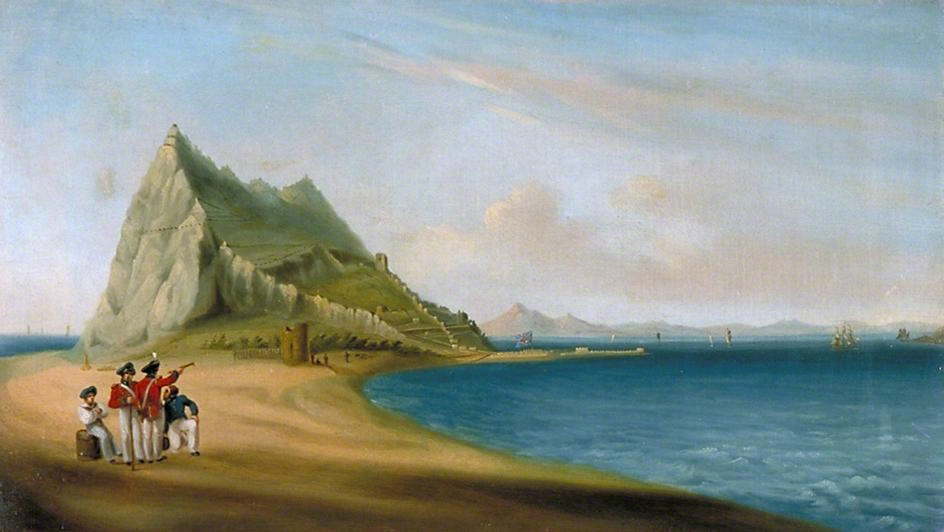
The territory's area measures only 6.7 square kilometres (2.6 sq mi). Most of the land area is occupied by the steeply sloping Rock of Gibraltar, which reaches a height of 426 metres (1,398 ft). The town of Gibraltar lies at the base of the Rock on the west side of the peninsula. A narrow, low-lying isthmus connects the peninsula to the Spanish mainland. The North Face of the Rock is a nearly vertical cliff 396 metres (1,299 ft) high overlooking the isthmus; the only land access to the town is via a coastal strip about 350 metres (1,150 ft) wide, which was considerably narrower before the reclamation of land from the sea during the 20th century.
Gibraltar's geography has thus given it considerable natural defensive advantages. It is virtually impossible to scale the eastern or northern sides of the Rock, which are either vertical or nearly so. To the south, the relatively flat area around Europa Point is surrounded by cliffs that are up to 30 metres (98 ft) high. The western side is the only practicable area for a landing, but even here the steep slopes on which the town is built work to the advantage of a defender. These factors have given it an enormous military significance over the centuries.
Gibraltar's appearance in prehistory was very different. Whereas today it is surrounded by sea, the water level was much lower in prehistoric times, when the polar ice caps were larger. The current peninsula was surrounded by a fertile coastal plain, with marshes and sand dunes supporting an abundant variety of animals and plants.
Hub AI
History of Gibraltar AI simulator
(@History of Gibraltar_simulator)
History of Gibraltar
The history of Gibraltar, a small peninsula on the southern Iberian coast near the entrance of the Mediterranean Sea, spans over 2,900 years. The peninsula was a place of reverence in ancient times, and it later became "one of the most densely fortified and fought-over places in Europe". Gibraltar's location has given it an outsized role in the history of Europe. Its fortified town, established in the Middle Ages, has hosted garrisons that have fought in numerous sieges and battles over the centuries. The Rock of Gibraltar is a limestone monolith and fortress in Gibraltar that has held historical and military significance and has become a tourist attraction.
Gibraltar was first inhabited over 50,000 years ago by Neanderthals. Gibraltar's recorded history began around 950 BC, with the Phoenicians among the first to recognise and worship the genius loci of the place. There is also evidence that shrines to Hercules were built on the Rock of Gibraltar. The Romans named the jutting protrusion of limestone Mons Calpe (the "Hollow Mountain"); they regarded it as one of the twin Pillars of Hercules. Gibraltar became part of the Visigothic Kingdom of Hispania following the collapse of the Roman Empire and came under Muslim Moorish rule in 711 AD. It was permanently settled for the first time by the Moors and was renamed Jebel Tariq (meaning "the Mount of Tariq"). This phrase was later corrupted into Gibraltar. The Christian Crown of Castile annexed Gibraltar in 1309, but lost it to the Moors in 1333. Gibraltar was retaken by the Castilians in 1462. It later became part of the unified Kingdom of Spain, and it remained under Spanish rule until 1704. Gibraltar was captured during the War of the Spanish Succession by an Anglo-Dutch fleet in the name of Charles VI of Austria, the Habsburg contender to the Spanish throne. At the war's end, Spain ceded the territory to Britain under the terms of the 1713 Treaty of Utrecht. While Spain attempted on multiple occasions to retake Gibraltar, its attempts were unsuccessful. By the late 18th century, Gibraltar had faced fourteen sieges over a period of 500 years.
The colony grew rapidly during the 19th and early 20th centuries, becoming a stopping point for vessels en route to India via the Suez Canal. A large British naval base was constructed there at the end of the 19th century, and that naval base became the backbone of Gibraltar's economy. British control of Gibraltar enabled the Allies to control the entrance to the Mediterranean Sea during the Second World War; during the war, Gibraltar was attacked on several occasions by German, Italian and Vichy French forces, but those attacks caused little damage. After the war, Spanish dictator General Francisco Franco revived Spain's claim to the territory. As the territorial dispute intensified, Spain closed its border with Gibraltar between 1969 and 1985 and communications links were severed. Spain's position was supported by Latin American countries, but was rejected by Britain and by the Gibraltarians themselves, who vigorously asserted their right to self-determination.
Gibraltar is a British overseas territory and city. Since 1985, Gibraltar has undergone major changes as a result of reductions in Britain's overseas defence commitments. Most British forces left the territory, and its economy is based on tourism, financial services, shipping and Internet gambling. Gibraltar is largely self-governed and has its own parliament, although the UK maintains responsibility for its defence and foreign policy. It has become one of the wealthiest areas of the European Union.
The history of Gibraltar has been driven by its strategic position near the entrance of the Mediterranean Sea. It is a narrow peninsula at the eastern side of the Bay of Gibraltar, 6 kilometres (4 mi) from the city of Algeciras. Gibraltar is on the far south coast of Spain at one of the narrowest points in the Mediterranean, only 24 kilometres (15 mi) from the coast of Morocco in North Africa. Its position on the bay makes it an advantageous natural anchorage for ships. As one writer has put it, "whoever controls Gibraltar also controls the movement of ships into and out of the Mediterranean. In terms of military and naval power, few places have a more strategic location than Gibraltar."
The territory's area measures only 6.7 square kilometres (2.6 sq mi). Most of the land area is occupied by the steeply sloping Rock of Gibraltar, which reaches a height of 426 metres (1,398 ft). The town of Gibraltar lies at the base of the Rock on the west side of the peninsula. A narrow, low-lying isthmus connects the peninsula to the Spanish mainland. The North Face of the Rock is a nearly vertical cliff 396 metres (1,299 ft) high overlooking the isthmus; the only land access to the town is via a coastal strip about 350 metres (1,150 ft) wide, which was considerably narrower before the reclamation of land from the sea during the 20th century.
Gibraltar's geography has thus given it considerable natural defensive advantages. It is virtually impossible to scale the eastern or northern sides of the Rock, which are either vertical or nearly so. To the south, the relatively flat area around Europa Point is surrounded by cliffs that are up to 30 metres (98 ft) high. The western side is the only practicable area for a landing, but even here the steep slopes on which the town is built work to the advantage of a defender. These factors have given it an enormous military significance over the centuries.
Gibraltar's appearance in prehistory was very different. Whereas today it is surrounded by sea, the water level was much lower in prehistoric times, when the polar ice caps were larger. The current peninsula was surrounded by a fertile coastal plain, with marshes and sand dunes supporting an abundant variety of animals and plants.
Recent media