
Recent from talks
History of Sudan
Knowledge base stats:
Talk channels stats:
Members stats:
History of Sudan
The history of Sudan refers to the territory that today makes up Republic of the Sudan and the state of South Sudan, which became independent in 2011. The territory of Sudan is geographically part of a larger African region, also known as "Sudan". The term is derived from Arabic: بلاد السودان bilād as-sūdān, or "land of the black people", and has sometimes been used more widely referring to the Sahel belt of West and Central Africa.
The modern Republic of the Sudan was formed in early 1956 and inherited its boundaries from Anglo-Egyptian Sudan, established in 1899. For times predating 1899, usage of the term "Sudan" mainly applied to the Turkish Sudan and the Mahdist State, and a wider and changing territory between Egypt in the North and regions in the South adjacent to modern Uganda, Kenya and Ethiopia.
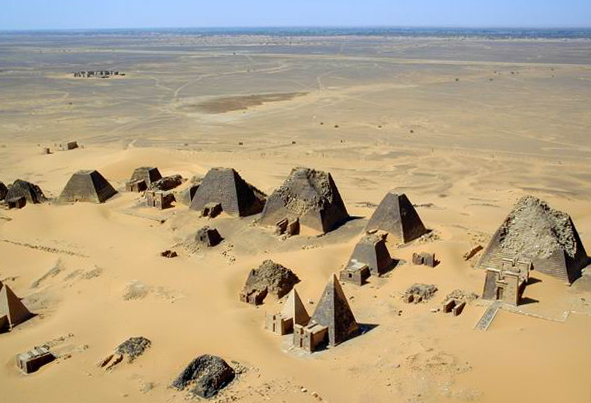
The early history of the Kingdom of Kush, located along the Nile region in northern Sudan, is intertwined with the history of ancient Egypt, with which it was politically allied over several regnal eras. By virtue of its proximity to Egypt, Sudan participated in the wider history of the Near East, with the important 25th dynasty of Egypt and the Christianization of the three Nubian kingdoms Nobatia, Makuria, and Alodia in the sixth century. As a result of Christianization, the Old Nubian language stands as the oldest recorded Nilo-Saharan language (earliest records dating to the eighth century in an adaptation of the Coptic alphabet).
While Islam was already present on the Sudanese Red Sea coast and the adjacent territories since the 7th century, the Nile Valley did not undergo Islamization until the 14th-15th century, following the decline of the Christian kingdoms. These kingdoms were succeeded by the Sultanate of Sennar in the early 16th century, which controlled large parts of the Nile Valley and the Eastern Desert, while the kingdoms of Darfur controlled the western part of Sudan. Two small kingdoms arose in the southern regions, the Shilluk Kingdom of 1490, and Taqali of 1750, near modern-day South Sudan, but both northern and southern regions were seized by Muhammad Ali of Egypt during the 1820s. The oppressive rule of Muhammad Ali and his immediate successors is credited for stirring up resentment against the Turco-Egyptian and British rulers and led to the establishment of the Mahdist State, founded by Muhammad Ahmad in 1881.
Since independence in 1956, the history of Sudan has been tarnished by internal conflict, including the First Sudanese Civil War (1955–1972), the Second Sudanese Civil War (1983–2005) –culminating in the secession of South Sudan on 9 July 2011– the War in Darfur (2003–2020) and the current Sudanese civil war (2023–present).
Affad 23 is an archaeological site located in the Affad region of southern Dongola Reach in northern Sudan, which hosts "the well-preserved remains of prehistoric camps (relics of the oldest open-air hut in the world) and diverse hunting and gathering loci some 50,000 years old".
Evidence from cattle bones found at Letti Desert 2 in Sudan suggests that cattle may have been domesticated independently in Africa at the same time as in the Middle East – around 10,000 years ago. By the eighth millennium BC, people of a Neolithic culture had settled into a sedentary way of life there in fortified mud-brick villages, where they supplemented hunting and fishing on the Nile with grain gathering and cattle herding. Genetic data suggests the Kordofan melon is the closest relative to the modern watermelon which may indicate it was first domesticated in Sudan. During the fifth millennium BC, migrations from the drying Sahara brought neolithic people into the Nile Valley along with agriculture. The population that resulted from this cultural and genetic mixing developed a social hierarchy over the next centuries and became the Kingdom of Kush (with the capital at Kerma) around 1070 BC. Anthropological and archaeological research indicates that during the pre-dynastic period Lower Nubia and Magadan Upper Egypt were ethnically, and culturally nearly identical, and thus, simultaneously evolved systems of Pharaonic kingship by 3300 BC. Together with other countries on Red Sea, Sudan is considered the most likely location of the land known to the ancient Egyptians as Punt (or "Ta Netjeru", meaning "God's Plan"), whose first mention dates to the 10th century BC.
In eastern Sudan, the Butana Group appears around 4000 BC. These people produced simple decorated pottery, lived in round huts and were most likely herdsmen, hunters, but also consumed land snails and there is evidence for some agriculture. The earliest archaeological evidence for the origins of domesticated sorghum come from the Butana Group in the 4th millennium BC. The Gash Group started around 3000 BC and is another prehistory culture known from several places. These people produced decorated pottery and lived from farming and cattle breeding. Mahal Teglinos was an important place about 10 hectare large. In the center were excavated mud brick built houses. Seals and seal impressions attest a higher level of administration. Burials in an elite cemetery were marked with rough tomb stones. In the second millennium followed the Jebel Mokram Group. They produced pottery with simple incised decoration and lived in simple round huts. Cattle breeding was most likely the economical base.
Hub AI
History of Sudan AI simulator
(@History of Sudan_simulator)
History of Sudan
The history of Sudan refers to the territory that today makes up Republic of the Sudan and the state of South Sudan, which became independent in 2011. The territory of Sudan is geographically part of a larger African region, also known as "Sudan". The term is derived from Arabic: بلاد السودان bilād as-sūdān, or "land of the black people", and has sometimes been used more widely referring to the Sahel belt of West and Central Africa.
The modern Republic of the Sudan was formed in early 1956 and inherited its boundaries from Anglo-Egyptian Sudan, established in 1899. For times predating 1899, usage of the term "Sudan" mainly applied to the Turkish Sudan and the Mahdist State, and a wider and changing territory between Egypt in the North and regions in the South adjacent to modern Uganda, Kenya and Ethiopia.
The early history of the Kingdom of Kush, located along the Nile region in northern Sudan, is intertwined with the history of ancient Egypt, with which it was politically allied over several regnal eras. By virtue of its proximity to Egypt, Sudan participated in the wider history of the Near East, with the important 25th dynasty of Egypt and the Christianization of the three Nubian kingdoms Nobatia, Makuria, and Alodia in the sixth century. As a result of Christianization, the Old Nubian language stands as the oldest recorded Nilo-Saharan language (earliest records dating to the eighth century in an adaptation of the Coptic alphabet).
While Islam was already present on the Sudanese Red Sea coast and the adjacent territories since the 7th century, the Nile Valley did not undergo Islamization until the 14th-15th century, following the decline of the Christian kingdoms. These kingdoms were succeeded by the Sultanate of Sennar in the early 16th century, which controlled large parts of the Nile Valley and the Eastern Desert, while the kingdoms of Darfur controlled the western part of Sudan. Two small kingdoms arose in the southern regions, the Shilluk Kingdom of 1490, and Taqali of 1750, near modern-day South Sudan, but both northern and southern regions were seized by Muhammad Ali of Egypt during the 1820s. The oppressive rule of Muhammad Ali and his immediate successors is credited for stirring up resentment against the Turco-Egyptian and British rulers and led to the establishment of the Mahdist State, founded by Muhammad Ahmad in 1881.
Since independence in 1956, the history of Sudan has been tarnished by internal conflict, including the First Sudanese Civil War (1955–1972), the Second Sudanese Civil War (1983–2005) –culminating in the secession of South Sudan on 9 July 2011– the War in Darfur (2003–2020) and the current Sudanese civil war (2023–present).
Affad 23 is an archaeological site located in the Affad region of southern Dongola Reach in northern Sudan, which hosts "the well-preserved remains of prehistoric camps (relics of the oldest open-air hut in the world) and diverse hunting and gathering loci some 50,000 years old".
Evidence from cattle bones found at Letti Desert 2 in Sudan suggests that cattle may have been domesticated independently in Africa at the same time as in the Middle East – around 10,000 years ago. By the eighth millennium BC, people of a Neolithic culture had settled into a sedentary way of life there in fortified mud-brick villages, where they supplemented hunting and fishing on the Nile with grain gathering and cattle herding. Genetic data suggests the Kordofan melon is the closest relative to the modern watermelon which may indicate it was first domesticated in Sudan. During the fifth millennium BC, migrations from the drying Sahara brought neolithic people into the Nile Valley along with agriculture. The population that resulted from this cultural and genetic mixing developed a social hierarchy over the next centuries and became the Kingdom of Kush (with the capital at Kerma) around 1070 BC. Anthropological and archaeological research indicates that during the pre-dynastic period Lower Nubia and Magadan Upper Egypt were ethnically, and culturally nearly identical, and thus, simultaneously evolved systems of Pharaonic kingship by 3300 BC. Together with other countries on Red Sea, Sudan is considered the most likely location of the land known to the ancient Egyptians as Punt (or "Ta Netjeru", meaning "God's Plan"), whose first mention dates to the 10th century BC.
In eastern Sudan, the Butana Group appears around 4000 BC. These people produced simple decorated pottery, lived in round huts and were most likely herdsmen, hunters, but also consumed land snails and there is evidence for some agriculture. The earliest archaeological evidence for the origins of domesticated sorghum come from the Butana Group in the 4th millennium BC. The Gash Group started around 3000 BC and is another prehistory culture known from several places. These people produced decorated pottery and lived from farming and cattle breeding. Mahal Teglinos was an important place about 10 hectare large. In the center were excavated mud brick built houses. Seals and seal impressions attest a higher level of administration. Burials in an elite cemetery were marked with rough tomb stones. In the second millennium followed the Jebel Mokram Group. They produced pottery with simple incised decoration and lived in simple round huts. Cattle breeding was most likely the economical base.
Recent media