Hubbry Logo
History of The CitadelHistory of The CitadelMain
Open search
History of The Citadel
Community hub
History of The Citadel
logo
8 pages, 0 posts
0 subscribers
Be the first to start a discussion here.
History of The Citadel
from Wikipedia

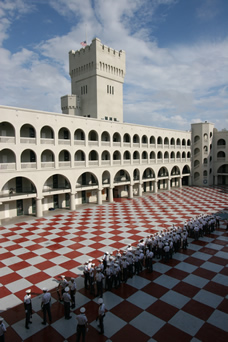
Checkerboard Quadrangle of Padgett Thomas Barracks

The History of The Citadel began in the early 1820s with the formation of a militia and state arsenal in response to an alleged slave revolt in 1822.[1] By 1842 the arsenal grew into an academy, with the Legislature establishing it as the South Carolina Military Academy. Cadets played a key role in the Civil War by assisting in the battalion firing upon a federal ship three months before the war began. Many Confederate officers attended the school.[2] Renamed in 1910 as The Citadel, the school's academic reputation grew. After moving the campus near Hampton Park in 1922, the college has grown substantially. In 1969, graduate student Maxine Hudson became the first woman to earn a degree from The Citadel.[3] The Citadel saw the graduation of its first Black student, Charles D. Foster in 1970, 16 years after legal segregation ended in public schools.[4] Following a rocky journey, The Citadel graduated its first female Cadet, future congresswoman Nancy Mace, in 1999. The school has produced many military officers, business, and political leaders throughout its history.

Citadel Academy

[edit]

The Citadel traces its origins to an arsenal constructed by the state of South Carolina to defend white Charlestonians against possible uprisings of enslaved people following the thwarted Denmark Vesey rebellion of 1822.[5][6][7] In 1829 South Carolina constructed an arsenal on what is now Marion Square in downtown Charleston to house arms and ammunition. The State entered into an agreement in 1830 with the War Department for Federal troops from nearby Fort Moultrie to garrison this new arsenal. State militia replaced them in 1832. Over the next 10 years arsenals throughout the state were consolidated in Charleston and Columbia. Governor John Richardson eventually proposed converting both into military academies based upon the Norwich University model and on December 20, 1842 the South Carolina Legislature passed "an Act to convert the Arsenal at Columbia and the citadel and magazine in and near Charleston, into Military Schools" thereby transforming the two state arsenals into the South Carolina Military Academy. The act specified:

That the students when admitted, shall be formed into a military corps, and shall constitute the public guard of the Arsenal at Columbia, and of the Citadel and Magazine in and near Charleston ... to guard effectually, the public arms and other property at the places aforsaid ...[8]

The first 20 cadets reported to the Citadel Academy at Marion Square in downtown Charleston on March 20, 1843, a date now celebrated as "Corps Day". Initially both schools operated as separate institutions governed by a common Board of Visitors, but in 1845 the Arsenal Academy in Columbia became an auxiliary to the Citadel Academy in Charleston. First year students attended the Arsenal then transferred to the Citadel Academy to complete their education. Both schools continued to operate during the Civil War, but the Arsenal in Columbia was burned by Union forces and never reopened. The only surviving building from the Arsenal is the current Governor's Mansion.[9]

Mexican–American War

[edit]

Citadel cadets and faculty members trained South Carolina's Palmetto Regiment for service in the Mexican–American War; 17 graduates and cadets fought with the unit which teamed with U.S. Marines to enter the famous "Halls of Montezuma" in Mexico City in 1847.[10] Lt. William J. Magill, a member of the first graduating class of 1846 was the first alumnus to serve in the U.S. Army and was a member of the 3d Dragoons under future President Zachary Taylor in the Mexican War.[11]: 10 

American Civil War and aftermath

[edit]
The Citadel at the start of the Civil War

When South Carolina declared that it had seceded from the Union in December 1860, Major Robert Anderson moved his garrison of U.S. troops to Fort Sumter and requested reinforcements from the federal government. On January 9, 1861, a battery on Morris Island manned by Citadel Academy cadets fired on the U.S. steamer Star of the West, preventing it from reaching Fort Sumter with troops and supplies.[12] Along with Confederate troops, Citadel cadets also manned several guns at "the battery" on Charleston harbor during the firing on Fort Sumter of April 12–13, 1861;[11]: 23  The first shot of the bombardment is believed by many historians to have been fired by Second Lieutenant Henry S. Farley, Class of 1860.[13]

On January 28, 1861 the Corps of Cadets from the Arsenal Academy (in Columbia) and the Citadel Academy (in Charleston) known as The SC Military Academy was made part of the military organization of the state and named the Battalion of State Cadets. The Academy continued to operate as a military academy, but classes were often disrupted when the governor called the cadets into military service. Mounting and manning heavy guns, performing guard duty, providing security and escorting prisoners were among the services performed by the cadets. The Battalion of State Cadets participated in eight engagements during the Civil War. As a result of these actions, the state of South Carolina authorized the flag of the South Carolina Corps of Cadets to carry the following Confederate battle streamers:[14][15][16]: 11 

The old Citadel, Charleston in 1940.
  1. Confederate States Army
  2. Star of the West, January 9, 1861
  3. Wappoo Cut, November 1861
  4. James Island, June 1862
  5. Charleston and Vicinity, July–October 1863
  6. James Island, June 1864
  7. Tulifinny, December 1864
  8. James Island, December 1864 – February 1865
  9. Williamston, May 1865

(The Confederate States Army streamer is gray embroidered in silver and the remainder embroidered in blue)[15]

In early December, 1864 Governor Milledge Luke Bonham ordered the Battalion of State Cadets to Tulifinny Creek near Yemassee, South Carolina to join a small Confederate force defending the Charleston and Savannah Railroad. On December 7 and 9 the entire Corps of Cadets from the SCMA fought a much larger Union force (including a contingent of U.S. Marines) in the Battle of Tulifinny, successfully defending the rail line and forcing the Union troops to withdraw; the cadets suffered eight casualties and one cadet died after the battle from his injuries. The Battalion of State Cadets was commended for their display of discipline and gallantry under fire winning the admiration of the veteran troops who fought with them, only The Citadel and The Virginia Military Institute have fought pitched battle with their entire student bodies; The Citadel is also one of only 7 colleges to have received a battle streamer for wartime service. During the Civil War, 43 graduates and 200 former cadets were Killed in Action.[17]

On February 18, 1865, the school ceased operation as a college when Union troops entered Charleston and occupied the site. Following the war, the Board of Visitors eventually regained possession of The Citadel campus and with the urging of Governor Johnson Hagood, Class of 1847, the South Carolina Legislature passed an act to reopen the college. The 1882 session began with an enrollment of 185 cadets.

Into the 20th century

[edit]
The Citadel bulldog mascot

In the war with Spain in 1898 more Citadel alumni volunteered for service than were needed.[18] In World War I, Citadel graduates were among the first contingents of American troops to fight with the Australian, and later British and French divisions; several served prominently with the Marine Corps at the Battle of Belleau Wood. The name of the college was officially changed in 1910 to "The Citadel, The Military College of South Carolina"; the word "Academy" had become synonymous with secondary schools and the public had the misconception that the South Carolina Military Academy was a preparatory school.[19] By that time the school had outgrown its facility despite numerous additions, in 1918 the city of Charleston offered the state of South Carolina 176 acres (71 ha) on the banks of the Ashley River for a new campus on the condition that the state fund the construction.[20] The state accepted the offer on February 26, 1919 and allotted $300,000 towards the construction of a new campus.[21] In 1921 the title of the head of the school was changed from Superintendent to President, Colonel Oliver J. Bond was the last Superintendent and first President of The Citadel.

The college moved to its current location in 1922; the new campus initially consisted of only a barracks, admin/classroom building, mess hall, gym and hospital but in the next 3 decades grew rapidly. New barracks were constructed in 1926, 1938 and 1942 bringing bed capacity up to nearly 2,000; between 1936 and 1939 a chapel, armory/field house, new mess hall and 2 more academic buildings were added. Capers Hall, the main academic building was built in 1951, a student activities building was added in 1957 and Daniel Library was completed in 1960; Deas Hall, the Physical Education facility opened in 1976.

During World War II, the entire Class of 1944 was drafted and only 2 graduated. By 1943 so many cadets had left school to join the military that enrollment had dropped to less than 500 but was soon bolstered with the addition of active duty service members attending as part of the Army Specialized Training Program. Of the 2,976 living alumni in 1946 all but 49 served their country. Citadel alumni were members of some of the most famous units of the war to include the Flying Tigers, the Doolittle Raiders and the RAF Eagle Squadrons; 280 alumni were Killed in Action, 67 were declared Missing and 65 became Prisoners of War. In the immediate postwar period veteran students utilizing the GI Bill swelled the size of the school to record levels and at one time outnumbered cadets more than 2 to 1. [18]

Starting in the late 1980s a major initiative was begun to renovate older campus facilities and replace aging ones; McAlister Field House underwent an extensive rebuilding in 1987–89 that increased seating capacity from 4,500 to 6,000; in 1991 a new mess hall and classroom building (Grimsley Hall) were completed, a major renovation of the administration building (Bond Hall) was finished in 1993 and the beach house was rebuilt in 1995 after having been destroyed by Hurricane Hugo in 1989. A new barracks was constructed in 1996 and over the next decade three of the original four barracks were razed and rebuilt, the newest academic building (Thompson Hall) was completed in 2003. The Holliday Alumni Center located on Hagood Avenue just south of campus was dedicated in 2001, Johnson Hagood Stadium has had major improvements in recent years including a new field house and reconstruction of the home stands including a new press box tower that features club level seating and luxury boxes.[22]

The growth of the college has allowed for continuously expanding academic offerings; in 1916 only 3 majors were offered, at present 65 courses of study are available at both the undergraduate and postgraduate level. A Graduate School, the first in the Lowcountry area was established in 1968 to fill the educational needs of a growing metropolitan area. In recent years new majors in high demand fields such as Computer Science, Criminal Justice, Sports Management, Nursing and Mechanical Engineering have been established; minors are now offered in diverse subjects including Cybersecurity, East Asian Studies, International Relations, Management Information Systems and African American Studies.[23][24][25]

Additional facilities work continues, with a new building for the business school and a rebuilt Capers Hall (home of humanities and social sciences) slated for 2018 and beyond, and a rebuilt boat house and repairs to the beach house also recently undertaken.

Women in the Corps of Cadets

[edit]

The Corps of Cadets was officially all male until 1996. In 1995, Shannon Faulkner won a two-and-a-half-year legal battle and was granted admission by order of a federal judge. She reported to the campus on the first day of freshman orientation, but was admitted to the school's infirmary immediately following lunch. She left the school after she received dozens of death threats and her family's home was vandalized.[26][27] A Supreme Court ruling in a discrimination lawsuit against Virginia Military Institute eventually compelled the school to officially change its admission policy to admit women.[28]

The first group of four female cadets matriculated in August 1996; using credits from another school Nancy Mace completed her degree in three years and became the first female graduate in Corps history on May 9, 1999. Czech born Petra Lovetinska was the first female graduate to have attended for four years, the first foreign female cadet, and after receiving her U.S. citizenship by Act of Congress, the first female graduate to be commissioned into the U.S. military.[29][30] The other two women did not remain to finish their first year.[31] As of September 2013 women comprise 7% of the Corps of Cadets and 21% of the overall student body.[32]

In the graduating class of 2012 Shanna M. Couch and Alexandria R. Burns were named First and Second Honor Graduates respectively. This was the first time in school history that either of the top two graduates of a class were women. A four-year starter on the soccer team, Couch was also the first woman at The Citadel to receive an NCAA Postgraduate Scholarship.[33] Burns, a native of Pendleton, South Carolina, was recognised for her remarkable academic achievement by the Anderson County Council in a resolution passed in June 2012.[34]

On March 21, 2018, The Citadel announced that Sarah J. Zorn would serve as Regimental Commander, the highest ranking cadet for the 2018–19 academic year. She will be the first woman to hold that position.[35]

References

[edit]
Revisions and contributorsEdit on WikipediaRead on Wikipedia
from Grokipedia
The Citadel, The Military College of , originated as a state arsenal constructed in 1822 in Charleston following Denmark Vesey's slave revolt, and was converted into a in 1842 to train officers for the militia, with instruction commencing in 1843 under a modeled on the at West Point and the . Initially paired with a counterpart institution at the Arsenal in Columbia, it emphasized a blend of and for a corps of cadets, including "beneficiary cadets" from less affluent regions to broaden access. During the , Citadel cadets fired upon the merchant vessel on January 9, 1861—the first armed engagement of the conflict—while attempting to resupply federal forces at , and subsequently participated in eight Confederate defensive actions, including the defense of James Island; of its 224 living graduates at , 209 served the Confederacy, contributing to the institution's receipt of nine battle streamers. Union occupation of Charleston in February 1865 halted operations, with the campus repurposed as a hospital and barracks, leading to a period of dormancy until reopening in 1882 after Reconstruction, when it adopted its current name and refocused on producing citizen-soldiers for civil and military service. In the , expanded amid world wars and societal shifts, integrating its first African American in 1966 and, following federal court rulings against its all-male policy, admitting women to the of Cadets in 1996, with the first female graduate emerging in 1999; it also established the Citadel Graduate College in 1994 to offer evening and graduate programs to non-cadets. Today, with over 2,300 cadets, it upholds traditions like the officer-led honor code and knob year while adapting to coeducation and diverse enrollment, having produced thousands of military officers, including generals and admirals, alongside leaders in business and government.

Origins and Founding

Establishment as State Arsenal

The South Carolina State Arsenal in Charleston, later known as the Old Citadel, originated in response to the Denmark Vesey slave insurrection plot uncovered in 1822, which heightened fears among white residents of a potential uprising by enslaved Africans. To safeguard the city and store state arms, construction of a fortified arsenal and guardhouse began on the site of the present-day Marion Square, designed by architect Frederick Wesner in a medieval castle style for defensive purposes. The structure, completed around 1829, initially housed a small guard detachment, with federal troops from Fort Moultrie providing security starting in 1830. The of 1832–1833 further underscored the need for independent state military preparedness amid tensions with the federal government over tariff policies, leading to expel federal troops from the and assert control. In , the state legislature consolidated arms and munitions at two primary depots: in Charleston and the in Columbia, establishing a centralized system to arm state militias against potential external threats or internal unrest. This served as a secure repository for firearms, , and other ordnance, manned by state-appointed custodians and a modest tasked with preventing unauthorized access, particularly in light of ongoing concerns over slave rebellions. Until its repurposing in 1842, functioned primarily as a defensive outpost and storage facility, reflecting South Carolina's emphasis on localized military autonomy during a period of sectional discord and domestic security anxieties. The facility's strategic location in downtown Charleston enabled rapid mobilization of defenses, though it saw limited active use beyond routine maintenance and occasional drills prior to the Civil War.

Creation of the South Carolina Military Academy

Following the and persistent fears of slave insurrections, the sought to bolster state defense by combining military guardianship with education. On December 20, 1842, the legislature passed an act converting the Citadel arsenal in Charleston and the Arsenal in Columbia into military schools under the unified name South Carolina Military Academy. This transformation replaced standing guards with cadet companies responsible for securing state arms and property, while providing instruction to instill discipline, character, and patriotism in South Carolina's youth. The academy's structure comprised two branches: the Arsenal Academy in Columbia for preliminary training and the Academy in Charleston for advanced studies, with cadets advancing from the former to the latter after their initial year. Annual state funding allocated $8,000 to the Arsenal branch and $16,000 to the branch to cover operations, , and facilities. A governor-appointed Board of Visitors supervised the institution, appointing superintendents and professors, and prescribing a emphasizing alongside and other essential disciplines deemed necessary for effective state service. Operations began on March 20, 1843, when 28 cadets enrolled at the Arsenal Academy, marking the practical launch of the academy's dual-campus model. This establishment addressed South Carolina's strategic needs for a reliable, locally trained militia capable of responding to both internal threats and potential federal encroachments, reflecting the state's commitment to self-reliant military preparedness.

Antebellum Era

Pre-Civil War Expansion and Curriculum

Following its establishment in 1842, the Military Academy underwent gradual expansion in enrollment and operational scope prior to the Civil War. Initial cadet numbers stood at 34 in 1843, reflecting modest beginnings, but grew steadily to approximately 296 by 1864, with significant increases occurring in the antebellum decades as the institution gained prominence as a state-supported military educator. The academy maintained a dual-campus structure, with first-year s stationed at the Arsenal in Columbia for foundational training before transferring to the Citadel campus in Charleston for advanced studies, enabling efficient resource use across the state. This arrangement supported broader accessibility for youth, fostering a that emphasized state defense and discipline. The curriculum blended rigorous military instruction with academic pursuits, drawing direct inspiration from the Virginia Military Institute's model, which prioritized practical sciences over purely . Core subjects included , , natural sciences, and French—essential for and tactics—alongside mandatory , , and moral training to instill and allegiance to . Cadets pursued a structured four-year course, supplemented by summer encampments and statewide "Corps Trips" initiated around , which served dual purposes of and practical field experience, including community engagements like parades and social events to secure legislative and popular support. Leadership transitions bolstered institutional stability and adaptation. After initial Superintendent William F. Graham's death in 1844, Major Richard W. Colcock, a West Point graduate, took command and corresponded with VMI's Francis H. Smith for guidance on administration, fiscal management, and examination protocols, implementing reforms to enhance efficiency. Colcock's tenure emphasized fiscal control and commandant roles, while Major Peter F. Stevens, an academy alumnus, assumed superintendency in 1859, further refining assessment methods borrowed from peer institutions. These efforts, combined with tuition adjustments—from $200 in 1843 to higher rates by the 1850s—facilitated sustained growth without major infrastructural overhauls, relying on existing arsenal facilities for barracks, classrooms, and armories.

Involvement in the Mexican-American War

The South Carolina Military Academy, established in 1842 and later known as , contributed to the U.S. effort in the Mexican-American War (1846–1848) primarily through the training of state volunteers and the service of its early alumni. The academy's inaugural graduating class of 1846, consisting of six cadets, assumed a key role in preparing 's Palmetto Regiment, a volunteer unit formed on June 29, 1846, under Colonel Pierce Mason Butler. Cadets from this class acted as drillmasters, instructing junior officers and recruits in and discipline at the Charleston Arsenal before the regiment's deployment to . The Palmetto Regiment, comprising approximately 1,000 men, participated in major campaigns under Generals and , including the battles of (September 1846) and the advance on . While the academy itself did not deploy its en masse, from the 1846 class joined the , marking the institution's initial involvement in foreign conflict. This early participation established a precedent, with Citadel graduates serving in every subsequent U.S. war. Notable among these was Judah P. Alexander, a member of the Class of 1846, who became the first Citadel alumnus to die in American combat, succumbing during the war's campaigns. The regiment suffered significant casualties, with around 150 killed or wounded, reflecting the harsh conditions of the conflict, though specific alumni losses beyond Alexander remain sparsely documented in primary records. This training and alumni service underscored the academy's emerging function as a source of disciplined military leadership for South Carolina amid national expansionist policies.

Civil War Period

Cadet Contributions to Confederate Defense

Following 's secession on December 20, 1860, cadets from the South Carolina Military Academy, including those at in Charleston, were mobilized to support Confederate defenses. On January 9, 1861, approximately 40 Citadel cadets manned a battery of four 24-pound siege guns on and fired the initial shots at the Union supply ship as it approached to reinforce , striking the vessel three times and compelling it to withdraw. This action marked an early escalation in hostilities, though the formal commencement of the Civil War is dated to the bombardment of on April 12, 1861. On January 28, 1861, the legislature established the Battalion of State Cadets, comprising students from both and the Arsenal Academy in Columbia, to bolster local defense efforts under the command of Major James B. White, a Citadel graduate. The , often numbering around 300 cadets, performed routine duties such as mounting and manning heavy batteries, conducting guard duty at key installations, and escorting prisoners throughout the war. Over the course of the conflict, the cadets participated in eight distinct engagements primarily defending Charleston and other sites, earning battle streamers for their flag. Notable actions included repelling Union forces at Wappoo Cut in November 1861 and engagements on James Island in June 1862, contributing to the Confederate victory at the Battle of Secessionville. Cadets also supported defenses during the 1863 assaults on Battery Wagner on Morris Island, manning guns amid the prolonged siege of Charleston Harbor. In December 1864, the full battalion, including Citadel cadets, was ordered to Tulifinny Creek near Orangeburg to impede General William T. Sherman's advance through the Carolinas; numbering about 150 Citadel cadets within a larger force, they helped repel multiple Union attacks from December 6 to 9, defeating a Federal detachment exceeding twice their strength despite sustaining casualties, including the only enrolled Citadel cadet killed in action, William J. B. Patterson, on December 7. As Union forces closed in during early 1865, the academy suspended operations in , with remaining cadets integrated into field units. The battalion's final organized action occurred on May 1, 1865, near Williamston, , where cadets skirmished with Union raiders in one of the last Confederate resistances east of the before surrendering shortly thereafter. Overall, the cadets' service provided critical support to Confederate and needs, leveraging their academy training in an otherwise resource-strapped defense.

Occupation and Temporary Closure

As Union forces under Major General William T. Sherman approached Charleston in mid-February 1865, Confederate defenders evacuated the city on February 17, allowing federal troops to enter unopposed the following day. On February 18, 1865, Union soldiers occupied The Citadel's facilities, immediately halting all academic and training operations at the South Carolina Academy. The occupation marked the end of the institution's active role in Confederate defense, as the had been furloughed earlier that month amid the collapsing Southern lines. The Citadel building, originally constructed as a state in , was repurposed by federal troops as a and headquarters during the Reconstruction period. Union forces maintained control of the site for federal military purposes, with no reported structural damage to the main Citadel edifice itself, unlike the adjacent , which suffered destruction by fire in 1865. This prolonged military use prevented any resumption of educational activities, contributing to the academy's effective closure as an institution of learning. The facility remained under federal confiscation for nearly 17 years, reflecting the broader federal oversight of Southern military sites amid postwar political tensions. Efforts to reclaim and revive The Citadel faced delays due to Reconstruction policies, economic devastation in , and the need for state legislative approval to restore its . The temporary closure spanned from 1865 until 1882, when the institution reopened under revised governance, signaling a shift toward institutional recovery. During this , surviving cadets and alumni dispersed, with many having already contributed to Confederate service earlier in the war, underscoring the academy's transformation from an active military asset to an idle federal outpost.

Reconstruction and Revival

Post-War Challenges and Reopening in 1882

Following the fall of Charleston to Union forces on February 18, 1865, The Citadel's campus was seized and occupied by federal troops, who repurposed the facility as a military garrison, effectively halting its operations as an . This occupation persisted for 14 years until the spring of 1879, amid the broader , during which faced severe economic collapse, widespread poverty, and political upheaval under federal military governance and Republican state control. The state's agrarian economy, devastated by the loss of over 18,000 white male lives in the war and the emancipation of enslaved labor, generated limited public funds, exacerbating fiscal constraints on reviving state-supported institutions like The Citadel. The occupation compounded physical and operational challenges; the adjacent South Carolina Arsenal, a sister facility integrated into the academy system, was destroyed by fire in 1865, scattering resources and complicating any immediate recovery efforts. With federal troops using the Citadel grounds for barracks and defense, alumni associations formed in exile but lacked authority or access to reclaim the property, delaying organized revival until Reconstruction's end in 1877 and troop withdrawal two years later. Post-1879 advocacy intensified, led by Citadel alumnus and former Confederate Brigadier General Johnson Hagood (class of 1847), who argued for reopening to instill military discipline and technical education among white South Carolinians of modest means, shifting from its pre-war elite focus to broader state service amid lingering sectional resentments and the need for social order. By early 1882, persistent lobbying from the Association of Graduates and sympathetic legislators overcame budgetary hesitations, culminating in the General Assembly's passage of "An Act to Authorize the Re-Opening of the " on January 31. The institution resumed classes in October 1882 under Superintendent John P. Thomas, admitting both fee-paying cadets and state-sponsored "beneficiary" cadets from indigent families, with an initial enrollment reflecting renewed commitment to and despite the 17-year hiatus. This reopening marked a pragmatic adaptation to 's diminished postwar circumstances, prioritizing institutional survival over pre-war grandeur.

Institutional Adjustments During Readjustment

Following the end of federal occupation in 1879, the Board of Visitors was reconstituted in 1878 under Governor and Johnson Hagood, a Citadel alumnus and Confederate general, to oversee the property and advocate for revival amid 's strained post-Reconstruction finances. On January 31, 1882, the narrowly passed "An Act to Authorize the Re-Opening of the South Carolina Military Academy" by a single vote in the Senate, reflecting fiscal debates over state debt and limited appropriations during the Readjustment era's emphasis on debt reduction and conservative budgeting. The institution reopened on October 2, 1882, with an initial enrollment of 189 , comprising a mix of tuition-paying students and a novel " cadet" track designed to address enrollment shortfalls and state funding limitations. cadets received state-subsidized education in exchange for a post-graduation commitment to teach in public schools for a period equivalent to their training, thereby repaying the investment through service rather than immediate fees; this system aimed to bolster the academy's viability without increasing direct legislative outlays during the era's fiscal retrenchment. adjustments included the Charleston City Council's lease of the property from the state to facilitate operations, granting oversight while maintaining state authority over and . Curriculum and operations retained core antebellum elements, such as mandatory military drill and instruction modeled on the U.S. at West Point, but were adapted for postwar realities with stricter financial accountability; the 1882 Board of Visitors minutes specified cadet uniform costs at approximately $25 per set and outlined repair budgets for dilapidated facilities, prioritizing essential over expansion. These measures ensured continuity of the academy's dual role as an educational institution and state guard, even as South Carolina's Readjuster policies curtailed broader public spending to manage bonded indebtedness exceeding $20 million from Reconstruction-era bonds. By 1885, enrollment stabilized at around 200 cadets, supported by modest state allocations that avoided the repudiation favored by some Readjusters, thus preserving the academy's funding amid partisan fiscal battles.

Early 20th Century Developments

World War I and Cadet Mobilization

Following the ' declaration of war on on April 6, 1917, 's Corps of Cadets and recent alumni mobilized extensively to support the war effort, leveraging the institution's established military training programs. The had already designated as a site for officer training, enabling the recommendation of honor graduates for commissions as second lieutenants in the , which facilitated rapid integration into federal forces. All 33 members of the Class of 1917 entered military service immediately upon graduation that year, setting a for total commitment from subsequent classes. The extended to the Class of 1918, with every graduate ultimately serving in the armed forces, reflecting the college's role in producing trained officers amid urgent national needs. In total, approximately 315 to 316 Citadel graduates deployed to , including an undetermined number of alumni, with 277 commissioned as officers across various branches. Cadets benefited from pre-war drills in , , and field , which aligned with requirements and minimized training gaps upon enlistment or commissioning. This effort contributed to broader U.S. , where colleges like supplemented Reserve Officer Training Corps initiatives to address officer shortages. Citadel alumni distinguished themselves in combat, earning five Distinguished Service Crosses for valor, while two graduates received both the Distinguished Service Cross and . The war resulted in significant sacrifices, with at least nine to 13 alumni fatalities recorded, underscoring the institution's direct contributions to Allied victories on the Western Front. Post-mobilization, the college maintained operations but faced enrollment pressures from wartime drafts, reinforcing its identity as a pipeline for .

Interwar Growth and Academic Enhancements

In 1922, The Citadel relocated from its original site on Marion Square in downtown Charleston to a new 100-acre campus along the Ashley River, adjacent to Hampton Park, which had been donated by the city. This move addressed overcrowding at the previous location, where enrollment had reached full capacity of 242 cadets by 1910, and facilitated future expansion through construction of initial facilities like Padgett-Thomas Barracks. The larger campus supported increased cadet numbers and infrastructure development during the interwar years. Academic credentials advanced significantly on December 5, 1924, when The Citadel received initial from the Southern Association of Colleges and Schools, marking a milestone in recognizing its programs as meeting regional standards. Between 1922 and 1932, the institution expanded its curriculum, broadening offerings beyond traditional military and focuses to enhance liberal arts and professional preparation. Under President General Charles P. Summerall, who assumed leadership in 1931 after retiring as U.S. Army , further academic enhancements occurred, including revamping, addition of new majors, and recruitment of holding doctoral degrees. These changes elevated scholarly standards and secured full status, positioning as a more robust undergraduate institution amid interwar demands for educated leaders.

Mid-20th Century Transformations

World War II Impacts and Discipline Changes

During , The Citadel experienced significant mobilization of its cadets and alumni, with over 6,000 men from the institution serving in various theaters of the conflict. The college contributed to the war effort through direct participation, including the training of raw recruits in newly formed military units, with cadets traveling as far as to conduct drills. Casualties were substantial, with 281 alumni names engraved on The Citadel War Memorial for those or who died during the war, reflecting losses across eighteen classes in alone. A notable example of this occurred in 1943, when the entire Class of 1944—originally set to enter their senior year—was ordered to and shipped out en masse, preventing the class from graduating as a cohesive unit and earning it the designation "The Class That Never Was." This event, coupled with widespread enlistments following the U.S. entry into the war in , led to a drastic reduction in campus enrollment by 1943, emptying the ranks and straining the institution's operations. In response, adapted by accelerating academic programs and focusing resources on supporting the , though specific graduation rates for affected classes dropped sharply, with only two members of the Class of 1944 ultimately receiving degrees. These wartime pressures prompted temporary changes to disciplinary structures, including the official suspension of the fourth-class system—the rigorous and regimen for incoming freshmen—for four years amid the enrollment crisis. This system, central to instilling and hierarchy, could not be sustained with diminished numbers of upperclassmen to enforce it. Following the war's end in 1945, the fourth-class system was reinstated in a modified form, incorporating adjustments to uniforms, haircuts, and overall regimentation to align with military influences and returning veterans' experiences, though core elements of accountability persisted. These adaptations reflected a pragmatic response to external demands while preserving the college's emphasis on .

Post-WWII Expansion and Cold War Role

Following , experienced significant enrollment expansion driven by the influx of veterans utilizing the Servicemen's Readjustment Act of 1944, commonly known as the , which enabled millions of former service members to pursue higher education. Returning veterans swelled the student body to record levels, temporarily outnumbering traditional cadets and necessitating adaptations in campus operations to accommodate the surge. This growth marked a departure from wartime depletions, when enrollment had plummeted due to cadet enlistments, with the institution contributing over 6,000 alumni and cadets to the . The post-war period also featured leadership instability, with four presidents serving in a 16-year span amid broader institutional transitions. Stability arrived in 1954 with the appointment of General , a renowned commander who had led the Fifth Army in the Italian campaign. During his 12-year tenure until 1965, Clark leveraged his military prestige to boost enrollment further, establish an endowment fund, and modernize facilities, enhancing the college's academic and physical infrastructure to support expanded operations. In the Cold War era, The Citadel fulfilled a key role as a senior military college by commissioning officers through its Reserve Officers' Training Corps (ROTC) programs, contributing to U.S. national defense amid tensions with the Soviet Union. Approximately 1,500 alumni served on active duty during the Korean War (1950–1953), with 25 confirmed fatalities in combat or related actions, underscoring the institution's pipeline for reserve and regular forces. The college's emphasis on disciplined, citizen-soldier training aligned with federal priorities for officer production under acts like the ROTC Vitalization Act of 1964, which reinforced ROTC as the primary source of Army officers during proxy conflicts and deterrence efforts. This sustained involvement extended into later Cold War phases, with alumni deployments reflecting the institution's commitment to military readiness without mandatory post-graduation service for all cadets.

Social Integrations and Internal Reforms

Admission of African American Cadets

Charles DeLesline Foster became the first African American cadet admitted to The Citadel's Corps of Cadets on September 6, 1966, marking the institution's initial step toward racial desegregation. A Charleston native and honors graduate of the segregated Charles A. Brown High School, the 18-year-old Foster applied voluntarily and was accepted without court order, unlike subsequent gender integration efforts. This admission occurred against a backdrop of resistance from Citadel leadership; President General had publicly opposed Supreme Court-mandated in Southern institutions, viewing it as externally imposed social engineering rather than organic change. Prior to 1966, the Corps had remained all-white since the college's founding in 1842, reflecting South Carolina's entrenched segregation policies post-Reconstruction. Foster's enrollment initiated a gradual integration process, with Joseph Shine admitted as the second African American in 1967. Both pioneers endured significant adversity, including overt racial epithets, , and subtle within the and fourth-class (plebe) system, where white cadets occasionally expressed hostility through derogatory remarks about Foster's appearance during formations. Despite these pressures, which tested the institution's rigid discipline and hierarchy, Foster persevered through the demanding regimen of military training, academics, and traditions, graduating in 1970 as the first African American alumnus of the Corps. Shine followed, earning his degree in 1971. The scarcity of contemporaneous media coverage—contrasting sharply with national attention on events like the University of Mississippi's 1962 integration—reflected the Citadel's low-profile approach and South Carolina's avoidance of federal confrontation at the time. Subsequent admissions accelerated modestly in the late and , driven by evolving state policies and civil rights enforcement rather than litigation specific to . By the , African American enrollment had increased, enabling milestones such as the selection of the first black regimental commander in 1993. Integration proceeded without the dramatic federal interventions seen at other Southern universities, aligning with the Citadel's emphasis on voluntary adaptation to maintain institutional autonomy. In recognition of these early efforts, the college unveiled a honoring Foster and Shine in 2021, underscoring their role in transforming the into a more diverse body while preserving its military ethos. In 1993, applied for admission to 's Corps of Cadets and was initially accepted before the institution revoked her offer upon discovering her , prompting her to file a federal lawsuit alleging violation of the of the Fourteenth Amendment. The district court trial occurred from May 16 to May 27, 1994, after which, on July 22, 1994, the court issued findings of fact, conclusions of law, and an order ruling that 's male-only policy constituted intentional without an "exceedingly persuasive justification," as required under for sex-based classifications. appealed, arguing that its single-sex model preserved a unique military-style education essential for leadership development and that integration would undermine the corps' discipline and traditions, but the Fourth Circuit largely upheld the district court's decision in 1995, leading to further appeals. On August 9, 1995, Chief Justice denied The 's emergency request for a stay from the , clearing the path for Faulkner's enrollment as the first female cadet. She matriculated on August 15, 1995, but withdrew on October 13, 1995, after approximately five weeks, citing emotional and physical exhaustion from intense scrutiny, threats, and isolation, though she received her degree in 2006 upon completing requirements elsewhere. Faulkner's case paralleled the contemporaneous challenge at (VMI), culminating in the 's June 26, 1996, decision in , which invalidated state-sponsored single-sex military education absent a remedy providing substantially equivalent benefits to excluded women, exerting direct pressure on The . Facing inevitable defeat on appeal and influenced by the VMI ruling, The Citadel's board announced on June 28, 1996, that it would admit qualified women to the Corps of Cadets starting in the fall, abandoning plans for a parallel leadership program deemed inadequate by courts. Four women enrolled in August 1996 as part of the first coeducational class, undergoing the same rigorous regimen of military training, physical fitness, and academic standards as male cadets. , one of these pioneers, persisted through the four-year program and became the first woman to graduate from the Corps in May 1999 with a degree in , demonstrating that women could meet the institution's demands despite initial resistance and cultural adjustments. By 2000, subsequent classes saw increased female enrollment, with courts awarding legal fees to plaintiffs' counsel to affirm the policy's , though reported no dilution of its core military ethos.

Hazing Controversies and Discipline Evolution

Hazing at has been a persistent element of its fourth-class system, intended to instill discipline and camaraderie among incoming cadets known as "knobs," but often escalating into physical and . Early accounts, fictionalized in Pat Conroy's 1980 novel based on his experiences as a graduate, depicted severe rituals including beatings and isolation, reflecting a culture where upperclassmen enforced through . In 1986, five cadets were confined to barracks for a Black cadet, sparking public outrage over racial targeting amid the institution's recent integration efforts. The 1990s marked intensified scrutiny, particularly following the admission of women in 1995 after federal lawsuits. In 1997, two female cadets endured involving lit cigarettes held near their skin, leading to one cadet's dismissal and punishments for nine others; Jeanie Mentavlos, who withdrew, described scalding showers, forced exercises until collapse, and upperclassmen threats as part of a pattern targeting newcomers. A 1994 New Yorker profile highlighted the "relentless" male-only environment's role in perpetuating such practices, including group punishments and enforced silence that masked reporting. In 1992, amid athlete complaints of abuse like excessive physical drills, the college banned specific exercises, signaling initial reforms to distinguish authorized training from unauthorized cruelty. Discipline evolved through policy tightening and structural changes, though incidents continued. By 2015, investigations confirmed four hazing cases, resulting in dismissals or suspensions, while 20 cadets faced penalties amid 85 allegations, including unauthorized restraints and assaults; four voluntarily departed. In 2019, President overhauled the fourth-class system by reducing upperclassmen authority over knobs' daily routines, shifting enforcement to cadre officers to curb clandestine while preserving military rigor. The Citadel's 2025 anti- policy prohibits all forms, emphasizing prevention through education and swift adjudication, yet reports from and parents indicate cultural resistance, with rituals adapting underground despite oversight. These reforms reflect a balance between tradition and accountability, driven by scandals rather than internal consensus.

Contemporary History

Achievements in Military and Civic Leadership

Graduates of The Citadel have achieved prominent positions in U.S. military leadership, with 312 alumni attaining the rank of general or admiral as of 2024. The institution commissions more officers into the armed forces annually than any other college in the United States, excluding the federal service academies. Recent examples include General Kenneth F. McKenzie Jr. (Class of 1979), who served as Commander of U.S. Central Command from 2018 to 2021, overseeing operations across the Middle East, Central Asia, and parts of South Asia. Other post-2000 advancements feature Major General Glenn K. Rieth (Class of 1980) in the U.S. Army and Rear Admiral John T. Palmer (Class of 1988) in the U.S. Navy, reflecting sustained contributions to senior command roles. The Citadel's Army ROTC program, known as the Palmetto Battalion, has consistently produced top-performing cadets, ranking among the nation's elite in and commissioning quality since the early . In 2022 alone, the program commissioned dozens of new officers across branches including , , , and . The college has also marked milestones such as producing its first African American three-star general in recent years, underscoring advancements in diverse within the military. In civic leadership, Citadel alumni have held influential roles in government and business, often leveraging the institution's emphasis on principled decision-making. (Class of 1999), the first woman to graduate from The Citadel's Corps of Cadets, was elected to the U.S. in 2020, representing South Carolina's 1st district and focusing on and . J. Gresham Barrett (Class of 1983) served as U.S. Congressman for South Carolina's 3rd district from 2003 to 2011, chairing subcommittees on defense and . honorees include Claudius Watts IV (Class of 1983), inducted into the Baker School of Hall of Fame in 2023 for founding and managing Meeting Street Partners, a firm investing in and initiatives. These accomplishments highlight a pattern where translates to effective civilian governance and enterprise , with alumni comprising a significant portion of South Carolina's executive and legislative figures historically.

Symbolism Debates and Cultural Shifts

In the mid-2010s, The Citadel faced intensified scrutiny over the Confederate Naval Jack flag displayed in Summerall Chapel since 1939, symbolizing the institution's historical ties to Southern military heritage during the Civil War era. Following the June 2015 mass shooting at Charleston's Emanuel African Methodist Episcopal Church, the Board of Visitors voted to relocate the flag from the chapel, viewing it as inconsistent with evolving societal sensitivities toward Confederate iconography. However, South Carolina's Heritage Act of 2000, which safeguards certain historical displays including those in state-supported institutions, prevented its removal without legislative amendment, prompting legal opinions affirming its protected status. Defenders, including some alumni and state lawmakers, argued the flag represented regional history and valor rather than endorsement of slavery or racial animus, while critics, such as U.S. Rep. James Clyburn, contended it perpetuated division in a diversifying military context. Debates persisted into the 2020s, with renewed calls for removal amid national reckonings over racial symbols. In June 2020, a group of approximately 20 under Citadel Alumni for Change petitioned for its disposal, citing parallels to Mississippi's retirement of its Confederate-emblazoned , which The promptly removed from the despite lacking Heritage Act protection. State Sen. introduced a 2021 Senate resolution directing immediate removal and disposal, framing the flag as a "symbol of hate" incompatible with modern inclusivity, though it garnered no legislative traction. As of 2025, the flag remains in place, underscoring tensions between preservation of institutional symbolism—rooted in The Citadel's founding amid antebellum defenses—and pressures for cultural adaptation in a post-2000 era of heightened diversity, where Black cadets comprised about 10% of the by 2020. Parallel symbolism debates emerged over accommodations for religious attire, highlighting clashes between personal cultural expressions and the uniformity emblematic of . In 2016, a prospective Muslim requested permission to wear a integrated with the standard uniform, invoking religious liberty under the First Amendment; The denied the waiver in May, prioritizing unaltered regalia as essential to esprit de corps and operational cohesion, consistent with federal military precedents limiting visible deviations. The advocated for the exception, arguing it mirrored allowances for Sikh turbans in active-duty forces, but institutional leaders maintained that such changes risked eroding the symbolic equality enforced by identical attire. The did not enroll, amplifying discussions on whether evolving necessitated recalibrating traditions forged in a historically homogeneous context. These debates coincided with incremental cultural shifts reinforcing adaptability while safeguarding core ethos. In 2020, under President , The Citadel implemented the "sophomore shuffle," mandating company reassignments after freshman year to foster broader interpersonal bonds, mitigate insular subcultures, and enhance amid criticisms of persistent cliques from prior integration eras. By 2019, the elected its first dual-minority leadership slate for top regimental posts, signaling progress in representational symbolism without diluting disciplinary rigor. Recent initiatives, such as the 2024 Cross-Cultural Competence program for international cadets, further embed into , reflecting causal pressures from globalized military service demands while resisting wholesale symbolic overhauls that could undermine the institution's identity as a bastion of unyielding tradition.

Developments from 2000 to 2025

In January 2005, John Grinalds retired as president after overseeing the institution's transition following the admission of women in the . John W. Rosa, USAF (Ret.), assumed the presidency in 2006, emphasizing academic excellence and leader development. Under Rosa's leadership, The Citadel doubled the number of programs and students in the School of Engineering, expanded overall academic offerings, and achieved record enrollments in the , reaching full capacity. During the 2002–2003 academic year, The Citadel reorganized its departments into five schools—, , , and Social Sciences, and and —each led by a dean to enhance administrative efficiency and academic focus. Rosa's administration also completed a $100 million capital campaign supporting and program growth, including the groundbreaking for a new building in 2017, the first major academic construction since 1974. Undergraduate enrollment expanded from approximately 2,300 in the early 2000s to over 2,700 by fall 2024, reflecting sustained growth amid national trends in higher education. Rosa retired in 2018, succeeded by General Glenn M. Walters, USMC (Ret.), the first Marine Corps officer to lead the institution, inaugurated in 2019. Walters introduced the "Our Mighty Citadel 2026" strategic plan, outlining six initiatives to strengthen leader development, academic rigor, community engagement, and facilities modernization. Key outcomes included the establishment of the Krause School of Leadership and Ethics in 2023, funded by a transformational gift, and ongoing capital projects such as the completion of Bastin Hall in 2019 and the renovation of Capers Hall in 2023. The plan's facilities initiative addressed a $315 million backlog in maintenance needs, prioritizing cadet barracks and academic spaces. In 2022, The Citadel marked the centennial of its campus relocation to the Ashley River site, underscoring its enduring ties to Charleston. By 2025, under Walters, the institution continued commissioning high numbers of officers, maintaining its role in producing military leaders while adapting to contemporary educational demands.

References

Add your contribution
Related Hubs
User Avatar
No comments yet.