


Community hub
Recent from talks
Contribute something
Nothing was collected or created yet.
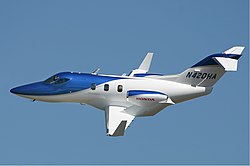
Honda HA-420 HondaJet
View on Wikipedia
The Honda HA-420 HondaJet is a light business jet produced by the Honda Aircraft Company of Greensboro, North Carolina, United States. Original concepts of the aircraft started in 1997 and were completed in 1999. It took its maiden flight on December 3, 2003, received its FAA type certificate in December 2015, and was first delivered that same month.
Key Information


The six- or seven-seat aircraft has a composite fuselage and an aluminum wing, and is powered by two unusually mounted GE Honda HF120 turbofans, on pylons above the wing. It can cruise at 422 knots [kn] (782 km/h; 486 mph) and has a range of up to 1,547 nautical miles [nmi] (2,865 km; 1,780 mi). The HondaJet has received several aeronautic design and innovation accolades.
Development
[edit].jpg)
Honda began to study small-sized business jets in the late 1980s, using engines from other manufacturers. The Honda MH01 turboprop used an all-composite construction,[3] and the Honda MH02 was fabricated and assembled at Mississippi State University's Raspet Flight Research Laboratory in the late 1980s and early 1990s. The MH02 was a prototype using carbon fiber/epoxy composite materials and was the first all-composite light business jet to fly.[4] Flight testing on the MH02 continued through 1996, after which the aircraft was shipped to Japan.[5]
Lead designer and company founder Michimasa Fujino began sketching the HondaJet in 1997, and the concept was solidified in 1999. According to Fujino, design of the HondaJet nose was inspired by Salvatore Ferragamo shoes.[6] Testing in the Boeing windtunnel indicated a valid concept in 1999.[3][7]
In October 2000, Honda R&D Americas established a research facility at the Piedmont Triad International Airport in Greensboro, North Carolina[8][9] On December 3, 2003, a proof-of-concept HondaJet conducted its first successful test flight at the Greensboro facility.[10] At this point, Honda executives remained unsure about whether or not to commercialize the HondaJet program.[11][8][12] To better understand the commercial potential of the HondaJet, Fujino publicly displayed it for the first time on July 28, 2005, at the annual EAA AirVenture Oshkosh airshow.[13][14] The debut attracted strong interest, and convinced Honda executives to commercialize the HondaJet, which Honda publicly announced at the following year's AirVenture.[15][16]
In 2006, Honda announced the commercialization of the jet with a first delivery then planned for 2010.[17] At the time, pricing was set at $3.65 million.[18] The first FAA-conforming (built to Federal Aviation Administration rules) HondaJet achieved its first flight on December 20, 2010.[19] The first flight of the first production HondaJet occurred on June 27, 2014,[20][21] and it was displayed at that year's AirVenture on July 28.[22][23] Four HondaJets had test-flown 2,500 hours as of 2015[update].[24]
The HondaJet was awarded a provisional type certificate by the FAA in March 2015. This enabled continued production[25][26] and demonstration flights, including a HondaJet tour in Japan and Europe in 2015.[27] The aircraft received its FAA type certificate in December 2015,[28][29] and received its European Aviation Safety Agency (EASA) type certificate in May 2016.[30] The HondaJet was also certified in Japan in December 2018.[31]
Estimates for Honda's investment into the Hondajet program range from one[1] to 1.5-2 billion dollars.[8]
Production
[edit]
The production aircraft are built at Piedmont Triad International Airport. Construction of the factory began in 2007 and was completed in late 2011.[32][33] In early 2015, there were 12 aircraft in final assembly and five more in earlier stages of production.[26] Twenty aircraft were in production by May 2015. Honda estimated it would produce 40 aircraft in the first full year and up to 60 each year after that.[27] The engine factory achieved certification in March 2015.[26][34]
Honda delivered the first customer aircraft on December 23, 2015, at its world headquarters in Greensboro, North Carolina.[35] The first delivery of a HondaJet to a European aircraft dealer took place in April 2016.[36] About 20% of the first 100 aircraft ordered were destined for European customers, according to coverage in April 2016.[37]
Honda planned to ramp up production to 80 units per year after March 2019. Sixteen aircraft were delivered in the first three quarters of 2016, reaching a 36-per-year production rate.[38] In 2017, 15 were produced in the first quarter, and the annual target is between 55 and 60 aircraft.[39] After deliveries began in late 2015, the HondaJet soon became one of the top-selling aircraft in its class.[40][41]
In July 2019, Honda Aircraft began construction of a new $15.5 million, 82,000-square-foot (7,600 m2) wing assembly center on its campus.[42] The new facility, which is meant to enhance production efficiency by allowing wings to be assembled concurrently,[43] was opened in September 2020.[44]
HondaJet Elite
[edit]
In May 2018, the $5.2 million (as of 2018) HondaJet Elite was revealed,[45] with an expanded performance envelope, improved interior and updated flight deck.[46] The type certificate was amended by the FAA on May 2, 2018, and soon followed by EASA.[46] Honda began deliveries on August 7, 2018.[47]
Elite's elevator authority is increased to reduce its takeoff roll by 500 to 3,491 ft (152 to 1,064 m),[48] reducing the Cessna Citation M2's take-off advantage.[45] Range is increased by 214 to 1,437 nmi (396 to 2,661 km; 246 to 1,654 mi) with an auxiliary fuel tank and aerodynamic improvements. The horizontal stabilizer tips are extended slightly and hinge gaps tightened up, allowing energized flow over the stabilizer without its vortex generators.[46] A new engine inlet reduces vibration and cabin noise, the lavatory receives a belted seat allowing a seventh occupant even with a galley; avionics improvements with Garmin G3000-based flight deck include takeoff and landing (TOLD) calculations, angle of attack protection, and Flight Stream 510[clarification needed]functionality.[45][49]
Elite's payload is increased by over 200 lb (91 kg): 107 pounds (49 kg) from the empty weight reduction and 100 pounds (45 kg) from an increased maximum takeoff weight, while 16 US gal (61 L) larger fuel tank fills unused space in the aft fuselage.[50]
At a weight of 9,500 lb (4,300 kg) and ISA+3 °C, the HondaJet Elite cruises at Mach 0.676 or 390 kn (720 km/h) TAS, while burning 570 lb (260 kg) per hour, better than book predictions.[51]
In October 2019, Honda Aircraft Company presented the first medevac-configured HondaJet Elite for air ambulance use.[52] In the same month, a HondaJet Elite flew to the 2019 National Business Aviation Association meeting using sustainable aviation fuel.[52] Also in 2019, HondaJet received type certification in China, Canada, and Turkey.[41] By then, its unit cost was US$5.28 million.[53]
In 2020, EASA certified HondaJet Elite for steep approaches (descent angles of up to 5.5°), and for up to eight occupants (with the galley replaced by a seat).[54] In May 2021, the MTOW of the Elite S was raised by 91 kg (200 lb).[55] In 2022, its equipped price was $5.75M.[56]
HondaJet APMG
[edit]To retrofit some of the upgrades of HondaJet Elite to pre-Elite HondaJets, an APMG (Advanced Performance Modification Group) upgrade is available for $250,000. This includes 100 to 120 nmi range increase,[57] and a 45 kg (99 lb) MTOW increase and take-off run reduction by 135 m (443 ft) to 1,064 m (3,491 ft); this is achieved by an extending the span of the horizontal tailplane by a few inches, and by removing wing fences and vortex generators.[58] Avionics upgrades include takeoff and landing (TOLD) calculations, Flight Stream 510 wireless gateway compatibility, an enhanced electronic checklist, angle-of-attack indicator on the PFD, and visual approaches.[57] On the other hand, HondaJet Elite features such as an additional fuel tank or engine inlet acoustic improvement, are not available with APMG.[59]
HA-480 Echelon
[edit]
On October 12, 2021, Honda unveiled the HondaJet 2600 Concept, at the 2021 NBAA Business Aviation Convention and Exhibition as a mockup was displayed; with a cabin for up to 11 seats, it offers a range of 2,625 nmi (4,862 km; 3,021 mi), a cruising speed of 450 kn (830 km/h; 520 mph) and a ceiling of 47,000 ft (14,000 m).[60] The $10–12 million jet would be the longest-range single-pilot business aircraft, it would keep the HondaJet configuration, stretched from 42.6 to 57.8 ft (13.0 to 17.6 m), and has a 56.7 ft (17.3 m) wingspan, 16 ft (4.9 m) larger, for a maximum takeoff weight of 17,500 lb (7,900 kg) and a 3,300 ft (1,000 m) takeoff distance, while its fuselage cross-section is more ovoid with a taller 62.5 in (1,590 mm) height.[61] With a double club seating, the HondaJet 2600 concept was intended for testing the market to assess demand before deciding to launch the program.[62]
In June 2023, the company announced that it will proceed to production of the HondaJet 2600.[63] The HA-480 Echelon is to be certified as a variant to share a common type rating with similar Garmin G3000 cockpits.[64] By October 2023, it had received 350 letters of intent. Assembly is projected to begin in 2025, with the first flight planned for late 2026 in anticipation of certification in 2028 or 2029.[64] It will be powered by 3,600 lbf (16 kN) Williams FJ44-4C turbofans and Spirit AeroSystems will build a new carbon-fibre fuselage for a 11.4 cm (4.5 in) higher, 14–18 cm (5.5–7.1 in) wider cabin.[64] It should be 20% more fuel-efficient than its competition, the Cessna Citation CJ3/CJ4, Embraer Phenom 300 and Pilatus PC-24.[64]
HondaJet Elite II
[edit]_(7-28-2023).jpg)
Announced on October 17, 2022, the $6.95 million new model has improved aerodynamics, increased fuel capacity and gross weight by 200 lb (91 kg), giving a range of 1,547 nmi (2,865 km; 1,780 mi) and a cruise of 422 kn (782 km/h; 486 mph). It has a Garmin G3000 integrated flight deck, autothrottles from the first half of 2023 and a Garmin emergency autoland system later on in 2023. It features a new paint scheme and redesigned interior. FAA certification was received on November 2, 2022.[65][66]
Design
[edit]
.jpg)
The HondaJet is a low-wing monoplane that uses a composite fuselage and an aluminum wing.[7][67] It belongs to the very light jet category.[68]
It uses two engines mounted on pylons above the wing, a configuration called Over-The-Wing Engine Mount, or OTWEM, by Honda Aircraft.[69] This configuration maximizes cabin space by removing the structure required to mount engines on the rear of the fuselage.[3] A similar over-wing engine configuration was used in the 1970s on the VFW-Fokker 614, but had limited the aircraft's speed due to interference between the engine and the wing.[70][71] This, along with the overall commercial failure of the VFW-Fokker 614, made the over-wing configuration unpopular with aircraft designers.[71][72][73] To avoid these issues, Honda used computer analysis and wind tunnel testing to find the optimal position for engine placement on top of the wings, which was determined to be at 75 percent of the wing chord.[70] The HondaJet's engines are positioned in such a way that the airflow over the wing is superimposed with the airflow around the engine to minimize wave drag at high speed.[74] The HondaJet designer calls this "favorable interference."[72] This configuration not only eliminated the problems associated with earlier over-wing engine mounts, but actually reduced wave drag compared to a conventional rear-fuselage mounted configuration.[72] OTWEM configuration is often named the most unusual feature of the HondaJet.[9]
The nose and wing are designed for laminar flow, and the main fuselage has a constant profile, making an eventual stretch easier. The combination of engine placement, wing and fuselage was achieved using computer simulations and wind tunnels.[7][75] The HondaJet has a retractable tricycle landing gear with both main and nose landing gear single-wheeled.[7]
The aircraft is powered by two GE Honda HF120 turbofans, developed with GE Aviation under the GE-Honda partnership. Honda began developing its own small turbofan engine, the HF118, in 1999, leading to the HF120. The HF120 was test-flown on a Cessna Citation CJ1.[76] The engine features a single fan, a two-stage compressor and a two-stage turbine. The GE Honda HF120 received FAA type certification on December 13, 2013,[77] and production certification in 2015.[26][34]
Honda claims that the combination of lightweight materials, aerodynamics and efficient engines gave the HondaJet up to 20% better fuel efficiency than similar aircraft.[78][79] In 2019, Business & Commercial Aviation reported that for a 1,000 nmi (1,900 km; 1,200 mi) 4-passenger mission, HondaJet Elite uses 1,872 lb (849 kg) of fuel, compared to 1,919 lb (870 kg) (3% more) for the Phenom 100EV, and to 2,018 lb (915 kg) (8% more) for the Citation M2; for a 300 nmi (560 km; 350 mi) mission the numbers become 679 lb (308 kg), 753 lb (342 kg) (11% more), and 804 lb (365 kg) (18% more) respectively.[53]

The interior dimensions are 17.80 ft (5.43 m) long, 5.00 ft (1.52 m) wide, and 4.83 ft (1.47 m) high, while the cabin is 12.1 ft (3.7 m) long besides the enclosed lavatory.[80] Total interior volume is 324 cu ft (9.2 m3), and luggage capacity is 66 cu ft (1.9 m3).[70] The aircraft is equipped with a touchscreen 3-display Garmin G3000[81] glass cockpit system.
Accolades
[edit]Michimasa Fujino received the Business & Commercial Aviation – Vision Award (2008),[82] the AIAA – Aircraft Design Award (2012),[83] the SAE International – Clarence L. (Kelly) Johnson Aerospace Vehicle Design and Development Award (2013),[84] the 2014 ICAS award for Innovation in Aeronautics for leading the design,[85][86] the Living Legends of Aviation Industry Leader of the Year award,[87][88] as well as the 2021 AIAA Reed Aeronautics Award.[89]
The HondaJet was included in the Robb Report – Best of the Best : Business Jets (2007),[90] in the Aviation Week & Space Technology – Techs To Watch (2010),[91] in the 2014 'Best of What's New' by Popular Science magazine,[92] the Flying Magazine – Flying Innovation Award in 2017,[93] and the AIN 2021 'Top Flight' Awards.[94] The Honda Aircraft Company received the AIAA Foundation Award for Excellence in 2018.[95]
Operational history
[edit]HondaJet has an ICAO designator HDJT.[96] As of December 2021, the 200 HondaJet aircraft in service have logged 98,000 hours with a 99.7% dispatch reliability.[97]
Accidents involving the aircraft
[edit]As of August 2025[update], the HA-420 had been involved in six hull-loss accidents with five fatalities.[98]
In May 2023, fractional ownership company Jet It voluntarily grounded its fleet of HA-420s, following a runway excursion on landing on May 17, 2023, which involved a different operator. Jet It CEO Glenn Gonzales indicated that Honda's customer support was "grossly inadequate" and announced plans in the autumn of 2022 to sell its fleet of HondaJets and buy Embraer Phenom 300s instead. As a result, Honda launched a lawsuit against Jet It in December 2022, for an alleged breach of contract in reselling one of its Honda aircraft, although the lawsuit was subsequently settled out of court. The HondaJet Owners and Pilots Association also called for a safety stand-down and meeting for its members, as a result of eight HondaJet accidents in the previous 12 months.[99]
The first fatal accident involving a HondaJet happened on November 5, 2024, when an HA-420 with registration N57HP overran the runway on takeoff and crashed into a vehicle on the adjacent road at Falcon Field in Mesa, Arizona. Four of the five people on board the HondaJet and the driver of the vehicle were killed.[100]
On April 7, 2025, HondaJet N826E overran the runway on landing at Southwest Oregon Regional Airport and ended up in Coos Bay. All five people on board survived.[101]
Specifications
[edit]| Variant | HondaJet[102] | HondaJet APMG[103] | Elite[49] | Elite S[104] | Elite II[105] | Echelon[106] | |
|---|---|---|---|---|---|---|---|
| Cockpit crew | 1 or 2 | ||||||
| Typical seating | 4 or 5 passengers | 5 or 6 passengers | 6, 8 or 9 passengers | ||||
| Maximum seating[a] | 6 passengers | 7 passengers | 10 passengers | ||||
| Length | 42 ft 7 in (12.99 m) | 57 ft 10 in (17.62 m) | |||||
| Wingspan | 39 ft 9 in (12.12 m) | 56 ft 9 in (17.29 m) | |||||
| Height | 14 ft 11 in (4.54 m) | 15 ft 11 in (4.84 m) | |||||
| MTOW | 10,600 lb (4,808 kg) | 10,701 lb (4,854 kg)[107][108] | 10,900 lb (4,944 kg)[108] | 11,100 lb (5,035 kg) | 17,550 lb (7,938 kg) | ||
| Cabin height | 4.83 ft (1.47 m)[80] | 5 ft 3 in (1.59 m) | |||||
| Cabin width | 5 ft (1.52 m)[80] | 5 ft 1 in (1.55 m) | |||||
| Engine (× 2) | GE Honda HF120, 2,050 lbf (9.1 kN)[b] | Williams FJ44-4C, 3,450 lbf (15.3 kN) | |||||
| Cruising speed | 422 kn (782 km/h; 486 mph) at FL300 | 450 kn (830 km/h; 520 mph) at FL470 | |||||
| Range[c] | 4 occupants | 1,223 nmi (2,265 km; 1,407 mi) | 1,359 nmi (2,517 km; 1,564 mi) | 1,437 nmi (2,661 km; 1,654 mi) | 1,547 nmi (2,865 km; 1,780 mi) | — | |
| 5 occupants | — | 1,308 nmi (2,422 km; 1,505 mi) | 1,402 nmi (2,597 km; 1,613 mi) | — | 2,625 nmi (4,862 km; 3,021 mi) | ||
Deliveries
[edit]| Year | 2015 | 2016 | 2017 | 2018 | 2019 | 2020 | 2021 | 2022 | 2023 | 2024 | All |
|---|---|---|---|---|---|---|---|---|---|---|---|
| Deliveries | 2 | 23 | 43 | 37 | 36 | 31 | 37 | 17 | 22 | 11 | 259 |
| Billings (million $) (est.) | 9 | 103.5 | 209.2 | 183.1 | 179.5 | 164.3 | 199.3 | 104.8 | 152.9 | 76.5 | 1,382.1 |
| Average (million $) (est.) | 4.5 | 4.5 | 4.87 | 4.95 | 4.99 | 5.3 | 5.39 | 6.16 | 6.95 | 6.95 | 5.34 |
| Ref. | [109] | [110] | [111] | [112] | [113] | [114] | [115] | [116] | [117] |
Deliveries slowed in 2018 because of a combination of the transition to the HondaJet Elite, timing of fleet deliveries and customers' schedules.[118] In 2020, they slowed again due to the COVID-19 pandemic.[119]
See also
[edit]
Related development
Aircraft of comparable role, configuration, and era
Related lists
References
[edit]- ^ a b Tajitsu, Naomi; Shiraki, Maki (March 27, 2017). "Honda faces long haul to recoup jet costs". Reuters. Archived from the original on October 27, 2021. Retrieved October 24, 2018.
- ^ Hemmerdinger, Jon (February 1, 2024). "Honda Aircraft marks 250th delivery of ultra-light HA-420 HondaJet". Flight International. Archived from the original on February 4, 2024. Retrieved February 12, 2024.
- ^ a b c Warwick, Graham (January 9–15, 2007). "Opening doors" (PDF). Flight International. Archived from the original on October 25, 2021. Retrieved March 28, 2015.
- ^ "Raspet Flight Research Laboratory: History/Honda Jet". Ae.msstate.edu. Archived from the original on September 7, 2003. Retrieved December 23, 2010.
- ^ "Aircraft N3079N Data". airport-data.com. Archived from the original on February 17, 2019. Retrieved August 2, 2020.
- ^ Zhang, Benjamin (February 25, 2019). "HondaJet's CEO explains why the $5.25 million private jet's nose is inspired by a pair of Ferragamo high heels". Business Insider. Archived from the original on June 27, 2021. Retrieved April 27, 2020.
- ^ a b c d Fujino, Michimasa (May–June 2005). "Design and Development of the HondaJet" (PDF). Journal of Aircraft. 42 (3): 755–764, 759. doi:10.2514/1.12268. Archived from the original on August 29, 2022. Retrieved March 28, 2015.
- ^ a b c Muller, Joann (May 25, 2015). "How The HondaJet Took Flight: An Engineer's 29-Year Obsession". Forbes. Archived from the original on April 7, 2022. Retrieved June 27, 2020.
- ^ a b Haines, Thomas B. (August 5, 2005). "HondaJet. Behind The Curtain" (PDF). aopa.com. Aircraft Owners and Pilots Association. Archived from the original on March 11, 2022. Retrieved August 20, 2020.
- ^ "Driven to Succeed". Wingsmagazine.com. Archived from the original on March 4, 2016.
- ^ Fujino, Michimasa (2013). "Case Study 4: HondaJet". In Carichner, Grant E.; Nicolai, Leland M. (eds.). Fundamentals of Aircraft and Airship Design, Volume 2 – Airship Design and Case Studies. American Institute of Aeronautics and Astronautics. pp. 641–642. ISBN 978-1-60086-898-6.
- ^ Matoon, Jeff (May–June 2012). "The world of HondaJet" (PDF). PilotMag. p. 5. Archived from the original (PDF) on April 2, 2015.
- ^ Kenny, Brian (December 6, 2018). "Honda Created a Civic for Very Light Jets. How High Will It Fly?". Cold Call Podcast (Podcast). Harvard Business School. Event occurs at 14:50. Archived from the original on August 10, 2020. Retrieved August 20, 2020.
- ^ "HondaJet makes world debut at EAA AirVenture". AINonline.com. October 4, 2006. Archived from the original on October 27, 2021. Retrieved February 5, 2015.
- ^ Olsen, Patricia R. (October 12, 2018). "From Business Jet Designer to Company C.E.O." The New York Times. Archived from the original on April 26, 2022. Retrieved August 20, 2020.
- ^ "Honda Gives Green Light for HondaJet". AINonline.com. November 14, 2006. Archived from the original on September 7, 2022. Retrieved February 5, 2015.
- ^ "Honda Aircraft Company Established" (Press release). Honda Aircraft Company. August 6, 2006. Archived from the original on October 25, 2021. Retrieved July 11, 2019.
- ^ "Honda Begins Sales of its HondaJet Advanced Light Jet" (Press release). Honda. October 17, 2006. Archived from the original on January 30, 2023. Retrieved January 30, 2023.
- ^ Welch, Jonathan (December 22, 2010). "New HondaJet Makes First Flight". The Wall Street Journal. Archived from the original on October 27, 2020. Retrieved February 5, 2015.
- ^ "Flight sends Hondajet into next phase". Aviation Pros. Burlington, N.C. July 1, 2014. Archived from the original on October 10, 2024.
- ^ "First Production HondaJet Takes Off". Fly-Corporate.com. Archived from the original on April 2, 2015. Retrieved January 27, 2015.
- ^ Whitfield, Bethany (July 29, 2014). "Production Conforming HondaJet Debuts at Oshkosh". Flying. Archived from the original on September 16, 2024.
- ^ Reynolds, Ric. (July 28, 2014). "HondaJet Makes Another Oshkosh First". Experimental Aircraft Association. Archived from the original on July 30, 2014.
- ^ Kauh, Elaine (March 27, 2015). "HondaJet Nears Final Type Certification". avweb.com. Aviation Publishing Group. Archived from the original on August 14, 2016. Retrieved March 30, 2015.
- ^ Thurber, Matt (March 27, 2015). "HondaJet Receives Provisional FAA Certification". Aviation International News. Archived from the original on June 30, 2018. Retrieved March 27, 2015.
- ^ a b c d Trimble, Stephen (March 27, 2015). "HondaJet gains provisional type certificate, deliveries near". FlightGlobal. Reed Business Information. Archived from the original on October 20, 2020. Retrieved March 29, 2015.
- ^ a b Lynch, Kerry (May 18, 2015). "HondaJet Debuts In Europe With Certification Close". Aviation International News. Archived from the original on March 22, 2018. Retrieved May 18, 2015.
- ^ Trimble, Stephen (December 9, 2015). "FAA awards type certification to HondaJet". FlightGlobal. Archived from the original on November 8, 2020. Retrieved December 9, 2015.
- ^ "TYPE CERTIFICATE DATA SHEET NO. A00018AT Revision 0" (PDF). FAA. December 8, 2015. Archived from the original (PDF) on December 21, 2021. Retrieved June 23, 2016.
- ^ "HondaJet Achieves EASA Certification". Flying. May 24, 2016. Archived from the original on March 22, 2018. Retrieved May 24, 2016.
- ^ "HondaJet Elite Receives Type Certification in Japan" (Press release). Honda Aircraft Company. December 10, 2018. Archived from the original on July 25, 2019. Retrieved June 26, 2019.
- ^ "Honda Aircraft Company Updates HondaJet Program". Hondajet.honda.com. Hondajet. April 30, 2009. Archived from the original on May 11, 2009. Retrieved December 23, 2010.
- ^ Pope, Stephen (July 13, 2011). "With Pride, Honda Shows Off Its New Factory". Flying. Archived from the original on September 18, 2022. Retrieved August 2, 2020.
- ^ a b Trautvetter, Chad (March 18, 2015). "GE Honda Wins FAA Production Certificate for HF120 Engine". Aviation International News. Archived from the original on August 3, 2017. Retrieved March 21, 2015.
- ^ "Honda Aircraft delivers its first HondaJet". Fox 8. December 24, 2015. Archived from the original on April 15, 2019. Retrieved January 12, 2019.
- ^ Namowitz, Dan (July 11, 2016). "HONDA GAINS FAA PRODUCTION CERTIFICATE". AOPA. Archived from the original on September 14, 2016. Retrieved July 18, 2016.
- ^ Haines, Thomas (April 20, 2016). "Europe gets its first HondaJet". AOPA.org. Archived from the original on August 18, 2019. Retrieved September 21, 2017.
- ^ Trautvetter, Chad (November 14, 2016). "HondaJet Production To Reach 80 Annually by March 2019". Aviation International News. Archived from the original on November 6, 2021. Retrieved November 15, 2016.
- ^ Reals, Kerry (May 22, 2017). "HondaJet global sales drive ramps up with SE Asia entry". Flight Global. Archived from the original on September 22, 2017. Retrieved May 22, 2017.
- ^ Lyon, Peter (August 24, 2019). "World's Best-Selling Entry-Level Business Plane HondaJet Outclasses Rivals With Radical Design". Forbes. Archived from the original on September 15, 2022. Retrieved July 26, 2020.
- ^ a b Warfield, Andy (February 19, 2020). "HondaJet earns most-delivered in class aircraft for third straight year". Triad Business Journal. Archived from the original on March 23, 2020. Retrieved July 8, 2020.
- ^ Craver, Richard (May 20, 2019). "Honda Aircraft to build new facility in Greensboro, invest an additional $15.5 million". www.greensboro.com. Archived from the original on June 27, 2020. Retrieved June 25, 2020.
- ^ Sarsfield, Kate (May 20, 2019). "Honda poised to break ground on new wing assembly plant". Archived from the original on January 22, 2021. Retrieved December 29, 2020.
- ^ Warfield, Andy (January 14, 2021). "Honda Aircraft Co. begins operations at new Wing Production and Service Parts Facility at PTI". Triad Business Journal. American City Business Journals. Archived from the original on June 29, 2022. Retrieved March 24, 2021.
- ^ a b c Trimble, Stephen (May 28, 2018). "HondaJet rolls out Elite upgrade package 30 months after EIS". Flightglobal. Archived from the original on September 18, 2022. Retrieved May 28, 2018.
- ^ a b c Thurber, Matt (June 15, 2018). "HondaJet Elite is Honda's Newest Light Jet". Aviation International News. Archived from the original on September 27, 2021. Retrieved August 8, 2019.
- ^ Trautvetter, Chad (August 8, 2018). "First HondaJet Elite Delivered". AIN online. Archived from the original on November 28, 2021. Retrieved August 9, 2018.
- ^ Bergqvist, Pia (August 15, 2019). "We Fly: HondaJet Elite". Flying. Archived from the original on May 18, 2022. Retrieved May 8, 2020.
- ^ a b "HondaJet Elite Brochure" (PDF). Honda Aircraft Company. p. 8. Archived from the original (PDF) on February 26, 2020. Retrieved June 6, 2019.
- ^ Thurber, Matt (May 27, 2018). "Honda Aircraft Unveils Elite HondaJet". AIN online. Archived from the original on September 27, 2021. Retrieved May 28, 2018.
- ^ George, Fred (September 19, 2019). "Pilot Report: HondaJet Elite Unparalleled attention to detail". Business & Commercial Aviation. Archived from the original on February 16, 2021. Retrieved October 7, 2019.
- ^ a b Boatman, Julie (October 23, 2019). "HondaJet Introduces Medevac Version of HondaJet Elite". Archived from the original on October 22, 2021. Retrieved June 28, 2020.
- ^ a b "Purchase Planning Handbook" (PDF). Business & Commercial Aviation. Aviation Week Network. June 2019. Archived (PDF) from the original on December 21, 2021. Retrieved June 12, 2020.
- ^ Sarsfield, Kate (February 18, 2020). "Europe clears HondaJet Elite for steep approaches and increased occupancy". Flight Global. Archived from the original on October 22, 2021. Retrieved April 25, 2020.
- ^ Hemmerdinger, Jon (May 26, 2021). "Honda unveils new HondaJet variant, Elite S". Flight Global. Archived from the original on February 18, 2022. Retrieved May 26, 2021.
- ^ "Purchase planning handbook – Jets table". Business & Commercial Aircraft. Second Quarter 2022. Archived from the original on August 23, 2022. Retrieved June 7, 2022.
- ^ a b Thurber, Matt (October 16, 2018). "HondaJet Owners Can Improve on Original". AINonline. Archived from the original on June 9, 2020. Retrieved June 9, 2020.
- ^ Jones, Max Kingsley (October 15, 2018). "NBAA: Performance package offered for baseline HondaJet". FlightGlobal. Archived from the original on October 4, 2021. Retrieved October 15, 2018.
- ^ Pikett, Rich (December 28, 2018). "Our first look at the HondaJet Elite". Twin and Turbine. Twin&Turbine. Archived from the original on March 4, 2021. Retrieved June 9, 2020.
- ^ "Honda Aircraft Company Unveils HondaJet 2600 Concept at NBAA 2021" (Press release). Honda Aircraft Company. October 12, 2021. Archived from the original on June 19, 2022. Retrieved October 13, 2021.
- ^ Norris, Guy (October 12, 2021). "Honda Reveals HondaJet 2600 Light Jet Concept". Aviation Week. Archived from the original on December 20, 2021. Retrieved October 13, 2021.
- ^ Thurber, Matt (October 12, 2021). "Honda Aircraft Unveils 2600 'Concept' Jet". AIN online. Archived from the original on December 9, 2021. Retrieved October 13, 2021.
The cabin features a modular design, with options for seats such as two double clubs
- ^ Niles, Russ (June 15, 2023). "Honda Goes Ahead With Larger Bizjet Model". AVweb. Archived from the original on June 15, 2023. Retrieved June 15, 2023.
- ^ a b c d Hemmerdinger, Jon (October 20, 2023). "Honda Aircraft embarks on campaign to certify Echelon as an HA-420 derivative". Flightglobal. Archived from the original on October 22, 2023. Retrieved October 23, 2023.
- ^ Anglisano, Larry (October 17, 2022). "Honda Announces HondaJet Elite II". AVweb. Archived from the original on October 18, 2022.
- ^ Reed, Jessica (November 7, 2022). "HondaJet Elite II Receives FAA Type Certification". Avionics International. Archived from the original on August 17, 2024. Retrieved August 17, 2024.
- ^ Gardiner, Ginger (May 1, 2012). "Composite Fuselage Helps Hondajet Upend Biz-Jet Market". Compositesworld.com. Gardner Business Media. Archived from the original on February 27, 2021. Retrieved August 20, 2020.
- ^ Huddleston Jr., Tom (March 4, 2019). "Check out Honda's new $5 million private jet". CNBC. Archived from the original on February 11, 2021. Retrieved December 29, 2020.
- ^ "HondaJet Brochure" (PDF). Honda Aircraft Company. Archived from the original on December 21, 2021. Retrieved August 20, 2020.
- ^ a b c Thurber, Matt (December 18, 2006). "Honda reveals new details about the cabin of its jet". AIN online. Archived from the original on August 29, 2018. Retrieved August 28, 2018.
- ^ a b Berguin, Steven H.; Sudharshan Ashwin Renganathan; Jai Ahuja; Mengzhen Chen; Christian Perron; Jimmy Tai; Dimitri N. Mavris (October 2018). CFD Study of an Over-Wing Nacelle Configuration (Technical report). Georgia Institute of Technology. 1853/60464.
- ^ a b c Fujino, Michimasa (2013). "Case Study 4: HondaJet". In Carichner, Grant E.; Nicolai, Leland M. (eds.). Fundamentals of Aircraft and Airship Design, Volume 2 – Airship Design and Case Studies. American Institute of Aeronautics and Astronautics. pp. 615–647. ISBN 978-1-60086-898-6.
- ^ Shòu, Tuó (February 10, 2018). "Běntián kāi mài de shuāng fā pēnqì shì fēijī, wèi shà bǎ fādòngjī dǐng zài jī yì shàng?——Zhuānfǎng HondaJet shèjì shī téngyě dào gé" 本田开卖的双发喷气式飞机,为啥把发动机顶在机翼上?——专访HondaJet设计师藤野道格 [Honda has Started to Sell a Twin-Engine Light Jet, but why did they put the Engines on top of the Wings? An Interview with HondaJet Designer Michimasa Fujino]. guokr (in Chinese). Archived from the original on September 18, 2022. Retrieved September 8, 2020.
- ^ Fujino, Michimasa (November–December 2003). "Wave-Drag Characteristics of an Over-the-Wing Nacelle Business-Jet Configuration" (PDF). Journal of Aircraft. 40 (6): 1177–1184. doi:10.2514/2.7207. Archived from the original on August 29, 2022. Retrieved August 26, 2020.
- ^ Garrison, Peter (December 2006). "Technicalities". Flying. p. 83.
- ^ "Approval testing continues for HF120 turbofan". Aviation International News. Archived from the original on March 4, 2016. Retrieved March 20, 2015.
- ^ "FAA Certifies GE Honda Aero Engines HF120 Turbofan". Aviation International News. Archived from the original on March 16, 2016. Retrieved March 20, 2015.
- ^ Kim, Chang-Ran (January 30, 2012). "Honda out to shake up market with first jet next year". Reuters. Archived from the original on July 16, 2020. Retrieved July 16, 2020.
- ^ Warner, Guy (May 3, 2017). "Honda – from Motorbikes and Cars to Executive Jets". Flying in Ireland. Archived from the original on September 18, 2021. Retrieved July 17, 2020.
- ^ a b c "HondaJet brochure" (PDF). Honda. Archived from the original on December 21, 2021. Retrieved March 29, 2015.
- ^ Thurber, Matt (2016). "HondaJet Pilot Report" (PDF). AIN. Archived from the original (PDF) on April 9, 2022. Retrieved July 5, 2016.
- ^ "Michimasa Fujino – President and CEO, Honda Aircraft Co". Business & Commercial Aviation. December 1, 2008. Archived from the original on December 21, 2014. Retrieved June 26, 2019.
- ^ "Aircraft Design Award". AIAA. 2019. Archived from the original on June 24, 2019. Retrieved June 26, 2019.
- ^ "Clarence L. (Kelly) Johnson Aerospace Vehicle Design and Development Award". SAE International. Archived from the original on May 31, 2019. Retrieved June 24, 2019.
- ^ Trautvetter, Chad (September 11, 2014). "Aeronautical Sciences Council Recognizes Honda Aircraft Leader Fujino". AINonline. Archived from the original on October 9, 2019. Retrieved September 11, 2014.
- ^ "ICAS Awardees 2014" (PDF). ICAS. 2014. Archived (PDF) from the original on March 17, 2015. Retrieved June 26, 2019.
- ^ "Honda Aircraft's Fujino given prestigious honour". Wings. January 22, 2015. Archived from the original on August 22, 2017. Retrieved January 29, 2015.
- ^ "Honorees". Living Legends of Aviation. 2017. Archived from the original on July 8, 2019. Retrieved June 26, 2019.
- ^ "2021 Aerospace Spotlight Awards Gala". aiaa.org. AIAA. August 17, 2021. Archived from the original on July 7, 2022. Retrieved December 20, 2021.
- ^ Grady, Mary (June 1, 2007). "Best of the Best 2007: Business Jets: HondaJet". Robb Report. Archived from the original on September 25, 2021. Retrieved June 26, 2019.
- ^ Warwick, Graham (January 25, 2010). "Techs To Watch" (PDF). Aviation Week & Space Technology. Archived from the original on December 21, 2021. Retrieved June 26, 2019.
- ^ "Aerospace – Honda Aircraft Company HondaJet". Popular Science. Bonnier Corporation. October 30, 2014. Archived from the original on July 23, 2019. Retrieved June 26, 2019.
- ^ "HondaJet Wins Flying Innovation Award". Flying. July 25, 2017. Archived from the original on July 30, 2021. Retrieved March 21, 2018.
- ^ Huber, Mark (December 1, 2021). "AIN Announces 2021 Top Flight Award Winners". ain.com. AIN Publications. Archived from the original on January 6, 2022. Retrieved December 20, 2021.
- ^ "AIAA Foundation Award for Excellence". AIAA. 2019. Archived from the original on July 2, 2019. Retrieved June 26, 2019.
- ^ "Aircraft type designators" (PDF). International Civil Aviation Organization. Archived from the original (PDF) on March 24, 2022. Retrieved August 15, 2020.
- ^ Siebenmark, Jerry (December 16, 2021). "Honda Aircraft Delivers 200th HondaJet". AINonline.com. Archived from the original on January 31, 2022. Retrieved December 16, 2021.
- ^ "Honda HA-420 HondaJet". Aviation Safety Network. Flight Safety Foundation. Retrieved August 12, 2025. 3 accidents listed as "Destroyed, written off", 3 listed as "Substantial damage, written off"
- ^ Phelps, Mark (May 23, 2023). "Fractional Operator Grounds Its HondaJet Fleet; Honda Rebuts". AVweb. Archived from the original on May 24, 2023. Retrieved May 24, 2023.
- ^ "Accident Honda HA-420 HondaJet N57HP". Aviation Safety Network. Flight Safety Foundation. Archived from the original on November 6, 2024. Retrieved November 6, 2024.
- ^ "Small plane crashes into bay after skidding off runway at SW Oregon airport". KPTV. April 7, 2025. Retrieved April 8, 2025.
- ^ "HondaJet Brochure" (PDF). Honda Aircraft Company. Archived from the original on July 18, 2024. Retrieved April 22, 2024.
- ^ "HondaJet APMG - Specifications" (PDF). Honda Aircraft Company. Archived (PDF) from the original on May 6, 2021. Retrieved January 22, 2025.
- ^ "HondaJet Elite S Brochure" (PDF). Honda Aircraft Company. Archived from the original on July 18, 2024. Retrieved January 22, 2025.
- ^ "HondaJet Elite II Brochure" (PDF). Honda Aircraft Company. p. 12. Retrieved April 22, 2024.
- ^ "HondaJet Echelon Brochure" (PDF). Honda Aircraft Company. p. 10. Archived (PDF) from the original on April 22, 2024. Retrieved April 22, 2024.
- ^ "HondaJet Ownership| Official Site of Honda Corporate Jet Aircraft". Honda Aircraft Company. Archived from the original on September 8, 2024. Retrieved January 22, 2025.
- ^ a b "Type Certificate Data Sheet No. A00018AT Rev. 7" (PDF). Federal Aviation Administration. February 13, 2019. p. 2. Archived from the original (PDF) on July 9, 2022. Retrieved June 6, 2019.
- ^ "General Aviation Aircraft Shipment Report – 2015 Year End" (PDF). General Aviation Manufacturers Association. February 22, 2017. Archived (PDF) from the original on December 21, 2021. Retrieved August 8, 2018.
- ^ "General Aviation Aircraft Shipment Report – 2016 Year End" (PDF). General Aviation Manufacturers Association. May 8, 2018. Archived (PDF) from the original on December 21, 2021. Retrieved August 8, 2018.
- ^ "General Aviation Aircraft Shipment Report – 2017 Year End" (PDF). General Aviation Manufacturers Association. May 8, 2018. Archived (PDF) from the original on December 21, 2021. Retrieved August 8, 2018.
- ^ "General Aviation Aircraft Shipment Report – 2018 Year-End Report" (PDF). General Aviation Manufacturers Association. February 20, 2019. Archived (PDF) from the original on August 19, 2020. Retrieved February 21, 2019.
- ^ "General Aviation Aircraft Shipment Report – 2019 Year-End" (PDF). General Aviation Manufacturers Association. February 19, 2020. Archived (PDF) from the original on February 29, 2020. Retrieved April 19, 2020.
- ^ "General Aviation Aircraft Shipment Report – 2020 Year-End" (PDF). General Aviation Manufacturers Association. March 16, 2021. Archived (PDF) from the original on April 21, 2021. Retrieved April 21, 2021.
- ^ "General Aviation Aircraft Shipment Report – 2021 Year-End" (PDF). General Aviation Manufacturers Association. February 23, 2022. Archived (PDF) from the original on December 13, 2022. Retrieved December 13, 2022.
- ^ "General Aviation Aircraft Shipment Report – 2022 Year-End Report" (PDF). General Aviation Manufacturers Association. February 22, 2023. Archived (PDF) from the original on February 25, 2023. Retrieved February 26, 2023.
- ^ "General Aviation Aircraft Shipment Report – 2023 Year-End Report" (PDF). General Aviation Manufacturers Association. March 8, 2024. Archived (PDF) from the original on April 22, 2024. Retrieved April 22, 2024.
- ^ Bollinger, Luke (February 21, 2019). "Honda Aircraft Co. delivered 37 jets in 2018, most among its category". www.bizjournals.com. Archived from the original on January 24, 2020. Retrieved January 24, 2020.
- ^ Hemmerdinger, Jon (February 24, 2021). "Business jet deliveries sink 20% in 2020". Flight Global. Archived from the original on November 3, 2021. Retrieved January 18, 2022.
External links
[edit]
- Official website
- "HondaJet Elite".
- "HondaJet Specifications". Honda. Archived from the original on July 3, 2016. Retrieved July 5, 2016.
- Michimasa Fujino, Honda R&D Americas (2004). "Development of the HondaJet" (PDF). International Council of the Aeronautical Sciences.
Honda HA-420 HondaJet
View on GrokipediaDevelopment
Origins and early research
Honda's involvement in aviation began in 1986 when the company initiated research into small aircraft and jet engine technologies at its Wako Research Center in Japan, driven by a vision to leverage its automotive engineering expertise for more efficient personal transportation solutions.[16][17] This effort reflected Honda's broader goal of applying principles of reliability, fuel efficiency, and innovation from automobile design to the aviation sector, aiming to create advanced light jets that could transform business travel.[18][19] In the early 1990s, Honda expanded its research through a partnership with Mississippi State University, focusing on composite materials for aircraft structures, which led to the development of the MH02, an all-composite experimental business jet prototype.[16][20] The MH02, built in collaboration with the university's Raspet Flight Research Laboratory, conducted flight tests from 1993 to 1996 to evaluate engine placement and composite airframe performance, accumulating over 170 hours of flight time.[20] Concurrently, Honda conducted subscale model tests in the 1990s, including 1/6-scale and 1/3-scale wind tunnel experiments at its facilities and Boeing's transonic tunnel, to validate the over-the-wing engine mount (OTWEM) configuration for reduced drag and improved cabin space.[21][22] By 1997, Honda had developed the HF118 turbofan engine for testing purposes, which powered the proof-of-concept HondaJet demonstrator that achieved its first flight on December 3, 2003, at the company's Greensboro facility, marking a key validation of the design's aerodynamics and systems.[17][9] This flight, part of approximately 200 hours of initial testing, confirmed the viability of the OTWEM and composite fuselage concepts.[23] Funded primarily through internal Honda R&D investments since 1986, the project culminated in 2006 with the establishment of Honda Aircraft Company and the public announcement of the HondaJet program, including the unveiling of a full-scale fuselage mockup at the NBAA convention to begin accepting sales orders.[24][25][26]Design and prototyping
The Honda HA-420 HondaJet project was publicly announced on October 17, 2006, at the National Business Aviation Association (NBAA) convention in Orlando, Florida, where Honda Aircraft Company disclosed key specifications, pricing starting at $3.65 million, and plans for commercialization.[27] This announcement followed years of internal research, with the proof-of-concept prototype—a full-scale demonstrator—having already completed initial flight tests to validate the core design elements. Construction of conforming prototypes for certification began in the late 2000s, with the first such aircraft rolled out ahead of its maiden flight in 2010.[28] Central to the HondaJet's design were innovative aerodynamic features aimed at enhancing efficiency and performance. The aircraft incorporated a natural laminar flow (NLF) wing and fuselage nose, developed through computational analyses and wind tunnel experiments to promote smooth airflow attachment over extensive surface areas, thereby reducing drag by up to 20% compared to conventional designs.[29] Complementing this was the over-the-wing engine mount (OTWEM) configuration, which positions the engines atop the wings to minimize interference drag, suppress cabin noise by isolating engines from the fuselage, and eliminate the need for internal structural supports, allowing for a wider cabin.[30] These elements were refined iteratively during prototyping to balance high-speed performance with low-speed handling.[28] The prototyping phase spanned several years, involving the assembly of multiple aircraft for structural, systems, and environmental testing between 2008 and 2011. Extensive wind tunnel evaluations were performed at NASA's Langley Research Center, where a 1/9-scale model underwent high-Reynolds-number testing in the National Transonic Facility during 2004 and 2005 to confirm the NLF characteristics and OTWEM aerodynamics under transonic conditions.[31] This data informed final adjustments to the airframe before full-scale builds. By March 2015, the flight test fleet consisted of four dedicated HondaJets.[32] Flight testing commenced with the demonstrator's maiden flight on December 3, 2003, from the company's facility in Greensboro, North Carolina, accumulating over 500 hours to prove the OTWEM and NLF technologies in real-world conditions.[33] The first FAA-conforming prototype followed with its initial flight on December 21, 2010, also from Greensboro, initiating the structured certification program.[34] The overall test campaign encompassed diverse maneuvers, systems integration, and performance validation, surpassing 3,000 total flight hours by December 2015 across more than 70 U.S. locations.[35]Certification and testing
The certification process for the Honda HA-420 HondaJet began with the FAA issuing Type Inspection Authorization in December 2013, marking the start of formal certification flight testing on production-conforming aircraft.[36] This phase involved rigorous validation to meet safety and performance standards under 14 CFR Part 23, Amendment 62, for normal category airplanes with a maximum takeoff weight under 12,500 pounds.[37] The aircraft achieved full FAA type certification on December 8, 2015, enabling entry into service and confirming compliance with airworthiness requirements for structure, systems, propulsion, and flight characteristics.[35] The certification testing program encompassed over 3,000 flight hours on four dedicated test aircraft, conducted at more than 70 U.S. locations to simulate diverse operational environments.[38] Key regimes included envelope expansion to maximum speeds of 422 knots true airspeed and altitudes up to 43,000 feet, validating aerodynamic stability and control across the full flight regime.[39] Icing certification tests assessed anti-icing systems, such as heated leading edges and windshields, in controlled facilities and natural conditions to ensure safe operations in known icing environments.[40] Additionally, the Garmin G3000 avionics suite underwent qualification for functionality, human factors, and integration with flight controls, supporting single-pilot operations while meeting reduced vertical separation minimum (RVSM) standards for high-altitude flight.[38] Following FAA approval, international validations expanded the HondaJet's global availability. The European Aviation Safety Agency (EASA) issued type certification on May 23, 2016, affirming equivalence to CS-23 standards and enabling European registrations.[41] The Japan Civil Aviation Bureau (JCAB) granted certification for the enhanced HondaJet Elite variant in December 2018, after demonstrating compliance with Japanese airworthiness directives, with prior validations for the base model supporting regional operations.[42] By 2018, additional approvals included the Brazilian National Civil Aviation Agency (ANAC) in 2017 and others, such as Transport Canada, covering key markets. In a significant 2025 development, Honda Aircraft Company completed FAA Type Inspection Authorization testing for the Garmin Emergency Autoland system on the HondaJet Elite II variant in October, enhancing emergency capabilities for single-pilot missions by enabling fully autonomous landings in incapacitation scenarios.[43] This update builds on the original certification by integrating advanced automation while maintaining Part 23 compliance.[44]Production facilities
Honda Aircraft Company was established in August 2006 as a wholly owned subsidiary of Honda Motor Co., Ltd., to oversee the development, manufacturing, and sales of the HondaJet aircraft.[17] The company's world headquarters and primary production facility are located in Greensboro, North Carolina, at Piedmont Triad International Airport; construction began in June 2007, with the initial phase opening in spring 2008 and encompassing approximately 369,000 square feet for assembly, research, and testing operations.[45] Following FAA type certification in November 2015, Honda Aircraft commenced full-scale production of the HA-420 HondaJet at the Greensboro facility, with the first customer delivery occurring on December 23, 2015.[46] Production rates ramped up progressively, reaching a target of 80 units per year by March 2019 to meet growing global demand.[47] The manufacturing process relies on a global supply chain, with key components such as the HF120 turbofan engines provided through a joint venture between GE Aviation and Honda Aero, Inc.[48] In a move to strengthen its presence in the Japanese market, Honda Aircraft Company announced on May 15, 2025, that Honda Airways Co., Ltd., would serve as its Authorized Sales Representative in Japan, effective from April 2025, to enhance sales and support services for regional customers.[49] Complementing these operational expansions, the company advanced its sustainability initiatives with a milestone test flight on October 13, 2025, when a production-model HondaJet Elite II completed the first successful flight for a twin-turbine very light business jet using 100% sustainable aviation fuel (SAF), demonstrating compatibility with blends like hydroprocessed esters and fatty acids synthetic paraffinic kerosene.[50]Variants
HA-420 standard model
The HA-420 HondaJet, the original certified variant of the HondaJet family, is a light business jet designed for efficiency and performance in its class. It accommodates up to six occupants, typically configured with one pilot and five passengers or two crew members and four passengers. Powered by two GE Honda HF120 turbofan engines mounted over the wing, each producing 2,050 pounds of thrust, the aircraft achieves a maximum cruise speed of 422 knots true airspeed (KTAS) and an NBAA IFR range of 1,223 nautical miles with four occupants.[4][3][51] Key to its baseline design is the over-the-wing engine mount (OTWEM) configuration, which positions the engines above the wing to reduce drag, minimize cabin noise, and maximize interior space without compromising structural integrity. The airframe incorporates natural laminar flow (NLF) wing and fuselage nose surfaces, enabling up to 58% laminar flow on the wing to enhance fuel efficiency and speed. The cockpit features a customized Garmin G3000 all-glass avionics suite with three 14-inch landscape displays and dual touchscreen controllers, providing integrated flight management and synthetic vision technology.[30][29][52] Honda Aircraft Company began customer deliveries of the HA-420 in December 2015, shortly after receiving FAA type certification, with the first aircraft handed over on December 23 to an early U.S. customer. Initial pricing for the standard model was approximately $4.5 million. Production of the unmodified HA-420 continued from 2015 through 2018, with around 100 units delivered during this period before the introduction of enhanced variants.[46][19][53]Elite series upgrades
The HondaJet Elite series represents a series of iterative enhancements to the base HA-420 HondaJet, focusing on improved performance, range, and passenger comfort to meet evolving market demands in the very light jet segment. Introduced starting in 2018, these upgrades build on the standard model's foundational design by incorporating aerodynamic refinements, advanced avionics, and interior improvements without altering the core over-the-wing engine configuration.[54] The HondaJet Elite, unveiled in May 2018, marked the first major upgrade with an extended range of 1,437 nautical miles (nm) under NBAA IFR reserves for four occupants, a 17% improvement over the standard model's 1,223 nm capability achieved through an auxiliary fuel tank and aerodynamic fairings. It also introduced autothrottle functionality in the Garmin G3000 avionics suite for smoother speed management during cruise and approach, alongside an enhanced climb rate of 4,100 feet per minute, enabling quicker ascents to the aircraft's 43,000-foot service ceiling. The base price at launch was $5.25 million, positioning it as a premium option for owner-pilots and small charter operators seeking greater mission flexibility.[55][54][56] In 2021, the HondaJet Elite S further refined these capabilities with a 200-pound increase in maximum takeoff weight, allowing operators to carry additional payload while extending the range by up to 120 nm at higher loads compared to the prior model, maintaining the NBAA IFR range of 1,437 nautical miles with four occupants. Aerodynamic enhancements, including over-the-wing winglets, contribute to improved efficiency. Interior options were expanded to include a full-service galley and customizable seating arrangements, emphasizing luxury for up to six occupants (including crew). These updates maintained the Elite's core performance while prioritizing operational efficiency and passenger experience.[57][58] The HondaJet Elite II, announced in October 2022 with initial deliveries in 2023, incorporated additional aerodynamic refinements such as refined engine nacelles and improved high-lift devices, resulting in a maximum cruise speed of 422 knots true airspeed (KTAS) and a baseline range of 1,547 nm. A further 200-pound gross weight increase supported heavier payloads without sacrificing efficiency, and the aircraft's list price was set at $6.95 million, reflecting its advanced features for transcontinental missions. This model solidified the series' reputation for class-leading speed and altitude performance in the very light jet category.[59][60][61] Across the Elite lineup, shared upgrades enhance usability and comfort, including larger cabin windows that provide panoramic views and increased natural light, contributing to a more spacious feel in the 5-foot-wide interior. Baggage capacity was standardized at 62 cubic feet, distributed across nose and aft compartments to accommodate up to 500 pounds, surpassing many competitors in the segment. An innovative speakerless audio system, developed with Bongiovi Aviation, uses integrated transducers for immersive, distortion-free sound throughout the cabin, eliminating traditional speakers to save space and reduce weight.[59][62][57]APMG variant
The HondaJet APMG (Advanced Performance Modification Group) variant was introduced in 2018 as a retrofit upgrade package for existing HA-420 HondaJet aircraft, aimed at enhancing overall performance and operational flexibility.[63] This modification addressed limitations in takeoff weight and runway requirements of the original model, allowing owners to achieve capabilities closer to those of later production variants without purchasing a new aircraft.[64] Key adaptations in the APMG include an increase in maximum takeoff weight to 10,700 pounds from the standard 10,600 pounds, enabling greater payload and baggage capacity for more passengers or additional equipment.[64] Aerodynamic refinements, such as an extended horizontal stabilizer span and removal of wing fences, contribute to improved efficiency and handling.[64] Avionics enhancements feature an advanced Garmin G3000 suite with TOLD (Takeoff and Landing Data) management system for real-time computation of V-speeds and runway performance, alongside Garmin Flight Stream 510 for wireless connectivity and flight planning.[64] These updates support operations in diverse conditions, including low-visibility approaches via integrated pilot aids.[64] The APMG variant has been applied in commercial and charter fleets, with limited retrofits primarily for operators seeking enhanced short-field access, such as at noise-sensitive or space-constrained airports.[65] It integrates foundational upgrades that were later incorporated into the HondaJet Elite series as a base platform.[66] Performance improvements include a reduced takeoff distance of less than 3,500 feet, approximately 440 feet shorter than the original HondaJet, alongside certification for steep approaches to enable service at airports like London City.[64] These tweaks provide about 10-11% better short-field capability over the standard model, with NBAA IFR range extended to 1,359 nautical miles under four-occupant conditions.[67]HA-480 Echelon
The HA-480 HondaJet Echelon represents Honda Aircraft Company's expansion of the HondaJet lineup into the light-midsize jet segment, building on the HA-420's over-the-wing engine mount and natural laminar flow wing design for enhanced performance. Initially unveiled as the HondaJet 2600 Concept in October 2021 at the National Business Aviation Convention & Exhibition (NBAA-BACE), it was positioned as a transcontinental-capable aircraft aimed at bridging the gap between very light jets and midsize competitors. In June 2023, Honda announced plans to commercialize the project, followed by its official naming as the HondaJet Echelon and designation as the HA-480 model in October 2023 at NBAA-BACE.[68][69] Key design advancements include a stretched fuselage enabling up to 11 passenger seats in a spacious cabin, a maximum range of 2,625 nautical miles for nonstop transcontinental U.S. flights with four passengers, and a high-speed cruise of 450 knots true airspeed (KTAS) at 47,000 feet. The aircraft is powered by two Williams International FJ44-4C turbofan engines, each producing 3,450 pounds of thrust, which contribute to improved fuel efficiency—approximately 20% better than competing light jets on typical missions. Development has progressed with ground testing initiated through the Advanced Systems Integration Test Facility (ASITF) powered on in August 2023, followed by assembly of the first flight-test article beginning in early 2025 at Honda's Greensboro, North Carolina facility; first flight is targeted for 2026, with FAA certification projected for 2028.[69][70][71] Innovations emphasize pilot workload reduction and safety for single-pilot operations, including an enhanced autothrottle system for automatic speed and power management, the Advanced Steering Augmentation System (ASAS) to assist with yaw stability during takeoff and landing, and a focus on overall transcontinental efficiency through aerodynamic refinements and lightweight composites. These features position the Echelon as a versatile platform for business aviation, prioritizing direct operating costs and environmental sustainability without compromising the HondaJet family's signature performance.[70][72]Design features
Airframe and aerodynamics
The HondaJet HA-420 features an airframe with a fuselage constructed entirely from carbon fiber reinforced epoxy composites, utilizing a 350-degree-F cure epoxy prepreg for enhanced strength-to-weight ratio and corrosion resistance. This composite structure accounts for the majority of the fuselage, enabling significant weight savings compared to traditional aluminum designs while maintaining structural rigidity. The wings, in contrast, employ an all-metal aluminum construction with integrally machined skins to ensure surface smoothness, which supports aerodynamic performance without the need for extensive composite use in that area.[73][74][75] Aerodynamic efficiency is achieved through natural laminar flow (NLF) technology applied to the wing airfoil and fuselage nose, minimizing drag by delaying airflow transition to turbulence. The NLF wing design maintains laminar flow over approximately 44% of the chord on the upper surface—extending well beyond the typical 25% for conventional NLF airfoils—while the fuselage nose reduces overall drag by about 10% relative to turbulent-flow equivalents. These features, developed through extensive wind tunnel testing, prioritize drag reduction across 95% of the wing surface and 70% of the fuselage where feasible, contributing to improved fuel efficiency and range. The wing itself has a span of 39.76 feet (12.12 meters) and an aspect ratio of 8.5, promoting lift-to-drag optimization in cruise flight.[76][21][73] The over-the-wing engine mount (OTWEM) configuration positions the engines atop the wing, eliminating fuselage-mounted support structures and reducing interference drag from engine-wing interactions. This placement also mitigates jet exhaust effects on the wing and tail, while decreasing cabin noise by isolating vibrations and sound transmission, achieving levels around 80 dB—approximately 5 dB quieter than comparable rear-mounted engine jets. OTWEM further enhances aerodynamics by suppressing shockwave formation at high speeds, lowering wave drag for better overall performance.[30][77] Structurally, the airframe is pressurized to 8.7 psi (60 kPa), maintaining a cabin altitude of 8,000 feet up to 41,000 feet for passenger comfort. The design withstands certification-required load factors, including positive maneuvers up to 4.4 g, and incorporates material properties resistant to environmental hazards such as hail and bird strikes, as verified through rigorous testing under FAA Part 23 standards. The composite fuselage provides inherent impact tolerance, while the wing's machined aluminum ensures durability against such events without compromising laminar flow characteristics.[21][73]Propulsion and systems
The Honda HA-420 HondaJet is powered by two GE Honda HF120 turbofan engines, each delivering 2,050 lbf (9.1 kN) of uninstalled thrust, derated from a maximum of 2,095 lbf for operational efficiency.[51] These engines feature a 2.9:1 bypass ratio and a dual-channel Full Authority Digital Engine Control (FADEC) system for precise management of fuel flow, variable geometry, and overall performance.[78] The HF120's design emphasizes low emissions through a rich-lean combustion process in its reverse annular combustor, which minimizes NOx, CO, HC, and smoke while meeting stringent environmental standards.[79] The fuel system stores approximately 2,850 lb (1,292 kg) of Jet A or approved blends in integral wing tanks, providing the capacity for extended range missions without auxiliary tanks.[4] In October 2025, Honda Aircraft Company demonstrated full compatibility with 100% sustainable aviation fuel (SAF) during a test flight of the HondaJet, building on prior ground tests by GE Honda Aero Engines in 2022 and 2023 that confirmed the HF120's ability to operate on neat SAF without performance degradation.[50] This capability supports reduced carbon emissions, with the engine's specific fuel consumption below 0.7 lb/lbf·hr during cruise, contributing to the aircraft's class-leading efficiency.[80] Systems integration on the HondaJet includes hydraulic actuators for primary flight controls, distributed across the ailerons, elevators, rudder, and flaps to ensure responsive handling under normal and emergency conditions.[81] The environmental control system (ECS) incorporates an electrically powered vapor-cycle air conditioning unit for cabin cooling and humidity management, complemented by bleed air from the engines for heating and anti-icing, while cabin pressurization is maintained via an electrically controlled outflow valve system for a comfortable 8.0 psi differential.[82] This hybrid approach optimizes weight and reliability, with the over-the-wing engine mounting (OTWEM) enhancing integration by reducing interference drag on the ECS air intakes. Key performance enablers include the aircraft's thrust-to-weight ratio of approximately 0.39 at maximum takeoff weight, enabling a climb rate exceeding 4,000 ft/min and service ceiling of 43,000 ft.[51] The HF120 engines provide automatic relight capability during flight, automatically detecting and responding to flameout conditions via FADEC to restore power without pilot intervention.[83] Overall, these elements deliver reduced emissions and operational costs, with the lean combustion architecture achieving compliance with ICAO Annex 16 standards for noise and pollutants.[84]Avionics and interior
The HondaJet HA-420 features the Garmin G3000 all-glass avionics suite, customized for optimal safety and pilot efficiency. This system includes three 14-inch high-resolution landscape displays and two touchscreen controllers that enable intuitive operation of flight management, navigation, and communication functions. Synthetic vision technology provides a three-dimensional terrain rendering to enhance situational awareness during low-visibility conditions. The avionics suite is equipped for ADS-B Out compliance and Reduced Vertical Separation Minimum (RVSM) operations, allowing access to high-altitude airspace.[52][85][86] In the HondaJet Elite II variant, the avionics have been upgraded to include Garmin Emergency Autoland, for which type inspection authorization testing was successfully completed in October 2025, with full FAA certification pending. This system enables automatic landing in scenarios such as pilot incapacitation, with the aircraft detecting the emergency via a dedicated switch or automatically and guiding itself to the nearest suitable runway while communicating with air traffic control. The cockpit accommodates a dual-pilot setup, though the aircraft is certified for single-pilot operations, with ergonomic design that reduces workload through automated features like autothrottle and advanced flight director modes.[87][44][88] The passenger cabin is modular, configured for 4 to 6 occupants in a club seating arrangement, with dimensions of 4 feet 10 inches in height and 5 feet in width, providing a spacious feel relative to other very light jets. Options include a fully enclosed lavatory with flushing toilet and sink, as well as a refreshment center for beverages and light meals. The Elite II introduces enhanced acoustic treatments that further reduce cabin noise, enhancing passenger comfort during cruise. Baggage capacity totals 62 cubic feet, distributed across an aft compartment and nose area. Customizations for the Elite II encompass redesigned interiors with premium leather finishes, new color palettes such as Onyx and Steel, high-speed Wi-Fi, and an integrated entertainment system for in-flight media.[10][4][89][90][51][91][92]Operational history
Entry into service and operators
The Honda HA-420 HondaJet entered commercial service following its first customer delivery on December 23, 2015, to an undisclosed U.S. buyer at Honda Aircraft Company's headquarters in Greensboro, North Carolina.[93] Initial revenue operations commenced in 2016, with early flights conducted by individual private owners and charter providers, marking the aircraft's transition from certification testing to active business use.[94] This rapid entry was facilitated by the jet's FAA type certification in December 2015, enabling immediate availability for short-haul missions. Adoption in fractional ownership programs accelerated shortly after entry, with operators leveraging the HondaJet's efficiency for shared access models. Early key players included Jet It, a U.S.-based fractional provider that built a fleet dedicated to the aircraft before ceasing operations in 2023.[95] By 2025, the global HondaJet fleet exceeded 260 aircraft operated by more than 200 entities worldwide, establishing it as the leader in the very light jet segment for short-haul business travel and pilot training flights.[96] Charter operators like Paramount Business Jets integrated the HondaJet into their networks for on-demand services, emphasizing its compact size and low operating costs.[97] Internationally, the aircraft saw growing uptake in Europe and Asia, with UK-based BookaJet inducting its first HondaJet Elite variant in 2025 to expand short-haul charter options.[98] In Asia, Honda Airways became the authorized sales representative for Japan in April 2025, supporting regional operators for business and training applications.[49] The Advanced Performance Modification Group (APMG) upgrade package, available since 2018, enhanced variants for specialized missions, including government and training roles with improved range and takeoff performance.[64] Current major operators include Volato, formerly the largest U.S. HondaJet fleet holder with 24 aircraft as of late 2023, though it reduced its fleet in 2024 amid financial challenges.[99] [100] The aircraft's positioning as a versatile very light jet has driven its use in diverse scenarios, from executive transport to flight instruction programs offered by authorized centers.[101]Deliveries and market performance
Honda Aircraft Company achieved its 100th delivery of the HA-420 HondaJet in 2018, marking a significant milestone shortly after entering the market.[102] By December 2021, the company had delivered the 200th aircraft, reflecting steady production growth.[103] Deliveries continued to accelerate, reaching over 260 units as of October 2025.[96] The HondaJet has maintained a leading position in the very light jet segment, capturing approximately 40% market share from 2015 to 2025 and consistently ranking as the most delivered aircraft in its class for multiple consecutive years.[104] [105] Annual delivery rates have varied, with 37 units in 2018 and plans for 14 to 15 in 2025, primarily of the Elite II variant.[106] [15] In October 2025, a production-model HondaJet completed the world's first 100% sustainable aviation fuel (SAF)-powered flight for a very light business jet, underscoring ongoing advancements in operational efficiency.[96] In terms of resale value, the HondaJet demonstrates strong retention, with approximately 62% value held after five years, equating to 38% depreciation—better than some competitors like the Cessna Citation Mustang at 42%.[107] Operating costs are competitive at around $1,135 per hour, driven by efficient variable expenses including fuel and maintenance. The aircraft's natural laminar flow design provides up to 20% better fuel efficiency compared to conventional very light jets, including rivals like the Embraer Phenom 100.[108] [109] Recent trends show expanding demand in Asia, bolstered by Honda Airways becoming the authorized sales representative for Japan in April 2025 to support regional growth.[49] The introduction of the Elite II model has driven orders, including a firm commitment for 25 units from Volato in 2022, with deliveries extending into 2025 and contributing to a robust order backlog exceeding 100 aircraft.[110]Accidents and safety record
The Honda HA-420 HondaJet has maintained a strong safety record since certification in 2015, with the global fleet achieving a dispatch reliability of 99.7% as of early 2024. As of September 2025, the Aviation Safety Network documented 37 incidents and accidents, predominantly runway excursions during landing or takeoff, though most resulted in no injuries or minor damage; additional incidents occurred in June and September 2025. The type has experienced only one fatal accident to date, with no fatalities reported in commercial operations.[111] Notable incidents include a runway excursion on April 17, 2018, during landing at an airport with gusty crosswinds up to 18 knots, where the aircraft veered off the runway into grass with no injuries to occupants. In March 2023, a HondaJet suffered a bird strike shortly after takeoff from Napa County Airport, California, prompting a precautionary circling and safe return landing without further incident. More recently, on November 5, 2024, a HondaJet aborted takeoff at Falcon Field Airport, Mesa, Arizona, overran the runway, breached a fence, and collided with a vehicle on a nearby road, killing four people on board and the vehicle's driver in the first fatal crash involving the type. Another serious event occurred on April 7, 2025, at Southwest Oregon Regional Airport, North Bend, when the aircraft overran the runway end during landing and entered adjacent water, resulting in one serious injury and four minor injuries to occupants.[112] [113] [114] [115] The National Transportation Safety Board (NTSB) investigations into several excursions have highlighted human factors, such as pilot miscalculations of landing speeds and required distances on wet runways, as in the May 2023 overrun at Summerville Airport, South Carolina, where the aircraft departed the runway and caught fire but with no fatalities. In response to a pattern of runway incidents, including asymmetric braking reports, the FAA issued airworthiness directives, such as AD 2021-22-12 requiring inspections and modifications to the elevator control system, and subsequent superseding directives in 2025 for related structural issues. Honda Aircraft has addressed findings through service bulletins, including one in 2022 for navigation performance on wet and contaminated runways. Additionally, the HondaJet Owners and Pilots Association launched targeted training programs in 2025 to mitigate excursion risks. Post-2025, Honda completed type inspection authorization testing for an enhanced Emergency Autoland system on the Elite II variant, enabling autonomous landing in pilot incapacitation scenarios to further bolster safety.[116] [117] [118] [119] [120]Technical specifications
HA-420 HondaJet Elite II
The HA-420 HondaJet Elite II represents the pinnacle of the HondaJet light business jet lineup, incorporating upgrades such as increased fuel capacity and gross weight for enhanced mission flexibility while maintaining the aircraft's signature efficiency and over-the-wing engine configuration. Certified by the FAA on November 2, 2022, it supports operations with a crew of 1 or 2 pilots and a passenger capacity of 5 to 7, enabling versatile configurations for short- to medium-range flights.[121][59][122] Key dimensions include an overall length of 42.62 ft (12.99 m), a wingspan of 39.76 ft (12.12 m), and a height of 14.90 ft (4.54 m), contributing to its compact footprint suitable for smaller airports. The aircraft's basic empty weight stands at 7,472 lb, while the maximum takeoff weight is 11,100 lb (5,034 kg), balancing payload and performance in the very light jet category. Fuel capacity totals approximately 3,100 lb (1,406 kg), supporting extended operations without compromising the low operating costs inherent to the design.[59][13][123] The Elite II is powered by two GE Honda HF120 turbofan engines, each delivering 2,050 lbf of thrust, mounted uniquely over the wings to reduce cabin noise and improve aerodynamics. This propulsion system enables a maximum speed of 422 KTAS and a service ceiling of 43,000 ft (13,106 m) for smooth avoidance of adverse weather. The NBAA IFR range extends to 1,547 nm with reserves, complemented by a rate of climb of 4,000 fpm and a takeoff distance of 3,699 ft over a 50-ft obstacle, allowing access to over 7,000 airports worldwide.[124][122]| Category | Parameter | Value | Unit |
|---|---|---|---|
| General Characteristics | Crew | 1–2 | - |
| Passenger Capacity | 5–7 | - | |
| Length | 42.62 | ft (12.99 m) | |
| Wingspan | 39.76 | ft (12.12 m) | |
| Height | 14.90 | ft (4.54 m) | |
| Basic Empty Weight | 7,472 | lb | |
| Maximum Takeoff Weight | 11,100 | lb (5,034 kg) | |
| Powerplant | Engines | 2 × GE Honda HF120 | turbofans |
| Thrust per Engine | 2,050 | lbf | |
| Performance | Maximum Speed | 422 | KTAS |
| Range (NBAA IFR, 4 pax) | 1,547 | nm | |
| Service Ceiling | 43,000 | ft (13,106 m) | |
| Rate of Climb | 4,000 | fpm | |
| Takeoff Distance | 3,699 | ft | |
| Fuel and Weights | Fuel Capacity | ~3,100 | lb (1,406 kg) |
HA-480 HondaJet Echelon
The HA-480 HondaJet Echelon represents Honda Aircraft Company's projected evolution of the HondaJet line into a light business jet, emphasizing extended range and increased passenger capacity while maintaining the signature over-the-wing engine mounting for reduced noise and improved efficiency. As of 2025, production of the first test article has begun, with first flight expected in 2026.[125] Designed for single-pilot operation, it is expected to accommodate 1-2 crew members and up to 10 passengers (for a total of 11 occupants), with flexible configurations allowing for 6-11 passengers depending on mission requirements. The stretched fuselage enables a larger cabin with enhanced legroom and baggage space of 120 cubic feet, targeting transcontinental missions such as New York to Los Angeles nonstop.[72][69] Key general characteristics include a fuselage length of 57.79 ft (17.62 m), wingspan of 56.72 ft (17.29 m), and overall height of 15.86 ft (4.84 m), providing a cabin interior length of 25.38 ft (7.74 m), width of 5.08 ft (1.55 m), and height of 5.21 ft (1.59 m). Projected weights feature an empty weight of approximately 9,000 lb (unconfirmed) and a maximum takeoff weight of 13,600 lb (projected, unconfirmed), supporting efficient operations in the light jet category.[126][127] The powerplant consists of two Williams International FJ44-4C turbofan engines mounted above the wings, each delivering 3,600 lbf of thrust to enable high-altitude performance and fuel efficiency improvements of over 20% compared to competitors on typical missions.[128][127][129] Performance projections highlight a maximum speed of 450 KTAS and an estimated cruise speed of 430 KTAS at FL450, with an NBAA IFR range of 2,625 nm (with 1 crew and 4 passengers). The service ceiling is targeted at 47,000 ft, a rate of climb of approximately 3,500 fpm (projected), and a takeoff distance of 3,300 ft under standard conditions. Fuel capacity is projected at approximately 4,000 lb (unconfirmed), enabling the extended range while prioritizing low operating costs and environmental efficiency.[126][69][130]| Category | Specification |
|---|---|
| Crew | 1-2 |
| Passenger Capacity | 6-11 |
| Length | 57.79 ft (17.62 m) |
| Wingspan | 56.72 ft (17.29 m) |
| Height | 15.86 ft (4.84 m) |
| Empty Weight | ~9,000 lb (projected, unconfirmed) |
| Max Takeoff Weight | 13,600 lb (projected, unconfirmed) |
| Powerplant | 2 × Williams FJ44-4C turbofans (3,600 lbf thrust each) |
| Max Speed | 450 KTAS |
| Cruise Speed | 430 KTAS (estimated at FL450) |
| Range | 2,625 nm (NBAA IFR, 1 crew + 4 pax) |
| Service Ceiling | 47,000 ft |
| Rate of Climb | ~3,500 fpm (projected) |
| Takeoff Distance | 3,300 ft (announced) |
| Fuel Capacity | ~4,000 lb (projected, unconfirmed) |