
Hubbry Logo
IdentifiabilityIdentifiabilityMain
Open search
Identifiability
Community hub
Identifiability
logo
7 pages, 0 posts
0 subscribers
Be the first to start a discussion here.
Contribute something
Identifiability
Identifiability
from Wikipedia

In statistics, identifiability is a property which a model must satisfy for precise inference to be possible. A model is identifiable if it is theoretically possible to learn the true values of this model's underlying parameters after obtaining an infinite number of observations from it. Mathematically, this is equivalent to saying that different values of the parameters must generate different probability distributions of the observable variables. Usually the model is identifiable only under certain technical restrictions, in which case the set of these requirements is called the identification conditions.

A model that fails to be identifiable is said to be non-identifiable or unidentifiable: two or more parametrizations are observationally equivalent. In some cases, even though a model is non-identifiable, it is still possible to learn the true values of a certain subset of the model parameters. In this case we say that the model is partially identifiable. In other cases it may be possible to learn the location of the true parameter up to a certain finite region of the parameter space, in which case the model is set identifiable.

Aside from strictly theoretical exploration of the model properties, identifiability can be referred to in a wider scope when a model is tested with experimental data sets, using identifiability analysis.[1]

Definition

[edit]

Let be a statistical model with parameter space . We say that is identifiable if the mapping is one-to-one:[2]

This definition means that distinct values of θ should correspond to distinct probability distributions: if θ1θ2, then also Pθ1Pθ2.[3] If the distributions are defined in terms of the probability density functions (pdfs), then two pdfs should be considered distinct only if they differ on a set of non-zero measure (for example two functions ƒ1(x) = 10 ≤ x < 1 and ƒ2(x) = 10 ≤ x ≤ 1 differ only at a single point x = 1 — a set of measure zero — and thus cannot be considered as distinct pdfs).

Identifiability of the model in the sense of invertibility of the map is equivalent to being able to learn the model's true parameter if the model can be observed indefinitely long. Indeed, if {Xt} ⊆ S is the sequence of observations from the model, then by the strong law of large numbers,

for every measurable set A ⊆ S (here 1{...} is the indicator function). Thus, with an infinite number of observations we will be able to find the true probability distribution P0 in the model, and since the identifiability condition above requires that the map be invertible, we will also be able to find the true value of the parameter which generated given distribution P0.

Examples

[edit]

Example 1

[edit]

Let be the normal location-scale family:

Then

This expression is equal to zero for almost all x only when all its coefficients are equal to zero, which is only possible when |σ1| = |σ2| and μ1 = μ2. Since in the scale parameter σ is restricted to be greater than zero, we conclude that the model is identifiable: ƒθ1 = ƒθ2θ1 = θ2.

Example 2

[edit]

Let be the standard linear regression model:

(where ′ denotes matrix transpose). Then the parameter β is identifiable if and only if the matrix is invertible. Thus, this is the identification condition in the model.

Example 3

[edit]

Suppose is the classical errors-in-variables linear model:
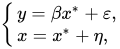
where (ε,η,x*) are jointly normal independent random variables with zero expected value and unknown variances, and only the variables (x,y) are observed. Then this model is not identifiable,[4] only the product βσ² is (where σ² is the variance of the latent regressor x*). This is also an example of a set identifiable model: although the exact value of β cannot be learned, we can guarantee that it must lie somewhere in the interval (βyx, 1÷βxy), where βyx is the coefficient in OLS regression of y on x, and βxy is the coefficient in OLS regression of x on y.[5]

If we abandon the normality assumption and require that x* were not normally distributed, retaining only the independence condition ε ⊥ η ⊥ x*, then the model becomes identifiable.[4]

See also

[edit]

References

[edit]

Further reading

[edit]
Revisions and contributorsEdit on WikipediaRead on Wikipedia
from Grokipedia
Identifiability is a core property of statistical models that guarantees the unique recovery of model parameters from the distribution of observed data, ensuring that different parameter values produce distinct observable probability distributions. This concept emerged in during , with Ragnar pioneering work on "statistical confluence analysis," which addressed the challenges of estimating linear relations amid errors and in economic data. By the mid-20th century, it became integral to and , where non-identifiability leads to inconsistent or multiple possible parameter estimates even with infinite data. In broader statistical theory, identifiability underpins the validity of , distinguishing it from estimability by focusing on theoretical uniqueness rather than finite-sample precision. In , identifiability extends to determining whether causal effects—such as average treatment effects—can be expressed solely in terms of observable data distributions, relying on assumptions like exchangeability, positivity, and consistency to link counterfactual outcomes to empirical measures. Applications span fields including , where it aids in assessing intervention impacts from observational studies; , for parameterizing dynamic models of biological processes; and , where it informs the reliability of inferred relationships in complex algorithms. Lack of identifiability often necessitates additional constraints, such as regularization or instrumental variables, to achieve practical .

Fundamentals

Definition

Identifiability is a core of statistical models that ensures different values of the model generate distinct probability distributions or likelihood functions, thereby permitting the unique determination of those from observed . This is essential for reliable and , as without it, multiple parameter sets could explain the same equally well, leading to in model interpretation. The concept of identifiability emerged in the as part of the development of modern statistical theory, building on earlier work such as Ragnar Frisch's 1930s contributions to identification issues in , with the term itself coined by economist Tjalling C. Koopmans in 1949 to address challenges in econometric modeling. It built on the foundational principles of likelihood-based inference established by Ronald A. Fisher in his 1922 paper on the mathematical foundations of theoretical statistics, which introduced . Intuitively, identifiability parallels the requirement for a unique solution in solving equations; non-identifiability manifests when distinct parameter configurations yield identical outcomes, akin to label switching in mixture models where interchangeable components produce the same overall distribution. This foundational notion underpins more precise formal conditions for identifiability explored elsewhere.

Formal Conditions

In parametric statistical models, identifiability requires that the mapping from the parameter space to the corresponding family of probability distributions {[Pθ](/page/P′′):θΘ}\{[P_\theta](/page/P′′) : \theta \in \Theta\} is injective. Formally, the model is identifiable if θ1θ2\theta_1 \neq \theta_2 implies Pθ1Pθ2P_{\theta_1} \neq P_{\theta_2}, where inequality denotes that the measures differ (i.e., they are not equal). θ1θ2    Pθ1Pθ2\theta_1 \neq \theta_2 \implies P_{\theta_1} \neq P_{\theta_2} This injectivity condition guarantees that distinct generate distinct distributions, providing the theoretical foundation for parameter recovery from observed data. In the context of likelihood-based for parametric models, for independent and identically distributed observations, identifiability holds when the mapping from θ\theta to the induced likelihood is injective with respect to the data-generating measure, ensuring that the true parameter can be distinguished from alternatives based on the observed likelihood. Finite-order identifiability extends this framework by requiring that parameters can be distinguished using only moments up to a finite order or from finite samples, rather than the full distribution. For instance, in homoscedastic Gaussian models with kk components in nk1n \geq k-1, moments up to order 4 suffice for algebraic identifiability when k=2,3,4k = 2, 3, 4, while order 3 suffices when k5k \geq 5. This property is particularly useful in models where full distributional knowledge is impractical, allowing identifiability checks via low-order statistics.

Types of Identifiability

Global Identifiability

Global identifiability in statistical models refers to the property where each distinct value θ\theta in the full parameter space Θ\Theta uniquely determines the PθP_{\theta} of the observed , meaning that if Pθ=PθP_{\theta} = P_{\theta'} for θ,θΘ\theta, \theta' \in \Theta, then θ=θ\theta = \theta'. This ensures that parameters can be recovered without ambiguity across the entire space, distinguishing it from weaker forms of identifiability that may hold only locally. The key condition for global identifiability is that the mapping from parameters to distributions, θPθ\theta \mapsto P_{\theta}, is injective (one-to-one) over all of Θ\Theta, implying a bijective correspondence in identifiable cases and the absence of any equivalence classes where multiple produce identical distributions. This injectivity prevents scenarios where distinct parameter sets yield the same likelihood, such as through compensatory adjustments among . Achieving global identifiability is challenging, particularly in complex models, where symmetries in the model structure often lead to multiple parameter configurations generating equivalent outputs, resulting in non-uniqueness. These symmetries frequently necessitate reparameterization to eliminate redundancies and reduce the dimensionality of Θ\Theta, transforming the model into an equivalent form where parameters are uniquely recoverable. Such issues are prevalent in high-dimensional or nonlinear systems, making global identifiability rare without careful model design.

Local Identifiability

Local identifiability refers to the property of a model θ0\theta_0 where, in a sufficiently small open neighborhood around θ0\theta_0, distinct parameter values produce distinct probability distributions. This means the mapping from the parameter space to the space of probability measures is injective locally at θ0\theta_0, ensuring that small perturbations in the parameter lead to uniquely observable changes in the model's output distribution. A key condition for local identifiability is that the Jacobian matrix of the mapping from parameters to the model's probability law has full column rank equal to the dimension of the parameter vector at θ0\theta_0. Equivalently, in likelihood-based frameworks, local identifiability holds if the Fisher information matrix I(θ0)I(\theta_0), defined as the expected negative Hessian of the log-likelihood, I(θ0)=E[2θθlogL(θ0)],I(\theta_0) = -\mathbb{E}\left[ \frac{\partial^2}{\partial \theta \partial \theta^\top} \log L(\theta_0) \right], has full rank equal to dim(θ)\dim(\theta). This nonsingularity condition ensures the parameter is recoverable up to approximations via derivatives. If the Jacobian is rank-deficient, higher-order conditions involving Taylor expansions of the mapping may be checked to establish local injectivity. In practice, local identifiability is sufficient to guarantee asymptotic consistency and normality of maximum likelihood estimators at the true parameter value under standard regularity conditions, as it supports the quadratic approximation of the likelihood near θ0\theta_0. However, it does not ensure a unique estimator in finite samples, where multiple local maxima may arise outside the neighborhood.

Structural Identifiability

Structural identifiability refers to the property of a where its can be uniquely determined from the model's functional form and the relationships between inputs and outputs, assuming ideal, noise-free data. This concept is particularly relevant for dynamical systems described by ordinary differential equations (ODEs) or partial differential equations (PDEs), where the identifiability depends solely on the deterministic mapping from to outputs, independent of experimental or data limitations. In essence, a model is structurally identifiable if distinct parameter sets do not produce identical input-output behaviors, ensuring that the parameter-to-output map is injective. This a priori assessment is crucial in fields like and to verify whether a model's allows unique parameter recovery before conducting experiments. Key conditions for structural identifiability often involve checking the uniqueness of representations such as transfer functions for linear systems or employing differential algebra methods for nonlinear dynamical systems. For linear time-invariant systems, structural identifiability is established if the transfer function's coefficients uniquely correspond to the model parameters, preventing ambiguities in the Markov parameters or state-space realizations. In nonlinear cases, differential algebra techniques, which treat the model equations as a differential ideal, generate elimination ideals to test whether parameters can be expressed uniquely in terms of inputs, outputs, and their derivatives; this approach has been formalized for rational polynomial models common in biological systems. These methods apply to ODE models of the form x˙=f(x,p,u)\dot{x} = f(x, p, u), y=g(x,p,t)y = g(x, p, t), where xx is the state, pp the parameters, uu the input, and yy the output, and extend to PDEs in spatio-temporal contexts by analyzing generating series or Laplace transforms to confirm output uniqueness. Seminal work by Godfrey and DiStefano formalized these concepts, emphasizing structural invariants in compartmental models. Unlike statistical identifiability, which incorporates , finite , and probabilistic to assess practical , structural identifiability focuses exclusively on the invertibility of the deterministic parameter-to-output map, providing a foundational check before data-driven analysis. For instance, in pharmacokinetic models, structural identifiability ensures that drug absorption and elimination rates can be uniquely inferred from concentration-time profiles based solely on the model's compartmental structure, without considering measurement errors; this is vital for physiologically based pharmacokinetic (PBPK) models where non-identifiable parameters might lead to ambiguous dosing predictions. Tools like the DAISY software implement to automate these checks for such applications.

Importance and Implications

Role in Parameter Estimation

Identifiability plays a crucial role in (MLE) by ensuring that the possesses a unique maximum corresponding to the true values. In identifiable models, the likelihood surface is well-behaved, allowing MLE to reliably locate the vector that maximizes the probability of observing the data. Conversely, non-identifiability results in flat or degenerate likelihood surfaces, where multiple values yield the same likelihood, leading to ridges or plateaus that complicate optimization and render point estimates unreliable. This flatness often manifests as multiple global maxima or extended regions of near-equivalent likelihood, preventing convergence to a single optimum and increasing sensitivity to initial conditions in numerical algorithms. For identifiable models, MLE estimators are consistent, meaning they converge in probability to the true parameter θ as the sample size increases, provided regularity conditions such as differentiability hold. This convergence relies on the injectivity of the mapping from parameters to distributions, ensuring that distinct θ values produce distinct data distributions. In non-identifiable cases, however, estimators fail to pinpoint a unique θ and instead converge to a set or manifold of equivalent parameters, undermining the precision of inference. Moreover, identifiability supports the asymptotic efficiency of MLE, where the estimators achieve the Cramér-Rao lower bound variance, optimizing the trade-off between bias and variance in large samples. Without it, efficiency breaks down, as the information matrix may become singular, inflating estimation uncertainty. To address non-identifiability, reparameterization strategies impose constraints that restore uniqueness, such as fixing scales or ordering components in mixture models. For instance, in Gaussian mixture models, non-identifiability arises from label switching and scale ambiguities, but fixing the sum of mixing proportions to 1 and ordering means by magnitude, or using relative reparameterizations, enforces a identifiable parameterization that stabilizes MLE. These approaches transform the parameter space to eliminate redundancies while preserving the model's generative process, enabling reliable estimation without altering the underlying distribution. The foundational link between identifiability and MLE was recognized in Ronald A. Fisher's seminal 1922 paper, where he established the principles of likelihood-based estimation and implicitly highlighted the need for unique parameter recovery to ensure method validity.

Relation to Other Statistical Properties

Identifiability plays a foundational role in ensuring the consistency of parameter estimators in statistical models. Specifically, for an estimator to be consistent—meaning it converges in probability to the true parameter value as the sample size increases—identifiability of the parameter is a necessary condition, though not sufficient on its own, as additional regularity conditions on the model and data-generating process are required. This necessity arises because non-identifiable parameters lead to multiple values that fit the observed data equally well, preventing convergence to a unique true value. For instance, in maximum likelihood estimation, identifiability ensures the likelihood function has a unique maximum corresponding to the true parameter, but without further assumptions like boundedness or differentiability, consistency may fail even if identifiability holds. Identifiability should be distinguished from estimability, which concerns the practical feasibility of estimating parameters from finite samples with noise and measurement error, focusing on precision and reliability in real-world scenarios rather than purely theoretical . In causal inference frameworks, identifiability is crucial for recovering causal effects from observational . Within structural equation models (SEMs), identifiability guarantees that the causal parameters, representing direct and indirect effects among latent and observed variables, can be uniquely estimated from the covariance structure, enabling inferences about underlying causal mechanisms. Similarly, in variables (IV) estimation, identifiability ensures that the causal effect of an endogenous regressor on the outcome can be isolated using exogenous instruments, provided the instruments satisfy and exclusion restrictions, thus allowing unbiased recovery of local average treatment effects. Without identifiability in these models, causal effects remain unrecoverable, leading to ambiguous interpretations of associations as causation. Identifiability extends beyond point identification—where parameters are uniquely pinned down—to partial identification in incomplete or underdetermined models. In such cases, the only bounds the within a set rather than identifying a single value, which is common in econometric models with or mechanisms. This partial approach, pioneered in works on bounds analysis, acknowledges that full point identification may be unattainable due to inherent limitations, yet still permits meaningful inference through set and . A key distinction exists between identifiability and overidentification, particularly in simultaneous equations models. Identifiability concerns the uniqueness of parameter recovery from the data, ensuring a one-to-one mapping between parameters and observable moments, whereas overidentification occurs when more instruments or restrictions are available than minimally required, facilitating specification tests like the Sargan-Hansen test without affecting the uniqueness of the identified parameters. This overabundance of information enhances model validation but does not resolve underidentification issues where parameters remain non-unique.

Examples

Identifiable Models

In , the model is typically expressed as Y=Xβ+ϵY = X\beta + \epsilon, where YY is the response vector, XX is the , β\beta is the vector, and ϵ\epsilon is the error term with mean zero and finite variance. The parameters β\beta are identifiable under the standard assumption that XX has full column rank, which precludes perfect among the predictors and ensures a unique solution for β\beta via the ordinary least squares estimator. This condition guarantees that different values of β\beta produce distinct conditional expectations E[YX]=XβE[Y|X] = X\beta, allowing reliable estimation from observed . Exponential families provide another class of identifiable models through their , f(yη)=h(y)exp(ηT(y)A(η))f(y|\eta) = h(y) \exp(\eta T(y) - A(\eta)), where η\eta is (canonical) parameter, T(y)T(y) is the , h(y)h(y) is the base measure, and A(η)A(\eta) is the log-partition function. In a minimal —where the components of T(y)T(y) are linearly independent—the canonical parameters η\eta are globally identifiable, meaning distinct η\eta values yield distinct distributions, as the mapping from η\eta to the is one-to-one. This identifiability stems from the strict convexity of A(η)A(\eta) and the full dimensionality of the natural parameter space, facilitating unique recovery of η\eta from the moments E[T(Y)]=A(η)E[T(Y)] = \nabla A(\eta). A concrete illustration is the normal distribution YN(μ,σ2)Y \sim N(\mu, \sigma^2), where the parameters μ\mu and σ2\sigma^2 are identifiable from the first two population moments. μ=E[Y],σ2=Var(Y)=E[Y2](E[Y])2.\begin{align*} \mu &= E[Y], \\ \sigma^2 &= \operatorname{Var}(Y) = E[Y^2] - (E[Y])^2. \end{align*} These moments uniquely determine μ\mu and σ2>0\sigma^2 > 0, as the or of the normal distribution is injective with respect to these parameters, ensuring no other distribution in the family matches the same and variance.

Non-Identifiable Models

Non-identifiable models arise when multiple distinct parameter sets yield the same observed data distribution, resulting in ambiguity during parameter estimation and . A classic example occurs in mixture models without label constraints, where the components are interchangeable due to the of the mixture density, leading to the label switching problem and non-uniqueness of the maximum likelihood estimates. This non-identifiability implies that the posterior distribution over parameters is multimodal, with modes corresponding to permutations of the component labels, which complicates and clustering tasks. Consider a two-component Gaussian , where the density is given by f(yθ)=π1ϕ(y;μ1,σ12)+π2ϕ(y;μ2,σ22)f(y|\theta) = \pi_1 \phi(y; \mu_1, \sigma_1^2) + \pi_2 \phi(y; \mu_2, \sigma_2^2) with π2=1π1\pi_2 = 1 - \pi_1 and ϕ\phi denoting the Gaussian density. Here, the parameter vector [θ](/page/Theta)=(μ1,σ1,π1,μ2,σ2)[\theta](/page/Theta) = (\mu_1, \sigma_1, \pi_1, \mu_2, \sigma_2) is non-identifiable because swapping the components—replacing (μ1,σ1,π1)(\mu_1, \sigma_1, \pi_1) with (μ2,σ2,π2)(\mu_2, \sigma_2, \pi_2) and vice versa—produces an equivalent density f(yθ)=f(yθ)f(y|\theta') = f(y|\theta), yet θθ\theta' \neq \theta. The consequences include unstable estimates across different optimization runs and challenges in assigning probabilistic labels to data points for downstream applications like . Another prominent case is , where the model assumes observed variables are linear combinations of latent factors plus noise, but the factor loadings exhibit rotational invariance. Without additional constraints, such as fixing certain loadings or imposing , the parameters are non-identifiable because any orthogonal rotation of the factors preserves the structure of the data. Specifically, if θ\theta represents the loading matrix, the likelihood satisfies L(θQ)=L(θ)L(\theta Q) = L(\theta) for any QQ, meaning infinitely many loading matrices θQ\theta Q are equivalent and yield identical model fits. This invariance leads to identifiability failure, rendering unique recovery of the underlying factor structure impossible and affecting the interpretability of the latent dimensions.

Methods for Assessing Identifiability

Analytical Methods

Analytical methods for assessing identifiability rely on algebraic and symbolic techniques to determine whether model parameters can be uniquely recovered from the input-output map without relying on numerical approximations or simulations. These approaches provide exact conditions for structural identifiability by examining the model's equations directly, often transforming the problem into solving systems of equations or checking equivalence classes of parameterizations. Developed primarily in the 1970s and 1980s within , with subsequent applications in from the early 2000s onward, these methods laid the foundation for verifying identifiability in linear and nonlinear dynamical systems. In state-space models, similarity transformation checks assess identifiability by determining if distinct parameter sets produce equivalent observable behaviors through coordinate changes in the state space. Specifically, a model is identifiable if there exists no non-trivial TT such that the transformed system matrices A=T1ATA' = T^{-1} A T, B=T1BB' = T^{-1} B, and C=CTC' = C T yield the same input-output response for all inputs, ensuring parameters are not confounded by state reparameterization. This technique, originally applied to linear compartmental models, verifies global identifiability by enumerating possible transformations and checking their impact on the or Markov parameters. Moment-based criteria evaluate identifiability by confirming that the statistical moments or cumulants of the output uniquely determine the parameters, particularly in or linear systems where higher-order statistics eliminate ambiguities from lower moments. For instance, in non-Gaussian processes, cumulants beyond the second order can distinguish parameter values that produce identical structures, as the cumulant-generating function provides a one-to-one mapping under certain rank conditions. This approach is effective for models where the output distribution's moments suffice to invert for parameters, avoiding reliance on full trajectory data. For nonlinear ordinary differential equation (ODE) models, differential algebra techniques compute identifiable parameter combinations by eliminating latent state variables from the input-output equations, forming an elimination ideal in the differential polynomial ring. The process involves generating differential extensions of the model equations and solving for whether the parameters appear in a rank-deficient manner within the ideal; if the ideal contains a polynomial solely in the parameters with finite roots, the model is locally identifiable. This method extends classical algebraic geometry to dynamical systems, enabling the derivation of identifiable functions even for complex nonlinear structures.

Numerical Methods

Numerical methods for assessing identifiability are essential when analytical approaches become computationally infeasible for high-dimensional or nonlinear models, providing empirical evaluations through optimization and sampling techniques. These methods focus on practical identifiability, examining how well can be recovered from data under realistic noise and experimental conditions. One prominent numerical technique is the profile likelihood method, which involves fixing a parameter of interest at various values across its plausible range and maximizing the likelihood over the remaining parameters for each fixed value. The resulting profile likelihood curve reveals non-identifiability if it exhibits flat regions where the likelihood remains nearly constant, indicating multiple parameter sets yield similar data fits. This approach is particularly useful for detecting practical non-identifiability in models, as demonstrated in workflows that propagate confidence sets to predictions. Bayesian methods offer another computational framework for identifiability assessment by analyzing the posterior distribution of parameters given the data and prior. Posterior profiles or marginal posteriors are computed to evaluate parameter recovery; well-identified parameters show concentrated posteriors, while non-identifiable ones result in diffuse or degenerate distributions. sampling is commonly employed to explore these posteriors, enabling checks on identifiability even in complex hierarchical models. Sensitivity analysis complements these by perturbing individual parameters and quantifying their impact on model outputs, often using local derivatives from the or global exploration via MCMC to identify locally non-identifiable parameters near the maximum likelihood estimate. This perturbation-based approach highlights parameters with minimal influence on observables, signaling potential identifiability issues. Several software tools facilitate these numerical assessments. DAISY employs differential algebra for initial structural checks that guide numerical profiling in dynamic systems. The Identifiability Toolbox in supports profile likelihood and sensitivity computations for models. Additionally, COPASI provides built-in functions for profile likelihood scans and Bayesian estimation to evaluate practical identifiability in biochemical networks.

Applications

In Econometrics

In econometrics, identifiability has been central since the 1940s, particularly through the work of the Cowles Commission, which developed foundational concepts for structural in simultaneous models. Researchers at the Commission, including , addressed the challenges of recovering causal parameters from reduced-form data, emphasizing that identifiability requires the structural parameters to be uniquely recoverable from observable distributions. This historical effort culminated in key monographs that formalized identification as a prerequisite for reliable inference in economic models, influencing subsequent advancements in . A cornerstone of identifiability in is the use of instrumental variables (IV) in simultaneous equations systems, where rank and order conditions ensure parameter recovery. The order condition, first articulated by Olav Reiersøl, is a necessary criterion stating that for an equation with GG included endogenous variables and KK exogenous variables, the number of excluded exogenous instruments must be at least G1G - 1 to achieve exact identification. The rank condition, developed by Theodore W. Anderson and Herman Rubin, is sufficient and requires that the G1×G1G-1 \times G-1 submatrix of the on excluded instruments has full rank, ensuring the instruments provide linearly independent variation orthogonal to the error term. These conditions underpin IV estimation by guaranteeing that the instruments correlate with the endogenous regressors but not with the disturbances, allowing consistent recovery of structural parameters. A classic illustration is the supply-demand model, where price and quantity are simultaneously determined, leading to endogeneity if estimated via ordinary least squares. Identifiability is achieved through exclusion restrictions: a demand shifter (e.g., ) excluded from the supply serves as an instrument for in demand , while a supply shifter (e.g., production costs) does the same for supply estimation. These restrictions ensure the instruments affect quantity only through , enabling unique recovery of the demand elasticity (typically negative) and supply elasticity (positive). When point identification fails due to insufficient instruments or model restrictions, partial identification provides bounds on parameters rather than point estimates, a framework advanced by Charles Manski. In matching models, such as those for labor market selection or two-sided matching, partial identification arises from unobservables like ability or preferences; for instance, bounds on average treatment effects can be derived using observed covariates and monotonicity assumptions, narrowing the range without full recovery. This approach is particularly useful in policy evaluation where data limitations prevent exact identifiability but allow estimates. In modern econometrics, randomized controlled trials (RCTs) ensure identifiability through randomization, which exogenously assigns treatment and eliminates selection bias, directly identifying causal effects as in the difference-in-means estimator. This builds on Cowles foundations by providing a gold standard for causal inference in economic policy contexts, such as development interventions.

In Systems Biology and Other Fields

In , identifiability plays a crucial role in modeling complex biological processes, particularly in where compartmental models describe dynamics within the body. These models divide the body into compartments representing different physiological spaces, such as plasma and tissues, with parameters governing transfer rates, absorption, and elimination. Structural identifiability analysis ensures that these parameters can be uniquely determined from observable data, like plasma concentration over time, preventing ambiguities in model interpretation and improving predictions for dosing and efficacy. For instance, in physiologically based pharmacokinetic (PBPK) models, identifiability assessments help evaluate whether tissue-specific parameters are recoverable, influencing model reduction strategies to enhance computational efficiency without loss of predictive power. A prominent example is the two-compartment pharmacokinetic model, commonly used to capture biphasic drug elimination where an initial rapid distribution phase is followed by slower clearance. In this setup, the central compartment represents plasma, and the peripheral compartment accounts for tissue distribution, with rate constants for intercompartmental transfer and elimination needing to be estimated from concentration-time profiles. Structural checks, such as those using or similarity transformations, reveal that under ideal conditions with continuous measurements, parameters like the and are locally identifiable, though indistinguishability can arise if inputs or outputs are restricted, such as bolus dosing without peripheral sampling. This model's identifiability has been pivotal in applications like (PET) imaging, where exact parameter recovery supports quantitative assessment of drug binding in tissues. Recent advancements, including 2025 analyses of compartmental frameworks, emphasize integrating these checks early to avoid non-identifiable configurations in . In , particularly within latent variable models, identifiability addresses challenges in disentangling underlying factors from high-dimensional data, ensuring that learned representations correspond uniquely to generative processes. Variational autoencoders (VAEs) exemplify this, as standard formulations suffer from non-identifiability due to rotational ambiguities in the , leading to inconsistent factor interpretations across training runs. Identifiable VAEs (iVAEs) mitigate this by incorporating constraints like non-factorized priors or auxiliary variables, enabling linear disentanglement up to and scaling, which is essential for tasks such as and data generation in biological datasets. For example, double iVAEs extend this to hierarchical structures, providing theoretical guarantees for recovering independent latent components in nonlinear settings, with applications in for modeling variability. Seminal works from 2021 onward have demonstrated the impact of these methods on reliable feature discovery without auxiliary supervision. As of 2025, identifiability concepts are extending to emerging interdisciplinary fields, including quantum physics and climate science, where parameter recovery from noisy or sparse observations is paramount. In , identifiability analysis for open unifies autonomous and controlled models, showing that Hamiltonian and dissipator parameters can be uniquely estimated from measurement trajectories under minimal assumptions, facilitating robust quantum control in devices like superconducting qubits. This has implications for quantum sensing and error correction, with recent experimental graybox approaches achieving high-fidelity identification in noisy environments. Similarly, in climate modeling, partial identifiability arises due to equifinality in parameter sets yielding similar projections, prompting methods like sensitivity-based profiling to constrain uncertainties in system models for better policy-relevant forecasts. For instance, analyses of global circulation models reveal that parameters for cloud feedback and ocean mixing are often weakly identifiable from historical data, driving the adoption of ensemble techniques to quantify structural ambiguities.

References

Add your contribution
Related Hubs
Contribute something
User Avatar
No comments yet.
