Hubbry Logo
ImbuncheImbuncheMain
Open search
Imbunche
Community hub
Imbunche
logo
8 pages, 0 posts
0 subscribers
Be the first to start a discussion here.
Imbunche
Imbunche
from Wikipedia
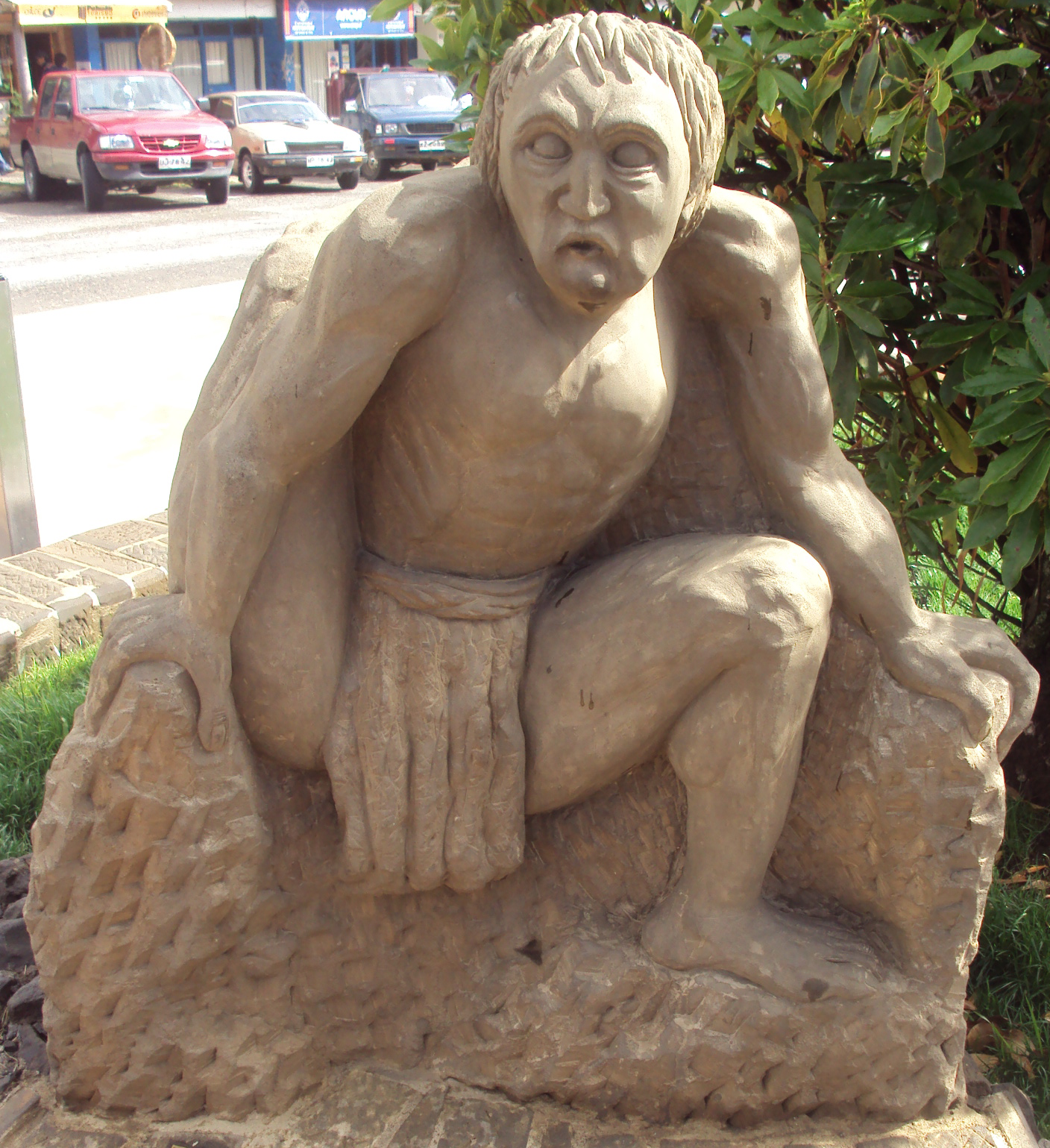
Imbunche statue in Plaza de Ancud, Chile.

In the Chilote folklore and Chilote mythology of Chiloé Island in southern Chile, the imbunche (Mapudungun: ifünche, lit. "short person") is a legendary monster that protects the entrance to a warlock's cave.

Description

[edit]

The imbunche is a deformed human with its head twisted backwards, along with having twisted arms, fingers, nose, mouth and ears. The creature walks on one foot or on three feet (actually one leg and two hands) because one of its legs is attached to the back of its neck. It has blue skin and sharp teeth. The imbunche cannot talk, and communicates only by guttural, rough and unpleasant sounds.

Legend

[edit]

According to legend, the imbunche is a first-born child less than nine days old that was kidnapped by, or sold by their parents to, a Brujo Chilote (a type of warlock of Chiloé). If the baby had been christened, the warlock debaptizes them through unknown means of black magic.

The Brujo chilote transforms the child into a deformed hairy monster by breaking their right leg and twisting it over their back. When the child is three months old their tongue is forked, their teeth turn sharp, their skin turns blue, and the warlock applies a magic cream over the child's back to cause thick hairs. During its first months the imbunche is fed on black cat's milk and goat flesh,[1] and when old enough, with human corpses from cemeteries.[2]

Besides guarding the entrance to the warlock's cave, the imbunche is used by warlocks as an instrument for revenge or curses. And, because it has acquired magical knowledge over its lifetime spent guarding the cave, even if the imbunche is not initiated into wizardry, it sometimes acts as the warlock's advisor.

The imbunche leaves the cave only in certain circumstances, such as when the cave is destroyed or discovered and the warlock moves to another cave, or when the warlocks have need of it and carry it thrashing and yelling, scaring the townspeople and announcing misfortune to come. The imbunche also comes out when the warlocks take it to the Warlock's Council.

The imbunche is fed solely by warlocks and is only allowed to search for its own edibles if food is lacking inside the cave.

[edit]

José Donoso's magical realist novel The Obscene Bird of Night reinterprets imbunche folklore as a way to bind a male child in a sack to prevent escape and bodily growth.

Travel writer Bruce Chatwin gives an account of Chilote witchcraft and the imbunche in his book In Patagonia.

British comic book writer Alan Moore wrote a version of the imbunche (here spelled invunche) very similar to Chatwin's description during his run on Swamp Thing, as an antagonist to John Constantine in the first story he appeared in. This imbunche has both legs turned backwards and the tongue is not forked. In addition, the left hand has been sewn under the skin of the right abdominal area making it appear as if the hand is tucked away.

An Imbunche appears in the Secret Saturdays animated series.

In the 2000 novel Portrait in Sepia (Retrato en Sepia) by Isabel Allende, the character Aurora del Valle recalls being told about the Imbunche in her childhood.

In the 2014 urban fantasy novel, Luke Coles and the Flower of Chiloe, the imbunche is mentioned seven times. Later in the series, imbunches appear in great numbers as Righteous Province's (Recta Provincia's) common foot soldiers.[3]

In the 2014 urban fantasy television series Constantine (based on the comics Swamp Thing and Hellblazer), the title character says that imbunche are nasty creatures that tore out throats during the time of Noah, but were presumed destroyed in the Great Flood. A living imbunche appears in "The Saint of Last Resorts". Constantine's friend, Ben, died because of an imbunche.

In the 2019 novel Nuestra parte de noche (translated to English in 2022 by Megan McDowell) by Mariana Enriquez who is based on Buenos Aires imbunche are mentioned. The main character, Juan, describes children who look like imbunche that are kept in a cave then saying “He turned back, ready to confront Mercedes, who was waiting for him at the door beside her imbunche child.” (Page 132).

In the 2020 Chilean-Brazilian Annecy-nominated animated film Nahuel and the Magic Book, Nahuel answered the riddle about the Imbunche when he made a deal with a goblin at the tavern.

References

[edit]
Revisions and contributorsEdit on WikipediaRead on Wikipedia
from Grokipedia
The Imbunche (also known as invunche or achucho de la cueva) is a monstrous entity from the of in southern , depicted as a deformed infant ritually transformed by brujos (warlocks or witches) into a grotesque, limbless guardian that protects the entrance to their secret cavern. In Chilote lore, the Imbunche originates as a human infant—typically kidnapped from its family between six months and one year of age—who undergoes a series of horrific deformations performed by a specialist called the Deformer. Legends vary on details such as the child's age and gender. These alterations include disarticulating the limbs, twisting the head 180 degrees, and sewing the right arm into a shoulder incision. Confined naked in an underground lair and sustained on human flesh, the creature loses the capacity for speech, communicating through guttural cries that guide novice brujos in rituals. This transformation symbolizes ultimate submission and perversion, turning a vulnerable child into an eternal, mindless servant. The Imbunche's primary role is as a sentinel for the Cueva de Quicaví, the legendary cave on serving as headquarters for the Recta Provincia (Righteous Province)—a clandestine of brujos believed to wield powers over the archipelago's , , and fortunes. It guards sacred treasures within, such as an ancient leather-bound book of spells and a silver basin that reveals hidden truths when filled with water, while also assisting in the initiation of novice brujos by demonstrating procedures through its eerie sounds. Rooted in the syncretic folklore of the indigenous Huilliche and peoples blended with Spanish colonial Catholicism, the legend gained prominence through eyewitness accounts from the 1880–1881 witch trials in , where accused warlocks like Mateo Coñuecar confessed to such practices amid regional famines and epidemics. These events, documented by Chilean McKenna, highlight the Imbunche as a cultural emblem of fear, isolation, and the dark undercurrents of insular life in . The figure has since influenced modern literature, including Bruce Chatwin's (1977), underscoring its enduring resonance in Chilean identity and storytelling.

Etymology and Origins

Etymology

The term "Imbunche" derives from the Mapudungun word ifünche or invunche, which translates to "deformed " or "short " in the context of indigenous Chilean . This etymology is supported by linguistic analysis attributing the word to Mapudungun roots, where it signifies a monstrous or dwarfish figure, often linked to mythological deformities. A breakdown of morphemes reveals i- as a prefix possibly indicating imperfection or intensification, combined with -fünche or -che, meaning "" or "people," as documented in early Mapudungun dictionaries like Febrés' 1765 Arte de la lengua general de . Alternatively, some sources parse it as ivum če, emphasizing "those consulted by witches" or small beings raised for sorcery. Spelling variations of the term appear across historical and contemporary texts, including Imbunche, Invunche, and Imbunchi, reflecting phonetic adaptations in transcription. In Spanish colonial documents from the 18th and 19th centuries, such as those referencing Chiloé's indigenous lore, the form invunche predominates, drawing from Veliche dialects—a variant of Mapudungun spoken in the region. Modern Chilean and anthropological works, however, often standardize it as Imbunche, aligning with broader while preserving the original indigenous pronunciation. The influence of the Mapuche language on Chilote terminology stems from the archipelago's indigenous heritage, where Huilliche and Veliche communities—closely related to speakers—integrated Mapudungun elements into local myths. This linguistic borrowing highlights the cultural continuity between mainland traditions and the isolated , shaping terms like Imbunche through centuries of oral transmission and colonial interaction.

Historical and Cultural Origins

The Imbunche legend emerged within the oral traditions of the Chilote people in the , reflecting a syncretic blend of indigenous cosmology and Spanish colonial influences from the 16th to 18th centuries. During the colonial period, Spanish authorities sought to suppress native spiritual practices, including those of shamans known as machis, leading to a fusion of pre-Hispanic beliefs in malevolent or deformed spirits with European fears of sorcery and . This cultural synthesis was particularly pronounced in Chiloé, where indigenous resistance to persisted, incorporating elements of Catholic into local myths. Chiloé's geographic isolation as an off southern played a crucial role in preserving these unique elements, shielding them from mainland assimilation pressures until the archipelago's integration into independent in the early . The region's remote location, combined with its prolonged loyalty to the Spanish crown—resisting Chilean independence until —allowed for the sustained transmission of oral narratives distinct from broader national . This insularity fostered a rich, insular mythological tradition that intertwined indigenous and colonial threads without significant external dilution. The first written mentions of the Imbunche appear in 19th-century Chilean ethnographies, notably during the 1880 trial against the "Brujos de Chiloé," where witnesses referenced in testimonies recorded by authorities. Ethnographer Ricardo Latcham later connected these accounts to pre-colonial beliefs in spirits like the "ivumche" (a hybrid) and "huitrancúll" (deformed entities associated with sorcery), highlighting ties to indigenous concepts of hechicería without direct colonial details. These early documented references underscore the Imbunche's roots in longstanding fears of , amplified by the 1851 Ancud Synod's condemnation of machis by the .

Description and Characteristics

Physical Appearance

The Imbunche is portrayed in Chilote as a grotesquely deformed humanoid, originating from a subjected to ritualistic alterations by brujos, resulting in a twisted and immobilized form. Its head is rotated 180 degrees backward, positioning the face at the rear of the . Folklore accounts vary on specific limb deformations: some describe the right inserted and sewn into an incision under the shoulder blade, while others mention the right leg fractured, contorted upward, and affixed to the neck or nape, compelling the creature to propel itself forward using its hands and the remaining left foot in a laborious, hopping . Limbs overall exhibit severe , with arms and legs wrenched into unnatural angles that further emphasize its abomination-like quality. The body of the Imbunche is enveloped in a dense, coarse mat of hair that grows unchecked, lending it a , beastly aspect and obscuring much of its underlying human structure. is a hallmark: all natural orifices, including the , are sewn closed, leaving only a minuscule for sustenance, typically raw , which prevents articulate speech and restricts communication to guttural, rasping emissions from the throat. Ears are sealed as part of the orifices, while the creature navigates through touch and instinct alone. These modifications render the Imbunche a pitiable yet terrifying sentinel, its hideous visage and muffled cries evoking profound horror in accounts. Depictions of the Imbunche maintain a consistent core as a humanoid abomination across traditional sources, though minor variations exist in the degree of limb attachment or the exact positioning of facial features. Its short, hunched stature—often described as petite rather than dwarfish—reinforces the image of a once-innocent child irrevocably warped into monstrosity. While some later interpretations introduce elements like a forked tongue or sharpened dentition emerging over time, the foundational traits of backward orientation, sewn orifices, and hirsute covering predominate in oral and documented Chilote traditions.

Abilities and Behaviors

In Chilote mythology, the Imbunche demonstrates restricted yet purposeful locomotion, typically hopping or crawling on one foot due to a limb twisted and bound behind its neck, supplemented by the use of its hands as additional supports for awkward, three-limbed movement. This mode of travel, while cumbersome, enables it to and guard the entrances to brujos' caves effectively, embodying its role as a vigilant sentinel despite the physical constraints imposed by its deformities. The creature's sensory and communicative abilities are profoundly altered, rendering it unable to hear human voices and incapable of coherent speech owing to its sewn-shut orifices, which are fitted only with a narrow feeding aperture. Instead, it relies on guttural cries or howls—described as terrifying "chivateos" resembling animal bleating—to alert brujos to intruders or signal distress, serving as its primary means of interaction in the nocturnal, hidden world of witchcraft. These vocalizations strike fear into those who hear them, reinforcing the Imbunche's function as a deterrent. Sustenance for the Imbunche is and ritualistic, with the creature fed raw —often from newborns—to maintain its monstrous vitality. This diet not only sustains the creature but symbolizes its complete severance from humanity, binding it eternally to the brujos' dark practices.

Myth and Legend

The Transformation Ritual

In Chilote mythology, the creation of an imbunche involves the abduction or sale of a firstborn male child between six months and one year of age to the brujos of the Recta Provincia, a secretive of warlocks. This selection ensures the child is vulnerable and untainted, making it ideal for the transformation into a permanent guardian. The ritual commences immediately upon acquisition, with the limbs disarticulated and the head rotated 180 degrees backward by a specialist. At , the right arm is sewn into an incision under the right shoulder blade using thread spun from an ewe's . These physical alterations are performed in the of the brujos' . Over the ensuing years, the child is confined naked in an underground lair and sustained on raw , losing the capacity for speech but acquiring an instinctive understanding of the brujos' rituals. Initially fed milk from a and herb-infused water, the imbunche later transitions to , accelerating its into a mindless beast. The full transformation renders the creature irreversible and devoted solely to defending the brujos' domain with guttural warnings and aggressive defenses. No lore provides for reversal, emphasizing the ritual's finality as a pact with dark forces.

Role in Brujo Society

In the secretive society of Chilote brujos, known as La Recta Provincia or the Mayoría, the Imbunche serves primarily as a fierce guardian of the entrance to their subterranean , often referred to as the Cueva de Quicaví, where the Cahuín de Brujos—ritual gatherings of —take place. Positioned at the threshold, it attacks intruders with unrelenting ferocity, using its deformed body to obstruct access and defend the society's treasures, such as ancient magical texts and scrying vessels. To alert the brujos of threats or impending needs, the Imbunche emits harsh, guttural cries that echo through the , signaling the to respond. Beyond guardianship, the Imbunche fulfills secondary roles that reinforce the brujos' authority and mystical operations. It is dispatched to carry out revenge curses against the enemies of the , terrifying or eliminating targets as an extension of the brujos' will, such as in cases of vendettas ordered by high-ranking members. Occasionally, it provides instinctive counsel to the group, drawing on its acquired knowledge of the society's procedures to warn of dangers or guide novices through head movements and cries during solemn meetings. Within the brujo hierarchy, the Imbunche occupies the lowest position as the most deformed and subservient entity, working alongside other monstrous servants like the Chivato—a goat-like creature—to secure the without participating in or rituals. Subordinate to the society's leaders, including kings, viceroys, and the Committee of the Cave, it functions as a mute, instinct-driven , embodying the brujos' control over the to maintain their isolation and power.

Cultural Significance

In Chilote Mythology

In , the Imbunche serves as the grotesque guardian of the secret caves used by the brujos for their clandestine gatherings, known as the Cahuín de Brujos, which embody the shadowy aspects of indigenous magic blending traditions with colonial influences. These s, held in hidden locations like the caves near Quicavi, involved a hierarchical society called La Recta Provincia, where the Imbunche—created through the deformation of a —symbolized the irreversible corruption and secrecy of sorcery, protecting sacred artifacts such as a and a bowl lit by torches. The Imbunche stands in stark contrast to benevolent or ambiguously magical entities in Chilote lore, such as the , a ghostly ship crewed by drowned souls and brujos that sails underwater to facilitate trade and transport initiates, highlighting the Imbunche's role in evoking isolation, , and the perils of moral corruption within the archipelago's insular culture. While the represents communal supernatural aid and maritime mystery, the Imbunche underscores themes of entrapment and the dark consequences of pact-making with warlocks, reinforcing the dual nature of magic as both protective and destructive in island society. The Imbunche's myth endures in contemporary Chiloé through traditions that transmit warnings against ethical lapses and the allure of forbidden power, maintaining its cautionary function amid the archipelago's cultural isolation. 20th-century ethnographies, including studies by researchers like De Ruranges in 1975, have recorded its persistence in local narratives, with surveys indicating that such myths influence up to 39% of children's perceptions of in areas like Ancud, ensuring the legend's role in preserving Chilote identity.

Symbolism and Interpretations

The Imbunche legend in embodies profound symbolic themes, particularly parental betrayal and the irrevocable loss of innocence. The creature's origin as a firstborn child kidnapped or sold by its own parents to brujos underscores a deep-seated of familial disloyalty, transforming a vulnerable into a monstrous guardian through ritualistic . This narrative highlights the horrors of unchecked sorcery, where the child's body is sewn shut, limbs contorted, and senses deprived, symbolizing the complete surrender of humanity to dark magical forces within the isolated caves of Chiloé. Furthermore, the Imbunche reflects colonial-era anxieties about indigenous "savagery" and cultural , portraying the creature as a deformed hybrid of human and animal, evoking fears of resistance against Spanish imposition in southern Chile's rugged . Scholarly analyses emphasize the Imbunche's role in reinforcing social boundaries, with its form serving as a cautionary of exclusion for those deemed unfit or rebellious.

Representations in Media

Literature

In Chilean literature, the Imbunche serves as a potent symbol of the and the marginalized, most prominently in José Donoso's novel (1970). The narrative centers on the birth of a child destined to become an imbunche, with elderly women at La Casa de Encarnación planning to sew its orifices shut, transforming it into a messianic yet monstrous figure confined to isolation. This motif underscores the novel's exploration of physical and social sealing, reflecting themes of , identity dissolution, and resistance against societal norms. International authors have also incorporated the Imbunche to evoke cultural and dread. In Chatwin's travelogue (1977), the creature is documented as a guardian of Chilote brujos' caves, detailing its creation through systematic disfigurement: a stolen child undergoes limb twisting, head rotation via , and arm insertion under the shoulder blade, sewn with ewe's thread, resulting in a speechless, flesh-fed being that instructs novices with guttural cries. This account blends with ethnographic observation, highlighting the Imbunche's role in secretive societies. Argentine writer reimagines the Imbunche in her horror novel Nuestra parte de noche (2019), where it appears as a product of ritualistic breaking: the body is shattered, head twisted like a to face backward, evoking a "half-crushed insect" that crawls deformed and stitched. Integrated into a broader of orders and , it amplifies themes of violation and otherworldliness. Across these works, the Imbunche consistently symbolizes and isolation, uniquely woven into plots to probe power dynamics, , and the boundaries of the human form.

Film, Television, and Other Media

The Imbunche, frequently rendered as "Invunche" in adaptations, has been portrayed in film and television as a nightmarish guardian creature rooted in Chilote , emphasizing its grotesque transformation and protective role for sorcerers. In the 2014-2015 series Constantine, the Invunche serves as a demonic in the episode arc "The Saint of Last Resorts" (Season 1, Episodes 8-9), where it is summoned by the Brujería—a coven of male witches—to guard their rituals and devour infants, confronting exorcist in a Mexico-based storyline that adapts elements from DC Comics lore. The depiction highlights the creature's , with its limbs bound and head twisted between its legs, aligning with mythological descriptions while amplifying its supernatural menace. In animated film, the 2020 Chilean-Brazilian production incorporates the Imbunche in a more accessible, child-oriented manner as part of a riddle posed by a character, tying into the story's exploration of Chiloé region's myths and a boy's quest to overcome fear of the sea. Directed by Germán Acuña, the film uses the creature to evoke without graphic violence, presenting it as a deformed monster within a fantasy adventure framework that draws on and Chilote traditions. Beyond live-action and animation, the Imbunche appears in comics and video games as a monstrous adversary. In Alan Moore's Swamp Thing (DC Comics, Vol. 2 #37, 1985), co-created with Rick Veitch, the Invunche is a tortured, legless abomination engineered by the Brujería to assassinate the titular hero, showcasing visceral horror through its ritualistic deformation and role as a coven enforcer.) Similarly, in the 2014 IDW Publishing comic Ghostbusters International #9, Imbunche entities guard Brujo caves on Chiloé Island, attacking the Ghostbusters team in a storyline blending myth with supernatural comedy. In video games, the Invunche features as a cryptid enemy in The Secret Saturdays: Beasts of the 5th Sun (2009), a tie-in to the animated series, where players encounter it in river environments as a bloating, adaptive leech-like foe inspired by folklore. Chilean media has also explored the Imbunche through short films and horror contexts, such as the 2014 experimental short Invunches, directed by Roberto Aschieri, which relocates the legend to urban Santiago, portraying the creature as a symbol of societal distortion amid modern settings. These visual reinterpretations often emphasize the Imbunche's themes of violation and monstrosity, adapting its mythic horror for contemporary audiences while preserving cultural specificity.

References

Add your contribution
Related Hubs
User Avatar
No comments yet.