Hubbry Logo
Komati RiverKomati RiverMain
Open search
Komati River
Community hub
Komati River
logo
8 pages, 0 posts
0 subscribers
Be the first to start a discussion here.
Komati River
Komati River
from Wikipedia

Komati River
Komatirivier, Incomati River, Inkomati River
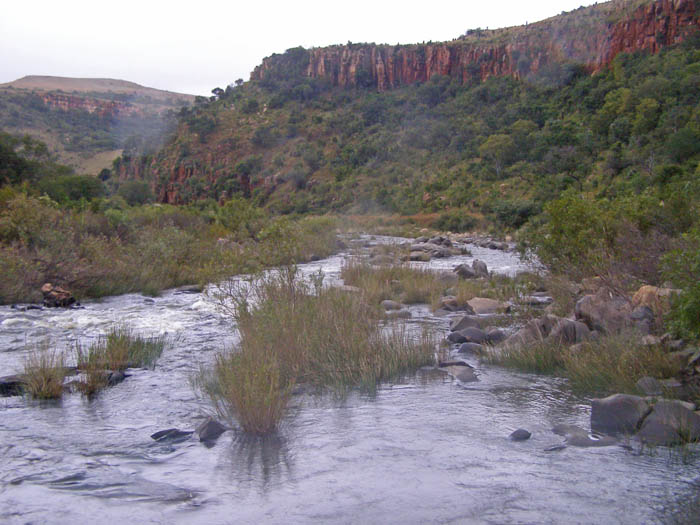
The gorge near Carolina in the upper Komati River
Map
EtymologyFrom the Swazi language word for "cow", meaning hippos
Location
Countries
Physical characteristics
Source 
 • locationNear Ermelo, Mpumalanga
 • elevation1,800 m (5,900 ft)
MouthIndian Ocean
 • location
Maputo Bay
 • coordinates
25°48′57.46″S 32°43′38.89″E / 25.8159611°S 32.7274694°E / -25.8159611; 32.7274694
Length480 km (300 mi)
Basin size50,000 km2 (19,000 sq mi)
Discharge 
 • average111 m3/s (3,900 cu ft/s)

The Komati River,[1] also known as the Inkomati River[2] or Incomati River[3] (in Mozambique, from Portuguese Rio Incomati[4]), is a river in South Africa, Eswatini and Mozambique. Originating in north-western Eswatini, it is joined by the Crocodile River in the Lebombo Mountains, enters far south-western Mozambique below the border town of Komatipoort, and enters the Indian Ocean around 24 km (15 mi) north-east of Maputo.[4]

It is 480 kilometres (298 mi) long, with a drainage basin 50,000 square kilometres (19,300 sq mi) in size. Its mean annual discharge is 111 m3/s (3,920 cfs) at its mouth.[5]

The name Komati is derived from inkomati, meaning "cow" in siSwati, as its perennial nature is compared to a cow that always has milk.[6]

Geography

[edit]
Location of the Komati River and its tributaries with the respective country border

The river originates west of Carolina, rising at an elevation of about 1,800 m (5,906 ft) near Breyten in the Ermelo district of the Mpumalanga province.[7] It flows in a general northeasterly direction and reaches the Indian Ocean at Maputo Bay, after a course of some 800 km (497 mi).[8]

The Komati Gorge is situated in the upper reaches of the Komati River and is the habitat of some endangered species such as the southern bald ibis.[9] In 2001 the 115 m high wall of the Maguga Dam was completed south of Piggs Peak, Eswatini, 26°4′51.57″S 31°15′25.84″E / 26.0809917°S 31.2571778°E / -26.0809917; 31.2571778

In its upper valley near Steynsdorp are goldfields, but the reefs consist almost entirely of low grade ore. The river descends the Drakensberg by a pass 48 km (30 mi) south of Barberton, and is deflected northward at the eastern border of Eswatini, keeping a course parallel to the Lebombo mountains. Just west of 32° E and 25° 25′ S, near the town of Komatipoort, it is joined by the Crocodile River. The Crocodile tributary rises, as the Elands River, in the Bergendal (1,961 m) near the upper waters of the Komati, and flows eastwards across the highveld, being turned northward as it reaches the Drakensberg escarpment. The fall to the lowveld is over 600 metres in 48 km (30 mi), and across the 161 km (100 mi) wide country between the Drakensberg and the Lebombo there is a further fall of 900 metres.[8]

The Uitkoms Waterfall in the Bank Spruit, a tributary in the upper reaches of the Komati, Mpumalanga

Just over a kilometre below the junction of the Crocodile, the united stream, which from this point is also known as the Manhissa, passes to the coastal plain through a 190 m high cleft, high in the Lebombo known as Komatipoort, featuring some picturesque falls. At Komatipoort, which marks the border between South Africa and Mozambique, the river is less than 100 km (60 mi) from its mouth in a direct line, but in crossing the plain it makes a wide sweep of 322 km (200 mi), first northwards before turning southwards, forming lagoon-like expanses and backwaters and receiving from the north several tributaries. In flood time there is a connection northward through the swamps with the basin of the Limpopo. The Komati enters the sea 24 km (15 mi) north of Maputo. It is navigable from its mouth, where the water is up to 5m deep, to the foot of the Lebombo.[8]

History

[edit]

The Portuguese named the river's lower reaches the Rio des Reijs, either "river of rice" or "river of kings".[10] Subsequently, Jan van Riebeeck's journal mentions a Rio de Reijs, when he dispatched a ship up the east coast in search of rice supplies.[11] In voortrekker Louis Tregardt's journal it is referred to as the Manhissa,[12] a name still extant, while to the British it was known as the King George River.[13]

In 1725 a Dutch expedition led by Francois de Kuiper explored the region of the lower Komati and travelled 30 km into the current Mpumalanga province, before they were attacked by local tribes and had to return to Delagoa Bay.

On the September 23, 1900 during the Second Boer War, 3,000 Boers crossed the frontier at the small town of Komatipoort, and surrendered to the Portuguese authorities.[8]

On November 7, 1900, the banks of the Komati became the site of a battle between the British Empire and the Boers. The Battle of Leliefontein was a retreat by the British, harassed by the Boers, who were threatening to capture the British Artillery. The British guns were saved by the Royal Canadian Dragoons who charged the Boers, whereby they placed the guns out of their reach.

Railway

[edit]

The railway from Maputo to Pretoria traverses the plain in a direct line, and at seventy-two kilometres, reaches the Komati. It follows the south bank of the river and enters the high country at Komati Poort. From the Poort westward the railway skirts the south bank of the Crocodile River throughout its length.[8] This railway was originally constructed by the Netherlands-South African Railway Company (NZASM) and was officially inaugurated in 1895.

See also

[edit]

References

[edit]
[edit]
Revisions and contributorsEdit on WikipediaRead on Wikipedia
from Grokipedia
The Komati River is a major transboundary waterway in that originates in the region of South Africa's province, near the town of Carolina in the Mountains at an elevation of approximately 1,800 meters above . It flows eastward for about 480 kilometers through and into , where it joins the Crocodile River near to form the Inkomati River, which continues southeast for another 110 kilometers before emptying into the at via a wide . The river drains a basin of roughly 46,800 square kilometers, distributed as 63% in , 5% in , and 32% in , supporting diverse ecosystems and human activities across these nations. The Komati River plays a critical role in regional water resource management, governed by international agreements including the 1992 Treaty on the Development and Utilization of the Water Resources of the Komati River Basin between and , and the 2002 Tripartite Interim Agreement incorporating to ensure equitable sharing and sustainable use. Its waters, with a mean annual discharge of 100–200 cubic meters per second at the estuary, are heavily utilized for —particularly for and generation through dams like Maguga and Nooitgedacht, and domestic and industrial supply, with abstractions accounting for up to 50% of the flow. Recent developments include the decommissioning of the Komati Power Station in 2022 and ongoing plans to repurpose it as a facility as of 2024. The basin's economy relies on these activities, alongside and , though seasonal flows are torrential during the (November to March) and low during the (April to October), exacerbating vulnerabilities to and over-extraction. Ecologically, the Komati River supports rich , including 56 species such as Labeobarbus marequensis and Oreochromis mossambicus, 75 species of , and various , with upper reaches in protected areas like Songimvelo and Malolotja Nature Reserves maintaining near-natural conditions. However, the overall instream ecological status is moderately impaired (Class C), affected by flow regulation from six major dams and numerous weirs, sedimentation from agricultural and mining activities, like the redclaw crayfish (), and pollution including nutrient enrichment and asbestos residues. Conservation efforts focus on maintaining a target ecological category of 70% integrity, with monitoring by agencies like the Inkomati-Usuthu Catchment Management Agency emphasizing restoration and control to preserve the river's role in supporting wetlands, riparian zones, and downstream fisheries in .

Geography

Course

The Komati River originates near Carolina in the region of , , at an of approximately 1,800 meters above . Additional headwaters arise in the Northern Mountains and Malolotja in , contributing to its upper reaches. From its source, the river flows generally eastward for a total length of approximately 414 kilometers through and , before joining the Crocodile River near in to form the Inkomati River, which flows into and enters the via . Its covers about 48,000 square kilometers, distributed as approximately 63% in , 5% in , and 32% in , encompassing diverse landscapes from highland plateaus to coastal lowlands. Key tributaries include the Crocodile River, which joins the Komati near in at an elevation of about 118 meters, the Elands River, and the Usutu River, which drains significant portions of . Other notable tributaries, such as the Boesmanspruit (46.5 km long, originating at 1,760 m), Mtsoli (56.8 km), and Mhlambanyatsi (57.6 km), feed into the main stem along its course, enhancing its volume as it progresses. The river's path features prominent topographic elements, including the Komati Gorge, where it descends sharply from the escarpment, and a crossing of the in its lower reaches near the border. Overall, the elevation drops from around 1,800 meters at the source to 118 meters at the Crocodile confluence, shaping a dynamic profile of steep gradients and broader valleys. The Komati maintains perennial flow throughout its course, supporting consistent water availability despite seasonal variations and upstream impoundments. Its name derives from the Swazi term "inkomati," meaning "cow," reflecting the river's reliable, milk-like flow that sustains regional ecosystems and communities.

Hydrology

The Komati River exhibits a mean annual discharge of approximately 114 m³/s at the Inkomati into the , corresponding to about 3,600 million cubic meters per year, though this varies significantly due to seasonal rainfall patterns. These variations are driven by the river's yet highly fluctuating flow regime, with high annual variability where the standard deviation reaches about 60% of the mean annual runoff. The basin's is strongly influenced by a subtropical climate, featuring high rainfall from to that accounts for the majority of annual and often leads to flooding, contrasted by dry winters from to with minimal runoff. Annual across the basin ranges from about 550 mm in the eastern lowveld near to 1,400 mm in the western escarpment near Barberton, creating a west-to-east that affects local recharge and flow contributions. Mean annual Class A-pan rates of 1,700–1,900 mm further exacerbate water losses, particularly in reservoirs and open water bodies, reducing effective runoff in drier periods. The flow regime is characterized by peak discharges during the wet summer season, when monthly flows can exceed 10 m³/s at upstream sites, dropping to less than 1 m³/s in the dry winter months, reflecting the basin's reliance on rainfall for sustained flow. Historical events underscore this variability; for instance, the February 2000 floods produced peak discharges representing a one-in-200-year event on the Komati, causing widespread inundation downstream. Major tributaries such as the Lomati, with a natural mean annual runoff of 322 million cubic meters, and the Teespruit, contributing about 61 million cubic meters, significantly augment the main stem's flow, particularly in the middle reaches, while also introducing loads that elevate and deposition rates due to upstream land uses like and . Water quality metrics show generally neutral to slightly alkaline levels (7.5–8.9) across the basin, with concentrations such as ortho-phosphate remaining low (<0.02–0.10 mg/L) in upper reaches but increasing downstream from agricultural inputs. interactions play a key role in maintaining baseflows during dry periods, especially in the aquifers where yields range from 0.8 to 25 liters per second and support recharge through interbasin flows.

Ecology and Biodiversity

Flora and Fauna

The Komati River basin supports a rich array of flora and , shaped by its diverse s ranging from montane grasslands to lowland s and riparian zones. The basin's includes over 500 bird species, 56 species, and numerous mammals, amphibians, and reptiles, with several endemic and threatened taxa highlighting its ecological significance. Riparian and ecosystems play a crucial role in sustaining this diversity by providing corridors and supporting food webs. The flora of the Komati River basin features characteristic riparian vegetation dominated by acacias such as Acacia nigrescens and fever trees (Vachellia xanthophloea), which stabilize riverbanks and provide shade along the watercourse. Wetlands support reeds like Phragmites mauritianus and grasses including Leersia hexandra and Panicum maximum, alongside trees such as Ficus sycomorus and Syzygium cordatum. In the Komati Gorge, endemic plants like Syzygium komatiense thrive in the humid, forested microhabitats, contributing to the area's unique botanical diversity. Invasive species, including water hyacinth (Eichhornia crassipes) in the lower reaches and Sesbania punicea along riparian zones, pose threats by outcompeting natives and altering water flow, though they can temporarily enhance habitat complexity for some invertebrates. Fauna in the basin encompasses a variety of mammals, including hippos (Hippopotamus amphibius), Nile crocodiles (Crocodylus niloticus), and antelopes such as roan antelope (Hippotragus equinus), which inhabit the riverine and floodplain areas. Crocodiles serve as apex predators in the food web, regulating populations of fish and smaller vertebrates while indicating overall ecosystem health. The river supports 56 native fish species, among them endangered ones like the Brevis minnow (Chetia brevis) and Labeobarbus marequensis, which prefer rocky riffles and pools. Amphibians and reptiles are diverse, including various frogs and lizards adapted to aquatic and semi-aquatic environments. The basin hosts over 500 bird species, with the middle Komati River valley alone recording 137 in riverine strips; endangered birds such as the southern bald ibis (Geronticus calvus) frequent cliffs and wetlands, while Cape vultures (Gyps coprotheres) soar over the gorge. The basin also supports 120 species of Odonata, contributing significantly to regional invertebrate diversity. Invasive species such as the Australian redclaw crayfish (Cherax quadricarinatus), introduced and spreading since the early 2000s, pose threats to native aquatic life. Komati Gorge stands out as a biodiversity hotspot, offering critical habitat for birds, reptiles, and endemic taxa amid its steep cliffs and forested slopes.

Conservation Efforts

The River Health Programme (RHP), initiated in in 1996, conducts regular of the Komati River to assess ecological integrity using metrics such as the South African Scoring System (SASS5) for macroinvertebrates and the Response Assessment Index (FRAI). This program, now integrated into the River Ecostatus Monitoring Programme (REMP), has evaluated sites across the catchment since its inception, providing data for . Complementing RHP efforts, the Komati Catchment Ecological Water Requirements (EWR) Study, completed in 2005 by the Department of Water and Sanitation, determined minimum flows to sustain aquatic habitats, recommending allocations of 11.6% to 35.6% of mean annual runoff across key reaches to maintain ecological categories from B (largely ) to D (largely modified). These studies inform dam release strategies and reserve determinations to prevent over-abstraction. Pollution in the Komati basin primarily stems from agricultural runoff carrying pesticides and fertilizers, mining effluents including and residues from legacy sites, and untreated or partially treated from treatment works. Mitigation includes upgrading facilities, such as those near Carolina and Badplaas, community education on waste disposal, and monitoring irrigation return flows to reduce nutrient loads like phosphates and exceeding resource quality objectives. The Komati Basin Water Authority (KOBWA) also enforces standards through joint patrols with authorities. Habitat restoration initiatives focus on wetland rehabilitation to enhance water retention and filtration, with recommendations for zones of at least 20 meters and removal of encroaching . Anti-erosion measures target formation (dongas) in vulnerable areas, such as the 2024 KOBWA project at Endlemeni in , which involves phased filling with gravel waste, vegetation planting, and contour bunding to stabilize soils and reduce sedimentation. Portions of the Komati basin fall within protected areas, including Songimvelo Nature Reserve and Malolotja Nature Reserve in and , which safeguard upper catchment headwaters. The lower reaches, at the confluence with the Crocodile River, border , contributing to transfrontier conservation. Monitoring and removal of , such as and , occur in these reserves, with infestation levels reduced by 60-80% through targeted clearing. The 2019 Ecostatus assessment rated the catchment's overall ecological health as moderately modified (Category C) across most sub-quaternary reaches, with integrated scores of 73.6% for and 85.4% for macroinvertebrates, indicating resilience in upper areas but degradation from flow regulation and in lower sections.

Infrastructure and Development

Dams and

The Komati River basin features several major dams constructed primarily under the Komati River Basin Development Project, aimed at enhancing water storage, , and energy production across and . These structures include the Maguga Dam in and the Driekoppies Dam in , both completed as part of Phase 1 of the project in the early 2000s, along with upstream facilities like the Inyaka, Kwena, and Nooitgedacht Dams. The Nooitgedacht Dam, an earth-fill structure on the main Komati River completed in 1962, has a storage capacity of 51.4 million cubic meters and serves primarily for purposes. The dams collectively provide storage capacities exceeding 800 million cubic meters, supporting regional in a semi-arid area prone to variable flows. The Maguga Dam, located on the main stem of the Komati River in , stands 115 meters high and has a storage capacity of 332 million cubic meters; it was completed in 2001 as an designed for efficient water retention in narrow valleys. Its primary purposes include for water-intensive crops such as , flood control by attenuating peak flows, and generation through an integrated 20 MW plant that contributes to Eswatini's national electricity supply. In March 2025, the Maguga Hydropower Expansion Project was launched to add up to 33 MW of capacity through feasibility-studied additions, enhancing output. The Driekoppies Dam, situated on the Lomati River tributary in and completed in 1997 with first filling in 2000, offers 251 million cubic meters of storage at full supply and focuses on domestic , flow stabilization, and augmentation of downstream schemes. Further upstream, the Inyaka Dam on the Marite River tributary holds 123.7 million cubic meters and serves mainly needs for agricultural users in the upper basin, while the Kwena Dam on the Crocodile River provides 158.7 million cubic meters of regulation capacity to support and urban demands in South Africa's province. Together, these dams enable across roughly 50,000 hectares in the basin, particularly benefiting cross-border agricultural development. Hydropower in the Komati basin is centered on the Maguga facility, which generates 20 MW via two turbine units and plays a key role in regional electricity production, supplying peaking power to Eswatini's grid and offsetting reliance on imported energy. The overall basin infrastructure, including the 2025-initiated expansions at Maguga, contributes to sustainable energy goals by harnessing the river's seasonal flows for renewable output without large-scale environmental disruption. These dams have significantly reduced downstream flooding risks by regulating high-flow events, but they have also altered natural sediment transport, leading to decreased deposition in lower reaches and potential long-term channel adjustments.

Transportation Networks

The –Maputo railway, constructed between 1890 and 1894 by the Netherlands-South African Railway Company, crosses the Komati plain and parallels the river's south bank in its lower section before reaching the border at . A prominent feature is the dressed stone bridge spanning the Komati River near , engineered to navigate the challenging terrain and support cross-border connectivity. The line, spanning 567 km in 1,067 mm Cape gauge, was inaugurated on , 1895, establishing a vital link from to Delagoa Bay (now ) for the Transvaal Republic's trade access. Historically, the railway expanded in the early to accommodate and mineral exports from Mpumalanga's coalfields, boosting regional . Today, operated by in and CFM in , it primarily handles freight volumes of 15–20 million tonnes per annum, including , chrome, and agricultural goods, with limited passenger services such as the Komati Express. Recent upgrades, including a €145 million investment announced in July 2025 for modernization of the –Ressano Garcia section, aim to increase capacity to 30 million tonnes annually and enhance reliability. Road infrastructure along the Komati River centers on the within the Maputo Corridor, which provides essential crossings for overland trade. The Komati River Bridge B1604, located at km 67 on N4 Section 8 in , was built in 1940 to facilitate access to the Lebombo (Ressano Garcia) border post between and . This bridge underwent major rehabilitation in 2017, involving bearing replacements, crack repairs, and beam strengthening to handle increased freight traffic. The N4 and associated border facilities at support multimodal trade flows between , , and , transporting goods like minerals and produce to Port. Integration with the Maputo Development Corridor has modernized these networks since the , incorporating toll roads and rail synergies to streamline regional logistics.

History

Exploration and Naming

The Komati River played a vital role in the pre-colonial societies of , serving as a key resource for indigenous groups such as the Swazi and Tsonga peoples. The Swazi utilized the river's middleveld valleys for settlement and , establishing communities that supported their agrarian economy through cultivation and rearing in the fertile lowlands. Similarly, Tsonga groups, including the Shangana-Tsonga, inhabited the surrounding Lowveld region, depending on the river's proximity for crop-based subsistence farming without initial reliance on . The river's consistent flow facilitated these activities, providing water for and sustaining human habitation along its course. The name "Komati" originates from indigenous languages, reflecting the river's cultural and ecological significance. In Swazi, it derives from a term meaning "cow," alluding to the abundant lands and possibly the hippos that inhabited its waters, which were symbolically linked to in local lore. The Zulu variant, "iKomati," similarly translates to "cow" and likely refers to historical watering spots or events associated with the river's banks. These names underscore the river's pre-colonial value as a hub for pastoral and agricultural life among Nguni-speaking peoples. European exploration of the Komati River began with voyages along the east coast in the 16th and 17th centuries, during which the lower reaches were named "Rio des Reijs," interpreted as either "river of rice" due to potential agricultural observations or "river of kings" in reference to local rulers. By the mid-18th century, Dutch interest emerged; in 1725, an expedition led by Francois de Kuiper, dispatched from Delagoa Bay by the , explored the lower Komati region, crossing the river at a ford later named De Kuiper’s Drift near present-day . Comprising 31 men, the party advanced about 30 kilometers into the interior before being ambushed by local warriors under Chief Dawano, prompting a retreat across the river. Alternative names from this era included "Manhissa," persisting in some local usage. In the , as colonial expansion intensified, British and Boer surveyors mapped the Komati River basin in the Eastern Transvaal to facilitate land allocation and boundary delineation. These efforts, spanning 1852 to 1905, involved systematic topographical surveys that integrated the river into colonial administrative frameworks, upholding and expanding Boer land title systems under British oversight. Such mapping documented the river's course through the and its role in , contributing to early treaties like the 1869 Portugal-Transvaal agreement, which referenced the river as "Comatie" for boundary purposes. British explorers and officials also applied names like "King George River" in their records, reflecting imperial nomenclature during this period of reconnaissance.

Colonial and Modern Conflicts

During the late , European colonial expansion in the Transvaal region led to the establishment of farms and missions along the banks of the Komati River, primarily by Boer settlers seeking arable land for agriculture. These settlements, initiated in the 1840s and 1850s as part of the , transformed riparian areas into productive farmlands focused on crops like and tobacco, often displacing local African communities through land grants from the . Missions, such as those operated by the Missionary Society, were also founded in the 1860s near the river's middle reaches to proselytize among the Tsonga and Swazi populations, providing a foothold for colonial administration and trade. Border disputes in exacerbated tensions, as the undefined frontier between the Transvaal and Swaziland kingdoms led to conflicts over grazing rights and water access along the Komati, culminating in the 1894 Anglo-Swazi Convention that formalized the river as a . The Second Boer War (1899–1902) intensified conflicts involving the Komati River, which served as a strategic waterway for troop movements and supply lines in eastern Transvaal. In September 1900, approximately 3,000 Boer forces under General retreated to on the river's banks and surrendered to neutral Portuguese authorities across the border, marking a significant collapse in Boer resistance in the region. Later that year, on 7 November, the Battle of Leliefontein unfolded near the Komati River, 30 kilometers south of , where British and Canadian troops, including the Royal Canadian Dragoons, repelled a Boer while protecting a ; the river's crossings were critical for the Boers' flanking maneuvers, resulting in a British victory that secured supply routes but at the cost of heavy casualties. No major Boer surrenders occurred at nearby forts directly on the river, though the war's guerrilla phase saw fortified positions along the Komati used for defensive stands against British advances. In the , apartheid policies (1948–1994) institutionalized water diversions from the Komati River, prioritizing white-owned commercial farms through state-controlled irrigation schemes like the Komati Irrigation Board. These diversions, which abstracted significant volumes for citrus and sugarcane plantations in , systematically excluded black riparian communities from equitable access, reinforcing by tying water rights to land ownership dominated by whites. Following the end of apartheid in 1994, land reform programs under the Restitution of Land Rights Act sought to redistribute riparian lands along the Komati to previously dispossessed communities, but implementation challenges, including limited water allocations decoupled from land titles under the 1998 National Water Act, led to socioeconomic strains for emerging black farmers reliant on the river. Recent conflicts in the 2000s stemmed from exacerbated by droughts and overuse in the Komati basin, particularly during the severe dry periods of 2002–2007, when South African abstractions exceeded allocations by 8.2 million cubic meters in the 2002/03 . Local disputes arose among riparian communities and farmers in over irrigation priorities, with overuse for agriculture straining downstream supplies and prompting protests against perceived inequities in water distribution managed by the Inkomati Catchment Management Agency. By 2005/06, conservation measures achieved savings of 29.5 million cubic meters, mitigating some tensions, though ongoing droughts highlighted vulnerabilities in post-reform water governance.

International Relations

Water Sharing Agreements

The water sharing agreements for the Komati River, part of the broader Incomati Basin, have evolved through bilateral and multilateral treaties to address equitable allocation among , (formerly Swaziland), and . These agreements emerged in response to historical tensions over upstream diversions, establishing frameworks for joint development, abstractions, and minimum flows to downstream users. The initial formal agreement was signed on October 13, 1964, between and (acting on behalf of ) concerning rivers of mutual interest, including the Komati. This bilateral pact provided for cooperative utilization of the Komati's water resources, emphasizing joint investigations and potential dam construction to support and in both territories, while ensuring no detriment to existing uses. A key followed on March 13, 1992, between and on the development and utilization of the Komati River Basin's . This agreement outlined a comprehensive , including the construction and operation of such as Maguga and Driekoppies, with allocations based on the long-term yield of joint schemes—effectively sharing developed equally between the two countries at approximately 50% each for and other uses. It also established mechanisms for abstractions, return flows, and equitable distribution to prevent overuse. Net annual consumptive allocations under the were approximately 539 million m³ (158 million m³ high assurance plus 381 million m³ low assurance) and 275 million m³ (15 million m³ high assurance plus 260 million m³ low assurance), with additional provisions for losses. Public consultations to review this were concluded in 2023, but no new agreement has been finalized as of 2025. The multilateral framework expanded with the Tripartite Interim Agreement signed on August 29, 2002, between , , and for cooperation on the protection and sustainable utilization of the Incomati and Maputo watercourses, encompassing the Komati River. This treaty specified interim water use allocations through a defined flow regime for the broader basins, incorporating the 1992 Komati allocations for upstream abstractions while reserving significant downstream flows for —equivalent to about 45% of the Komati catchment's mean annual runoff (approximately 1,430 million m³)—to support environmental needs and urban supplies in . For the Komati specifically, upstream caps aligned with the ( ~564 million m³/year, ~283 million m³/year), with allocated limited (~30 million m³/year) plus reserved flows up to 87.6 million m³ for city supply. Dispute resolution provisions include consultation and arbitration to maintain equity. Implementation of these agreements relies on quota systems monitored through joint commissions, with allocated approximately 165 million m³/year from Komati abstractions for domestic and agricultural needs under the 1992 treaty's framework. Challenges arise during droughts, such as the 1982 event that prompted to request additional releases from , and more recent scarcity periods that have led to non-compliance with minimum flows, straining relations and highlighting the need for amid climate variability.

Basin Management Organizations

The Komati River Basin, shared by , , and , is managed through several transboundary institutions focused on coordinated resource utilization and operational oversight. The Komati Basin Water Authority (KOBWA), established in 1993 as a bi-national entity between and under the 1992 Treaty on the Development and Utilization of the of the Komati Basin, is responsible for the joint development, operation, and maintenance of water infrastructure in the basin. KOBWA oversees key projects such as the Maguga Dam in and the Komati Downstream Development Project in , including monitoring water quality, quantity, and environmental impacts to ensure equitable allocation and sustainable use. At the tripartite level, the Incomati and Maputo Watercourse Commission (INMACOM), established in November 2021 as the permanent successor to the Tripartite Permanent Technical Committee (TPTC, founded in 1983), facilitates policy coordination among , , and for the broader Incomati Basin, which encompasses the Komati River. INMACOM addresses issues of common interest, such as system-wide operating rules through subgroups like the Incomati Systems Operation Task Group formed in 2002, promoting integrated across borders. Bilateral mechanisms complement these efforts via Joint Water Commissions, such as the Komati Joint Water Commission (KJWC) between and , established in 1992 to implement technical aspects of basin management. These commissions handle , joint monitoring, and emergency response protocols, including coordination during hydrological events. Similar bilateral structures exist with under the broader Incomati framework to support technical collaboration. In February 2025, KOBWA and INMACOM signed a to enhance cooperation on water resource management and sustainability across the Incomati, Mlumati, and basins. These organizations have achieved notable progress in operational cooperation, including the development of joint flood warning systems that enhanced response during events like the 2000 floods, and capacity-building programs that promote skills transfer among member states. Funding for initiatives, such as dam construction and monitoring infrastructure, has been secured from development banks including the Development Bank of Southern Africa, which provided loans exceeding R488 million for key projects.

References

Add your contribution
Related Hubs
User Avatar
No comments yet.