Hubbry Logo
search
logo
2304527

Inelastic collision

logo
Community Hub0 Subscribers
Read side by side
from Wikipedia
A bouncing ball captured with a stroboscopic flash at 25 images per second. Each impact of the ball is inelastic, meaning that energy dissipates at each bounce. Ignoring air resistance, the square root of the ratio of the height of one bounce to that of the preceding bounce gives the coefficient of restitution for the ball/surface impact.

An inelastic collision, in contrast to an elastic collision, is a collision in which kinetic energy is not conserved due to the action of internal friction.

In collisions of macroscopic bodies, some kinetic energy is turned into vibrational energy of the atoms, causing a heating effect, and the bodies are deformed.

The molecules of a gas or liquid rarely experience perfectly elastic collisions because kinetic energy is exchanged between the molecules' translational motion and their internal degrees of freedom with each collision. At any one instant, half the collisions are – to a varying extent – inelastic (the pair possesses less kinetic energy after the collision than before), and half could be described as “super-elastic” (possessing more kinetic energy after the collision than before). Averaged across an entire sample, molecular collisions are elastic. [1]

Although inelastic collisions do not conserve kinetic energy, they do obey conservation of momentum.[2] Simple ballistic pendulum problems obey the conservation of kinetic energy only when the block swings to its largest angle.

In nuclear physics, an inelastic collision is one in which the incoming particle causes the nucleus it strikes to become excited or to break up. Deep inelastic scattering is a method of probing the structure of subatomic particles in much the same way as Rutherford probed the inside of the atom (see Rutherford scattering). Such experiments were performed on protons in the late 1960s using high-energy electrons at the Stanford Linear Accelerator (SLAC). As in Rutherford scattering, deep inelastic scattering of electrons by proton targets revealed that most of the incident electrons interact very little and pass straight through, with only a small number bouncing back. This indicates that the charge in the proton is concentrated in small lumps, reminiscent of Rutherford's discovery that the positive charge in an atom is concentrated at the nucleus. However, in the case of the proton, the evidence suggested three distinct concentrations of charge (quarks) and not one.

Formula

[edit]

The formula for the velocities after a one-dimensional collision is:
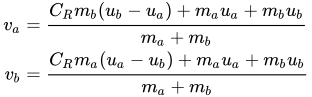
where

  • va is the final velocity of the first object after impact
  • vb is the final velocity of the second object after impact
  • ua is the initial velocity of the first object before impact
  • ub is the initial velocity of the second object before impact
  • ma is the mass of the first object
  • mb is the mass of the second object
  • CR is the coefficient of restitution; if it is 1 we have an elastic collision; if it is 0 we have a perfectly inelastic collision, see below.

In a center of momentum frame the formulas reduce to:
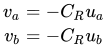
For two- and three-dimensional collisions the velocities in these formulas are the components perpendicular to the tangent line/plane at the point of contact.

If assuming the objects are not rotating before or after the collision, the normal impulse is:

where is the normal vector.

Assuming no friction, this gives the velocity updates:

Perfectly inelastic collision

[edit]
A completely inelastic collision between equal masses

A perfectly inelastic collision occurs when the maximum amount of kinetic energy of a system is lost. In a perfectly inelastic collision, i.e., a zero coefficient of restitution, the colliding particles stick together. In such a collision, kinetic energy is lost by bonding the two bodies together. This bonding energy usually results in a maximum kinetic energy loss of the system. It is necessary to consider conservation of momentum: (Note: In the sliding block example above, momentum of the two body system is only conserved if the surface has zero friction. With friction, momentum of the two bodies is transferred to the surface that the two bodies are sliding upon. Similarly, if there is air resistance, the momentum of the bodies can be transferred to the air.) The equation below holds true for the two-body (Body A, Body B) system collision in the example above. In this example, momentum of the system is conserved because there is no friction between the sliding bodies and the surface. where v is the final velocity, which is hence given by The reduction of total kinetic energy is equal to the total kinetic energy before the collision in a center of momentum frame with respect to the system of two particles, because in such a frame the kinetic energy after the collision is zero. In this frame most of the kinetic energy before the collision is that of the particle with the smaller mass. In another frame, in addition to the reduction of kinetic energy there may be a transfer of kinetic energy from one particle to the other; the fact that this depends on the frame shows how relative this is. The change in kinetic energy is hence:

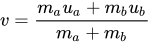
where μ is the reduced mass and urel is the relative velocity of the bodies before collision. With time reversed we have the situation of two objects pushed away from each other, e.g. shooting a projectile, or a rocket applying thrust (compare the derivation of the Tsiolkovsky rocket equation).

Partially inelastic collisions

[edit]

Partially inelastic collisions are the most common form of collisions in the real world. In this type of collision, the objects involved in the collisions do not stick, but some kinetic energy is still lost. Friction, sound and heat are some ways the kinetic energy can be lost through partial inelastic collisions.

See also

[edit]

References

[edit]
Revisions and contributorsEdit on WikipediaRead on Wikipedia
from Grokipedia
An inelastic collision is a collision between two or more objects in which the total kinetic energy of the system before and after the collision is not the same, with some kinetic energy being converted into other forms such as heat, sound, or permanent deformation of the objects.[1] Unlike elastic collisions, where both linear momentum and kinetic energy are conserved, inelastic collisions conserve linear momentum but not kinetic energy, due to internal forces acting between the colliding bodies that dissipate energy.[2] Total energy remains conserved, as the lost kinetic energy is transformed into other forms such as heat, sound, or deformation, adhering to the principle of conservation of energy.[3] Inelastic collisions are classified by the degree of energy loss, with perfectly inelastic collisions representing the extreme case where the objects stick together after impact, maximizing kinetic energy dissipation and resulting in a single combined velocity determined solely by momentum conservation.[4] The coefficient of restitution, defined as the relative speed of separation divided by the relative speed of approach, quantifies the inelasticity; for perfectly inelastic collisions, it equals zero, indicating no rebound.[2] Common real-world examples include a car crash, where vehicles deform and energy is lost to heat and sound, or a ballistic pendulum, where a bullet embeds in a block, converting kinetic energy into potential energy as the system swings upward.[1] These collisions are fundamental in analyzing systems like traffic accidents, sports impacts, and explosive events, where the formula for momentum conservation, $ m_1 v_1 + m_2 v_2 = (m_1 + m_2) v_f $ for perfectly inelastic cases, allows prediction of post-collision motion.[4]

Definition and Principles

Definition of Inelastic Collision

An inelastic collision is a type of collision in classical mechanics in which the total kinetic energy of the system is not conserved, although linear momentum is conserved in the absence of external forces.[5][2] In contrast to elastic collisions, where both momentum and kinetic energy remain unchanged, inelastic collisions involve a transformation of kinetic energy into other forms.[6] Key characteristics of inelastic collisions include the potential for objects to deform, stick together, or separate with reduced relative speed, resulting in energy dissipation through mechanisms such as heat, sound, or permanent material deformation.[5][2] These collisions are prevalent in macroscopic, everyday scenarios where ideal elastic behavior is rare due to the presence of internal dissipative forces.[6] The concept of inelastic collisions emerged within classical mechanics, building upon Isaac Newton's foundational laws of motion and his 1687 introduction of the coefficient of restitution for impacts.[7] Qualitative examples include a car crash, where vehicles crumple and kinetic energy converts to heat and deformation, or a rubber ball dropped onto a hard floor, which bounces lower due to energy lost as sound and internal friction.[5][6]

Conservation Principles

In collisions, the conservation of linear momentum is a fundamental principle that holds for both elastic and inelastic types when the system is isolated. This law states that the total linear momentum of the system before the collision equals the total linear momentum after the collision, expressed vectorially as pi=pf\vec{p}_i = \vec{p}_f, where p\vec{p} denotes momentum.[8] For a one-dimensional collision involving two objects of masses m1m_1 and m2m_2 with initial velocities v1iv_{1i} and v2iv_{2i}, and final velocities v1fv_{1f} and v2fv_{2f}, the principle simplifies to m1v1i+m2v2i=m1v1f+m2v2fm_1 v_{1i} + m_2 v_{2i} = m_1 v_{1f} + m_2 v_{2f}.[9] This conservation arises from Newton's third law, as the internal forces between the colliding objects are equal and opposite, resulting in no net change in the system's momentum.[10] Unlike momentum, kinetic energy is not conserved in inelastic collisions. The total kinetic energy before the collision exceeds that after, as indicated by 12m1v1i2+12m2v2i2>12m1v1f2+12m2v2f2\frac{1}{2} m_1 v_{1i}^2 + \frac{1}{2} m_2 v_{2i}^2 > \frac{1}{2} m_1 v_{1f}^2 + \frac{1}{2} m_2 v_{2f}^2.[5] The lost kinetic energy transforms into non-mechanical forms, such as heat, sound, or internal deformation energy within the objects.[2] This dissipation occurs due to internal frictional or dissipative forces during the interaction, which do not affect the overall momentum but reduce the system's mechanical energy.[11] These conservation principles apply under the prerequisite of an isolated system, where no external forces act on the colliding objects, ensuring that only internal impulses influence the outcomes.[12] During the collision, the impulse delivered by internal forces causes temporary deformation, but because these forces are pairwise equal and opposite, they preserve the total momentum while allowing energy loss in inelastic cases.[5] This framework enables the analysis of collision dynamics without needing to model every microscopic interaction.[13]

Degrees of Inelasticity

Perfectly Inelastic Collisions

In a perfectly inelastic collision, the colliding objects adhere to each other upon impact and subsequently move as a single combined unit, representing the case of maximum inelasticity where all relative motion between the objects ceases.[2] This outcome occurs because the internal forces during the collision deform or bind the objects, dissipating energy into forms such as heat, sound, or deformation without allowing any rebound.[3] The key kinematic result follows directly from the conservation of linear momentum, as no external forces act on the system in the collision's direction. For two objects with masses m1m_1 and m2m_2, initial velocities v1iv_{1i} and v2iv_{2i}, the common final velocity vfv_f is given by
vf=m1v1i+m2v2im1+m2. v_f = \frac{m_1 v_{1i} + m_2 v_{2i}}{m_1 + m_2}.
This equation holds in one dimension and assumes the collision is isolated, aligning with the general principle that total momentum remains constant.[14] Kinetic energy is not conserved in such collisions, with the loss maximized compared to other inelastic types. Specifically, in the center-of-mass frame, the entire initial relative kinetic energy12μvrel2\frac{1}{2} \mu v_{\text{rel}}^2, where μ=m1m2m1+m2\mu = \frac{m_1 m_2}{m_1 + m_2} is the reduced mass and vrel=v1iv2iv_{\text{rel}} = v_{1i} - v_{2i}—is dissipated into non-mechanical forms.[3] In a simplified one-dimensional case where the second object is initially at rest (v2i=0v_{2i} = 0), the fractional kinetic energy loss simplifies to m2m1+m2\frac{m_2}{m_1 + m_2}, illustrating how the loss fraction depends on the mass ratio and approaches unity when one mass greatly exceeds the other.[14] Common examples include two balls of clay colliding and merging into a single lump, where the sticky material ensures they stick together and lose nearly all relative motion's energy.[15] Another illustrative case is the ballistic pendulum, in which a bullet embeds into a suspended block, causing the combined mass to swing upward; here, the initial kinetic energy of the bullet-block system post-collision converts partly to gravitational potential energy, with the embedding demonstrating perfect inelasticity.[16]

Partially Inelastic Collisions

Partially inelastic collisions represent an intermediate case between elastic and perfectly inelastic collisions, where colliding objects separate after impact but rebound with a reduced relative speed compared to their approach speed. In these interactions, kinetic energy is not conserved due to dissipative processes, while momentum remains conserved in isolated systems. This contrasts with perfectly inelastic collisions, which serve as a limiting case where relative motion ceases entirely upon sticking.[17][18] The degree of inelasticity is quantified by the coefficient of restitution ee, defined as the ratio of the relative speed of separation to the relative speed of approach, with 0<e<10 < e < 1 for partially inelastic collisions.[5] During a partially inelastic collision, the objects undergo temporary deformation upon contact, such as compression or bending, without fusing together permanently. This deformation dissipates a portion of the initial kinetic energy into forms like heat, sound, or internal vibrations, leading to a net loss in the system's mechanical energy. Such collisions are prevalent in real-world scenarios, including a tennis ball impacting a racket, where the ball compresses and rebounds with diminished speed, or low-speed traffic accidents between vehicles that bounce apart without structural merging.[5][19] The extent of energy loss in partially inelastic collisions varies widely based on the materials' properties, such as their elasticity, hardness, and surface conditions, as well as the collision's intensity. In typical everyday interactions, this loss constitutes a partial fraction of the initial kinetic energy, depending on the objects involved.[18][20] As the degree of inelasticity diminishes—through factors like increased material resilience or reduced deformation—the collision's characteristics gradually approach those of an elastic interaction, where the post-collision relative speed equals the pre-collision value and kinetic energy is fully preserved.[6]

Quantitative Analysis

Coefficient of Restitution

The coefficient of restitution, denoted as $ e $, is a dimensionless parameter that quantifies the elasticity of a collision by measuring the ratio of the relative velocity of separation to the relative velocity of approach along the line of impact. Mathematically, it is defined as
e=v2v1v2v1, e = -\frac{v_{2}' - v_{1}'}{v_{2} - v_{1}},
where $ v_1 $ and $ v_2 $ are the components of the velocities of the two objects before collision, and $ v_1' $ and $ v_2' $ are the corresponding components after collision, with the negative sign ensuring $ e $ is positive since the relative velocity reverses direction in rebounding collisions.[21] This parameter ranges from 0 to 1, where $ e = 1 $ indicates a perfectly elastic collision with no energy loss, $ e = 0 $ corresponds to a perfectly inelastic collision where the objects stick together without rebound, and values between 0 and 1 describe partially inelastic collisions with some energy dissipation.[22] The concept was first introduced by Isaac Newton in his 1687 work Philosophiæ Naturalis Principia Mathematica, where he proposed the coefficient based on experimental observations of rebound velocities, though his formulation assumed a direct proportionality without accounting for the then-unknown principle of kinetic energy conservation, leading to limitations in applicability for certain material behaviors.[7] In the 19th century, Siméon Denis Poisson refined the understanding by hypothesizing that the coefficient represents the ratio of the impulse during the restitution phase to the impulse during the compression phase of the collision, providing a more physically grounded impulse-based interpretation that better aligned with emerging theories of impact dynamics.[23] Modern tabulations of $ e $ values for various material pairs, such as approximately 0.8 for steel colliding with steel, are derived from empirical data and serve as references in engineering analyses.[24] Experimentally, the coefficient is determined through methods like drop tests, where an object is released from a known height onto a surface, and the rebound height or velocity is measured to compute $ e $ from the velocity ratio. High-speed imaging, often using cameras capturing at rates exceeding 1000 frames per second, allows precise tracking of pre- and post-impact velocities, while factors such as material properties, impact speed, angle of incidence, surface roughness, and environmental conditions like humidity can influence the measured value.[25] These techniques ensure accurate quantification, particularly for validating models in fields like materials science and biomechanics.[26]

Velocity and Energy Formulas

In one-dimensional inelastic collisions between two objects of masses m1m_1 and m2m_2 with initial velocities v1iv_{1i} and v2iv_{2i}, the post-collision velocities v1fv_{1f} and v2fv_{2f} are derived by solving the conservation of linear momentum and the definition of the coefficient of restitution ee simultaneously.[27] The momentum conservation equation is m1v1i+m2v2i=m1v1f+m2v2fm_1 v_{1i} + m_2 v_{2i} = m_1 v_{1f} + m_2 v_{2f}, while the coefficient of restitution provides v2fv1f=e(v2iv1i)v_{2f} - v_{1f} = -e (v_{2i} - v_{1i}).[27] Solving these yields the final velocities:
v1f=m1em2m1+m2v1i+(1+e)m2m1+m2v2i v_{1f} = \frac{m_1 - e m_2}{m_1 + m_2} v_{1i} + \frac{(1 + e) m_2}{m_1 + m_2} v_{2i}
v2f=(1+e)m1m1+m2v1i+m2em1m1+m2v2i v_{2f} = \frac{(1 + e) m_1}{m_1 + m_2} v_{1i} + \frac{m_2 - e m_1}{m_1 + m_2} v_{2i}
These expressions generalize the elastic case (e=1e = 1) and reduce to the perfectly inelastic case (e=0e = 0) where both objects move with common velocity m1v1i+m2v2im1+m2\frac{m_1 v_{1i} + m_2 v_{2i}}{m_1 + m_2}.[27] The kinetic energy after the collision is less than the initial kinetic energy due to dissipation, with the post-collision kinetic energy given by KEf=KEiΔKEKE_f = KE_i - \Delta KE, where the energy loss ΔKE\Delta KE is:
ΔKE=12μ(1e2)(v1iv2i)2 \Delta KE = \frac{1}{2} \mu (1 - e^2) (v_{1i} - v_{2i})^2
Here, μ=m1m2m1+m2\mu = \frac{m_1 m_2}{m_1 + m_2} is the reduced mass, and (v1iv2i)(v_{1i} - v_{2i}) is the initial relative velocity.[28] This loss is zero for elastic collisions (e=1e = 1) and maximum for perfectly inelastic collisions (e=0e = 0), representing the fraction of kinetic energy converted to other forms such as heat or deformation.[28] For two-dimensional collisions, the analysis decomposes velocities into components along the line of impact (normal direction) and perpendicular to it (tangential direction). The coefficient of restitution ee applies only to the normal components, using the one-dimensional formulas above, while the tangential components remain unchanged for each object since no impulse acts in that direction.[29] Momentum conservation is enforced separately in both directions, allowing reconstruction of the full post-collision velocities by recombining the components.[29]

Real-World Implications

Common Examples

Inelastic collisions are prevalent in everyday scenarios, where kinetic energy is not conserved but momentum is, leading to deformation or other forms of energy dissipation. A prominent example is frontal car crashes, which are typically partially inelastic with coefficients of restitution (e) ranging from approximately 0.1 to 0.5, depending on vehicle design and impact speed.[30] Modern vehicles incorporate crumple zones in the front ends to intentionally absorb impact energy through controlled deformation, reducing the force transmitted to occupants and thereby enhancing safety. This design principle transforms kinetic energy into plastic deformation and heat, exemplifying how engineering leverages partial inelasticity to mitigate injury risks. In sports, collisions between objects often exhibit partial inelasticity, as seen in the impact of a golf ball with a club head, where the coefficient of restitution is around 0.8, allowing for efficient energy transfer while some is lost to deformation of the ball's cover and club face.[31] This partial rebound contributes to the ball's launch velocity, which is crucial for distance. In contrast, dropping a ball of putty onto a hard surface demonstrates a perfectly inelastic collision with e ≈ 0, as the putty sticks and deforms without bouncing, converting nearly all kinetic energy into internal heating and shape change. Such examples highlight how varying degrees of inelasticity affect performance in athletic equipment design. Laboratory demonstrations provide controlled ways to observe inelastic collisions, such as using air tracks with inelastic bumpers attached to gliders, where the bumpers cause the gliders to stick together upon collision (e ≈ 0 for perfectly inelastic cases) or partially rebound (e > 0 for partial cases), allowing students to verify momentum conservation while noting energy loss through sound and deformation. Variants of Newton's cradle, modified with clay or Velcro attachments instead of elastic balls, further illustrate inelastic behavior by showing reduced or absent rebounds, emphasizing the transition from elastic to inelastic dynamics in a visually engaging setup. Biological contexts also involve inelastic collisions, particularly in human falls or animal impacts, where the body absorbs energy through soft tissue deformation, leading to injuries like bruises or fractures due to the dissipation of kinetic energy as heat and internal damage. For instance, when a person lands awkwardly after a jump, the nearly perfectly inelastic nature of the impact at heel strike results in energy absorption by joints and muscles, which can cause microtrauma if the forces exceed physiological limits. This underscores the protective role of biological structures in managing inelastic energy transfer to prevent catastrophic failure.

Energy Dissipation Mechanisms

In inelastic collisions, kinetic energy is dissipated through various physical processes that convert it into other forms, such as thermal energy, rather than being conserved as in elastic collisions. The primary mechanisms include plastic deformation, frictional heating, sound production, and vibrational energy, each contributing to the irreversible loss of mechanical energy. These processes ensure compliance with the second law of thermodynamics, as the total entropy of the system increases during the energy transformation.[32] Plastic deformation occurs when colliding objects undergo permanent shape changes, particularly in ductile materials like metals, where atomic bonds rearrange under stress, absorbing kinetic energy as internal work. This mechanism is dominant in high-impact scenarios, such as metal-on-metal contacts, where the energy required to exceed the yield strength leads to microstructural alterations like dislocations in crystal lattices. In polymers, similar deformation involves chain stretching and entanglement, further dissipating energy through molecular rearrangements. Microstructural features, such as grain boundaries in metals or cross-link densities in polymers, play a critical role in determining the extent of this dissipation, with finer microstructures often enhancing energy absorption capacity. Frictional heating arises from sliding or rubbing contacts during the collision, converting kinetic energy into thermal energy via microscopic interactions at the interface. This process generates localized temperature rises, often exceeding hundreds of degrees Celsius in brief impacts, and is particularly pronounced in rough surfaces where asperities interact. Sound waves and vibrations represent additional dissipation pathways, as elastic waves propagate through the materials, carrying away energy that is eventually damped into heat through internal friction. These acoustic emissions can account for a small fraction of the lost energy in macroscopic collisions. In viscoelastic materials, such as rubbers or biological tissues, energy dissipation is prominently featured through hysteresis, where the stress-strain curve forms a loop during loading and unloading cycles, with the area enclosed representing the energy lost per cycle—often primarily to heat. This viscoelastic behavior stems from the time-dependent response of polymer chains, leading to internal friction that scales with strain rate and temperature. In automobile crashes, a significant portion of the dissipated kinetic energy is converted to heat through these combined mechanisms, underscoring their efficiency in real-world applications. Thermodynamically, these dissipations align with the second law by increasing the system's entropy, as the ordered kinetic energy disperses into disordered thermal states. Recent research in nanoscale engineering has explored inelastic collisions at the atomic or molecular scale, where classical mechanisms like plastic deformation persist but are modulated by quantum effects, such as tunneling or discrete energy levels, potentially altering dissipation pathways in applications like nanomachines or quantum dots.

References

User Avatar
No comments yet.
