Hubbry Logo
Cloud iridescenceCloud iridescenceMain
Open search
Cloud iridescence
Community hub
Cloud iridescence
logo
8 pages, 0 posts
0 subscribers
Be the first to start a discussion here.
Cloud iridescence
Cloud iridescence
from Wikipedia
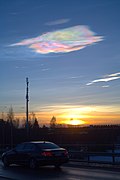
Iridescent mid altitude clouds
Iridescent polar stratospheric cloud at sunset over Aberdeen, Scotland
Cloud iridescence, seen above the clouds covered with grey clouds, Pondicherry, India

Cloud iridescence or irisation is a colorful optical phenomenon that occurs in a cloud and appears in the general proximity of the Sun or Moon. The colors resemble those seen in soap bubbles and oil on a water surface. It is a type of photometeor. This fairly common phenomenon is most often observed in altocumulus,[1] cirrocumulus, lenticular,[2] and cirrus clouds.[3][4][5] They sometimes appear as bands parallel to the edge of the clouds. Iridescence is also seen in the much rarer polar stratospheric clouds, also called nacreous clouds.[6]

The colors are usually pastel, but can be very vivid or mingled together, sometimes similar to mother-of-pearl.[7] When appearing near the Sun, the effect can be difficult to spot as it is drowned in the Sun's glare. This may be overcome by shielding the sunlight with one's hand or hiding it behind a tree or building. Other aids are dark glasses, or observing the sky reflected in a convex mirror or in a pool of water.

Etymology

[edit]

Irisations are named after the Greek goddess Iris, goddess of rainbows and messenger of Zeus and Hera to the mortals below.[8]

Mechanism

[edit]

Iridescent clouds are a diffraction phenomenon caused by small water droplets or small ice crystals individually scattering light. Larger ice crystals do not produce iridescence, but can cause halos, a different phenomenon.[9]

Irisation is caused by very uniform water droplets diffracting light (within 10 degrees from the Sun) and by first order interference effects[10] (beyond about 10 degrees from the Sun). It can extend up to 40 degrees from the Sun.[11]

If parts of clouds contain small water droplets or ice crystals of similar size, their cumulative effect is seen as colors. The cloud must be optically thin, so that most rays encounter only a single droplet. Iridescence is therefore mostly seen at cloud edges or in semi-transparent clouds, while newly forming clouds produce the brightest and most colorful iridescence. When the particles in a thin cloud are very similar in size over a large extent, the iridescence takes on the structured form of a corona, a bright circular disk around the Sun or Moon surrounded by one or more colored rings.[9][12][13]

[edit]

See also

[edit]

References

[edit]
[edit]
Revisions and contributorsEdit on WikipediaRead on Wikipedia
from Grokipedia
Cloud iridescence is a rare atmospheric in which thin clouds exhibit brilliant, rainbow-like colors, typically and , due to the of by small, uniformly sized droplets or crystals. This effect arises when passes through clouds containing particles of nearly identical size, causing the light waves to bend and interfere, producing vivid spectral bands that contour the cloud edges or form spots within the cloud. is the primary mechanism, similar to that seen in coronas but more colorful when particle uniformity is high, and it requires the cloud to be positioned within about 30 degrees of the sun or moon for optimal visibility. Iridescence most commonly occurs in altocumulus, cirrocumulus, cirrus, or lenticular clouds that are semi-transparent or newly forming, as these conditions promote the necessary monodisperse particle distributions. It is distinct from a silver lining, which appears as a bright white edge on thicker clouds without the multicolored display, though both stem from . The phenomenon is relatively uncommon due to the precise environmental requirements, but it has been documented in various settings, including mountain wave clouds where wave-induced uniformity enhances the colors.

Overview

Definition and characteristics

Cloud iridescence, also known as irisation, is an atmospheric optical phenomenon featuring brilliant pastel colors on or within clouds, evoking the sheen of mother-of-pearl or oil slicks on water. These colors manifest as mingled hues or distinct bands nearly parallel to the cloud margins, typically displaying subtle shades of green, pink, red, orange, yellow, blue, and violet in a rainbow-like sequence. The display appears in the general vicinity of the Sun or Moon—often within 1° to 10° angular distance from the light source—but is not centered on it, allowing the colors to emerge at the cloud's edges or through semi-transparent portions. As a type of photometeor, cloud iridescence represents irisation in the atmosphere, where light scattering produces these vivid yet delicate patterns. The effect stems broadly from by uniformly sized particles in the cloud, creating interference that separates wavelengths into colors. Visibility is optimal under clear skies, as the subtle colors can be obscured by glare or haze; they are most striking when the light source is positioned just beyond the cloud's direct line, extending up to 40° in rare cases. The phenomenon typically endures for minutes to a few hours, though it fades as shifting cloud positions relative to the Sun or cause the colors to dissipate. It continues to be observed worldwide, with notable sightings in regions like and as of 2025. Though fairly common globally, cloud iridescence remains fleeting and elusive, with occurrences more noticeable in summer due to frequent thin cloud development or in polar regions where specialized iridescent displays amplify the effect.

Etymology and historical context

The term "iridescence" derives from the Latin īris, meaning "rainbow," which itself stems from the Greek ἶρις (îris), referring to the rainbow and the name of the goddess Iris, messenger of the gods and personification of the rainbow. In meteorological contexts, the phenomenon in clouds is often called "irisation," a term coined in the 19th century to describe the shimmering, rainbow-like colors produced by diffraction, emphasizing the visual similarity to the goddess's arc. This nomenclature highlights the ancient association between atmospheric colors and mythological rainbows, distinguishing it from broader optical effects. Early documentation of colored atmospheric phenomena appears in Aristotle's Meteorology (circa 350 BCE), where he describes unusual hues in clouds—such as red, green, or yellow in rods near the sun—resulting from the reflection and of sunlight through misty vapors, interpreting them as natural phenomena akin to solar halos. These observations, though not fully mechanistic, mark one of the first systematic ancient accounts of colored effects in the atmosphere. In the 17th century, provided more detailed insights in his Micrographia (1665), observing iridescent colors in thin films and soap bubbles through and linking them to wave-like interference of light, a principle extended by contemporaries to explain similar effects in clouds. The 19th century saw systematic meteorological study, with examining iridescent Alpine clouds in his Six Lectures on Light (1873), attributing their pastel bands to by uniform water droplets, thus establishing a foundational explanation for the phenomenon's . This work paved the way for formal , culminating in the (1896), which defined irisation as a supplementary cloud feature involving colored patches or bands near the sun or moon, standardizing its recognition in global weather observation. In various cultures, iridescent clouds have been referenced in as omens or divine signs, often evoking the rainbow's symbolism of bridges between earthly and celestial realms, as seen in Greek myths tied to Iris. Such interpretations appear in Native American traditions, where colorful clouds symbolized spiritual messages or clan totems, reflecting a broader human tendency to imbue rare atmospheric displays with supernatural significance.

Physical principles

Diffraction mechanism

Cloud iridescence arises from the diffraction of by small cloud particles, where behaves as electromagnetic waves with wavelengths in the ranging from approximately 400 to 700 nm. Diffraction occurs when these waves encounter obstacles or apertures comparable in size to the , causing the to bend around the edges and spread out, producing interference patterns. In the scattering process, individual small particles, such as droplets or crystals, cause single of through . The diffracted waves from different parts of the particle travel varying path lengths to the observer, resulting in constructive interference for certain wavelengths and destructive interference for others. This selective reinforcement separates colors, with longer wavelengths (e.g., red) diffracting at larger angles than shorter ones (e.g., ), creating the observed iridescent hues. The angular position of the diffracted colors can be approximated using the formula for the first diffraction maximum: θλd\theta \approx \frac{\lambda}{d} where θ\theta is the diffraction angle, λ\lambda is the wavelength of light, and dd is the particle diameter. This relation illustrates why specific colors appear at particular positions relative to the source, as smaller particles produce wider diffraction patterns. Unlike in phenomena such as rainbows, in cloud iridescence does not involve light bending through the interior of particles due to a change in . Instead, it is a surface effect from wave bending around the particle edges, and the resulting colors often do not follow a strict spectral order because of overlapping contributions from multiple events. Smaller particles (e.g., 1-10 μm) are required for iridescence at larger angular distances from the Sun, producing broader color patterns, while larger particles yield narrower .

Droplet and crystal properties

Cloud iridescence arises from the diffraction of by cloud particles with diameters typically ranging from 5 to 25 micrometers, which are comparable to the wavelengths of visible and much smaller than raindrops exceeding 100 micrometers. These particles must be sufficiently small to produce separated color bands through forward , as larger sizes result in narrower diffraction angles where colors overlap and appear white. The composition of these particles is either supercooled liquid droplets in lower-altitude clouds, such as altocumulus, or tiny ice crystals in higher clouds like cirrus, both capable of diffracting to create the iridescent effect. Particles scatter light broadly without wavelength-dependent separation when sizes lead to significant color overlap. A high degree of uniformity in within a localized region is crucial for coherent patterns, with narrow size distributions—often spanning just a few micrometers—ensuring similar angles across the patch and producing vivid, structured colors. Size variations lead to desynchronized , smearing the colors or eliminating the phenomenon entirely. In-situ measurements from research aircraft, employing cloud particle imagers and holographic probes, have verified these microphysical properties in iridescent clouds, revealing mean diameters around 12 to 16 micrometers in mountain wave formations, for instance. Such techniques capture high-resolution images of individual particles, confirming the required small sizes and uniformity.

Formation conditions

Associated cloud types

Cloud iridescence primarily occurs in thin, layered clouds featuring small, uniform droplets or s that diffract effectively. The most common associated cloud types are altocumulus, cirrocumulus, lenticular, and cirrus. Altocumulus clouds, mid-level formations often appearing as wavy or undulating sheets, are frequent sites for iridescence due to their semi-transparent nature and droplet uniformity shortly after formation. Cirrocumulus and cirrus clouds, high-altitude types with small ripples or thin wisps respectively, exhibit the phenomenon because of their low concentrations and narrow size distributions. Lenticular clouds, lens-shaped and generated by atmospheric wave activity, particularly display iridescence along their edges in regions with orographic influences, such as near mountain ranges in mid-latitudes. Iridescence occasionally appears in supplementary types, including pileus clouds—small cap-like formations atop developing cumulus—and the edges of young cumulonimbus, where rapid growth maintains droplet uniformity. These occurrences are less common than in primary types, as they require specific conditions of recent cloud development and minimal optical thickness to preserve the narrow particle size needed for . Overall, such displays are more prevalent in mid-latitudes, where wave activity enhances the formation of suitable cloud structures like lenticularis.

Atmospheric requirements

Cloud iridescence requires the light source, typically the Sun or , to be positioned at a low with a less than 30 degrees to enhance visibility through reduced atmospheric , while the cloud itself must be offset by 1 to 20 degrees from the direct line of sight to the light source to prevent and allow the diffracted colors to stand out. This offset is crucial because iridescence arises from in thin cloud layers, and viewing too close to the light source overwhelms the subtle color bands with intense brightness. Twilight conditions further improve observation by lowering the light source and dimming the sky background, making the hues more prominent. The phenomenon manifests primarily in newly forming clouds, where water droplets have similar growth histories before coalescence disrupts size homogeneity, ensuring they grow uniformly. Stable atmospheric conditions with gentle promote this even growth by maintaining consistent droplet histories across the cloud patch, as seen in quasi-steady wave motions that allow rapid without rapid mixing. Iridescence often develops in clear skies associated with approaching weather fronts or , where moist air is gently elevated to form thin layers without excessive vertical motion. Suitable temperatures typically range from 0°C to -40°C for supercooled liquid droplets essential for the required particle sizes, and colder conditions down to -70°C can support it if ice crystals remain uniform. Its rarity stems from the need for low to preserve droplet uniformity, as even mild mixing can broaden size distributions and wash out colors; additionally, or aerosols disrupt by introducing variable particle sizes, leading to polydisperse droplets that inhibit coherent .

Observations and variations

Notable occurrences

Cloud iridescence has been documented in various modern sightings, showcasing its vivid colors in diverse atmospheric settings. In December 2023, an outbreak of polar stratospheric clouds, resembling nacreous formations, produced intense iridescent displays over the regions of , , and , visible for three consecutive days from December 18 to 20. These clouds, elevated in the due to the , diffracted sunlight into pearl-like hues, rivaling auroral spectacles in brilliance. Regional hotspots reveal patterns where specific topography and weather favor . In the Sierra Nevada mountains of , lenticular clouds frequently exhibit iridescence along their edges, particularly during westerly winds that create standing wave formations over the range. Scandinavian fjords and coastal areas, such as those in , often host iridescent cirrocumulus clouds, with notable displays over and where thin, uniform ice crystals enhance the effect. In Australia's inland regions like the Wheatbelt of , summer altocumulus clouds have produced fleeting iridescent patches, as observed in October 2023 near Goomalling. Rare events underscore the phenomenon's elusiveness and scientific interest. A 2025 coastal sighting in , captured in February, featured rainbow-like iridescence in altocumulus clouds, explained by through uniform droplets during stable post-winter conditions. In , December 2023 brought unusual nacreous iridescence over , northern England, and the West Midlands, with spectral colors likened to UFOs, prompting widespread photography amid unseasonal stratospheric cooling. Documentation of these occurrences relies on and . The Observer app enables users to photograph and log observations, including , which are collocated with data for validation. NASA's MODIS instrument provides property products that verify iridescent features through and visible analysis, aiding in global tracking.

Extraterrestrial examples

Cloud iridescence has been observed on Mars, extending the phenomenon beyond Earth's atmosphere to other planetary environments. NASA's Curiosity rover captured images of a feather-shaped iridescent cloud in Gale Crater on Sol 3724 (January 27, 2023), just after sunset, during a campaign to study high-altitude clouds. This cloud, likely composed of carbon dioxide ice crystals, formed more than 60 kilometers above the surface in the thin Martian atmosphere, where extreme cold allows ice particles to grow uniformly and diffract sunlight into vibrant colors. The iridescence appears as a spectrum of hues, with color variations indicating changes in particle size across the cloud, similar to diffraction effects seen in terrestrial nacreous clouds. A subsequent observation by on Sol 4426 (January 17, 2025) revealed additional iridescent clouds drifting over the Martian landscape, showcasing wispy formations with rainbow-like edges during twilight. These clouds consist of ice particles at altitudes around 60 kilometers, highlighting how seasonal heating lifts volatiles into the upper atmosphere, enabling the formation of uniform that produce the optical effect. The colors observed span the , adapted to Mars's reddish surface lighting but originating from the same ultraviolet-to-visible diffraction as on . Such Martian examples demonstrate the universality of cloud iridescence in thin atmospheres, where small, monodisperse particles enable pronounced regardless of the dominant gas composition. This underscores the role of local atmospheric dynamics and particle properties in generating the phenomenon across solar system bodies.

Distinctions from coronas

A corona is an consisting of one or more colored rings centered on the Sun or , produced by of through clouds containing uniformly sized water droplets or crystals typically ranging from 10 to 25 micrometers in . These rings form concentric spectra with blue hues on the inner edges fading to red on the outer edges, resulting from constructive and destructive interference in the diffraction patterns from particles of consistent size across a broad area. In contrast, cloud iridescence differs markedly in appearance and formation: it manifests as off-center, patchy displays of rather than symmetrical rings, often appearing as fragmented or swirling bands due to localized regions of uniform droplet sizes across the . While both phenomena arise from , iridescence arises from small regions of nearly uniform droplet sizes (typically under 25 micrometers) displaced from the light source, producing localized, patchy displays without the symmetrical fading gradient of coronas. Overlap can occur in thinning clouds where a central corona transitions into peripheral ; for instance, in altocumulus or mountain wave clouds, uniform droplets near the light source produce ring-like features, while size variations at the edges yield patchy iridescent fragments. Observers can distinguish them by noting that coronas typically surround and partially obscure the direct view of the Sun or through the cloud, whereas often appears displaced from the light source, allowing unobstructed visibility of it.

Comparisons with rainbows and halos

Cloud iridescence differs fundamentally from rainbows in both mechanism and appearance. Rainbows form through , internal reflection, and dispersion of in larger raindrops, typically exceeding 0.5 mm in , which bend light rays to produce a full (or from the ground) centered on the , with a consistent sequence from red on the outer edge to violet on the inner. In contrast, iridescence arises solely from by much smaller, nearly uniform water droplets or ice crystals (around 10-20 micrometers), resulting in localized, irregular patches of shimmering colors without a defined geometric structure or fixed color ordering. Similarly, halos represent a refractive phenomenon involving hexagonal ice prisms in high-altitude cirrus clouds, where sunlight deviates by precise angles—most commonly 22° or 46°—to create sharply defined circular rings or arcs encircling the Sun or , with the angular radius determined by the crystals' geometric symmetry. , however, produces diffuse, non-circular color bands due to the wave interference from , lacking the halo's angular precision and often appearing offset from the Sun by up to 30° without forming complete rings. While all three phenomena involve atmospheric of sunlight, they diverge in particle characteristics: rainbows require sizable liquid raindrops for geometric , halos depend on structured ice crystals for , and iridescence demands quasi-uniform tiny droplets or crystals for coherent , a uniformity not essential for the other two. This shared reliance on highlights light's interaction with atmospheric particles but underscores iridescence's unique need for minimal size variation to avoid color blurring. Common misidentifications occur between and related , such as fogbows—pale, white versions of rainbows formed by in small droplets (typically 10–50 micrometers in diameter)—which lack iridescence's vivid, localized hues and instead produce faint, full arcs opposite the Sun. Likewise, sundogs (parhelia), bright halo fragments appearing as colorful patches 22° to the Sun's sides via , can resemble iridescent lenticular clouds but feature more saturated, tangential colors aligned with the halo circle rather than the jumbled, diffraction-driven bands of .

References

Add your contribution
Related Hubs
User Avatar
No comments yet.