
Recent from talks
Irritator
Knowledge base stats:
Talk channels stats:
Members stats:
Irritator
Irritator is a genus of spinosaurid dinosaur that lived in what is now Brazil during the Albian stage of the Early Cretaceous Period, about 113 to 110 million years ago. It is known from a nearly complete skull found in the Romualdo Formation of the Araripe Basin. Fossil dealers had acquired this skull and sold it to the State Museum of Natural History Stuttgart. It was the subject of an ongoing international restitution dispute between Germany and Brazil, until its return to Brazil in 2026. In 1996, the specimen became the holotype of the type species Irritator challengeri. The genus name comes from the word "irritation", reflecting the feelings of paleontologists who found the skull had been heavily damaged and altered by the collectors. The species name is a homage to the fictional character Professor Challenger from Arthur Conan Doyle's novels.
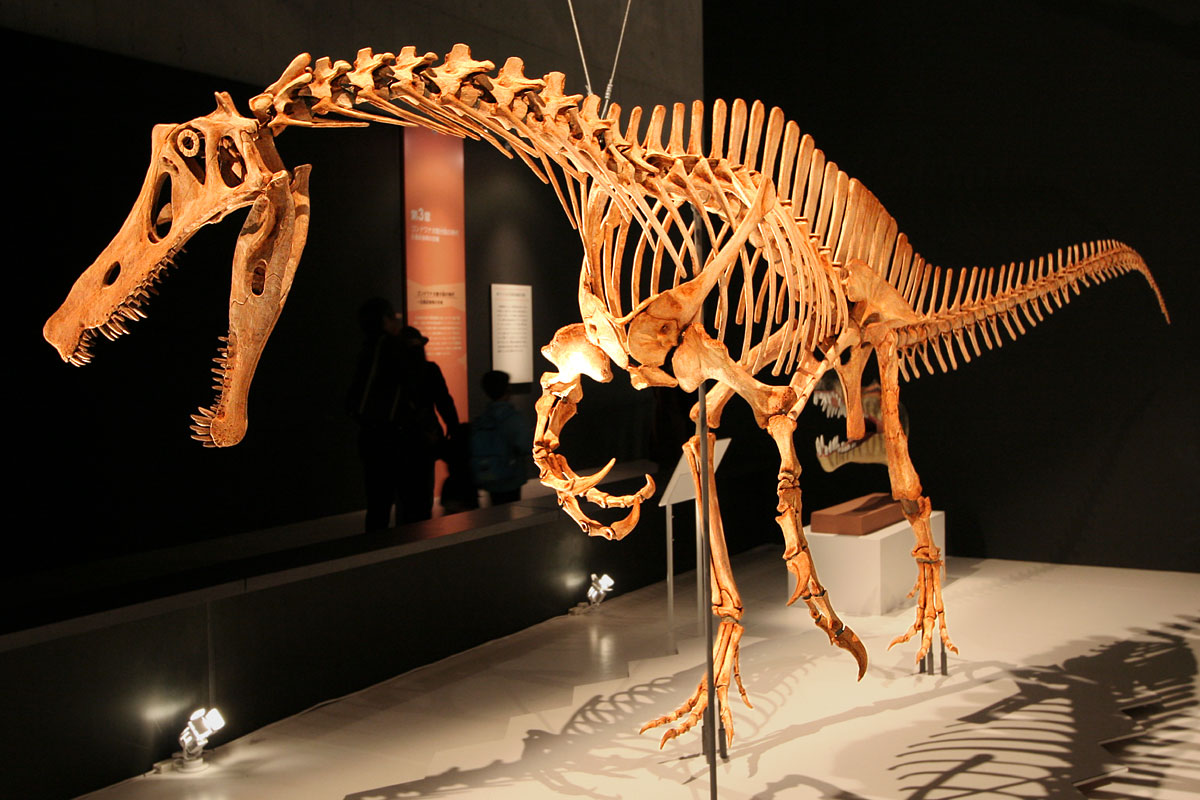
Some paleontologists regard Angaturama limai—known from a snout tip that was described a few weeks later also in 1996—as a potential junior synonym of Irritator. Both animals hail from the same stratigraphic units of the Araripe Basin. It was also previously proposed that Irritator and Angaturama's skull parts belonged to the same specimen. Although this has been cast into doubt, more overlapping fossil material is needed to confirm whether they are the same animal or not. Other spinosaurid skeletal material, some of which could belong to Irritator or Angaturama, was retrieved from the Romualdo Formation, allowing for a replica skeleton to be made and mounted for display at the National Museum of Rio de Janeiro in 2009.
Estimated at between 6 and 8 meters (20 and 26 ft) in length, Irritator weighed around 1 tonne (1.1 short tons), making it one of the smallest spinosaurids known. Its long, shallow and slender snout was lined with straight and unserrated conical teeth. Lengthwise atop the head ran a thin sagittal crest, to which powerful neck muscles were likely anchored. The nostrils were positioned far back from the tip of the snout, and a rigid secondary palate on the roof of the mouth would have strengthened the jaw when feeding. Belonging to a subadult, Irritator challengeri's holotype remains the most completely preserved spinosaurid skull yet found. The Angaturama snout tip expanded to the sides in a rosette-like shape, bearing long teeth and an unusually tall crest. One possible skeleton indicates it, like other spinosaurids, had enlarged first-finger claws and a sail running down its back.
Irritator had been mistaken initially for a pterosaur, and later a maniraptoran dinosaur. In 1996, the animal was identified as a spinosaurid theropod. The holotype skull was thoroughly prepared before being redescribed in 2002, confirming this classification. Both Irritator and Angaturama belong to the Spinosaurinae subfamily. A generalist diet—like that of today's crocodilians—has been suggested; Irritator might have preyed mainly on fish and any other small prey animals it could catch. Fossil evidence is known of an individual that ate a pterosaur, either from hunting or scavenging it. Irritator may have had semiaquatic habits, and inhabited the tropical environment of a coastal lagoon surrounded by dry regions. It coexisted with other carnivorous theropods as well as turtles, crocodyliforms, and a large number of pterosaur and fish species.
The holotype of Irritator was excavated from a chalk concretion containing the rear of a large skull with lower jaws near the town of Santana do Cariri in northeastern Brazil. This fossil was acquired by fossil traffickers and taken to the State Museum of Natural History in Stuttgart, Germany. At the time it was assumed to be the skull of a giant basal pterosaur, or flying reptile, since the Chapada do Araripe region is famous for its copious pterosaur finds, and the German museum often bought such pieces. As it promised to be a unique discovery of singular importance, German and British pterosaur experts were contacted to study the exemplar. A paper describing it as a pterosaur had already been submitted for publication when the authors, German paleontologist Eberhard Frey and British paleontologist David Martill, were disabused of this notion by the peer reviewers, who suggested the fossil belonged to a theropod dinosaur.
The skull was flattened sideways somewhat and, as is common with fossils, was partly crushed. The right side was well preserved, while the left was extensively damaged during collection. Some of the skull's hindmost upper surface had eroded, and the lower jaw lacked its front end, both owing to breakage during fossilization. Parts of the specimen were also cracked due to being part of a septarian concretion. The tip of the upper jaw was also missing. Since there were no signs of erosion, it had most probably broken off during or after the fossil's collection. Evident corrosion on certain bones indicates acid preparation had been attempted. A vertical fracture was present across the middle of the skull, which had apparently been sealed with car body filler. In hopes of making it look more complete and valuable, the fossil traders had severely obscured the skull beneath plaster; a widespread practice among local collectors in the Chapada do Araripe, especially on fish fossils. The buyers were unaware of the modifications to the specimen until it was sent to universities in the United Kingdom for CT scan imaging. This revealed the collectors had tried to reconstruct the skull by grafting parts of the maxilla (main upper jaw bone) onto the front of the rostrum (snout). The skull (designated SMNS 58022) became the holotype specimen of the new genus and species Irritator challengeri in February 1996, when it was first scientifically described by paleontologists David M. Martill, Arthur R.I. Cruickshank, Eberhard Frey, Philip G. Small and Maria Clarke. In this paper, Martill and his team wrote that the generic name Irritator came "from irritation, the feeling the authors felt (understated here) when discovering that the snout had been artificially elongated." The type species, Irritator challengeri, was named after Professor Challenger, a character in Arthur Conan Doyle's novels, specifically The Lost World. Two years earlier, Frey and Martill had named a new pterosaur species from the Crato Formation Arthurdactylus conandoylei, after the novelist himself.
When Martill and colleagues first described Irritator challengeri, the holotype was still extensively encased in calcareous rock matrix. Under the supervision of American paleontologist Hans-Dieter Sues, technician Diane M. Scott from the University of Toronto Mississauga assumed the task of fully extracting the skull bones from the rock, allowing for a detailed redescription in 2002. Published by Sues, Frey, Martill, and Scott, this inspection of the now fully prepared specimen negated many of Martill and colleagues' original observations, which were based on misinterpretations of the damaged and largely concealed skull. The estimated length of the complete skull was 24 cm (9.4 in) shorter than previously proposed. What was originally thought to be a prominent head crest proved to be an unattached, indeterminate bone fragment. As in the previous study, Sues and colleagues regarded the African and possibly South American genus Spinosaurus as the most similar taxon to Irritator, because they shared many dental features, including mostly straight conical tooth crowns, thin enamel, well-defined edges with no serrations, and lengthwise fluting. Since little was known of Spinosaurus's skull at the time, these similarities were enough for the authors to suggest a possible junior synonymy of Irritator with Spinosaurus. Sues and colleagues noted that more overlapping skull material was needed for further diagnosis. As more of Spinosaurus's skull became known, later research maintained separation of the two taxa.
Although the site of discovery is uncertain due to it having been trafficked out of Brazil and the lack of provenance documentation presented in the species description, the specimen most probably stems from the Romualdo Formation (previously designated the Romualdo Member of the then Santana Formation). This assignment was confirmed by microfossils of the ostracod Pattersoncypris, and fish scales from the ichthyodectid Cladocyclus, both found in the Romualdo Formation. Questioning of local fossil dealers hinted at a locality near the village of Buxexé close to Santana Do Cariri at the flank of the Chapada do Araripe, at a height of approximately 650 meters (2,130 ft). Since the Romualdo Formation is indeed exposed there, and the matrix encasing the holotype has the same color and texture as those rocks, this locality can be regarded as the probable site of the discovery of the fossil. Irritator challengeri was the first dinosaur described from the Romualdo Formation, and its holotype specimen represents the most completely preserved spinosaurid skull known.
Hub AI
Irritator AI simulator
(@Irritator_simulator)
Irritator
Irritator is a genus of spinosaurid dinosaur that lived in what is now Brazil during the Albian stage of the Early Cretaceous Period, about 113 to 110 million years ago. It is known from a nearly complete skull found in the Romualdo Formation of the Araripe Basin. Fossil dealers had acquired this skull and sold it to the State Museum of Natural History Stuttgart. It was the subject of an ongoing international restitution dispute between Germany and Brazil, until its return to Brazil in 2026. In 1996, the specimen became the holotype of the type species Irritator challengeri. The genus name comes from the word "irritation", reflecting the feelings of paleontologists who found the skull had been heavily damaged and altered by the collectors. The species name is a homage to the fictional character Professor Challenger from Arthur Conan Doyle's novels.
Some paleontologists regard Angaturama limai—known from a snout tip that was described a few weeks later also in 1996—as a potential junior synonym of Irritator. Both animals hail from the same stratigraphic units of the Araripe Basin. It was also previously proposed that Irritator and Angaturama's skull parts belonged to the same specimen. Although this has been cast into doubt, more overlapping fossil material is needed to confirm whether they are the same animal or not. Other spinosaurid skeletal material, some of which could belong to Irritator or Angaturama, was retrieved from the Romualdo Formation, allowing for a replica skeleton to be made and mounted for display at the National Museum of Rio de Janeiro in 2009.
Estimated at between 6 and 8 meters (20 and 26 ft) in length, Irritator weighed around 1 tonne (1.1 short tons), making it one of the smallest spinosaurids known. Its long, shallow and slender snout was lined with straight and unserrated conical teeth. Lengthwise atop the head ran a thin sagittal crest, to which powerful neck muscles were likely anchored. The nostrils were positioned far back from the tip of the snout, and a rigid secondary palate on the roof of the mouth would have strengthened the jaw when feeding. Belonging to a subadult, Irritator challengeri's holotype remains the most completely preserved spinosaurid skull yet found. The Angaturama snout tip expanded to the sides in a rosette-like shape, bearing long teeth and an unusually tall crest. One possible skeleton indicates it, like other spinosaurids, had enlarged first-finger claws and a sail running down its back.
Irritator had been mistaken initially for a pterosaur, and later a maniraptoran dinosaur. In 1996, the animal was identified as a spinosaurid theropod. The holotype skull was thoroughly prepared before being redescribed in 2002, confirming this classification. Both Irritator and Angaturama belong to the Spinosaurinae subfamily. A generalist diet—like that of today's crocodilians—has been suggested; Irritator might have preyed mainly on fish and any other small prey animals it could catch. Fossil evidence is known of an individual that ate a pterosaur, either from hunting or scavenging it. Irritator may have had semiaquatic habits, and inhabited the tropical environment of a coastal lagoon surrounded by dry regions. It coexisted with other carnivorous theropods as well as turtles, crocodyliforms, and a large number of pterosaur and fish species.
The holotype of Irritator was excavated from a chalk concretion containing the rear of a large skull with lower jaws near the town of Santana do Cariri in northeastern Brazil. This fossil was acquired by fossil traffickers and taken to the State Museum of Natural History in Stuttgart, Germany. At the time it was assumed to be the skull of a giant basal pterosaur, or flying reptile, since the Chapada do Araripe region is famous for its copious pterosaur finds, and the German museum often bought such pieces. As it promised to be a unique discovery of singular importance, German and British pterosaur experts were contacted to study the exemplar. A paper describing it as a pterosaur had already been submitted for publication when the authors, German paleontologist Eberhard Frey and British paleontologist David Martill, were disabused of this notion by the peer reviewers, who suggested the fossil belonged to a theropod dinosaur.
The skull was flattened sideways somewhat and, as is common with fossils, was partly crushed. The right side was well preserved, while the left was extensively damaged during collection. Some of the skull's hindmost upper surface had eroded, and the lower jaw lacked its front end, both owing to breakage during fossilization. Parts of the specimen were also cracked due to being part of a septarian concretion. The tip of the upper jaw was also missing. Since there were no signs of erosion, it had most probably broken off during or after the fossil's collection. Evident corrosion on certain bones indicates acid preparation had been attempted. A vertical fracture was present across the middle of the skull, which had apparently been sealed with car body filler. In hopes of making it look more complete and valuable, the fossil traders had severely obscured the skull beneath plaster; a widespread practice among local collectors in the Chapada do Araripe, especially on fish fossils. The buyers were unaware of the modifications to the specimen until it was sent to universities in the United Kingdom for CT scan imaging. This revealed the collectors had tried to reconstruct the skull by grafting parts of the maxilla (main upper jaw bone) onto the front of the rostrum (snout). The skull (designated SMNS 58022) became the holotype specimen of the new genus and species Irritator challengeri in February 1996, when it was first scientifically described by paleontologists David M. Martill, Arthur R.I. Cruickshank, Eberhard Frey, Philip G. Small and Maria Clarke. In this paper, Martill and his team wrote that the generic name Irritator came "from irritation, the feeling the authors felt (understated here) when discovering that the snout had been artificially elongated." The type species, Irritator challengeri, was named after Professor Challenger, a character in Arthur Conan Doyle's novels, specifically The Lost World. Two years earlier, Frey and Martill had named a new pterosaur species from the Crato Formation Arthurdactylus conandoylei, after the novelist himself.
When Martill and colleagues first described Irritator challengeri, the holotype was still extensively encased in calcareous rock matrix. Under the supervision of American paleontologist Hans-Dieter Sues, technician Diane M. Scott from the University of Toronto Mississauga assumed the task of fully extracting the skull bones from the rock, allowing for a detailed redescription in 2002. Published by Sues, Frey, Martill, and Scott, this inspection of the now fully prepared specimen negated many of Martill and colleagues' original observations, which were based on misinterpretations of the damaged and largely concealed skull. The estimated length of the complete skull was 24 cm (9.4 in) shorter than previously proposed. What was originally thought to be a prominent head crest proved to be an unattached, indeterminate bone fragment. As in the previous study, Sues and colleagues regarded the African and possibly South American genus Spinosaurus as the most similar taxon to Irritator, because they shared many dental features, including mostly straight conical tooth crowns, thin enamel, well-defined edges with no serrations, and lengthwise fluting. Since little was known of Spinosaurus's skull at the time, these similarities were enough for the authors to suggest a possible junior synonymy of Irritator with Spinosaurus. Sues and colleagues noted that more overlapping skull material was needed for further diagnosis. As more of Spinosaurus's skull became known, later research maintained separation of the two taxa.
Although the site of discovery is uncertain due to it having been trafficked out of Brazil and the lack of provenance documentation presented in the species description, the specimen most probably stems from the Romualdo Formation (previously designated the Romualdo Member of the then Santana Formation). This assignment was confirmed by microfossils of the ostracod Pattersoncypris, and fish scales from the ichthyodectid Cladocyclus, both found in the Romualdo Formation. Questioning of local fossil dealers hinted at a locality near the village of Buxexé close to Santana Do Cariri at the flank of the Chapada do Araripe, at a height of approximately 650 meters (2,130 ft). Since the Romualdo Formation is indeed exposed there, and the matrix encasing the holotype has the same color and texture as those rocks, this locality can be regarded as the probable site of the discovery of the fossil. Irritator challengeri was the first dinosaur described from the Romualdo Formation, and its holotype specimen represents the most completely preserved spinosaurid skull known.
Recent media