Hubbry Logo
search
logo
2222668

Isolated singularity

logo
Community Hub0 Subscribers
Read side by side
from Wikipedia

In complex analysis, a branch of mathematics, an isolated singularity is one that has no other singularities close to it. In other words, a complex number z0 is an isolated singularity of a function f if there exists an open disk D centered at z0 such that f is holomorphic on D \ {z0}, that is, on the set obtained from D by taking z0 out.

Formally, and within the general scope of general topology, an isolated singularity of a holomorphic function is any isolated point of the boundary of the domain . In other words, if is an open subset of , and is a holomorphic function, then is an isolated singularity of .

Every singularity of a meromorphic function on an open subset is isolated, but isolation of singularities alone is not sufficient to guarantee a function is meromorphic. Many important tools of complex analysis such as Laurent series and the residue theorem require that all relevant singularities of the function be isolated. There are three types of isolated singularities: removable singularities, poles and essential singularities.

Examples

[edit]
  • The function has 0 as an isolated singularity.
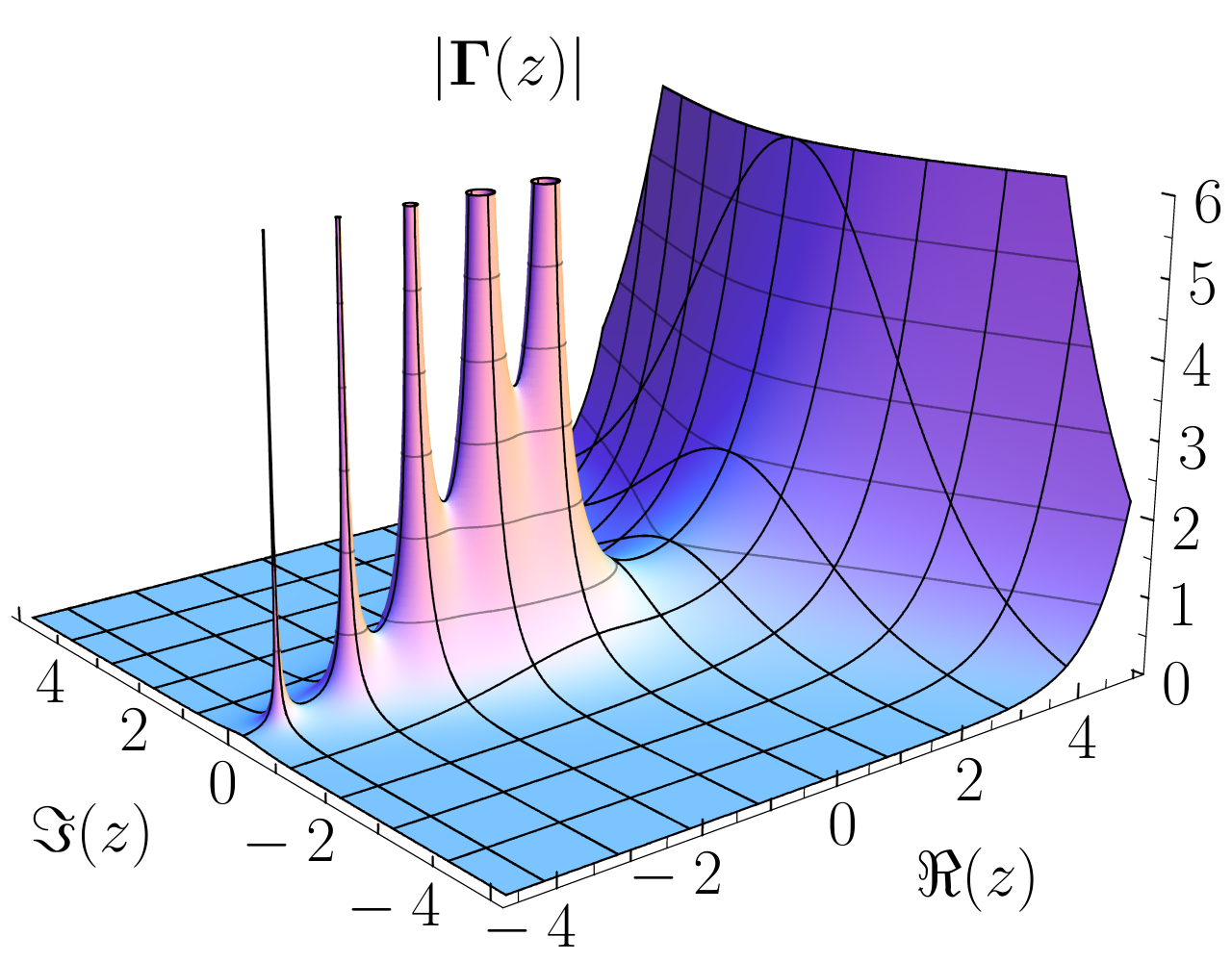
  • The cosecant function has every integer as an isolated singularity.

Nonisolated singularities

[edit]

Other than isolated singularities, complex functions of one variable may exhibit other singular behavior. Namely, two kinds of nonisolated singularities exist:

  • Cluster points, i.e. limit points of isolated singularities: if they are all poles, despite admitting Laurent series expansions on each of them, no such expansion is possible at its limit.
  • Natural boundaries, i.e. any non-isolated set (e.g. a curve) around which functions cannot be analytically continued (or outside them if they are closed curves in the Riemann sphere).

Examples

[edit]
The natural boundary of this power series is the unit circle (read examples).
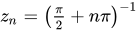
  • The function is meromorphic on , with simple poles at , for every . Since , every punctured disk centered at has an infinite number of singularities within, so no Laurent expansion is available for around , which is in fact a cluster point of its poles.
  • The function has a singularity at 0 which is not isolated, since there are additional singularities at the reciprocal of every integer, which are located arbitrarily close to 0 (though the singularities at these reciprocals are themselves isolated).
  • The function defined via the Maclaurin series converges inside the open unit disk centred at and has the unit circle as its natural boundary.
[edit]
Revisions and contributorsEdit on WikipediaRead on Wikipedia
from Grokipedia
In complex analysis, an isolated singularity of a holomorphic function ff is a point z0z_0 in the complex plane where ff fails to be holomorphic, but is holomorphic throughout some deleted disk 0<zz0<r0 < |z - z_0| < r for a positive radius rr.[1] Such singularities are distinguished from non-isolated ones, like branch points, by the existence of a punctured neighborhood free of other singularities.[1] Isolated singularities are classified into three principal types based on the Laurent series expansion of ff around z0z_0, which includes a principal part consisting of negative powers of (zz0)(z - z_0).[2] A removable singularity arises when the principal part is zero, meaning limzz0f(z)\lim_{z \to z_0} f(z) exists and is finite; by Riemann's removable singularity theorem, ff can be redefined at z0z_0 to make it holomorphic there.[1] A pole of order mm (a positive integer) occurs when the principal part has finitely many terms up to (zz0)m(z - z_0)^{-m}, with the coefficient of that term nonzero, leading to f(z)|f(z)| \to \infty as zz0z \to z_0; in this case, f(z)=h(z)(zz0)mf(z) = \frac{h(z)}{(z - z_0)^m} where hh is holomorphic and h(z0)0h(z_0) \neq 0.[2] An essential singularity, by contrast, features infinitely many negative powers in the Laurent series, resulting in highly erratic behavior near z0z_0, such as unbounded oscillation.[3] The study of isolated singularities is fundamental to residue theory and contour integration, as residues are computed from the coefficient of the (zz0)1(z - z_0)^{-1} term in the Laurent series.[4] For essential singularities, the Casorati–Weierstrass theorem states that the image of any punctured neighborhood under ff is dense in the complex plane, underscoring their wild nature.[5] Classic examples include the pole at z=0z = 0 for f(z)=1/zf(z) = 1/z, the removable singularity at z=0z = 0 for sinz/z\sin z / z, and the essential singularity at z=0z = 0 for e1/ze^{1/z}.[1]

Definition and Basic Concepts

Formal Definition

In complex analysis, a point $ z_0 $ in the complex plane is called a singularity of a function $ f $ if $ f $ fails to be analytic at $ z_0 $.[6] Specifically, $ z_0 $ is an isolated singularity of $ f $ if there exists some $ r > 0 $ such that $ f $ is analytic in the punctured disk $ 0 < |z - z_0| < r $, but $ f $ is not analytic at $ z_0 $ itself.[6][7] Here, analyticity refers to the property of being holomorphic, meaning that $ f $ is complex differentiable at every point in some open domain containing that point.[6][8] In contrast, at a regular point $ z_0 $, $ f $ is analytic in some full neighborhood including $ z_0 $, so $ f $ is holomorphic there without exception.[6][7]

Punctured Neighborhood

In complex analysis, the punctured neighborhood of an isolated singularity at a point $ z_0 \in \mathbb{C} $ is defined as the punctured disk $ { z \in \mathbb{C} : 0 < |z - z_0| < r } $ for some radius $ r > 0 $, where the function in question is holomorphic throughout this region but not necessarily at $ z_0 $ itself.[9] This setup excludes the singular point $ z_0 $ while capturing the immediate surroundings, allowing the function to be analytic in a disk centered at $ z_0 $ minus the origin point.[10] The isolation condition requires that no other singularities of the function lie within this punctured disk, meaning $ z_0 $ is the sole singular point in some full disk $ |z - z_0| < r $.[11] This topological separation ensures the singularity behaves independently, without interference from nearby singularities, and facilitates local analysis around $ z_0 $.[2] While the punctured disk is central to the geometric setup for isolated singularities, a more general annular region $ r_1 < |z - z_0| < r_2 $ with $ 0 < r_1 < r_2 $ arises in contexts like Laurent series expansions, where the inner radius $ r_1 $ can be positive to avoid the singularity, though the isolation focuses on the case starting from the origin.[12] This annular structure extends the domain for convergence but preserves the key property that the function remains holomorphic in the region excluding $ z_0 $.[13]

Classification of Isolated Singularities

Removable Singularities

A removable singularity at an isolated singular point $ z_0 $ of a holomorphic function $ f $ defined on a punctured neighborhood of $ z_0 $ is characterized by the existence of a finite limit $ \lim_{z \to z_0} f(z) = L \in \mathbb{C} $.[14] In this case, the function fails to be defined at $ z_0 $, but redefining $ f(z_0) = L $ extends $ f $ to a holomorphic function on the entire neighborhood, including $ z_0 $.[14] This property distinguishes removable singularities as the mildest type among isolated singularities, allowing the function to behave analytically after a simple redefinition. Riemann's removable singularity theorem provides a key criterion: if $ f $ is holomorphic and bounded on a punctured disk centered at $ z_0 $, then the singularity at $ z_0 $ is removable, and $ f $ extends holomorphically to the full disk.[15] Equivalently, the singularity is removable if and only if the Laurent series of $ f $ around $ z_0 $ has no principal part, meaning all coefficients of negative powers of $ (z - z_0) $ vanish, reducing the expansion to a Taylor series.[14] A representative example is the function $ f(z) = \frac{\sin z}{z} $, which is undefined at $ z = 0 $ but has $ \lim_{z \to 0} f(z) = 1 $, confirming a removable singularity there.[14] Defining $ f(0) = 1 $ yields the entire sinc function, which is holomorphic everywhere.[1]

Poles

A pole is an isolated singularity at a point $ z_0 $ where the function $ f(z) $ exhibits unbounded growth in a manner controlled by a finite power of $ (z - z_0) $. Specifically, $ z_0 $ is a pole of order $ m $ (with $ m \geq 1 $) if $ m $ is the smallest positive integer such that $ \lim_{z \to z_0} (z - z_0)^m f(z) $ exists and is a nonzero finite complex number, while for all smaller positive integers $ k < m $, the limit $ \lim_{z \to z_0} (z - z_0)^k f(z) $ either does not exist or is infinite.[16] Equivalently, in the Laurent series expansion of $ f(z) $ around $ z_0 $, given by
f(z)=n=an(zz0)n f(z) = \sum_{n=-\infty}^{\infty} a_n (z - z_0)^n
valid in a punctured neighborhood of $ z_0 $, the principal part consists of finitely many negative powers, specifically up to $ -m $, with $ a_{-m} \neq 0 $ and $ a_n = 0 $ for all $ n < -m $.[17] The principal part is thus
k=1mak(zz0)k, \sum_{k=1}^{m} a_{-k} (z - z_0)^{-k},
which dominates the behavior near $ z_0 $. This finite principal part distinguishes poles from other isolated singularities.[2] The order $ m $ can also be determined as the smallest integer such that $ g(z) = (z - z_0)^m f(z) $ is analytic at $ z_0 $ and $ g(z_0) \neq 0 $.[18] Near $ z_0 $, $ f(z) $ behaves asymptotically like $ a_{-m} (z - z_0)^{-m} $, reflecting polynomial-like growth in the reciprocal sense.[17] As $ z $ approaches $ z_0 $, $ |f(z)| \to \infty $, confirming the singularity is non-removable and unbounded.[16] This divergence occurs along all paths to $ z_0 $, with the rate governed by the order $ m $.[2]

Essential Singularities

In complex analysis, an essential singularity at a point $ z_0 $ is an isolated singularity that cannot be classified as either removable or a pole.[19] It arises when the Laurent series expansion of the function around $ z_0 $ contains infinitely many terms with negative powers of $ (z - z_0) $, indicating unbounded irregularity without the finite principal part seen in poles.[20] This infinite descent in the series reflects a profound lack of analytic continuation, distinguishing essential singularities from milder types where the function either extends holomorphically or grows like a rational power.[21] The behavior of a holomorphic function near an essential singularity is markedly chaotic. In any punctured neighborhood of the singularity, the image under $ f $ is dense in the complex plane, as stated by the Casorati-Weierstrass theorem. This wild oscillation prevents any consistent limiting behavior, such as approaching a finite value or infinity in a controlled manner, and underscores the "essential" nature of the disruption to analyticity.[19] A prototypical example is the function $ f(z) = e^{1/z} $, which has an essential singularity at $ z = 0 $.[14] As $ z $ approaches 0 along the positive real axis, $ f(z) $ tends to infinity, but along the negative real axis, it approaches 0; in any small punctured disk around 0, the image of $ f $ is dense in the entire complex plane, exemplifying the theorem's density property. This exponential form highlights how transcendental functions can produce such singularities, contrasting with the algebraic simplicity of poles in rational functions.[20]

Laurent Series and Residues

Laurent Series Expansion

The Laurent series expansion serves as the fundamental analytic tool for representing holomorphic functions in a punctured neighborhood of an isolated singularity at $ z_0 $, allowing decomposition into parts that reveal the nature of the singularity.[22] For a function $ f $ holomorphic in the annulus $ 0 < |z - z_0| < R $ for some $ R > 0 $, the series takes the general form
f(z)=n=an(zz0)n, f(z) = \sum_{n=-\infty}^{\infty} a_n (z - z_0)^n,
which converges uniformly on compact subsets of this punctured disk.[13] This representation extends the Taylor series by incorporating negative powers, enabling analysis of behavior near $ z_0 $.[23] The series divides into two distinct components: the principal part, consisting of the terms with negative exponents,
n=1an(zz0)n, \sum_{n=-\infty}^{-1} a_n (z - z_0)^n,
which captures the singular behavior at $ z_0 $, and the regular (or holomorphic) part,
n=0an(zz0)n, \sum_{n=0}^{\infty} a_n (z - z_0)^n,
which is analytic at $ z_0 $ and resembles a standard power series.[22] The principal part determines the type of isolated singularity: if it vanishes (all $ a_n = 0 $ for $ n < 0 $), the singularity is removable; if it contains finitely many nonzero terms, the singularity is a pole of order equal to the highest negative power with nonzero coefficient; and if it has infinitely many nonzero terms, the singularity is essential.[13] The coefficients $ a_n $ of the Laurent series are uniquely determined by the Cauchy integral formula adapted to the annulus. Specifically, for any simple closed contour $ C $ enclosing $ z_0 $ and lying within the region of holomorphy,
an=12πiCf(ζ)(ζz0)n+1dζ, a_n = \frac{1}{2\pi i} \oint_C \frac{f(\zeta)}{(\zeta - z_0)^{n+1}} \, d\zeta,
valid for all integers $ n $.[23] This uniqueness theorem ensures that the expansion is independent of the choice of contour or annulus, provided the function is holomorphic there, and it underpins the classification by allowing direct computation of the principal part from the function's values.[22]

Computation of Residues

The residue of a function ff at an isolated singularity z0z_0, denoted Res(f,z0)\operatorname{Res}(f, z_0), is defined as the coefficient a1a_{-1} of the term (zz0)1(z - z_0)^{-1} in the Laurent series expansion of ff around z0z_0:
f(z)=n=an(zz0)n,Res(f,z0)=a1. f(z) = \sum_{n=-\infty}^{\infty} a_n (z - z_0)^n, \quad \operatorname{Res}(f, z_0) = a_{-1}.
This coefficient captures the contribution of the singularity to contour integrals enclosing z0z_0.[24] For a removable singularity at z0z_0, the Laurent series has no negative powers, so the principal part vanishes and Res(f,z0)=0\operatorname{Res}(f, z_0) = 0.[24] At a pole of order mm (where m1m \geq 1) located at z0z_0, the residue is given by the formula
Res(f,z0)=1(m1)!limzz0dm1dzm1[(zz0)mf(z)]. \operatorname{Res}(f, z_0) = \frac{1}{(m-1)!} \lim_{z \to z_0} \frac{d^{m-1}}{dz^{m-1}} \left[ (z - z_0)^m f(z) \right].
This expression arises from differentiating the analytic part after multiplying by (zz0)m(z - z_0)^m to remove the pole. For a simple pole (m=1m=1), it simplifies to Res(f,z0)=limzz0(zz0)f(z)\operatorname{Res}(f, z_0) = \lim_{z \to z_0} (z - z_0) f(z).[24][25] For an essential singularity at z0z_0, the residue must generally be extracted from the full Laurent series, as there is no finite-order pole formula. For example, the function f(z)=e1/zf(z) = e^{1/z} has an essential singularity at z=0z=0, with Laurent series n=01n!zn\sum_{n=0}^{\infty} \frac{1}{n!} z^{-n}, yielding Res(f,0)=a1=11!=1\operatorname{Res}(f, 0) = a_{-1} = \frac{1}{1!} = 1.[24][26] Residues at isolated singularities enable the evaluation of contour integrals via the residue theorem, which states that for a closed contour CC enclosing singularities at zkz_k, Cf(z)dz=2πiRes(f,zk)\oint_C f(z) \, dz = 2\pi i \sum \operatorname{Res}(f, z_k).[24]

Properties and Theorems

Casorati-Weierstrass Theorem

The Casorati–Weierstrass theorem characterizes the behavior of holomorphic functions near an essential singularity. Specifically, if $ f $ is holomorphic in the punctured disk $ 0 < |z - z_0| < r $ for some $ r > 0 $ and has an essential singularity at $ z_0 $, then the image $ f({ z : 0 < |z - z_0| < r }) $ is dense in the complex plane $ \mathbb{C} $.[5] This means that for any complex number $ w \in \mathbb{C} $ and any $ \varepsilon > 0 $, there exists a sequence $ { z_n } $ in the punctured disk with $ z_n \to z_0 $ such that $ |f(z_n) - w| < \varepsilon $. The result highlights the "wild" oscillation of functions at essential singularities, distinguishing them from other types. A proof proceeds by contradiction, leveraging the Laurent series expansion of $ f $ around $ z_0 $. Suppose the image is not dense; then there exist $ w \in \mathbb{C} $ and $ \delta > 0 $ such that $ |f(z) - w| \geq \delta $ for all $ z $ in the punctured disk. Consider $ g(z) = 1/(f(z) - w) $, which is holomorphic and bounded by $ 1/\delta $ in the punctured disk, implying a removable singularity at $ z_0 $ by Riemann's theorem. Extending $ g $ holomorphically to $ z_0 $, if $ g(z_0) \neq 0 $, then $ f(z) - w $ extends holomorphically, contradicting the essential singularity. If $ g(z_0) = 0 $, then $ f(z) - w $ has a pole at $ z_0 $, again contradicting the essential nature, as the Laurent series would have a finite principal part. The infinite principal part of the Laurent series thus ensures the density. This density contrasts sharply with the behavior at poles and removable singularities. At a pole of order $ m $, $ |f(z)| \to \infty $ as $ z \to z_0 $, so the image avoids any neighborhood of 0, lying instead in $ { w : |w| > R } $ for some $ R > 0 $ sufficiently close to $ z_0 $.[5] For a removable singularity, $ f $ extends to a holomorphic function at $ z_0 $, remaining bounded in a full neighborhood and thus not dense in the entire plane unless the extension is constant. Essential singularities, by the theorem, fill the plane densely due to their unbounded and oscillatory nature. The theorem is named after the Italian mathematician Felice Casorati, who first published it in his 1868 work Teorica delle funzioni di variabili complesse, and Karl Weierstrass, who independently proved it in his 1876 paper "Zur Theorie der eindeutigen analytischen Funktionen."[27] It was also discovered independently by Yulian Sokhotski in 1868, leading to its occasional designation as the Casorati–Sokhotski–Weierstrass theorem in some literature.[28]

Great Picard Theorem

The Great Picard Theorem asserts that if a holomorphic function ff has an essential singularity at a point z0Cz_0 \in \mathbb{C}, then in every punctured neighborhood of z0z_0, the function f(z)f(z) assumes every complex value infinitely often, with at most one possible exception.[29] This result highlights the extreme behavior of functions near essential singularities, where the image is not merely dense but recurrent for nearly all values.[30] This theorem refines the Casorati-Weierstrass theorem by elevating the mere density of the image in punctured neighborhoods to infinite attainments for all complex numbers except possibly one.[29] The proof typically employs the Montel theorem on normal families, noting that holomorphic functions on the plane omitting three fixed values form a normal family.[29] If ff omitted two values near the singularity, rescaling or composition arguments would imply normality, contradicting the essential singularity unless the function is constant or has a milder singularity.[31] Alternative approaches use the modular function λ(τ)\lambda(\tau) from uniformization theory or Harnack-type inequalities for subharmonic functions to establish the infinite repetitions.[31] A global counterpart is the Little Picard Theorem, which states that any non-constant entire function omits at most one complex value from its range.[32] This follows similar ideas, applying Liouville's theorem to suitably transformed functions that omit multiple values.[29]

Examples

Rational Functions

Rational functions provide a fundamental class of examples for isolated singularities in complex analysis, as their singularities are algebraic and occur precisely at the zeros of the denominator polynomial. A rational function is expressed in the general form $ f(z) = \frac{p(z)}{q(z)} $, where $ p(z) $ and $ q(z) $ are polynomials in the complex variable $ z $, and the function is holomorphic everywhere except possibly at points where $ q(z) = 0 $.[33] These points are isolated singularities, provided they are finite and distinct from the zeros of $ p(z) $.[34] If $ q(z_0) = 0 $ but $ p(z_0) \neq 0 $, then $ z = z_0 $ is a pole of $ f(z) $, and the order of the pole equals the multiplicity of the root $ z_0 $ of $ q(z) $. For instance, if $ q(z) $ has a zero of order $ m $ at $ z_0 $, the Laurent series of $ f(z) $ around $ z_0 $ has principal part consisting of terms up to $ (z - z_0)^{-m} $, with the coefficient of $ (z - z_0)^{-m} $ being nonzero.[33][34] This behavior reflects the finite-order blow-up of $ |f(z)| $ as $ z \to z_0 $, scaling as $ |z - z_0|^{-m} $.[14] In contrast, if $ p(z) $ and $ q(z) $ share a common zero at $ z_0 $ with the multiplicity of the zero in $ p(z) $ at least as large as that in $ q(z) $, the apparent singularity at $ z_0 $ is removable. Canceling the common factor $ (z - z_0)^k $ (where $ k $ is the minimum multiplicity) yields a holomorphic function at $ z_0 $, which can be extended continuously by defining $ f(z_0) $ as the limit value.[34] For example, $ f(z) = \frac{z^2 - 1}{z - 1} = z + 1 $ for $ z \neq 1 $, removing the singularity at $ z = 1 $ by setting $ f(1) = 2 $.[34] The partial fraction decomposition of a rational function explicitly reveals its principal parts at the poles, facilitating the classification of singularities. Assuming $ p(z) $ and $ q(z) $ have no common factors and $ \deg p < \deg q $, $ f(z) $ decomposes as a sum of a polynomial (possibly constant) plus terms of the form $ \sum_{j=1}^k \frac{R_j(z)}{(z - \beta_j)^{d_j}} $, where each $ R_j(z) $ is a polynomial of degree less than $ d_j $, the $ \beta_j $ are the distinct poles, and $ d_j $ is the order of the pole at $ \beta_j $.[33] The principal part at each pole is the negative powers in the expansion of these terms, confirming the pole order and enabling residue computation.[35] A concrete illustration is $ f(z) = \frac{1}{z^2 - 1} = \frac{1}{(z-1)(z+1)} $, which has simple poles (order 1) at $ z = 1 $ and $ z = -1 $, since the denominator factors have simple zeros and the numerator is nonzero there.[33] The partial fraction decomposition is $ f(z) = \frac{1/2}{z-1} - \frac{1/2}{z+1} $, so the residues—the coefficients of $ (z - z_k)^{-1} $—are $ +1/2 $ at $ z = 1 $ and $ -1/2 $ at $ z = -1 $.[35] This decomposition highlights the isolated nature of these poles and their principal parts.[33]

Transcendental Functions

Transcendental functions often exhibit isolated singularities with more intricate behaviors than those of rational functions, particularly essential singularities arising from their non-algebraic nature. A quintessential example is the function $ f(z) = e^{1/z} $, which possesses an essential singularity at $ z = 0 $. The Laurent series expansion of $ e^{1/z} $ about this point is $ \sum_{n=0}^{\infty} \frac{1}{n!} z^{-n} $, featuring infinitely many negative powers in the principal part, confirming the essential nature of the singularity.[13] Near $ z = 0 $, the behavior of $ e^{1/z} $ is highly erratic; along the positive real axis as $ x \to 0^+ $, $ e^{1/x} $ tends to infinity, while along the negative real axis as $ x \to 0^- $, it approaches 0, illustrating wild oscillations. Moreover, in any punctured neighborhood of 0, $ e^{1/z} $ assumes every complex value except 0 infinitely often, a consequence of the Great Picard Theorem applied to essential singularities.[9] In contrast, some transcendental functions display isolated poles. The cotangent function $ \cot(\pi z) $ has simple poles at every integer $ z = n $, where $ n \in \mathbb{Z} $, with each residue equal to $ 1/\pi $. This periodic arrangement of poles underscores the function's meromorphic character across the complex plane.[36] Another illustrative essential singularity occurs in $ g(z) = \sin(1/z) $ at $ z = 0 $, where the Laurent series includes infinitely many negative odd powers, such as $ \sum_{k=0}^{\infty} (-1)^k \frac{1}{(2k+1)!} z^{-(2k+1)} $. The zeros of $ \sin(1/z) $ at $ z = 1/(k\pi) $ for integers $ k \neq 0 $ accumulate at 0, forming dense clusters in the domain that contribute to the singularity's complexity, while the function's image near 0 exhibits dense coverage of the complex plane with exceptional density around certain values.[37]

Non-Isolated Singularities

Natural Boundaries

In complex analysis, a natural boundary of a holomorphic function is a curve or line segment, such as the unit circle, along which the singularities of the function are dense, thereby preventing analytic continuation across that boundary. This density implies that every point on the boundary is a singularity or a limit point of singularities, rendering it impossible to extend the function holomorphically into any neighborhood that crosses the boundary. Unlike isolated singularities, where the function remains analytic in a punctured disk around the point, a natural boundary lacks such a disk free of singularities on one side.[38] A classic example is the lacunary power series $ f(z) = \sum_{n=1}^{\infty} z^{n!} $, which converges to a holomorphic function inside the unit disk $ |z| < 1 $ but has the unit circle $ |z| = 1 $ as its natural boundary. For points $ z = e^{2\pi i p/q} $ on the unit circle, where $ p/q $ is rational, the partial sums of the series grow unbounded in every neighborhood of such points, and since these points are dense on the circle, singularities accumulate everywhere along it. This prevents any analytic continuation beyond the disk, as the function becomes unbounded near every boundary point.[39] The Ostrowski-Hadamard gap theorem provides a general condition under which a power series exhibits a natural boundary. Specifically, if the exponents $ n_k $ in the series $ \sum a_k z^{n_k} $ satisfy $ n_{k+1}/n_k \geq 1 + \delta $ for some $ \delta > 0 $ and all $ k $, with $ \limsup |a_k|^{1/n_k} = 1 $, then the circle of convergence serves as a natural boundary for the function. This theorem, building on earlier work by Hadamard, highlights how large gaps in the exponents lead to dense singularities on the boundary, contrasting sharply with series lacking such gaps, which may allow continuation.[40]

Cluster Singularities

A cluster singularity, also known as an accumulation point or limit point of singularities, arises when a sequence of isolated singularities converges to a point in the complex plane. For instance, if a function has simple poles at the points $ z = 1/n $ for each positive integer $ n $, then $ z = 0 $ serves as the cluster singularity, as these poles accumulate at the origin.[41] Unlike an isolated singularity, where there exists a punctured disk around the point in which the function is analytic, a cluster singularity is non-isolated by nature. In every punctured neighborhood of the cluster point, infinitely many singularities are present, preventing the function from being analytic in any such deleted disk. This accumulation violates the condition for isolation, rendering standard Laurent series expansions inapplicable at the cluster point itself.[41] A classic example is the function $ f(z) = \tan(1/z) $, which exhibits poles where $ \cos(1/z) = 0 $, specifically at $ z_k = 1/(\pi/2 + k\pi) $ for nonzero integers $ k $. These points $ z_k $ approach 0 as $ |k| \to \infty $, forming a cluster of poles at the origin and establishing $ z = 0 $ as a non-isolated singularity. Near this cluster point, the function displays highly irregular behavior, densely approaching all complex values in accordance with generalizations of the Casorati-Weierstrass theorem.[41] The presence of a cluster singularity has significant implications for the analytic continuation and meromorphicity of the function. It precludes classification of the point using the categories of removable singularities, poles, or isolated essential singularities, as no finite principal part in a Laurent expansion exists. Consequently, the function cannot be meromorphic in any domain encompassing the cluster point, limiting extensions to regions excluding the accumulation.[41]

References

User Avatar
No comments yet.