


Community hub
Recent from talks
Contribute something
Nothing was collected or created yet.
Italy Star
View on Wikipedia
| The Italy Star | |
|---|---|
 | |
| Type | Military campaign medal |
| Awarded for | Entry into operational area |
| Country |  United Kingdom United Kingdom |
| Presented by | the Monarch of the United Kingdom and the Dominions of the British Commonwealth, and Emperor of India |
| Eligibility | All Ranks |
| Campaign | Italy 1943–1945 |
| Established | May 1945 |
 Ribbon bar | |
| Order of wear | |
| Next (higher) | Burma Star |
| Next (lower) | France and Germany Star |
| Related | France: Italian campaign medal 1943–44 |
The Italy Star is a military campaign medal, instituted by the United Kingdom in May 1945 for award to British Commonwealth forces who served in the Italian Campaign from 1943 to 1945, during the Second World War.[1][2]
The Second World War Stars
[edit]On 8 July 1943, the 1939–43 Star (later named the 1939–1945 Star) and the Africa Star became the first two campaign stars instituted by the United Kingdom, and by May 1945 a total of eight stars and nine clasps had been established to reward campaign service during the Second World War.[1] One more campaign star, the Arctic Star, and one more clasp, the Bomber Command Clasp, were belatedly added on 26 February 2013, more than sixty-seven years after the end of the war.[3][4][5]
Including the Arctic Star and the Bomber Command clasp, no-one could be awarded more than six campaign stars, with five of the ten clasps denoting service that would have qualified for a second star. Only one clasp could be worn on any one campaign star. The maximum of six possible stars are the following:[3][5][1]
- The 1939–1945 Star with, when awarded, either the Battle of Britain or the Bomber Command clasp.[6]
- Only one of the Atlantic Star, Air Crew Europe Star or France and Germany Star. Those earning more than one received the first qualified for, with the second denoted by the appropriate ribbon clasp.[7][8][9]
- The Arctic Star.[5][10]
- The Africa Star with, if awarded, the first earned of clasps for North Africa 1942–43, 8th Army or 1st Army.[11]
- Either the Pacific Star or Burma Star. Those earning both received the first qualified for, with the appropriate clasp to represent the second.[12][13]
- The Italy Star.[2] No clasps were awarded with the Italy Star.[3]
All recipients of campaign stars also received the War Medal.[14]
Institution
[edit]After their victory in North Africa, the Allies used their positions in Tunisia and Malta to invade Sicily, a campaign that lasted from 10 July to 17 August 1943. After this swift victory, the Allies pressed on into Italy on 3 September 1943, they also invading Italian-occupied Greece, Yugoslavia, Corsica and Sardinia. The campaign in Italy itself continued until the end of the war in Europe on 8 May 1945.[15][16]
The Italy Star was instituted by the United Kingdom in May 1945 for award to those who had served in operations during the Italian Campaign, from the capture of Pantelleria on 11 June 1943 to the end of active hostilities in Europe on 8 May 1945.[1][2][17]
Award criteria
[edit]The eligibility criteria for the award of the Italy Star was different for service at sea, on land and in the air.[2]
Service afloat
[edit]The qualifying sea areas for the award of the Italy Star were the Mediterranean Command, the Aegean, and Albanian and Cretan waters between 11 June 1943 and 8 May 1945 inclusive. Entry into operational service in an operational area in the Mediterranean or in naval operations during the invasion of the South of France counted, on condition that the six months service requirement for the award of the 1939-1945 Star had been completed.[2][15]
Casual entry into the qualifying sea areas which was not directly connected with actual operations, service in Merchant Navy vessels landing troops or supplies at ports in North Africa, Palestine, Syria and in Cyprus, or service in vessels at ports in Spain, the Balearic Islands and Turkey east of 30° East, were not regarded as qualifying service for the Italy Star.[2]
The award of a gallantry medal or Mention in Dispatches for action while serving in a qualifying area, qualified the recipient for the award of the Italy Star, regardless of service duration. Personnel whose required service period was terminated prematurely by death, disability or wounds due to service were also awarded the Star regardless of service duration.[2]
Certain special conditions applied governing the award to Naval personnel who entered operational service less than six months before the end of the War. Those who entered operational service in the qualifying area on or after 10 November 1944 were awarded the Italy Star but, in such cases, the 1939-1945 Star could not be awarded for service of less than 180 days.[2][15]
Service ashore
[edit]No prior time qualification was required for service on land, with qualifying service by Army, Naval shore-based and Royal Air Force non-air crew personnel being entry into an operational area as part of the establishment in the following areas, all dates inclusive:[2][3]
- Aegean from 11 June 1943 to 8 May 1945.
- Corsica from 11 June to 4 October 1943.
- Dodecanese from 11 June 1943 to 8 May 1945.
- Greece from 11 June 1943 to 8 May 1945.
- Italy, including Elba, from 11 June 1943 to 8 May 1945.
- Pantelleria on 11 June 1943.
- Sardinia from 11 June to 19 September 1943.
- Sicily from 11 June to 17 August 1943.
- Yugoslavia from 11 June 1943 to 8 May 1945.
Army personnel who entered Austrian territory during the closing stages of hostilities in Europe were eligible for the Italy Star, and not for the France and Germany Star.[2]
Airborne Service
[edit]Air crew who flew on operations against the enemy in the Mediterranean theatre, or over Europe from bases in the Mediterranean area, required no prior time qualification and qualified by one operational sortie. The Italy Star could not, however, be awarded to air crew based elsewhere than in the Mediterranean area. The qualification for flying personnel posted or employed on air transport or ferrying duties was at least three landings in any of the qualifying areas during the stipulated dates. Army airborne troops who took part in airborne operations in a qualifying army area were also eligible.[2][3][15]
Flights to Europe from bases in the Mediterranean area during the period from 11 July 1943 to 8 May 1945 qualified for the Italy Star, not the France and Germany Star.[2][3]
Description
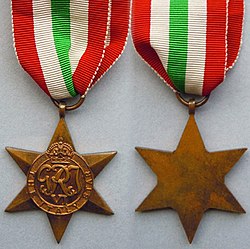
[edit]The set of nine campaign stars was designed by the Royal Mint engravers. The stars all have a ring suspender which passes through an eyelet formed above the uppermost point of the star. They are six–pointed stars, struck in yellow copper zinc alloy to fit into a 44 millimetres diameter circle, with a maximum width of 38 millimetres and 50 millimetres high from the bottom point of the star to the top of the eyelet.[18]
- Obverse
The obverse has a central design of the Royal Cypher "GRI VI", surmounted by a crown. A circlet, the top of which is covered by the crown, surrounds the cypher and is inscribed "THE ITALY STAR".[18]

- Reverse
The reverse is plain.
- Naming
The British Honours Committee decided that Second World War campaign medals awarded to British forces would be issued unnamed,[19] a policy applied by all but three British Commonwealth countries. The recipient's details were impressed on the reverse of the stars awarded to Indians, South Africans and, after a campaign led by veteran organisations, to Australians. In the case of Indians, naming consisted of the recipient's force number, rank, initials, surname and service arm or corps, and for South Africans and Australians, of the force number, initials and surname, in block capitals.[3][18][20][21][22]
- Ribbon
The ribbon is 32 millimetres wide, with a 7 millimetres wide red band and a 6 millimetres wide white band, repeated in reverse order and separated by a 6 millimetres wide green band. The colours are those of the Flag of Italy.[1][15][18]
The ribbons for this medal and the Defence Medal as well as those of the other Second World War campaign stars, with the exception of the Arctic Star, were devised by King George VI.[1][23]
Order of wear
[edit]The order of wear of the Second World War campaign stars was determined by their respective campaign start dates and by the campaign's duration. This is the order worn, even when a recipient qualified for them in a different order. The Defence Medal and War Medal are worn after the stars.[24] The Canadian Volunteer Service Medal is worn after the Defence Medal and before the War Medal, with other Commonwealth war medals worn after the War Medal.[24]
- The 1939–1945 Star, from 3 September 1939 to 2 September 1945, the full duration of the Second World War.[6]
- The Atlantic Star, from 3 September 1939 to 8 May 1945, the duration of the Battle of the Atlantic and the War in Europe.[7]
- The Arctic Star, from 3 September 1939 to 8 May 1945, the duration of the Arctic Convoys and the War in Europe.[10]
- The Air Crew Europe Star, from 3 September 1939 to 5 June 1944, the period until D-Day minus one.[8]
- The Africa Star, from 10 June 1940 to 12 May 1943, the duration of the North African Campaign.[11]
- The Pacific Star, from 8 December 1941 to 2 September 1945, the duration of the Pacific War.[12]
- The Burma Star, from 11 December 1941 to 2 September 1945, the duration of the Burma Campaign.[13]
- The Italy Star, from 11 June 1943 to 8 May 1945, the duration of the Italian Campaign.[2]
- The France and Germany Star, from 6 June 1944 to 8 May 1945, the duration of the North-West Europe Campaign.[9]
- The Defence Medal, from 3 September 1939 to 8 May 1945 (2 September 1945 for those serving in the Far East and the Pacific),[25] the duration of the Second World War.[26]
- The War Medal, from 3 September 1939 to 2 September 1945, the full duration of the Second World War.[27]
The Italy Star is therefore worn as shown:[24]
| Order of Wear | |||||
|---|---|---|---|---|---|

|

|

|
|

|

|
- Preceded by the 1939–1945 Star.
- Preceded by the Africa Star.
- Preceded by the Burma Star.
- Succeeded by the Defence Medal.
- Succeeded by the War Medal.
External links
[edit]References
[edit]- ^ a b c d e f Committee on the Grant of Honours, Decorations and Medals in Time of War (May 1945). "Campaign Stars and the Defence Medal (Regulations)". London: HM Stationery Office. Retrieved 1 August 2010.
- ^ a b c d e f g h i j k l m New Zealand Defence Force – The Italy Star Eligibility Rules Archived 27 April 2015 at the Wayback Machine (Access date 12 April 2015)
- ^ a b c d e f g Stephen Stratford Medals site: British Military & Criminal History, 1900 to 1999. 1939–45 Star (Access date 1 April 2015)
- ^ War Service (Decorations) – Statement in the House of Commons by Winston Churchill on 3 August 1943 (HC Deb 03 August 1943 vol 391 cc2091-3) (Access date 9 April 2015)
- ^ a b c The National Archives – Ministry of Defence – Arctic Star and Bomber Command Clasp (Access date 1 April 2015)
- ^ a b New Zealand Defence Force – The 1939–45 Star Eligibility Rules Archived 3 March 2016 at the Wayback Machine (Access date 12 April 2015)
- ^ a b New Zealand Defence Force – The Atlantic Star Eligibility Rules Archived 15 January 2015 at the Wayback Machine (Access date 4 April 2015)
- ^ a b New Zealand Defence Force – The Air Crew Europe Star Eligibility Rules Archived 15 January 2015 at the Wayback Machine (Access date 12 April 2015)
- ^ a b New Zealand Defence Force – The France and Germany Star Eligibility Rules Archived 15 January 2015 at the Wayback Machine (Access date 12 April 2015)
- ^ a b New Zealand Defence Force – The Arctic Star Archived 21 March 2015 at the Wayback Machine (Access date 12 April 2015)
- ^ a b New Zealand Defence Force – The Africa Star Eligibility Rules Archived 15 January 2015 at the Wayback Machine (Access date 12 April 2015)
- ^ a b New Zealand Defence Force – The Pacific Star Eligibility Rules Archived 15 January 2015 at the Wayback Machine (Access date 9 April 2015)
- ^ a b New Zealand Defence Force – The Burma Star Eligibility Rules Archived 15 January 2015 at the Wayback Machine (Access date 12 April 2015)
- ^ Captain H. Taprell Dorling. Ribbons and Medals. pp. 97-98. Published A.H.Baldwin & Sons, London. 1956.
- ^ a b c d e GOV.UK - Defence and armed forces – guidance - Medals: campaigns, descriptions and eligibility - Italy Star (Access date 17 April 2015)
- ^ Italy Star Association 1943-1945 - About us (Access date 17 April 2015)
- ^ New Zealand Defence Force - British Commonwealth War And Campaign Medals Awarded To New Zealanders - The Italy Star Archived 15 June 2007 at the Wayback Machine (Access date 17 April 2015)
- ^ a b c d Returned Services Association - Military Medals - The Italy Star Archived 25 March 2020 at the Wayback Machine (Access date 17 April 2015)
- ^ Joslin, Litherland and Simpkin. British Battles and Medals. p. 246. Published by Spink, London. 1988.
- ^ Memoirs - My Days With The I.A.F (1940-48) - V S C Bonarjee, IAS Archived 25 August 2013 at the Wayback Machine (Access date 14 April 2015)
- ^ Rear Side of the Medals Archived 14 February 2010 at the Wayback Machine (Access date 14 April 2015)
- ^ A distinction almost denied: the naming of Australia's Second World War medals, Trevor Turner. Orders & Medals Research Society Journal, September 2018, pp 148-157
- ^ Forces War Records - Medals - 1939-1945 Star (Access date 2 April 2015)
- ^ a b c "No. 40204". The London Gazette (Supplement). 11 June 1954. p. 3538.
- ^ Captain H. Taprell Dorling. Ribbons and Medals. p. 97. Published A.H.Baldwin & Sons, London. 1956.
- ^ New Zealand Defence Force - The Defence Medal Eligibility Rules Archived 15 January 2015 at the Wayback Machine (Access date 21 April 2015)
- ^ New Zealand Defence Force - The War Medal 1939-45 Eligibility Rules Archived 29 April 2015 at the Wayback Machine (Access date 22 April 2015)


.png)


.png)


.jpg)


.png)


_ribbon.png)
_ribbon.png)


_Ribbon.png)
_Ribbon.png)


_ribbon.png)
_ribbon.png)
_ribbon.png)
_ribbon.png)
_ribbon.png)
_ribbon.png)


.png)
.png)


.png)


.png)
.png)
.png)


.png)
.png)
.png)
.png)

.png)


.png)
.png)


.png)


.gif)

.gif)


.gif)


.gif)
.gif)

.gif)
.png)
.gif)
.png)
.gif)
.png)
.gif)


.png)
.gif)
.gif)

.gif)


.png)


.png)
.png)


.png)
.png)


.png)


