Hubbry Logo
GrosgrainGrosgrainMain
Open search
Grosgrain
Community hub
Grosgrain
logo
8 pages, 0 posts
0 subscribers
Be the first to start a discussion here.
Grosgrain
Grosgrain
from Wikipedia
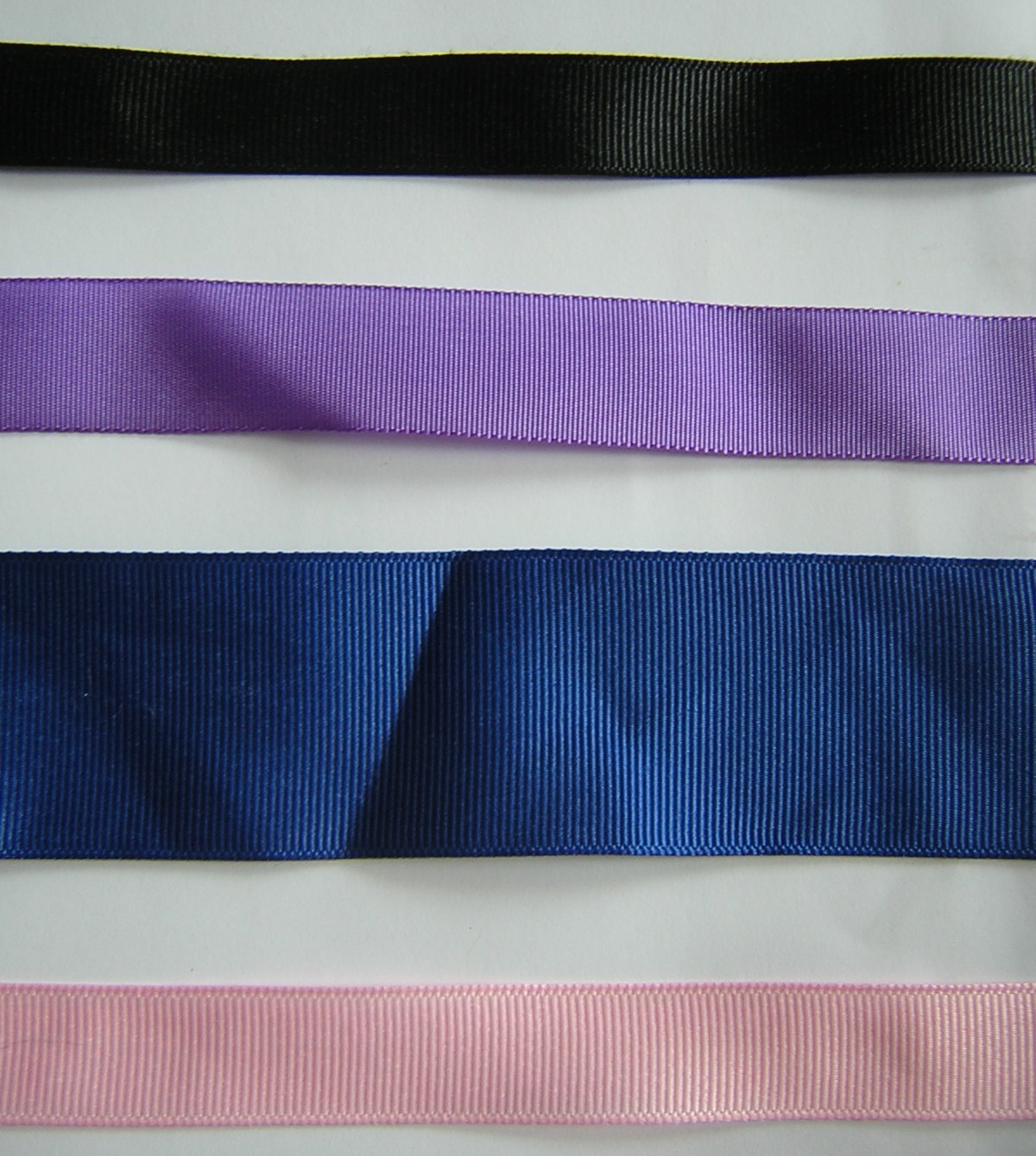
A close-up of a piece of grosgrain ribbon. Note the ribs that go across the ribbon.
Grosgrain ribbons in various colors and widths

Grosgrain (/ˈɡrɡrn/ GROH-grayn,[1] also sometimes /ˈɡrɒsɡrn/ GROS-grayn), or grogram, is a type of fabric or ribbon defined by the fact that its weft is heavier than its warp, creating prominent transverse ribs. Grosgrain is a plain weave corded[a] fabric, with heavier cords than poplin but lighter than faille,[2][3] and is known for being a firm, close-woven, fine-corded fabric.[4] Grosgrain has a dull appearance, with little luster in comparison to many fabric weaves, such as satin, often used for ribbons; however, it is comparatively very strong.[5] Grosgrain fabric is most commonly available in black, but grosgrain ribbon comes in a large variety of colors and patterns. The ribbon is very similar to Petersham ribbon in its appearance, but it does not have the ability to follow the curves of a surface or edge the way that the latter does.

"Grosgrain" is commonly used to refer to a heavy, stiff ribbon of silk or nylon[6] woven via taffeta weave using a heavy weft, which results in distinct transverse ribs. Historically, grosgrain was made from wool, silk, or a combination of fibers such as silk and wool or silk and mohair.[2] When a combination of fibers was used, the result was sometimes given the name grogram, silk mohair, gros de Tours or gros de Naples.[2][7][8]

Etymology

[edit]

Grosgrain is both a direct French loan word and a folk corruption of the French word grogram.[9] Grogram, originally gros gram (appeared in literature in 1562),[citation needed] is defined as a coarse, loosely woven fabric of silk, silk and mohair, or silk and wool.[10] The adjective gros means thick or coarse, originally from the Old French gros, itself derived from the Latin grossus.[11] Grain is derived from Old French graine, itself derived from the Latin grana (plural of granum) – seed or in some contexts texture.[4][12]

Thus gros gram, grogram and grosgrain are all one and the same: a large grain - hence coarse - texture fabric.[11][13]

The term grog, meaning alcohol, is related to the term grogram. In the 1740s, Admiral Edward Vernon, who was known as "Old Grog" because of the grogram cloak he wore, introduced the rum ration in the British Royal Navy. It is from his attire that the naval term grog is derived.[14][15][16][17]

Moire

[edit]

Moire is a waved or watered effect produced especially on grosgrain silk and woolen moreen via engraved rollers and high pressure on carded material. The result is a peculiar luster which works best when made from a corded fabric like grosgrain.[18]

During the Middle Ages, moire was held in high esteem and was, as currently, used for women's dresses, for capes, and for facings, trimmings, etc.[19]

Use in clothing

[edit]

History

[edit]

Throughout the 17th century, grosgrain fabric was used as the fabric body (corpus) for many garments, including waistcoats, jackets, petticoats, breeches, sleeves, jerkins and many other items of clothing, as a cheaper alternative for the lower socio-economic demographic than fine-woven silk or wool.[20] Factories in America started to produce grosgrain silk in the late 19th century.[21][22]

Throughout the 1920s, the term grosgrain seems to have remained true to original definition as a garment fabric.[23] However, during the 1920s, it fell out of favor as a garment fabric, and was defined identically to contemporary terminology as a grosgrain ribbon.

Structural uses

[edit]

Lustrous grosgrain is used extensively to join female semi-detached clothing articles such as bodices to skirts and similar, where this necessary joint may be visible.[24] Ribbed grosgrain may be used similarly to twill tape for internal gussets and reinforcements. Grosgrain ribbon is often used for facings and for waistbands.[25][26] McCall's Sewing Book states: "grosgrain ribbon is used with any heavy fabric to reduce bulk", though it may be the word "bulk" is used in the sense of outward appearance, rather than actual mass. McCall elaborates: "grosgrain is used to finish the back of novelty braid or to face the back of any fabric belt."[25][26][27]

Evening wear

[edit]

As a more subtle option to lustrous satin, grosgrain is very popular with evening wear, used on the facings of lapels of most dress coats and high-end dinner jackets and tuxedos. Grosgrain is traditionally used to hem and highlight the cut of lapels, collars and visible outermost edges of the formal frock coat and the later morning coat.[28] Grosgrain is preferred over satin for practicality—it is more durable than silk or satin, as the fabric does not snag as easily.[29] Grosgrain is also used for matching accessories such as bow ties[29] and cummerbunds, though these are often in barathea to complement the main suiting.

Millinery

[edit]

Grosgrain is also used in millinery. Grosgrain ribbons are popular for use in ribbon decorations for hats, however, grosgrain is most notably used in top hats, fedora hats, and opera hats, or as the trimming band on the Homburg.[30]

Other uses

[edit]

Book-binding

[edit]

Grosgrain fabric and ribbon are common structural fabrics for the joining or reinforcement of spines or sheaves in fine commercial and hobby bookbinding and book restoration.[31]

Graduation leis

[edit]

When it comes to graduation leis, various types of ribbons can be used to create decorative accents and secure the flowers or other elements together. Grosgrain ribbon has a ribbed texture and is slightly thicker than satin ribbon. It provides a more textured and structured appearance to the lei. Grosgrain ribbon is available in various colors and patterns.[32]

Cargo and packing use

[edit]

A particular characteristic of grosgrain ribbon is that the thicker weft resists longitudinal curling, and so it exerts an even pressure when tied around crushable materials. Nylon grosgrain is often used as heavy-duty webbing or binding around luggage, packs, messenger bags and other heavy-use "soft" goods. It is also used for securing cargo. It can be dyed and is available in a variety of colours, though it is typically dyed black.

Early seat belts and military webbing during World War II was typically made of hemp, jute or linen grosgrain.

Craft

[edit]

Grosgrain made out of cotton or low-cost synthetic fibres such as polyester are very common for gift-wrap ribbons, or for decorating and ornamenting scrapbooks and greeting cards. Grosgrain ribbon is used for a variety of different crafts as well, from bead making,[6] to book-binding,[31] trimming or embellishing,[33] as well as a multitude of other uses. Grosgrain ribbon is the primary ribbon material used in the hair bow industry.[citation needed]

Lanyards

[edit]

Grosgrain woven from cotton or low-cost synthetic fibres such as polyester are very popular for use as lanyard, straps, and are often sold printed for use by large corporate companies as a marketing or branding tool.

Percussion

[edit]

Polyester grosgrain in a 58 in (16 mm) width can be used as the tensioning material attaching the snares of a snare drum to the throw-off mechanism, with the ribbing providing good insurance against slippage. Some musicians use it in an attempt to lessen sympathetic snare buzz from external sources, as it will hold the tab ends of the snares closer to the head than string, providing more damping than mylar straps.

See also

[edit]

Notes

[edit]

References

[edit]
Revisions and contributorsEdit on WikipediaRead on Wikipedia
from Grokipedia
Grosgrain is a strong, close-woven corded fabric, usually made of or and often featuring a filler, characterized by its distinctive horizontal created by a heavier weft than warp. This plain-weave structure results in a stiff, durable material with a subtle, matte luster and a dressy appearance that distinguishes it from smoother fabrics like or faille. The term "grosgrain" derives from the French gros grain, meaning "coarse grain" or "coarse texture," directly alluding to the fabric's prominent, grain-like ribbing. Dating back to 17th-century , grosgrain was historically woven from , , or blends including , and prized for its structural integrity in garments such as waistcoats, petticoats, and ceremonial vestments. Related ribbed fabrics like grogram predate it in European silk production. In modern contexts, it is often produced from synthetics like or as narrow ribbons, valued for versatility in trimming, hatbands, bow-making, and , where its firm texture holds shapes effectively without fraying. Beyond apparel, grosgrain's robustness and aesthetic appeal extend to decorative applications, including trim, accents, and projects, maintaining its status as an elegant yet practical fabric in contemporary . Its production typically involves a high-density warp of fine or yarns paired with thicker weft threads, ensuring the characteristic ridges that provide both visual interest and functional strength.

Definition and Characteristics

Overview

Grosgrain is a heavily ribbed, closely or , typically featuring a warp of , , or synthetic fibers such as paired with a heavier weft often of , and is characterized by prominent crosswise known as , created by heavier weft yarns relative to the warp. Wool was used historically. This structure gives grosgrain a distinctive, corded appearance that distinguishes it from smoother textiles like . It exists primarily in two forms: wide bolts of fabric suitable for apparel and , and narrow ribbons used for trimming, binding, and decorative accents. Today, grosgrain is valued as a versatile material that balances luxury in high-end with utility in everyday items, due to its durability and structured form.

Physical Properties

Grosgrain features a distinctive crosswise ribbing formed by heavier filling (weft) yarns compared to the finer warp yarns, creating a pronounced "large " texture that runs perpendicular to the length of the fabric. This ribbed structure results from a tight where the weft dominates, giving the material its characteristic corded appearance. The fabric exhibits notable , including inherent and excellent retention, which allow it to maintain form under stress without creasing or distorting easily. It also demonstrates strong resistance to fraying and slipping, attributes that enhance its suitability for applications requiring structural integrity. In terms of appearance, grosgrain possesses a matte finish that contrasts with the glossy sheen of ribbons, contributing to its understated elegance. It is commonly available in widths ranging from 1/8 inch to several inches, such as up to 4 inches, accommodating diverse design needs. When properly dyed, the material is colorfast, ensuring vibrant hues remain stable over time. A variation known as moiré grosgrain introduces a watered, wavy through calendering, a finishing process that adds subtle sheen and visual depth while preserving the underlying ribbed texture. This treatment enhances the fabric's aesthetic versatility without altering its core structure. Sensory qualities of grosgrain include a firm hand-feel due to its structured weave, paired with moderate weight that positions it as heavier than comparable ribbons, providing a substantial yet manageable tactile experience.

Etymology and History

Etymology

The term "grosgrain" originates from the French phrase gros grain, literally meaning "coarse grain" or "large grain," a reference to the fabric's prominent horizontal ribs that create a textured, grain-like appearance. This linguistic root traces back to the 16th century, when "gros grain" first appeared in English as a descriptor for ribbed silk fabrics, often anglicized as "grogram," a coarse, heavy material used in clothing and upholstery. The specific compound form "grosgrain" emerged later in the 19th century, with documented English usage beginning around 1865–1870, solidifying its application to finer, corded silk or rayon ribbons and trims. It differs from similar French-derived terms like "gros de Londres," which denotes a heavier, cross-ribbed variant with alternating coarse and fine yarns, named for its association with trade routes but sharing the same ribbed heritage. The term's integration into English was driven by France's dominance in the luxury fabric trade from the onward, as French exports of ribbed silks to and beyond popularized Gallic terminology among merchants and dressmakers.

Historical Development

The earliest evidence of grosgrain weave appears in 15th-century , where silk ribbons featuring a heavier weft than warp—characteristic of grosgrain binding—were discovered in archaeological contexts in Bruges, Belgium, likely used as trimmings for or accessories in mercantile households. These items, dyed yellow with luteolin-based dyes for enhanced color fastness, reflect the growing sophistication of production in medieval trade centers. By the early , grosgrain had emerged as a prominent fabric in and , employed for luxury garments such as waistcoats, jerkins, petticoats, and , valued for its texture and durability. This rise was closely tied to the influence of French silk weaving guilds, particularly in and Tours, which regulated production and innovation in corded silks from the onward, fostering exports along European trade routes and eventually to America via transatlantic commerce in the 18th and 19th centuries. In , the fabric's adoption followed the influx of French techniques post-Restoration, enhancing embellishments on formal attire. In the , grosgrain transitioned prominently into form, becoming a staple trim for Victorian-era garments, hats, and accessories, where its structured ribs provided both aesthetic appeal and functional . Industrialization during the 1870s-1880s enabled through mechanized looms, democratizing access to this once-elite material and integrating it into broader fashion applications. The 20th century brought adaptations with the incorporation of synthetic fibers like and after , improving affordability and versatility while maintaining the fabric's signature texture. Grosgrain reached a peak in the for evening wear, as seen in designs like Pierre Balmain's embroidered grosgrain gowns, which highlighted its elegance in structured silhouettes.

Production

Materials Used

Grosgrain ribbon is traditionally produced using fibers, with serving as the primary material for luxury variants due to its smooth luster and fine texture. is often used as a filler, particularly in the weft, to add body and enhance the ribbed structure. is another historical fiber option, valued for its durability and slight elasticity in ribbon construction. Blends such as silk-wool or silk-mohair have been employed to enhance texture and strength, combining silk's sheen with wool's resilience or mohair's loft for more robust applications. In modern production, synthetic fibers dominate for their affordability and performance advantages, including nylon and polyester, which offer wrinkle resistance and longevity in everyday items. Rayon and acetate provide cost-effective alternatives, with acetate often used in semi-luxury contexts for its silk-like drape and sheen. The distinctive ribbed appearance of grosgrain arises from specific yarn properties, where high-twist yarns are typically used in the warp for longitudinal stability, while heavier, low-twist yarns in the weft create the prominent transverse ribs. This contrast in twist and weight ensures the fabric's structured form without compromising flexibility. Silk fibers are sourced from the cocoons of mulberry silkworms (), which are cultivated on mulberry leaves in operations. derives from the fleece of sheep, sheared annually from breeds like for fine quality. Synthetic fibers such as and are manufactured through processes using feedstocks derived from crude oil. Since the 2010s, there has been a shift toward sustainable practices in grosgrain production, incorporating recycled synthetics like post-consumer to reduce environmental impact and promote principles in . These eco-grosgrain options maintain the ribbon's core attributes while minimizing reliance on virgin resources.

Weaving Process

Grosgrain is woven using a structure, also known as a weave, where fine warp yarns are interlaced with coarser weft yarns to produce prominent horizontal characteristic of the fabric. This weft-ribbed configuration features a high of warp threads crossed by a lower of weft picks, creating the distinctive "gros grain" (large ) texture through the heavier weft that packs tightly against the warp. The weaving process begins with setting up a specialized , typically a dobby loom, which allows for precise control over the rib patterning by selecting specific warp threads for each weft insertion. Warp yarns, often finer or synthetic fibers, are stretched taut across the loom's width, while the coarser weft is inserted perpendicularly using a shuttle or mechanism, alternating over and under the warp to form the tight, ribbed structure. This method ensures the transverse ribs emerge as the weft compresses during beating-up, with modern high-speed narrow looms enabling efficient production of wide fabric bolts. After weaving, the fabric undergoes finishing techniques to enhance durability and appearance, including post-weave for vibrant, even color distribution using certified, wash-resistant dyes under digital control for consistency. For synthetic variants, heat-setting stabilizes the structure by applying controlled heat to fix the yarns, while calendering smooths the surface under pressure and heat, though grosgrain's ribs are preserved to maintain texture. In ribbon production, the wide is slit into narrow widths using automated precision cutters, achieving tolerances as fine as millimeters for sizes from 3.5 mm to 66 mm. Edge treatments may include incorporating thin wire along the selvedges during for added stiffness in wired grosgrain, or heat-sealing cut ends to prevent fraying. Historically, grosgrain was hand-woven on simple frame looms for small-scale production, but since the , automated power looms have dominated, increasing output through mechanical weft insertion and faster operation compared to manual methods.

Uses in Fashion and Apparel

Structural and Everyday

Grosgrain ribbon serves as a key material in structural elements of , providing essential support for shape retention in collars, cuffs, and waistbands. Its ribbed texture and firm weave offer stability without adding bulk, making it ideal for reinforcing areas that experience frequent movement or tension. In garment , it is commonly applied to these components to maintain crisp lines and prevent distortion over time. Historically, grosgrain found use in everyday and semi-formal apparel during the , where it contributed to the durability of and other tailored pieces by lining or critical seams. By the , it appeared in petticoats and Victorian as an alternative or casing for boning, helping to support structured silhouettes while allowing flexibility in lighter garments. This application leveraged grosgrain's strength to mimic the rigidity of whalebone without the rigidity's full stiffness, particularly in and bodice reinforcements. In contemporary everyday clothing, grosgrain continues to play a practical role in belt loops, garment trims, and linings for shirts, skirts, and jackets, where it adds and a subtle texture. Its use in these items enhances longevity by distributing stress evenly across seams and edges. A specific technique involves sewing grosgrain as stay tape along shoulder or side seams to inhibit , ensuring the garment retains its intended fit during wear and washing. Modern adaptations extend grosgrain's utility into casual , such as belts that provide adjustable support or accents on shoes for added detail and grip. Compared to , grosgrain exhibits superior durability due to its heavier weave, which resists fraying and maintains form under repeated use, making it preferable for high-wear accessories.

Evening Wear and Accessories

Grosgrain ribbon has long been favored in evening wear for its ability to create structured yet elegant decorative elements, such as bows, sashes, and rosettes on gowns. In the , designers like Lucile incorporated grosgrain into evening ensembles, using it for linings, waistbands, and trims that added subtle volume and definition to flapper-style dresses, enhancing the era's sleek silhouettes without overwhelming the lightweight fabrics. By the , this versatility extended to cocktail attire, where crafted full evening gowns from grosgrain, leveraging its ribbed texture for a luxurious, form-fitting drape that accentuated the popular in fashion. These applications highlighted grosgrain's role in providing both aesthetic appeal and practical support in formal garments. In fashion accessories, grosgrain excels as a trim material, offering durability and a matte finish that complements luxurious elements. Millinery traditions from the onward frequently employed grosgrain for bands, where its stiffness ensures a secure fit and crisp outline on styles like cloche and pillbox s, adding elegance to evening ensembles. For handbags, narrow grosgrain ribbons serve as straps or edging, providing a non-slip grip and structured that maintains during formal events. Similarly, in jewelry, grosgrain acts as a backing for brooches and clips, preventing slippage on delicate fabrics while contributing to an overall refined appearance. Techniques like pleating and looping transform grosgrain into voluminous accents suitable for formal settings, with its inherent rigidity facilitating precise folds. In 1920s designs, pleating created rosettes and looped bows for sashes, drawing on the weave's lines to guide manipulations for added dimension. Moiré variants of grosgrain, featuring a subtle pattern, introduce a gentle shimmer under evening lights, ideal for cummerbunds or edges in bridal , where the effect enhances without overpowering. Culturally, grosgrain continues to appear in high-profile formal contexts, such as 21st-century Hollywood red-carpet events. At the 2025 Met Gala, designer Maximilian Davis incorporated grosgrain into Paloma Elsesser's Ferragamo gown, using it to modernize fur trims and evoke dandyish elegance. In bridal attire, it trims veils with bordered edges for a clean, enduring hold and forms pleated cummerbunds that pair with tuxedos, maintaining formality across ceremonies. Key advantages of grosgrain in these applications include its textured surface, which provides a non-slip grip for ties, clips, and accessories, ensuring stability during movement. Additionally, its ability to retain a crisp appearance under or ambient lighting stems from the fabric's , resisting wrinkles and offering subtle visual interest through ribbed reflections.

Other Applications

Industrial and Functional Uses

Grosgrain ribbon serves as a durable structural material in , particularly for reinforcing book spines in volumes. Its ribbed texture and strength provide reliable support for binding sheaves and joints, making it suitable for both commercial production and hobbyist projects. This application has been common since the late , aligning with the commercial development of grosgrain fabrics. In the shipping and packaging industries, synthetic grosgrain ribbon is employed for and trimming, capitalizing on its high tensile strength and resistance to wear. Polyester variants offer enhanced UV resistance, allowing it to withstand handling stresses in without fraying or stretching excessively. For example, it is used in lightweight applications to reinforce edges. Grosgrain's robustness makes it ideal for lanyards, where it functions as the primary strap for ID badge holders in professional workplaces. The material's stiffness maintains shape under daily use, while its smooth surface prevents irritation during extended wear, and attachments like lobster clasps ensure secure fastening of essentials. This leverages the ribbon's inherent to support and in environments such as offices, construction sites, and healthcare facilities. In percussion instruments, grosgrain ribbon is applied as snare ribbon to attach snare wires, a practice noted since the mid-20th century. Its woven structure provides flexibility and strength, reducing slippage while allowing adjustment during play. Synthetic versions provide additional weather resistance for outdoor performances. Synthetic grosgrain ribbon is also utilized in Hawaiian-style leis, where it ensures longevity during outdoor ceremonies. These garlands, constructed by looping and knotting the ribbon in vibrant colors, offer a durable alternative to fresh flowers, maintaining form in humid conditions common to such events.

Crafts and Decorative Uses

Grosgrain ribbon's and distinctive texture make it a favored for various crafts and decorative applications, where it provides both and aesthetic appeal. Crafters often employ it to create sturdy bows and embellishments that hold their shape without fraying, ideal for adding to handmade items. Its in multiple widths and colors allows for versatile customization, including or to match specific themes. In home decoration, grosgrain ribbon is commonly used to refresh everyday objects, such as adhering strips to lampshades for a patterned update or trimming throw pillows and curtains to introduce subtle elegance. It can also frame photo displays or bind scrapbook pages, enhancing visual depth while offering a firm, non-slip grip for layered designs. For office settings, short lengths serve as accents, like tying into shapes for monitors or event decorations, promoting a professional yet creative atmosphere. Beyond interiors, grosgrain finds extensive use in personal crafts like jewelry making, where it forms the base for bracelets, necklaces, and earrings through braiding or beading techniques, leveraging its for lasting wear. Hair accessories, including bows and headbands, benefit from its moldability when steamed, allowing it to curve smoothly around shapes. In and card crafting, it acts as borders or ties for albums, restoring older volumes with reinforced binding for longevity. These applications highlight grosgrain's role in blending functionality with ornamental detail across DIY projects.

References

Add your contribution
Related Hubs
User Avatar
No comments yet.