


Community hub
Recent from talks
Contribute something
Nothing was collected or created yet.
Jacob Haugaard
View on Wikipedia
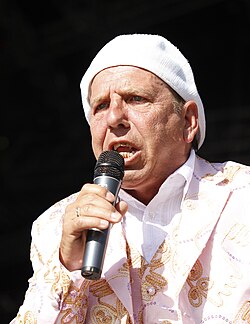
Daniel Jacob Haugaard[2] (born 12 May 1952) is a Danish-Faroese comedian, actor, musician, composer, writer, TV host and former representative in the Danish Parliament.[3]
Key Information


Activities
[edit]Jacob Haugaard has been a well-known performer in Denmark for many years, mixing comedy, singing and instrumental music in his own unique style. He is usually dressed in an ever-changing range of gaudy suits, and often plays a home-made guitar for which he is well known. He has recorded many music records and CDs since 1977.[3] Haugaard has also produced radio, films and TV, mostly comedy and sketches and has a long history of close cooperation with comedian and entertainer Finn Nørbygaard, since 1984. They performed as the Finn & Jacob duo for many years. Haugaard lived in Malling near Aarhus for many years, where he ran his own TV station from a disused watertower in his backyard, until he was elected as an MP.
In his younger days, Haugaard was a leader in the "Union of Deliberate Work-avoiding Elements" (Danish abbreviation SABAE),[4] SABAE was a frivolous political party whose membership included numerous academics and journalists. The organisation was meant partially as a joke, but with a critical edge towards the modern capitalist society, and especially the labour market. They found inspiration in both Marxist and anarchist theories. SABAE's best known slogan was "if work is healthy, give it to the sick!".[5]
Haugaard ran for every parliamentary election as a joke from 1979 onwards, until he unexpectedly won a seat in the 1994 general election representing the area around Aarhus. Running as an independent (though representing SABAE), he attracted 23,253 votes, enough to become one of the local members for the Aarhus area in the Parliament of Denmark from 1994–98. After his term expired, he decided not to seek re-election. Among his pointedly absurd campaign promises were: 8 hours of free time, 8 hours of rest and 8 hours of sleep; more tailwind on bicycle paths; promises of better weather; right to impotency; Nutella in field rations (which was actually implemented); and shorter queues in supermarkets.[6][7] Asylum rated his win in the parliamentary election the 11th greatest prank of all time.[7] When his portrait was hung in the parliament, Haugaard commented that it should serve as a warning that any idiotic populist might get elected.
References
[edit]- ^ "Jacob Haugaard" (in Danish). CMC. Archived from the original on 19 July 2011. Retrieved 14 July 2009.
- ^ "Jacob Haugaard" (in Danish). Folketinget. Archived from the original on 19 June 2007. Retrieved 10 March 2020.
- ^ a b Jacob Haugaard. "Info". Jacob Haugaards Hjemmeside (in Danish). Retrieved 16 October 2014.
- ^ Simon H. Laub (22 February 1994). "The Jacob Haugaard platform". Retrieved 30 September 2014.
- ^ S.A. Bae (SABAE) (1979). Arbejdsfrihedens Spøgelse (in Danish) (1st ed.). Husets Forlag and Forlaget Afveje (Aarhus). ISBN 87-87582-84-8. Archived from the original on 6 October 2014. Retrieved 30 September 2014.
- ^ "Løsgængeren Jacob Haugaard" (PDF) (in Danish). Jakob Nørgaard-Petersen, stud.scient.pol., Aarhus Universitet. Archived from the original (PDF) on 19 July 2011. Retrieved 27 March 2010.
- ^ a b "The Greatest Pranks of All Time". Asylum.com. Archived from the original on 5 April 2009. Retrieved 23 September 2010.
External links
[edit]- Jacob Haugaard: Jacob Haugaards Hjemmeside. Official Homepage (in Danish)
- Jacob Haugaard at IMDb
- Asylum Archived 2 April 2009 at the Wayback Machine
| International | |
|---|---|
| National | |
| Artists | |

Jacob Haugaard
View on GrokipediaEarly Life
Birth and Upbringing
Daniel Jacob Haugaard was born on 12 May 1952 in Tvøroyri, on the Faroe Islands.[6][1] His family, of mixed Danish and Faroese descent, relocated to Risskov, a suburb of Aarhus, Denmark, in the late 1950s.[6] Haugaard grew up in a nuclear family consisting of his parents and two siblings, Jan and Agnes, in a working-class household near a psychiatric hospital in Aarhus.[7][8] His father provided economic stability during his childhood, though Haugaard later reflected on the tendency in such environments to anticipate financial worries.[9]Education and Early Influences
Haugaard completed his realeksamen, the examination concluding basic secondary education in Denmark, at Elise Smiths Skole in Aarhus in 1969. He subsequently earned his hf-eksamen, a higher preparatory examination serving as a pathway to further studies or vocational training, from Vejlby Risskov Amtsgymnasium in 1974. He did not pursue university-level education, instead entering the workforce in various roles, including as a cleaning assistant, prior to establishing himself in entertainment.[6][10] Born on 12 May 1952 in Tvøroyri, Faroe Islands, to a Faroese mother, Hansina Kathrina Haugaard, an inspectress, and a Danish father, Aage Haugaard, a constructor and carpenter, Haugaard relocated to Denmark during early childhood. He attended primary education at Vejlby Skole in the Aarhus suburb of Vejlby-Risskov, where he grew up amid a large extended family of 18 members living along a single street, fostering values of mutual assistance and hard work. This familial emphasis on helpfulness shaped his approach to interpersonal relations and community engagement.[1][11][12] His dual Danish-Faroese heritage provided early exposure to contrasting cultural norms, with the Faroese side contributing to a strong sense of faith and resilience that influenced his personal worldview. These formative experiences, combined with a working-class upbringing, informed his later satirical commentary on societal absurdities, though no specific mentors or artistic precursors are documented from this period.[13][14][15]Entertainment Career
Comedy and Satirical Performances
Jacob Haugaard established himself as a comedian in Denmark through live performances blending absurd humor, music, and satire, often performing as a self-taught juggler and multi-instrumentalist.[16] His style emphasizes unpredictability, combining stand-up routines with songs and sketches that critique everyday absurdities and societal norms.[17] Haugaard has maintained an active presence in comedy circuits, booking solo stand-up shows noted for their original, spontaneous energy that defies conventional formats.[18] A significant portion of his satirical work emerged from collaborations, particularly with comedian Finn Nørbygaard, forming the duo Finn & Jacob. Their joint performances featured improvised sketches and musical numbers lampooning Danish culture and bureaucracy.[19] The duo's 2005 television series Finn & Jacob vender tilbage showcased live-recorded routines from their national tour, highlighting Haugaard's vocal and instrumental contributions alongside Nørbygaard's physical comedy.[20] A live video release in 2006 captured the tour's highlights, emphasizing satirical takes on relationships and modern life through exaggerated characters and timing-based humor.[21] Haugaard's solo acts and duo work often incorporated musical satire, with original compositions delivering punchlines via lyrics that mock consumerism and authority without relying on partisan alignment.[22] These performances, spanning revues and one-man shows, drew audiences through their rejection of scripted predictability, fostering a cult following for their raw, unpolished edge.[23] While specific debut dates for early cabaret-style routines remain undocumented in primary sources, his comedy output predates his 1979 political forays, establishing satire as a core element of his stage persona.[24]Acting and Film Roles
Haugaard began his acting career in the late 1980s with comedic supporting roles in Danish feature films, leveraging his background in satire and performance. His debut film appearance was as Esben, a bumbling farmer character, in The Fight for the Red Cow (1987), a family-oriented adventure comedy.[25] He followed this with lead roles as the titular Jacob, a hapless everyman, in the ensemble comedy The Jut-Nuts (1988) and its sequel The Jut-Nuts III (1989), both part of a series depicting quirky Jutlandic misadventures.[25] In the 1990s and early 2000s, Haugaard took on varied character parts, including the evangelical figure Billy Graham in the provocative drama The Return (1992).[25] He portrayed José, a flamboyant sidekick, in the pirate-themed family film Jolly Roger (2001), and Erling, a gangster associate, in the action-comedy Old Men in New Cars: In China They Eat Dogs II (2002).[25] Later credits include voice acting in international animations, such as the wise pigeon Pops in The Secret Life of Pets (2016) and a minor voice role in its sequel (2019), as well as the Midwestern pigeon in Disney's Bolt (2008).[25] His most recent film role was as the janitor Vicevært Svendsen in the children's adventure The Crumbs: It's Hard to Be 11 Years Old (2022).[25] Haugaard has also made cameo appearances in films like Århus by Night (2003, stylized as Århusiansk for begyndere) and contributed to television acting, including roles in series such as The Kingdom (1998) and Fikumdik (1997).[25]| Year | Title | Role |
|---|---|---|
| 1987 | The Fight for the Red Cow | Esben, bondeknold |
| 1988 | The Jut-Nuts | Jacob |
| 1989 | The Jut-Nuts III | Jacob |
| 1992 | The Return | Billy Graham |
| 2001 | Jolly Roger | José |
| 2002 | Old Men in New Cars: In China They Eat Dogs II | Erling |
| 2008 | Bolt | Midvest due (voice) |
| 2016 | The Secret Life of Pets | Pops (voice) |
| 2019 | The Secret Life of Pets 2 | Voice |
| 2022 | The Crumbs: It's Hard to Be 11 Years Old | Vicevært Svendsen |