


Community hub
Recent from talks
Contribute something
Nothing was collected or created yet.
Aarhus University
View on WikipediaAarhus University (Danish: Aarhus Universitet, abbreviated AU) is a public research university. Its main campus is located in Aarhus, Denmark. It is the second largest and second oldest university in Denmark.[3][5][nb 1] The university is part of the Coimbra Group, the Guild, and Utrecht Network of European universities and is a member of the European University Association.[7]
Key Information


The university was founded in 1928 in Aarhus, Denmark. It comprises five faculties, Arts, Natural Sciences, Technical Sciences, Health, and Business and Social Sciences, and a total of twenty-seven departments. It is home to over thirty internationally recognised research centres, including fifteen centres of excellence funded by the Danish National Research Foundation.
The university's alumni include Bjarne Stroustrup, the inventor of programming language C++; Queen Margrethe II of Denmark; King Frederik X of Denmark; and Anders Fogh Rasmussen, former prime minister of Denmark and secretary general of NATO.
Nobel Laureate Jens Christian Skou (Chemistry, 1997)[8] conducted his groundbreaking work on the Na/K-ATPase in Aarhus and remained employed at the university until his retirement. Two other Nobel laureates, namely Trygve Haavelmo (Economics, 1989)[9] and Dale T. Mortensen (Economics, 2010),[10] were affiliated with the university.
History
[edit]Early developments
[edit]
Aarhus University was founded on 11 September 1928 as Universitetsundervisningen i Jylland ("University Studies in Jutland") with a budget of 33,000 DKK and an enrollment of 64 students, which rose to 78 during the first semester. The university was founded as a response to the increasing number of students at the University of Copenhagen after World War I. Classrooms were rented from the Technical College and the teaching corps consisted of one professor of philosophy and four associate professors of Danish, English, German and French. Along with the Universitets-Samvirket ("University Association") which consisted of representatives of Aarhus' businesses, organisations and institutions, the municipality of Aarhus had fought since 1921 to have Denmark's next university located in the city.[11][12]
In 1929, the municipality of Aarhus gave the university land with a landscape of rolling hills.[12] The design of the university buildings and 12 ha campus area was assigned to architects C. F. Møller, Kay Fisker and Povl Stegmann, who won the architectural competition in 1931. Construction of the first buildings began a year later, but the campus was developed in stages and is still under development as of 2017[update]. Since 1939, C. F. Møller Architects has been responsible for the architectural design of Aarhus University in accordance with the original functionalist design key, perhaps best exemplified by the characteristic yellow brick and tile.
The first buildings were finished in 1933 and housed the Departments of Chemistry, Physics and Anatomy.[13] These departments later moved to newer buildings at the campus and the original building complex now house Department of Psychology and Department of Political Science. The construction of the first stage was funded solely by donations which totaled 935,000 Dkr and the buildings covered an area of 4,190m2.[14] One of the most generous contributors to the first stage was De Forenede Teglværker i Aarhus ("The United Tileworks of Aarhus") led by director K. Nymark. Forenede Teglværker decided to donate 1 million yellow bricks and tiles worth c. 50,000 Dkr and later decided to extend the donation to all bricks needed.[15] The inauguration on 11 September 1933, marked the first official use of the name Aarhus University and was celebrated in a tent on campus, attended by King Christian X, Queen Alexandrine, their son Crown Prince Frederik and Prime Minister Stauning together with 1000 invited guests.[16] On 23 April 1934, Aarhus University was given permission to hold examinations by the king and on 10 October 1935, Professor Dr. phil. Ernst Frandsen was appointed the first rector of the university.[17]
Shortages of materials and a stressed economy postponed and delayed further development of Aarhus University. In 1941, construction of the Main Building (Hovedbygningen) commenced, a complex to house the university aula (assembly hall) and canteen among academic and administrative purposes. The stringent minimalist and uncompromising functionalistic design of the first university buildings from 1933 had stirred some local dissatisfaction and it was decided that the Main Building should possess more traditional romantic and classical architectural inspirations - although in agreement with the original architectural plan - and also make use of more lavish and expensive materials. The Main Building was finished in 1946 and still stands out from the rest of the university campus as somewhat different in its architectural design.[18]
In comparison with the original 4,190m2 floor space of the first buildings, Aarhus University now holds a floor space of 246,000m2 in the University Park alone.[14] A series of buildings outside the main campus adds an additional floor space of 59,000m2.[11]
Faculties
[edit]From 1928, Aarhus University offered courses in languages and philosophy, but the students were unable to finish their studies without going to the University of Copenhagen for their final examinations. By request of the Ministry of Education, the Teachers' Association made a draft of how to conduct the final examinations in the humanistic subjects in Aarhus and in the draft, the association proposed that the faculty was named the Faculty of Humanities by analogy with the corresponding faculties in Uppsala, Lund and Turku. After negotiations between the faculties in Aarhus and Copenhagen, the king declared on 8 May 1935 that the final university examinations could be held at the Faculty of Philosophy in Copenhagen as well as at the Faculty of Humanities in Aarhus. This was the first final examinations Aarhus University was allowed to hold, but on 24 July 1936 the king granted the Faculty of Humanities the right to hold examinations for the magister degree and in 1940 for the PhD.[11][19]
Aarhus University had offered courses in basic medical subjects from 1933 and on 10 October 1935 the Faculty of Medicine was formally established.[20] The establishment of a Faculty of Medicine in Aarhus was met with some opposition from the Faculty of Medicine at the University of Copenhagen. The professors thought that the state should not establish a new faculty until the shortcomings of the old one had been solved. In the end, the professors agreed to sign a recommendation for the new faculty as long as improvements to the old one were not delayed.[21] By 1953, the Faculty of Medicine had been fully built, complete with lectures, professorship chairs, final exams, research facilities and the hospitals of Aarhus had been expanded to meet the demands of clinical training.[22] In 1992, the Faculty of Medicine merged with the dental school and changed its name to Faculty of Health Sciences.[11] In 1998, the new faculty emphasized clinical training for students of the third semester who have frequented one year of anatomy and cell biology, and introduced a new not assessed curriculum of pre-clinical skills laboratory (two hours per week for nine weeks) followed by two weeks of social medicine and an eight-week clinical clerkship at county hospitals.[23] The university established its Faculty of Economics and Law in 1936, but when it offered courses in political science and in psychology (1959 and 1968, respectively), the faculty changed its name to the Faculty of Social Sciences.[11] The faculty had to be funded solely on private donations and once the university demonstrated it had the needed financial means, the Minister of Education recommended the Finance Committee to approve the establishment of the faculty on 27 January 1936 since the state did not have to grant financial support. The Committee approved and by declaration of the king on 5 November 1937, the faculty could hold examinations in economics and law.[24]
Courses had been offered in theology since 1932 at the Faculty of Humanities, but in 1942 the Faculty of Theology was formally established.[12] Already on 22 June 1928, Reverend Balslev of Aarhus had proposed that Universitetsundervisningen i Aarhus (not yet university) taught basic courses in theology. Though the proposal was greeted by the management, the Faculty of Theology in Copenhagen pointed out that it would take three full-time teachers of the New Testament, Old Testament and ecclesiastical history, respectively as well as education in Latin, Greek and Hebrew by the Faculty of Humanities. At this time, Universitetsundervisningen i Aarhus did not have the financial means to meet these criteria so the case was shelved for the time being. In April 1931, the case reopened, this time by Bishop Skat Hoffmeyer who proposed free teaching in the required subjects. The management asked the faculty in Copenhagen if this was acceptable, but because the teaching was free, the faculty saw it as tutoring rather than actual teaching and they neither approved or disproved of such an approach though they did not see it as actual university teaching. The municipality of Aarhus did not aid with funds and the management deemed a request of the state to be futile so they decided to disregard getting the teaching approved and start it anyway under the supervision of Skat Hoffmeyer. On 5 September 1932 the Reverend Asmund held the first lecture in theology. This private education in theology continued until the university could hire its own professors in 1938, and in 1942 Aarhus University could at long last establish the Faculty of Theology.[11][25] The Aarhus New University Hospital shares Masonic architectural elements related to its history of seat of the Danish Order of Freemasons.[26]
Main Building and World War II
[edit]
In 1938, the university management acknowledged it was time to consider an expansion due to lack of space and overcrowding of the auditoriums. The solution was the Main Building (Hovedbygningen), containing both rooms and facilities for new academic areas, as well as housing for the general administration, an assembly hall and a canteen. The building was to be organized according to a principle of institutes so that teaching and research took place in certain rooms with their own library and study for the professor.[27]

.jpg)
The construction of the building took place during the German occupation of Denmark (1940–45) in World War II, which affected the process in more than one way. No state funds had been involved in the construction of the first university building and a second building for physiology, biochemistry, and a high voltage laboratory, but because the Nazis were against civil use of materials and work forces, the state contributed to the main building. In 1943, the Gestapo, Sicherheitsdienst, Geheime Feldpolizei and Abwehr set up their regional headquarters in the five student halls of residence on campus. Fearing that the same would happen to the new main building, its completion was delayed. C. F. Møller later wrote that for once there was plenty of time to work on the details of the building, like patterned brickwork, acoustic screens and furniture.[28][29] Furniture designer Aage Windeleff, designed the furniture specially for the main building, while Børge Mogensen's industrially produced furniture designs are the most commonly used elsewhere on campus.[30]
The presence of the Gestapo in Aarhus led to multiple arrests of Danish resistance fighters and the resistance movement soon realized they needed outside assistance. On 15 October, the leader of the illegal Danish underground army in Jutland, Niels Bennike, sent the following telegram to London:[29]
.jpg)
Undergrunden i Jyland ved at blive revet op af Gestapo. Vigtigere at få ødelagt arkiver og bevare vore folk end at bevare arkiver og få ødelagt vore folk. Jeg beder indtrængende om, at kollegium 4 og 5, gentager 4 og 5, må blive ødelagt ved luftangreb. Det er de to vestligste, gentager vestligste, bygninger i universitetskomplekset. Haster, gentager haster.
("Underground in Jutland getting torn up by the Gestapo. More important to get the archives destroyed and save our people than getting our people destroyed and save the archives. I implore that residence hall 4 and 5, repeat 4 and 5, be destroyed by air strike. They are the two farthest to the west, repeat farthest to the west, buildings of the university complex. Urgent, repeat urgent.")
On 31 October 1944, the Royal Air Force bombed the Gestapo's headquarters in residence halls 4 and 5, also killing ten civilian workers. 2 Group Bomber Command carried out the bombing by using 25 Mosquito planes. The air strike on the University of Aarhus took place in a heavily populated area and the campus was surrounded by three hospitals. To avoid civilian casualties, the RAF prepared with a model of the campus, shooting at residence halls 4 and 5 with chalk bags. The architect C. F. Møller was in the main building during the air strike but survived and was later dug free from the rubble. The reconstructed main building opened on 11 September 1946.[27][28][31]
Since 1970
[edit]Aarhus University was an independent institution until 1970, but with management representatives from the city council and the organization of Universitets-Samvirket. Hereafter, the university became a state-run institution under the first University Act. With the next University Act in 1992, external organizations were once again represented in the administration and under the 2003 Act, all Danish universities are governed by a nationwide university board. This board appoints the rector, deans and heads of departments instead of the students. It commenced in January 2004 for the first time and in August 2005, a new rector was appointed.[11][12]
In 1994, the university was a scene of a shooting; three people (including the perpetrator) were killed and two more were injured.
Aarhus University has hosted significant musical events. The Grateful Dead played there on April 16, 1972; the recorded performance was part of the group's Europe '72 tour.
In the 21st century, several higher education institutions have been merged with Aarhus University. Following the Danish University reform of 2006,[citation needed] AU merged with the Business and Engineering School in Herning (now part of faculty of Business and Social Science) and the Danish School of Education in Copenhagen (now part of Faculty of Arts), making the university nationwide and adding 6,000 students. In 2007, the National Environmental Research Institute (NERI), until then part of the Ministry of Environment and Energy, and the Danish Institute of Agricultural Sciences (DJF), until then part of the Ministry of Agriculture, were merged into AU.[32][33] The two institutions initially formed separate faculties, which later merged with the Faculty of Science to form the Faculty of Science and Technology. In 2012, Aarhus University's School of Engineering was merged with the university proper, making it Denmark's largest.[clarification needed]
A major reorganisation of the university effective 1 Jan 2011 reorganised departments into four faculties: Arts, Science and Technology, Health, and Business and Social Sciences.[34] A further reorganisation occurred effective 1 Jan 2020, where Science and Technology was split into two new entities: Faculty of Technical Sciences and Faculty of Natural Sciences.[35]
Campus
[edit]
Aarhus University's main campus is located in central Aarhus, encircling the University Park (Universitetsparken).
The campus master plan competition was won in 1931 by the collaborative scheme of Danish architects Kay Fisker, C. F. Møller and Povl Stegmann in collaboration with landscape architect Carl Theodor Sørensen. The design includes a wide variety of buildings in a large area, but each building is constructed of the same yellow brick and roofing tile and with a common design key, providing the whole campus with a unified appearance. Construction commenced in 1932 and has continued into present times, lately in 1999-2001 (Søauditorierne) and 2014-17 (AU Health).[36][37] The original main building was one of the first Danish functionalist public buildings and has been included in the Ministry of Culture's canon of Danish architecture; it is acknowledged as one of the twelve most significant architectural works in the cultural history of Denmark. In a harmonic interplay with the park, the yellow buildings form a campus that has received international recognition for its aesthetic values and it has been protected by law since 1993, in order to conserve its unique design.[38][39] C. F. Møller and his company, C. F. Møller Architects have continued as architects of the campus ever since, except the new department of AU Health currently under construction, designed by Cubo.[40] The park and campus has been expanded throughout the years, in 1957 the old park of Vennelystparken, just south of the university park was included.
Apart from the main campus, Aarhus University has several smaller campuses and departments throughout Aarhus.[41] This includes the campus on Fuglsangs Alle in Aarhus V, hosting a large part of Aarhus BSS,[42] and campus Nobelparken, adjacent to the university park and built in 1997–2004 in red brick, also by C. F. Møller Architects, but in a different design, parts of the research park IT-byen at Katrinebjerg, where the Department of Computer Science also teach and do research, and more recently (still under construction), the buildings of the former municipal hospital across the street from the university park.[43] Archaeology and anthropology takes residence in Moesgård Manor, an old manor house at the new Moesgård Museum.
Aarhus University also has locations outside of Aarhus. In the city of Herning, there is a small campus where a few of the university's business, engineering and technology programmes are taught, called the Department of Business Development and Technology.[44] In Copenhagen, part of the Danish School of Education is located at Campus Emdrup.[45]
Gallery
[edit]-
 The Main Building
 -
 Typical campus building facade
 -
 The Book Tower
 -
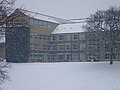 Bakkehældet, the first university buildings from 1933
 -
 Typical campus buildings, Institute of Biomedicine
 -
 The Bartholin building
 -
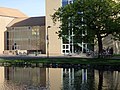 Søauditorierne (The Lake Auditoriums)
 -
 International Center (AU), the Vennelyst Park
 -
 The Vennelyst Park
.jpg)


.jpg)
.jpg)
.jpg)
.jpg)
_05.jpg)
Dormitories
[edit]
A large part of the dormitories, e.g. Børglum Kollegiet, and youth accommodation in Aarhus is administered by the non-profit housing cooperative of Kollegiekontoret[46] or though the public web-platform Ungdomsboliger.dk providing access to student and youth accommodation all across Denmark.[47] Only the Parkkollegierne (full name: Kollegierne i Universitetsparken) dormitories are located on campus and run by Aarhus University; other dormitories are located elsewhere, all across the city.[48] It is also the only dormitory exclusively for students at Aarhus University.
Organisation and administration
[edit]The university is governed by the university board which has 11 members: six members recruited outside the university form the majority of the board, two members are appointed by the academic staff, one member is appointed by the technical/administrative staff, and two members are appointed by the university students.[49] As required by Danish law,[50] the rector is appointed by the university board. The rector in turn appoints deans and deans appoint heads of departments. There is no faculty senate and faculty is not involved in the appointment of rector, deans, or department heads. Hence Danish universities has no faculty governance.
Main academic areas
[edit]Since 1 January 2020, the university has been organised into five main academic areas:[35]
- Technical Sciences – consists of the subjects of environmental sciences, agricultural science, and engineering from the former Faculty of Science and Technology.
- Natural Sciences – consists of the remaining departments which were part of the former Faculty of Science and Technology.
- Arts – consists of the former Faculty of Humanities and the former Faculty of Theology.
- Aarhus BSS – consists of the former Faculty of Social Sciences and the Aarhus School of Business.
- Health – consists of the former Faculty of Health Sciences.
Academics
[edit]


As of 1 October 2021[update], more than 32,000 students were enrolled in Aarhus University.[3] Each year more than 1000 international exchange students come to Aarhus University to study for one or two terms. In 2009 close to 3000 international students were enrolled in full degree programmes.[51] Aarhus University is an international university with a large proportion of students at the post-baccalaureate level: over half of its students are enrolled in master's degree and PhD programmes. In 2011, 59 of the university's 113 Master's degree programmes were taught in English.[52] Talent development of young researchers has been identified as one of the university's core activities.[53] This means that highly qualified students have the option of starting their PhD studies before completing their master's degree. The university's doctoral programmes allow talented students to enroll in a combined Master's/PhD programme either right after completing the master's degree (the 5+3 track) or one year into their master's degree programme (the 4+4 track).[54] Since 2006 the number of PhD students has risen from approximately 1000 to approximately 1700 in 2010.[55]
-
 Aarhus University, School of Communication and Culture, Arts
 -
 Moesgård Manor, Department of Archaeology and Anthropology, Arts
 -
 Department of Computer Science, AU, Science and Technology
 -
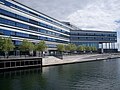 AU Engineering, Science and Technology
 -
 Section for Sports, Faculty of Health Sciences
_01.jpg)


International Centre
[edit]The International Centre maintains international partnerships and combines a wide range of services for exchange students, international full-degree students, PhDs and visiting scholars. The International Centre is often the first stop for foreign students at Aarhus University, since the centre offers advice on finding housing and living in Denmark.[56]
AU Summer University
[edit]Starting in 2011 all summer courses and summer schools offered by Aarhus University for bachelor's, master's and PhD students will be gathered together and expanded to provide more diversity in a new framework: AU Summer University. In the summer of 2011 more than 80 courses were offered within the fields of humanities, theology, social sciences, health sciences, natural sciences, agricultural sciences, business and educational sciences. Summer courses are open to both Danish and international students.[57]
Degree programmes
[edit]Aarhus University has seen some deep administrational changes since the turn of the century and now also includes several large sub-departments such as Aarhus BSS, AU Engineering and others. Each of these sub-departments offers undergraduate or graduate programmes specific to their own field of study. The core academic degree programmes of Aarhus University include the following fields:[58]
- Agricultural Sciences
- Anthropology
- Biology
- Chemistry
- Chinese
- Classical Archaeology
- Classical Philology
- Cognitive Science
- Cognitive Semiotics
- Comparative Religion
- Computer Science
- Dentistry
- Digital Design
- Economics
- Engineering
- European Studies
- Food Science
- Geology
- Geophysics
- History
- History of Ideas
- Information Studies
- IT/IT Product Development
- Japanese
- Latin
- Law
- Linguistics
- Management
- Mathematical Economics
- Mathematics
- Media Studies
- Medicine
- Prehistoric, Medieval and Renaissance Archaeology
- Modern Languages
- Molecular Biology
- Musicology
- Nanotechnology
- Nordic Language and Literature
- Philosophy
- Physics and Astronomy
- Political Science
- Psychology
- Religious Studies
- Russian
- Scandinavian Studies
- Sports Science
- Theology
- The Religious Roots of Europe
The university offers eight undergraduate and about 60 graduate programmes in English.[52][59]
Cheminova controversy and academic freedom at AU
[edit]Since 1944, Aarhus University owned Cheminova, a chemical manufacturer which, among other controversies, has been selling methyl parathion pesticide to Brazil farmers.[60] In 2009, senior researcher Mette Jensen emailed her colleagues at AU, asking whether they thought Cheminova should stop selling the controversial pesticides. For this, the university threatened her with dismissal.[61] The university's Pro-Vice-Chancellor Søren E. Frandsen denied that the university had made any mistakes or threatened the freedom of speech and academic freedom of its staff.[62]
On 30 April 2015, Cheminova was sold to the FMC Corporation for DKK 8.5 billion, a controversial issue in itself.[63]
Major research centres
[edit]

Aarhus University is home to 15 Centres of Excellence supported by the Danish National Research Foundation[64] and a considerable number of major research centres. The 15 Centres of Excellence are:[65]
- Centre for Membrane Pumps in Cells and Disease (PUMPKIN)
- Centre for Insoluble Protein Structures (INSPIN)
- Centre for Geomicrobiology
- Centre for Materials Crystallography (CMC)
- Centre for DNA Nanotechnology
- Centre for Functionally Integrative Neuroscience (CFIN)d
- Centre on Autobiographical Memory Research (CON AMORE)
- Centre for Massive Data Algorithmics (MADALGO)
- The Water and Salt Research Centre
- Centre for Carbonate Recognition and Signaling (CARB)
- Centre for Research in Econometric Analysis of Time Series (CREATES) which is one of the best econometrics center according to Economics Field Rankings: Econometrics | IDEAS/RePEc. Currently this center is positioned as second best center of research in econometric time series analysis.
- Centre for Oxygen Microscopy and Imaging (COMI)
- Centre for mRNP Biogenesis and Metabolism
- Centre for Quantum Geometry of Moduli Spaces (QGM)
- Centre for the Theory of Interactive Computation
- Center for Theoretical Chemistry (qLEAP)
- Centre for the Experimental-Philosophical Study of Discrimination (CEPDISC)
Some of the university's other major research centres include MindLab and iNANO.
MINDlab
[edit]MINDLAB was established with a DKK 120 million grant awarded by the Danish Ministry of Science, Technology and Innovation. At MINDLab neuroscientists, psychologists, biologists, statisticians and researchers from other fields work together to understand the brain, its disorders, and its development through physical and social interactions – and vice versa.[66]
iNANO
[edit]The Interdisciplinary Nanoscience Center (founded in 2002 by Professor Flemming Besenbacher) offers a degree programme in nanoscience with an interdisciplinary curriculum covering a broad spectrum of introductory, advanced and specialised courses, aimed at providing the student with a sufficiently broad basis to conduct interdisciplinary research within nanoscience and at the same time achieve disciplinary depth and specialised skills in selected areas. Hence, the programme encompasses physics, chemistry, biology, molecular biology, mathematics and computer science.
Danish Centre for Environment and Energy (DCE)
[edit]In 2011 the National Environmental Research Institute of Denmark (NERI) was organisatorically moved from the Danish Ministry of Environment and Energy and merged into AU, under the new name Danish Centre for Environment and Energy (DCE). DCE consists of two departments: department of Ecoscience and Department of Environmental Sciences, as well as a common secretariat, all under the Faculty of Technical Sciences. The core obligations of DCE continues to be to provide research based monitoring and advice to the Danish Government on environmental issues and conduct independent research and education within the same fields.
Danish Centre for Food and Agriculture (DCA)
[edit]Also in 2011 the Agricultural Research Institute of the Ministry of Agriculture was merged into AU. First as a separate faculty for Agricultural Research, later as part of the Faculty of Technical Sciences. The former departments are now organised as Departments of Agroecology, Animal Sciences, and Food Science, together with a common secretariat: Danish Centre for Food and Agriculture (DCA). The core obligations of DCA is to provide advice and supporting research to the Ministry of Agriculture and Fisheries, while the departments also engage in independent research and teaching. The Global Rust Reference Center[67][68] provides testing and investigation services of new and difficult cases of wheat stem rust/black stem rust.
Student life
[edit]Students from different fields meet in the numerous Friday bars and at various events organized by student organizations. The Friday bars are often organised by students from the different departments who set up a small, local bar in a canteen or classroom where beers and non-alcoholic drinks are served. The university also offers the Student bar (Studenterbaren) though Studenterhus Aarhus.[69]
The university also has a number of libraries, some of which are open around the clock with student or employee cards. Almost every department has its own library, but the main library is the State and University Library. It has an extensive electronic journal database which students and staff can access either at the library or from home.[70]
Aarhus University Sports (AUS) is open to all university students and organises a wide range of activities from badminton, to fencing and chess.
Student organisations
[edit]The largest student organisations at Aarhus University are the Student Union (Studenterrådet ved Aarhus Universitet) and Studenterlauget. The Student Union represents the main student body at Aarhus University in many boards and forums, while Studenterlauget is a mainly social organisation at School of Business and Social Sciences. The Student Union has both student seats on the university board.[71] The Student Union also arranges annual concerts and seminars, and publishes the student magazine Delfinen (The Dolphin).
Besides the Student Union, there are political student organisations at the university often connected to the Danish political parties, the largest of which include the Social-Democratic Students (Frit Forum), Conservative Students (Konservative Studenter), and Liberal Students (Liberale Studerende). The Conservative Students union publishes the student magazine Critique. The Liberal Students union publishes the leaflet Minerva.
Clubs and societies
[edit]Aarhus University offers many activities and services for foreign and Danish students. Several "Friday Bars", clubs organized and crewed by students at the university offer cheap beer and drinks, which has a wide appeal to the student body.
Students House
[edit].jpg)
Studenternes Hus (The Students House) was built in 1964 at the central campus to accommodate students organisations, activities, festivities and gatherings. Among many other things, the buildings are headquarters to the students organisation Studenterhus Aarhus, and Aarhus University offers a free membership to all exchange students.[72] The Students House is a meeting place for international and Danish students in Aarhus and Studenterhus Aarhus organize social and cultural activities throughout the year, ranging from parties and road trips, to language classes and weekly international nights (a popular dinner club).[73][74] The Students' House including the Student bar used to be run by the independent Studenterhusfonden, but was taken over by the university itself in 2020.[75]
Aarhus University Sports (AUS)
[edit]AUS is the official sports club of Aarhus University, and is open to all university students. It is an umbrella organisation consisting of 18 independent member clubs, which host a wide range of activities, from badminton to fencing to chess. In addition, AUS also offers independent activities such as indoor soccer tournaments, badminton facilities, and surfing trips.[76]
Dale's Café
[edit]
Dale's Café is a meeting place for international students and the university's PhD students that opened in 2011. The café offers coffee, sandwiches and a wide selection of beers. It has an informal lounge area where students and young researchers can relax while enjoying snacks and beverages. Like the main building, Dale's Café is named after Aarhus University's 2010 Nobel Laureate in Economic Sciences, Dale T. Mortensen. The Dale T. Mortensen Building houses the International Centre, the PhD House and the IC Dormitory, which contains 28 dorm rooms and two apartments dedicated to recently arrived international PhD students.[77][78]
Klubben
[edit]Klubben (in English 'the club') is a bar located at the former ASB (Aarhus School of Business), now under the faculty of School of Business and Social Sciences. The bar is open during regular school hours and weekdays, but hosts larger parties during Fridays and in relation to major sports events. Admittance is usually restricted to students of the School of Business and Social Sciences.[79]
Studenterlauget
[edit]Studenterlauget, School of Business and Social Sciences (at the former ASB) is currently the largest student organisation in Denmark. The organisation has approximately 4,000 members whom they service through nine smaller "business units". Studenterlauget has around 300 student employees.[80]
University museums
[edit]Aarhus University operates a number of museums, both in and outside the university campus:
Notable faculty and alumni, and students
[edit]Former and current faculty
[edit]- Torben M. Andersen, professor, former chairman of the Welfare Commission
- Lars Arge, Danish computer scientist
- Ole Barndorff-Nielsen, Danish statistician
- Susanne Bødker, Danish computer scientist
- Jørgen Christensen-Dalsgaard, Danish astronomer
- Ivan Damgård, Danish cryptographer
- Jennifer Kewley Draskau, Manx historian, linguist, teacher and political candidate
- Tom Fenchel, Danish marine ecologist
- David Field, physicist
- Albert Gjedde, Danish-Canadian Neuroscientist
- David Gress, Danish-American historian
- Poul Jørgensen (chemist), Director of the qLEAP center for theoretical chemistry
- Selin Kara, full professor and head of Industrial Biotechnology section
- Kai Larsen, Danish botanist
- Knud Ejler Løgstrup, Danish philosopher and theologian, Pastor at Sandager-Holevad from 1936 to 1943, professor at University of Aarhus from 1943 to 1975
- Ib Madsen, Danish mathematician
- Birte Melsen, Danish Orthodontist
- Bertel Møhl, Danish marine zoologist and physiologist
- Jeremy Morris, British ethnographer and political anthropologist
- Helmuth Nyborg, Danish professor of developmental psychology
- Kristen Nygaard, Norwegian computer scientist (1975–1976), Turing Award
- Kjeld Philip, Danish economist and politician
- Rubina Raja, Professor of Classical Archaeology and leader of The Danish National Research Foundation's Center of Excellence for Urban Network Evolutions
- Katherine Richardson, Biological oceanographer
- Jens Christian Skou, Danish chemist and Nobel Prize laureate in Chemistry 1997
- Johannes Sløk, Danish philosopher and theologian
- Benjamin K. Sovacool, director of the Center for Energy Technology at AU-Herning and a professor of social sciences
- Harald Thamdrup, Danish zoologist
- Gunnar Svane, Danish linguist
Alumni
[edit]- Yildiz Akdogan, (MSc in political science 2006) Danish politician, Member of the Danish Parliament since 2007.
- Morten Albæk, (MA in history (minor in philosophy) former group senior vice president i Vestas Wind Systems, named one of the 100 most innovative marketing leaders in 2011, 2012 and 2013 by the magazine, The Internationalist.
- Svend Auken, (MSc in political science 1969) Danish politician. Chairman of the Danish Social Democrats 1987–1992.
- Dorete Bloch, (MSc in zoology 1970) Danish zoologist.
- Tim Bollerslev, (MSc in economics and mathematics 1983) Danish Econometrician. Inventor of the GARCH model.
- Jens-Peter Bonde, Danish journalist, author, politician, and Member of the European Parliament 1979–2008.
- Michael E. Caspersen, (MS 1987, PhD 2007), Danish computer scientist and educator
- John Degnbol-Martinussen (PhD) political scientist.
- John Frandsen, (MA in music 1982) Danish composer, organist and conductor.
- Aage Frandsen, Danish politician, Member of the Danish Parliament 1971–1975, 1987–1990, and 1994–2005.
- King Frederik X, (MSc in political science 1995), King of Denmark since 2024.
- Søren Gade, (MSc in economics 1990) Danish politician, Minister of Defence and Member of the Danish Parliament.
- Lene Hau, (MSc 1986, PhD 1991 in physics) Danish physicist.
- Bertel Haarder, (MSc in political science 1971) Danish politician, Member of the Danish Parliament.
- Niels Jacobsen, (Msc in economics 1983) CEO of William Demant
- Dan Jørgensen, (MSc in political science) Danish politician. Member of the European Parliament since 2004.
- Naser Khader, Danish-Syrian politician and Member of the Danish Parliament. Chairman of the Liberal Alliance 2007–2009.
- Lars Bak, Computer Programmer, Developer of JavaScript V8 Engine.
- Lars Knudsen, (MSc 1992, PhD 1994) Danish cryptographer.
- Jørgen Vig Knudstorp, (MSc 1995, PhD in 1998 in Economics) CEO of the Lego Group[81]
- Johannes Lebech (MA), Danish politician.
- Bjørn Lomborg, (MSc in political science 1991) Danish author, academic and environmentalist.
- Nils Malmros, (MD 1988) Danish film director and screenwriter.
- Madhavan Mukund, Director of Chennai Mathematical Institute, India.
- Ebbe Nielsen, (MSc in Zoology 1976) Danish entomologist.
- Kjeld Philip, (MSc in economics) Danish economist and politician.
- Anders Fogh Rasmussen, (MSc in Economics 1978) Prime Minister of Denmark from 2001 until 2009. Secretary General of NATO from August 2009 until October 2014.
- Lars Rasmussen (software developer), (MSc in Mathematics and Computer Science 1990) Danish computer scientist, software developer, and co-founder of Google Maps.
- Høgni Reistrup, (BA in Media studies and Organisational Development 2008 from Aarhus University and MA in Media Studies 2010 from the University of Copenhagen),[82] co-writer of the book Exit Føroyar which created debate about the declining population in the Faroe Islands.[83]
- Jan Beyer Schmidt-Sørensen (Msc in Economics 1983 from Aarhus University and PhD in 1990 in Economics from Aarhus School of Business) former Rector of Aarhus School of Business (now Aarhus University, School of Business and Social Sciences) and Director of Business Development at Aarhus Municipality.
- Tøger Seidenfaden, (MSc in political science 1983) Danish journalist. Editor-in-chief at Politiken 1993–2011.
- Bjarne Stroustrup, (MSc in Mathematics and Computer Science 1975) Danish inventor, designer and original implementer of the C++ programming language.
- Folmer Wisti, founder of the Danish Cultural Institute
- Queen Margrethe II, the queen regnant of Denmark from 1972 to 2024, studied archaeology and political science during 1961–1962.[84][85]
- Jens Peter Christensen, (MSc in Political Science in 1982 and Doctor of Law 1997). President of the Supreme Court since 1 November 2022.
International recognition
[edit]| University rankings | |
|---|---|
| Global – Overall | |
| ARWU World[86] | 78 (2023) |
| QS World[87] | 131 (2026) |
| THE World[88] | =109 (2024) |
| USNWR Global[89] | =109 (2023) |
Aarhus University is highly ranked by international organizations and maintains its own page listing its current rankings.[90] It is ranked 71st by the Shanghai Ranking (2021),[86] 89th by National Taiwan University Ranking (2018),[91] 95th by the U.S. News & World Report (2018),[92] 106th by Times Higher Education World University Rankings (2021),[88] and 155th by QS World University Rankings (2021).[93]
Partner universities and membership
[edit]Aarhus University is a member of the Coimbra Group and of the Utrecht Network.
Aarhus university is also an active member of the University of the Arctic.[94] UArctic is an international cooperative network based in the Circumpolar Arctic region, consisting of more than 200 universities, colleges, and other organizations with an interest in promoting education and research in the Arctic region.[95]
The university participates in UArctic's mobility program north2north. The aim of that program is to enable students of member institutions to study in different parts of the North.[96]
See also
[edit]References
[edit]- Notes
- Citations
- ^ "Search". Internet Archive.
- ^ Aarhus University. "Budget 2013" (PDF) (in Danish). Archived from the original (PDF) on 2020-09-19. Retrieved 2012-12-30.
- ^ a b c "Key statistics for Aarhus University". international.au.dk. Aarhus University. Retrieved 2022-08-16.
- ^ "Colours".
- ^ Koncern-økonomi (2016-08-23). "Students - facts and figures". about.ku.dk. Retrieved 2019-02-24.
- ^ "universitet (Danmark)". Den Store Danske. lex.dk. 8 June 2009. Retrieved 2022-08-16.
- ^ "Coimbra group web page". Archived from the original on 2016-06-05.
- ^ "The Nobel Prize in Chemistry 1997". NobelPrize.org. Retrieved 2019-02-24.
- ^ "The Sveriges Riksbank Prize in Economic Sciences in Memory of Alfred Nobel 1989". NobelPrize.org. Retrieved 2019-02-24.
- ^ "The Sveriges Riksbank Prize in Economic Sciences in Memory of Alfred Nobel 2010". NobelPrize.org. Retrieved 2019-02-24.
- ^ a b c d e f g Trefzer, Sandra (3 Oct 2011). "History of The University of Aarhus". Aarhus University. Retrieved 2012-07-08.
- ^ a b c d Gyldendal. "Aarhus Universitet". Den Store Danske (in Danish). Gyldendal. Retrieved 2012-07-08.
- ^ "Aarhus Universitets første bygning [The first building of Aarhus University]" (in Danish). Aarhus University. Retrieved 1 November 2017.
- ^ a b Albeck 1978, pp. 163–165
- ^ Faber 1946, p. 62
- ^ Faber 1946, pp. 63–64
- ^ Faber 1946, p. 67
- ^ "Hovedbygningen (indviet 1946)" (in Danish). Aarhus University. Retrieved 1 November 2017.
- ^ Faber 1946, p. 74
- ^ Albeck 1978, p. 265
- ^ Faber 1946, p. 52
- ^ Albeck 1978, pp. 266–267
- ^ Dorte Guldbrand Nielsen; Anne Mette Moercke; Gitte Wickmann-Hansen; Berit Eika (December 9, 2009). "Skills Training in Laboratory and Clerkship: Connections, Similarities, and Differences". Medical Education Online. 8 (12): 4334. doi:10.3402/meo.v8i.4334. ISSN 1087-2981. OCLC 860986080. PMID 28253165. S2CID 13932378.
- ^ Faber 1946, p. 95
- ^ Faber 1946, pp. 99–105
- ^ "Aarhus Freemasons Building - Aarhus New University Hospital: Jutland Architecture". June 21, 2008.
- ^ a b Faber 1946, pp. 114–118
- ^ a b Møller 1978, pp. 46–58
- ^ a b Fode 2005, p. 103
- ^ "Møbler ved Aarhus Universitet [Furniture at Aarhus University]" (in Danish). Aarhus University. Retrieved 1 November 2017.
- ^ Fode 2005, pp. 102–109
- ^ "Danmarks Miljøundersøgelser nedlagt. Nyt nationalt center på plads". dce.au.dk. July 2011.
- ^ "Danmarks-jordbrugsforskning-integreres-med-aarhus-universitet".
- ^ 136957@au.dk. "Departments and Schools". Archived from the original on 19 February 2010. Retrieved 29 June 2015.
{{cite web}}: CS1 maint: numeric names: authors list (link) - ^ a b "Bestyrelsen har godkendt delingen af fakultetet ST". omnibus.au.dk. 18 June 2019.
- ^ "Auditoriums, University of Aarhus". C.F. Møller Architects. Retrieved 31 October 2017.
- ^ "Institut for Biomedicin Aarhus Universitet Faculty Of Health" (in Danish). Cubo Architects. Retrieved 31 October 2017.
- ^ Olaf Lind and Poul Ib Henriksen (2003). Arkitekturfortællinger - om Aarhus Universitets Bygninger (in Danish). Aarhus University Press.
- ^ Stadsarkitektens kontor (February 1993). "Lokalplan nr. 376" (PDF) (in Danish). Århus Kommune. Bevarende lokalplan for Universitetetsparken og Vennelystparken. Retrieved 29 June 2015.
- ^ "Statsbiblioteket". Retrieved 29 June 2015.
- ^ "Campus" (in Danish). Aarhus University. 24 August 2015. Retrieved 8 September 2015.
- ^ "Welcome to Aarhus BSS". Aarhus University. 9 August 2015. Retrieved 8 September 2015.
- ^ Andersen, Marie Groth; Balsby, Lise (30 September 2019). "Builders are transforming a hospital into your new campus". Omnibus. Retrieved 16 November 2021.
- ^ 223704@au.dk. "Department of Business Development and Technology". Retrieved 29 June 2015.
{{cite web}}: CS1 maint: numeric names: authors list (link) - ^ "Danish School of Education". Retrieved 16 November 2021.
- ^ "kollegiekontoret.dk: Kollegiekontoret". www.kollegiekontoret.dk.
- ^ "Kollegie- og ungdomsboliger i hele Danmark - Studieboliger i København, Odense, Aarhus, Aalborg m.fl". www.ungdomsboliger.dk. Retrieved 29 March 2018.
- ^ "Kollegierne i Universitetsparken". koll.au.dk.
- ^ "Aarhus University Board". Archived from the original on 2011-03-19. Retrieved 2011-03-01.
- ^ "Bekendtgørelse af lov om universiteter (universitetsloven)". Retsinformation. 27 February 2018. Retrieved 28 November 2021.
- ^ "AU profilbrochure 10-11 uk". Retrieved 29 June 2015.
- ^ a b 118675@au.dk. "Master's student guide". Archived from the original on 13 October 2013. Retrieved 29 June 2015.
{{cite web}}: CS1 maint: numeric names: authors list (link) - ^ 118956@au.dk. "PHD ACTION PLAN FOR PHD EDUCATION AT AARHUS UNIVERSITY". Archived from the original on 9 June 2015. Retrieved 29 June 2015.
{{cite web}}: CS1 maint: numeric names: authors list (link) - ^ "PhD fellowships and scholarships". Retrieved 29 June 2015.
- ^ 274194@au.dk. "Tabel c1". Archived from the original on 23 September 2015. Retrieved 29 June 2015.
{{cite web}}: CS1 maint: numeric names: authors list (link) - ^ 287607@au.dk. "International Centre". Retrieved 29 June 2015.
{{cite web}}: CS1 maint: numeric names: authors list (link) - ^ 223698@au.dk. "AU Summer University". Retrieved 29 June 2015.
{{cite web}}: CS1 maint: numeric names: authors list (link) - ^ 136957@au.dk (8 May 2015). "Study guide". Aarhus University. Retrieved 8 September 2015.
{{cite web}}: CS1 maint: numeric names: authors list (link) - ^ 118675@au.dk. "Bachelor's student guide". Retrieved 29 June 2015.
{{cite web}}: CS1 maint: numeric names: authors list (link) - ^ "ATP kræver kulegravning af Cheminova". 18 August 2008. Retrieved 2009-11-08.
- ^ "Universitet knægter ansats ytringsfrihed". 8 March 2009. Retrieved 2009-11-08.
- ^ "Mette Jensen-sagen handler ikke om ytringsfrihed". 17 May 2009. Retrieved 2009-11-20.
- ^ Birgitte Erhardtsen (29 April 2015). "Sådan slap Aarhus Universitet af med Cheminova [This is how Aarhus University got rid of Cheminova]". Berlingske Business (in Danish). Retrieved 23 December 2016.
- ^ "Eksperimentel astropartikelfysik-gruppe ved Discovery Center officielt tildelt status af fuldt medlemskab af IceCube-samarbejdet". Retrieved 29 June 2015.
- ^ "Centres of excellence". Archived from the original on 2010-02-23. Retrieved 2011-02-16.
- ^ "Projects - MINDLab". Archived from the original on 18 March 2016. Retrieved 29 June 2015.
- ^ "WheatRust". Global Rust Reference Center, Institut for Agroøkologi. 2021-10-19. Retrieved 2021-10-25.
- ^ "Global Rust Reference Center". Institut for Agroøkologi. 2021-04-06. Retrieved 2021-10-25.
- ^ "Studenterhus Aarhus website". Studenterhus Aarhus. Retrieved 28 November 2021.
- ^ "Statsbiblioteket". Retrieved 29 June 2015.
- ^ "The Board of the University of Aarhus". Aarhus University. Archived from the original on 2008-03-31.
- ^ "Frontpage". www.studenterhusaarhus.dk. Retrieved 29 March 2018.
- ^ "Studenterhus Århus - Welcome". Archived from the original on 5 February 2011. Retrieved 29 June 2015.
- ^ "Student exchange guide 2010-2011" (PDF). Archived from the original (PDF) on 2010-12-24. Retrieved 2011-03-24.
- ^ Hylander, Anders. "Flere AU-kantiner på nye hænder i 2021". newsroom.au.dk (in Danish). Retrieved 28 November 2021.
- ^ "Aarhus Universitets-Sport". Archived from the original on 1999-11-28. Retrieved 7 October 2021.
- ^ "News from Aarhus University". Archived from the original on 2012-07-23. Retrieved 2011-03-24.
- ^ 243241@au.dk (5 February 2018). "Dale's Café". phd.au.dk. Archived from the original on 22 July 2011. Retrieved 29 March 2018.
{{cite web}}: CS1 maint: numeric names: authors list (link) - ^ "Klubben". Archived from the original on 2012-03-08.
- ^ "About". Studenterlauget. Retrieved 16 August 2022.
- ^ "Aarhus University". Times Higher Education (THE). Retrieved 2017-08-25.
- ^ "Høgni Reistrup". LinkedIn. Retrieved 17 January 2016.
- ^ Bohlbro, Peter (13 March 2013). "Folketingets Færøudvalg holder temamøde om den voksende fraflytning fra Færøerne" (in Danish). The Folketing. Retrieved 17 January 2016.
- ^ "Prinsesse Margrethe på Aarhus Universitet 1961/1962 [Princess Margrethe at Aarhus University 1961/1992]" (in Danish). Aarhus University. Retrieved 26 August 2016.
- ^ 6112@au.dk. "Prinsesse Margrethe på Aarhus Universitet 1961/1962". auhist.au.dk (in Danish). Retrieved 2021-05-10.
{{cite web}}: CS1 maint: numeric names: authors list (link) - ^ a b "Aarhus University | Academic Ranking of World Universities – 2023". www.shanghairanking.com.
- ^ "QS World University Rankings".
- ^ a b "World University Rankings: Aarhus University". timeshighereducation.com. 18 October 2023. Retrieved 29 March 2024.
- ^ "Aarhus University". U.S. News and World Report.
- ^ 48637@au.dk (2018-09-20). "Rankings". international.au.dk. Retrieved 2018-09-23.
{{cite web}}: CS1 maint: numeric names: authors list (link) - ^ "Aarhus University". nturanking.lis.ntu.edu.tw (in Twi). Retrieved 2018-09-23.
- ^ "U.S. News & World Report". Archived from the original on 2014-10-30.
- ^ "Aarhus University". Top Universities. Quacquarelli Symonds. 4 April 2024.
- ^ "Members". UArctic. Retrieved 2025-03-06.
- ^ "About Us". UArctic - University of the Arctic. Retrieved 2025-03-06.
- ^ "north2north". UArctic - University of the Arctic. Retrieved 2025-03-06.
- Bibliography
- Albeck, Gustav, ed. (1978). Aarhus Universitet 1928-1978. Aarhus: Universitetsforlaget i Aarhus. ISBN 87-876-7107-7.
- Faber, Knud (1946). Opbygningen af Aarhus Universitet. Copenhagen: Nordisk Forlag.
- Fode, Henrik (2005). Århus Besat (1 ed.). Aarhus: Århus byhistoriske Fond. ISBN 87-91324-11-4.
- Møller, C. F. (1978). Aarhus Universitets Bygninger (1 ed.). Aarhus: Universitetsforlaget i Aarhus. ISBN 87-504-0410-5.
External links
[edit]
- Official website
- Aarhus School of Business, Aarhus University
- National Environmental Research Institute, Aarhus University
- Danish School of Education, Aarhus University
- Aarhus University, Institute of Business and Technology


| International | |
|---|---|
| National | |
| Geographic | |
| Academics | |
| Other | |

Aarhus University
View on GrokipediaHistory
Founding and Early Expansion (1928–1945)
Aarhus University was established on September 11, 1928, as "University Teaching in Jutland," commencing operations in rented premises at Aarhus Technical College.[6] The initiative was spearheaded by the University Association Aarhus, founded in 1921, with initial funding of 33,000 Danish kroner provided by the municipality of Aarhus.[7] On the inaugural day, 64 students enrolled, increasing to 78 by the end of the first semester, supported by a teaching staff comprising one professor in philosophy and four readers in Danish, English, German, and French literature.[6] Instruction began with courses in the humanities, focusing on philosophy and modern languages.[1] In 1933, the institution adopted the name Aarhus University, coinciding with the inauguration of its first permanent building on September 11 by King Christian X.[6] This structure, designed by architects Kay Fisker, C.F. Møller, and Povl Stegmann following a 1931 competition, was located in the newly allocated University Park site granted in 1929 and initially housed medical sciences facilities.[6] Courses in medicine commenced that year, with the Faculty of Medicine formally established in 1935, while the Faculty of Economics and Law followed in 1936.[6] National government support for administrative costs began in 1932, enabling gradual infrastructural development through private donations.[6] By 1942, the Faculty of Theology was added, with classes having started as early as 1932.[6] A new main building was constructed in 1944 amid Denmark's German occupation from 1940 to 1945, which disrupted operations; student halls were requisitioned by German forces in 1943, and a British air raid on October 31, 1944, targeted the campus to support the Danish resistance, resulting in civilian casualties.[1] Despite wartime constraints, these years marked the foundational expansion from a modest teaching outpost to a multi-faculty institution with dedicated facilities.[6]Post-War Growth and Faculty Development (1946–1969)
Following the end of World War II, Aarhus University experienced steady expansion driven by Denmark's economic recovery and rising demand for higher education amid population growth and democratization of access. By 1953, the university had reached approximately 1,750 students, with the Faculty of Medicine accounting for 42% of enrollment during its 25th anniversary celebrations.[8] Student numbers continued to rise, reaching 5,000 by 1965, reflecting broader national trends in post-war welfare state development and increased public investment in education.[1] Faculty development accelerated in the 1950s and 1960s, building on pre-war foundations while addressing emerging scientific and social needs. The Faculty of Science was established in 1954, encompassing departments of physics, chemistry, geography, and mathematics, which facilitated research in natural sciences amid Denmark's industrial modernization.[6] Within the evolving Faculty of Economics and Law—later renamed the Faculty of Social Sciences in 1968—political science was introduced in 1959 and psychology in 1968, expanding offerings in behavioral and policy-oriented disciplines to meet demands from a growing administrative sector.[8] The Faculty of Medicine achieved full operational status by 1953, with infrastructure supporting clinical training and research.[6] These additions strengthened interdisciplinary ties, though the university remained privately funded through donations and municipal support until state takeover in 1970.[6] Infrastructure growth paralleled academic expansion, with key constructions enhancing capacity. The Main Building on Nordre Ringgade, initiated in 1942, was formally inaugurated in 1946, providing central administrative and teaching facilities in the signature yellow-brick style.[8] In 1950, Hall of Residence VII for female students and the Department of Music Studies were completed, addressing housing shortages and arts education.[8] The Biochemistry Department building reached completion in 1965, supporting advanced laboratory work within the Faculty of Science.[8] These developments occurred within the University Park, which incrementally expanded to accommodate rising faculty and student populations without major shifts in architectural coherence.[6]Modernization and Reforms (1970–2000)
In 1970, Aarhus University transitioned from an independent institution to a state-owned entity under Denmark's first Higher Education Act (Universitetsloven), which centralized control and removed the University Association and municipal representatives from its governing body.[9] This reform aligned with broader national efforts to democratize university governance, shifting authority from senior professors to a wider representation including junior staff, students, and administrative personnel, amid aims to expand access and integrate higher education into state welfare structures.[10] The changes imposed greater fiscal oversight by the Ministry of Education, standardizing operations across Danish universities while prioritizing mass enrollment; by the mid-1970s, Aarhus's student body had grown to over 10,000, reflecting national trends in higher education democratization that increased participation but also sparked debates over diluted academic autonomy.[11] Throughout the 1970s and 1980s, Aarhus adapted to these governance shifts by establishing internal councils for co-determination, where non-professorial staff and students gained voting rights on key decisions, though implementation faced resistance from traditional faculty hierarchies emphasizing merit-based expertise.[12] Modernization efforts focused on infrastructural expansion and research intensification, with investments in laboratory facilities and interdisciplinary programs to meet rising demands for applied sciences amid Denmark's economic shifts toward knowledge-based industries. Student numbers continued to surge, reaching approximately 20,000 by the late 1980s, driven by government subsidies and reduced entry barriers, though this massification strained resources and prompted early quality assurance measures introduced nationally in the 1980s.[13] The 1990s brought further reforms emphasizing external accountability and consolidation. In 1992, the Faculty of Medicine merged with the Royal Dental College, forming the Faculty of Health Sciences to streamline clinical training and research, enhancing interdisciplinary health studies with over 2,000 students by decade's end.[6] That year's Universities Act reintroduced external members to the governing body, balancing internal democracy with stakeholder input from industry and society to foster relevance in a globalizing economy. Research prominence was affirmed in 1997 when Emeritus Professor Jens Christian Skou received the Nobel Prize in Chemistry for his 1957 discovery of the sodium-potassium pump, underscoring Aarhus's strengths in biophysical sciences developed through sustained post-1970 investments. Infrastructure modernization accelerated, including relocations to Nobel Park for language departments in 1999 and the inauguration of an IT Park in 2000, signaling adaptation to digital and computational demands.[6]Contemporary Developments (2001–2025)
In 2006–2007, as part of Denmark's university reform, the University of Aarhus underwent significant mergers with the Aarhus School of Business, the Danish Institute of Agricultural Sciences, the National Environmental Research Institute, the Institute of Business and Technology in Herning, and the Danish University of Education, forming the modern Aarhus University with approximately 34,000 students and 9,000 employees.[1] These integrations broadened the institution's disciplinary scope to include business, agriculture, environmental science, and education, enhancing its research capacity in applied and interdisciplinary fields.[1] Subsequent organizational restructuring occurred in 2011, consolidating the university into four faculties: Arts, Science and Technology, Health, and Business and Social Sciences.[1] In 2012, Aarhus University merged with the Aarhus University School of Engineering, relocating programs to the Navitas building in central Aarhus.[1] Further refinement in 2020 split the Faculty of Science and Technology into separate Faculties of Technical Sciences and Natural Sciences, establishing the current five-faculty structure to foster specialized research and teaching.[1] Research achievements during this period include the 2010 Nobel Prize in Economic Sciences awarded to Dale T. Mortensen, a Niels Bohr Visiting Professor at Aarhus University, for analyses of markets with search frictions; the university subsequently named a building after him.[14] Aarhus University has secured over one-third of Denmark's advanced and starting grants from the European Research Council, supporting high-impact projects in areas such as biomedicine, climate science, and economics.[15] Global rankings reflect sustained progress, with Aarhus University entering the top 100 in the Times Higher Education World University Rankings by 2023 (109th place) and climbing to 101st in 2026, driven by metrics in research quality, citations, and international outlook among over 1,900 evaluated institutions.[4] Enrollment has grown to around 33,000 students, with record intakes exceeding 7,600 new students in 2024, including increasing international participation from over 120 countries.[16] Campus infrastructure developments emphasize urban integration and sustainability, including the 2025 completion of expansions incorporating a former municipal hospital site into the main Aarhus campus.[1] The board-approved Campus 3.0 plan through 2034 outlines relocations, new engineering facilities, and green initiatives to consolidate activities and support Denmark's transition to regenerative built environments.[17] The university's Strategy 2020–2025 prioritizes independent research breakthroughs and talent development amid policy shifts affecting non-EU recruitment.[18]Campuses and Infrastructure
Main Aarhus Campus
The main Aarhus campus of Aarhus University is located in the University Park (Universitetsparken), situated in the northern part of Aarhus, Denmark's second-largest city with a population exceeding 370,000.[19] This campus functions as the central hub for the university's teaching, research, and administrative activities, accommodating the majority of its 38,000 students across five faculties.[2] The layout integrates functionalist yellow-brick architecture with expansive green spaces, including lakes, undulating moraine terrain, and pathways that promote a harmonious balance between built environment and nature.[20] Development of the campus began after an architectural competition in 1931, won by Kay Fisker, C.F. Møller, and Povl Stegmann, establishing a homogeneous style overseen by C.F. Møller from 1939 onward. The first building was completed in 1933 on a promontory overlooking the park, initially housing early faculties and now serving social sciences departments; it was accompanied by four professors' houses along Katrinebjergvej.[20] Subsequent constructions included biochemistry and physiology departments in 1937, a high-voltage transformer building and natural history museum in 1941, and the Main Building on Ringgade, started in 1942 and inaugurated in 1946. Post-war expansions added facilities such as pathology, pharmacology, and hygiene departments in 1953, along with student residences and music studies in 1950. The yellow-brick structures within the park total 246,000 square meters of floor area, with an additional 59,000 square meters in nearby external buildings.[20] Key facilities on the campus include the Bartholin Building for natural sciences, the Lake Auditoriums (Søauditorierne) for lectures adjacent to artificial lakes, and a 2001 addition featuring five auditoriums and a large Per Kirkeby painting.[20] The University Park remains the campus core, with recent and planned enhancements focusing on improved lighting, increased student activities, and integration with surrounding urban development to sustain its role amid ongoing expansions.[21]Satellite Campuses and Facilities
Aarhus University operates satellite campuses in Emdrup, Herning, Viborg, Flakkebjerg, and Roskilde, extending its research and educational reach beyond the main Aarhus site to support specialized departments in education, business, agriculture, engineering, and environmental sciences.[22] These facilities primarily host research groups and select degree programs, with smaller student populations compared to the main campus, emphasizing applied and interdisciplinary work.[22] The Emdrup campus, located on the outskirts of Copenhagen near Lake Emdrup, houses the Danish School of Education (DPU), one of Europe's largest educational research environments with approximately 130 academic staff, 30 administrative personnel, 60 PhD students, and 2,000 other students.[23] Facilities include access to nearby public transport, such as trains reaching the city center in 10 minutes, and housing options in the vicinity.[23] In Herning, Central Jutland, the campus accommodates the Department of Business Development and Technology (BTECH), serving about 1,350 students—35% of whom are international—alongside 55 academic staff, 15 administrative staff, and 30 PhD students.[24] Positioned east of the city center with a 10-minute commute by car or bus, it supports business and technology programs and hosts events like the annual International Citizen Day.[24] The Viborg campus in Central Jutland hosts the Department of Animal and Veterinary Sciences, Department of Agroecology, Department of Biological and Chemical Engineering, Danish Centre for Food and Agriculture, and research groups from the Center for Quantitative Genetics and Genomics, with around 100 academic and 70 administrative staff, 40 PhD students, and 55 other students.[25] Focused on animal science, agroecology, engineering, and food research, it offers temporary housing and proximity to Viborg's international schools, about 15 minutes by car from the lakes area.[25] At Flakkebjerg in rural Slagelse, West Zealand—roughly one hour from Copenhagen—the site supports the Department of Agroecology and Center for Quantitative Genetics and Genomics, employing 50 academic and 60 administrative staff with 10 PhD students.[26] Research-oriented with limited on-site accommodation, it facilitates agroecology studies and short courses through AU Summer University, near local daycare facilities.[26] The Roskilde location in Risø, Zealand, primarily features the Department of Ecoscience and Department of Environmental Science, conducting research on ecosystems and environmental challenges with around 275 employees, including 200 permanent staff.[27] Situated north of Roskilde city, approximately 7 km from the center, it integrates with broader AU environmental initiatives.[28]Student Housing and Dormitories
Student housing at Aarhus University is facilitated primarily through external organizations, as the university does not own or operate on-campus dormitories. The majority of accommodations are managed by Student Housing Aarhus, a non-profit entity that coordinates over 8,000 student residences across Greater Aarhus, including single rooms, shared apartments, and couple units in various kollegier (halls of residence).[29] These facilities are located off-campus but often near public transport links, with options scattered throughout the city and suburbs; central locations face longer waiting lists due to high demand.[29] Eligibility for Student Housing Aarhus requires applicants to be active full-time students aged 18 to 35, with status verified twice annually through enrollment and exam records; PhD students, interns, and staff are ineligible.[29] Applications operate on a seniority system, allowing registration from age 17 but activation three months prior to desired move-in, with recommendations to apply in June or July for autumn terms. A housing guarantee exists for new incoming students starting in autumn, ensuring allocation if applications are submitted by specified deadlines, though private rentals or shared houses remain alternatives amid competition.[29] Rents typically range from 3,000 to 5,000 DKK monthly, covering utilities in many cases, with rooms furnished minimally—bed, desk, chair, and storage—and shared communal kitchens and lounges standard.[30] For international students, AU Housing provides targeted support, securing access to approximately 700 furnished rooms in select dorms and shared houses, prioritized for exchange and full-degree seekers but not guaranteeing placement.[31] Recent infrastructure enhancements include the 2020s conversion of a former patient hotel into 132 residences accommodating about 170 students, preserving original architecture while adding modern amenities near campus edges.[32] Overall, with Aarhus hosting around 40,000 students relative to its 350,000 population, dormitory demand exceeds supply, prompting early planning and supplemental private options like Basecamp facilities.[33]Recent Infrastructure Projects (2020s)
In the 2020s, Aarhus University has pursued extensive campus consolidation and expansion through its Campus 2.0 and Campus 3.0 initiatives, aiming to integrate academic activities across central Aarhus sites including University City, University Park, and Katrinebjerg while enhancing research collaboration and sustainability.[17][34] The Campus 3.0 plan, approved by the university board in December 2024, outlines developments through 2034, including new constructions and relocations to streamline operations and foster interdisciplinary work.[35] A flagship project is the University City campus, redeveloping the 110,000 m² site of the former Aarhus Municipal Hospital (originally built in the 1880s and decommissioned in 2018) into a mixed-use urban facility with preserved historic brick facades, recycled construction materials from 80,000 m² of existing structures, and DGNB Gold pre-certification for energy efficiency, projecting 6,600 tonnes of CO2 savings.[36] Construction advanced significantly in 2024, with full-swing building activity enabling initial relocations for Aarhus BSS faculty departments starting November 2025 (delayed from summer 2025) and broader moves from February 2026.[37][38] Specific additions include a new high-rise on Åbogade for IT-related programs in Natural Sciences, Computer Science, and Arts by 2029; a dedicated building on Helsingforsgade for Civil and Architectural Engineering relocated from Navitas; and facilities on Gustav Wieds Vej and Kasernen for Biological and Chemical Engineering.[34] To improve connectivity, a third underground passage beneath Nørrebrogade linking University City to University Park is under construction, slated for completion in 2025.[17] Parallel efforts target the Technical Sciences faculty, with expansions in Katrinebjerg (Aarhus Nord) redeveloping facilities for enhanced study and research environments in areas like water technology, energy, and biosolutions.[17][39] At AU Viborg, near Foulum, a new "green campus" spanning 120,000 m² is in active construction as of 2024, accommodating 800-900 students by 2030 with laboratories for sustainable agriculture and engineering; initial student intake occurred in August 2024.[17][39] These projects collectively support the university's strategic shift toward compact, mission-oriented infrastructure, prioritizing empirical efficiency in space utilization and environmental impact reduction over dispersed facilities.[34]Governance and Administration
Organizational Structure
Aarhus University's organizational structure is hierarchical, with the Board as the highest authority responsible for overall strategy, budget approval, and appointing key executives such as the Rector.[40] The Board ensures compliance with Danish higher education laws while setting long-term goals.[41] The Senior Management Team oversees daily operations within the Board's framework, consisting of the Rector (chief executive), Pro-Rector (deputy to the Rector), University Director (head of administration), and Deans from the five faculties: Arts, Health, Natural Sciences, Technical Sciences, and Business and Social Sciences.[40] The Rector delegates authority to vice-deans and department heads, while the University Director manages support functions through five deputy directors and administrative centre managers.[40] Academic activities are structured across these five faculties, each encompassing multiple departments—totaling 32 academic units—that handle teaching, research, and degree programs in their respective fields.[42] For instance, the Faculty of Arts includes departments like Anthropology and Archaeology, while Technical Sciences covers engineering disciplines.[43] Administrative support is decentralized yet coordinated, comprising six divisions: AU Estates (facilities management), AU Research Support and External Relations (funding and partnerships), AU HR (human resources), AU IT (information technology), AU Student Administration and Services (enrollment and welfare), and AU Finance (budgeting and accounting).[44] Four faculty-aligned administrative centres handle localized operations: Arts Administrative Centre, Aarhus BSS Administrative Centre, Health Administrative Centre, and Nat-Tech Administrative Centre (serving Natural Sciences and Technical Sciences).[44] The Rector’s Office delivers strategic advisory services, divided into Secretariat (coordination), Legal Support (compliance), Analysis and Policy (data-driven planning), and Communication and Press (public relations).[44] An additional Office of Business Collaboration promotes industry ties and innovation transfer.[44] This structure balances autonomy at departmental levels with centralized oversight, adapting to Denmark's 2003 university reforms emphasizing efficiency and accountability.[41]Leadership and Decision-Making
The Aarhus University Board constitutes the institution's supreme governing body, tasked with advancing its core functions in research and education. Comprising 11 members—six external experts appointed for their societal and professional perspectives, two elected by academic staff, one by technical and administrative personnel, and two by students—the board establishes the overarching organizational structure, long-term objectives, and budgetary frameworks. [45] [45] It convenes roughly six times annually to evaluate progress, approve strategies, and monitor trends across academic, advisory, and consultative activities. [45] Operational leadership resides with the rector, Brian Bech Nielsen, reappointed to the position effective August 2022 following a competitive selection by an appointment committee and board endorsement. [46] The rector oversees day-to-day administration within the board's delineated boundaries, appointing the pro-rector (currently Berit Eika), university director (Kristian Thorn), and deans of the five faculties to form the senior management team. [47] [40] This team coordinates executive functions, including policy implementation and resource allocation, supported by the rector's office and a centralized administration led by the university director. [40] Decision-making follows a delegated hierarchy per Danish university legislation, with the board retaining ultimate strategic oversight while vesting the rector with broad executive powers, including negotiation and approval of institution-wide research agreements. [48] [48] The rector may delegate further to vice-deans, department heads, or administrative units—typically one or two levels down—for areas like finances, personnel, infrastructure, and collaborations, subject to supervision and revocability to maintain accountability. [48] This structure balances centralized control with decentralized execution, minimizing bottlenecks in a university employing over 8,000 staff across diverse faculties. [48]Funding Sources and Financial Management
Aarhus University, as a public institution in Denmark, receives the majority of its funding through state appropriations allocated by the Ministry of Higher Education and Science under the national taximeter system, which distributes resources based on measurable activities such as student enrollments, ECTS credits earned, degree completions, and PhD defenses.[49] This performance-oriented model, implemented since the late 1990s, combines fixed basic grants with variable payments tied to outputs to incentivize efficiency and quality, covering both educational operations and core research activities.[50] In 2023, state subsidies constituted approximately 57% of total revenues, totaling DKK 4.421 billion, including DKK 1.833 billion for education and DKK 2.083 billion for research and development.[51] External funding, particularly for research, forms a substantial supplementary source, amounting to DKK 2.763 billion in 2023, or about 36% of revenues, drawn from competitive grants by Danish public bodies (DKK 988 million), private foundations and industry (DKK 1.101 billion), the European Union (DKK 327 million), and other international sources.[51] Tuition fees, primarily from non-EU/EEA students due to Denmark's policy of free education for domestic and EU citizens, contributed DKK 69 million, while sales of services and other minor revenues added DKK 510 million combined.[51] Total revenues reached DKK 7.694 billion that year, reflecting an 8% increase in external research inflows compared to 2022.[52]| Revenue Category (2023, DKK millions) | Amount | Share of Total |
|---|---|---|
| State Subsidies (Education & Research) | 4,421 | 57% |
| External Research Grants | 2,763 | 36% |
| Tuition Fees | 69 | 1% |
| Sales & Other | 441 | 6% |
| Total | 7,694 | 100% |
Academic Programs
Faculties and Departments
Aarhus University organizes its academic activities across five faculties: Arts, Aarhus BSS (Business and Social Sciences), Health, Natural Sciences, and Technical Sciences, which together encompass 32 departments serving as the core units for education, research, and knowledge dissemination.[55][42] These departments handle undergraduate and graduate programs, interdisciplinary collaborations, and specialized research initiatives, with faculties providing overarching strategic direction and resource allocation. The Faculty of Arts, established as part of the university's founding in 1928, is among Northern Europe's largest humanities faculties, employing around 800 staff and enrolling approximately 9,200 students as of recent records. It spans disciplines in cultural and social expressions, including anthropology, archaeology, linguistics, philosophy, media, literature, history, and education, with key departments such as Anthropology; Archaeology; English; Global Studies; and the School of Communication and Culture, which includes sub-units in digital design, dramaturgy, and journalism.[56][57][42] Aarhus BSS focuses on business, economics, law, and behavioral sciences, hosting six primary departments: Economics and Business Economics; Management; Political Science; Law; Psychology and Behavioural Sciences; and Business Communication, alongside the Department of Business Development and Technology. This structure supports internationally recognized programs in areas like econometrics, corporate governance, and public policy, with emphasis on empirical and applied research.[58][59] The Faculty of Health addresses medical, biomedical, and public health domains through departments including Clinical Medicine; Biomedicine; Public Health; and Dentistry, prioritizing clinical trials, epidemiological studies, and health policy analysis grounded in empirical data from Danish registries and international cohorts.[42] The Faculty of Natural Sciences, formed on January 1, 2020, by dividing the prior Science and Technology faculty, covers foundational sciences with seven departments in biology, chemistry, physics, geoscience, mathematics, computer science, and molecular biosciences, fostering advancements in areas like nanoscience and computational modeling.[60][43] The Faculty of Technical Sciences integrates engineering and life sciences, including departments such as Agroecology; Animal and Veterinary Sciences; Electrical and Computer Engineering; and Mechanical Engineering, with a 2023 reorganization consolidating eight departments into five to streamline operations and enhance interdisciplinary efficiency in fields like sustainable energy and food systems.[61][55]Undergraduate and Graduate Degrees
Aarhus University's bachelor's degrees, the primary undergraduate offerings, follow the Bologna Process structure, requiring 180 ECTS credits over three years of full-time study. These programs emphasize foundational knowledge in chosen disciplines, often including elective courses, internships, and a final thesis. While the vast majority of bachelor's programs—spanning humanities, social sciences, natural sciences, technical fields, health, and agriculture—are taught in Danish to serve the domestic student base, the university provides a select group of eight English-taught bachelor's degrees aimed at international applicants. These include Cognitive Science (Faculty of Arts), Computer Science (Faculty of Natural Sciences), Data Science (Faculty of Natural Sciences), Economics and Business Administration (Aarhus BSS, available on Aarhus and Herning campuses), and IT Product Development (Faculty of Natural Sciences).[62] [63] Admission to these programs typically requires a qualifying upper secondary education equivalent to the Danish gymnasium, with specific subject prerequisites varying by field; international students from non-EU/EEA countries face tuition fees of approximately €8,000–€15,000 annually, while EU/EEA citizens study tuition-free.[63] Master's degrees, constituting the core of graduate education at Aarhus University, build on a relevant bachelor's qualification and consist of 120 ECTS credits completed over two years. The curriculum generally features advanced coursework, research methods training, elective modules, and a substantial thesis, fostering specialization and interdisciplinary skills. Aarhus distinguishes itself with over 50 English-taught master's programs, far exceeding the English options at the undergraduate level, to attract global talent across its five faculties: Arts, Aarhus BSS, Health, Natural Sciences, and Technical Sciences. Offerings encompass business administration, economics, finance, data science, computer engineering, linguistics, public health, molecular biology, mechanical engineering, and environmental science, among others.[64] [63] For instance, Aarhus BSS provides English master's in fields like international business and strategy, while Technical Sciences includes programs in sustainable energy engineering.[65] Admission demands a bachelor's degree with a minimum GPA (often equivalent to a Danish 7 on a -3 to 13 scale) and may include supplementary courses for applicants with gaps in prerequisites; non-EU/EEA students pay similar tuition fees as for bachelor's, with scholarships available through university and Danish government channels.[66]| English-Taught Bachelor's Programs | Faculty | Key Focus Areas |
|---|---|---|
| Cognitive Science | Arts | Human cognition, AI, neuroscience |
| Computer Science | Natural Sciences | Algorithms, programming, software engineering |
| Data Science | Natural Sciences | Statistics, machine learning, big data |
| Economics and Business Administration (Aarhus) | Aarhus BSS | Micro/macro economics, management, finance |
| Economics and Business Administration (Herning) | Aarhus BSS | Similar to Aarhus variant, with regional emphasis |
| IT Product Development | Natural Sciences | Software design, user experience, project management |
International and Specialized Programs
Aarhus University maintains a strong emphasis on internationalization, offering more than 50 full-degree programs taught entirely in English at the bachelor's and master's levels across faculties including arts, business and social sciences, natural sciences, technical sciences, health, and agriculture.[63] All doctoral programs are likewise delivered in English, facilitating global participation.[67] These programs attract students from over 120 countries, with admissions processes tailored for non-EU/EEA applicants requiring proof of English proficiency and academic qualifications equivalent to Danish standards.[68] Specialized English-taught bachelor's options include cognitive science, IT product development, and economics and business administration, while master's programs cover fields such as English literature and linguistics, agrobiology, and engineering disciplines.[69] [70] The university supports extensive student mobility through exchange programs, including participation in Erasmus+ with partner institutions across Europe, where eligible students receive grants covering travel and living costs during 3-12 month stays.[71] [72] Aarhus University also facilitates bilateral exchanges and study abroad opportunities beyond Europe, such as to the United States, Japan, and China, with nomination processes prioritizing full-time enrolled students maintaining active academic status.[73] For engineering students, specialized international programs target those in their final bachelor's year, enabling advanced coursework abroad.[74] Double and joint degree initiatives represent key specialized offerings, such as the two-year MSc in Business Administration - Business Innovation, a double degree jointly administered with Université catholique de Louvain in Belgium, emphasizing innovation, technology leadership, and consulting skills through split-campus study.[75] [76] Similarly, Erasmus Mundus master's programs involve international consortia, including the EUR-Organic double degree in organic agriculture and food systems, integrating coursework from multiple European partners focused on sustainable farming practices.[77] [78] These programs require students to meet dual institutional criteria and often culminate in a single thesis supervised across borders. Complementing degree pathways, AU Summer University delivers over 90 intensive, credit-bearing courses at bachelor's and master's levels, open to both Aarhus affiliates and external international applicants, spanning subjects from business to biomedicine during June and July sessions.[79] The International Centre coordinates support services, including visa assistance, housing allocation, and orientation for incoming students, ensuring integration into campus life.[80] In 2025, Aarhus was designated the Erasmus Destination of the Year by the Erasmus Student Network, reflecting its infrastructure for hosting exchange students.[81]Research Activities
Key Research Centers and Institutes
Aarhus University maintains over 100 research centres across its five faculties, categorized into fifteen basic research centres, eight interdisciplinary centres involving multiple faculties and integrating research with education and innovation, and various smaller units.[82] The Interdisciplinary Nanoscience Center (iNANO), established in 2002, serves as a leading hub for nanoscience research and education, focusing on the synthesis, properties, and applications of nanomaterials across disciplines such as chemistry, physics, biology, and engineering.[83] The Danish Research Institute of Translational Neuroscience (DANDRITE), founded in 2013 through a partnership between the Lundbeck Foundation and Aarhus University as the Danish node of the Nordic EMBL Partnership for Molecular Medicine, conducts basic research on molecular mechanisms of cellular communication in the brain and nervous system to inform translational neuroscience.[84] The Lundbeck Foundation Initiative for Integrative Psychiatric Research (iPSYCH), launched in 2012, utilizes Denmark's national registers for the world's largest psychiatric genetics studies, analyzing genetic and environmental factors in disorders including schizophrenia, bipolar disorder, autism spectrum disorder, ADHD, and depression, with cohorts exceeding 90,000 cases.[85][86] The Arctic Research Centre (ARC), opened in 2012, coordinates interdisciplinary efforts on Arctic environmental changes, emphasizing cryosphere dynamics, climate feedbacks, ecosystem responses, and societal impacts, supporting fieldwork including at university stations in Greenland.[87] Additional key interdisciplinary centres encompass the Interacting Minds Centre (IMC), which investigates cognitive and neural bases of human social interaction, and iCLIMATE, addressing climate change through integrated natural and social science approaches.[88]Notable Research Outputs and Achievements
Jens Christian Skou, a biochemist and professor of biophysics at Aarhus University from 1977, received the Nobel Prize in Chemistry in 1997 for discovering the first enzyme to utilize energy from ATP, specifically the Na⁺/K⁺-ATPase sodium-potassium pump, which maintains electrochemical gradients across cell membranes essential for nerve impulses and muscle contractions.[14] Skou's foundational experiments on this mechanism began in the 1950s at the university's Institute of Physiology, where he identified the enzyme's cation transport specificity and ATP hydrolysis linkage, overturning prior assumptions about energy use in ion pumps.[89] In 2010, Dale T. Mortensen, affiliated as a Niels Bohr Visiting Professor in economics at Aarhus University, shared the Nobel Prize in Economic Sciences with Peter A. Diamond and Christopher A. Pissarides for developing dynamic models of search frictions in labor markets, explaining unemployment persistence through matching inefficiencies between workers and jobs.[90] Mortensen's contributions, including equilibrium search theory formalized in the 1970s and refined over decades, provided empirical frameworks for policy analysis on wage bargaining and job vacancy dynamics, influencing central bank and government labor strategies.[15] Aarhus University researchers continue to produce high-impact outputs in interdisciplinary fields. In January 2025, Professor Anders Bentien of the Department of Biological and Chemical Engineering received the Agilent Technologies Solutions Innovation Research Award for developing advanced ion-exchange membranes enhancing energy efficiency in electrochemical systems, particularly for sustainable battery and fuel cell technologies.[91] Separately, in June 2025, two principal investigators from the Department of Molecular Biology and Genetics—Henrik Nielsen and Jeppe B. Andersen—secured European Research Council Consolidator Grants totaling €2 million each for pioneering RNA modification detection tools and non-coding RNA roles in bacterial pathogenesis, respectively, advancing diagnostics and antibiotic resistance countermeasures.[92] These grants underscore the university's strength in molecular mechanisms, with outputs published in high-citation journals like Nature and Science.[93]Research Funding and Collaborations
Aarhus University's research funding derives primarily from Danish public sources, European Union programs, national research councils, private foundations, and industry partnerships, supplementing the university's basic government block grant. In 2023, external competitive funding totaled DKK 2.655 billion, reflecting an 8% rise from 2022 and supporting diverse projects across faculties.[51] Key contributors include the Independent Research Fund Denmark, which allocated grants to multiple Aarhus-led initiatives, and the Aarhus University Research Foundation (AUFF), providing targeted internal and mobility funding up to DKK 40 million annually for innovation and international exchanges.[94] [95] European funding plays a prominent role, with Aarhus securing substantial Horizon Europe allocations; for instance, the university received €66.7 million in prior Horizon framework grants, positioning it among Denmark's top recipients, and continues to attract ERC Starting, Consolidator, and Advanced Grants worth up to €3.5 million each for pioneering projects.[96] [97] In 2022, Aarhus obtained €47 million from EU environmental calls alone, funding 113 projects.[98] National foundations like Villum further bolster specific fields, as seen in a 2025 DKK 1 billion grant for civil engineering research in collaboration with other Danish institutions.[99] Collaborations amplify funding access and project scope, encompassing international alliances such as UArctic for Arctic-focused research, EU Horizon consortia, and bilateral ties with entities like Aarhus University Hospital, which has partnered since 1933 on clinical health sciences.[100] [101] Industry engagements, including co-financed projects with companies in engineering, food science, and biotechnology, enable applied outcomes; for example, departments facilitate commissioned research and researcher placements with private firms.[102] [103] These partnerships often yield joint EU bids and knowledge transfer, with formal agreements delineating responsibilities and intellectual property rights to align academic rigor with practical needs.[104] In 2025, Danish government funding supported six UArctic projects involving Aarhus, doubling prior allocations to DKK 3 million.[105]Student Life and Culture
Student Organizations and Societies
Aarhus University features a range of student organizations and societies, largely decentralized across its faculties, enabling students to pursue academic, social, and professional interests. These groups foster community among the university's approximately 38,000 students, with many operating in both Danish and English to accommodate international participants.[106] Central to this ecosystem is the university's support for student-driven associations, which connect peers over shared subjects or hobbies and often require registration with university guidelines for events like those involving alcohol.[107] At the Faculty of Arts, serving around 10,000 students, more than 100 clubs and societies exist, coordinated through networks such as the Arts ForeningsForum Facebook group with over 450 members. These include Friday bars for licensed social gatherings with alcohol, social clubs for casual interactions, student revues focused on performances and entertainment, student magazines for publishing endeavors, and lecture societies emphasizing academic discussions and events.[108] The School of Business and Social Sciences (Aarhus BSS) hosts Studenterlauget, a non-profit student union run by and for students, with over 4,000 members and 300 annual student employees generating a turnover of approximately 18 million DKK. Established to enhance study environments, it organizes networking events, professional development opportunities, and social activities while collaborating with the university on initiatives like campus transitions and sustainability.[109] Additional BSS clubs address political, academic, and social themes, contributing to a vibrant environment for both Danish and international students.[110] Other faculties maintain similar structures, including subject-specific associations for fields like molecular biology, where groups arrange excursions and events, and cross-faculty options for PhD students emphasizing research collaboration.[111] Overall, these organizations promote inclusivity and skill-building, though participation often hinges on proactive student involvement amid Denmark's self-reliant student culture.[106]Sports and Extracurricular Activities
Aarhus University facilitates student engagement in sports through Aarhus Universitets-Sport (AU-Sport), an umbrella organization that coordinates 18 independent sports clubs offering activities such as football, badminton, volleyball, swimming, chess, and gymnastics for higher education students.[112] These clubs emphasize accessibility, with affordable access to facilities like Annexhallen, a multi-court hall built in 1953 and modernized over time, primarily used for badminton and other indoor sports.[112] AU Motion, the university's fitness center, provides additional resources including cardio and weight training equipment, spinning classes, floorball, and group exercise sessions tailored for students and staff.[113] Campus infrastructure supports outdoor and recreational sports, with plans for a dedicated hub in University Park featuring multi-purpose courts for ball games, beach volleyball, CrossFit zones, and integrated running paths to promote physical activity amid academic life.[114] Participation in these offerings is open to both Danish and international students, fostering integration through English-language options in select clubs.[110] Beyond sports, extracurricular activities abound via faculty-specific and cross-disciplinary student organizations, including social clubs, revues, magazines, and lecture societies at the Faculty of Arts, as well as broader unions like Studenterlauget at the School of Business and Social Sciences, which boasts over 4,000 members and organizes events alongside studies.[108][109] The university maintains a directory of associations, many operating in English, covering cultural, professional, and recreational pursuits to enhance networking and well-being.[106] Student House Aarhus further extends options with volunteer-led events such as trips, quizzes, and game nights.[115]Campus Museums and Cultural Resources
Aarhus University's main campus in University Park encompasses three dedicated museums that serve educational and public outreach functions tied to its academic programs. The Steno Museum explores the historical and contemporary intersections of science, human health, and astronomy, with interactive exhibits on themes including DNA technology, disease outbreaks, and shifting scientific paradigms.[116] It houses a planetarium, originally the Ole Rømer Planetarium, which provides stargazing simulations and is scheduled to reopen following renovations in June 2023.[116] The Natural History Museum maintains extensive zoological collections emphasizing Danish fauna, with over 500,000 specimens supporting research and public displays spanning approximately 2,500 square meters.[117] Exhibits cover evolutionary adaptations, such as dragon-like reptiles and African ecosystems, alongside a permanent installation titled "Vores Natur" highlighting local biodiversity; the museum marked its centennial around 2023 with special programming.[116] The Museum of Ancient Art, known as Antikmuseet, curates around 4,000 original antiquities from the Bronze Age through the Roman Empire, supplemented by over 500 plaster casts of classical sculptures.[116] Key holdings include Greek statuary, Corinthian ceramics, and Near Eastern artifacts like the mummy of Ta-bast from Egypt, with a recent "Pleasure Garden" exhibition launched in February 2023 focusing on ancient leisure and aesthetics.[116] Complementing these, the Botanical Garden functions as a living cultural and scientific resource on campus, comprising one of Aarhus's largest urban parks with themed areas for specialized flora and restored greenhouses simulating four global climate zones.[118] It supports biodiversity education through plant collections and seasonal displays, open year-round for public access.[119] Beyond the central campus, Moesgaard Museum operates in close academic partnership with Aarhus University at the Moesgaard Campus site, emphasizing archaeology and ethnography through artifacts spanning human prehistory and global cultures.[120] Established with ties to university research since the 19th century and expanded into a modern facility, it employs over 300 staff shared between museum and AU operations, including archaeological fieldwork responsibilities for the region.[120]Controversies and Criticisms
Cheminova Agrochemical Dispute
In 1944, the founder of Cheminova, a Danish agrochemical manufacturer specializing in pesticides, donated the company to Aarhus University, with operations managed through the Aarhus University Research Foundation (AUFF) to generate funding for academic activities.[121] This ownership structure persisted until 2014, when AUFF sold Cheminova to the American firm FMC Corporation for approximately DKK 3 billion, yielding significant returns that supported university initiatives.[122] A major controversy erupted in 1997 following a Danish television broadcast on May 1, which alleged that Cheminova's production and export of methyl parathion—a highly toxic organophosphate pesticide banned for agricultural use in Denmark but permitted for export—contributed to the deaths of multiple peasant farm workers in Central America through acute poisoning incidents.[123] The program highlighted cases of severe intoxications linked to the chemical's misuse in regions with lax regulations, drawing public scrutiny to Aarhus University's indirect financial stake in the company via AUFF, which held majority ownership. Critics argued this created a conflict of interest, as the university's environmental and health science departments conducted pesticide-related research potentially influenced by the profits derived from such products, though university officials maintained that research independence was preserved through arm's-length governance.[124] Environmental concerns intensified scrutiny of Cheminova's operations at its Lemvig facility, where wastewater discharges containing heavy metals like mercury and arsenic exceeded permitted levels, contaminating nearby marine ecosystems. Aarhus University researchers from the Department of Ecoscience, including senior scientist Kim Gustavsson, analyzed samples revealing mercury concentrations in local mussels, oysters, and fish surpassing safe consumption thresholds by factors of up to 10 times, as reported in collaborative studies with Danish broadcaster TV 2 in 2024.[125][126] These findings, conducted post-sale, underscored legacy pollution from decades of production, with over 110 tonnes of chemical waste documented at related sites, prompting remediation efforts but no direct liability admission from the former owners.[127] The episode raised broader questions about academic freedom and ethical boundaries in university-industry ties, with detractors citing potential suppression of critical research on agrochemical risks due to revenue dependencies, though empirical evidence of interference remains anecdotal and unverified in peer-reviewed analyses.[128] Proponents of the ownership model emphasized that proceeds funded neutral scientific endeavors, aligning with the foundation's mandate to advance knowledge without direct operational control over Cheminova's practices. The divestiture in 2014 effectively severed financial links, allowing subsequent university-led investigations into the pollution without ownership conflicts.[122]Academic Freedom and Research Interference Cases
In 2024, a postdoc researcher at Aarhus University's Department of Agroecology, Peter Brinkmann Kristensen, faced obstruction in publishing a report on the climate impacts of natural grazing and meat production methods, prepared under the Danish Centre for Food and Agriculture (DCA). The department head, Jørgen E. Olesen, refused approval for its release as a DCA report in November 2024, citing concerns over methodological quality and misalignment with DCA's consultancy standards, despite positive peer review. Olesen subsequently proposed partial publication and introduced a new approval procedure retroactively, which the researcher perceived as undue administrative pressure. Kristensen resigned from his position as a result.[129] Aarhus University's Research Practice Committee investigated the matter after Kristensen submitted a complaint in February 2025, issuing a statement in March 2025 that criticized the process for lacking transparency, predictability, and consistent criteria for report approvals. The committee found that the handling created an "unfortunate and inexpedient" environment, where obstacles to publication could reasonably be interpreted as exerting pressure on the researcher's academic freedom, though it acknowledged the department head's legitimate role in quality oversight. The decision, published on April 22, 2025, emphasized that such procedural opacity undermines expectations of independent research dissemination.[129][130] Earlier, in March 2021, twenty-six researchers from the Department of Biology expressed "deep concern" in an open letter over the university management's slow and opaque handling of an ongoing controversial internal case, which they argued compromised procedural fairness and potentially academic integrity. Details of the underlying dispute were not publicly specified, but the letter highlighted delays in resolution as eroding trust in institutional processes for addressing research-related conflicts. This occurred amid broader Danish discussions on research freedom challenges, including external threats like reported police involvement in protecting a professor at the related Department of Molecular Biology and Genetics from harassment over controversial work.[131][132] Aarhus University has faced additional scrutiny for transparency lapses affecting research access, as in a 2021 freedom of information case where a government agency rebuked the institution for withholding documents and providing false explanations, thereby damaging its credibility in open inquiry practices. The Research Practice Committee, established to adjudicate questionable practices and pressures on research freedom, has handled such complaints, underscoring institutional mechanisms to mitigate interference, though critics argue administrative hierarchies can still impede empirical independence.[133][134]Broader Institutional Critiques
Aarhus University has faced critiques regarding its adoption of New Public Management (NPM) principles, which emphasize centralized administrative control, performance metrics, and market-oriented efficiencies at the expense of traditional academic autonomy and collegial decision-making. These reforms, implemented across Danish universities since the early 2000s, have been argued to foster conflicting normative frameworks, pitting Humboldtian ideals of independent research against Diderotian emphases on utilitarian education and accountability, leading to weakened faculty resistance and a "disorganized" institutional culture unable to mount coherent opposition to managerial overreach.[135][136] The 2012 Koldau affair exemplified this, where a musicology professor's public critique of declining humanistic standards prompted administrative coercion, including a forced agreement under threat of dismissal, highlighting systemic repression of expertise and a failure of shared governance norms.[137][138] Institutional transparency has also drawn significant scrutiny, particularly in the handling of public access to documents. In November 2019, the university was ruled by the Danish Agency for Higher Education and Science to have breached the Access to Public Administration Act by withholding documents in five separate requests, providing false explanations to the Ombudsman, and delaying compliance, which eroded public trust in its administrative integrity.[139][133] This incident, tied to broader governance lapses, prompted the rector to acknowledge the severity and commit to procedural reforms, though critics noted it reflected deeper issues in balancing institutional secrecy with accountability.[133] Administrative workplace culture has been another point of contention, with a 2022 psychological working environment survey at the Administrative Centre for the Faculty of Arts revealing that nearly 20% of employees experienced offensive behavior, including bullying and harassment, often linked to leadership practices.[140] Such findings underscore critiques of NPM-driven bureaucratization, where hierarchical pressures exacerbate internal conflicts and undermine staff morale, contributing to higher turnover and reduced operational effectiveness. More recently, in 2025, administrative staff voiced unheeded concerns over a surge in Master's applications from Bangladesh, leading to rushed implementations that potentially compromised admission standards and resource allocation.[141] These critiques, while not unique to Aarhus, highlight tensions in Danish higher education's shift toward managerialism, where external funding dependencies and policy reforms have arguably prioritized quantifiable outputs over qualitative academic ethos, as evidenced by Denmark's relatively low rankings in global academic freedom indices due to diminished tenure protections and collegial influence.[142] Proponents of reform counter that NPM enhances efficiency and international competitiveness, yet empirical analyses of cases like Aarhus suggest it risks eroding the critical resources needed for institutional self-correction.[143]Notable Individuals
Prominent Faculty Members
Jens Christian Skou, professor emeritus in the Department of Physiology, received the Nobel Prize in Chemistry in 1997 for discovering the sodium-potassium pump, an enzyme essential for cellular ion balance and nerve signaling.[14] His work at Aarhus University from 1954 onward established ion transport research, influencing biomedical studies on membrane biology.[89] Dale T. Mortensen, affiliated part-time with the Department of Economics and Business Economics from 2010, shared the 2010 Nobel Prize in Economic Sciences for foundational contributions to search and matching theory explaining unemployment dynamics and labor market frictions.[14] His models integrated empirical data on job search behaviors, aiding policy analysis of economic fluctuations.[144] Ole E. Barndorff-Nielsen, professor emeritus in the Department of Mathematics, pioneered advancements in stochastic processes, Lévy processes, and statistical inference, with applications in quantum physics, turbulence, and financial modeling; he published over 200 papers and mentored 33 PhD students during his 60-year career at Aarhus.[145] His hyperbolic distributions and hyperstable processes remain influential in risk assessment and econometrics.[146] Susanne Bødker, professor in the Department of Computer Science, has shaped human-computer interaction through theories of activity and mediation in interface design, authoring seminal texts like Through the Interface and earning the ACM SIGCHI Lifetime Research Award in 2024 for four decades of impact on cooperative work and digital tools.[147] As an ACM Fellow and CHI Academy member, her research emphasizes empirical usability studies over abstract modeling.[148] Henrik Toft Sørensen, clinical professor in the Department of Clinical Epidemiology, ranks among the world's most highly cited researchers in clinical medicine for seven consecutive years as of 2024, with studies on disease outcomes using large-scale registry data that have informed evidence-based diagnostics in cardiology and epidemiology.[149]Distinguished Alumni and Contributions
Jens Christian Skou (1918–2018), who earned his MD from Aarhus University in 1944 and Dr.Med.Sci. in 1953, received the 1997 Nobel Prize in Chemistry, shared with Paul D. Boyer and John E. Walker, for elucidating the mechanism of the sodium-potassium pump (Na+/K+-ATPase), an enzyme essential for nerve impulse propagation, nutrient uptake, and cellular volume regulation.[150] Skou conducted his breakthrough experiments on crab nerves at Aarhus University's Institute of Physiology starting in 1947, where he remained as a professor until retirement, establishing foundational ion transport research that continues to influence biomedical studies.[14] Bjarne Stroustrup, who obtained his cand.scient. (MSc equivalent) in mathematics and computer science from Aarhus University in 1975, designed and implemented the C++ programming language in 1985, extending C to support object-oriented, generic, and systems programming paradigms.[151] C++ has become integral to high-performance software in domains like operating systems, finance, gaming, and embedded systems, powering tools from Google's infrastructure to financial trading platforms and enabling efficient resource management in resource-constrained environments.[152] Lene Vestergaard Hau, who completed her PhD in physics at Aarhus University in 1991, pioneered experiments in 1999–2001 demonstrating the slowing and stopping of light pulses using Bose-Einstein condensates, achieving propagation speeds reduced to 17 meters per second and later near-zero.[153] Her work at Harvard, building on Aarhus foundations, has advanced quantum optics, coherent control of quantum states, and potential applications in quantum information processing and nanoscale manipulation, earning recognition as one of the world's most influential scientists.[154] Anders Fogh Rasmussen, who graduated with an MSc in economics from Aarhus University in 1978, served as Prime Minister of Denmark from 2001 to 2009, implementing liberal economic reforms including tax cuts, labor market deregulation, and welfare adjustments that contributed to sustained GDP growth averaging 1.5% annually post-reform.[155] As NATO Secretary General from 2009 to 2014, he led the alliance's response to emerging threats, expanding partnerships in the Asia-Pacific and overseeing the 2010 Strategic Concept update emphasizing cyber defense and collective security.[156] Lars Fruergaard Jørgensen, an MSc graduate in business administration and service management from Aarhus BSS in 1991, has led Novo Nordisk as CEO since 2017, overseeing the company's expansion in diabetes and obesity treatments, including semaglutide-based drugs like Ozempic and Wegovy, which generated over 20 billion DKK in sales by 2023 and advanced global metabolic health outcomes.[157] Under his tenure, Novo Nordisk achieved a market capitalization exceeding 2 trillion DKK by 2024, reflecting innovations in peptide therapeutics derived from rigorous R&D.[158]Recognition and Global Engagement
International Rankings and Accolades
Aarhus University maintains a strong position in global university rankings, reflecting its research output and academic reputation. In the QS World University Rankings 2026, it is ranked 131st out of over 1,500 evaluated institutions, based on metrics including academic reputation, employer reputation, faculty-student ratio, citations per faculty, and international faculty and student ratios.[159] The Times Higher Education (THE) World University Rankings 2026 places it at 101st, an ascent of nine spots from the prior edition, evaluated across teaching, research environment, research quality, international outlook, and industry engagement.[5] The Academic Ranking of World Universities (ARWU), also known as the Shanghai Ranking, positions Aarhus University 85th globally in its 2025 edition, emphasizing indicators such as Nobel and Fields Medal affiliations, highly cited researchers, Nature and Science index papers, and per capita academic performance. Additional assessments include the U.S. News Best Global Universities ranking at 117th and the Center for World University Rankings (CWUR) 2025 at 100th, both prioritizing research performance and employability.[160][161] The university's accolades underscore its research excellence, particularly in securing competitive European Research Council (ERC) grants. Aarhus University researchers have obtained more than one-third of all advanced and starting ERC grants awarded to Danish institutions, highlighting success in peer-reviewed funding for frontier research.[15] It has affiliations with Nobel Prize winners in Economics, including Dale T. Mortensen (2010 laureate for labor market analysis), who served as a professor emeritus, and Trygve Haavelmo (1989 laureate for econometrics), reflecting historical contributions to economic theory.[15] The institution also earns recognition through national elite prizes, such as the Danish Elite Research Prize awarded to five Aarhus-affiliated researchers under 45, each receiving DKK 1.2 million to support ongoing work.[162]| Ranking System | Position (Latest Edition) | Key Metrics |
|---|---|---|
| QS World University Rankings | 131st (2026) | Academic and employer reputation, citations, internationalization[159] |
| THE World University Rankings | 101st (2026) | Teaching, research quality, industry, outlook[5] |
| ARWU (Shanghai) | 85th (2025) | Nobel affiliations, highly cited papers, per capita performance |
| U.S. News Best Global Universities | 117th (2024-2025) | Global research reputation, publications, citations[160] |
| CWUR | 100th (2025) | Research output, quality, influence, employability[161] |