


Community hub
Recent from talks
Contribute something
Nothing was collected or created yet.
Jason Dunham
View on Wikipedia
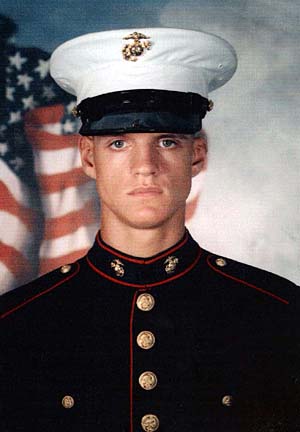
Jason Lee Dunham (November 10, 1981 – April 22, 2004) was a corporal in the United States Marine Corps who was posthumously awarded the Medal of Honor for his actions while serving with 3rd Battalion 7th Marines during the Iraq War. While on a patrol in Husaybah, his unit was attacked. In the course of the fighting, Dunham deliberately used his helmet and body to cover a live grenade and save nearby Marines. When it exploded Dunham was gravely injured and died eight days later.
Key Information


Early life and education
[edit]Jason Dunham was born on November 10, 1981, in Scio, New York, and resided there with his parents, Dan and Deb, and his three siblings, two brothers and a sister. He graduated from Scio High School in 2000,[1] having played basketball for his high school team.[2]
Military service
[edit]
,_honoring_the_late_Cpl.jpg)
Dunham joined the United States Marine Corps in 2000. After graduating from recruit training on October 27 from Golf Company Platoon 2092, he served as a Security Force sentry at Naval Submarine Base Kings Bay in Georgia until 2003.[2]
In early 2004, Dunham was serving as a squad leader with 4th Platoon, Company K, 3rd Battalion, 7th Marine Regiment, 1st Marine Division, I Marine Expeditionary Force.[3] His unit was based in Al-Karābilah.
On April 14, 2004, the battalion commander's convoy came under attack near Husaybah, Iraq, and 4th Platoon was dispatched on patrol to investigate. Dunham and his squad intercepted a number of cars spotted near the scene of the attack, which the patrol detained to search for weapons.[4] When the squad approached a white Toyota Land Cruiser and discovered AK-47s, the driver exited and attacked the Marines in an attempt to flee. Dunham responded by closing in for hand-to-hand combat to subdue him. During the fighting, the individual dropped an armed Mills 36M hand grenade.
Dunham, to save the rest of his men, deliberately threw himself on the grenade, attempting to use his PASGT helmet to shield himself and others from the explosion,[2] warning the others to "watch his hands."[4] Dunham, the insurgent, and two other Marines nearby were all wounded by grenade fragments.
Dunham was severely wounded by the grenade blast, and was immediately evacuated. Within days, he arrived at National Naval Medical Center in Bethesda, Maryland, in a coma, where he was being treated for his injuries. After being diagnosed with brain damage and deemed unlikely to recover, he was taken off life support eight days later, on April 22, 2004.[4][5][6] Shortly beforehand, Commandant of the Marine Corps, General Michael Hagee, presented Dunham with the Purple Heart. Dunham's parents were at his bedside when he died.[5]
In 2004, Michael M. Phillips, staff writer for The Wall Street Journal, wrote an article summarizing Dunham's actions that appeared on page A1 of the May 25 edition.[7] In 2005, Phillips published The Gift of Valor: A War Story, which told Dunham's life story.[3]
Honors and awards
[edit] | This section needs additional citations for verification. (March 2018) |
In addition to the Medal of Honor and his other military decorations, Dunham has also received other honors:
- USS Jason Dunham (DDG-109)
- The United States Post Office in Scio, New York was renamed the Corporal Jason L. Dunham Post Office
- The Marine Corps Security Force Barracks at Naval Submarine Base Kings Bay Georgia was renamed the Corporal Jason Dunham Barracks
- Crucible warrior's station at both Marine Corps Recruit Depot Parris Island, South Carolina and at San Diego, California, are named in his honor
- The Marine Corps League Chapter in Palm Desert, California is named in his honor.
- The Cpl Dunham Room, Corporals Course, Marine Corps Air Station Beaufort, South Carolina.
- A chapter of the Leathernecks Motorcycle Club International is named in his honor.
- Dunham Hall is a Marine Corps dining facility named after Cpl Jason Dunham on Marine Corps Air Ground Combat Center in Twentynine Palms.
Military decorations
[edit]Dunham's awards include:[2]

|

|

| |||

|

|

| |||
  |

|

| |||
 
| |||||
-
 Dunham's uniform on display aboard USS Jason Dunham
 -
 President George W. Bush presents the Medal of Honor to the family of Jason Dunham during a ceremony in the East Room on January 11, 2007


Medal of Honor
[edit]Shortly after his death, Lieutenant Colonel Matthew Lopez, Dunham's commanding officer, began the process of nominating him for the Medal of Honor, the United States' highest award for valor in combat. On November 10, 2006, at the dedication of the National Museum of the Marine Corps, President George W. Bush announced that Corporal Dunham would receive the Medal of Honor, making him the second recipient of the Medal of Honor for actions in the Iraq War and the first Marine recipient for actions since the Vietnam War.[8]
President Bush presented Dunham's family with the Medal of Honor in a ceremony in the East Room of the White House on January 11, 2007.[9][10]
Citation
[edit]The President of the United States in the name of The Congress takes pride in presenting the Medal of Honor posthumously to
JASON L. DUNHAM
UNITED STATES MARINE CORPS
For service as set forth in the following citation:

For conspicuous gallantry and intrepidity at the risk of his life above and beyond the call of duty while serving as Rifle Squad Leader, 4th Platoon, Company K, Third Battalion, Seventh Marines (Reinforced), Regimental Combat Team 7, First Marine Division (Reinforced), on 14 April 2004. Corporal Dunham's squad was conducting a reconnaissance mission in the town of Karabilah, Iraq, when they heard rocket-propelled grenade and small arms fire erupt approximately two kilometers to the west. Corporal Dunham led his Combined Anti-Armor Team towards the engagement to provide fire support to their Battalion Commander's convoy, which had been ambushed as it was traveling to Camp Husaybah. As Corporal Dunham and his Marines advanced, they quickly began to receive enemy fire. Corporal Dunham ordered his squad to dismount their vehicles and led one of his fire teams on foot several blocks south of the ambushed convoy. Discovering seven Iraqi vehicles in a column attempting to depart, Corporal Dunham and his team stopped the vehicles to search them for weapons. As they approached the vehicles, an insurgent leaped out and attacked Corporal Dunham. Corporal Dunham wrestled the insurgent to the ground and in the ensuing struggle saw the insurgent release a grenade. Corporal Dunham immediately alerted his fellow Marines to the threat. Aware of the imminent danger and without hesitation, Corporal Dunham covered the grenade with his helmet and body, bearing the brunt of the explosion and shielding his Marines from the blast. In an ultimate and selfless act of bravery in which he was mortally wounded, he saved the lives of at least two fellow Marines. By his undaunted courage, intrepid fighting spirit, and unwavering devotion to duty, Corporal Dunham gallantly gave his life for his country, thereby reflecting great credit upon himself and upholding the highest traditions of the Marine Corps and the United States Naval Service".[11]
USS Jason Dunham
[edit]_announcement_graphic.jpg)
On March 20, 2007, the Navy reported that a new Arleigh Burke-class destroyer guided missile destroyer would be named USS Jason Dunham (DDG-109), in his honor. In a formal ceremony in Scio on March 23, 2007, Navy Secretary Donald C. Winter officially announced the naming of DDG-109 after Dunham.[12][13] The keel was laid at a ceremony on April 11, 2008, at Bath Iron Works in Bath, Maine.[14] The ship was christened on August 1, 2009, with Dunham's mother Debra acting as the ship's sponsor.[15][16]
Among family members and officials present at the christening, also in attendance were Dunham's Kilo Company commander, Major Trent Gibson, as well as Sergeant Bill Hampton and Corporal Kelly Miller, whose lives he saved, and retired General Hagee. A piece of Dunham's helmet is encased in the mast.[17][18] The Jason Dunham was commissioned on November 13, 2010.[19][20] The ship's galley, named "Jason's Dugout", is decorated with memorabilia from Dunham's favorite baseball team, the New York Yankees.[21]
Other namesakes
[edit]
The Marine Corps Security Force Barracks at Naval Submarine Base Kings Bay was renamed the Cpl Jason Dunham Barracks in late June 2007.[22]
The Cpl Dunham room is located at the Corporals Course at Marine Corps Air Station Beaufort, South Carolina.
A Crucible warrior's station at the Marine Corps Recruit Depot Parris Island, South Carolina and Marine Corps Recruit Depot San Diego, California was named in his honor. When recruits arrive at this station, they will read Cpl Dunham's Medal of Honor citation, and then perform ground-fighting techniques reflecting those Dunham used to defend himself and his fellow Marines leading to his nomination for the Medal of Honor.
A bill to rename the Scio post office, located at 4422 West Sciota Street in Scio, New York, as the Corporal Jason L. Dunham Post Office was submitted to the House of Representatives in December 2005 by Congressman Randy Kuhl. The bill was immediately passed in the House with support from all New York delegation members. With the support of both New York Senators Chuck Schumer and Hillary Clinton, the bill passed the Senate. On March 14, 2006, President Bush signed the bill.[23] He also met with Dunham's family, who gave him a copy of The Gift of Valor.[24]
See also
[edit]
- List of Medal of Honor recipients
- Rafael Peralta – another US marine who died while shielding others from a grenade
References
[edit]- Specific
- ^ "Remembering Medal of Honor recipient Jason Dunham". Marine Corps News. United States Marine Corps. November 16, 2010. Archived from the original on October 7, 2012. Retrieved March 8, 2015.
- ^ a b c d "Corporal Jason L. Dunham, USMC (deceased)". Who's Who in Marine Corps History. United States Marine Corps History Division. Archived from the original on June 15, 2011. Retrieved March 8, 2015.
- ^ a b Phillips, 2005.
- ^ a b c Dunham: A Life of Honor (video documentary). United States Marine Corps. Archived from the original on July 18, 2011. Retrieved March 8, 2015.
- ^ a b Garcia, Sgt Jose L. "Marines honor corporal's heroic sacrifice". Marine Corps News. United States Marine Corps. Archived from the original on June 29, 2011. Retrieved March 8, 2015.
- ^ Phillips, Michael M. "How Do You Repay A Hero's Sacrifice; Three years ago, a fellow Marine gave his life to save Kelly Miller. It has been a hard road since". The Wall Street Journal. p. A1.
- ^ Phillips, Michael M. "In Combat, Marine Put Theory to Test, Comrades Believe Cpl. Dunham's Quick Action in Face of Grenade Saved 2 Lives" (PDF). The Wall Street Journal. p. A1. Archived from the original (PDF) on April 6, 2015. Retrieved January 6, 2016. Republished on Jason Dunham Memorial Website.
- ^ Fuentes, Gidget. "Medal of Honor is first for a Marine since Vietnam". Marine Corps Times. Archived from the original on February 5, 2012. Retrieved March 8, 2015.
- ^ Donnelly, Sally B. "Iraq: The War Without Honors". TIME. Archived from the original on December 10, 2006. Retrieved March 8, 2015.
- ^ Hoellwarth, John. "Dunham family to get Medal of Honor Thursday". Marine Corps Times. Archived from the original on June 12, 2012. Retrieved March 8, 2015.
- ^ "Medal of Honor recipients". American Medal of Honor recipients for the Iraq War. United States Army Center of Military History. Archived from the original on May 26, 2009. Retrieved March 8, 2015.
- ^ "Destroyer to be named after N.Y. Marine". NBC News]. Associated Press. Retrieved March 8, 2015.
- ^ "Navy Names New Guided-Missile Destroyer USS Jason Dunham". Navy newsstand. United States Navy. Story Number NNS070323-25. Archived from the original on June 30, 2008. Retrieved March 8, 2015.
- ^ Gams, PFC Michael T. "Legacy lives aboard USS Jason Dunham". Marines Magazine. United States Marine Corps. Archived from the original on October 29, 2014. Retrieved March 8, 2015.
- ^ "Navy Christens Newest Arleigh Burke-Class Ship Jason Dunham". Navy News Service. Archived from the original on June 29, 2011. Retrieved March 8, 2015.
- ^ Lugo, LCpl A.J. USS Jason Dunham (video newscast). Bath, Maine: United States Marine Corps. Archived from the original on July 18, 2011. Retrieved March 8, 2015.
- ^ "Ship named for MoH recipient to be christened". Navy Times. July 29, 2009. Retrieved March 8, 2015.
- ^ Gams, PFC Michael T. "Putting the pieces in their place; Cpl. Dunham's legacy lives on". Marine Corps Air Ground Combat Center Twentynine Palms. United States Marine Corps. Archived from the original on October 7, 2012. Retrieved March 8, 2015.
- ^ "Jason Dunham". Naval Vessel Register. Retrieved March 8, 2015.
- ^ "Navy to Commission New Guided-Missile Destroyer Jason Dunham". Navy News Service. Archived from the original on March 5, 2012. Retrieved March 8, 2015.
- ^ Shea, Sgt Jimmy D. "USS Jason Dunham commissioned, legacy lives on". United States Marine Corps. Archived from the original on October 7, 2012. Retrieved March 8, 2015.
- ^ MC2 (SW) Michael Wiss. "Marine Barracks to be renamed for Medal of Honor recipient". Kings Bay Periscope. United States Navy. Archived from the original on September 28, 2007. Retrieved March 8, 2015.
{{cite news}}: CS1 maint: numeric names: authors list (link) - ^ Kuhl, John R. "Kuhl Bill to honor Dunham passes House: Kuhl bill names post office in Scio after fallen Marine Corporal Jason Dunham". New York's 29th congressional district. United States House of Representatives. Retrieved March 8, 2015.
{{cite web}}:|archive-url=is malformed: timestamp (help)CS1 maint: url-status (link) - ^ WHEC-TV News 10 broadcast, March 16, 2006.
- General
- "Jason Dunham Medal of Honor citation". Marine Corps News. United States Marine Corps. Archived from the original on January 12, 2007. Retrieved January 11, 2007.
- Phillips, Michael M. (2005). The Gift of Valor: A War Story. New York City: Broadway Books. ISBN 0-7679-2037-6.
- "Schumer asks President to award Congressional Medal of Honor to Hero NY Marine who died after saving others in Iraq". Press Release from Senator Charles E. Schumer. United States Senate. May 27, 2004. Archived from the original on June 30, 2006. Retrieved July 9, 2006.
- Kniess, Jr., David C. "Dunham, American Son: The Story of Cpl Jason L. Dunham". Archived from the original on November 9, 2010. Retrieved September 29, 2010.
- Dunn, SSgt Scott. "First Long War Marine to receive Medal of Honor". Marine Corps News. United States Marine Corps. Retrieved March 8, 2015.
- Block, Melissa. "Cpl. Jason Dunham's "Gift of Valor"". All Things Considered. NPR. Retrieved March 8, 2015.
- "Marines keep me safe". Talking Proud. Archived from the original on July 15, 2006. Retrieved March 8, 2015.
- "A Hero's Hand". CNN. Retrieved March 8, 2015.
- "USS Jason Dunham DDG-109". MaritimeQuest. Retrieved March 8, 2015.
External links
[edit]
- "Jason L. Dunham memorial website". July 17, 2015. Archived from the original on July 17, 2015. Retrieved March 26, 2018.
- "Official website for USS Jason Dunham (DDG 109)". United States Navy. Archived from the original on July 8, 2015. Retrieved March 3, 2009.
| International | |
|---|---|
| National | |

Jason Dunham
View on GrokipediaEarly Life
Upbringing in Scio, New York
Jason Lee Dunham was born on November 10, 1981, in Scio, New York, a rural town in Allegany County with a population of approximately 1,800 residents.[5][2] Adopted as an infant by Dan Dunham, a U.S. Air Force veteran, and his wife Deb, a local public school teacher, Dunham was raised alongside three siblings in a family emphasizing public service and military tradition.[8][5][9] Throughout his childhood and adolescence in Scio, Dunham was characterized by family and friends as an all-American boy: an above-average student who actively participated in sports, with a particular passion for basketball, reflecting the close-knit, community-oriented environment of the town.[4][10] He remained in Scio until completing his education, graduating from Scio Central School in early 2000.[11][12]Education and Formative Influences
Dunham attended Scio Central School in his hometown of Scio, New York, graduating in early 2000.[2] During high school, he participated in basketball, contributing to team activities that honed his teamwork and discipline.[13] He was described as a quiet individual who enjoyed outdoor pursuits such as hunting and fishing, reflecting a rural upbringing that emphasized self-reliance.[12] His formative influences included a family environment steeped in public service; his adoptive father, Dan Dunham, was an Air Force veteran, while his mother, Deb, served as a public school teacher in Scio.[5] This background, combined with early displays of leadership in sports and community settings, cultivated traits of unselfishness and responsibility evident in his later military conduct.[10] Living his entire pre-enlistment life in the small town of Scio fostered a strong sense of duty and camaraderie among peers.[12]Enlistment and Marine Corps Training
Decision to Join and Initial Training
Dunham graduated from Scio Central School in June 2000 and enlisted in the United States Marine Corps shortly thereafter, seeking the challenge of its rigorous training to distinguish himself beyond his father's Army service.[5] His decision reflected an early aptitude for leadership and physical demands, honed through high school athletics where he excelled in wrestling and football.[10] He reported to Marine Corps Recruit Depot Parris Island, South Carolina, for recruit training in the summer of 2000, completing the 13-week program on October 27, 2000.[4] Boot camp emphasized discipline, marksmanship, and combat skills, transforming civilians into Marines through intense physical conditioning and team-building exercises. Following graduation, Dunham initially served as a security forces sentry, gaining foundational experience before advancing to infantry roles.[4]Development as a Leader
After completing recruit training at Marine Corps Recruit Depot Parris Island in July 2000, Dunham initially served with Marine Corps Security Forces at Naval Submarine Base Kings Bay, Georgia.[2] Seeking greater challenges, he volunteered for transfer to the infantry and was assigned to Company K, 3rd Battalion, 7th Marines at Twentynine Palms, California, where he underwent further specialized training in infantry tactics and operations.[2] This move demonstrated early initiative and commitment to combat roles, marking a pivotal step in honing his operational skills beyond basic security duties.[10] Promoted to corporal by early 2003, Dunham was selected as a rifle squad leader in the 4th Platoon, a role requiring demonstrated reliability, tactical proficiency, and the ability to inspire subordinates—qualities he exhibited through consistent engagement with his peers.[14] Contemporaries noted his genuine concern for fellow Marines, calm demeanor under pressure, and habit of sharing hardships, such as training and living conditions, which fostered trust and cohesion within his unit prior to deployment.[15] These traits, cultivated through unit exercises and progressive responsibilities, positioned him as a capable non-commissioned officer admired for his selflessness and leadership by example.[10]Deployment and Service in Operation Iraqi Freedom
Assignment to 2nd Battalion, 7th Marines
After completing his initial enlistment period with Marine Corps Security Forces at Naval Submarine Base Kings Bay, Georgia, Corporal Jason L. Dunham requested and received a transfer to an infantry unit in 2003. He was assigned to Company K, 3rd Battalion, 7th Marines (3/7), 1st Marine Division, based at Marine Corps Base Twentynine Palms, California, joining the battalion in October 2003 with a group of 37 other Marines.[16][4] Within 3/7, Dunham initially filled the role of machine gunner but quickly advanced due to his initiative and reliability, assuming duties as rifle squad leader for the 4th Platoon.[16][1] This assignment positioned him for the battalion's imminent deployment, as 3/7 prepared for combat operations in Iraq under Operation Iraqi Freedom, emphasizing counterinsurgency efforts in western Al Anbar Province.[2] The transfer marked Dunham's shift from static security duties to frontline infantry service, aligning with his expressed desire for more demanding roles amid escalating global operations post-9/11.[17] By early 2004, as the unit conducted pre-deployment training, Dunham's leadership contributed to squad cohesion in anticipation of urban patrolling and reconnaissance missions.[4]Patrolling in Al Anbar Province
In early 2004, Company K, 3rd Battalion, 7th Marines, deployed to Al Anbar Province as part of Regimental Combat Team 7, assuming responsibility for stability and security operations in the western Euphrates River valley, including the border towns of Husaybah and Karabilah.[18] These areas served as key infiltration routes for insurgents and foreign fighters crossing from Syria, prompting routine patrolling to disrupt enemy movements, secure supply lines, and prevent attacks on coalition forces and Iraqi civilians.[1] Patrols typically involved combined anti-armor teams (CAATs) like Corporal Dunham's, which combined rifle squads with heavy machine guns and anti-tank weapons mounted on high-mobility multipurpose wheeled vehicles (HMMWVs) for rapid response.[1] Dismounted elements conducted reconnaissance missions on foot through urban environments, navigating narrow streets and checking suspicious vehicles for weapons and explosives, as insurgents frequently employed hit-and-run tactics with small-arms fire, rocket-propelled grenades, and improvised explosive devices.[1] By April, escalating tensions—fueled by broader unrest in nearby Fallujah—intensified patrol frequency, with units establishing checkpoints and sweeping hamlets to gather intelligence and deter ambushes.[19] Dunham, leading a squad in the 4th Platoon, participated in these operations, emphasizing disciplined fire control and squad cohesion amid the constant threat of concealed enemies embedded in civilian areas.[1] The patrols faced a deteriorating security environment, with insurgents launching coordinated assaults to test Marine resolve, resulting in multiple firefights and casualties across the battalion in the weeks leading to mid-April.[20] Despite the hazards, these missions succeeded in maintaining operational tempo, enabling the unit to support larger counterinsurgency efforts while minimizing civilian harm through precise rules of engagement.[21]The Combat Incident in Husaybah
Engagement with Insurgents
On April 14, 2004, Corporal Jason L. Dunham's squad from Company K, 3rd Battalion, 7th Marines, was conducting a reconnaissance mission in the town of Karabilah, Al Anbar Province, Iraq, when they heard rocket-propelled grenade and small arms fire erupting approximately two kilometers to the west.[1] The fire stemmed from an ambush on the battalion commander's convoy by insurgents, prompting Dunham, as rifle squad leader of a combined anti-armor team, to lead his unit toward the engagement to provide fire support.[3] [22] Upon arriving at the scene, Dunham's squad took positions on a rooftop overlooking the fight, delivering suppressive fire against the insurgents attacking the convoy and beleaguered Marines below.[1] This support helped stabilize the initial ambush, which involved coordinated insurgent assaults using small arms and RPGs in the urban environment near the Syrian border. During the exchange, the Marines repelled multiple insurgent positions, but the threat persisted as enemy fighters maneuvered to flank the convoy.[7] As the firefight continued, Dunham's team detected an insurgent who had infiltrated the building housing the command group, posing an immediate threat to leadership elements.[22] Dunham promptly organized and led a small assault team into the structure to neutralize the penetrator, initiating close-quarters combat.[1] The insurgent responded with rifle fire at point-blank range, striking and wounding two Marines before the situation escalated further.[3] This direct engagement highlighted the insurgents' tactic of blending into civilian areas to launch surprise attacks on Marine patrols and convoys in the Al Qaim region.Dunham's Act of Valor
On April 14, 2004, Corporal Jason L. Dunham, serving as rifle squad leader for the 4th Platoon, Company K, 3rd Battalion, 7th Marines, was conducting zone reconnaissance along a supply route near Husaybah, Al Anbar Province, Iraq, when his unit received reports of an attack on a nearby Marine convoy.[1] Dunham promptly directed his combined anti-armor team, consisting of seven Marines and one Navy Corpsman, toward the engagement site to provide fire support.[2] Upon arrival, the squad encountered four Iraqi insurgents in close proximity to the ambushed vehicles.[3] Without hesitation, Dunham ordered his Marines to dismount and advance on the enemy positions. As the squad closed in, one insurgent seized a fellow Marine by the throat in an attempt to take him hostage. Dunham, along with two squad members, immediately tackled the attacker to the ground, initiating a fierce hand-to-hand struggle.[1] During the melee, the insurgent managed to pull the pin and release a grenade. Spotting the device, Dunham shouted warnings to his comrades—"Grenade!"—and urgently directed them to seek cover while positioning himself over the explosive.[2] With no time to retreat, he placed his Kevlar helmet over the grenade and threw his body atop it, deliberately absorbing the impending blast to shield the others.[3] The grenade detonated seconds later, with Dunham bearing the full force of the fragmentation and concussive effects. His actions prevented lethal injuries to at least two nearby Marines, though two others sustained minor wounds from shrapnel.[1] Dunham himself suffered catastrophic injuries, including severe brain trauma from over a dozen shrapnel pieces penetrating his helmet and skull, yet his selfless sacrifice exemplified extraordinary valor under immediate threat.[2] The remaining insurgents were neutralized by the squad's fire, securing the area.Medical Aftermath and Death
Evacuation and Treatment
Following the grenade explosion on April 14, 2004, Corporal Jason Dunham sustained severe injuries, including irreparable brain damage from shrapnel penetrating his skull, and was immediately evacuated from the battlefield near Husaybah, Iraq.[4][17] Medical personnel stabilized him at the site before rapid transport via military medical evacuation assets to a field hospital. Dunham was then transferred to Ibn Sina Hospital in Baghdad for initial surgical intervention and intensive care, addressing traumatic brain injury and associated complications such as swelling and hemorrhage. From there, he was airlifted to Landstuhl Regional Medical Center in Germany for advanced neurosurgical evaluation and stabilization, a standard progression in the U.S. military's casualty evacuation chain during Operation Iraqi Freedom. Within a couple of days of the incident, he arrived at the National Naval Medical Center in Bethesda, Maryland, where he remained in a coma under life support.[4][23] Medical assessments at Bethesda confirmed the extent of his brain damage, rendering recovery improbable despite aggressive treatments including mechanical ventilation and intracranial pressure monitoring.[4][13] Physicians determined that further intervention would not restore neurological function, leading to the decision to withdraw life support on April 22, 2004.[4][13] This sequence reflected the era's military medical protocols, prioritizing rapid evacuation to higher echelons of care amid the challenges of combat-zone trauma.[22]Final Days and Passing
Following evacuation to the National Naval Medical Center in Bethesda, Maryland, Dunham remained in a coma due to irreparable brain damage caused by shrapnel that had pierced his skull during the grenade explosion.[4] Medical assessments determined that recovery was unlikely, with severe neurological impairment rendering long-term survival improbable.[17] His parents, Dan and Debora Dunham, stayed at his bedside throughout, grappling with the prognosis alongside medical staff.[24] On April 22, 2004—eight days after the incident—Dunham's family, informed by his prior living will and discussions with his father about end-of-life preferences, authorized the removal of life support.[25] He passed away later that day at age 22, surrounded by his parents, sister, and fellow Marines who had traveled to honor his sacrifice.[26] Dunham's death marked the culmination of his selfless act, which had saved the lives of at least two comrades in Husaybah.[27]Posthumous Honors and Recognition
Medal of Honor Process and Ceremony
Following Corporal Jason L. Dunham's death on April 22, 2004, his commanding officers initiated the Medal of Honor recommendation process based on eyewitness accounts from the April 14 engagement in Karabilah, Iraq, where he placed his helmet over a grenade and then covered it with his body to shield fellow Marines.[1] The nomination underwent rigorous review, including validation of survivor testimonies and incident reconstruction, progressing through the U.S. Marine Corps chain of command to the Secretary of the Navy, Secretary of Defense, and finally to presidential approval under established Department of Defense protocols for extraordinary heroism.[2] This process, which typically spans years to ensure evidentiary substantiation, confirmed Dunham's actions met the Medal of Honor criteria of "conspicuous gallantry and intrepidity at the risk of life above and beyond the call of duty."[1] President George W. Bush approved the award in late 2006, marking Dunham as the first Marine Corps recipient for Operation Iraqi Freedom and the first overall since the Vietnam War.[28] The posthumous presentation occurred on January 11, 2007, in the East Room of the White House, where Bush personally bestowed the medal upon Dunham's parents, Dan and Debora Dunham, in the presence of military leaders, family, and fellow service members.[28] In his remarks, Bush emphasized Dunham's leadership as a squad leader and his deliberate sacrifice, stating, "In the fierce struggle against terrorists in Iraq, Corporal Dunham's act of valor saved the lives of two of his men and possibly many more."[28] The ceremony underscored the rarity of the award, with Dunham being only the second service member honored for Iraq War actions after Army Sergeant First Class Paul R. Smith in 2005.[29] Official transcripts and video from the event document the emotional proceedings, including tributes to Dunham's pre-combat writings expressing commitment to his Marines.[28] No significant disputes arose during the review, distinguishing it from other high-profile nominations that faced evidentiary challenges or downgrades.[30]Military Decorations and Citation
Dunham was posthumously awarded the Medal of Honor, the United States' highest military decoration for valor, on January 11, 2007, during a White House ceremony where President George W. Bush presented the medal to his parents, Dan and Debora Dunham.[2] The award recognized his actions on April 14, 2004, in Husaybah, Iraq, where he sacrificed his life to save fellow Marines by covering a grenade with his helmet and body.[1]
For conspicuous gallantry and intrepidity at the risk of his life above and beyond the call of duty while serving as Rifle Squad leader, 4th Platoon, Company K, 3d Battalion, 7th Marines, Regimental Combat Team 7, 1st Marine Division, I Marine Expeditionary Force, U.S. Marine Corps, on 14 April 2004, in support of Operation Iraqi Freedom. Early in the morning, during a reconnaissance mission in Husaybah, Al Anbar Province, Iraq, Corporal Dunham's squad was conducting a search of a house when an insurgent ambushed a nearby Iraqi National Guardsman, wounding him. As his squad provided suppressive fire, Corporal Dunham moved to aid the casualty and engaged the insurgent in hand-to-hand combat. During the struggle, the enemy released a grenade. With complete disregard for his own life, Corporal Dunham warned his Marines and smothered the grenade with his helmet and body, absorbing the explosion that gravely wounded him but saved at least two comrades. Corporal Dunham's extraordinary heroism and unselfish devotion to duty reflect the highest credit upon himself and the Marine Corps, and uphold the noblest traditions of the United States Naval Service.[1][5]In addition to the Medal of Honor, Dunham received the Purple Heart shortly before his death on April 22, 2004, for wounds sustained in combat.[31] His other decorations included the Combat Action Ribbon for direct participation in ground combat, Navy Meritorious Unit Commendation for unit valor, Marine Corps Good Conduct Medal for exemplary service, National Defense Service Medal with one bronze service star, Iraq Campaign Medal, Global War on Terrorism Service Medal, and Navy and Marine Corps Sea Service Deployment Ribbon.[2] He also earned the Rifle Marksman badge (sharpshooter qualification) and Pistol Expert badge during training.[2]