


Community hub
Recent from talks
Contribute something
Nothing was collected or created yet.
Chick Evans
View on Wikipedia
Charles E. "Chick" Evans Jr. (July 18, 1890 – November 6, 1979) was a prominent American amateur golfer of the 1910s and 1920s. Evans, who won the 1910 Western Open, became the first amateur to win both the U.S. Open and U.S. Amateur in one year, a feat he achieved in 1916. Evans won the U.S. Amateur again in 1920, and was runner-up three times. Selected to the Walker Cup team in 1922, 1924, and 1928, he competed in a record 50 consecutive U.S. Amateurs in his long career. Evans achieved all of this while carrying only seven hickory-shafted clubs.
Key Information


In addition to his golf career, Evans is known for founding the Evans Scholars Foundation, which provides a college scholarship for qualified caddies.
In 1960, Evans was voted the Bob Jones Award, the highest honor given by the United States Golf Association in recognition of distinguished sportsmanship in golf. He is a member of the World Golf Hall of Fame.
Early life
[edit]Born in Indianapolis, Indiana, Evans' family moved to Chicago when he was eight years old, and he grew up on the north side of the city. His father, Charles Evans, was one of the most influential librarians of the 20th century. At the age of eight, he was first exposed to golf as a caddie at a Chicago course, the Edgewater Golf Club. He attended secondary school at the Evanston Academy, and won the 1907 and 1908 Western Interscholastic tournaments. He led in the founding of the Western Interscholastic Golf Association (WIGA), and led Evanston Academy to the 1908 WIGA team championship.[2]
Golf career
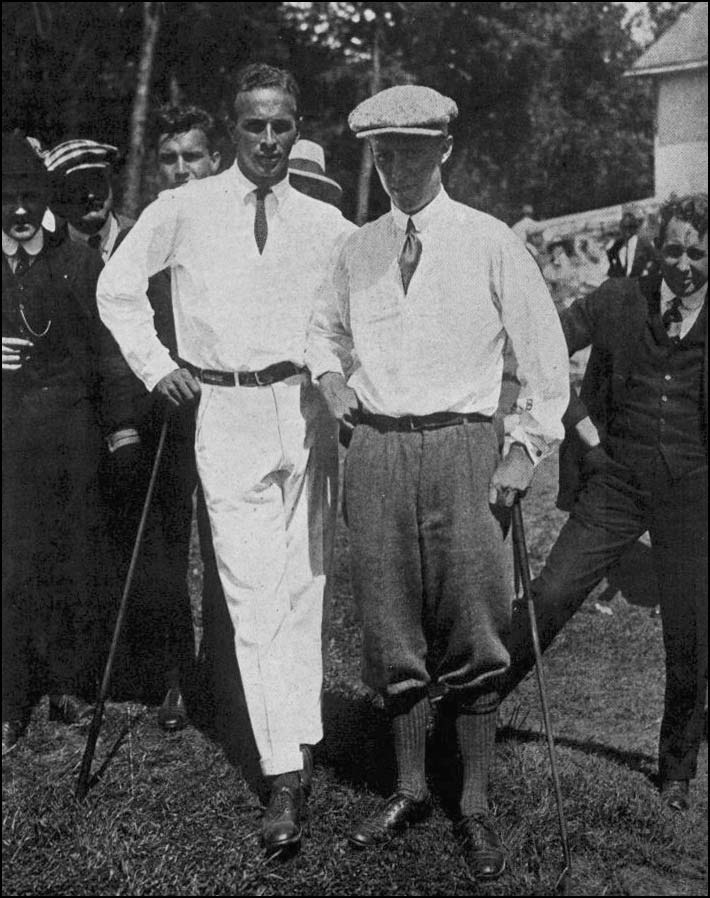
[edit].jpg)
From these beginnings, Evans became one of the most acclaimed American amateur golfers of his time. The accomplishment that gave him the most contemporary publicity came in 1916, when he won both the U.S. Amateur and U.S. Open in the same year. Evans was the first person to accomplish this task, and only Bobby Jones has done it since.
Evans also won the Western Open in 1910 by defeating George Simpson 6 and 5 in the 36-hole final. He was the only amateur to do so until Scott Verplank in 1985.[3] Simpson graciously praised Evans on his victory, saying “I’ve learned the greatest golf lesson of my life today. I consider it a greater honor to be beaten by the kind of golf you have played than to have remained out of the tournament because I did not fancy match play.”[4]
Into the 1960s, Evans was an active participant in senior tournaments, and still competed in U.S. Amateur events, eventually setting a record of completing 50 of these championships. Evans played his last rounds of competitive golf in 1968, winning the Illinois Open that year. His last Western Amateur was in 1967.[1]
After his retirement, Evans continued to attend events as a spectator and converse with the fans and players.
Evans Scholars Foundation
[edit]After his wins in 1916, Evans was given several thousand dollars in royalties for recording golf instructions for the Brunswick Record Company, and in 1921 he received royalties from a golf book.[5] If he had accepted this money Evans would have lost his amateur status. His mother suggested that he put the money to good use by sponsoring a scholarship fund for caddies.
Evans, who was unable to finish his own matriculation at Northwestern University, recalled that his mother "wouldn't think of accepting my money unless we could arrange it to be trusted to furnish educations for deserving qualified caddies." He said his mother "pointed out that the money came from golf and thus should go back into golf -- It was all her dream -- her idea."
Evans went to the Western Golf Association (WGA), an organization that ran the golf championships in the Midwest, to get their support for his scholarship. By 1930, the Evans Scholars Foundation had formed[3] and two caddies, Harold Fink and Jim McGinnis, were named the first two Evans Scholars.
Chick Evans' long friendship with Chicago tax attorney, Carleton Blunt, had proved to be the catalyst for launching the Evans Scholars Foundation. Blunt, an avid golfer and philanthropist, supported Evans' vision for helping caddies attend colleges and universities across the country by raising the necessary funds for decades.
The criteria used to choose the recipients were scholarship, fellowship and leadership. Since that time, over 10,600 caddies have become Evans Scholars and attained college educations. The Evans scholarship program continues today as the largest scholarship organization in sports and the largest privately funded scholarship program in the United States.
Evans Scholarship houses exist at the following Universities: University of Colorado, University of Illinois, Northwestern University, Marquette University, University of Wisconsin, Purdue University, Ohio State University, Northern Illinois University, University of Missouri, Indiana University, University of Michigan, Michigan State University, Miami University and the University of Minnesota.
On February 19, 2014, the Evans Scholars Foundation announced their plans to build a new chapter house at the University of Oregon. It is the first new Scholarship House in 27 years.[6] In addition to those universities at which houses exist, scholarship recipients attend several other universities around the country. More than 800 caddies currently attend college on an Evans Scholarship.
Death and legacy
[edit]_and_Chick_Evans_(1890%E2%80%931979)_at_Memorial_Park_Cemetery,_Skokie,_IL.jpg)
Evans died on November 6, 1979, at age 89, and was buried at Memorial Park Cemetery in Skokie, Illinois. His wife, Esther, had died in 1967 after 40 years of marriage. They had no children.[1] The Chick Evans Golf Course in Morton Grove, a north suburb of Chicago, is named in his honor.
Tournament wins (22)
[edit]- 1907 Chicago Amateur, Western Junior, Western Interscholastic
- 1908 Chicago Amateur, Western Interscholastic
- 1909 Western Amateur[7]
- 1910 Western Open[4]
- 1911 French Open Amateur Championship, North and South Amateur, Chicago Amateur
- 1912 Western Amateur[7]
- 1914 Western Amateur, Chicago District Amateur[7]
- 1915 Western Amateur[7]
- 1916 U.S. Open, U.S. Amateur
- 1920 U.S. Amateur, Western Amateur
- 1921 Western Amateur
- 1922 Western Amateur
- 1923 Western Amateur
- 1925 Kansas City Open
Professional major championships
[edit]
Wins (1)
[edit]| Year | Championship | 54 Holes | Winning score | Margin | Runner-up |
|---|---|---|---|---|---|
| 1916 | U.S. Open | 3 shot lead | −2 (70-69-74-73=286) | 2 strokes |  Jock Hutchison Jock Hutchison
|
Results timeline
[edit]Note: As an amateur, Evans was ineligible to play in the PGA Championship.
| Tournament | 1911 | 1912 | 1913 | 1914 | 1915 | 1916 | 1917 | 1918 | 1919 |
|---|---|---|---|---|---|---|---|---|---|
| U.S. Open | 2 LA | 18 | 1 LA | NT | NT | T9 LA | |||
| The Open Championship | T49 | NT | NT | NT | NT | NT |
| Tournament | 1920 | 1921 | 1922 | 1923 | 1924 | 1925 | 1926 | 1927 | 1928 | 1929 |
|---|---|---|---|---|---|---|---|---|---|---|
| U.S. Open | T6 LA | 4 LA | 16 | T14 | T10 | T13 | CUT | CUT | ||
| The Open Championship |
| Tournament | 1930 | 1931 | 1932 | 1933 | 1934 | 1935 | 1936 | 1937 | 1938 | 1939 |
|---|---|---|---|---|---|---|---|---|---|---|
| Masters Tournament | NYF | NYF | NYF | NYF | ||||||
| U.S. Open | T54 | T50 | ||||||||
| The Open Championship |
| Tournament | 1940 | 1941 | 1942 | 1943 | 1944 | 1945 | 1946 | 1947 | 1948 | 1949 |
|---|---|---|---|---|---|---|---|---|---|---|
| Masters Tournament | 51 | NT | NT | NT | ||||||
| U.S. Open | CUT | NT | NT | NT | NT | CUT | CUT | CUT | ||
| The Open Championship | NT | NT | NT | NT | NT | NT |
| Tournament | 1950 | 1951 | 1952 | 1953 | 1954 | 1955 | 1956 | 1957 | 1958 | 1959 | 1960 |
|---|---|---|---|---|---|---|---|---|---|---|---|
| Masters Tournament | 64 | CUT | CUT | ||||||||
| U.S. Open | CUT | ||||||||||
| The Open Championship |
LA = Low amateur
NYF = Tournament not yet founded
NT = No tournament
CUT = missed the half-way cut
"T" indicates a tie for a place
Amateur major championships
[edit]Wins (2)
[edit]| Year | Championship | Winning score | Runner-up |
|---|---|---|---|
| 1916 | U.S. Amateur | 4 & 3 |  Robert A. Gardner Robert A. Gardner
|
| 1920 | U.S. Amateur | 7 & 6 | Francis Ouimet
|
Results timeline
[edit]| Tournament | 1909 | 1910 | 1911 | 1912 | 1913 | 1914 | 1915 | 1916 | 1917 | 1918 | 1919 |
|---|---|---|---|---|---|---|---|---|---|---|---|
| U.S. Amateur | SF M | SF | SF | 2 M | SF M | R32 | R32 | 1 | NT | NT | R16 |
| The Amateur Championship | R16 | R32 | NT | NT | NT | NT | NT |
| Tournament | 1920 | 1921 | 1922 | 1923 | 1924 | 1925 | 1926 | 1927 | 1928 | 1929 |
|---|---|---|---|---|---|---|---|---|---|---|
| U.S. Amateur | 1 | SF | 2 | R32 M | R32 | DNQ | QF | 2 | R32 | DNQ |
| The Amateur Championship | R64 | R128 |
| Tournament | 1930 | 1931 | 1932 | 1933 | 1934 | 1935 | 1936 | 1937 | 1938 | 1939 |
|---|---|---|---|---|---|---|---|---|---|---|
| U.S. Amateur | DNQ | DNQ | QF | R32 | QF | R256 | R64 | QF | DNQ | |
| The Amateur Championship |
| Tournament | 1940 | 1941 | 1942 | 1943 | 1944 | 1945 | 1946 | 1947 | 1948 | 1949 |
|---|---|---|---|---|---|---|---|---|---|---|
| U.S. Amateur | DNQ | DNQ | NT | NT | NT | NT | DNQ | R256 | R128 | R256 |
| The Amateur Championship | NT | NT | NT | NT | NT | NT | R64 | R128 |
| Tournament | 1950 | 1951 | 1952 | 1953 | 1954 | 1955 | 1956 | 1957 | 1958 | 1959 |
|---|---|---|---|---|---|---|---|---|---|---|
| U.S. Amateur | R256 | R256 | R128 | R256 | R256 | R128 | R256 | R64 | R64 | R128 |
| The Amateur Championship | R512 | R128 | R256 | R64 |
| Tournament | 1960 | 1961 | 1962 |
|---|---|---|---|
| U.S. Amateur | R256 | R256 | R256 |
| The Amateur Championship |
M = Medalist
DNQ = Did not qualify for match play portion
R256, R128, R64, R32, R16, QF, SF = Round in which player lost in match play
Sources: Amateur Championship: 1911,[8] 1914,[9] 1921,[10] 1926,[11] 1946,[12] 1949,[13] 1950,[14] 1952,[15] 1953,[16] 1955[17]
U.S. national team appearances
[edit]Amateur
- Walker Cup: 1922 (winners), 1924 (winners), 1928 (winners)
References
[edit]- ^ a b c "Amateur golf star Chick Evans dies". Wilmington Morning Star. Associated Press. November 8, 1979. p. 7-D. Retrieved April 14, 2013.
- ^ Pruter, Robert (2013). The Rise of American High School Sports and the Search for Control, 1880-1930. Syracuse University Press. pp. 130–1.
- ^ a b "Chick Evans Biography". Western Golf Association. Archived from the original on October 18, 2013. Retrieved September 2, 2013.
- ^ a b "Amateur Evans is New Western Open Title Holder". The Inter Ocean. Chicago, Illinois. September 4, 1910. p. 16 – via Newspapers.com.
- ^ Evans, Charles (1921). Chick Evans' Golf Book. Chicago: Reilly & Lee (for Thos E Wilson). Retrieved April 14, 2013.
- ^ "Evans Scholars Foundation to open Scholarship House at the University of Oregon". February 19, 2014. Retrieved February 20, 2014.
- ^ a b c d "Chick Evans Wins". Richmond Times Dispatch. July 25, 1915. p. 1. Retrieved May 19, 2015.
- ^ "'Chick' Evans Inn Britain" (PDF). The American Golfer. July 1911. pp. 179–87.
- ^ "Golf Illustrated, July, 1914, pg. 28". Archived from the original on December 5, 2014. Retrieved January 28, 2011.
- ^ The American Golfer, June 4, 1921, pg. 24.
- ^ The American Golfer, July, 1926, pg. 58. Archived June 16, 2012, at the Wayback Machine
- ^ The Glasgow Herald, May 30, 1946, pg. 2.
- ^ The Glasgow Herald, May 25, 1949, pg. 2.
- ^ The Glasgow Herald, May 23, 1950, pg. 9.
- ^ The Glasgow Herald, May 29, 1952, pg. 7.
- ^ The Glasgow Herald, May 27, 1953, pg. 4.
- ^ The Glasgow Herald, June 2, 1955, pg. 4.
External links
[edit]
- Works by or about Chick Evans at the Internet Archive
- USGA – Looking Back: 1916 U.S. Amateur at Merion
- Chick Evans at the World Golf Hall of Fame
- Official Site of the Western Golf Association/Evans Scholars Foundation
- Evans Scholarship Chapters
| International | |
|---|---|
| National | |
| Artists | |
| Other | |

Chick Evans
View on GrokipediaEarly life
Birth and family background
Charles "Chick" Evans Jr. was born on July 18, 1890, in Indianapolis, Indiana, to Charles Evans, a noted American librarian and bibliographer, and Lena Young Evans.[4] His father had begun his career in library science earlier in life, working at institutions such as the Boston Athenaeum and the Indianapolis Public Library before advancing in the field.[5] In 1893, when Evans was three years old, the family relocated to Chicago, Illinois, to allow his father to take a position as classifier of collections at the newly established Newberry Library, an opportunity that aligned with his expertise in bibliography.[2]) They settled in a middle-class neighborhood on the city's north side, near the Edgewater Golf Club, in a home that reflected their professional but unpretentious circumstances.[6] Evans was the second of three children, sharing the household with siblings Eliot H. Evans and a sister who later married Donald Jones; the family dynamics emphasized intellectual pursuits, with his father's scholarly dedication shaping a home environment focused on learning and discipline.[7] His mother placed particular stress on education, later collaborating with him on initiatives to support academic opportunities for others.[2] Raised in modest financial means that required self-reliance, Evans developed an early empathy for working-class youth, influenced by the family's transition from Indianapolis to Chicago's emerging cultural scene.Introduction to golf and education
Charles "Chick" Evans Jr.'s introduction to golf came through his family's relocation to Chicago in 1893, which provided access to local golf clubs. At the age of eight in 1898, he began caddying at the Edgewater Golf Club on Chicago's North Side, where he carried bags for players at a rate of 10 cents per round on the nine-hole course. This early role allowed him to closely observe elite golfers and club professionals, fostering a deep appreciation for the sport while helping to support his family financially during challenging times.[8][1][9][10] Through these long hours on the course, Evans developed a strong work ethic and taught himself the fundamentals of golf by mimicking the techniques of the professionals he watched. His caddying experience not only honed his understanding of strategy and course management but also instilled values of perseverance and humility that would define his approach to the game. Balancing this demanding work with his growing interest in golf, Evans transitioned from observer to participant, laying the groundwork for his future achievements without formal instruction.[1][11] Evans pursued his formal education at Evanston Academy, enrolling around 1904 and excelling academically despite his commitments to caddying. He demonstrated his emerging golf talent by winning the Western Interscholastic individual titles in both 1907 and 1908, while also contributing to his school's team success in 1908. These high school accomplishments highlighted his ability to integrate rigorous studies with athletic pursuits, reflecting a disciplined mindset shaped by his early experiences.[12][13] Following graduation in 1909, Evans briefly attended Northwestern University to study business but left without completing a degree to focus on golf and emerging professional opportunities in stock brokerage. His time at the university was short-lived, yet he continued to value education broadly, drawing significant informal learning from interactions with golfers and mentors at the clubs where he caddied and played. This blend of structured schooling and practical, golf-centric education profoundly influenced his development as both a player and a future philanthropist.[14]Golf career
Early amateur successes
At the age of 17, Evans secured his first significant victory in the 1907 Chicago Amateur, marking the beginning of his competitive rise in regional golf circles.[15] This early triumph, achieved while still a high school student at Evanston Academy, showcased the skills he had honed as a caddie at local Chicago courses.[16] Evans' breakthrough on a national stage came in 1909 with his win in the Western Amateur, where he defeated established competitors to claim the title at age 19.[16] This victory propelled him into the national spotlight and was followed by consistent top finishes in regional events, demonstrating his growing prowess among top amateurs.[17] His performance that year also included earning medalist honors in the U.S. Amateur qualifying, underscoring his emerging talent.[1] In 1910, Evans achieved a landmark accomplishment by winning the Western Open as an amateur, becoming the first to do so in the tournament's history and beating a field that included professionals.[16] This feat, accomplished at the Chicago Golf Club, highlighted his ability to compete at the highest levels despite his amateur status.[1] Evans' playing style contributed to these successes, featuring exceptional control with long irons—praised by contemporaries like Gene Sarazen as superior to many professionals—alongside a reputation as a wonderful putter, though he self-described his driving as somewhat erratic.[1][18] Despite financial temptations to turn professional after such wins, Evans remained committed to amateur golf, prioritizing the integrity of the game.[16]Major championships and records
Charles Evans Jr., known as Chick Evans, achieved one of the most remarkable feats in golf history in 1916 by winning both the U.S. Open and U.S. Amateur championships, becoming the first amateur to accomplish this double in the same year.[19] In the U.S. Open at Minikahda Club in Minneapolis, Minnesota, Evans led wire-to-wire with opening rounds of 70 and 69—the first time anyone had broken 140 after 36 holes—and finished at 286, two strokes ahead of professional Jock Hutchison, setting a tournament scoring record that stood for years.[20] This victory marked only the third time an amateur had claimed the U.S. Open title in its history, underscoring the era's blurred lines between amateur and professional competition, where top amateurs like Evans could match the precision and endurance of paid golfers on demanding courses without financial incentives.[3] Unable to accept the $500 prize money as an amateur, Evans donated it to the American Red Cross to support World War I efforts, a gesture that reflected the patriotic spirit permeating American golf at the time.[21] Just three months later, Evans captured the U.S. Amateur at Merion Cricket Club in Haverford, Pennsylvania, defeating defending champion Robert A. Gardner 4 and 3 in the 36-hole final to secure his first national amateur title.[19][22] This triumph completed his unprecedented double, highlighting his versatility across stroke-play and match-play formats, and solidified his status as a bridge between the amateur ideal of sportsmanship and the emerging professionalism in golf.[1] Evans' 1916 season exemplified the amateur-professional dynamics of the pre-Depression era, when events like the U.S. Open allowed non-professionals to compete equally, fostering rivalries that elevated the sport's prestige and drew larger audiences, though professionals often dominated due to their full-time dedication.[20] Evans added a second U.S. Amateur title in 1920 at Engineers Country Club in Roslyn Harbor, New York, where he dispatched Francis Ouimet 7 and 6 in the final, demonstrating sustained excellence amid a field of rising talents like a young Bobby Jones.[1] His career longevity was equally impressive, marked by a record 50 consecutive appearances in the U.S. Amateur from 1909 to 1958, a streak that spanned nearly five decades and showcased his unwavering commitment to the event despite advancing age and evolving competition.[1] During this period, Evans reached the final as runner-up three times—in 1912, 1922, and 1927—often falling to formidable opponents in grueling match-play battles that tested mental fortitude as much as skill.[23] These results, combined with his domestic records, cemented Evans' legacy as a pioneer who thrived in the amateur-professional interplay, proving that dedication and natural talent could yield championships without monetary reward, influencing the sport's ethos for generations.[19]International and team appearances
Evans' first major international exposure came in 1921, when he traveled to England as part of the inaugural U.S. amateur team, marking a significant step in transatlantic competition for American golfers.[24] During the trip, he competed in the British Amateur Championship and the British Open as an amateur, though a wrist injury forced him to withdraw from the Open.[25] This journey, including an informal match against British amateurs at Royal Liverpool that the U.S. team won 9-3, highlighted Evans' role in early efforts to foster international amateur exchanges.[26] Evans represented the United States in three official Walker Cup matches, the biennial team competition against Great Britain and Ireland that began in 1922. In the inaugural event at Gleneagles, Scotland, he partnered with Robert Gardner to win their foursomes match 5 and 4 and defeated John Caven 5 and 4 in singles, contributing to the U.S. team's 8-4 victory.[27] At Garden City Golf Club in 1924, Evans won his singles match against William Murray 2 and 1, helping secure a 9-3 U.S. win, though he did not play in the foursomes.[28] His final appearance came in 1928 at Chicago Golf Club, where he and Bobby Jones won their foursomes 9 and 8 but Evans lost his singles to Eric Fiddian 3 and 2; the U.S. team dominated 11-1 overall.[29] Across these matches, Evans compiled a personal record of 4 wins and 1 loss.[1] His 1916 sweep of the U.S. Open and U.S. Amateur qualified Evans for these international selections, underscoring his status as a leading American amateur.[19] Evans' sustained involvement in U.S. amateur events, including a record 50 consecutive appearances from 1909 to 1958, exemplified the endurance and team-oriented spirit he brought to international play, inspiring subsequent generations of American golfers.[1]Philanthropy
Founding the Evans Scholars Foundation
Charles "Chick" Evans Jr., inspired by his own experiences as a young caddie at Chicago-area golf clubs, sought to provide educational opportunities for deserving caddies facing financial barriers.[30] In 1916, after winning the U.S. Open at Minikahda Club in Minneapolis, Evans, adhering to amateur status rules that prohibited prize money acceptance, donated his earnings from the victory to the Western Golf Association (WGA) to establish an educational fund specifically for caddies.[31] This initial contribution laid the groundwork for what would become a structured scholarship program, reflecting Evans' commitment to uplifting those in similar circumstances. The formal founding of the Evans Scholars Foundation occurred in 1930 through a partnership between Evans and the WGA, which agreed in 1929 to administer the trust fund he had established.[2] As a successful stockbroker, Evans personally seeded the program with his own earnings during the onset of the Great Depression, enabling its launch despite economic hardships that delayed broader implementation.[1] The first two recipients, Harold Fink and Jim McGinnis, enrolled that year at Northwestern University, Evans' alma mater, marking the beginning of the scholarship's operations.[2] At its core, the Evans Scholars Program offers full-tuition scholarships to high-achieving, financially needy golf caddies, with a strong emphasis on recipients' character, academic performance, and demonstrated caddying experience, requiring ongoing caddying hours and grade maintenance.[32] This focus ensured the program targeted individuals who exemplified the values Evans observed in the caddie community, providing not just financial aid but a pathway to higher education amid the era's challenges.[1]Expansion and modern impact
Following World War II, the Evans Scholars program expanded beyond its initial focus on Northwestern University, where all scholars had attended and the first chapter house was established. The program began sending scholars to additional universities, with the University of Colorado becoming a key early addition in the post-war period, established in 1967; the Eisenhower Chapter House in Boulder opened in 1968, which marked the beginning of dedicated housing facilities at other campuses.[33][34][35] This expansion facilitated broader access, enabling caddies from diverse regions to participate while maintaining the program's emphasis on community living and mutual support in chapter houses. By 2025, the Evans Scholars Foundation had achieved significant milestones in scale and reach. Over 12,575 caddies had graduated as Evans Scholars since the program's inception, with a record 1,260 actively enrolled for the 2025-2026 academic year across 27 leading universities nationwide. The foundation operates scholarship houses at select campuses, providing housing for more than 1,100 scholars and fostering environments that promote academic and personal development.[2][35] Recent developments underscore the program's ongoing growth and financial momentum. In 2024, the BMW Championship raised a record $10.2 million for the foundation, directly supporting scholarships for caddies. This influx enabled the awarding of 360 new scholarships for the 2025-2026 academic year, expanding opportunities for high-achieving youth. Additionally, new youth caddie programs were launched in 2025 at sites including The Evans at Canal Shores, near the Chick Evans Golf Course, to introduce local students to caddying and the scholarship pathway.[36][37][38] The program's impact extends through high academic outcomes and alumni contributions across sectors. Evans Scholars maintain a cumulative 3.3 GPA and achieve a 98% graduation rate, far exceeding national averages for similar demographics. Alumni pursue successful careers in business, golf industry roles, and the military, upholding a tradition of service that traces back to early scholars, including World War II veterans like Harold Fink, who served in the Navy. This legacy is reinforced annually through events like the NV5 Invitational, formerly the Evans Scholars Invitational, a Korn Ferry Tour tournament that generates proceeds for the foundation and highlights its role in developing future leaders.[2][39][40][41]Personal life and legacy
Marriage and professional pursuits
In 1928, Charles "Chick" Evans Jr. married Esther Underwood, the daughter of B. F. Underwood of Summit, New Jersey, in a ceremony at the Lake Placid Club chapel officiated by Rev. Dr. Charles H. Parkhurst.[42] The couple shared a 40-year marriage until Esther's death in 1967, during which time they had no children.[43] Evans pursued a career in Chicago's financial sector beginning in the 1910s, working as a bond salesman and specialist in investment securities; by 1926, he had accumulated sixteen years of experience in the field, operating from an office at 11 South La Salle Street.[44] This professional stability provided the financial independence necessary to preserve his amateur golf status, as he never sought prize money for personal gain and instead directed any earnings from exhibitions or endorsements toward charitable causes, including support for caddies.[43] Beyond his vocation, Evans led an active lifestyle that intersected with notable figures and places; he played golf with five U.S. Presidents and resided in a home bordering the Edgewater Country Club on Chicago's north side.[43] Following the 1930s, he scaled back his competitive golf commitments to prioritize his financial career and administrative responsibilities for the Evans Scholars Foundation.[43]Honors and death
Evans received several prestigious honors recognizing his sportsmanship and contributions to golf. In 1960, he was awarded the United States Golf Association's Bob Jones Award, the organization's highest accolade, bestowed for distinguished sportsmanship in golf.[1] He was inducted into the World Golf Hall of Fame in 1975.[10] Posthumously, in 1999, Evans was enshrined in the Caddie Hall of Fame for his lifelong advocacy on behalf of caddies.[11] In his later years, Evans remained actively involved with the Western Golf Association, serving as an honorary vice-president and hosting events into the 1970s, though his participation waned as age-related health issues took hold.[17] Evans died on November 6, 1979, at age 89 from natural causes at Augustana Hospital in Chicago.[43] He was buried at Memorial Park Cemetery in Skokie, Illinois.[45] His passing drew tributes from the golf community, with obituaries lauding his pioneering achievements and humanitarian efforts as a caddie-turned-champion.[43] The Evans Scholars Foundation emerged as his most profound legacy, having supported over 4,000 caddie-scholars by the time of his death.[43]Competitive record
Tournament wins
Chick Evans achieved 54 tournament wins during his illustrious amateur career, all while adhering strictly to amateur rules by forgoing prize money and donating any earnings to charitable causes.[46] These victories spanned from his teenage years to his mid-30s, showcasing his dominance in both national and regional competitions. Among them, Evans captured one professional major—the 1916 U.S. Open—where he outplayed a field of professionals, a testament to the inclusive nature of early 20th-century golf tournaments that pitted amateurs against pros. He also claimed two amateur majors with victories in the U.S. Amateur in 1916 and 1920. The other wins encompassed eight Western Amateurs, multiple Chicago-area titles, and other significant opens and internationals, highlighting his versatility and longevity in the sport. His 1916 sweep of the U.S. Open and U.S. Amateur remains a singular achievement in golf history. The following table lists 22 significant documented tournament wins, including the year, event, and brief notes on significance where applicable:| Year | Tournament | Notes |
|---|---|---|
| 1907 | Chicago Amateur | First major local title as a 17-year-old. |
| 1907 | Western Junior | Early national junior success. |
| 1907 | Western Interscholastic | High school championship win. |
| 1908 | Chicago Amateur | Back-to-back local dominance. |
| 1908 | Western Interscholastic | Repeat high school title. |
| 1909 | Western Amateur | First of eight Western Amateur victories. |
| 1910 | Western Open | Only amateur to win this major until 1985 (Scott Verplank); defeated pros. |
| 1911 | French Amateur | International breakthrough in Europe. |
| 1911 | North and South Amateur | Prestigious Southern invitational. |
| 1911 | Chicago Amateur | Third Chicago title. |
| 1912 | Western Amateur | Part of four consecutive wins (1912–1915). |
| 1914 | Western Amateur | Continued Western dominance. |
| 1914 | Chicago District Amateur | Regional defense of local form. |
| 1915 | Western Amateur | Completed four-year streak. |
| 1916 | U.S. Open | Professional major win as amateur; wire-to-wire victory. |
| 1916 | U.S. Amateur | Amateur major; double with U.S. Open. |
| 1920 | U.S. Amateur | Second U.S. Amateur title. |
| 1920 | Western Amateur | Resumed Western success post-war. |
| 1921 | Western Amateur | Extended streak to four more (1920–1923). |
| 1922 | Western Amateur | Key preparation for Walker Cup. |
| 1923 | Western Amateur | Eighth and final Western Amateur. |
| 1925 | Kansas City Open | Defeated pros including Hagen and Sarazen. |
Major championships results
Charles Evans Jr., known as Chick Evans, demonstrated remarkable longevity and consistency in major championships throughout his amateur career, competing in the U.S. Open from 1907 to 1957 and establishing a record of 50 consecutive appearances in the U.S. Amateur from 1909 to 1958. His results in these events highlight his prowess as an amateur against professionals and fellow amateurs, with key finishes underscoring his competitive edge in the hickory-shaft era.U.S. Open Results
Evans' U.S. Open performances included one victory and several top finishes, often as low amateur. He competed in the event over five decades, though detailed scores are available only for select years.| Year | Finish | Score | Notes |
|---|---|---|---|
| 1914 | 2nd | 291 | Runner-up to Walter Hagen; low amateur.[17][47] |
| 1915 | T10 | 307 | Top-10 finish. |
| 1916 | 1st | 286 | Winner; first sub-par total in Open history; low amateur; defeated Jock Hutchison by 2 strokes.[3][47] |
| 1920 | T3 | 298 | Tied for third; low amateur.[17][48] |
U.S. Amateur Results
As an amateur, Evans excelled in the U.S. Amateur, winning twice and reaching the final three times across his record 50 consecutive appearances. The match-play format suited his steady game, leading to 57 career wins in the event, the most of any player.[17][49] He reached the semifinals five times, tying for the most appearances, all leading to finals.| Year | Finish | Notes |
|---|---|---|
| 1912 | Runner-up | Lost to Jerome Travers, 7 & 6 in 36-hole final.[50][17] |
| 1916 | Winner | Defeated Robert Gardner, 4 & 3 in 36-hole final at Merion Cricket Club; first U.S. Open-Amateur double.[19][51] |
| 1920 | Winner | Defeated Francis Ouimet, 7 & 6 in 36-hole final at Engineers Country Club.[1][51] |
| 1922 | Runner-up | Lost to Jess Sweetser, 3 & 2 in 36-hole final. |
| 1927 | Runner-up | Lost to Bobby Jones, 8 & 7 in 36-hole final.[17] |
British Amateur Results
Evans competed internationally in the British Amateur, achieving a top-10 finish early in his career. Detailed results are limited, with participation focused on select years amid transatlantic travel challenges.| Year | Finish | Notes |
|---|---|---|
| 1911 | T9 | Reached round of 16; lost to eventual champion Harold Ridgway. Specific match score unavailable. |
| 1912 | Quarterfinalist | Advanced to quarterfinals; exact match outcomes not detailed in records. |
| 1920 | Semifinalist | Reached semifinals post-U.S. Amateur win; lost in semis. Specific details unavailable. |
Western Open Results (Quasi-Major)
The Western Open, considered a major-equivalent in the pre-Masters era, saw Evans win as an amateur in 1910—the first to do so—before later top finishes through the 1930s. The event's mix of amateurs and professionals highlighted his regional dominance.| Year | Finish | Notes |
|---|---|---|
| 1910 | Winner | Defeated George Simpson, 6 & 5 in 36-hole final at Beverly Country Club; only amateur winner until 1985.[16][1] |
| 1920s-1930s | Multiple top-10s | Achieved several strong placements, including runner-up finishes, though specific years and scores for non-win entries are not comprehensively recorded; competed regularly until the mid-1930s. |
National team participation
Charles "Chick" Evans Jr. represented the United States in its earliest international amateur team competitions against Great Britain, beginning with an informal match at Royal Liverpool Golf Club on May 21, 1921, which served as a precursor to the formal Walker Cup series.[26] In this 12-match event, the U.S. team dominated with a 9–3 victory; Evans contributed a win in the morning foursomes alongside Bobby Jones Jr., defeating J. Gordon Simpson and J.L.C. Jenkins 5&3, but lost his afternoon singles match to Cyril Tolley 4&3.[26] Evans was selected for the first three official Walker Cup teams, underscoring his status as a leading American amateur during the event's formative years.[1] The Walker Cup, contested biennially between U.S. and Great Britain & Ireland amateurs starting in 1922, saw Evans play a total of five matches across the 1922, 1924, and 1928 editions, all of which resulted in U.S. wins (8–4, 9–3, and 11–1, respectively).[27][28][29] His overall Walker Cup record was 4 wins and 1 loss, with 2 wins in foursomes and 2 wins–1 loss in singles.[27][28][29] Across all documented national team appearances, including the 1921 informal match, Evans compiled a 5–2 record in seven matches. The following table summarizes Evans' national team participations:| Year | Event | Opponent(s) | Personal Results |
|---|---|---|---|
| 1921 | Informal U.S. vs. GB&I Match (Royal Liverpool G.C.) | GB&I | Foursomes win (w/ Bobby Jones Jr. vs. J. Gordon Simpson/J.L.C. Jenkins, 5&3); Singles loss (vs. Cyril Tolley, 4&3)[26] |
| 1922 | Walker Cup (National Golf Links of America) | GB&I | Foursomes win (w/ Robert Gardner vs. Ernest Holderness/Dr. William L. Hunter, 5&4); Singles win (vs. John Caven, 5&4)[27] |
| 1924 | Walker Cup (Garden City G.C.) | GB&I | Singles win (vs. William Murray, 2&1)[28][54] |
| 1928 | Walker Cup (Chicago G.C.) | GB&I | Foursomes win (w/ Bobby Jones Jr. vs. Eric Fiddian/Hon. Michael Scott, 9&8); Singles loss (vs. Tony Torrance, 1 up)[29][55] |