


Community hub
Recent from talks
Contribute something
Nothing was collected or created yet.
Jim Carroll
View on Wikipedia | This article needs additional citations for verification. (October 2017) |
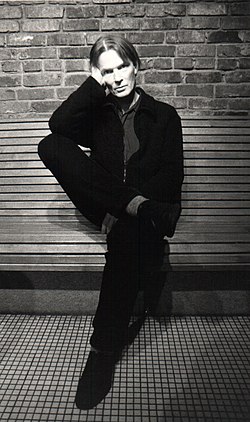
James Dennis Carroll (August 1, 1949 – September 11, 2009) was an American author, poet, and punk musician. Carroll was best known for his 1978 autobiographical work The Basketball Diaries, which inspired a 1995 film of the same title that starred Leonardo DiCaprio as Carroll, and his 1980 song "People Who Died" with the Jim Carroll Band.
Key Information


Early life and education
[edit]James Dennis Carroll was born on August 1, 1949[1] to a working-class family of Irish descent, and grew up in New York City's Lower East Side. When he was about 11 (in the sixth grade) his family moved north to Inwood in Upper Manhattan.[2]
He was taught by the LaSalle Christian Brothers. In the fall of 1963, he entered Rice High School in Harlem, but was soon awarded a scholarship to the elite Trinity School.[2] He attended Trinity from 1964 to 1968.[3]
Carroll was a basketball star in high school, but also developed an addiction to heroin.[3] He sometimes financed his habit through criminal behavior, including engaging in prostitution in the vicinity of 53rd Street and Third Avenue in Manhattan.[4] Carroll briefly attended Wagner College and Columbia University.[5] He dated Patti Smith.[3]
Career
[edit]
Carroll identified Rainer Maria Rilke, Frank O'Hara, John Ashbery, James Schuyler,[6] Allen Ginsberg, and William S. Burroughs as influences on his artistic career.[7]
Writing
[edit]While still in high school, Carroll published his first collection of poems, Organic Trains. Already attracting the attention of the local literati, his work began appearing in the Poetry Project's magazine The World in 1967. Soon his work was being published in elite literary magazines like Paris Review in 1968,[2] and Poetry the following year. In 1970, his second collection of poems, 4 Ups and 1 Down was published, and he started working for Andy Warhol. At first, he was writing film dialogue and inventing character names; later on, Carroll worked as the co-manager of Warhol's Theater. Carroll's first publication by a mainstream publisher (Grossman Publishers), the poetry collection Living at the Movies, was published in 1973.[8]
In 1978, Carroll published The Basketball Diaries, an autobiographical book concerning his life as a teenager in New York City's hard drug culture. Diaries is an edited collection of the diaries he kept during his high school years; it details his sexual experiences, his high school basketball career, and his addiction to heroin.[4][9][10]
In 1987, Carroll wrote a second memoir, Forced Entries: The Downtown Diaries 1971–1973, continuing his autobiography into his early adulthood in the New York City music and art scene as well as his struggle to kick his drug habit.[11]
After working as a musician, Carroll returned to writing full-time in the mid-1980s and began to appear regularly on the spoken-word circuit. Starting in 1991, Carroll performed readings from his then-in-progress first novel, The Petting Zoo.[12]
In 1995, Canadian filmmaker John L'Ecuyer adapted "Curtis's Charm", a short story from Carroll's 1993 book Fear of Dreaming, into the film Curtis's Charm.[13]
Music
[edit]In 1978, Carroll moved to California for a fresh start after overcoming his heroin addiction. After encouragement from Patti Smith, he formed the band 'Amsterdam,' a new wave/punk rock group. He and Smith once shared an apartment in New York City, along with Robert Mapplethorpe.[14] Amsterdam consisted of Steve Linsley on (bass), Wayne Woods on drums (he had previously been in hard rock band, Estus), and Brian Linsley and Terrell Winn on (guitars). He performed a spoken word piece with the Patti Smith Group in San Diego when the support band dropped out at the last moment.[citation needed]
They changed their name to The Jim Carroll Band and were able to secure a recording contract with Atlantic Records with the support of the Rolling Stones’ Keith Richards. Their 1980 debut album Catholic Boy, was originally intended to be released on Rolling Stones Records. The album featured contributions from Allen Lanier and Bobby Keys.[citation needed] Later albums were Dry Dreams (1982) and I Write Your Name (1983), both with contributions from Lenny Kaye and Paul Sanchez (guitar).[citation needed]
Carroll also collaborated with musicians Lou Reed, Blue Öyster Cult, Boz Scaggs, Ray Manzarek of The Doors, Pearl Jam, Electric Light Orchestra and Rancid.[citation needed] Carroll raps on the Rancid song "Junkie Man", off 1995's album "...And Out Come The Wolves". The title of the album is derived from the lyric that Carroll wrote and performed while in the studio.[15]
"People Who Died"
[edit]The Jim Carroll Band released a single, "People Who Died", from their debut album, which made it to No. 103 on the Bubbling Under Hot 100 chart.[16][17] The song's title was based on a poem by Ted Berrigan.[18]
"People Who Died" has continued to be used in other media and covered by other musicians. The first known use of "People Who Died" in film or television was in Steven Spielberg's 1982 film E.T. the Extra-Terrestrial opening the first scene with dialogue while the boys play Dungeons & Dragons. It was also used in the 1985 film Tuff Turf (which also featured a cameo appearance by the band)[19] and in the 1995 film The Basketball Diaries (based on Carroll's autobiography). It was included in 2004's Dawn of the Dead, and 2021's The Suicide Squad. It was featured in the 2015 episode "eps1.9_zer0-day.avi" in Season 1 of Mr. Robot and in the end credits of the 2022 episode "Everything Is Bellmore" of Season 4 of The Marvelous Mrs. Maisel.
The song was covered by John Cale for the 1995 film Antarctica and issued on Cale's Antártida soundtrack. The song also was covered by the super group Hollywood Vampires on their album Rise with vocals by Johnny Depp.
The song was also covered by UK rock band The Wildhearts for their 2009 ¡Chutzpah! Jnr EP, and in 2019 on a remastered, extended, re-release of their ¡Chutzpah! album. Against Me! released a version in 2018.
Personal life
[edit]Carroll became sober in the late 1970s.[3] After moving to California, he met Rosemary Klemfuss and the two were married in 1978.[4] The marriage eventually ended in divorce, but the pair remained friends.[3]
Death
[edit]Carroll died of a heart attack while working at his desk at his Manhattan home on September 11, 2009, at the age of 60. At the time of his death, he was in ill health due to pneumonia and hepatitis C.[1][20] His funeral Mass was held at Our Lady of Pompeii Catholic Church on Carmine Street in Greenwich Village.[21]
Books
[edit]Poetry
[edit]- Organic Trains (1967)
- 4 Ups and 1 Down (Angel Hair Press; 1970)
- Living at the Movies (Penguin Books; September 24, 1973)
- The Book of Nods (Puffin; April 1, 1986)
- Fear of Dreaming: The Selected Poems (Penguin Books; November 1, 1993)
- Void of Course: Poems 1994–1997 (Penguin Books; October 1, 1998) ISBN 0-14-058909-0
- 8 Fragments for Kurt Cobain (1994)
Prose
[edit]- The Basketball Diaries (memoir) (1978)
- Forced Entries: The Downtown Diaries 1971–1973 (memoir) (1987)
- The Petting Zoo (novel) (2010; published posthumously)[22][23]
Discography
[edit]Albums
[edit]- Catholic Boy (1980)
- Live Dreams (1981)
- Dry Dreams (1982)
- I Write Your Name (1983)
- A World Without Gravity: Best of The Jim Carroll Band (1993)
- Pools of Mercury (1998)[24][25] (2012 Digital Download)[26]
- Runaway EP (2000)
Spoken word
[edit]- Praying Mantis (1991) (2008 Digipak reissue)[27]
- The Basketball Diaries (1994)
- Pools of Mercury (1998)
Collaborations
[edit]- Live at Max's Kansas City, The Velvet Underground (1972)
- Club Ninja, Blue Öyster Cult (1985)
- Mistrial, Lou Reed (1986)
- Other Roads, Boz Scaggs (1988)
- Between Thought and Expression: The Lou Reed Anthology, Lou Reed (1992)
- ...And Out Come the Wolves, Rancid (1995)
- Catholic Boy, Pearl Jam (1995)
- Feeling You Up, Truly (1997)
- Yes I Ram, Jon Tiven Group (1999)
Compilations and soundtracks
[edit]- The Dial-a-Poem Poets (1972)
- Disconnected (1974)
- The Nova Convention (1979), with a once-only Frank Zappa performance
- One World Poetry (1981)
- Better an Old Demon than a New God (1984)
- Lou Reed at the Capitol Theatre (1984)
- Tuff Turf soundtrack (1985)
- Release #8 - 1993 (1993)
- Back to the Streets: Celebrating the Music of Don Covay (1993)
- Sedated in the Eighties (1993)
- New Wave Dance Hits: Just Can't Get Enough, Vol. 6 (1994)
- The Basketball Diaries (soundtrack) (1995)
- Put Your Tongue to the Rail: The Philly Comp for Catholic Children (Songs of the Jim Carroll Band) (1999)
- WBCN Naked 2000 (1999)
- Dawn of the Dead (2004)
- The Darwin Awards (2005)
See also
[edit]References
[edit]- ^ a b Grimes, William (September 13, 2009). "Jim Carroll, Poet and Punk Rocker, Is Dead at 60". The New York Times. Retrieved December 18, 2012.(subscription required)
- ^ a b c Mallon, Thomas (December 6, 2010). "Off the Rim: Jim Carroll's "The Petting Zoo"". The New Yorker. New York City: Condé Nast. pp. 90–93. Retrieved December 27, 2010.
- ^ a b c d e Williams, Alex (September 25, 2009). "The Last Days of Jim Carroll". The New York Times. New York City. Retrieved April 9, 2018.
- ^ a b c "Jim Carroll: Poet, punk rocker and author of 'The Basketball Diaries'". The Independent. London, England: Independent Print Ltd. October 26, 2009. Archived from the original on June 8, 2022.
- ^ "Jim Carroll: author of The Basketball Diaries". The Times. September 15, 2009. Archived from the original on May 24, 2010. Retrieved March 25, 2010.
- ^ O'Hehir, Andrew (April 12, 1995). "A Poet Half-Devoured – Jim Carroll Feature Articles". CatholicBoy.com. Retrieved December 18, 2012.
- ^ Goldman, Marlene (January 8, 1999). "Mercury Rising (1999) – Jim Carroll Interviews". CatholicBoy.com. Retrieved December 18, 2012.
- ^ "Living at the Movies, First Edition - Books by Jim Carroll - CatholicBoy.com". Catholicboy.com. Retrieved July 10, 2009.
- ^ Grimes, William (September 14, 2009). "Jim Carroll, Poet and Punk Rocker Who Wrote 'The Basketball Diaries', Dies at 60". The New York Times. New York City.
- ^ "ON LOCATION : Sex, Drugs, Pick and Roll : Jim Carroll's cult favorite 'The Basketball Diaries' is finally making it to the screen. It seems everyone wanted to star. Leonardo DiCaprio made the cut". Los Angeles Times. July 24, 1994. Retrieved October 31, 2019.
- ^ Carroll, Jim (1987). Forced Entries: The Downtown Diaries 1971-1973. New York City: Penguin Books. ISBN 978-0140085020.
- ^ Woo, Elaine (September 14, 2009). "Jim Carroll dies at 60; poet and punk rocker wrote about travails in 'The Basketball Diaries'". Los Angeles Times. Retrieved December 18, 2012.
- ^ "The romance of junkie paranoia". The Globe and Mail, September 14, 1995.
- ^ Smith, Patti (2010). Just Kids. New York: HarperCollins. pp. 162–164, 166–167. ISBN 978-0-06-093622-8.
- ^ "East Bay Recorders". East Bay Recorders. Retrieved November 18, 2024.
- ^ "US Hot 100 Bubbling Under (1959-2005)". top40weekly.com. May 13, 2017. Retrieved June 9, 2022.
- ^ "Jim Carroll Band Top Songs". musicvf.com. Retrieved June 9, 2022.
- ^ MacAdams, Lewis (September 16, 2009). "Remembering Jim Carroll". The Los Angeles Times. Retrieved December 18, 2012.
- ^ Jim Carroll at AllMusic
- ^ "CatholicBoy.com". Catholicboy.com. Retrieved February 27, 2013.
- ^ Warner, Simon (2013). Text and Drugs and Rock 'n' Roll: The Beats and Rock Culture. New York City: Bloomsbury Publishing USA. p. 370. ISBN 978-1441143037 – via Google Books.
- ^ "CatholicBoy.com". Catholicboy.com. Retrieved April 10, 2010.
- ^ "Edelweiss". Edelweiss.abovethetreeline.com. Retrieved April 20, 2010.
- ^ "Pools of Mercury - Jim Carroll | Release Info". AllMusic.
- ^ "Jim Carroll - Pools Of Mercury CD Album". Cduniverse.com.
- ^ "Pools of Mercury - Jim Carroll | Release Info". AllMusic.
- ^ "Jim Carroll - Praying Mantis CD Album". Cduniverse.com.
External links
[edit]
| International | |
|---|---|
| National | |
| Academics | |
| Artists | |
| People | |
| Other | |

Jim Carroll
View on GrokipediaEarly life
Upbringing
James Dennis Carroll was born on August 1, 1949, in New York City to a working-class Irish Catholic family of bartenders, with his father employed in the bar business.[2][9] His lineage traced back three generations in this trade, embedding a strong sense of Irish heritage and Catholic tradition into his early home life.[2] Carroll spent his early childhood on the Lower East Side of Manhattan, a densely populated neighborhood marked by immigrant communities and economic hardship, before his family relocated to Inwood in upper Manhattan when he was 11 years old.[10] This move shifted him from the gritty, multicultural bustle of the Lower East Side to a more insular, heavily Irish enclave, yet both environments exposed him to the raw dynamics of urban living.[9] From a young age, Carroll encountered the poetry and literature that would shape his creative path, influenced by his family's encouragement and the bohemian undercurrents of his Lower East Side surroundings, including echoes of the Beat Generation's emphasis on raw experience and rebellion.[2][11] At age 13, poet Ted Berrigan introduced him to Jack Kerouac, who praised his early writing, influencing his raw, confessional style.[12] These experiences fostered his initial interest in writing amid the city's literary scene.[13] His upbringing immersed him in urban poverty and street life, where he navigated tough crowds and the harsh realities of working-class existence, all underscored by a Catholic framework that intertwined spirituality with everyday struggles.[9] These elements—poverty's grit, streetwise survival, and Catholic ritual—profoundly informed the themes of addiction and spiritual seeking that permeated his later work.[10] This transition eventually led him toward formal education at Trinity School.[2]Education and athletics
Carroll attended public and Catholic schools in his early years before receiving a full scholarship to the elite Trinity School in Manhattan, where he studied from 1964 to 1968.[14] The move to Inwood in upper Manhattan around age 11 provided a more stable family environment during this transitional period.[10] At Trinity, Carroll emerged as a standout basketball player, serving as a high-scoring guard and earning all-city honors for his performance on the court.[14] His talent drew significant attention, leading to recruitment interest from several colleges and positioning him as a promising athlete in New York City's competitive high school scene.[14] Amid his athletic success, Carroll began experimenting with drugs around age 13, quickly developing a heroin addiction that introduced profound personal challenges during his teenage years.[15] This addiction created a double life, marked by risks of expulsion from Trinity and involvement in street hustling to support his habit.[16] During this time, Carroll also discovered his literary voice, publishing his first poems in school literary magazines while drawing inspiration from poets such as Rainer Maria Rilke and Frank O'Hara.[4] These early works reflected his emerging interest in poetry amid the turmoil of adolescence.[2]Career
Literary pursuits
Jim Carroll began his literary career as a teenager, publishing his debut poetry collection, Organic Trains, in 1967 at the age of 17.[2] This slim volume, published by the small press Penny Press, marked the start of his exploration of raw, confessional verse influenced by the urban grit of New York City.[2][17] He followed with 4 Ups and 1 Down in 1970, a limited-edition chapbook from Angel Hair Books that featured five poems, including "Blue Poles" and "Love Rockets," delving into themes of youthful rebellion and sensory overload.[18] By 1973, Carroll released Living at the Movies, his first major poetry collection from Grossman Publishers, which compiled earlier works and introduced a cinematic lens to his observations of street life and personal turmoil.[4][19] Carroll's breakthrough came with prose, particularly his memoir The Basketball Diaries in 1978, published by Tombouctou Books.[20] This raw account of his adolescent years as a high school basketball player turned heroin addict in 1960s New York captured the dangers of urban decay and addiction with unflinching detail, drawing from diaries he began at age 12 inspired by Jack Kerouac's On the Road.[10] The book established Carroll as a voice of gritty authenticity, blending poetic rhythm with narrative intensity.[2] He continued this vein in 1987 with Forced Entries: The Downtown Diaries 1971–1973, published by Penguin Books, which chronicled his post-recovery immersion in the downtown art scene, including stints at Andy Warhol's Factory, and themes of cultural excess and spiritual searching.[21] In his later poetry, Carroll shifted toward introspection and mysticism, as seen in The Book of Nods (1986, Penguin Books), a compilation blending earlier poems with new ones on dreams and existential nods to literary forebears.[4] Fear of Dreaming: The Selected Poems (1993, Penguin Books) gathered works from across his career, emphasizing recovery and transcendence.[4] This period also included 8 Fragments for Kurt Cobain (1994), a poignant elegy responding to the musician's suicide, later incorporated into his oeuvre and performed in spoken-word settings that echoed his musical pursuits.[22] His final poetry collection, Void of Course (1998, Penguin Books), explored spirituality and loss through fragmented, visionary pieces.[4] Influenced by Beat Generation figures like Allen Ginsberg, William S. Burroughs, and Jack Kerouac—whom he met through poet Ted Berrigan—Carroll's work recurrently addressed urban decay, addiction, recovery, and a quest for spiritual redemption.[23] These themes culminated posthumously in his semi-autobiographical novel The Petting Zoo (2010, Viking), edited from drafts spanning two decades and focusing on an artist's crisis of faith amid fame and personal demons.[24]Musical endeavors
Carroll's transition to music was rooted in his early spoken word performances during the 1970s at venues like The Poetry Project at St. Mark's Church in New York City, where he shared stages with figures from the New York School of poetry and emerging punk musicians such as Lou Reed and Patti Smith, drawing influence from the raw energy of the punk scene.[25][26] In 1978, inspired by this milieu, Carroll formed the Jim Carroll Band, a punk and new wave outfit featuring bassist Steve Linsley, drummer Wayne Woods, guitarist Brian Linsley, and guitarist Terrell Winn.[4][27] The group debuted with the album Catholic Boy in 1980 on Atco Records, which showcased Carroll's poetic lyrics set against driving punk rhythms; its lead single, "People Who Died"—a stark tribute to friends lost to drugs, violence, and accidents—peaked at No. 103 on the Billboard Hot 100.[28][4] The band followed with Dry Dreams in 1982 and I Write Your Name in 1983, both released on Atlantic Records, evolving their sound by blending punk rock's aggression with new wave's melodic structures while maintaining Carroll's introspective, literary-infused lyrics contributed by collaborators like Lenny Kaye.[4][29] After the band's dissolution in 1984, Carroll shifted toward solo spoken word projects with musical backing, releasing Pools of Mercury in 1998 on Mercury Records, a collection of poetic recitations over atmospheric instrumentation, and the EP Runaway in 2000 on Kill Rock Stars, marking his final studio effort before his death.[30][31]Personal life
Relationships
In the early 1970s, Jim Carroll entered into a long-term romantic relationship with singer and poet Patti Smith, with whom he shared an apartment in New York City alongside photographer Robert Mapplethorpe. This partnership immersed Carroll in the downtown arts scene, fostering connections that propelled his literary and musical ambitions.[32][8] In 1978, Carroll married Rosemary Klemfuss, a law student and college radio presenter he met while living in the artistic community of Bolinas, California, after relocating from New York in 1973 to distance himself from drugs. Their union, which endured until their divorce in 1986, reflected mutual passions for art and music, occurring amid Carroll's stabilization following his recovery.[33][34] After the divorce, Carroll led a reclusive existence devoted to his creative work, choosing not to remarry or form lasting cohabitations, with no public records of subsequent significant romantic partnerships or children.[13] Carroll also nurtured personal ties with literary mentors like Allen Ginsberg, whose guidance and shared poetic circles in New York bordered on familial bonds, offering inspiration during his formative years as a writer.[8][35]Addiction and recovery
Jim Carroll's heroin addiction began in his early teens, around age 13, while attending high school in New York City, where he initially experimented sporadically before escalating to daily use.[36] To fund his habit, he turned to prostitution and petty crime, experiences that permeated his adolescent life and later formed the raw core of his memoir The Basketball Diaries.[37] By his mid-teens, the addiction had intensified, intertwining with his poetic pursuits and leading to a decade-long dependency that isolated him from mainstream paths.[37] In the early 1970s, Carroll reached a breaking point amid overdose scares and failed attempts at institutionalization, prompting him to seek treatment in 1973 through methadone maintenance.[4] Disillusioned by the excesses of New York's downtown scene, he relocated to the coastal community of Bolinas, California, in 1974, where the serene environment and support from poet friends like Aram Saroyan aided his stabilization on methadone.[38][39] By the late 1970s, he achieved full sobriety, weaning off methadone and maintaining it for over three decades until his death.[33][40] Recovery profoundly shaped Carroll's creative trajectory, transforming the chaotic immediacy of his early heroin-fueled writing into a more disciplined exploration of memory and redemption, as seen in Forced Entries: The Downtown Diaries, 1971-1973.[39] This period marked a pivot from street-level survival narratives to reflective prose and music, with sobriety enabling sustained collaborations and the formation of the Jim Carroll Band, allowing him to channel past turmoil into enduring artistic output.[41]Death and legacy
Death
Jim Carroll died on September 11, 2009, at the age of 60, from a heart attack at his home in the Inwood neighborhood of Manhattan, New York City.[33] He was found collapsed at his desk, where he had been working on his novel The Petting Zoo, with no major prior health issues publicly reported beyond his history of addiction.[42] His long-term sobriety had enabled a productive period of writing in his later years.[14] A wake was held at the Greenwich Village Funeral Chapel on Bleecker Street, attended by a small group of family, friends, and admirers from the music and literary communities.[42] The following day, September 16, a funeral Mass was celebrated in traditional Catholic style at Our Lady of Pompeii Church in Greenwich Village.[10] Carroll was subsequently buried at St. Peter's Cemetery in Haverstraw, New York.[43] Initial media reports, including obituaries in The New York Times and The Los Angeles Times, emphasized Carroll's dual legacy as a revered poet and influential figure in the punk rock scene, reflecting on his raw depictions of urban youth and addiction.[33][14]Cultural impact
Carroll's memoir The Basketball Diaries inspired the 1995 film adaptation of the same name, directed by Scott Kalvert and starring Leonardo DiCaprio as the young Carroll, which dramatized his experiences of adolescence and addiction and exposed his writing to mainstream cinema audiences worldwide.[44] The film's portrayal of urban youth struggles amplified the cultural reach of Carroll's autobiographical voice, influencing discussions on drug culture in popular media.[45] Carroll's integration of Beat-influenced poetry with punk rock aesthetics left a significant mark on the spoken word and punk poetry scenes, fostering a raw, confessional style that blended literary depth with performative intensity. Scholarly examinations of New York City's 1970s poetry and punk rock milieu highlight his role in this hybrid form, positioning him as a key figure who opened poetry readings for artists like Lou Reed and contributed to the downtown arts ecosystem. His work's gritty urban narratives and rhythmic delivery inspired subsequent generations of performers navigating the intersection of literature and music. Following his death, Carroll received notable posthumous recognition, including the 2014 acquisition of his papers by the New York Public Library from his estate, encompassing manuscripts, recordings, and personal documents that enable ongoing scholarly access to his oeuvre.[4] Academic analyses have since delved into his Beat-punk fusion, emphasizing how his poetry captured the chaotic vitality of New York subcultures. Additionally, themes of addiction and recovery in his writings, particularly the abject horror of heroin dependency, have echoed in modern literary explorations of personal redemption and urban survival.[46] The enduring appeal of Carroll's music is evident in covers of his signature track "People Who Died," such as the 2019 rendition by Hollywood Vampires, which revitalized the song's punk anthem status among contemporary rock acts.[47] These tributes underscore his lasting resonance in popular culture, where his explorations of loss, spirituality, and resilience continue to inform artistic expressions of vulnerability.Bibliography
Poetry collections
Jim Carroll's poetry collections span his career from adolescence to maturity, showcasing his evolution as a poet through distinct volumes published over three decades. Organic Trains (1967) marks Carroll's debut as a poet at age 16, featuring a slim collection of 17 pages of early poems composed during New York City subway rides, evoking the surreal rhythms of urban youth.[2][48] 4 Ups and 1 Down (1970), published in a limited edition of 300 copies by Angel Hair Press, contains five experimental poems in an eight-page pamphlet format, exploring themes of youthful introspection and street life.[2][49] Living at the Movies (1973), issued by Penguin Books, draws on cinematic imagery and influences to weave hallucinatory verses about love, drugs, friendship, and artistic creation in a delicate yet menacing tone.[2][50] The Book of Nods (1986), published by Puffin Books, comprises witty prose poems and mythic sequences that blend dream-like narratives with parodies of traditional forms, unfolding through mysterious logic.[2][51] Fear of Dreaming: The Selected Poems (1993), a Penguin Poets anthology, gathers career-spanning selections from earlier works like Living at the Movies and The Book of Nods, alongside 15 new poems, offering a comprehensive overview of his poetic development.[2][52] 8 Fragments for Kurt Cobain (1994), released as a broadside by White Fields Press, serves as a poignant tribute to the musician through eight fragmented verses reflecting on genius, fame, and personal torment.[4][53] Void of Course (1998), a Penguin original compiling poems from 1994–1997, delves into later reflections on time, memory, desire, and the interplay of dream and reality in an urban context, including the piece "8 Fragments for Kurt Cobain."[2][54]Prose works
Jim Carroll's prose works primarily consist of memoirs drawn from his personal journals and a posthumously published novel, reflecting his raw, introspective style and experiences in New York's countercultural scenes. His writing often blends vivid street-level observations with explorations of addiction, art, and urban alienation. The Basketball Diaries, published in 1978 by Tombouctou Books, is an autobiographical memoir compiling journal entries from Carroll's teenage years between 1963 and 1966.[55] It chronicles his time as a promising basketball player at the elite Trinity School in Manhattan, juxtaposed against his rapid descent into drug addiction, petty crime, and survival on the streets of 1960s New York City.[33] The book begins with youthful exuberance for sports and school life but evolves into harrowing accounts of heroin use, hustling in Times Square, and brushes with the law, offering an unflinching portrait of adolescent rebellion and vulnerability.[33] Originally released in a limited edition, it was reissued by Bantam Books in 1980, gaining wider acclaim on college campuses for its gritty authenticity.[33] The memoir was later adapted into a 1995 film directed by Scott Kalvert, starring Leonardo DiCaprio as a fictionalized version of Carroll.[33] In 1987, Carroll published Forced Entries: The Downtown Diaries, 1971–1973 through Penguin Books, a sequel memoir extending his autobiographical narrative into early adulthood.[21] Drawing from journals kept during his immersion in New York's bohemian demimonde, the book details his efforts to establish himself as a poet amid the city's vibrant yet chaotic art scene, including stints at Andy Warhol's Factory and shared living spaces with figures like Patti Smith and Robert Mapplethorpe.[33] It captures the frenetic energy of downtown Manhattan, marked by drug-fueled nights, cultural encounters, and personal turmoil as Carroll navigated addiction and creative ambition.[39] The work maintains the diary format's immediacy, blending humor, horror, and sharp social commentary on the era's underground life.[56] Carroll's only novel, The Petting Zoo, was published posthumously in 2010 by Viking, completing a manuscript he had worked on for years.[57] The story centers on Billy Wolfram, a reclusive 38-year-old painter who rose to fame in the late-1980s New York art world before withdrawing from it in disillusionment.[58] Set against the backdrop of the city's glittering yet superficial cultural milieu, the narrative alternates between the weeks leading to Wolfram's apparent suicide in Central Park and flashbacks to his youth, where an obsession with a Metropolitan Museum of Art painting of a petting zoo symbolizes his existential unraveling.[58] Through Wolfram's crisis of faith and identity, the novel probes themes of artistic integrity, spiritual betrayal, and the hollowness of success, echoing Carroll's own reflections on creativity and loss.[59]Discography
Studio albums
The Jim Carroll Band's debut studio album, Catholic Boy, was released in 1980 by Atco Records and is noted for its punk-poetic tracks, including the hit single "People Who Died."[60] The band's follow-up album, Dry Dreams, appeared in 1982, also on Atco Records, and explored themes of maturity through a blend of new wave and post-punk elements.[61]- I Write Your Name*, the final studio album with the Jim Carroll Band before a hiatus, was issued in 1983 by Atlantic Records, incorporating art rock and pop influences.[62][63]