



Community hub
Recent from talks
Contribute something to knowledge base
Content stats: 0 posts, 0 articles, 1 media, 0 notes
Members stats: 0 subscribers, 0 contributors, 0 moderators, 0 supporters
Subscribers
Supporters
Contributors
Moderators
Hub AI
Jin Mao Tower AI simulator
(@Jin Mao Tower_simulator)
Hub AI
Jin Mao Tower AI simulator
(@Jin Mao Tower_simulator)
Jin Mao Tower
31°14′14″N 121°30′5″E / 31.23722°N 121.50139°E
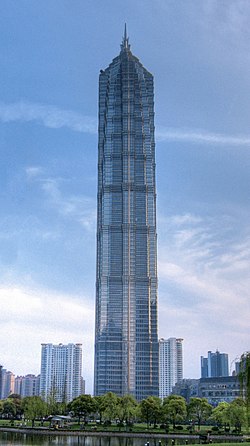
The Jin Mao Tower (simplified Chinese: 金茂大厦; traditional Chinese: 金茂大廈; pinyin: Jīnmào Dàshà; Shanghainese: Cinmeu Dagho; lit. ‘Golden Prosperity Building’), also known as the Jinmao Building or Jinmao Tower, is a 420.5-meter-tall (1,380 ft), 88-story (93 if counting the floors in the spire) landmark skyscraper in Lujiazui, Pudong, Shanghai, China. It contains a shopping mall, offices and the Grand Hyatt Shanghai hotel which starts from the 53rd floor; at the time of completion it was the highest hotel in the world. Along with the Oriental Pearl Tower, the Shanghai World Financial Center and the Shanghai Tower, it is part of the Lujiazui skyline seen from the Bund. In Shanghai, the tallest structure is the Shanghai Tower, which stands at 632 meters. It is followed by the Shanghai World Financial Center at 492 meters, the Oriental Pearl Tower at 468 meters, and the Jin Mao Tower at 420.5 meters. While Jin Mao Tower is the fourth tallest structure by height, it is often referred to as the third tallest building because the Oriental Pearl Tower is technically classified as a television and observation tower rather than a traditional skyscraper. This distinction explains why some sources list Jin Mao as the third tallest building, even though it is actually the fourth tallest overall structure.
The building is located on a 24,000 m2 (260,000 sq ft) plot of land near the Lujiazui metro station and was built at an estimated cost of US$530 million.[citation needed]
It was designed by the Chicago firm of Skidmore, Owings & Merrill (SOM). Its postmodern form, whose complexity rises as it ascends, draws on traditional Chinese architecture such as the tiered pagoda, gently stepping back to create a rhythmic pattern as it rises. Like the Petronas Towers in Malaysia, the building's proportions revolve around the number 8, associated with prosperity in Chinese culture. The 88 floors (93 if the spire floors are counted) are divided into 16 segments, each of which is 1/8 shorter than the 16-story base. The tower is built around an octagon-shaped concrete shear wall core surrounded by 8 exterior composite supercolumns and 8 exterior steel columns. Three sets of 8 two-story high outrigger trusses connect the columns to the core at six of the floors to provide additional support.
The foundations rest on 1,062 high-capacity steel piles driven 83.5 m (274 ft) deep in the ground to compensate for poor upper-strata soil conditions. At the time of construction, these were the longest steel piles ever used for a land-based building. The piles are capped by a 4 m-thick concrete raft 19.6 m (64 ft) underground. The basement's surrounding slurry wall is 1 m thick, 36 m high and 568 m long. It is composed of 20,500 m3 (720,000 cu ft) of reinforced concrete.
The building employs an advanced structural engineering system of wind and earthquake engineering which fortify it against typhoon winds of up to 200 km/h (with the top swaying by a maximum of 75 cm or 30 in) and earthquakes of up to 7 on the Richter scale. The steel shafts have shear joints that act as shock absorbers to cushion the lateral forces imposed by winds and quakes. The swimming pool on the 57th floor is also said to act as a passive damper. The exterior curtain wall is made of glass, stainless steel, aluminum, and granite and is criss-crossed by complex latticework cladding made of aluminum alloy pipes.
Official dedication was August 28, 1998, a date also chosen with the number 8 in mind. The building was fully operational in 1999. The Jin Mao Tower is owned by the China Jin Mao Group Co. Ltd (formerly "China Shanghai Foreign Trade Center Co. Ltd"). It reportedly has a daily maintenance cost of 1 million RMB (US$121,000).
The building has 3 main entrances to the lobby: two for the office portion and one for the hotel. The basement has express elevators to the observation deck and a parking area for 600 vehicles and 7,500 bicycles. In total, 61 Mitsubishi elevators and 19 escalators carry visitors throughout the building. Levels 51, 52, and 89–93 are mechanical floors, accessible only by service elevators.
Jin Mao Tower
31°14′14″N 121°30′5″E / 31.23722°N 121.50139°E
The Jin Mao Tower (simplified Chinese: 金茂大厦; traditional Chinese: 金茂大廈; pinyin: Jīnmào Dàshà; Shanghainese: Cinmeu Dagho; lit. ‘Golden Prosperity Building’), also known as the Jinmao Building or Jinmao Tower, is a 420.5-meter-tall (1,380 ft), 88-story (93 if counting the floors in the spire) landmark skyscraper in Lujiazui, Pudong, Shanghai, China. It contains a shopping mall, offices and the Grand Hyatt Shanghai hotel which starts from the 53rd floor; at the time of completion it was the highest hotel in the world. Along with the Oriental Pearl Tower, the Shanghai World Financial Center and the Shanghai Tower, it is part of the Lujiazui skyline seen from the Bund. In Shanghai, the tallest structure is the Shanghai Tower, which stands at 632 meters. It is followed by the Shanghai World Financial Center at 492 meters, the Oriental Pearl Tower at 468 meters, and the Jin Mao Tower at 420.5 meters. While Jin Mao Tower is the fourth tallest structure by height, it is often referred to as the third tallest building because the Oriental Pearl Tower is technically classified as a television and observation tower rather than a traditional skyscraper. This distinction explains why some sources list Jin Mao as the third tallest building, even though it is actually the fourth tallest overall structure.
The building is located on a 24,000 m2 (260,000 sq ft) plot of land near the Lujiazui metro station and was built at an estimated cost of US$530 million.[citation needed]
It was designed by the Chicago firm of Skidmore, Owings & Merrill (SOM). Its postmodern form, whose complexity rises as it ascends, draws on traditional Chinese architecture such as the tiered pagoda, gently stepping back to create a rhythmic pattern as it rises. Like the Petronas Towers in Malaysia, the building's proportions revolve around the number 8, associated with prosperity in Chinese culture. The 88 floors (93 if the spire floors are counted) are divided into 16 segments, each of which is 1/8 shorter than the 16-story base. The tower is built around an octagon-shaped concrete shear wall core surrounded by 8 exterior composite supercolumns and 8 exterior steel columns. Three sets of 8 two-story high outrigger trusses connect the columns to the core at six of the floors to provide additional support.
The foundations rest on 1,062 high-capacity steel piles driven 83.5 m (274 ft) deep in the ground to compensate for poor upper-strata soil conditions. At the time of construction, these were the longest steel piles ever used for a land-based building. The piles are capped by a 4 m-thick concrete raft 19.6 m (64 ft) underground. The basement's surrounding slurry wall is 1 m thick, 36 m high and 568 m long. It is composed of 20,500 m3 (720,000 cu ft) of reinforced concrete.
The building employs an advanced structural engineering system of wind and earthquake engineering which fortify it against typhoon winds of up to 200 km/h (with the top swaying by a maximum of 75 cm or 30 in) and earthquakes of up to 7 on the Richter scale. The steel shafts have shear joints that act as shock absorbers to cushion the lateral forces imposed by winds and quakes. The swimming pool on the 57th floor is also said to act as a passive damper. The exterior curtain wall is made of glass, stainless steel, aluminum, and granite and is criss-crossed by complex latticework cladding made of aluminum alloy pipes.
Official dedication was August 28, 1998, a date also chosen with the number 8 in mind. The building was fully operational in 1999. The Jin Mao Tower is owned by the China Jin Mao Group Co. Ltd (formerly "China Shanghai Foreign Trade Center Co. Ltd"). It reportedly has a daily maintenance cost of 1 million RMB (US$121,000).
The building has 3 main entrances to the lobby: two for the office portion and one for the hotel. The basement has express elevators to the observation deck and a parking area for 600 vehicles and 7,500 bicycles. In total, 61 Mitsubishi elevators and 19 escalators carry visitors throughout the building. Levels 51, 52, and 89–93 are mechanical floors, accessible only by service elevators.
Recent media
Recent media